
Specification and Verification of Programs with Pointers K

- Slides: 25
Specification and Verification of Programs with Pointers K. Rustan M. Leino Research in Software Engineering (Ri. SE) Microsoft Research, Redmond, WA part 0 Summer School on Logic and Theorem-Proving in Programming Languages Eugene, OR 28 July 2008
Contents Theory and techniques for building a basic program verifier for an object-based language Specification style and encoding thereof
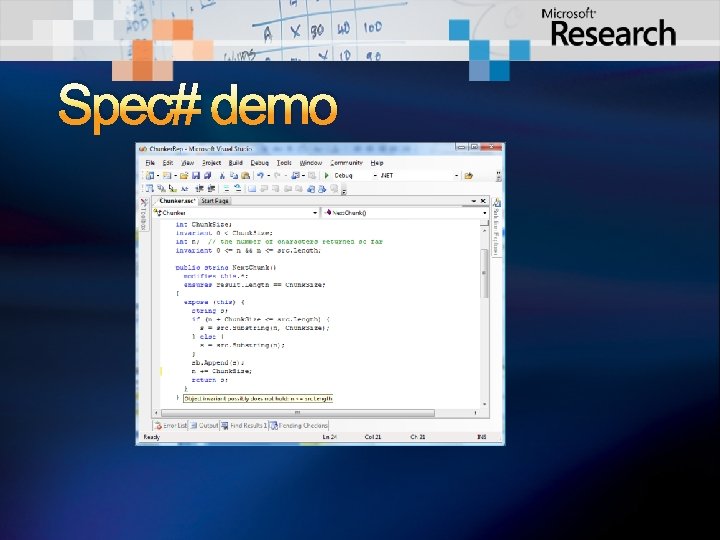
Spec# demo
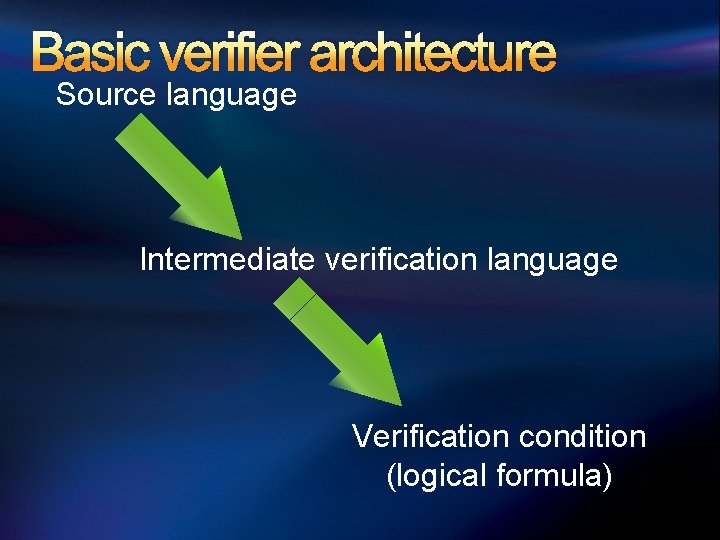
Basic verifier architecture Source language Intermediate verification language Verification condition (logical formula)
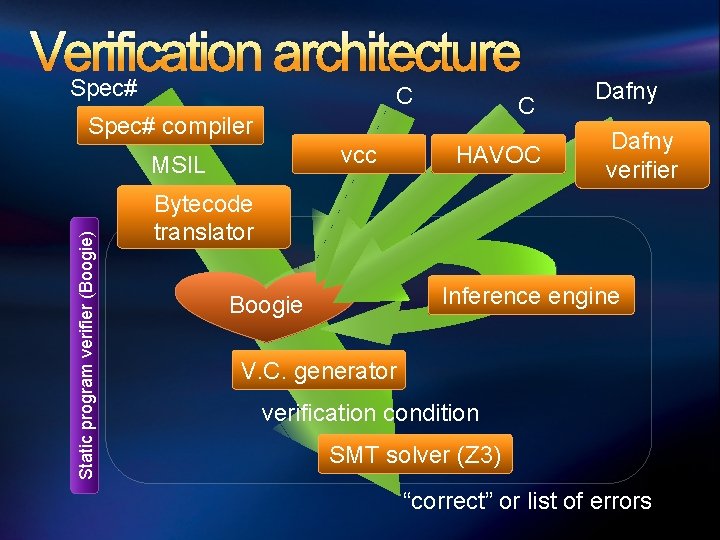
Verification architecture Spec# C C Spec# compiler vcc Static program verifier (Boogie) MSIL HAVOC Dafny verifier Bytecode translator Inference engine Boogie V. C. generator verification condition SMT solver (Z 3) “correct” or list of errors
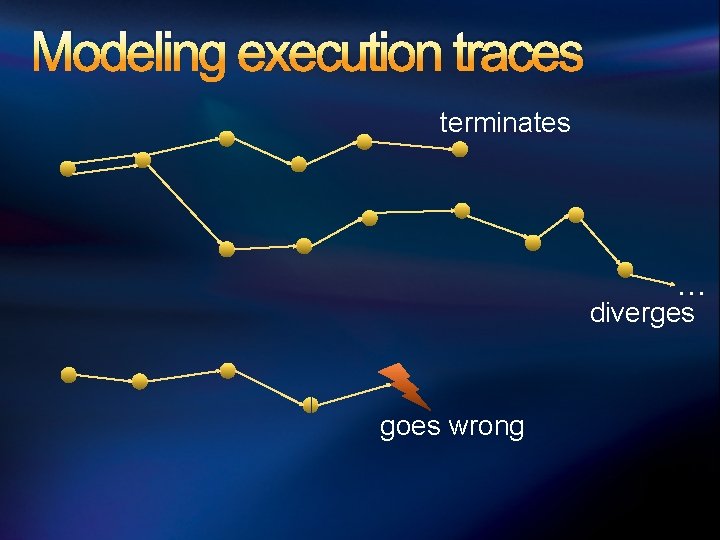
Modeling execution traces terminates … diverges goes wrong
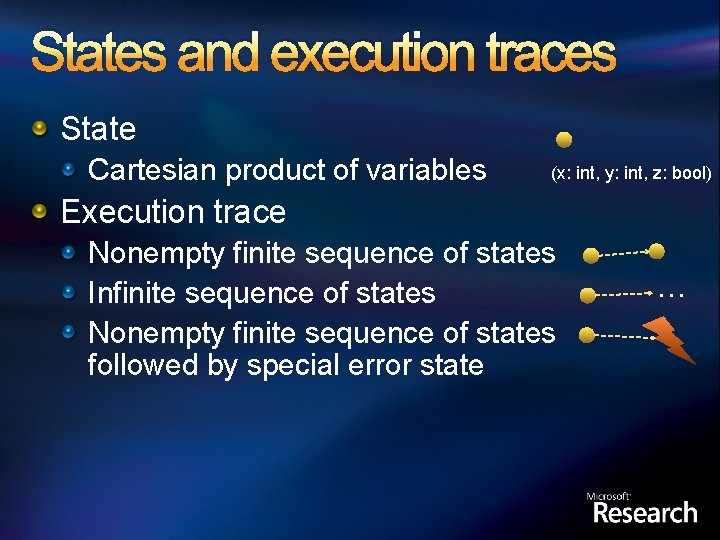
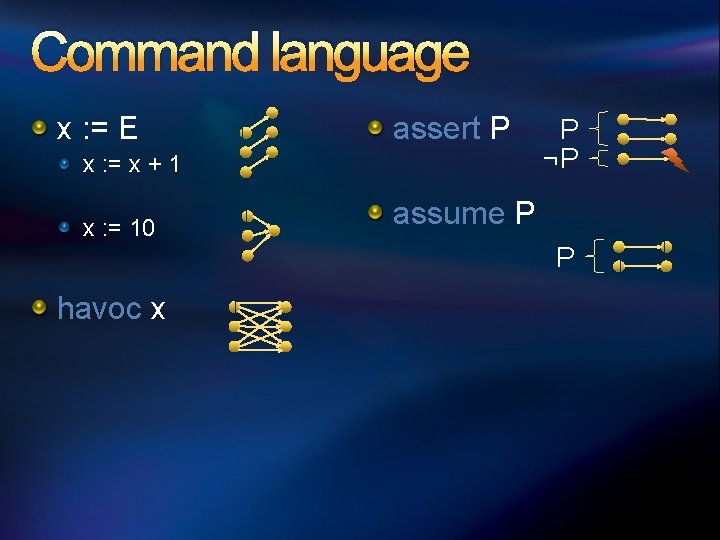
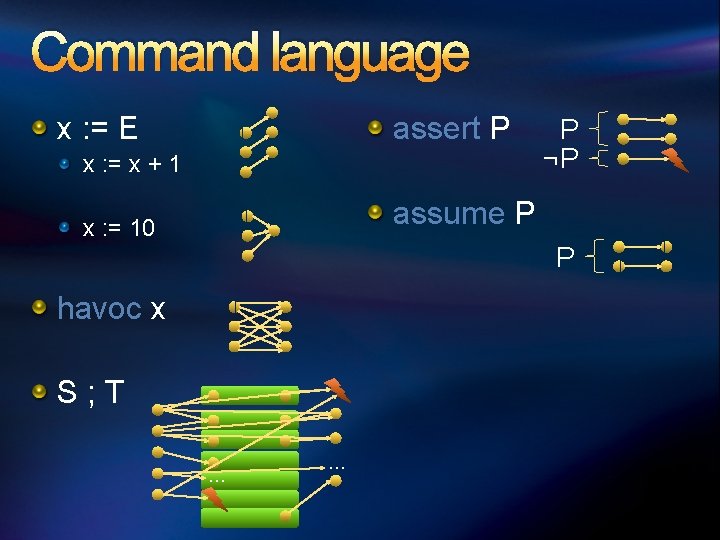
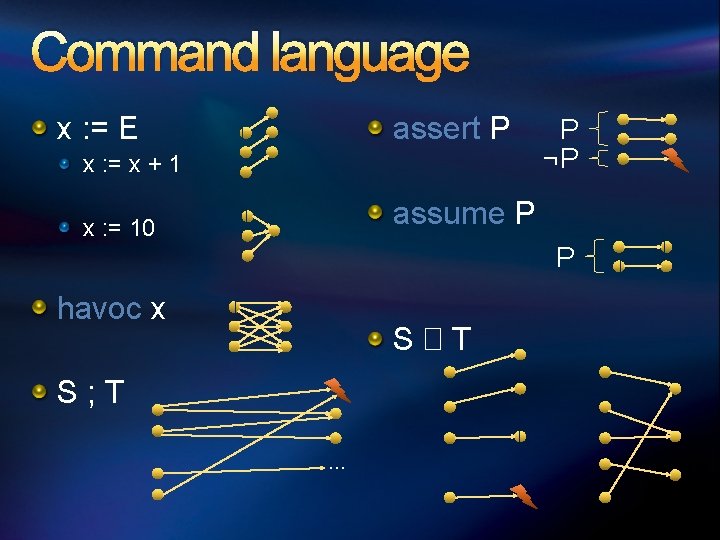
States and execution traces State Cartesian product of variables (x: int, y: int, z: bool) Execution trace Nonempty finite sequence of states Infinite sequence of states Nonempty finite sequence of states followed by special error state …
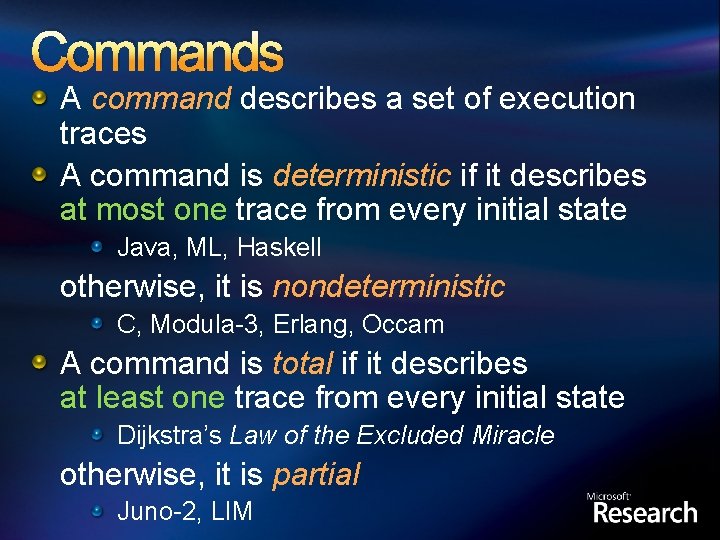
Commands A command describes a set of execution traces A command is deterministic if it describes at most one trace from every initial state Java, ML, Haskell otherwise, it is nondeterministic C, Modula-3, Erlang, Occam A command is total if it describes at least one trace from every initial state Dijkstra’s Law of the Excluded Miracle otherwise, it is partial Juno-2, LIM
Command language x : = E assert P x : = x + 1 x : = 10 P ¬P assume P P havoc x
Command language x : = E assert P x : = x + 1 P ¬P assume P x : = 10 P havoc x S; T … …
Command language x : = E assert P x : = x + 1 P ¬P assume P x : = 10 P havoc x S�T S; T …
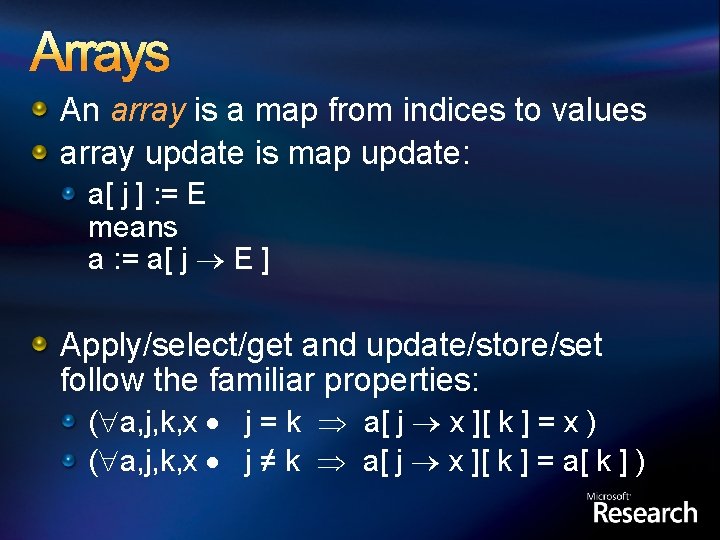
Arrays An array is a map from indices to values array update is map update: a[ j ] : = E means a : = a[ j E ] Apply/select/get and update/store/set follow the familiar properties: ( a, j, k, x j = k a[ j x ][ k ] = x ) ( a, j, k, x j ≠ k a[ j x ][ k ] = a[ k ] )
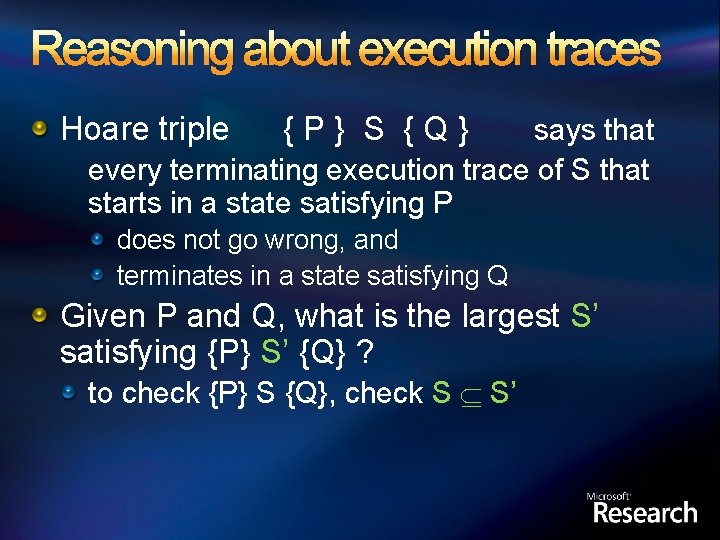
Reasoning about execution traces Hoare triple {P} S {Q} says that every terminating execution trace of S that starts in a state satisfying P does not go wrong, and terminates in a state satisfying Q Given P and Q, what is the largest S’ satisfying {P} S’ {Q} ? to check {P} S {Q}, check S S’
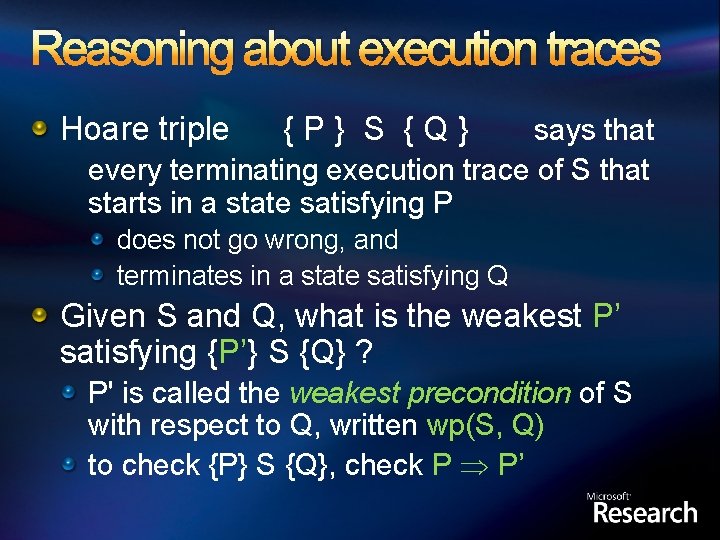
Reasoning about execution traces Hoare triple {P} S {Q} says that every terminating execution trace of S that starts in a state satisfying P does not go wrong, and terminates in a state satisfying Q Given S and Q, what is the weakest P’ satisfying {P’} S {Q} ? P' is called the weakest precondition of S with respect to Q, written wp(S, Q) to check {P} S {Q}, check P P’
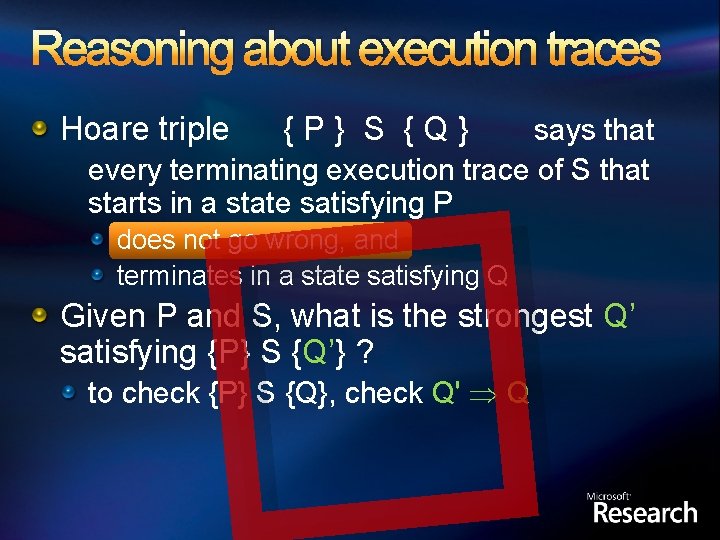
Reasoning about execution traces Hoare triple {P} S {Q} says that every terminating execution trace of S that starts in a state satisfying P does not go wrong, and terminates in a state satisfying Q Given P and S, what is the strongest Q’ satisfying {P} S {Q’} ? to check {P} S {Q}, check Q' Q
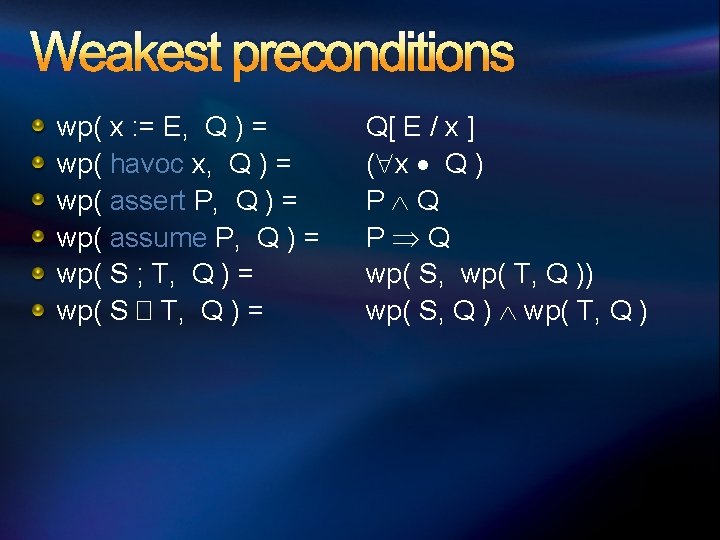
Weakest preconditions wp( x : = E, Q ) = wp( havoc x, Q ) = wp( assert P, Q ) = wp( assume P, Q ) = wp( S ; T, Q ) = wp( S � T, Q ) = Q[ E / x ] ( x Q ) P Q wp( S, wp( T, Q )) wp( S, Q ) wp( T, Q )
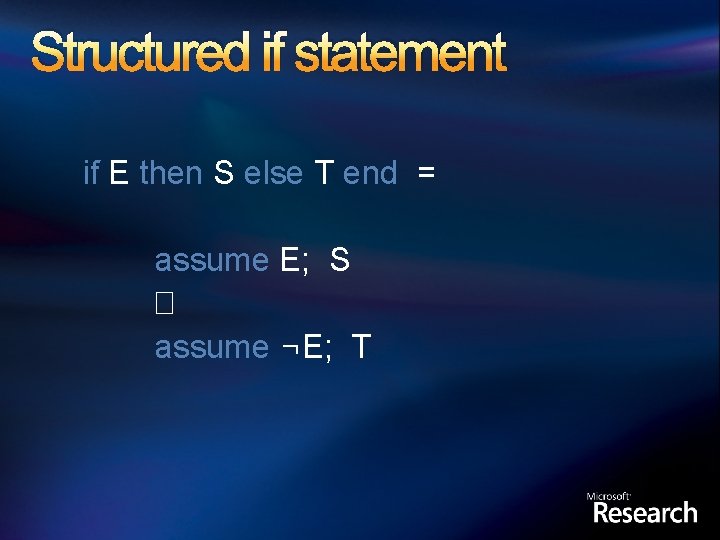
Structured if statement if E then S else T end = assume E; S � assume ¬E; T
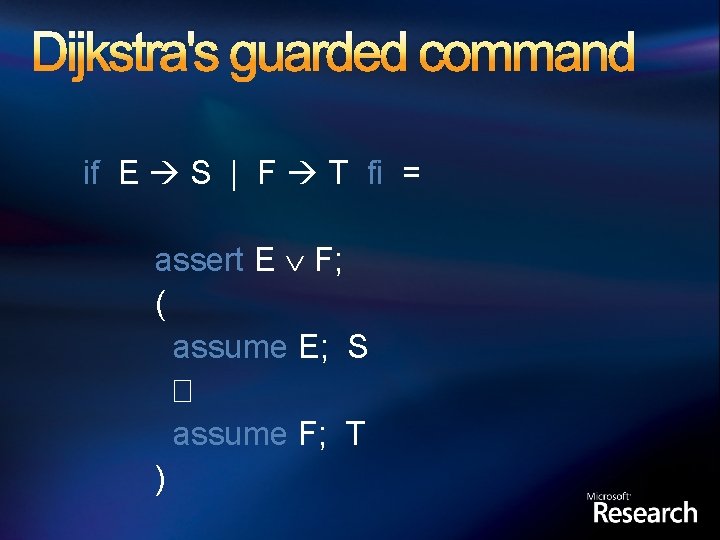
Dijkstra's guarded command if E S | F T fi = assert E F; ( assume E; S � assume F; T )
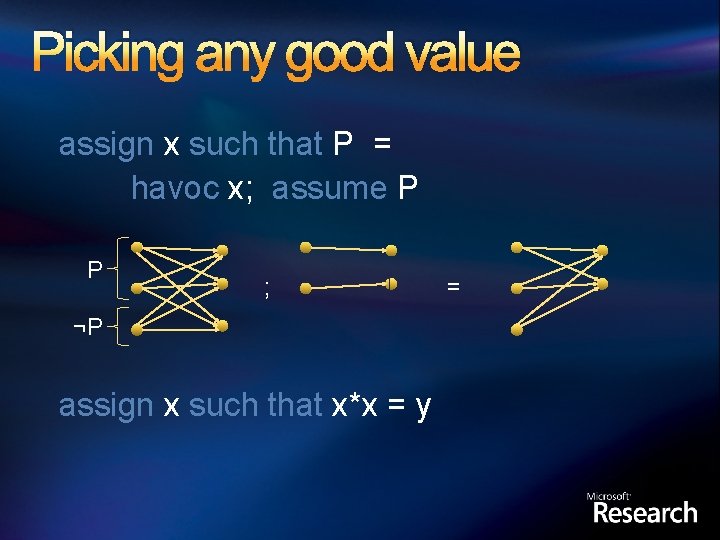
Picking any good value assign x such that P = havoc x; assume P P ; ¬P assign x such that x*x = y =
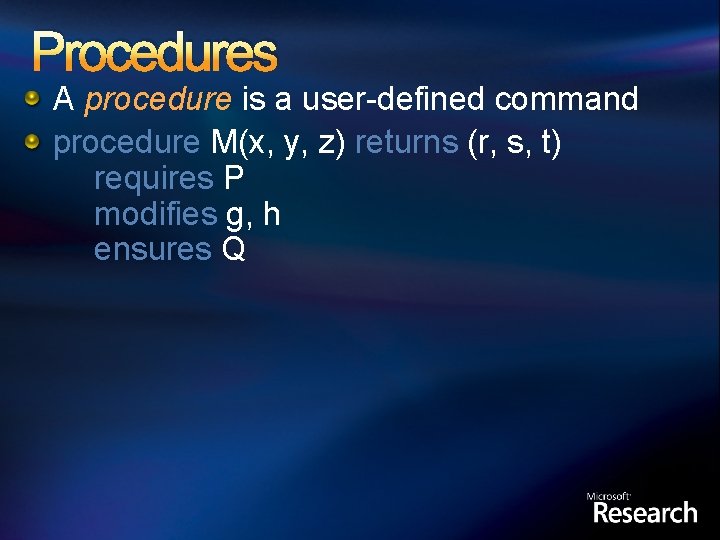
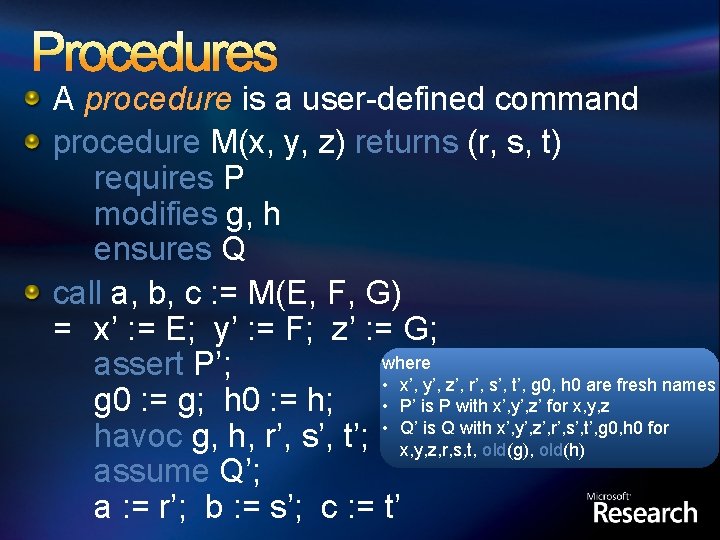
Procedures A procedure is a user-defined command procedure M(x, y, z) returns (r, s, t) requires P modifies g, h ensures Q
Procedure example procedure Inc(n) returns (b) requires 0 ≤ n modifies g ensures g = old(g) + n b = (g even)
Procedures A procedure is a user-defined command procedure M(x, y, z) returns (r, s, t) requires P modifies g, h ensures Q call a, b, c : = M(E, F, G) = x’ : = E; y’ : = F; z’ : = G; where assert P’; • x’, y’, z’, r’, s’, t’, g 0, h 0 are fresh names g 0 : = g; h 0 : = h; • P’ is P with x’, y’, z’ for x, y, z is Q with x’, y’, z’, r’, s’, t’, g 0, h 0 for havoc g, h, r’, s’, t’; • Q’ x, y, z, r, s, t, old(g), old(h) assume Q’; a : = r’; b : = s’; c : = t’
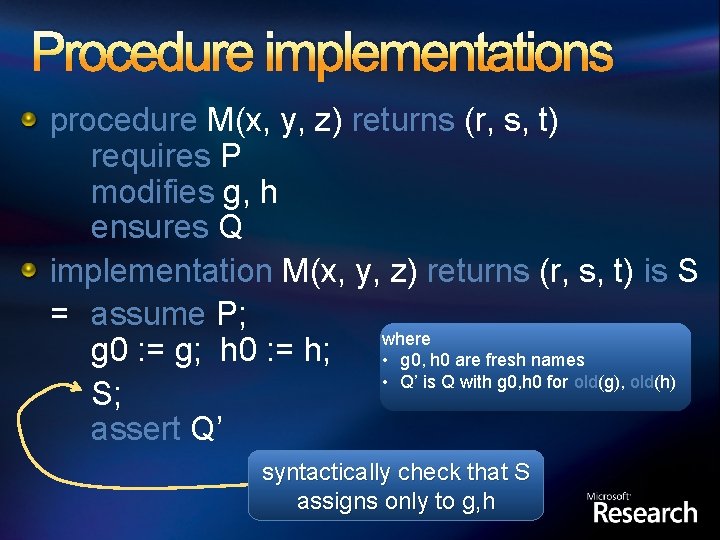
Procedure implementations procedure M(x, y, z) returns (r, s, t) requires P modifies g, h ensures Q implementation M(x, y, z) returns (r, s, t) is S = assume P; where g 0 : = g; h 0 : = h; • g 0, h 0 are fresh names • Q’ is Q with g 0, h 0 for old(g), old(h) S; assert Q’ syntactically check that S assigns only to g, h
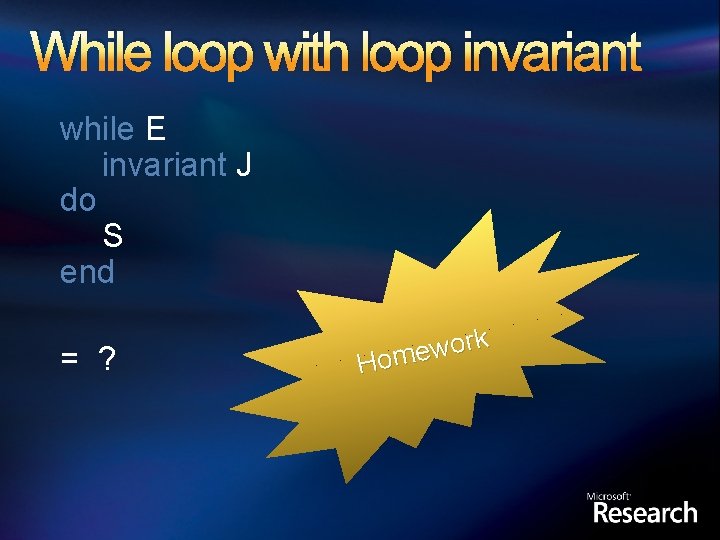
While loop with loop invariant while E invariant J do S end = ? rk o w e Hom
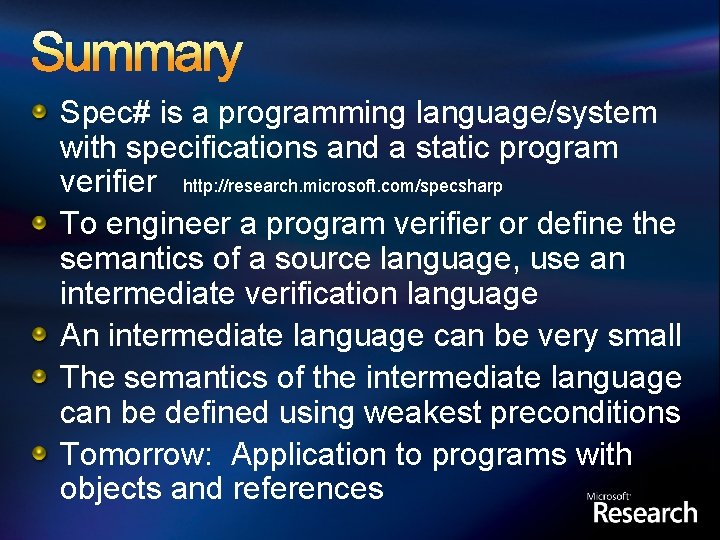
Summary Spec# is a programming language/system with specifications and a static program verifier http: //research. microsoft. com/specsharp To engineer a program verifier or define the semantics of a source language, use an intermediate verification language An intermediate language can be very small The semantics of the intermediate language can be defined using weakest preconditions Tomorrow: Application to programs with objects and references