
Specific Learning Disabilities Mrs Michelle Oesterreich Disability Description
Specific Learning Disabilities Mrs. Michelle Oesterreich
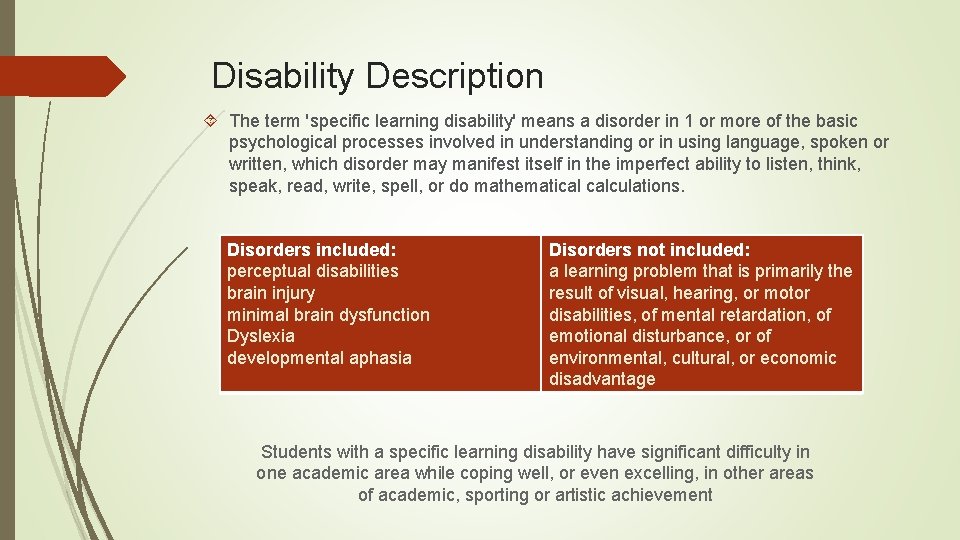
Disability Description The term 'specific learning disability' means a disorder in 1 or more of the basic psychological processes involved in understanding or in using language, spoken or written, which disorder may manifest itself in the imperfect ability to listen, think, speak, read, write, spell, or do mathematical calculations. Disorders included: perceptual disabilities brain injury minimal brain dysfunction Dyslexia developmental aphasia Disorders not included: a learning problem that is primarily the result of visual, hearing, or motor disabilities, of mental retardation, of emotional disturbance, or of environmental, cultural, or economic disadvantage Students with a specific learning disability have significant difficulty in one academic area while coping well, or even excelling, in other areas of academic, sporting or artistic achievement
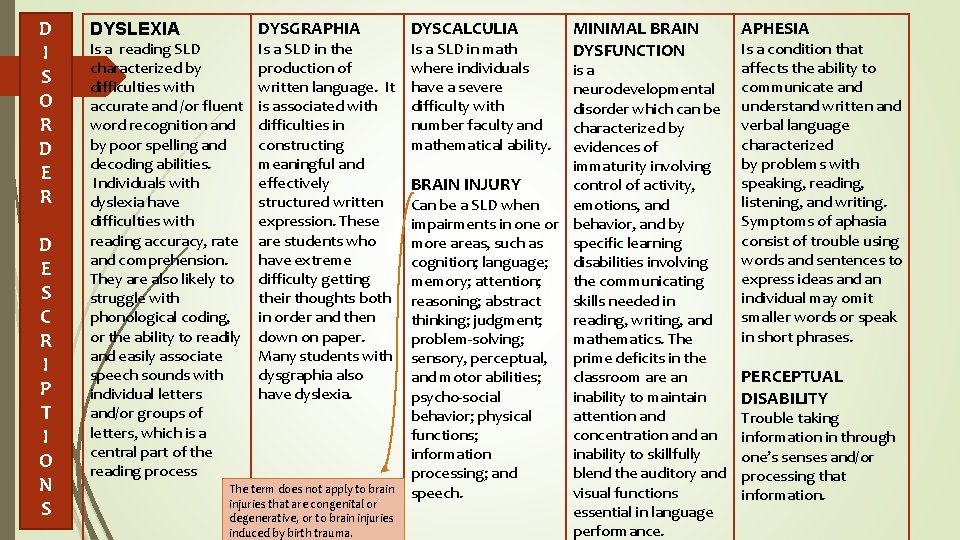
D I S O R D E S C R I P T I O N S DYSLEXIA Is a reading SLD characterized by difficulties with accurate and /or fluent word recognition and by poor spelling and decoding abilities. Individuals with dyslexia have difficulties with reading accuracy, rate and comprehension. They are also likely to struggle with phonological coding, or the ability to readily and easily associate speech sounds with individual letters and/or groups of letters, which is a central part of the reading process DYSGRAPHIA Is a SLD in the production of written language. It is associated with difficulties in constructing meaningful and effectively structured written expression. These are students who have extreme difficulty getting their thoughts both in order and then down on paper. Many students with dysgraphia also have dyslexia. The term does not apply to brain injuries that are congenital or degenerative, or to brain injuries induced by birth trauma. DYSCALCULIA Is a SLD in math where individuals have a severe difficulty with number faculty and mathematical ability. MINIMAL BRAIN DYSFUNCTION is a neurodevelopmental disorder which can be characterized by evidences of immaturity involving BRAIN INJURY control of activity, Can be a SLD when emotions, and impairments in one or behavior, and by more areas, such as specific learning cognition; language; disabilities involving memory; attention; the communicating reasoning; abstract skills needed in thinking; judgment; reading, writing, and problem-solving; mathematics. The sensory, perceptual, prime deficits in the and motor abilities; classroom are an psycho-social inability to maintain behavior; physical attention and functions; concentration and an information inability to skillfully processing; and blend the auditory and speech. visual functions essential in language performance. APHESIA Is a condition that affects the ability to communicate and understand written and verbal language characterized by problems with speaking, reading, listening, and writing. Symptoms of aphasia consist of trouble using words and sentences to express ideas and an individual may omit smaller words or speak in short phrases. PERCEPTUAL DISABILITY Trouble taking information in through one’s senses and/or processing that information.
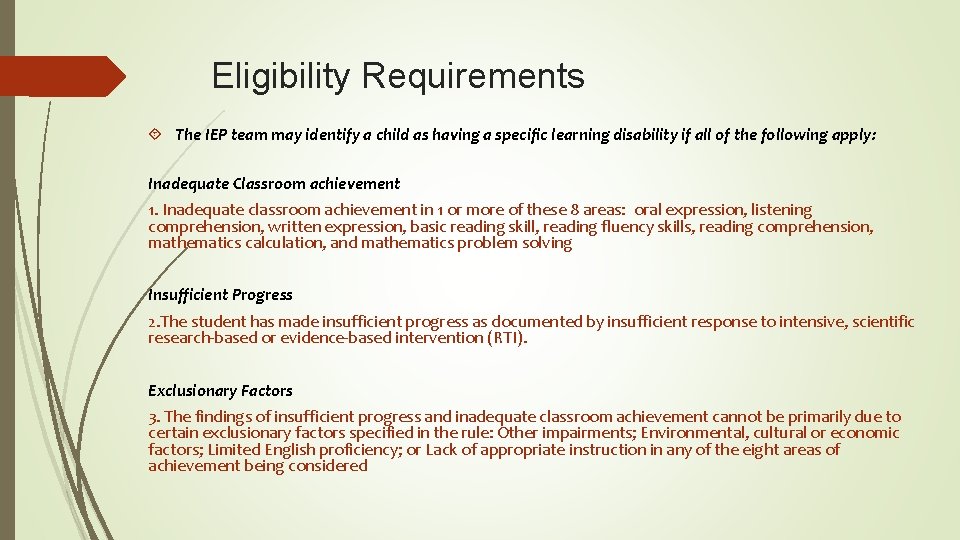
Eligibility Requirements The IEP team may identify a child as having a specific learning disability if all of the following apply: Inadequate Classroom achievement 1. Inadequate classroom achievement in 1 or more of these 8 areas: oral expression, listening comprehension, written expression, basic reading skill, reading fluency skills, reading comprehension, mathematics calculation, and mathematics problem solving Insufficient Progress 2. The student has made insufficient progress as documented by insufficient response to intensive, scientific research-based or evidence-based intervention (RTI). Exclusionary Factors 3. The findings of insufficient progress and inadequate classroom achievement cannot be primarily due to certain exclusionary factors specified in the rule: Other impairments; Environmental, cultural or economic factors; Limited English proficiency; or Lack of appropriate instruction in any of the eight areas of achievement being considered
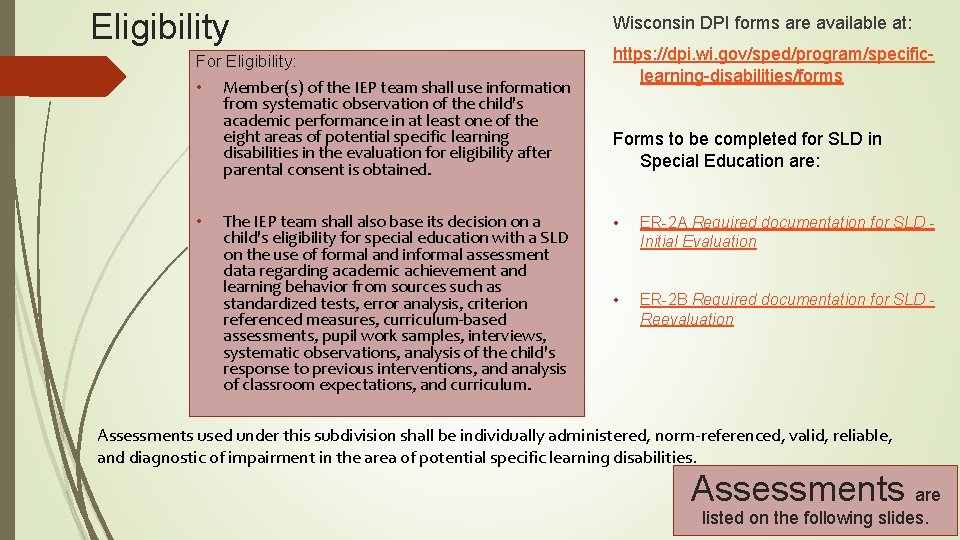
Eligibility For Eligibility: • • Member(s) of the IEP team shall use information from systematic observation of the child's academic performance in at least one of the eight areas of potential specific learning disabilities in the evaluation for eligibility after parental consent is obtained. The IEP team shall also base its decision on a child's eligibility for special education with a SLD on the use of formal and informal assessment data regarding academic achievement and learning behavior from sources such as standardized tests, error analysis, criterion referenced measures, curriculum-based assessments, pupil work samples, interviews, systematic observations, analysis of the child's response to previous interventions, and analysis of classroom expectations, and curriculum. Wisconsin DPI forms are available at: https: //dpi. wi. gov/sped/program/specificlearning-disabilities/forms Forms to be completed for SLD in Special Education are: • ER-2 A Required documentation for SLD Initial Evaluation • ER-2 B Required documentation for SLD Reevaluation Assessments used under this subdivision shall be individually administered, norm-referenced, valid, reliable, and diagnostic of impairment in the area of potential specific learning disabilities. Assessments are listed on the following slides.
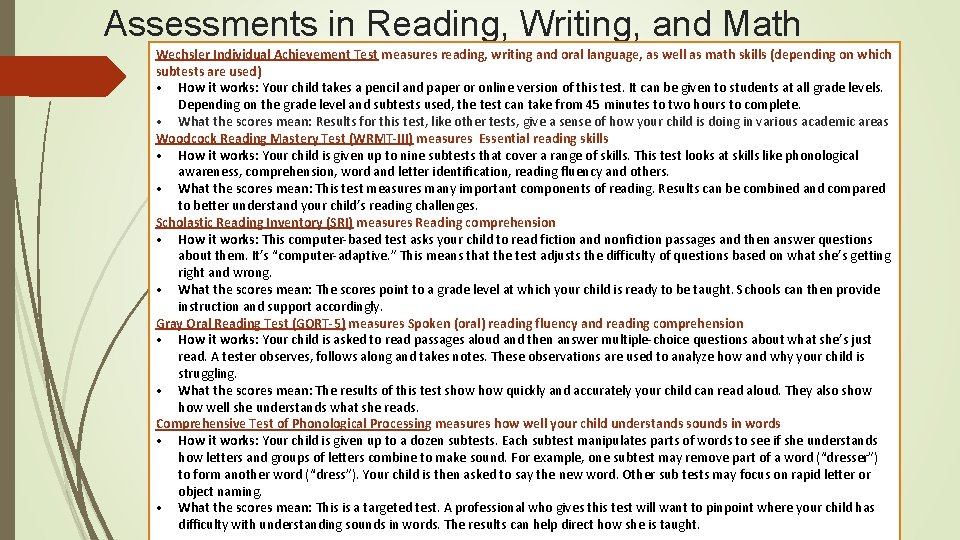
Assessments in Reading, Writing, and Math Wechsler Individual Achievement Test measures reading, writing and oral language, as well as math skills (depending on which subtests are used) • How it works: Your child takes a pencil and paper or online version of this test. It can be given to students at all grade levels. Depending on the grade level and subtests used, the test can take from 45 minutes to two hours to complete. • What the scores mean: Results for this test, like other tests, give a sense of how your child is doing in various academic areas Woodcock Reading Mastery Test (WRMT-III) measures Essential reading skills • How it works: Your child is given up to nine subtests that cover a range of skills. This test looks at skills like phonological awareness, comprehension, word and letter identification, reading fluency and others. • What the scores mean: This test measures many important components of reading. Results can be combined and compared to better understand your child’s reading challenges. Scholastic Reading Inventory (SRI) measures Reading comprehension • How it works: This computer-based test asks your child to read fiction and nonfiction passages and then answer questions about them. It’s “computer-adaptive. ” This means that the test adjusts the difficulty of questions based on what she’s getting right and wrong. • What the scores mean: The scores point to a grade level at which your child is ready to be taught. Schools can then provide instruction and support accordingly. Gray Oral Reading Test (GORT-5) measures Spoken (oral) reading fluency and reading comprehension • How it works: Your child is asked to read passages aloud and then answer multiple-choice questions about what she’s just read. A tester observes, follows along and takes notes. These observations are used to analyze how and why your child is struggling. • What the scores mean: The results of this test show quickly and accurately your child can read aloud. They also show well she understands what she reads. Comprehensive Test of Phonological Processing measures how well your child understands sounds in words • How it works: Your child is given up to a dozen subtests. Each subtest manipulates parts of words to see if she understands how letters and groups of letters combine to make sound. For example, one subtest may remove part of a word (“dresser”) to form another word (“dress”). Your child is then asked to say the new word. Other sub tests may focus on rapid letter or object naming. • What the scores mean: This is a targeted test. A professional who gives this test will want to pinpoint where your child has difficulty with understanding sounds in words. The results can help direct how she is taught.
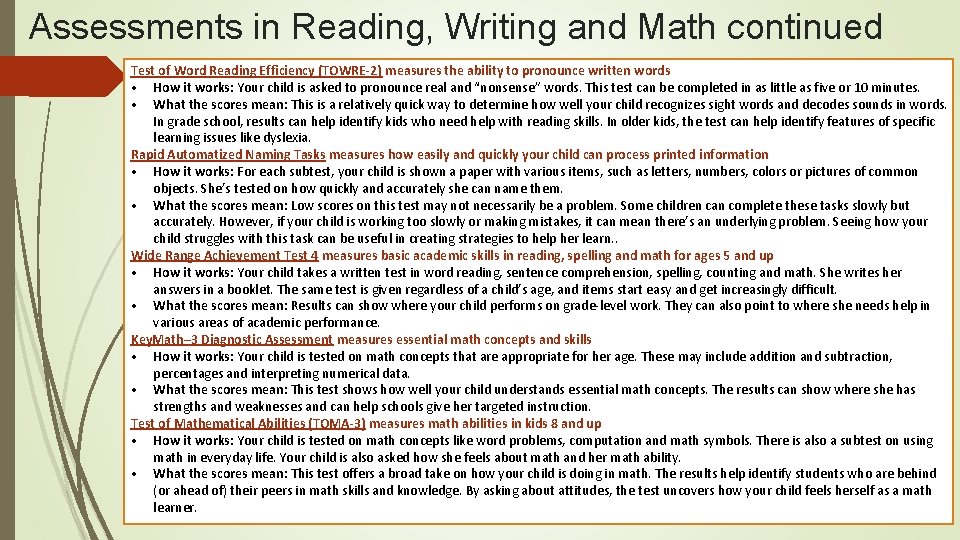
Assessments in Reading, Writing and Math continued Test of Word Reading Efficiency (TOWRE-2) measures the ability to pronounce written words • How it works: Your child is asked to pronounce real and “nonsense” words. This test can be completed in as little as five or 10 minutes. • What the scores mean: This is a relatively quick way to determine how well your child recognizes sight words and decodes sounds in words. In grade school, results can help identify kids who need help with reading skills. In older kids, the test can help identify features of specific learning issues like dyslexia. Rapid Automatized Naming Tasks measures how easily and quickly your child can process printed information • How it works: For each subtest, your child is shown a paper with various items, such as letters, numbers, colors or pictures of common objects. She’s tested on how quickly and accurately she can name them. • What the scores mean: Low scores on this test may not necessarily be a problem. Some children can complete these tasks slowly but accurately. However, if your child is working too slowly or making mistakes, it can mean there’s an underlying problem. Seeing how your child struggles with this task can be useful in creating strategies to help her learn. . Wide Range Achievement Test 4 measures basic academic skills in reading, spelling and math for ages 5 and up • How it works: Your child takes a written test in word reading, sentence comprehension, spelling, counting and math. She writes her answers in a booklet. The same test is given regardless of a child’s age, and items start easy and get increasingly difficult. • What the scores mean: Results can show where your child performs on grade-level work. They can also point to where she needs help in various areas of academic performance. Key. Math– 3 Diagnostic Assessment measures essential math concepts and skills • How it works: Your child is tested on math concepts that are appropriate for her age. These may include addition and subtraction, percentages and interpreting numerical data. • What the scores mean: This test shows how well your child understands essential math concepts. The results can show where she has strengths and weaknesses and can help schools give her targeted instruction. Test of Mathematical Abilities (TOMA-3) measures math abilities in kids 8 and up • How it works: Your child is tested on math concepts like word problems, computation and math symbols. There is also a subtest on using math in everyday life. Your child is also asked how she feels about math and her math ability. • What the scores mean: This test offers a broad take on how your child is doing in math. The results help identify students who are behind (or ahead of) their peers in math skills and knowledge. By asking about attitudes, the test uncovers how your child feels herself as a math learner.
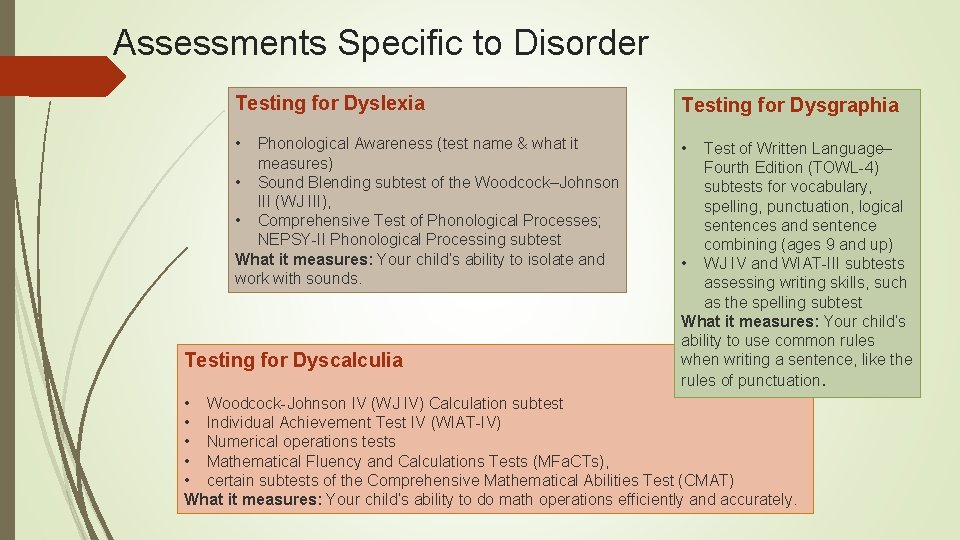
Assessments Specific to Disorder Testing for Dyslexia Testing for Dysgraphia • • Phonological Awareness (test name & what it measures) • Sound Blending subtest of the Woodcock–Johnson III (WJ III), • Comprehensive Test of Phonological Processes; NEPSY-II Phonological Processing subtest What it measures: Your child’s ability to isolate and work with sounds. Testing for Dyscalculia Test of Written Language– Fourth Edition (TOWL-4) subtests for vocabulary, spelling, punctuation, logical sentences and sentence combining (ages 9 and up) • WJ IV and WIAT-III subtests assessing writing skills, such as the spelling subtest What it measures: Your child’s ability to use common rules when writing a sentence, like the rules of punctuation. • Woodcock-Johnson IV (WJ IV) Calculation subtest • Individual Achievement Test IV (WIAT-IV) • Numerical operations tests • Mathematical Fluency and Calculations Tests (MFa. CTs), • certain subtests of the Comprehensive Mathematical Abilities Test (CMAT) What it measures: Your child’s ability to do math operations efficiently and accurately.
Teaching Strategies • A long list of teaching strategies for Reading, Writing, Math, Organization, Test Taking http: //do 2 learn. com/disabilities/Characteristics. And. Strategies/Specific. Learning. Disability_Strategies. html • Instructional Strategies in many areas from Understood https: //www. understood. org/en/school-learning/partnering-with-childs-school/instructional-strategies • Promoting Reading Comprehension in Secondary Students with LD https: //www. council-for-learning-disabilities. org/promoting-reading-comprehension-in-secondary-students-with-learningdisabilities • To help teach reading https: //dsf. net. au/teaching-reading-for-older-students-adults/ • To help teach spelling https: //dsf. net. au/teaching-spelling-for-older-students-adults/ • To help with written expression https: //dsf. net. au/teaching-written-expression-for-adults-etc/
Teacher Resources DSF Literacy and Clinical Services https: //dsf. net. au/ Understood for Learning and Attention Issues https: //www. understood. org/en/school-learning/evaluations/types-of-tests LDA: Support and Resources for Educators https: //ldaamerica. org/educators/ National Association of Special Education Teachers https: //www. naset. org/learningdisabilitie 2. 0. html Intervention Central http: //www. interventioncentral. org/teacher-resources/learning-disability-accommodations-finder
Parent Resources National Center for Learning Disabilities http: //www. ncld. org/ Learning Disabilities Association of America: Support & Resources for Parents https: //ldaamerica. org/parents/ Center for Parent Information and Resources: Leaning Disabilities http: //www. parentcenterhub. org/ld/ Special Education Guide: Support and Resources for Parents and Teachers http: //www. parentcenterhub. org/ld/
Some Concluding Points a specific learning disability is generally recognized as resulting in the child (or adult) “learning differently”. If it is apparent that this difference is interfering with a person’s capacity to access the curriculum or demonstrate their skills and knowledge, an individually targeted intervention should be provided. This should include both remediation and accommodations The most common specific learning disability is dyslexia, which is a persistent difficulty in the area of reading and spelling

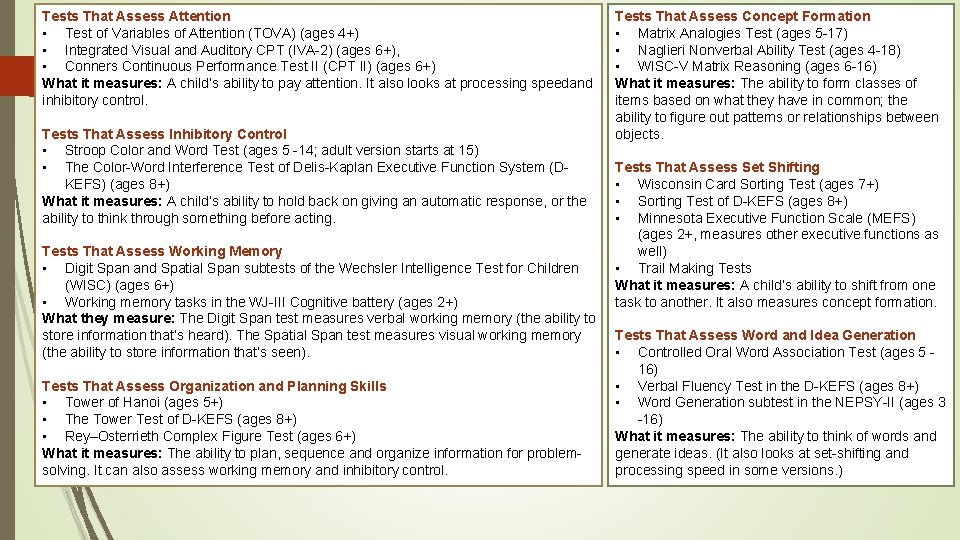
Tests That Assess Attention • Test of Variables of Attention (TOVA) (ages 4+) • Integrated Visual and Auditory CPT (IVA-2) (ages 6+), • Conners Continuous Performance Test II (CPT II) (ages 6+) What it measures: A child’s ability to pay attention. It also looks at processing speedand inhibitory control. Tests That Assess Inhibitory Control • Stroop Color and Word Test (ages 5 -14; adult version starts at 15) • The Color-Word Interference Test of Delis-Kaplan Executive Function System (DKEFS) (ages 8+) What it measures: A child’s ability to hold back on giving an automatic response, or the ability to think through something before acting. Tests That Assess Working Memory • Digit Span and Spatial Span subtests of the Wechsler Intelligence Test for Children (WISC) (ages 6+) • Working memory tasks in the WJ-III Cognitive battery (ages 2+) What they measure: The Digit Span test measures verbal working memory (the ability to store information that’s heard). The Spatial Span test measures visual working memory (the ability to store information that’s seen). Tests That Assess Organization and Planning Skills • Tower of Hanoi (ages 5+) • The Tower Test of D-KEFS (ages 8+) • Rey–Osterrieth Complex Figure Test (ages 6+) What it measures: The ability to plan, sequence and organize information for problemsolving. It can also assess working memory and inhibitory control. Tests That Assess Concept Formation • Matrix Analogies Test (ages 5 -17) • Naglieri Nonverbal Ability Test (ages 4 -18) • WISC-V Matrix Reasoning (ages 6 -16) What it measures: The ability to form classes of items based on what they have in common; the ability to figure out patterns or relationships between objects. Tests That Assess Set Shifting • Wisconsin Card Sorting Test (ages 7+) • Sorting Test of D-KEFS (ages 8+) • Minnesota Executive Function Scale (MEFS) (ages 2+, measures other executive functions as well) • Trail Making Tests What it measures: A child’s ability to shift from one task to another. It also measures concept formation. Tests That Assess Word and Idea Generation • Controlled Oral Word Association Test (ages 5 16) • Verbal Fluency Test in the D-KEFS (ages 8+) • Word Generation subtest in the NEPSY-II (ages 3 -16) What it measures: The ability to think of words and generate ideas. (It also looks at set-shifting and processing speed in some versions. )
- Slides: 14