
Specific Learning Difficulties in Adults Inclusion and Intervention

- Slides: 30
Specific Learning Difficulties in Adults Inclusion and Intervention
Specific Learning Difficulties/Differences (Sp. LD) Neurodevelopmental conditions that affect the individual’s abilities to learn in normal contexts by traditional methods Discrepancy between the individual’s general intellectual abilities and their abilities in certain areas of learning or under certain circumstances Distinct from global learning difficulties Sp. LD arise from processing differences rather than intellectual impairment
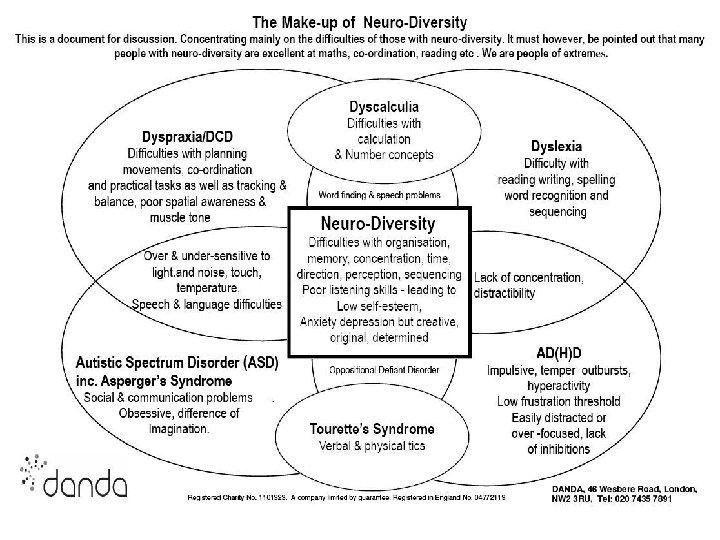
A number of Sp. LD have been individually labelled because of certain features: dyslexia (difficulties with reading and/or spelling) dyspraxia (motor coordination difficulties) dyscalculia (difficulties with number concepts/calculation) dysgraphia (difficulties with handwriting) attention deficit (hyperactivity) disorder (concentration difficulties and impulsivity) autistic spectrum disorders (social communication difficulties) specific language impairment (language difficulties – without other obvious cause) Tourette Syndrome (vocal/physical tic disorder) More than one Sp. LD may occur or can Sp. LD maylearning overlap in theoften auditory/visual processing difficulties impair and same person. accompany Sp. LD In adults, Sp. LD may be undiagnosed
Sp. LD and the whole person The high proportion of co-occuring Sp. LD conditions in individuals and the high number of shared characteristics across different labelled conditions suggests that the labels themselves may be artificial. The degree of crossover can make identification of conditions difficult. Professor Amanda Kirby, University of Wales discusses this difficulty and recommends working with the “whole person” focusing on individual strengths and adjusting for individual weaknesses: http: //www. dystalk. com/talks/57 -dyslexia-dyspraxia-amp-overlappinglearning-difficulties
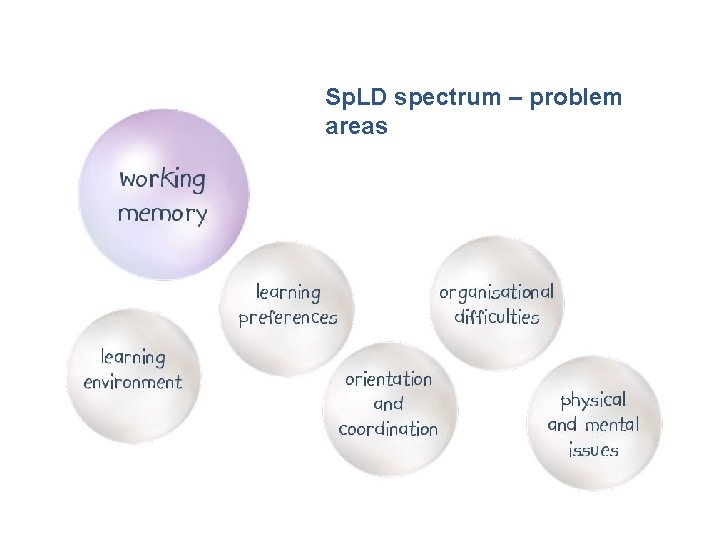
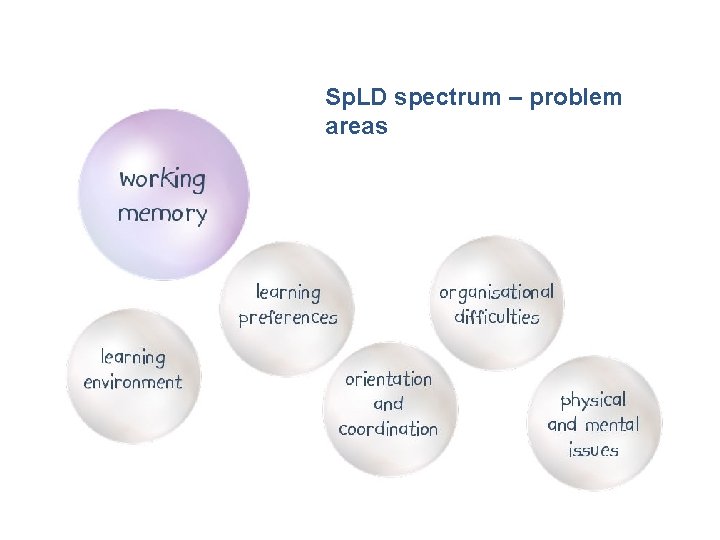
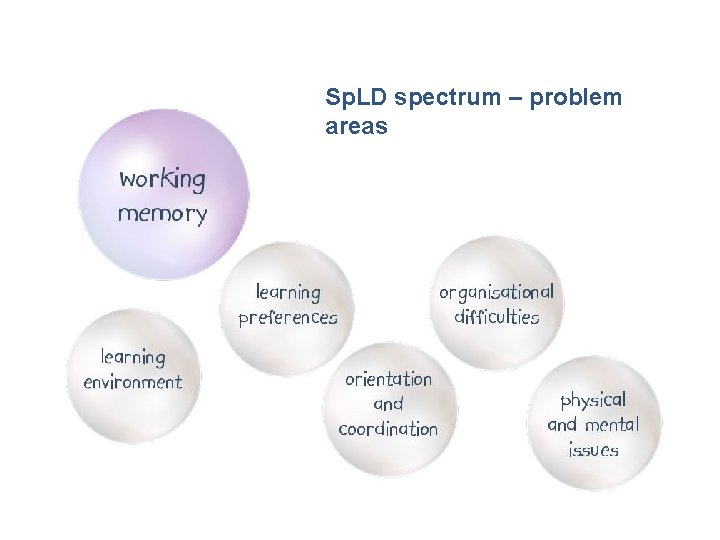
Sp. LD spectrum – problem areas
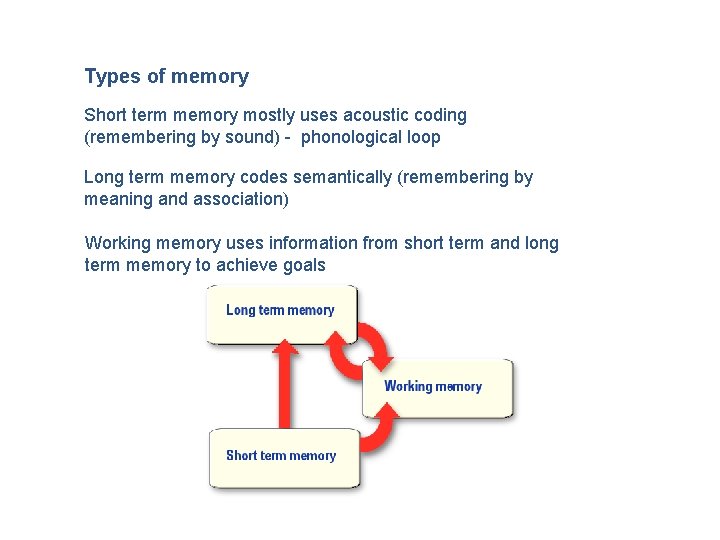
Types of memory Short term memory mostly uses acoustic coding (remembering by sound) - phonological loop Long term memory codes semantically (remembering by meaning and association) Working memory uses information from short term and long term memory to achieve goals
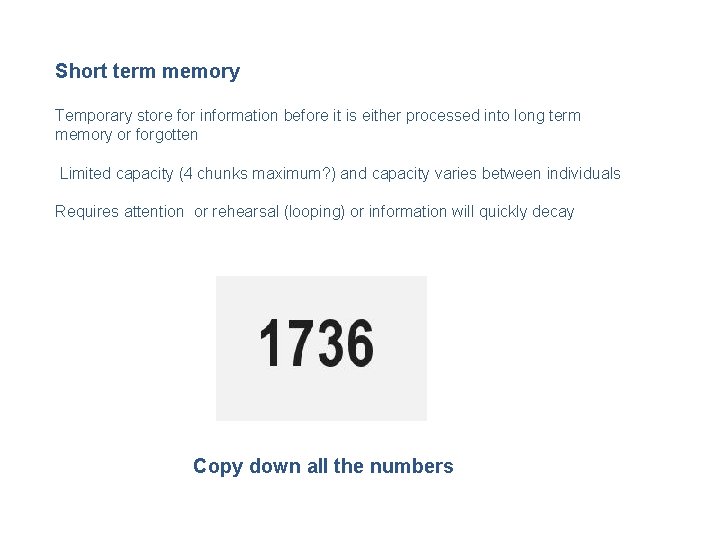
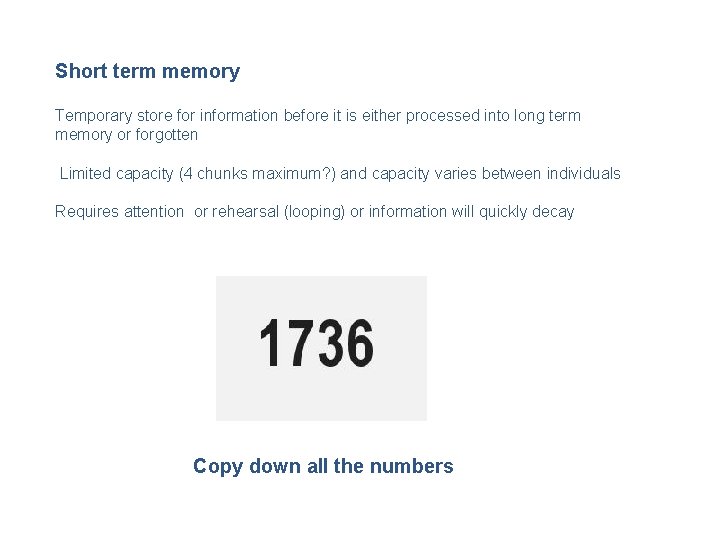
Short term memory Temporary store for information before it is either processed into long term memory or forgotten Limited capacity (4 chunks maximum? ) and capacity varies between individuals Requires attention or rehearsal (looping) or information will quickly decay Copy down all the numbers
Short term memory Temporary store for information before it is either processed into long term memory or forgotten Limited capacity (4 chunks maximum? ) and capacity varies between individuals Requires attention or rehearsal (looping) or information will quickly decay Copy down all the numbers
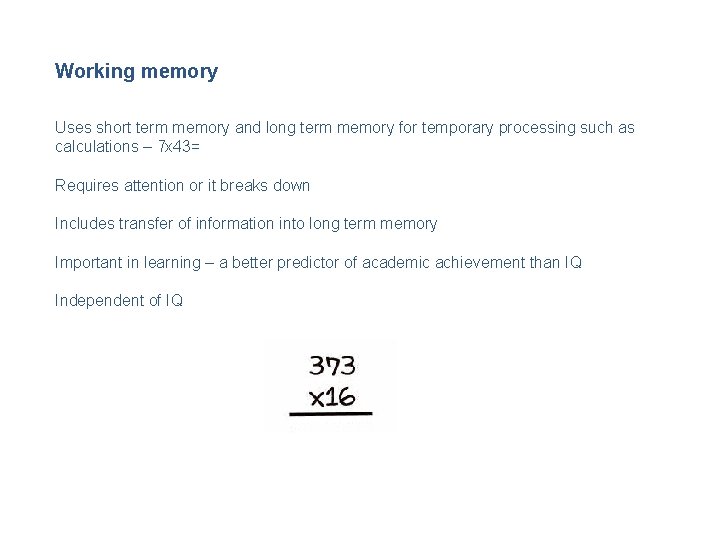
Working memory Uses short term memory and long term memory for temporary processing such as calculations – 7 x 43= Requires attention or it breaks down Includes transfer of information into long term memory Important in learning – a better predictor of academic achievement than IQ Independent of IQ
Measuring working memory n-back test (eg 2 -back; 3 -back)
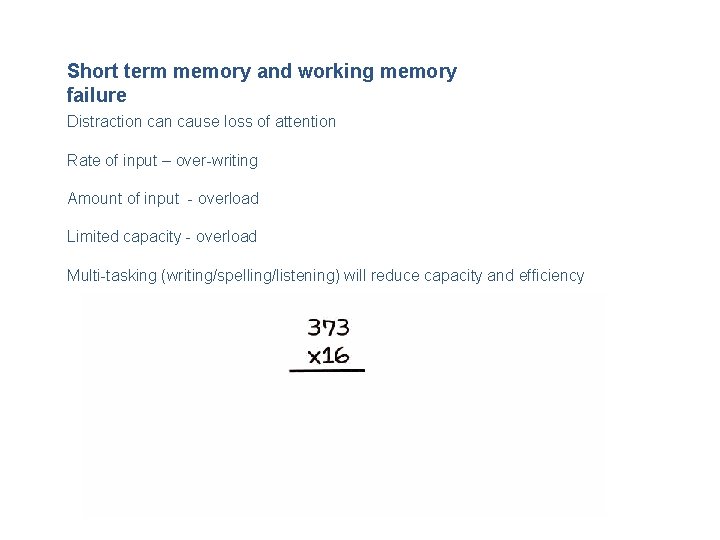
Short term memory and working memory failure Distraction cause loss of attention Rate of input – over-writing Amount of input - overload Limited capacity - overload Multi-tasking (writing/spelling/listening) will reduce capacity and efficiency
Short term memory and working memory failure Effects taking notes answering questions problem solving transfer into long term memory (learning) Problems with working memory can go unrecognised and may be dismissed as: lack of motivation lack of effort lack of interest Fatigue can result in giving up on tasks, loss of interest, behavioural problems What can you do to assist a learner with a poorer shortterm/working memory?
Sp. LD spectrum – problem areas
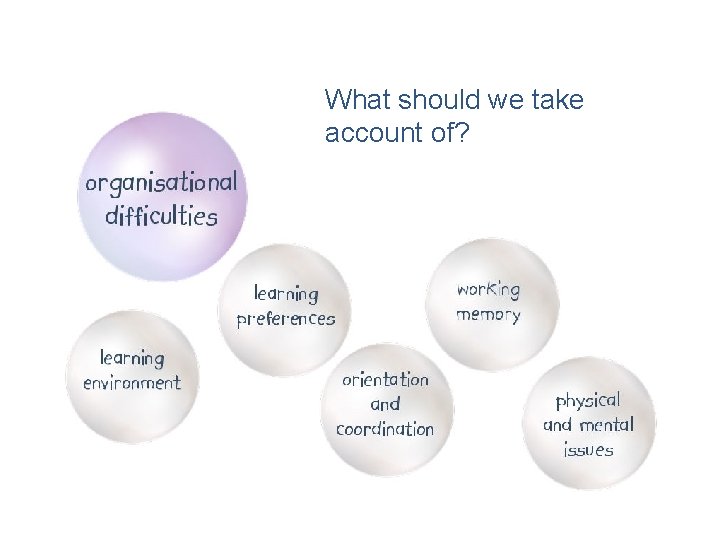
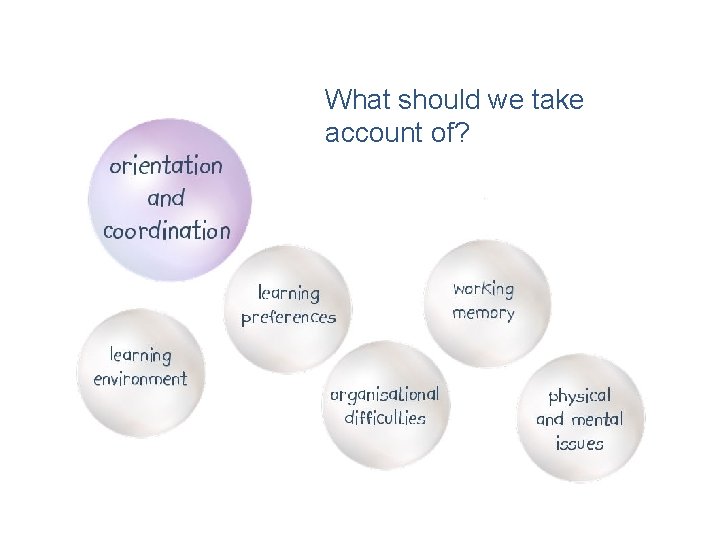
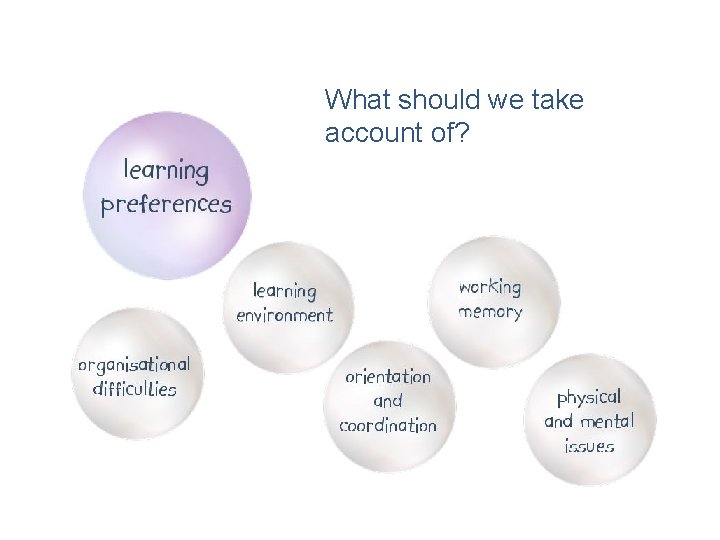
What should we take account of?
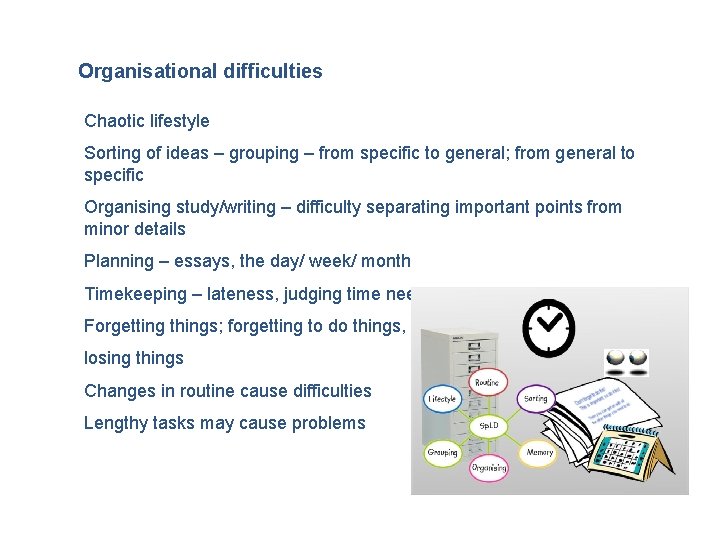
Organisational difficulties Chaotic lifestyle Sorting of ideas – grouping – from specific to general; from general to specific Organising study/writing – difficulty separating important points from minor details Planning – essays, the day/ week/ month Timekeeping – lateness, judging time needed Forgetting things; forgetting to do things, losing things Changes in routine cause difficulties Lengthy tasks may cause problems
What should we take account of?
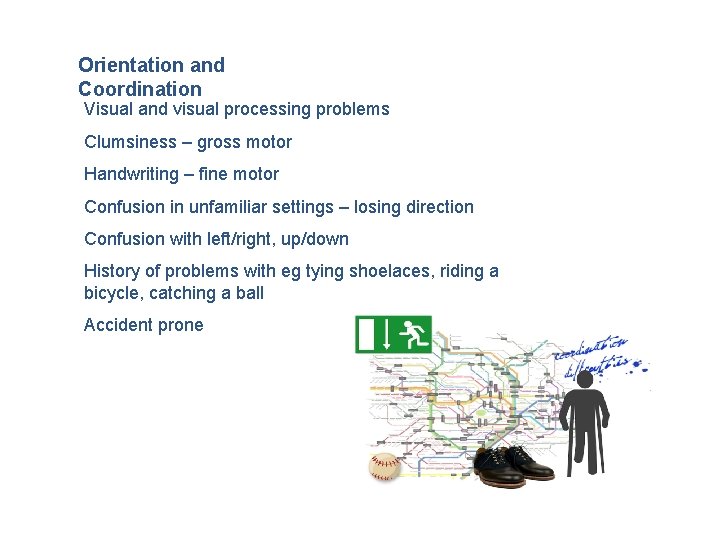
Orientation and Coordination Visual and visual processing problems Clumsiness – gross motor Handwriting – fine motor Confusion in unfamiliar settings – losing direction Confusion with left/right, up/down History of problems with eg tying shoelaces, riding a bicycle, catching a ball Accident prone
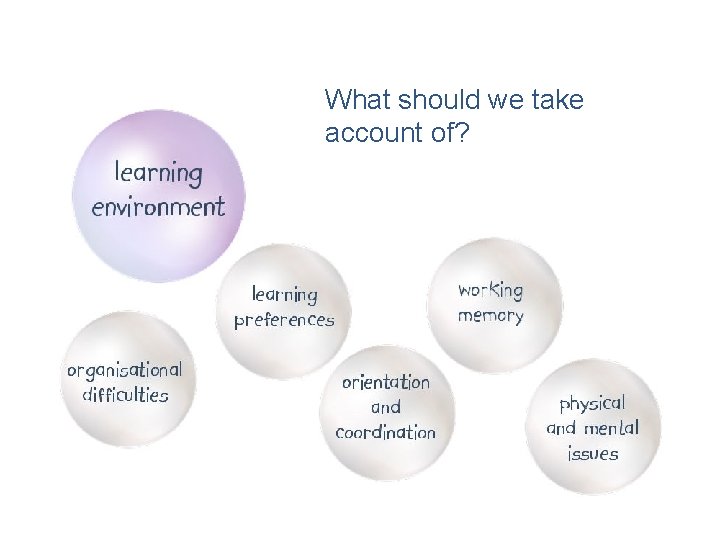
What should we take account of?
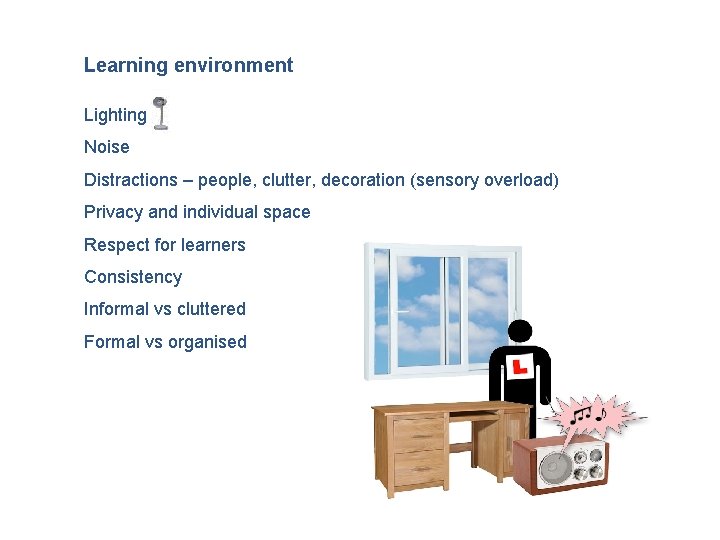
Learning environment Lighting Noise Distractions – people, clutter, decoration (sensory overload) Privacy and individual space Respect for learners Consistency Informal vs cluttered Formal vs organised
What should we take account of?
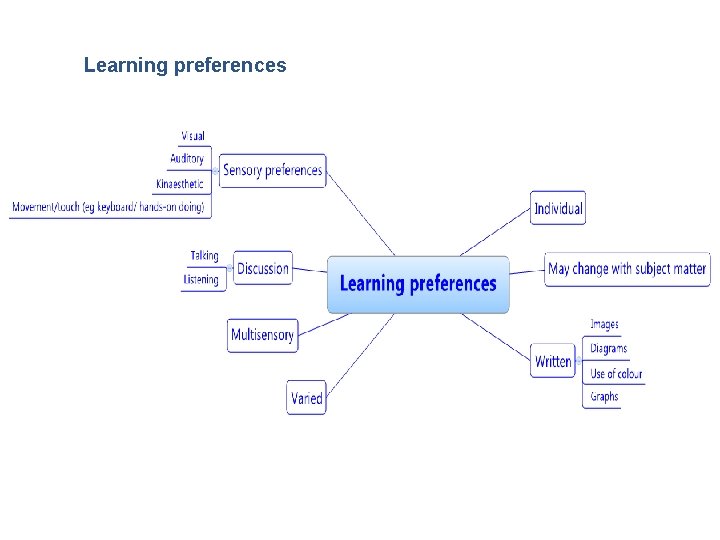
Learning preferences
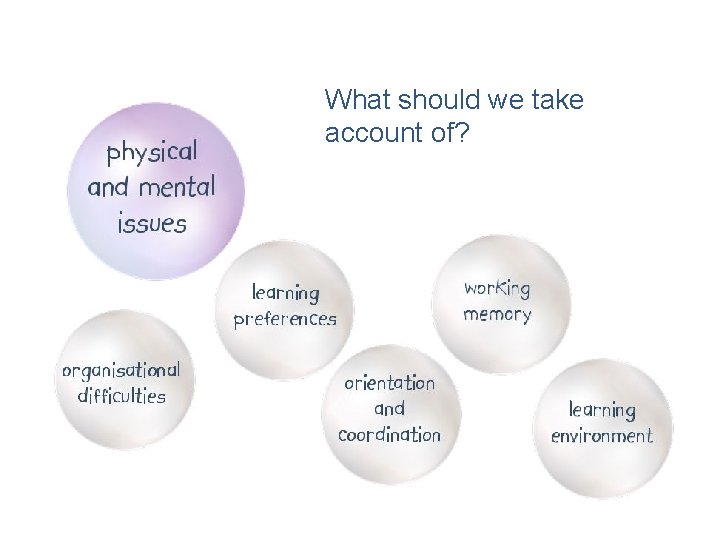
What should we take account of?
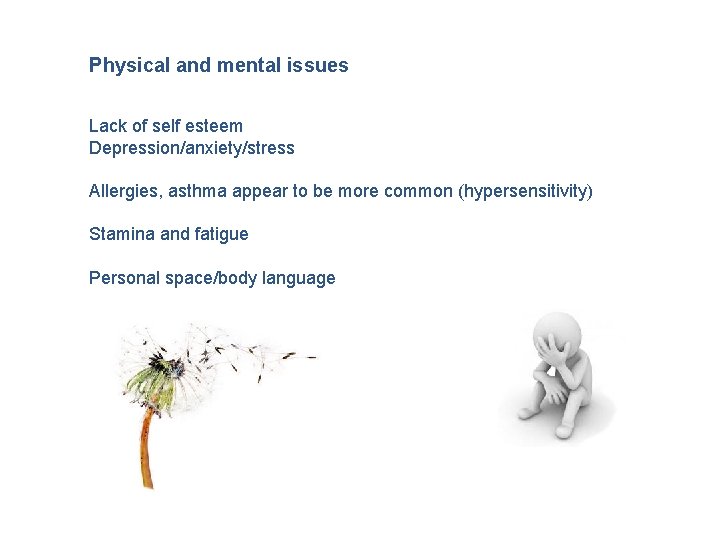
Physical and mental issues Lack of self esteem Depression/anxiety/stress Allergies, asthma appear to be more common (hypersensitivity) Stamina and fatigue Personal space/body language
Sp. LD spectrum – problem areas
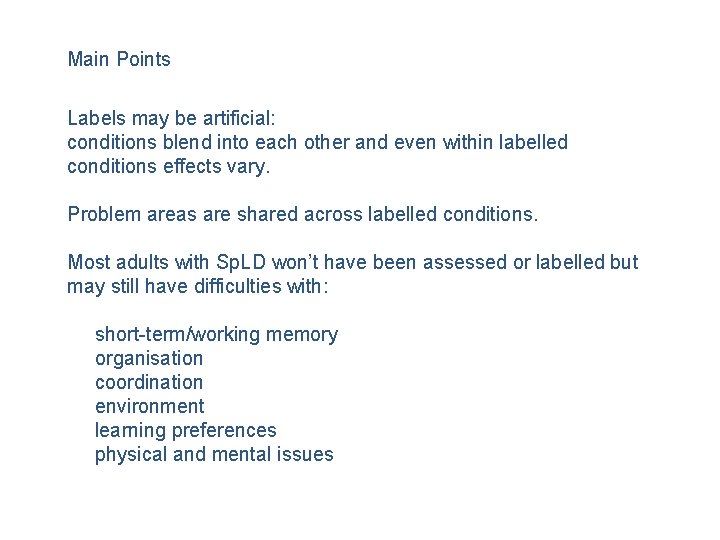
Main Points Labels may be artificial: conditions blend into each other and even within labelled conditions effects vary. Problem areas are shared across labelled conditions. Most adults with Sp. LD won’t have been assessed or labelled but may still have difficulties with: short-term/working memory organisation coordination environment learning preferences physical and mental issues
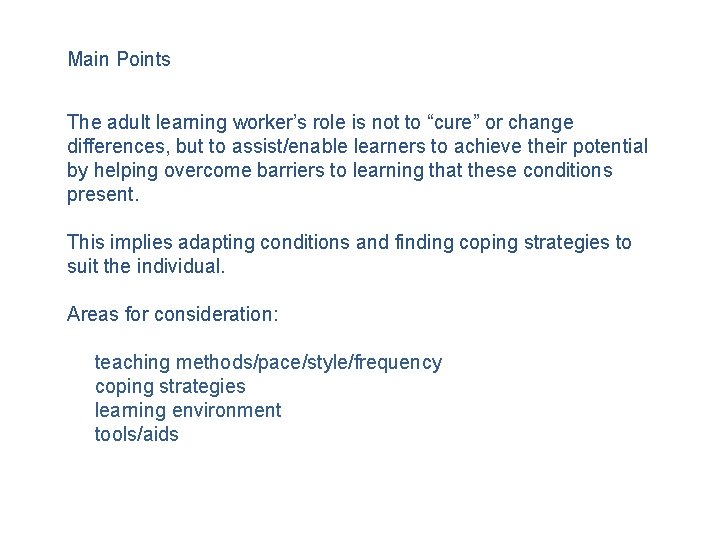
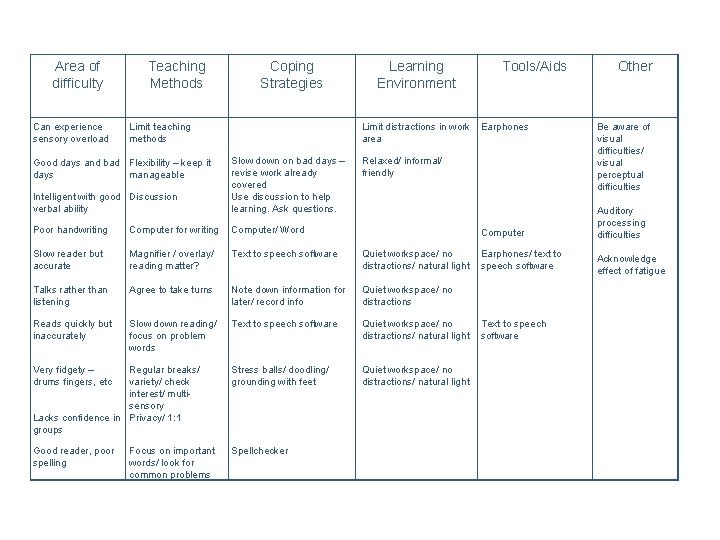
Main Points The adult learning worker’s role is not to “cure” or change differences, but to assist/enable learners to achieve their potential by helping overcome barriers to learning that these conditions present. This implies adapting conditions and finding coping strategies to suit the individual. Areas for consideration: teaching methods/pace/style/frequency coping strategies learning environment tools/aids
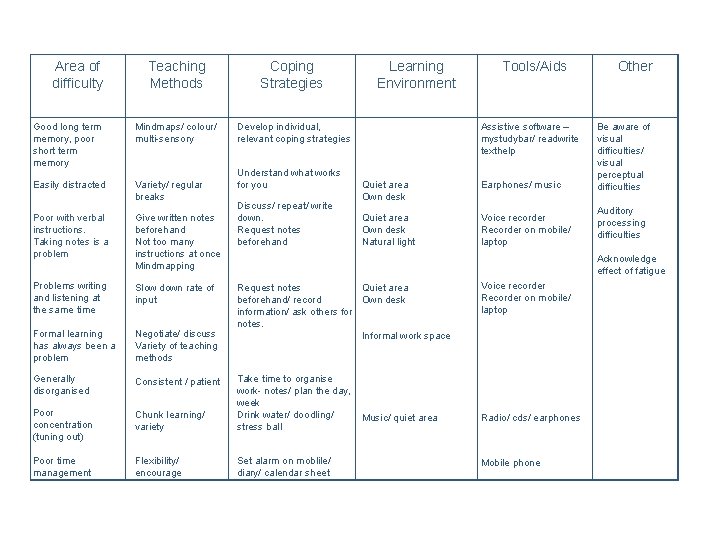
Area of difficulty Teaching Methods Coping Strategies Good long term memory, poor short term memory Mindmaps/ colour/ multi-sensory Develop individual, relevant coping strategies Easily distracted Variety/ regular breaks Poor with verbal instructions. Taking notes is a problem Give written notes beforehand Not too many instructions at once Mindmapping Problems writing and listening at the same time Slow down rate of input Formal learning has always been a problem Negotiate/ discuss Variety of teaching methods Generally disorganised Consistent / patient Poor concentration (tuning out) Chunk learning/ variety Take time to organise work- notes/ plan the day, week Drink water/ doodling/ stress ball Poor time management Flexibility/ encourage Set alarm on moblile/ diary/ calendar sheet Understand what works for you Discuss/ repeat/ write down. Request notes beforehand Learning Environment Tools/Aids Assistive software – mystudybar/ readwrite texthelp Quiet area Own desk Earphones/ music Quiet area Own desk Natural light Voice recorder Recorder on mobile/ laptop Other Be aware of visual difficulties/ visual perceptual difficulties Auditory processing difficulties Acknowledge effect of fatigue Request notes Quiet area beforehand/ record Own desk information/ ask others for notes. Informal work space Music/ quiet area Voice recorder Recorder on mobile/ laptop Radio/ cds/ earphones Mobile phone
Area of difficulty Can experience sensory overload Teaching Methods Coping Strategies Limit teaching methods Learning Environment Limit distractions in work area Intelligent with good Discussion verbal ability Slow down on bad days – revise work already covered Use discussion to help learning. Ask questions. Poor handwriting Computer for writing Computer/ Word Slow reader but accurate Magnifier / overlay/ reading matter? Text to speech software Quiet workspace/ no distractions/ natural light Talks rather than listening Agree to take turns Note down information for later/ record info Quiet workspace/ no distractions Reads quickly but inaccurately Slow down reading/ focus on problem words Text to speech software Quiet workspace/ no distractions/ natural light Regular breaks/ variety/ check interest/ multisensory Lacks confidence in Privacy/ 1: 1 groups Stress balls/ doodling/ grounding with feet Quiet workspace/ no distractions/ natural light Good reader, poor spelling Spellchecker Good days and bad Flexibility – keep it days manageable Very fidgety – drums fingers, etc Focus on important words/ look for common problems Tools/Aids Earphones Relaxed/ informal/ friendly Other Be aware of visual difficulties/ visual perceptual difficulties Computer Auditory processing difficulties Earphones/ text to speech software Acknowledge effect of fatigue Text to speech software
• www. educationscotland. gov. uk