
Specific Heat Capacity the amount of heat required

- Slides: 5
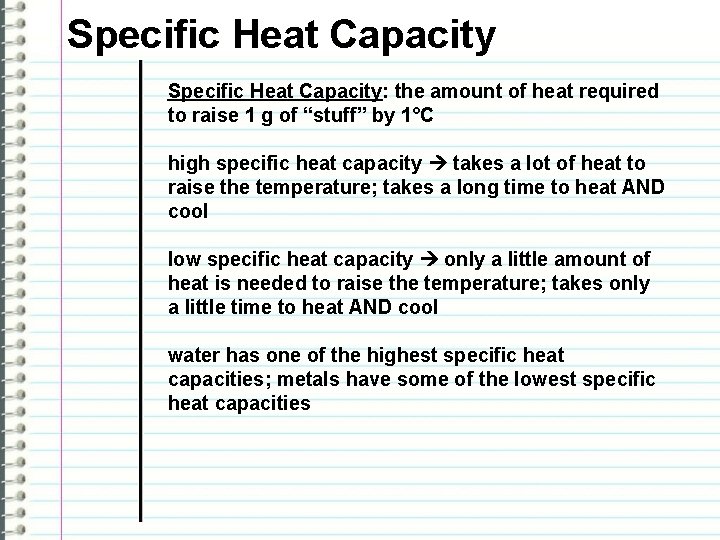
Specific Heat Capacity: the amount of heat required to raise 1 g of “stuff” by 1°C high specific heat capacity takes a lot of heat to raise the temperature; takes a long time to heat AND cool low specific heat capacity only a little amount of heat is needed to raise the temperature; takes only a little time to heat AND cool water has one of the highest specific heat capacities; metals have some of the lowest specific heat capacities
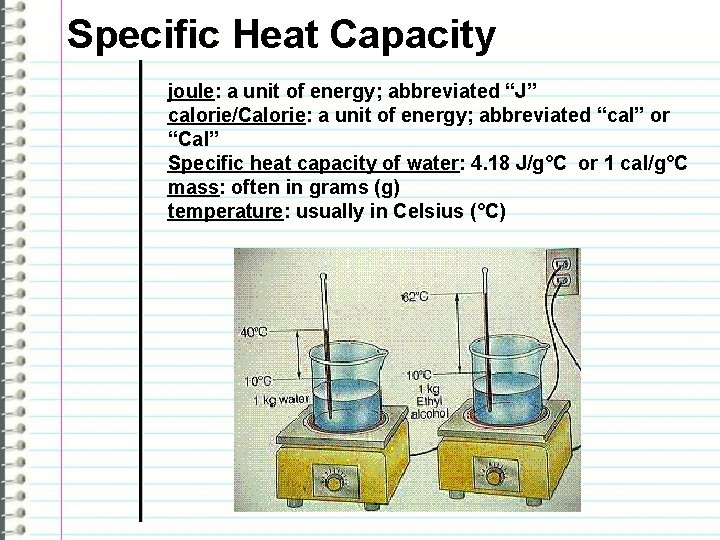
Specific Heat Capacity joule: a unit of energy; abbreviated “J” calorie/Calorie: a unit of energy; abbreviated “cal” or “Cal” Specific heat capacity of water: 4. 18 J/g°C or 1 cal/g°C mass: often in grams (g) temperature: usually in Celsius (°C)
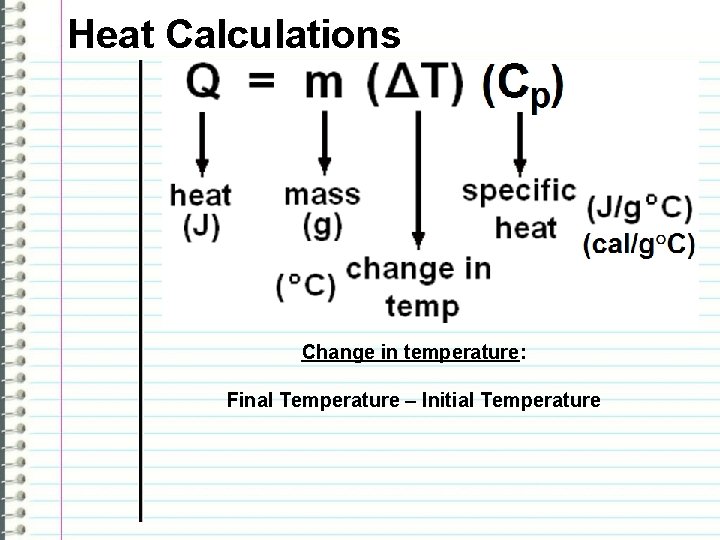
Heat Calculations Change in temperature: Final Temperature – Initial Temperature
GUESS A way to solve science problems: G: given U: unknown E: equation S: substitute S: solve
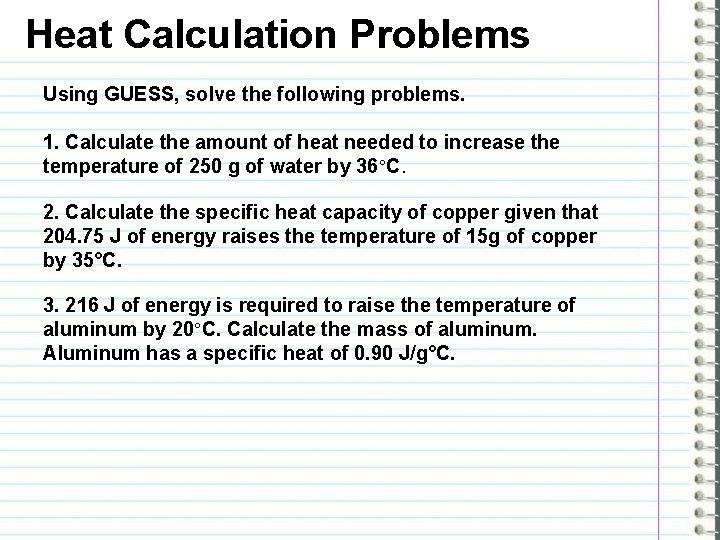
Heat Calculation Problems Using GUESS, solve the following problems. 1. Calculate the amount of heat needed to increase the temperature of 250 g of water by 36°C. 2. Calculate the specific heat capacity of copper given that 204. 75 J of energy raises the temperature of 15 g of copper by 35°C. 3. 216 J of energy is required to raise the temperature of aluminum by 20°C. Calculate the mass of aluminum. Aluminum has a specific heat of 0. 90 J/g°C.