
Specific details of swelling in uraniumplutonium nitride fuel

- Slides: 18
Specific details of swelling in uranium-plutonium nitride fuel used for fabrication of helium gasand liquid metal-bonded test fuel rods A. V. Belyaeva, F. N. Kryukov, O. N. Nikitin, and S. V. Kuzmin (JSC “SSC RIAR”) XI CONFERENCE ON REACTOR MATERIALS SCIENCE May 27 -31, 2019 Dimitrovgrad
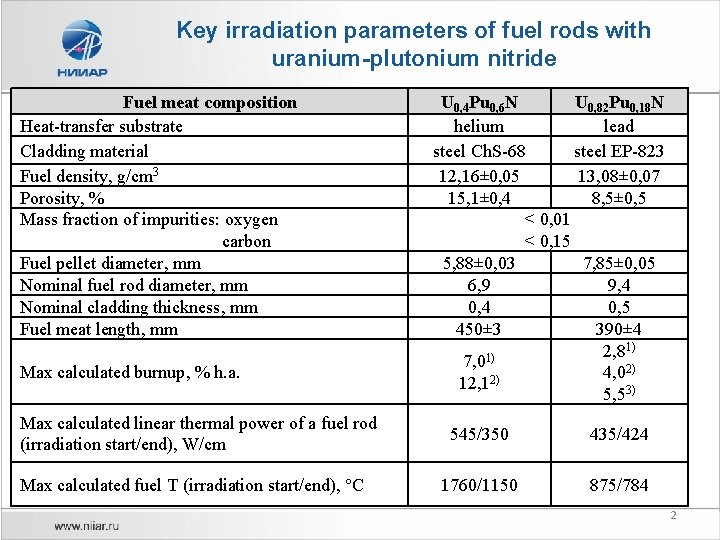
Key irradiation parameters of fuel rods with uranium-plutonium nitride Fuel meat composition Heat-transfer substrate Cladding material Fuel density, g/cm 3 Porosity, % Mass fraction of impurities: oxygen carbon Fuel pellet diameter, mm Nominal fuel rod diameter, mm Nominal cladding thickness, mm Fuel meat length, mm Max calculated burnup, % h. a. Max calculated linear thermal power of a fuel rod (irradiation start/end), W/cm Max calculated fuel T (irradiation start/end), °С U 0, 4 Pu 0, 6 N U 0, 82 Pu 0, 18 N helium lead steel Ch. S-68 steel EP-823 12, 16± 0, 05 13, 08± 0, 07 15, 1± 0, 4 8, 5± 0, 5 < 0, 01 < 0, 15 5, 88± 0, 03 7, 85± 0, 05 6, 9 9, 4 0, 5 450± 3 390± 4 2, 81) 1) 7, 0 4, 02) 2) 12, 1 5, 53) 545/350 435/424 1760/1150 875/784 2
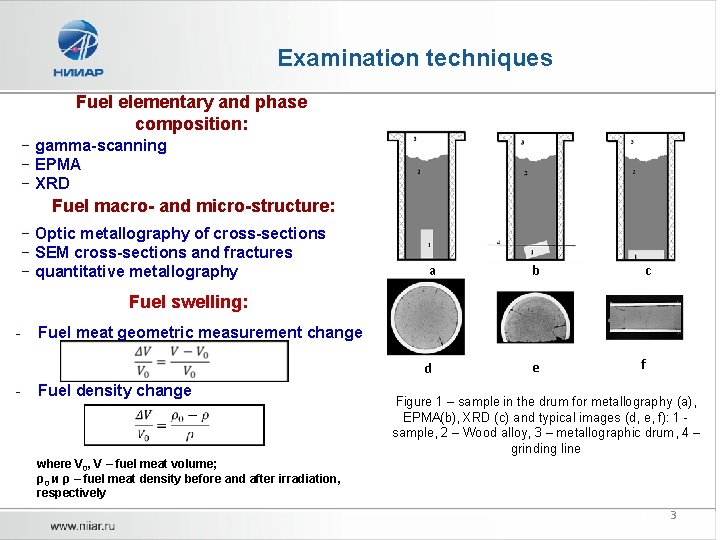
Examination techniques Fuel elementary and phase composition: − gamma-scanning − EPMA − XRD Fuel macro- and micro-structure: − Optic metallography of cross-sections − SEM cross-sections and fractures − quantitative metallography a b c e f Fuel swelling: - Fuel meat geometric measurement change d - Fuel density change Figure 1 – sample in the drum for metallography (a), EPMA(b), XRD (c) and typical images (d, e, f): 1 sample, 2 – Wood alloy, 3 – metallographic drum, 4 – grinding line where V 0, V – fuel meat volume; ρ0 и ρ – fuel meat density before and after irradiation, respectively 3
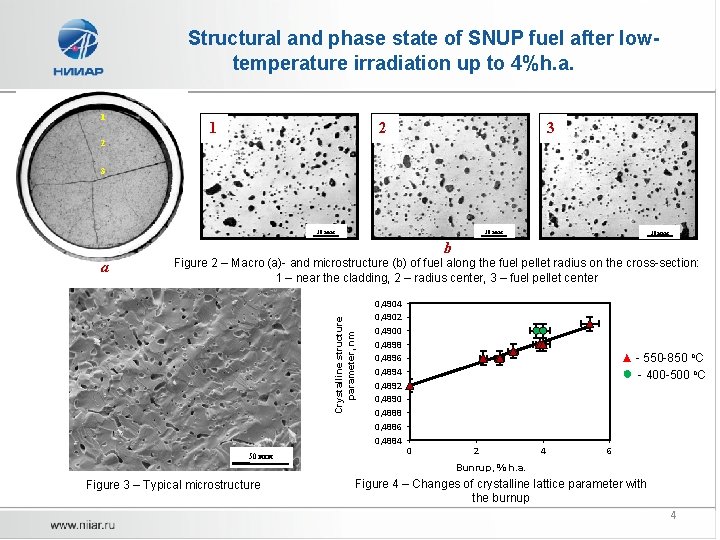
Structural and phase state of SNUP fuel after lowtemperature irradiation up to 4%h. a. 1 1 2 3 30 мкм b a Figure 2 – Macro (а)- and microstructure (b) of fuel along the fuel pellet radius on the cross-section: 1 – near the cladding, 2 – radius center, 3 – fuel pellet center Crystalline structure parameter, nm 0, 4904 0, 4902 0, 4900 0, 4898 ▲ - 550 -850 о. С ● - 400 -500 о. С 0, 4896 0, 4894 0, 4892 0, 4890 0, 4888 0, 4886 0, 4884 50 мкм 0 2 4 6 Bunrup, % h. a. Figure 3 – Typical microstructure Figure 4 – Changes of crystalline lattice parameter with the burnup 4
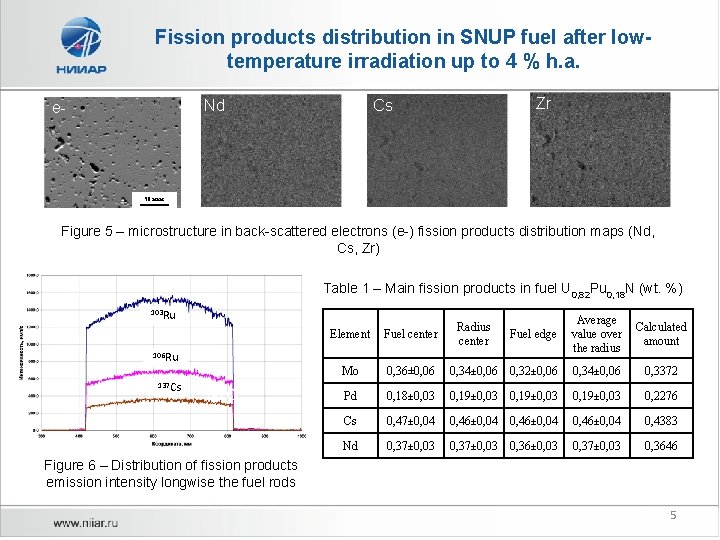
Fission products distribution in SNUP fuel after lowtemperature irradiation up to 4 % h. a. e– Nd Cs е- Zr Cs 50 мкм Тс Pd Figure 5 – microstructure in back-scattered electrons (е-) fission products distribution maps (Nd, Cs, Zr) Table 1 – Main fission products in fuel U 0, 82 Pu 0, 18 N (wt. %) 103 Ru 106 Ru Mo 137 Cs Mo Fuel edge Average value over the radius Calculated amount Element Fuel center Radius center Mo 0, 36± 0, 06 0, 34± 0, 06 0, 32± 0, 06 0, 34± 0, 06 0, 3372 Pd 0, 18± 0, 03 0, 19± 0, 03 0, 2276 Cs 0, 47± 0, 04 0, 46± 0, 04 0, 4383 Nd 0, 37± 0, 03 0, 36± 0, 03 0, 37± 0, 03 0, 3646 Figure 6 – Distribution of fission products emission intensity longwise the fuel rods 5
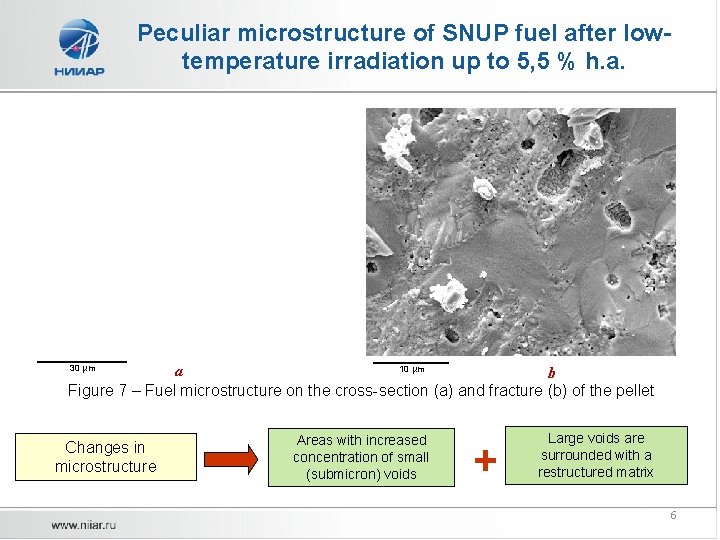
Peculiar microstructure of SNUP fuel after lowtemperature irradiation up to 5, 5 % h. a. 10 µm a b Figure 7 – Fuel microstructure on the cross-section (a) and fracture (b) of the pellet 30 µm Changes in microstructure Areas with increased concentration of small (submicron) voids + Large voids are surrounded with a restructured matrix 6
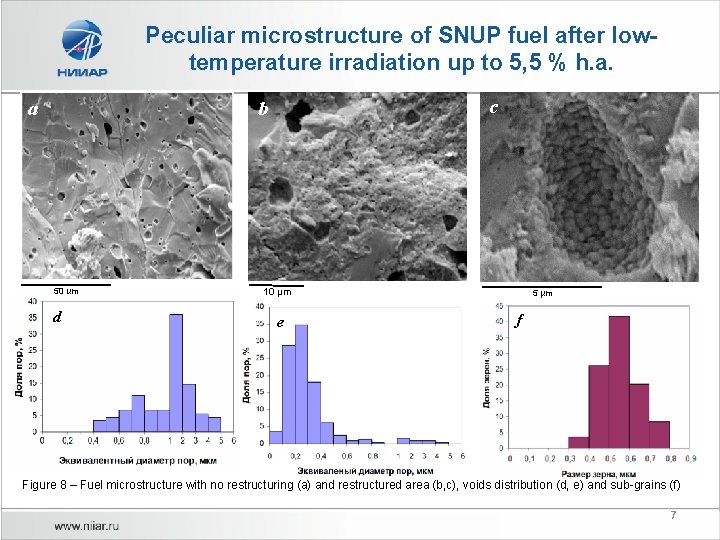
Peculiar microstructure of SNUP fuel after lowtemperature irradiation up to 5, 5 % h. a. a c b 50 µm d 10 µm e 5 µm f Figure 8 – Fuel microstructure with no restructuring (a) and restructured area (b, c), voids distribution (d, e) and sub-grains (f) 7
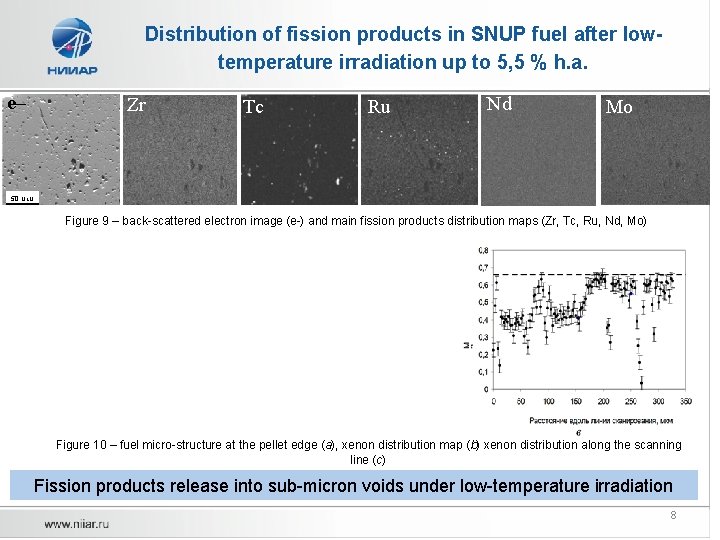
Distribution of fission products in SNUP fuel after lowtemperature irradiation up to 5, 5 % h. a. e– Zr Cs Тс Ru Nd Mo 50 мкм Figure 9 – back-scattered electron image (е-) and main fission products distribution maps (Zr, Tc, Ru, Nd, Mo) Figure 10 – fuel micro-structure at the pellet edge (a), xenon distribution map (b) xenon distribution along the scanning line (c) Fission products release into sub-micron voids under low-temperature irradiation 8
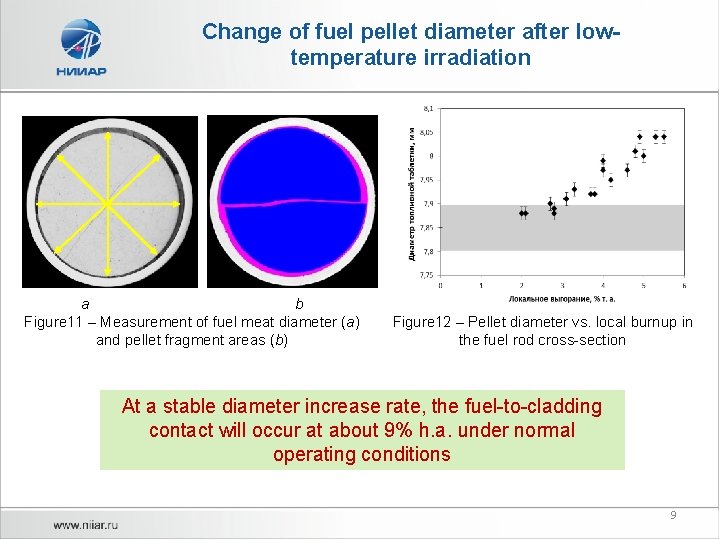
Change of fuel pellet diameter after lowtemperature irradiation 1 мм a b Figure 11 – Measurement of fuel meat diameter (a) and pellet fragment areas (b) Figure 12 – Pellet diameter vs. local burnup in the fuel rod cross-section At a stable diameter increase rate, the fuel-to-cladding contact will occur at about 9% h. a. under normal operating conditions 9
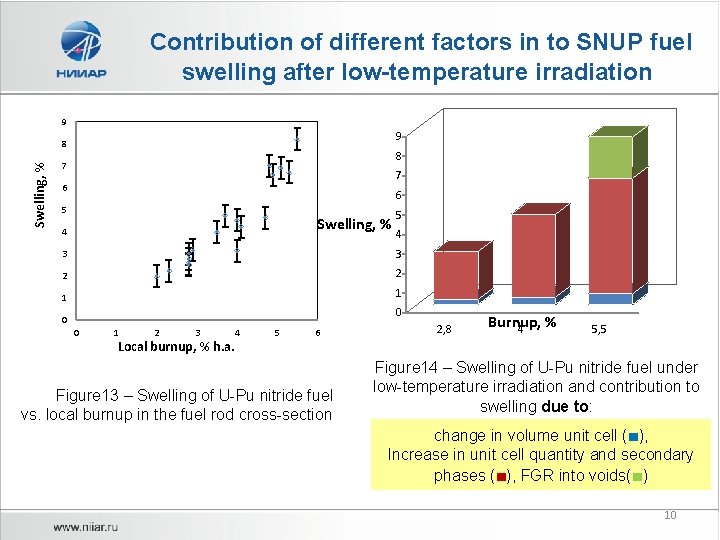
Contribution of different factors in to SNUP fuel swelling after low-temperature irradiation 9 9 Swelling, % 8 8 7 7 6 6 5 Swelling, % 4 5 4 3 3 2 2 1 1 0 0 0 1 2 3 Local burnup, % h. a. 4 5 6 Figure 13 – Swelling of U-Pu nitride fuel vs. local burnup in the fuel rod cross-section 2, 8 Burnup, % 4 5, 5 Figure 14 – Swelling of U-Pu nitride fuel under low-temperature irradiation and contribution to swelling due to: change in volume unit cell (■), Increase in unit cell quantity and secondary phases (■), FGR into voids(■) 10
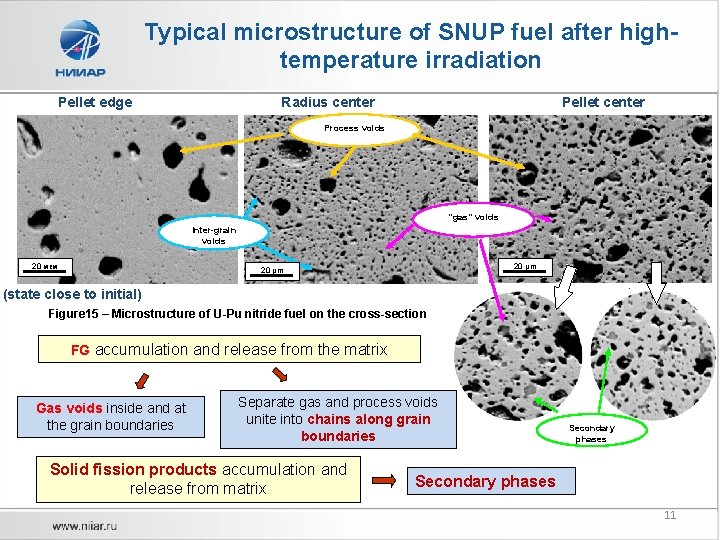
Typical microstructure of SNUP fuel after hightemperature irradiation Pellet edge Radius center Pellet center Process voids “gas” voids Inter-grain voids 20 мкм 20 µm (state close to initial) Figure 15 – Microstructure of U-Pu nitride fuel on the cross-section FG accumulation and release from the matrix Gas voids inside and at the grain boundaries Separate gas and process voids unite into chains along grain boundaries Solid fission products accumulation and release from matrix Secondary phases 11
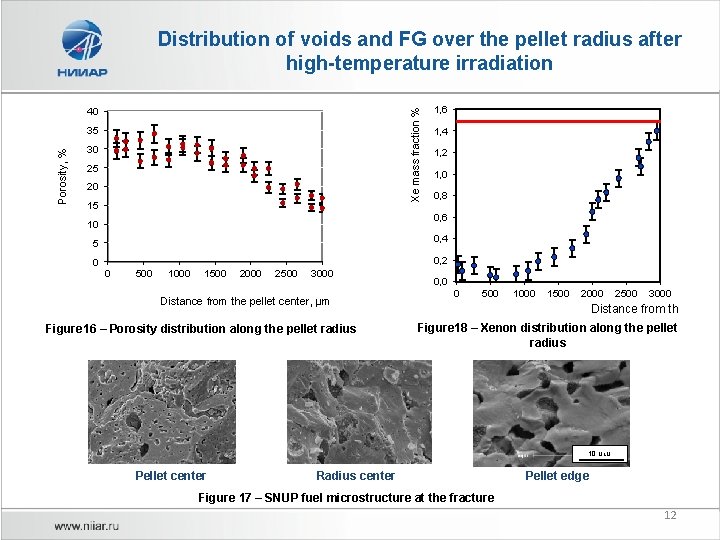
Distribution of voids and FG over the pellet radius after high-temperature irradiation Xe mass fraction % 40 Porosity, % 35 30 25 20 15 1, 6 1, 4 1, 2 1, 0 0, 8 0, 6 10 5 0, 4 0 0, 2 0 500 1000 1500 2000 2500 3000 Distance from the pellet center, µm Figure 16 – Porosity distribution along the pellet radius 0, 0 0 500 1000 1500 2000 2500 3000 Distance from the center Figure 18 – Xenon distribution along the pellet radius 10 мкм Pellet center Radius center Pellet edge Figure 17 – SNUP fuel microstructure at the fracture 12
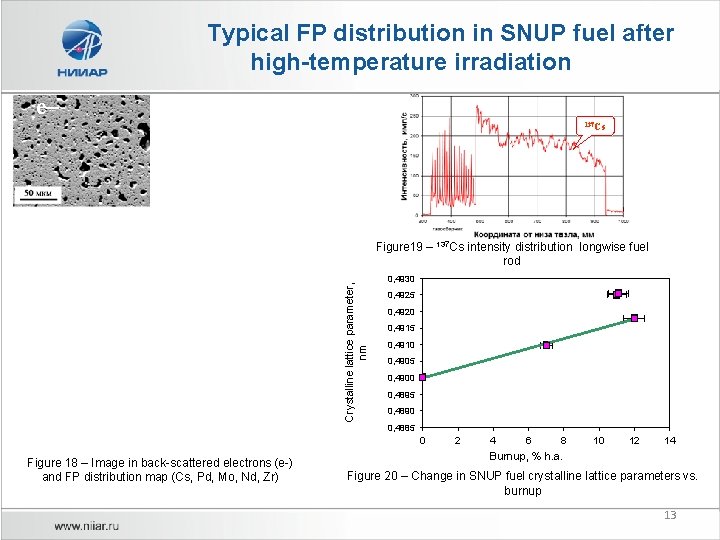
Typical FP distribution in SNUP fuel after high-temperature irradiation e– Pd Cs e– Mo Figure 19 – 137 Cs intensity distribution longwise fuel rod Zr Crystalline lattice parameter, nm Zr Nd 137 Cs 0, 4930 0, 4925 0, 4920 0, 4915 0, 4910 0, 4905 0, 4900 0, 4895 0, 4890 0, 4885 0 Figure 18 – Image in back-scattered electrons (е-) and FP distribution map (Cs, Pd, Mo, Nd, Zr) 2 4 6 8 Burnup, % h. a. 10 12 14 Figure 20 – Change in SNUP fuel crystalline lattice parameters vs. burnup 13
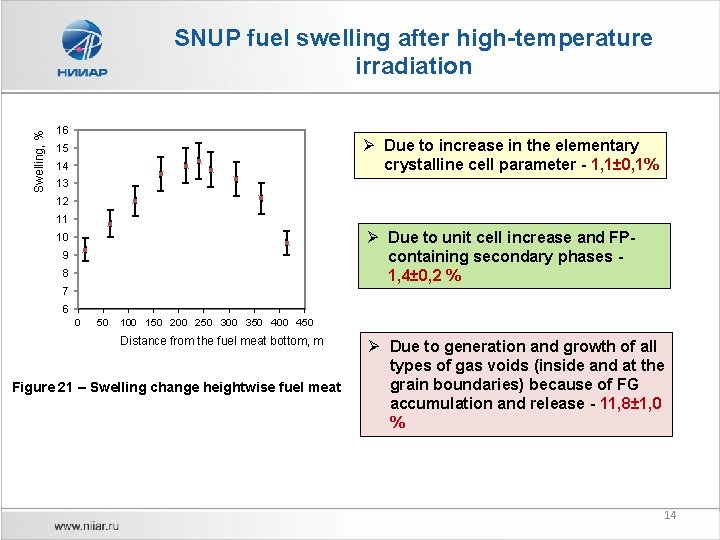
Swelling, % SNUP fuel swelling after high-temperature irradiation 16 Ø Due to increase in the elementary crystalline cell parameter - 1, 1± 0, 1% 15 14 13 12 11 Ø Due to unit cell increase and FPcontaining secondary phases 1, 4± 0, 2 % 10 9 8 7 6 0 50 100 150 200 250 300 350 400 450 Distance from the fuel meat bottom, mm Figure 21 – Swelling change heightwise fuel meat Ø Due to generation and growth of all types of gas voids (inside and at the grain boundaries) because of FG accumulation and release - 11, 8± 1, 0 % 14
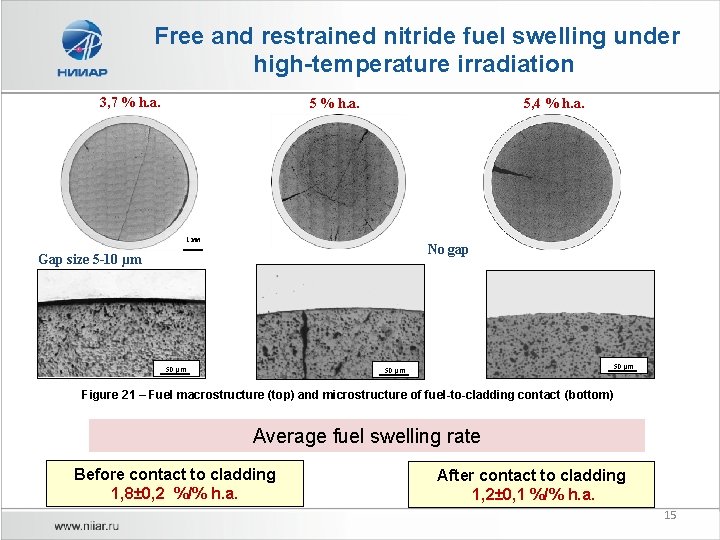
Free and restrained nitride fuel swelling under high-temperature irradiation 3, 7 % h. a. 5, 4 % h. a. 1 мм No gap Gap size 5 -10 µm 50 µm Figure 21 – Fuel macrostructure (top) and microstructure of fuel-to-cladding contact (bottom) Average fuel swelling rate Before contact to cladding 1, 8± 0, 2 %/% h. a. After contact to cladding 1, 2± 0, 1 %/% h. a. 15
Conclusions Ø Signs of restructuring of fuel composition (U 0, 82, Pu 0, 18) N, irradiated as part of liquid metal-bonded fuel rods in the temperature range 500 -880 ° C were found when the threshold burnup reached about 5. 5%h. a. , i. e. a sub-grain structure accompanied by an athermal FGR from the solid solution into voids. Ø The phenomenon of restructuring detected under low-temperature irradiation of nitride fuel leads to a change in the mechanism of its swelling: the value of swelling due to an increase in the volume of solid solution associated with the formation and accumulation of solid FP (with an initial burnup level of up to 4%h. a. ) is added by swelling due to the formation and growth of gas-filled voids that appeared during restructuring (at a burnup of 5. 5%h. a. ). The maximum swelling value was 8% with a local burnup of 5. 5%h. a. , of which 2. 1% is due to the formation of gas-filled voids and 5. 9% is due to the change in volume due to solid fission products located in the crystalline lattice of uranium-plutonium nitride and in the form of secondary phases. If the specified swelling rate is maintained, the fuel-to-cladding contact in the fuel rods of this design will occur at about 9%h. a. 16
Conclusions Ø When analyzing swelling of U 0, 4 Pu 0, 6 N fuel composition irradiated in a fuel rod with a helium sub-layer in the temperature range from 1000 to 1760°C, two stages were distinguished: a stage of free swelling before the fuel-to-cladding contact and a stage of swelling under mechanical retention from the cladding. It was shown that for this design of fuel rods and irradiation conditions, the fuel-to-cladding contact occurs at a local (in cross-section) burnup about 5%h. a. Ø The free swelling rate before the fuel-to-cladding contact was 1. 8% /% burnup. After contact, the swelling rate decreased to 1. 2% / burnup, which is associated with a decrease in the operating temperature of the fuel and the effect of compressive stresses from the cladding. Ø Swelling of uranium-plutonium nitride fuel irradiated in fuel rods with a helium sublayer occurred due to the accumulation of solid fission products that are in a state of solid solution in the SNUP fuel crystalline lattice or as independent phases, as well as due to the formation and growth of all gas voids due to the FG accumulation and release. The maximum swelling over the entire period of irradiation to burnup 12. 1% h. a. 17
СПАСИБО ЗА ВНИМАНИЕ! Thank you for attention!