
Species Interactions Lion Tapeworm Zebra Oak Gypsy moth
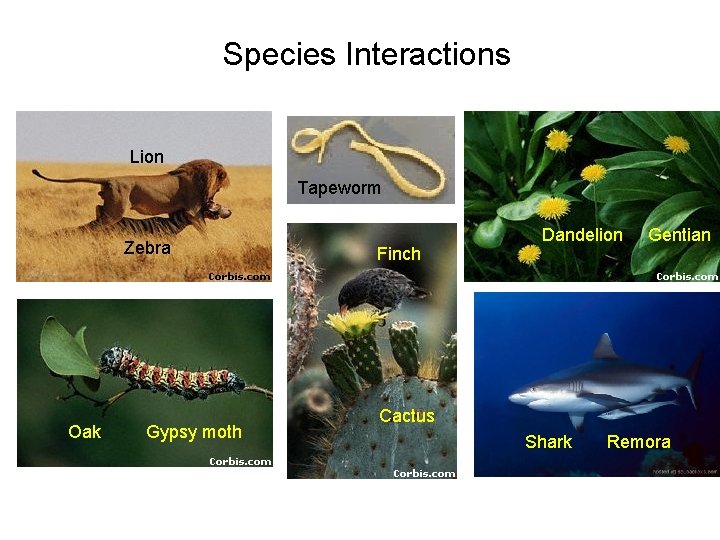
Species Interactions Lion Tapeworm Zebra Oak Gypsy moth Finch Dandelion Gentian Cactus Shark Remora
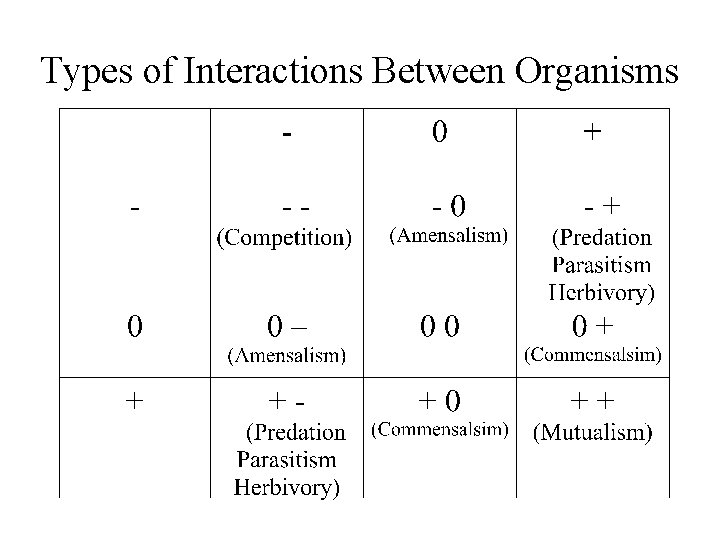
Types of Interactions Between Organisms
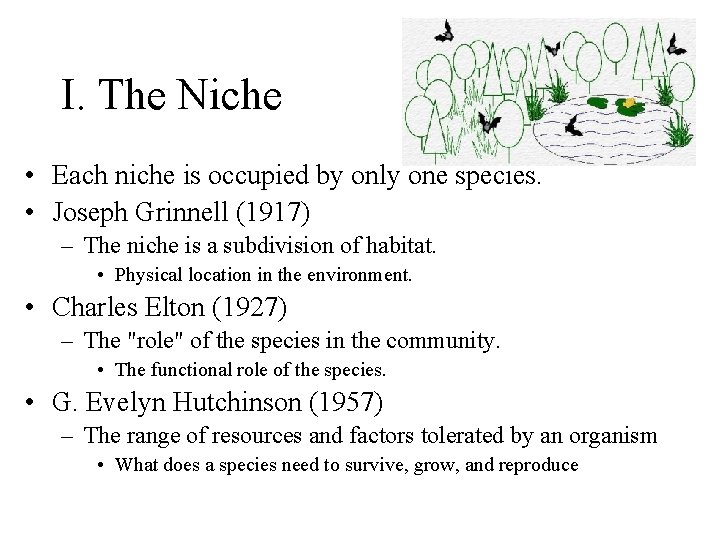
I. The Niche • Each niche is occupied by only one species. • Joseph Grinnell (1917) – The niche is a subdivision of habitat. • Physical location in the environment. • Charles Elton (1927) – The "role" of the species in the community. • The functional role of the species. • G. Evelyn Hutchinson (1957) – The range of resources and factors tolerated by an organism • What does a species need to survive, grow, and reproduce
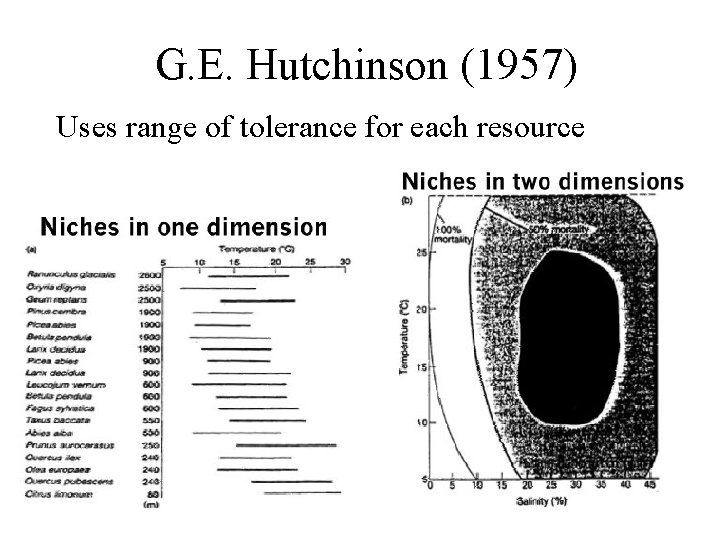
G. E. Hutchinson (1957) Uses range of tolerance for each resource
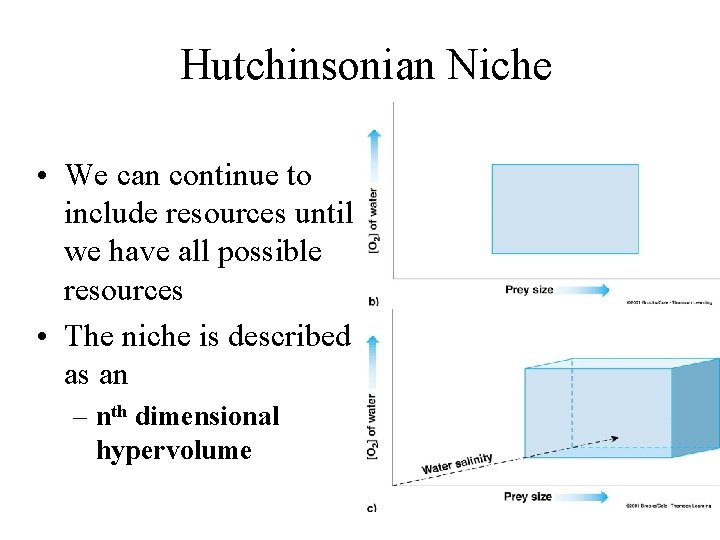
Hutchinsonian Niche • We can continue to include resources until we have all possible resources • The niche is described as an – nth dimensional hypervolume
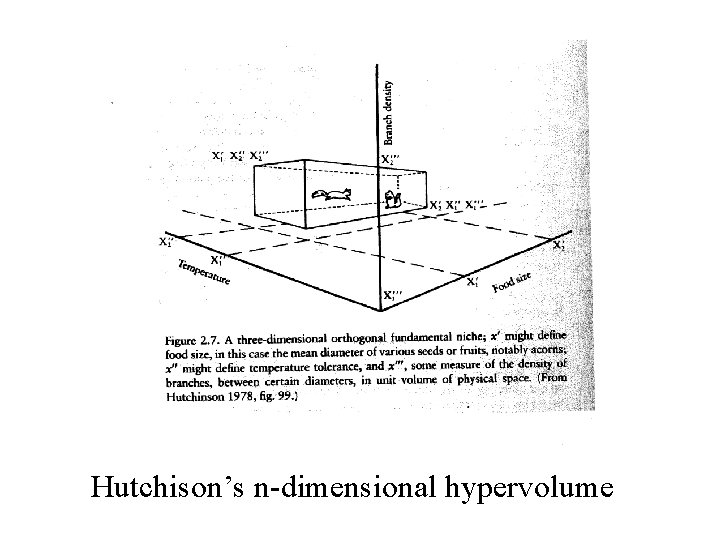
Hutchison’s n-dimensional hypervolume
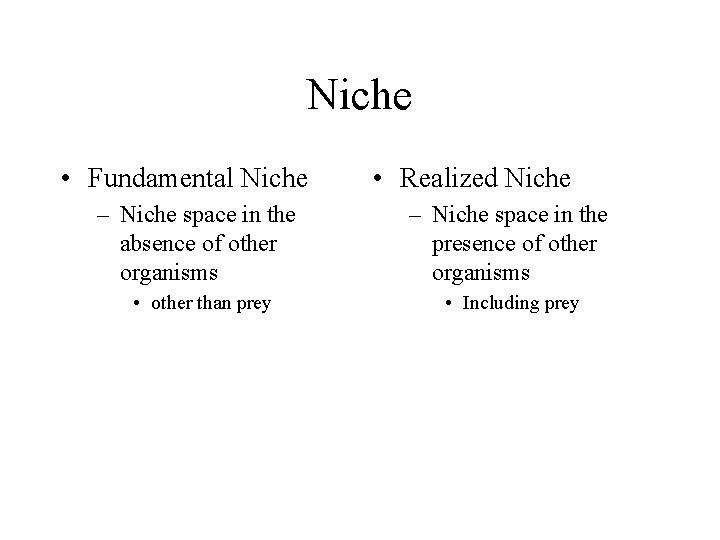
Niche • Fundamental Niche • Realized Niche – Niche space in the absence of other organisms – Niche space in the presence of other organisms • other than prey • Including prey
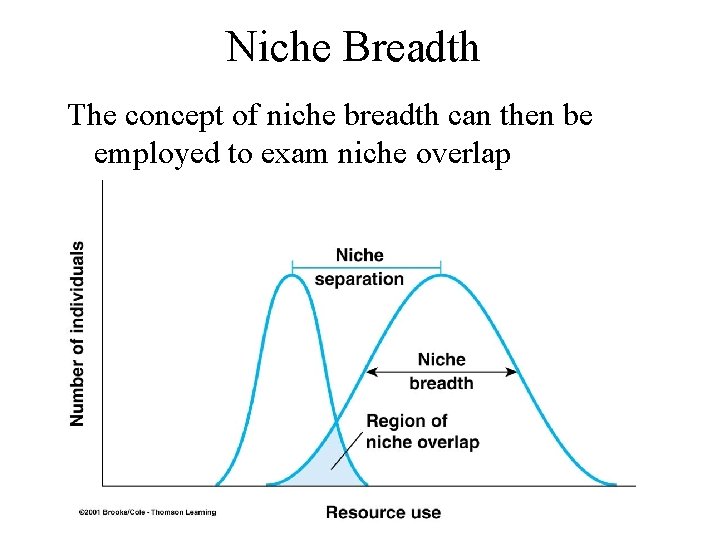
Niche Breadth The concept of niche breadth can then be employed to exam niche overlap
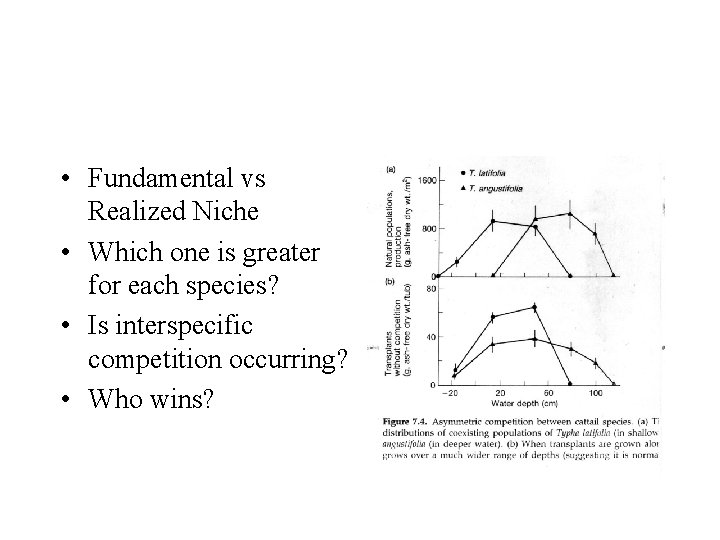
• Fundamental vs Realized Niche • Which one is greater for each species? • Is interspecific competition occurring? • Who wins?
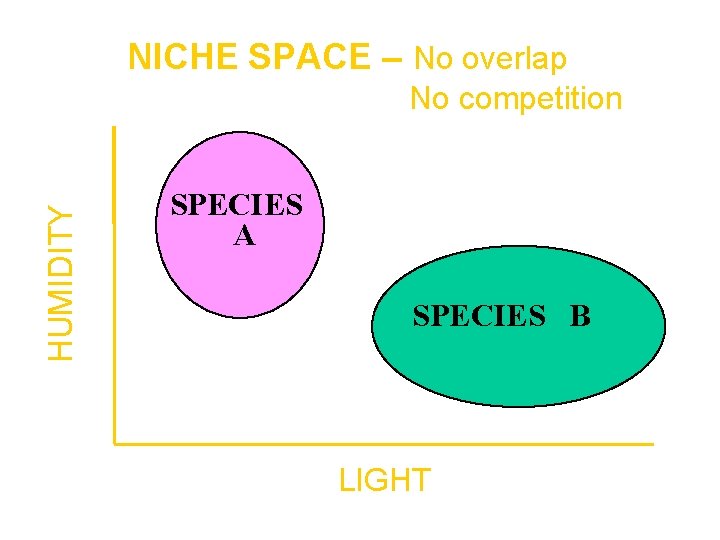
NICHE SPACE – No overlap HUMIDITY No competition SPECIES A SPECIES B LIGHT
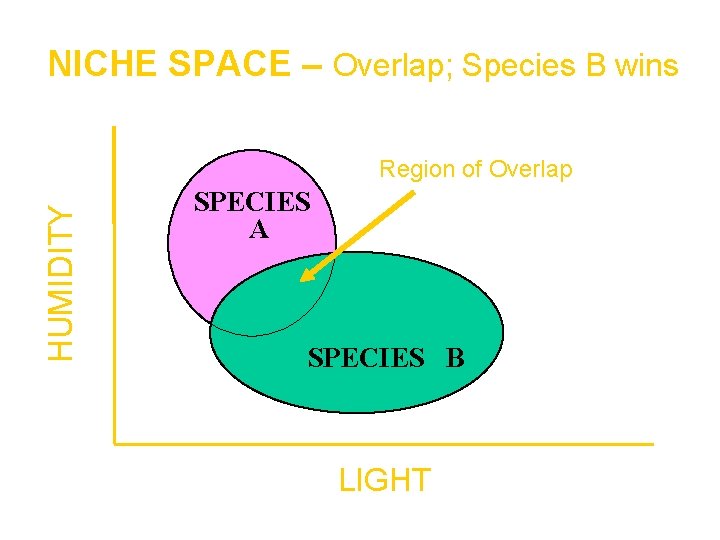
NICHE SPACE – Overlap; Species B wins HUMIDITY Region of Overlap SPECIES A SPECIES B LIGHT
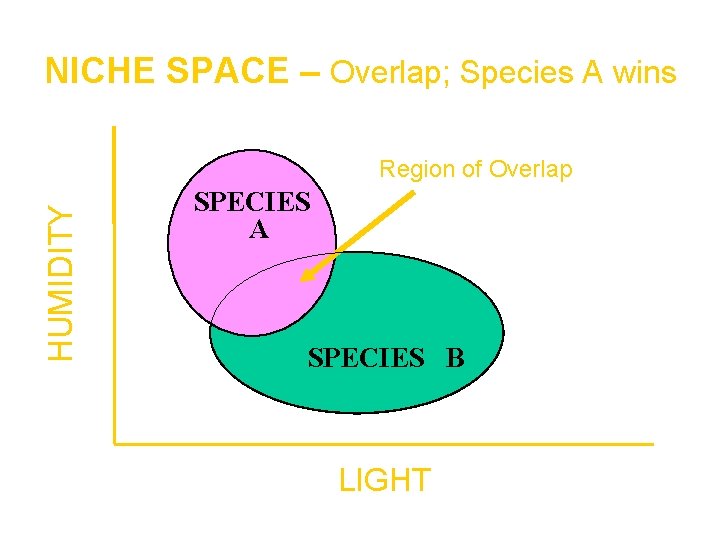
NICHE SPACE – Overlap; Species A wins HUMIDITY Region of Overlap SPECIES A SPECIES B LIGHT
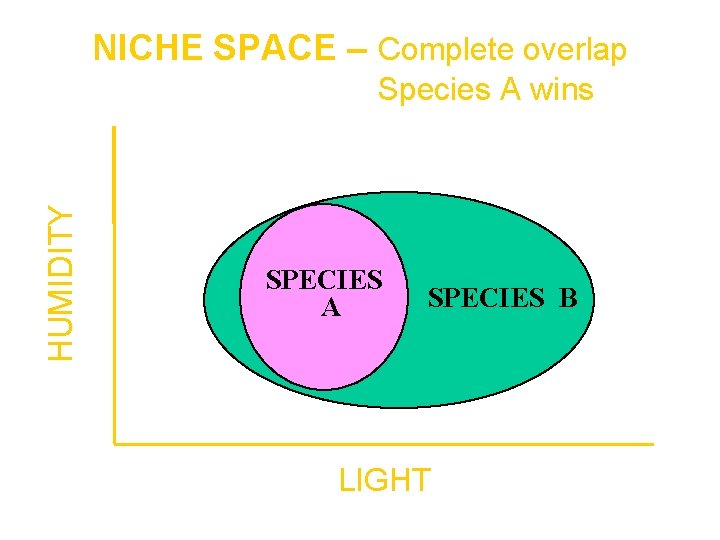
NICHE SPACE – Complete overlap HUMIDITY Species A wins SPECIES A SPECIES B LIGHT
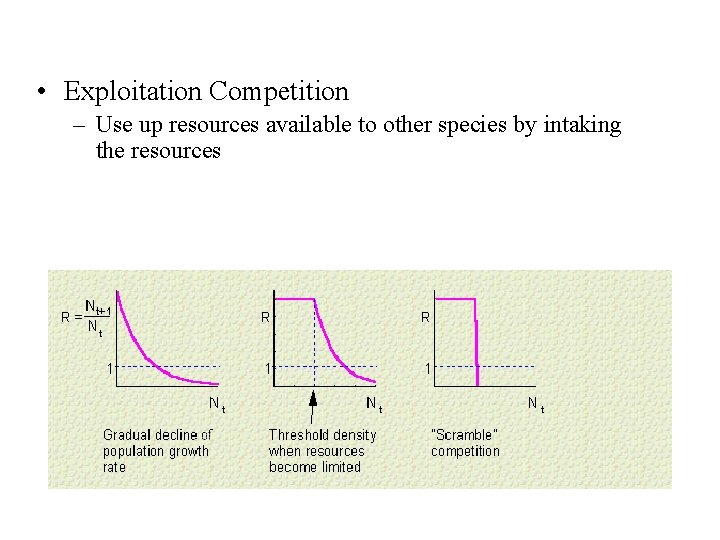
• Exploitation Competition – Use up resources available to other species by intaking the resources
Types of Competition • Interference Competition (contest) – Prevent other organisms from getting resources by interfering with consumption • Allelopathy • Antibiotics • Diffuse Competition – Competition can occur for a variety of resources from multiple other species
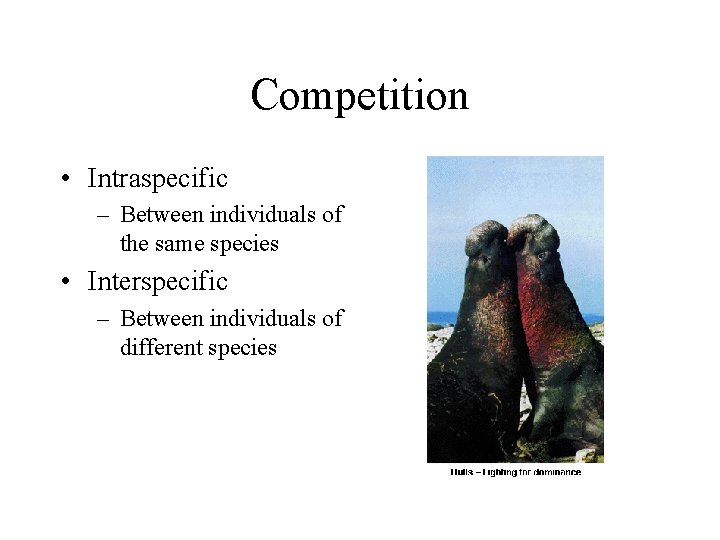
Competition • Intraspecific – Between individuals of the same species • Interspecific – Between individuals of different species
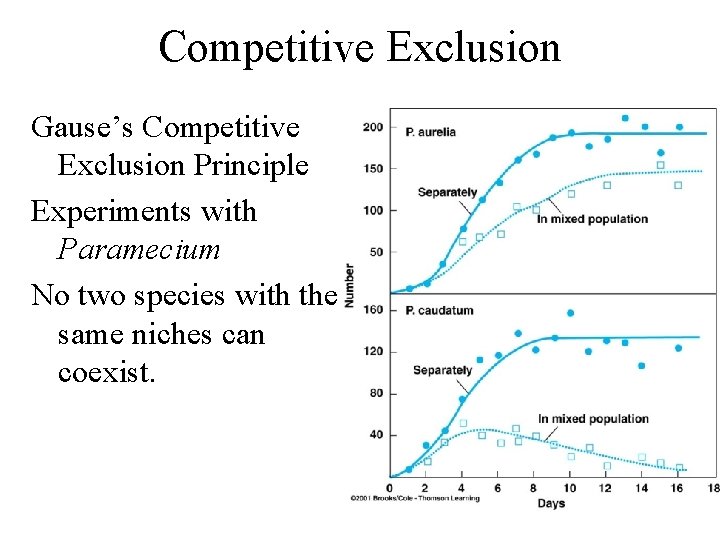
Competitive Exclusion Gause’s Competitive Exclusion Principle Experiments with Paramecium No two species with the same niches can coexist.
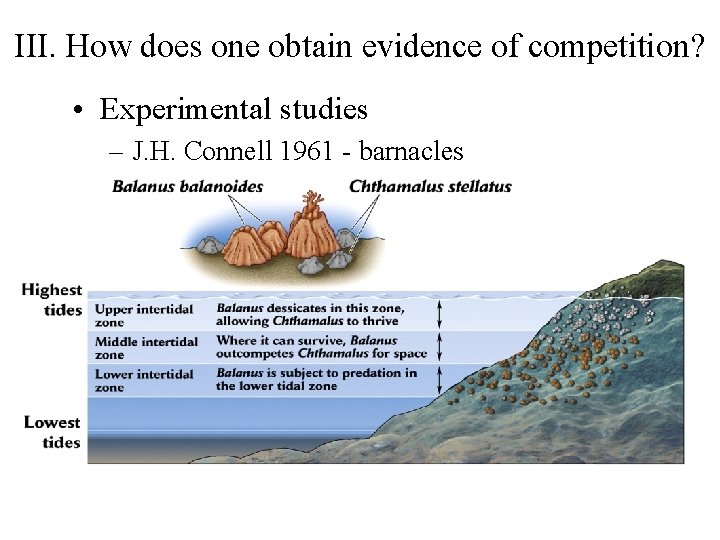
III. How does one obtain evidence of competition? • Experimental studies – J. H. Connell 1961 - barnacles
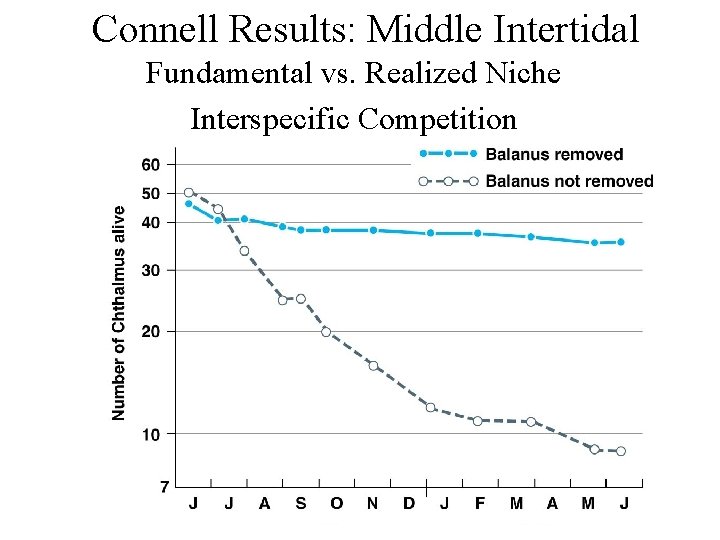
Connell Results: Middle Intertidal Fundamental vs. Realized Niche Interspecific Competition
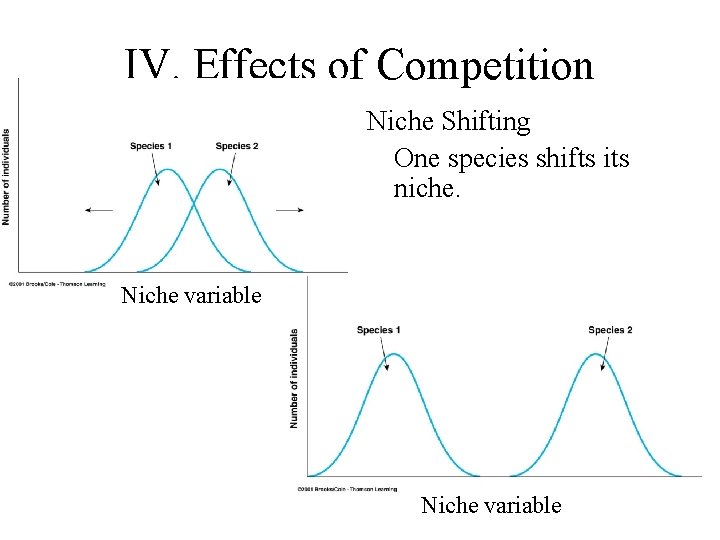
IV. Effects of Competition Niche Shifting One species shifts its niche. Niche variable
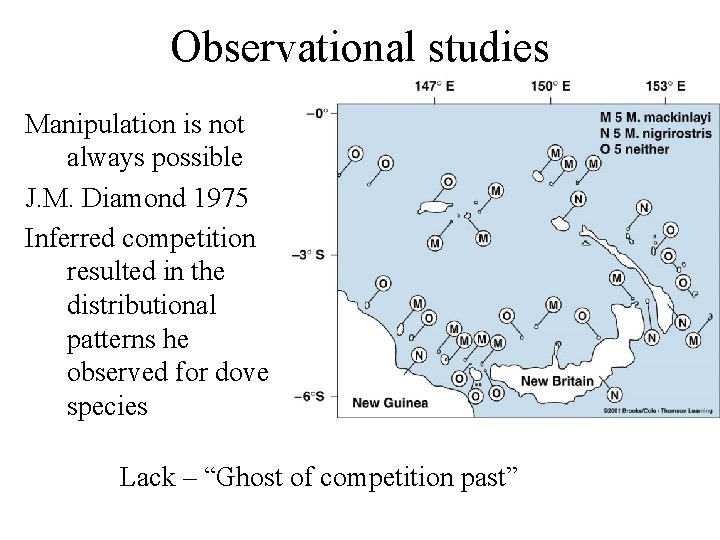
Observational studies Manipulation is not always possible J. M. Diamond 1975 Inferred competition resulted in the distributional patterns he observed for dove species Lack – “Ghost of competition past”
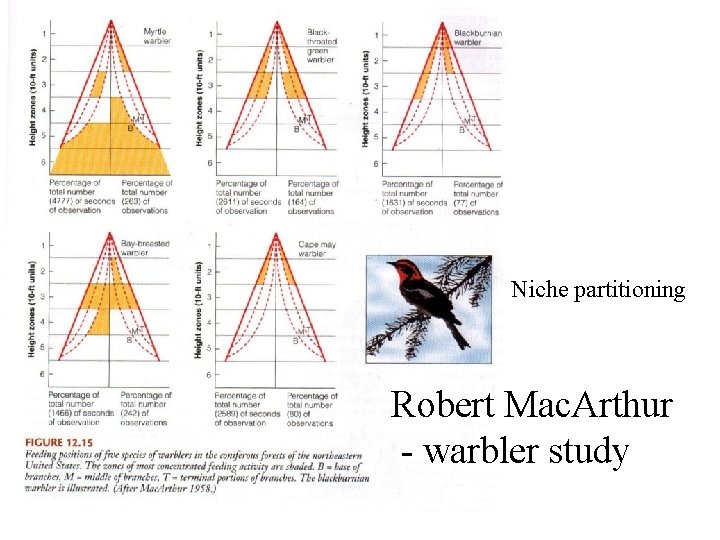
Niche partitioning Robert Mac. Arthur - warbler study
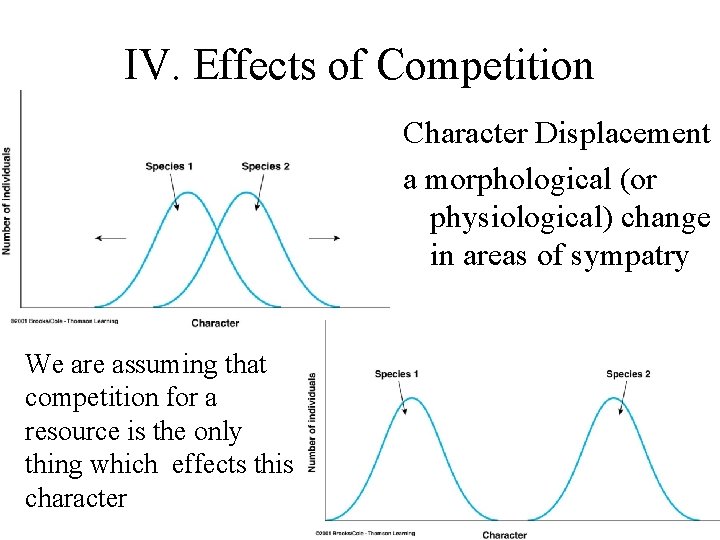
IV. Effects of Competition Character Displacement a morphological (or physiological) change in areas of sympatry We are assuming that competition for a resource is the only thing which effects this character
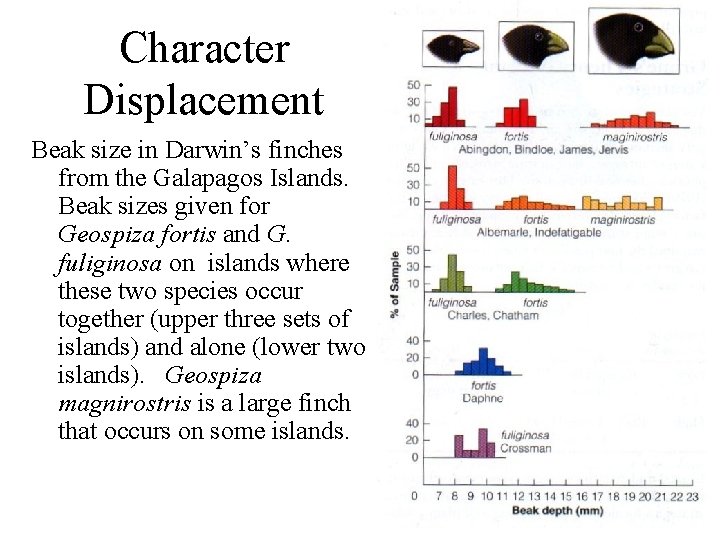
Character Displacement Beak size in Darwin’s finches from the Galapagos Islands. Beak sizes given for Geospiza fortis and G. fuliginosa on islands where these two species occur together (upper three sets of islands) and alone (lower two islands). Geospiza magnirostris is a large finch that occurs on some islands.
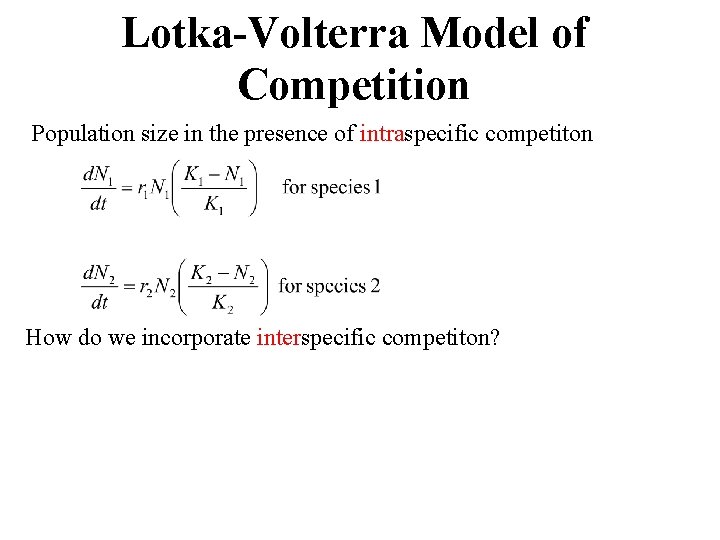
Lotka-Volterra Model of Competition Population size in the presence of intraspecific competiton How do we incorporate interspecific competiton?
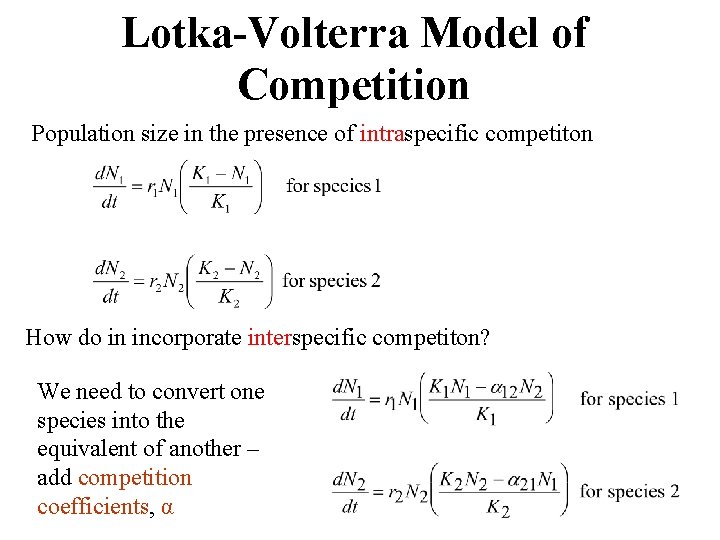
Lotka-Volterra Model of Competition Population size in the presence of intraspecific competiton How do in incorporate interspecific competiton? We need to convert one species into the equivalent of another – add competition coefficients, α
What would be the outcome of competition based on the Model? • Does one species have to win?
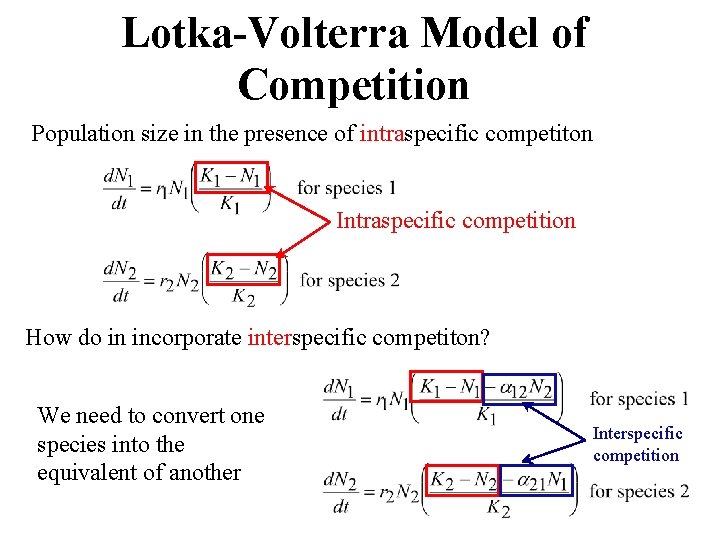
Lotka-Volterra Model of Competition Population size in the presence of intraspecific competiton Intraspecific competition How do in incorporate interspecific competiton? We need to convert one species into the equivalent of another Interspecific competition
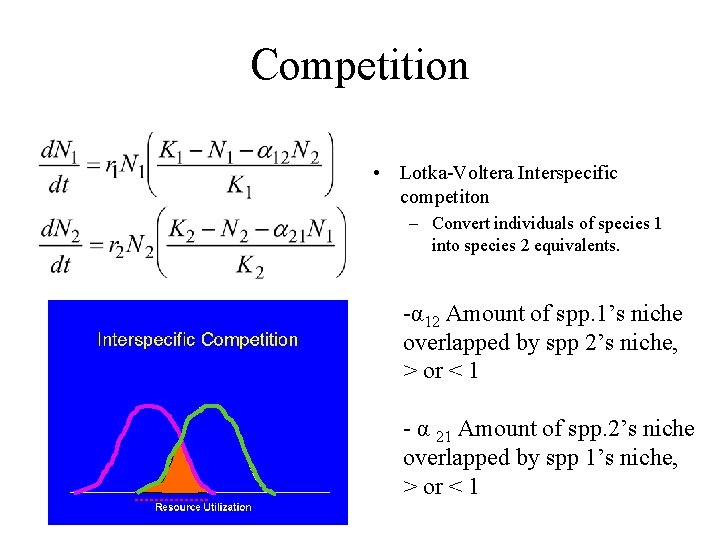
Competition • Lotka-Voltera Interspecific competiton – Convert individuals of species 1 into species 2 equivalents. -α 12 Amount of spp. 1’s niche overlapped by spp 2’s niche, > or < 1 - α 21 Amount of spp. 2’s niche overlapped by spp 1’s niche, > or < 1
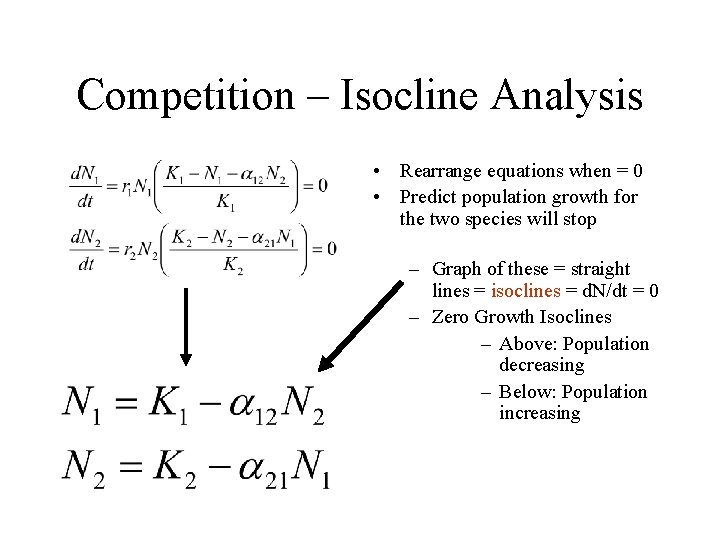
Competition – Isocline Analysis • Rearrange equations when = 0 • Predict population growth for the two species will stop – Graph of these = straight lines = isoclines = d. N/dt = 0 – Zero Growth Isoclines – Above: Population decreasing – Below: Population increasing
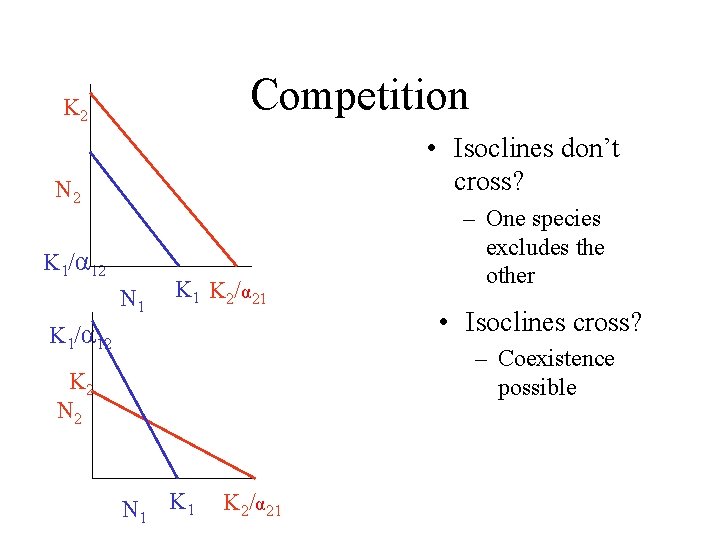
Competition K 2 • Isoclines don’t cross? N 2 K 1/α 12 N 1 K 2/α 21 K 1/α 12 – One species excludes the other • Isoclines cross? – Coexistence possible K 2 N 1 K 2/α 21
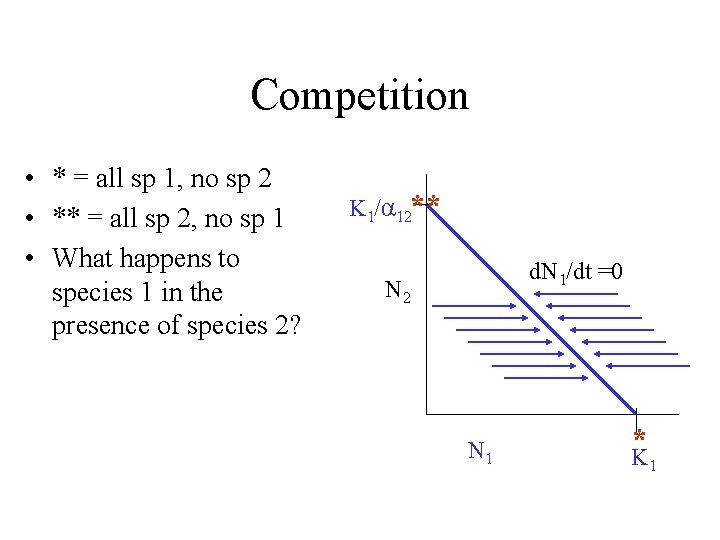
Competition • * = all sp 1, no sp 2 • ** = all sp 2, no sp 1 • What happens to species 1 in the presence of species 2? K 1/α 12** d. N 1/dt =0 N 2 N 1 * K 1
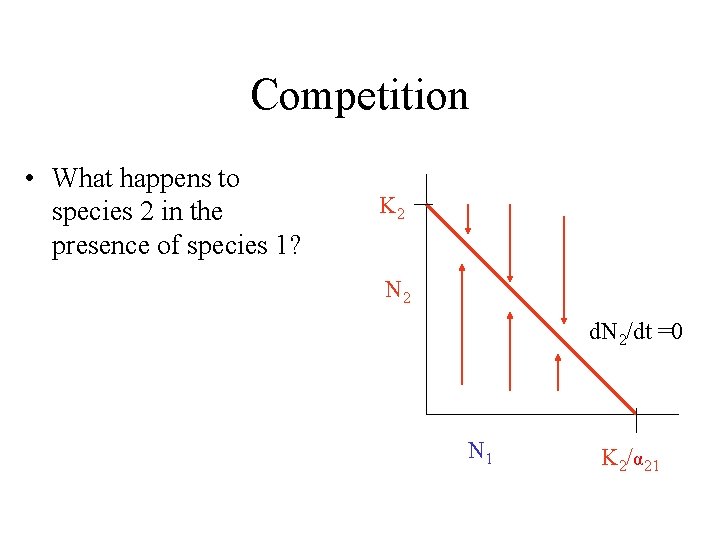
Competition • What happens to species 2 in the presence of species 1? K 2 N 2 d. N 2/dt =0 N 1 K 2/α 21
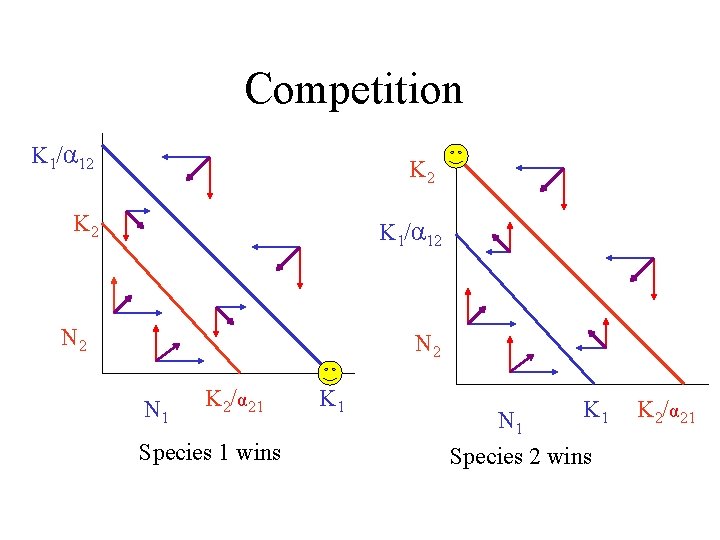
Competition K 1/α 12 K 2 K 1/α 12 N 2 N 1 K 2/α 21 Species 1 wins K 1 N 1 Species 2 wins K 2/α 21
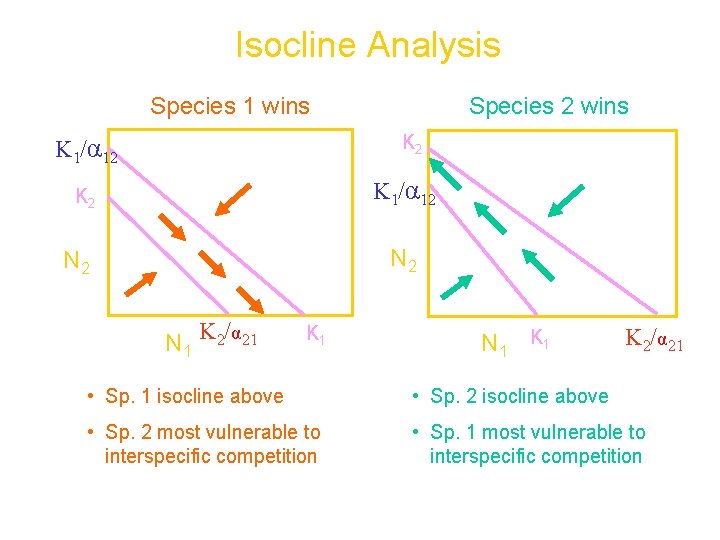
Isocline Analysis Species 1 wins Species 2 wins K 2 K 1/α 12 K 2 N 2 N 1 K 2/α 21 K 1 N 1 K 2/α 21 • Sp. 1 isocline above • Sp. 2 most vulnerable to interspecific competition • Sp. 1 most vulnerable to interspecific competition
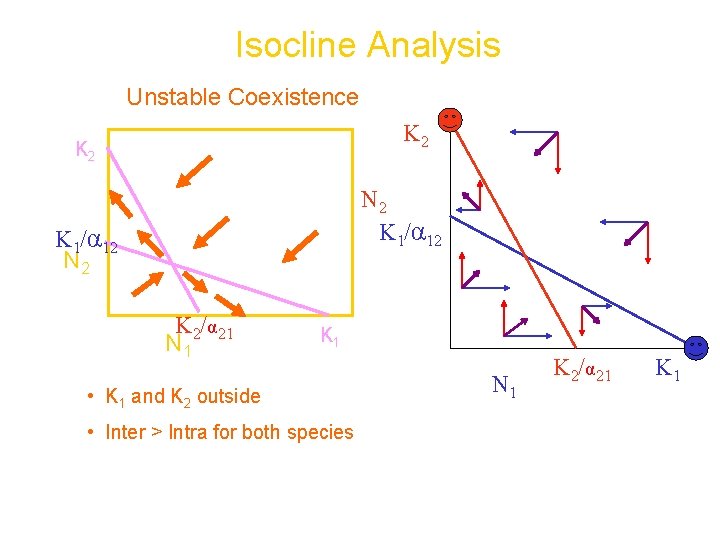
Isocline Analysis Unstable Coexistence K 2 N 2 K 1/α 12 N 2 K 2/α 21 N 1 K 1 • K 1 and K 2 outside • Inter > Intra for both species N 1 K 2/α 21 K 1
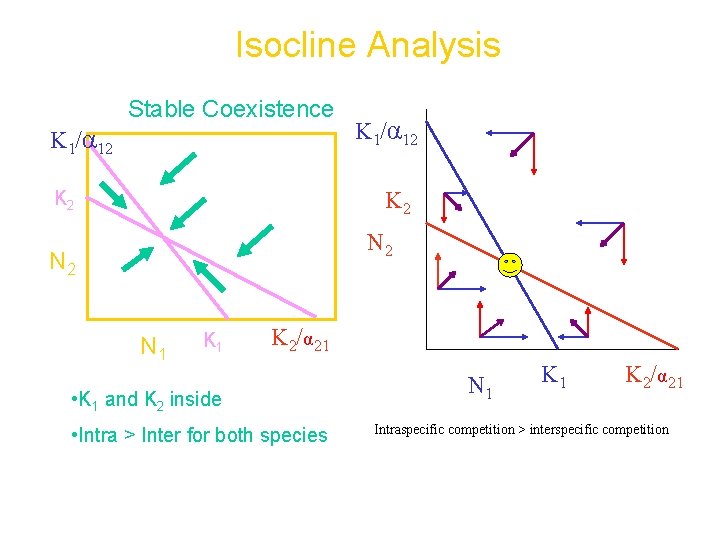
Isocline Analysis Stable Coexistence K 1/α 12 K 2 N 2 N 1 K 2/α 21 • K 1 and K 2 inside • Intra > Inter for both species N 1 K 2/α 21 Intraspecific competition > interspecific competition
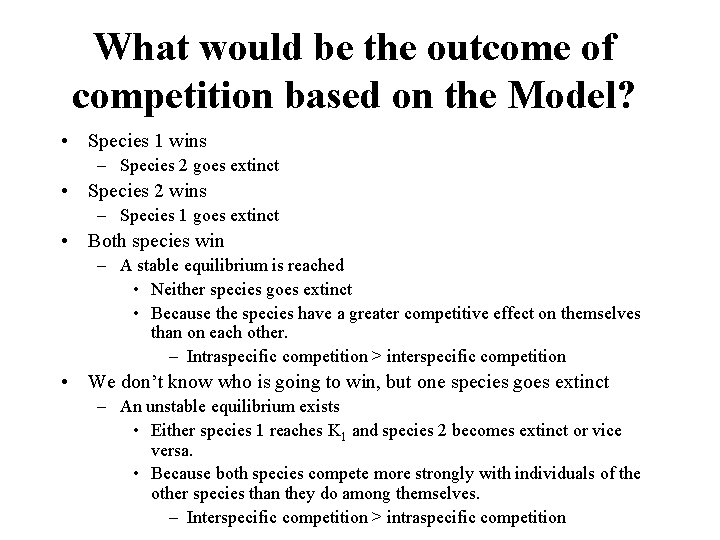
What would be the outcome of competition based on the Model? • Species 1 wins – Species 2 goes extinct • Species 2 wins – Species 1 goes extinct • Both species win – A stable equilibrium is reached • Neither species goes extinct • Because the species have a greater competitive effect on themselves than on each other. – Intraspecific competition > interspecific competition • We don’t know who is going to win, but one species goes extinct – An unstable equilibrium exists • Either species 1 reaches K 1 and species 2 becomes extinct or vice versa. • Because both species compete more strongly with individuals of the other species than they do among themselves. – Interspecific competition > intraspecific competition
- Slides: 38