
Species definitions Species definitions Phenetic species concept A

- Slides: 28
Species definitions
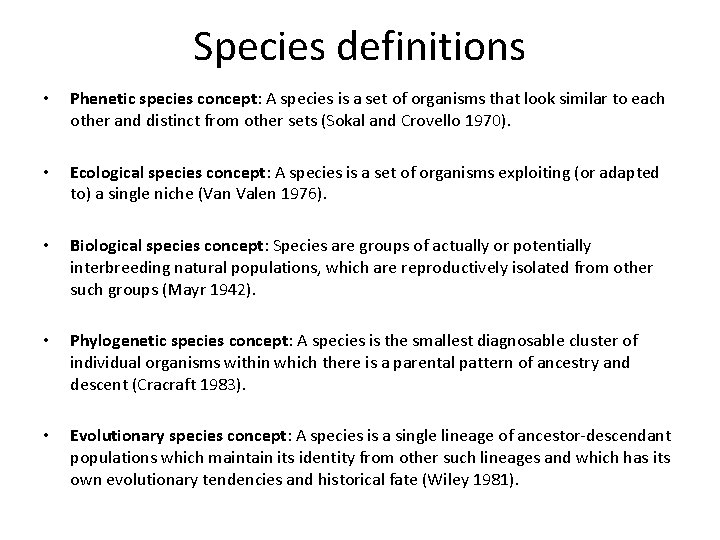
Species definitions • Phenetic species concept: A species is a set of organisms that look similar to each other and distinct from other sets (Sokal and Crovello 1970).
Species definitions • Phenetic species concept: A species is a set of organisms that look similar to each other and distinct from other sets (Sokal and Crovello 1970). • Ecological species concept: A species is a set of organisms exploiting (or adapted to) a single niche (Van Valen 1976).
Species definitions • Phenetic species concept: A species is a set of organisms that look similar to each other and distinct from other sets (Sokal and Crovello 1970). • Ecological species concept: A species is a set of organisms exploiting (or adapted to) a single niche (Van Valen 1976). • Biological species concept: Species are groups of actually or potentially interbreeding natural populations, which are reproductively isolated from other such groups (Mayr 1942).
Species definitions • Phenetic species concept: A species is a set of organisms that look similar to each other and distinct from other sets (Sokal and Crovello 1970). • Ecological species concept: A species is a set of organisms exploiting (or adapted to) a single niche (Van Valen 1976). • Biological species concept: Species are groups of actually or potentially interbreeding natural populations, which are reproductively isolated from other such groups (Mayr 1942). • Phylogenetic species concept: A species is the smallest diagnosable cluster of individual organisms within which there is a parental pattern of ancestry and descent (Cracraft 1983).
Species definitions • Phenetic species concept: A species is a set of organisms that look similar to each other and distinct from other sets (Sokal and Crovello 1970). • Ecological species concept: A species is a set of organisms exploiting (or adapted to) a single niche (Van Valen 1976). • Biological species concept: Species are groups of actually or potentially interbreeding natural populations, which are reproductively isolated from other such groups (Mayr 1942). • Phylogenetic species concept: A species is the smallest diagnosable cluster of individual organisms within which there is a parental pattern of ancestry and descent (Cracraft 1983). • Evolutionary species concept: A species is a single lineage of ancestor-descendant populations which maintain its identity from other such lineages and which has its own evolutionary tendencies and historical fate (Wiley 1981).
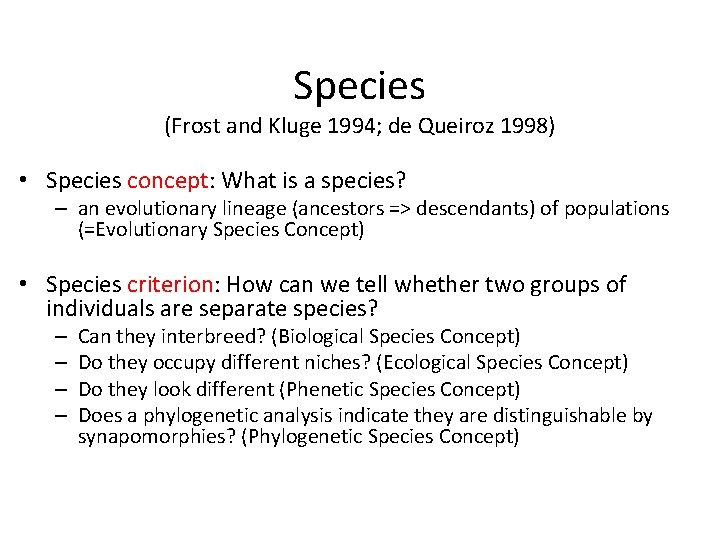
Species (Frost and Kluge 1994; de. Queiroz 1998) • Species concept: What is a species? • Species criterion: How can we tell whether two groups of individuals are separate species?
Species (Frost and Kluge 1994; de Queiroz 1998) • Species concept: What is a species? – an evolutionary lineage (ancestors => descendants) of populations (=Evolutionary Species Concept) • Species criterion: How can we tell whether two groups of individuals are separate species?
Species (Frost and Kluge 1994; de Queiroz 1998) • Species concept: What is a species? – an evolutionary lineage (ancestors => descendants) of populations (=Evolutionary Species Concept) • Species criterion: How can we tell whether two groups of individuals are separate species? – – Can they interbreed? (Biological Species Concept) Do they occupy different niches? (Ecological Species Concept) Do they look different (Phenetic Species Concept) Does a phylogenetic analysis indicate they are distinguishable by synapomorphies? (Phylogenetic Species Concept)
Species concepts: History • Pre-1942 – Essentialism – Key reading: Aristotle
Species concepts: History • Pre-1942 – Essentialism – Key reading: Aristotle • 1940 s-1990 s – Interbreeding; "population thinking" – Lots of philosophical work (Hull, Ghiselin, Hey) – Key reading: Mayr 1942. Systematics and the origin of species from the viewpoint of a zoologist.
Species concepts: History • Pre-1942 – Essentialism – Key reading: Aristotle • 1940 s-1990 s – Interbreeding; "population thinking" – Lots of philosophical work (Hull, Ghiselin, Hey) – Key reading: Mayr 1942. Systematics and the origin of species from the viewpoint of a zoologist. • 1990 s-now – Species = evolutionary lineages (Simpson, Wiley) – Operational/conceptual distinction – Key reading: Wiley 1981, Frost and Kluge 1994, de Queiroz 1998
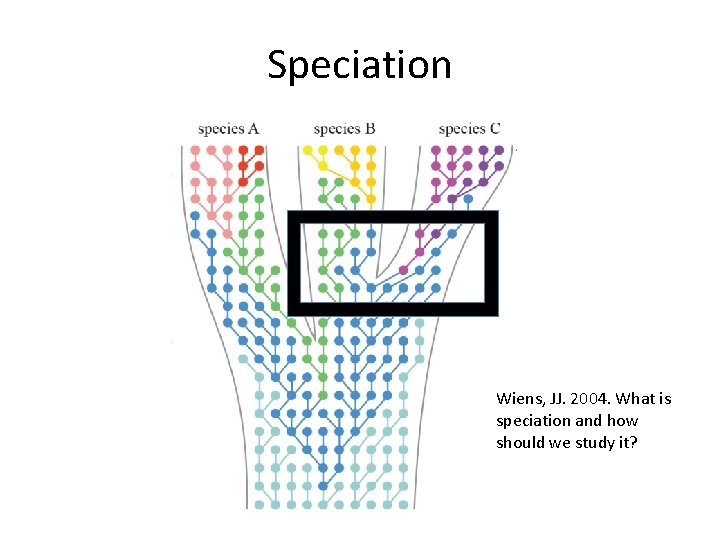
Speciation Wiens, JJ. 2004. What is speciation and how should we study it?
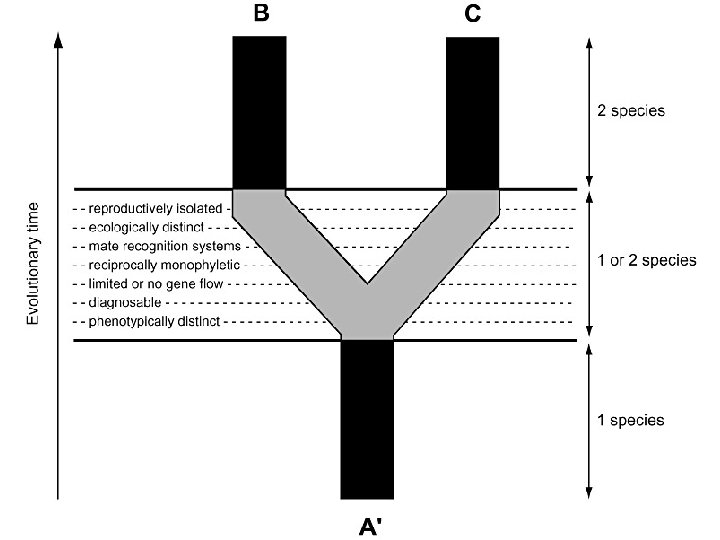
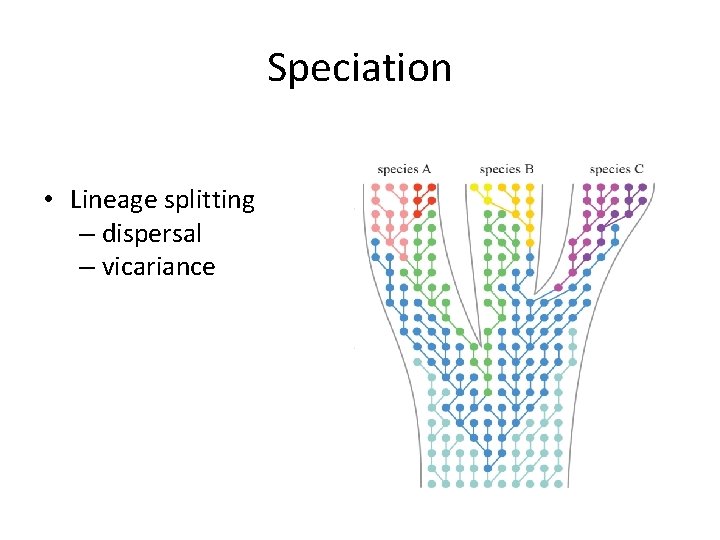
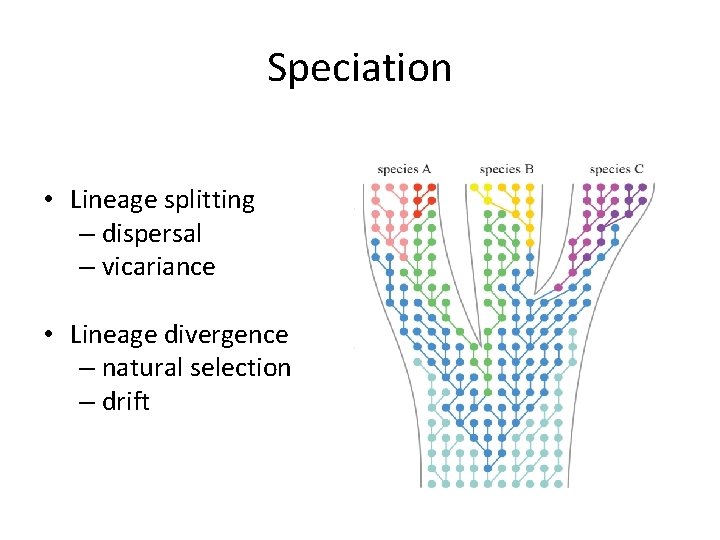
Speciation • Lineage splitting – dispersal – vicariance
Speciation • Lineage splitting – dispersal – vicariance • Lineage divergence – natural selection – drift
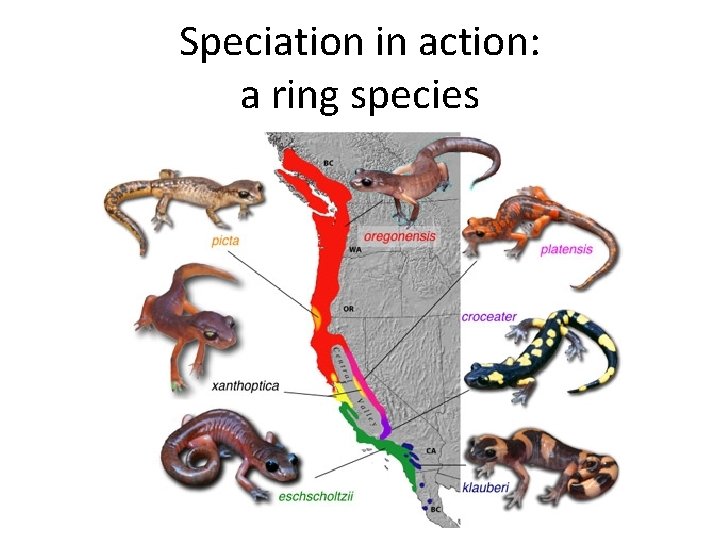
Speciation in action: a ring species
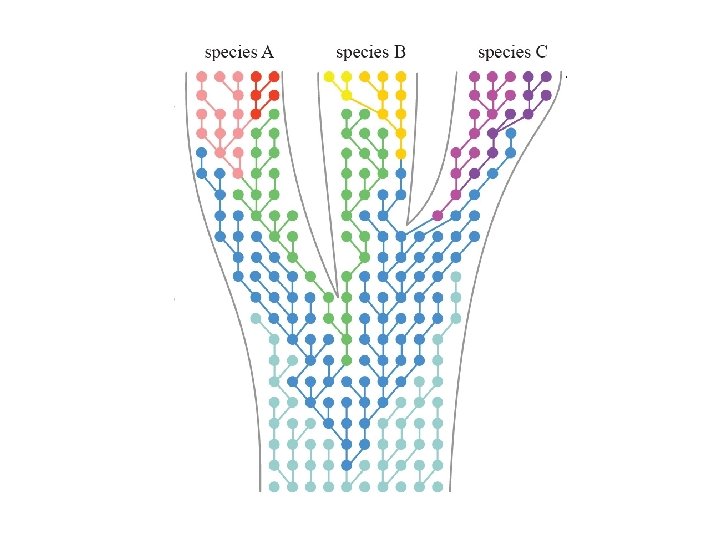
Summary/important aspects of species and speciation • Species are independent evolutionary lineages of populations (EVSC); most species "concepts" (BSC, PHYSC, ECSC, PHENSC) capture operational elements of this concept
Summary/important aspects of species and speciation • Species are independent evolutionary lineages of populations (EVSC); most species "concepts" (BSC, PHYSC, ECSC, PHENSC) capture operational elements of this concept • Species are "natural" entities, not human constructs – Subspecies are operational pattern classes
Summary/important aspects of species and speciation • Species are independent evolutionary lineages of populations (EVSC); most species "concepts" (BSC, PHYSC, ECSC, PHENSC) capture operational elements of this concept • Species are "natural" entities, not human constructs – Subspecies are operational pattern classes • Reproduction is (very) important, but it is just one aspect of species and speciation
Summary/important aspects of species and speciation • Species are independent evolutionary lineages of populations (EVSC); most species "concepts" (BSC, PHYSC, ECSC, PHENSC) capture operational elements of this concept • Species are "natural" entities, not human constructs – Subspecies are operational pattern classes • Reproduction is (very) important, but it is just one aspect of species and speciation • Speciation involves two steps: lineage splitting and lineage divergence
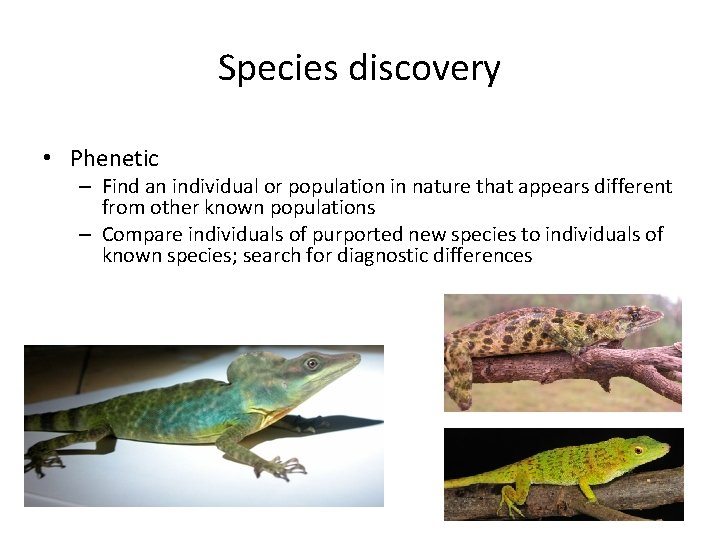
Species discovery • Phenetic – Find an individual or population in nature that appears different from other known populations – Compare individuals of purported new species to individuals of known species; search for diagnostic differences
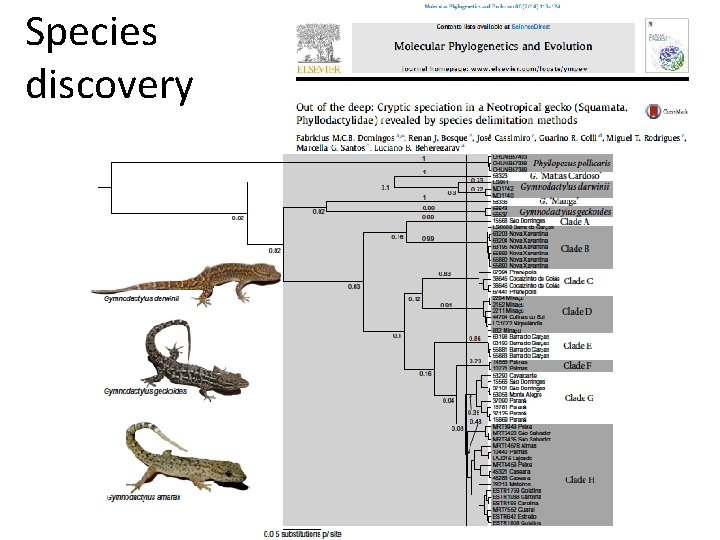
Species discovery • Phenetic – Find an individual or population in nature that appears different from other known populations – Compare individuals of purported new species to individuals of known species; search for diagnostic differences • Phylogenetic – Obtain DNA sequences for multiple individuals from throughout the range of a species – Perform phylogentic analysis – Recognize separate clades with some degree of genetic divergence as separate species
Species discovery
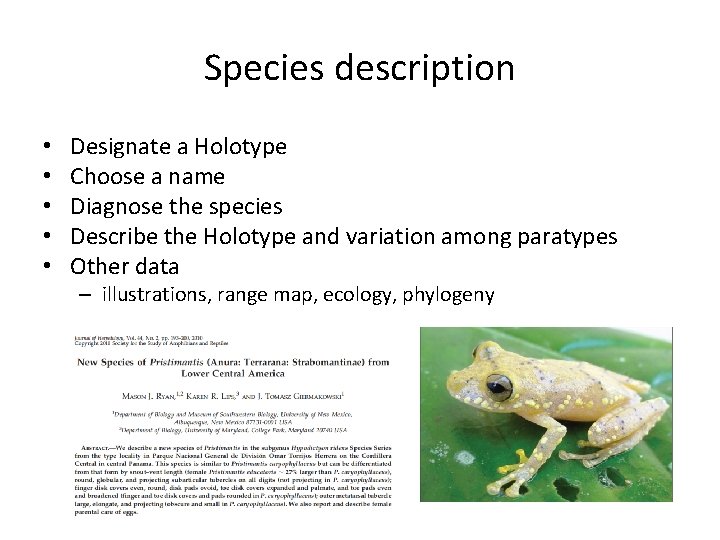
Species description • • • Designate a Holotype Choose a name Diagnose the species Describe the Holotype and variation among paratypes Other data – illustrations, range map, ecology, phylogeny