
SPECIATION OF SELENIUM AND ARSENIC IN AIRBORNE PARTICULATE
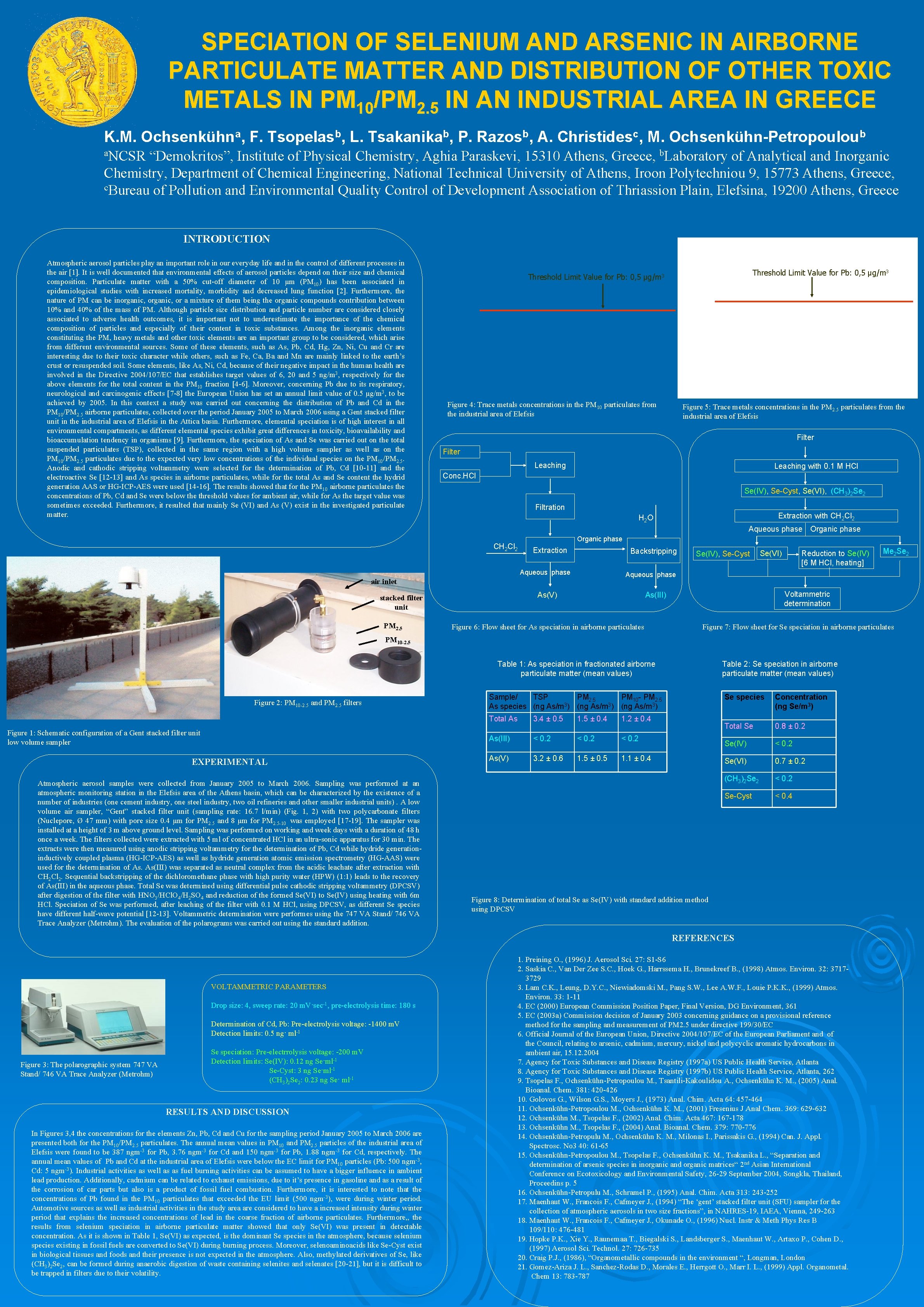
SPECIATION OF SELENIUM AND ARSENIC IN AIRBORNE PARTICULATE MATTER AND DISTRIBUTION OF OTHER TOXIC METALS IN PM 10/PM 2. 5 IN AN INDUSTRIAL AREA IN GREECE K. M. Ochsenkühna, F. Tsopelasb, L. Tsakanikab, P. Razosb, A. Christidesc, M. Ochsenkühn-Petropouloub a. NCSR “Demokritos”, Institute of Physical Chemistry, Aghia Paraskevi, 15310 Athens, Greece, b. Laboratory of Analytical and Inorganic Chemistry, Department of Chemical Engineering, National Technical University of Athens, Iroon Polytechniou 9, 15773 Athens, Greece, c. Bureau of Pollution and Environmental Quality Control of Development Association of Thriassion Plain, Elefsina, 19200 Athens, Greece INTRODUCTION Atmospheric aerosol particles play an important role in our everyday life and in the control of different processes in the air [1]. It is well documented that environmental effects of aerosol particles depend on their size and chemical composition. Particulate matter with a 50% cut-off diameter of 10 μm (PM 10) has been associated in epidemiological studies with increased mortality, morbidity and decreased lung function [2]. Furthermore, the nature of PM can be inorganic, or a mixture of them being the organic compounds contribution between 10% and 40% of the mass of PM. Although particle size distribution and particle number are considered closely associated to adverse health outcomes, it is important not to underestimate the importance of the chemical composition of particles and especially of their content in toxic substances. Among the inorganic elements constituting the PM, heavy metals and other toxic elements are an important group to be considered, which arise from different environmental sources. Some of these elements, such as As, Pb, Cd, Hg, Zn, Ni, Cu and Cr are interesting due to their toxic character while others, such as Fe, Ca, Ba and Mn are mainly linked to the earth’s crust or resuspended soil. Some elements, like As, Ni, Cd, because of their negative impact in the human health are involved in the Directive 2004/107/EC that establishes target values of 6, 20 and 5 ng/m 3, respectively for the above elements for the total content in the PM 10 fraction [4 -6]. Moreover, concerning Pb due to its respiratory, neurological and carcinogenic effects [7 -8] the European Union has set an annual limit value of 0. 5 μg/m 3, to be achieved by 2005. In this context a study was carried out concerning the distribution of Pb and Cd in the PM 10/PM 2. 5 airborne particulates, collected over the period January 2005 to March 2006 using a Gent stacked filter unit in the industrial area of Elefsis in the Attica basin. Furthermore, elemental speciation is of high interest in all environmental compartments, as different elemental species exhibit great differences in toxicity, bioavailability and bioaccumulation tendency in organisms [9]. Furthermore, the speciation of As and Se was carried out on the total suspended particulates (TSP), collected in the same region with a high volume sampler as well as on the PM 10/PM 2. 5 particulates due to the expected very low concentrations of the individual species on the PM 10/PM 2. 5. Anodic and cathodic stripping voltammetry were selected for the determination of Pb, Cd [10 -11] and the electroactive Se [12 -13] and As species in airborne particulates, while for the total As and Se content the hydrid generation AAS or HG-ICP-AES were used [14 -16]. The results showed that for the PM 10 airborne particulates the concentrations of Pb, Cd and Se were below the threshold values for ambient air, while for As the target value was sometimes exceeded. Furthermore, it resulted that mainly Se (VI) and As (V) exist in the investigated particulate matter. Threshold Limit Value for Pb: 0, 5 μg/m 3 Figure 4: Trace metals concentrations in the PM 10 particulates from the industrial area of Elefsis Figure 5: Trace metals concentrations in the PM 2. 5 particulates from the industrial area of Elefsis Filter Leaching with 0. 1 M HCl Conc. HCl Se(IV), Se-Cyst, Se(VI), (CH 3)2 Se 2 Filtration Extraction with CH 2 Cl 2 H 2 Ο Aqueous phase Organic phase CH 2 Cl 2 Organic phase Extraction Backstripping Aqueous phase PM 2. 5 Se(VI) Reduction to Se(IV) [6 M HCl, heating] As(V) Voltammetric determination As(ΙΙΙ) Figure 6: Flow sheet for As speciation in airborne particulates Figure 7: Flow sheet for Se speciation in airborne particulates PM 10 -2. 5 Table 1: As speciation in fractionated airborne particulate matter (mean values) Figure 2: PM 10 -2. 5 and PM 2. 5 filters Figure 1: Schematic configuration of a Gent stacked filter unit low volume sampler EXPERIMENTAL Atmospheric aerosol samples were collected from January 2005 to March 2006. Sampling was performed at an atmospheric monitoring station in the Elefsis area of the Athens basin, which can be characterized by the existence of a number of industries (one cement industry, one steel industry, two oil refineries and other smaller industrial units). A low volume air sampler, “Gent” stacked filter unit (sampling rate: 16. 7 l/min) (Fig. 1, 2) with two polycarbonate filters (Nuclepore, Ø 47 mm) with pore size 0. 4 μm for PM 2. 5 and 8 μm for PM 2. 5 -10 was employed [17 -19]. The sampler was installed at a height of 3 m above ground level. Sampling was performed on working and week days with a duration of 48 h once a week. The filters collected were extracted with 5 ml of concentrated HCl in an ultra-sonic apparatus for 30 min. The extracts were then measured using anodic stripping voltammetry for the determination of Pb, Cd while hydride generationinductively coupled plasma (HG-ICP-AES) as well as hydride generation atomic emission spectrometry (HG-AAS) were used for the determination of As. As(III) was separated as neutral complex from the acidic leachate after extraction with CH 2 Cl 2. Sequential backstripping of the dichloromethane phase with high purity water (HPW) (1: 1) leads to the recovery of As(III) in the aqueous phase. Total Se was determined using differential pulse cathodic stripping voltammetry (DPCSV) after digestion of the filter with HNO 3/HCl. O 4/H 2 SO 4 and reduction of the formed Se(VI) to Se(IV) using heating with 6 m HCl. Speciation of Se was performed, after leaching of the filter with 0. 1 M HCl, using DPCSV, as different Se species have different half-wave potential [12 -13]. Voltammetric determination were performes using the 747 VA Stand/ 746 VA Trace Analyzer (Metrohm). The evaluation of the polarograms was carried out using the standard addition. Table 2: Se speciation in airborne particulate matter (mean values) Sample/ TSP PM 2. 5 PM 10 - PM 2. 5 As species (ng As/m 3) Total As 3. 4 ± 0. 5 1. 5 ± 0. 4 1. 2 ± 0. 4 As(III) < 0. 2 As(V) 3. 2 ± 0. 6 1. 5 ± 0. 5 1. 1 ± 0. 4 Se species Concentration (ng Se/m 3) Total Se 0. 8 ± 0. 2 Se(IV) < 0. 2 Se(VI) 0. 7 ± 0. 2 (CH 3)2 Se 2 < 0. 2 Se-Cyst < 0. 4 Figure 8: Determination of total Se as Se(IV) with standard addition method using DPCSV REFERENCES VOLTAMMETRIC PARAMETERS Drop size: 4, sweep rate: 20 m. V·sec-1, pre-electrolysis time: 180 s Determination of Cd, Pb: Pre-electrolysis voltage: -1400 m. V Detection limits: 0. 5 ng· ml-1 Figure 3: The polarographic system 747 VA Stand/ 746 VA Trace Analyzer (Metrohm) Se speciation: Pre-electrrolysis voltage: -200 m. V Detection limits: Se(IV): 0. 12 ng Se·ml-1 Se-Cyst: 3 ng Se·ml-1 (CH 3)2 Se 2: 0. 23 ng Se· ml-1 RESULTS AND DISCUSSION In Figures 3, 4 the concentrations for the elements Zn, Pb, Cd and Cu for the sampling period January 2005 to March 2006 are presented both for the PM 10/PM 2. 5 particulates. The annual mean values in PM 10 and PM 2. 5 particles of the industrial area of Elefsis were found to be 387 ngm-3 for Pb, 3. 76 ngm-3 for Cd and 150 ngm-3 for Pb, 1. 88 ngm-3 for Cd, respectively. The annual mean values of Pb and Cd at the industrial area of Elefsis were below the EC limit for PM 10 particles (Pb: 500 ngm-3, Cd: 5 ngm-3). Industrial activities as well as as fuel burning activities can be assumed to have a bigger influence in ambient lead production. Additionally, cadmium can be related to exhaust emissions, due to it’s presence in gasoline and as a result of the corrosion of car parts but also is a product of fossil fuel combustion. Furthermore, it is interested to note that the concentrations of Pb found in the PM 10 particulates that exceeded the EU limit (500 ngm-3), were during winter period. Automotive sources as well as industrial activities in the study area are considered to have a increased intensity during winter period that explains the increased concentrations of lead in the coarse fraction of airborne particulates. Furthermore, , the results from selenium speciation in airborne particulate matter showed that only Se(VI) was present in detectable concentration. As it is shown in Table 1, Se(VI) as expected, is the dominant Se species in the atmosphere, because selenium species existing in fossil fuels are converted to Se(VI) during burning process. Moreover, selenoaminoacids like Se-Cyst exist in biological tissues and foods and their presence is not expected in the atmosphere. Also, methylated derivatives of Se, like (CH 3)2 Se 2, can be formed during anaerobic digestion of waste containing selenites and selenates [20 -21], but it is difficult to be trapped in filters due to their volatility. Me 2 Se 2 Aqueous phase air inlet stacked filter unit Se(IV), Se-Cyst 1. Preining O. , (1996) J. Aerosol Sci. 27: S 1 -S 6 2. Saskia C. , Van Der Zee S. C. , Hoek G. , Harrssema H. , Brunekreef B. , (1998) Atmos. Environ. 32: 37173729 3. Lam C. K. , Leung, D. Y. C. , Niewiadomski M. , Pang S. W. , Lee A. W. F. , Louie P. K. K. , (1999) Atmos. Environ. 33: 1 -11 4. EC (2000) European Commission Position Paper, Final Version, DG Environment, 361 5. EC (2003 a) Commission decision of January 2003 concerning guidance on a provisional reference method for the sampling and measurement of PM 2. 5 under directive 199/30/EC 6. Official Journal of the European Union, Directive 2004/107/EC of the European Parliament and of the Council, relating to arsenic, cadmium, mercury, nickel and polycyclic aromatic hydrocarbons in ambient air, 15. 12. 2004 7. Agency for Toxic Substances and Disease Registry (1997 a) US Public Health Service, Atlanta 8. Agency for Toxic Substances and Disease Registry (1997 b) US Public Health Service, Atlanta, 262 9. Tsopelas F. , Ochsenkühn-Petropoulou M. , Tsantili-Kakoulidou A. , Ochsenkühn K. M. , (2005) Anal. Bioanal. Chem. 381: 420 -426 10. Golovos G. , Wilson G. S. , Moyers J. , (1973) Anal. Chim. Acta 64: 457 -464 11. Ochsenkühn-Petropoulou M. , Ochsenkühn K. M. , (2001) Fresenius J Anal Chem. 369: 629 -632 12. Ochsenkühn M. , Tsopelas F. , (2002) Anal. Chim. Acta 467: 167 -178 13. Ochsenkühn M. , Tsopelas F. , (2004) Anal. Bioanal. Chem. 379: 770 -776 14. Ochsenkühn-Petropulu M. , Ochsenkühn K. M. , Milonas I. , Parissakis G. , (1994) Can. J. Appl. Spectrosc. No 3 40: 61 -65 15. Ochsenkühn-Petropoulou M. , Tsopelas F. , Ochsenkühn K. M. , Tsakanika L. , “Separation and determination of arsenic species in inorganic and organic matrices“ 2 nd Asian International Conference on Ecotoxicology and Environmental Safety, 26 -29 September 2004, Songkla, Thailand, Proceedins p. 5 16. Ochsenkühn-Petropulu M. , Schramel P. , (1995) Anal. Chim. Acta 313: 243 -252 17. Maenhaut W. , Francois F. , Cafmeyer J. , (1994) “The ‘gent’ stacked filter unit (SFU) sampler for the collection of atmospheric aerosols in two size fractions”, in NAHRES-19, IAEA, Vienna, 249 -263 18. Maenhaut W. , Francois F. , Cafmeyer J. , Okunade O. , (1996) Nucl. Instr & Meth Phys Res B 109/110: 476 -481 19. Hopke P. K. , Xie Y. , Raunemaa T. , Biegalski S. , Landsberger S. , Maenhaut W. , Artaxo P. , Cohen D. , (1997) Aerosol Sci. Technol. 27: 726 -735 20. Craig P. J. , (1986), “Organometallic compounds in the environment “, Longman, London 21. Gomez-Ariza J. L. , Sanchez-Rodas D. , Morales E. , Herrgott O. , Marr I. L. , (1999) Appl. Organometal. Chem 13: 783 -787
- Slides: 1