
Speciation and Complexation of Cd in Soil Solutions
- Slides: 13
Speciation and Complexation of Cd in Soil Solutions S. Sauvé, W. Norvell, M. Mc. Bride and Hendershot Cornell University (Ithaca, NY, USA) Mc. Gill University (Montréal, QC, Canada) QSAR Risk Assessment (Montréal, QC, Canada) (email: sebastien. sauve@umontreal. ca) W.
Objectives n Determine the free metal speciation of divalent Cd 2+ in soil solutions w Identify the physico-chemical characteristics of the soil which control Cd solubility and speciation • Quantify the contributions of p. H, total metal and organic matter n Propose simple semi-mechanistic regression models to estimate Cd solubility and free Cd 2+ speciation in contaminated soils © Sauvé 1999
Soils n 2 datasets w 64 Field-collected soils • Cd originating from long-term phosphate fertilizers, aerial deposition, sewage sludge application, diffuse and point source industrial contamination • Ithaca (NY), Montréal (QC), Québec & Colorado w 46 Metal salt spiked soils • One soil spiked up from 1 to 50 mg Cd kg-1 soil • p. H adjusted with HNO 3 and KOH © Sauvé 1999
Soil Properties n Soil p. HCa. Cl of 3. 5 to 8. 9 n Soil organic matter of 8. 0 to 108 g C kg-1 n Dissolved organic carbon 1. 1 to 140 mg C L-1 n Cd levels 2 w Soil totals of 0. 1 to 56 mg Cd kg-1 w Dissolved Cd of 0. 03 to 3500 µg Cd L-1 w Free Cd 2+ of 10 -10 to 10 -5 M © Sauvé 1999
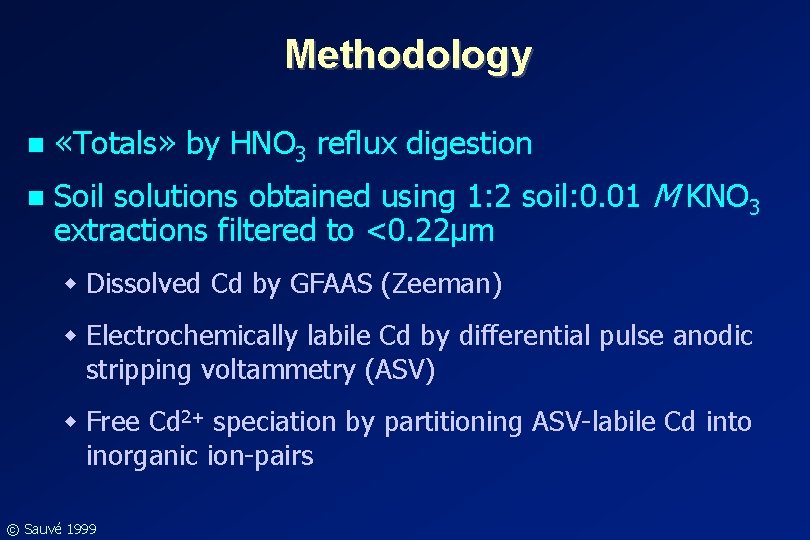
Methodology n «Totals» by HNO 3 reflux digestion n Soil solutions obtained using 1: 2 soil: 0. 01 M KNO 3 extractions filtered to <0. 22µm w Dissolved Cd by GFAAS (Zeeman) w Electrochemically labile Cd by differential pulse anodic stripping voltammetry (ASV) w Free Cd 2+ speciation by partitioning ASV-labile Cd into inorganic ion-pairs © Sauvé 1999
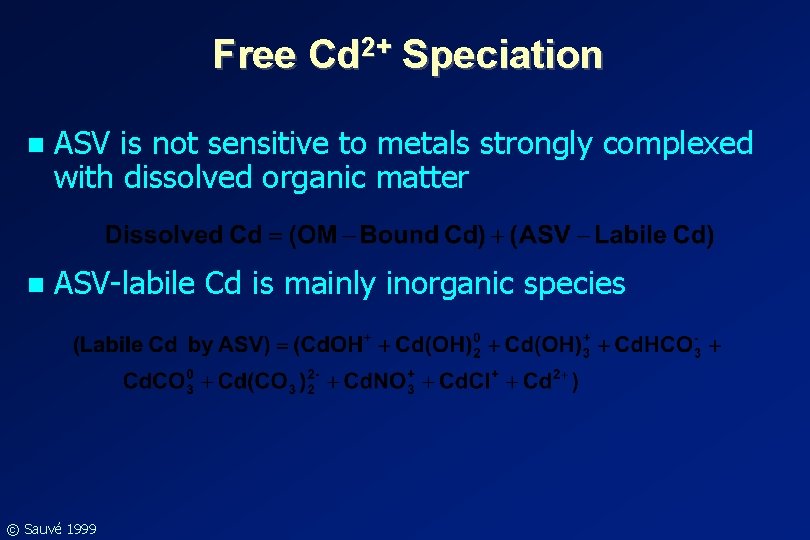
Free Cd 2+ Speciation n ASV is not sensitive to metals strongly complexed with dissolved organic matter n ASV-labile Cd is mainly inorganic species © Sauvé 1999
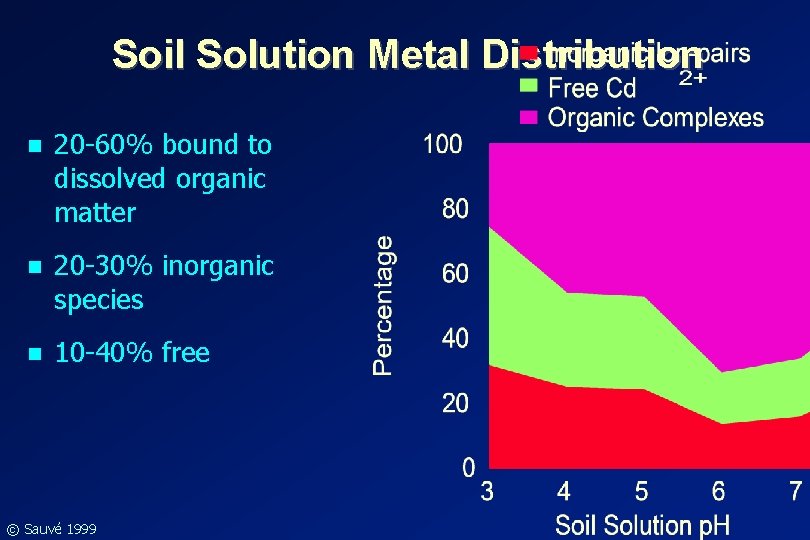
Soil Solution Metal Distribution n 20 -60% bound to dissolved organic matter n 20 -30% inorganic species n 10 -40% free © Sauvé 1999
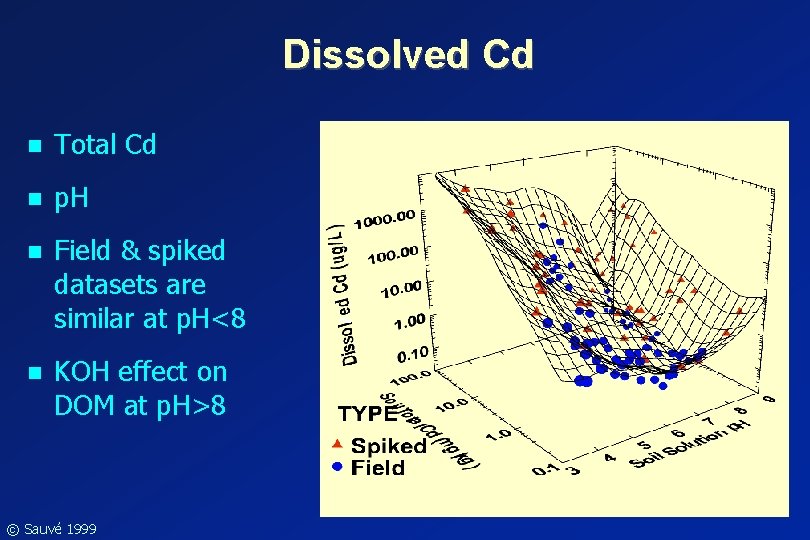
Dissolved Cd n Total Cd n p. H n Field & spiked datasets are similar at p. H<8 n KOH effect on DOM at p. H>8 © Sauvé 1999
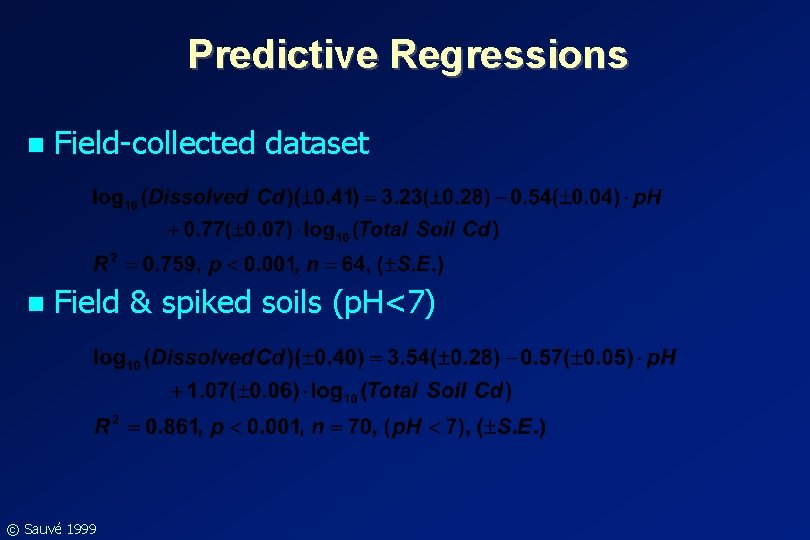
Predictive Regressions n Field-collected dataset n Field & spiked soils (p. H<7) © Sauvé 1999
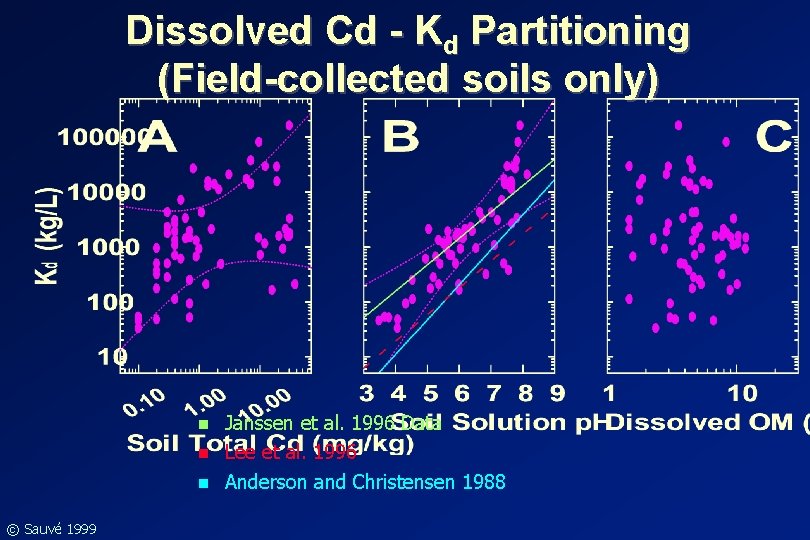
Dissolved Cd - Kd Partitioning (Field-collected soils only) n n n © Sauvé 1999 Janssen et al. 1996 Data Lee et al. 1996 Anderson and Christensen 1988
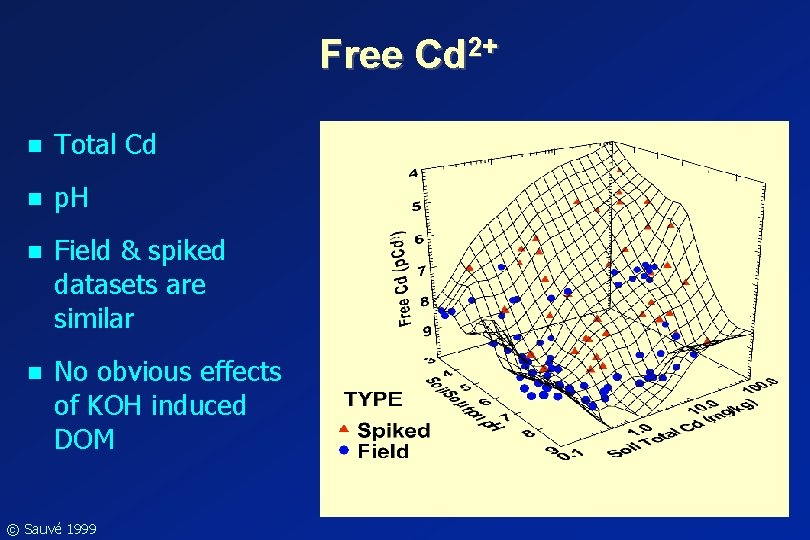
Free Cd 2+ n Total Cd n p. H n Field & spiked datasets are similar n No obvious effects of KOH induced DOM © Sauvé 1999
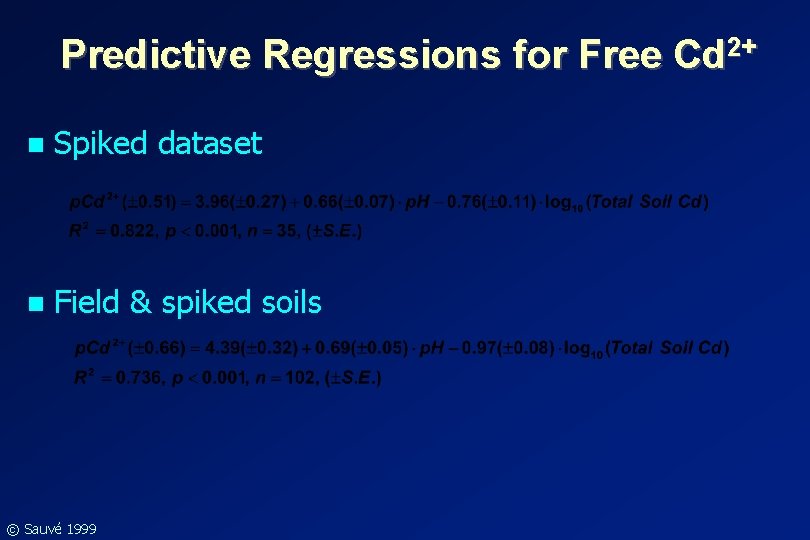
Predictive Regressions for Free Cd 2+ n Spiked dataset n Field & spiked soils © Sauvé 1999
Conclusions n Dissolved and free Cd 2+ in soil solutions can be predicted from simple regressions with total metal burden and soil solution p. H n Risk Assessment should consider the relative impact of soil properties like p. H © Sauvé 1999