
SPECIALTY PLASTICS Polyvinylfluoride PVF CORPORATE TRAINING AND PLANNING
- Slides: 14
SPECIALTY PLASTICS Polyvinylfluoride (PVF) CORPORATE TRAINING AND PLANNING
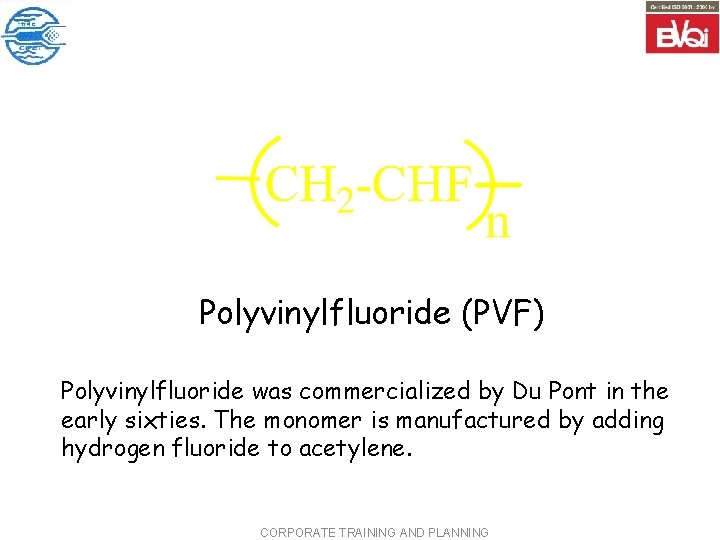
Polyvinylfluoride (PVF) Polyvinylfluoride was commercialized by Du Pont in the early sixties. The monomer is manufactured by adding hydrogen fluoride to acetylene. CORPORATE TRAINING AND PLANNING
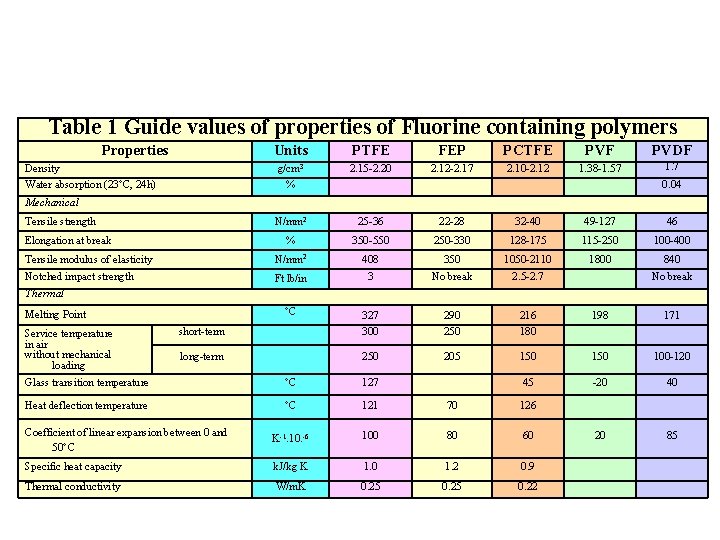
Structure and General Properties The crystalline melting point is 198°C and the molecular weight is 5 x 10⁴ to 2 x 10⁵. Many properties of PVF resemble those of PVC (low water absorption, resistance to hydrolysis, separation of HF at elevated temperature). The smaller F atoms result in a higher degree of crystallinity. The flame resistance is poorer than that of PVC; PVF continues to burn slowly after ignition. CORPORATE TRAINING AND PLANNING
Availability PVF is supplied only as film, weakly oriented or biaxially stretched film is available. Transition Temperatures The glass transition temperature is - 20 °C, the crystalline melting temperature 198 °C. CORPORATE TRAINING AND PLANNING
Optical Properties PVF films are transparent to visible and UV light. In the infrared region radiation with wavelengths between 7 and l 2 mm is absorbed. The refractive index n 20 D is 1. 45. Three optical axes must be differentiated for oriented films. CORPORATE TRAINING AND PLANNING
Chemical Properties Resistance to Chemicals PVF is resistant to acids, alkaline solutions and many solvents at room temperature. It is unaffected by boiling in carbon tetrachloride, benzene, acetone and methyl ketone. The resistance lies between that of PTFE and PCTFE. CORPORATE TRAINING AND PLANNING
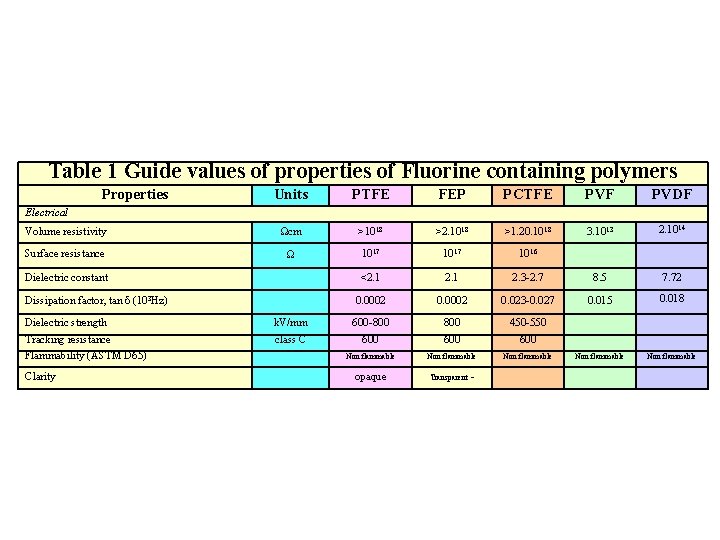
Flammability PVF burns slowly, i. e. its fire performance is somewhat poorer than that of PVC-U. Toxicological Assessment PVF is suitable for use with foodstuffs and is physiologically inert. CORPORATE TRAINING AND PLANNING
Processing-1 • PVF is supplied only as film. • It can be compression molded. • Cast film is made by pouring a mixture of 25 to 40% PVF and 75 to 60% dimethyl sulfoxide on to a platen and heating to 130 °C for a short time. • The paste-like mixture can also be extruded in hot oil at 160°C. • PVF films can be welded by heat impulse or high frequency. CORPORATE TRAINING AND PLANNING
Processing-2 • CORPORATE TRAINING AND PLANNING
Typical Applications The high weathering resistance of PVF makes it suitable for outdoor use as roof covering, cladding, pipe insulation, green houses, solar collectors (transparent to UV). Corrosion protection for metal panels, plywood and insulating board, road signs, packaging film, shrink tube. CORPORATE TRAINING AND PLANNING
Trade Names Kel-F (3 M Co. , US) KF Piezo Film (Kureha Chem. Ind. , IP) Tedlar (Du Pont de Nemours, US) CORPORATE TRAINING AND PLANNING
Further Reading 1. BRYDSON, J. A, Plastics Material, Butterworth Heinemann, oxford, New Delhi (2005) 2. DOMININGHAUS. H, Plastics for Engineering, Hanser publishers, Munich, New York (1998) 3. CHARLESS A. HARPER, Modern Plastics Hand Book Mc. Graw –Hill, New York (1999) CORPORATE TRAINING AND PLANNING
Table 1 Guide values of properties of Fluorine containing polymers Units PTFE FEP PCTFE PVF PVDF g/cm 3 % 2. 15 -2. 20 2. 12 -2. 17 2. 10 -2. 12 1. 38 -1. 57 1. 7 N/mm 2 25 -36 22 -28 32 -40 49 -127 46 % 350 -550 250 -330 128 -175 115 -250 100 -400 Tensile modulus of elasticity N/mm 2 408 350 1050 -2110 1800 840 Notched impact strength Ft lb/in 3 No break 2. 5 -2. 7 °C 290 216 short-term 327 300 250 180 long-term 250 205 Properties Density Water absorption (23°C, 24 h) 0. 04 Mechanical Tensile strength Elongation at break No break Thermal Melting Point Service temperature in air without mechanical loading 198 171 150 100 -120 45 -20 40 20 85 Glass transition temperature °C 127 Heat deflection temperature °C 121 70 126 Coefficient of linear expansion between 0 and 50°C K-1. 10. -6 100 80 60 Specific heat capacity k. J/kg K 1. 0 1. 2 0. 9 Thermal conductivity W/m. K 0. 25 0. 22
Table 1 Guide values of properties of Fluorine containing polymers Units PTFE FEP PCTFE PVF PVDF Volume resistivity Wcm >1018 >2. 1018 >1. 20. 1018 3. 1013 2. 1014 Surface resistance W 1017 1016 <2. 1 2. 3 -2. 7 8. 5 7. 72 0. 0002 0. 023 -0. 027 0. 015 0. 018 Non flammable Properties Electrical Dielectric constant Dissipation factor, tan d (103 Hz) Dielectric strength k. V/mm 600 -800 450 -550 Tracking resistance Flammability (ASTM D 65) class C 600 600 Non flammable Clarity opaque Transparent -