
SPECIALTY PLASTICS Polyphenylene sulfide PPS 1 CORPORATE TRAINING

- Slides: 28
SPECIALTY PLASTICS Polyphenylene sulfide (PPS) 1 CORPORATE TRAINING AND PLANNING
General Description Benzene rings and sulfur atoms form the backbone of the symmetrical macromolecule and characterize the properties: - high strength, stiffness and hardness, high heat distortion temperature, low moisture absorption, favorable flow properties, high dimensional stability, high chemical resistance, high weathering & radiation resistance low flammability (without additives). 2 CORPORATE TRAINING AND PLANNING
Structure and General Properties v 3 CORPORATE TRAINING AND PLANNING
Additives Among the high temperature resistant additives, the most important are glass fiber, carbon fiber & mineral fillers such as chalk, iron oxide and others – Carbon fiber reduces surface resistance & in special cases achieves a desired electrical conductivity – Mineral fillers improve processability, reduce shrinkage (particularly anisotropic shrinkage) and improve surface gloss – Graphite increases the stiffness of molded material – PTFE improves the friction and wear characteristics. CORPORATE TRAINING AND PLANNING 4
Availability Four basic grades of PPS compounds are: • glass-reinforced • glass- & mineral filled • pigmented glass- & mineral filled and • carbon fiber-reinforced. 40% glass-reinforced material has lower density and higher mechanical strength than glass- and mineral filled compounds which offer a good balance of properties at a lower cost & the pigmented glass- & mineral filled grade offers competitive properties & attractive colour at an intermediate cost. CORPORATE TRAINING AND PLANNING 5
Thermal Properties • No appreciable weight loss in filled PPS below 500 o. C in N 2 or air. • Coefficient of linear expansion is comparable to that of aluminium. • Water absorption of PPS is low. After immersion in water for 31 days at 100 °C, the increase in weight was only 1. 01 %. • Good Heat ageing resistance - UL long-term temperature indices of 170 °C for 40% w/w glass reinforced PPS & 200 °C for 40% w/w glass- and mineral filled PPS CORPORATE TRAINING AND PLANNING 6
Resistance to Chemicals • Excellent chemical resistance, better than other advanced engineering plastics • No known solvents below 200°C • Inert to steam, strong bases, fuels and acids • Minimal moisture absorption • Very low coefficient of linear thermal expansion • Stress-relieving manufacturing • PPS ideally suited for precise tolerance machined components CORPORATE TRAINING AND PLANNING 7
Resistance to Chemicals • • • At room temperature PPS is resistant to dilute mineral acids, alkaline solutions, aliphatic and aromatic hydrocarbons, ketones, alcohols chlorinated hydrocarbons, oils, fats, water and hydrolysis 8 CORPORATE TRAINING AND PLANNING
Flammability • PPS exhibits excellent fire retardancy (LOI = 53) • When exposed to a flame, molded PPS extinguishes only after removal of the ignition source & then chars forming shiny black crust there is slight expansion • It burns with a yellowish-orange flame giving off grey smoke with black traces and a smell of rotten eggs • It does not drip. 9 CORPORATE TRAINING AND PLANNING
Processing • PPS is injection and compression molded. • Non-stick coatings are applied to metal parts by fluidized bed dipping or electrostatic spraying. • Mold cavities should be well ventilated as air inclusions lead to weak flow lines. 10 CORPORATE TRAINING AND PLANNING
Processing Pre-drying • The glass fiber reinforced grades require drying only when stored in poor conditions. • It is recommended that the mineral-filled grades are dried for 6 hours at 160°C. • Regrind must be pre-dried. The excellent thermal stability of the material enables the proportion of regrind to be as high as 35%. 11 CORPORATE TRAINING AND PLANNING
Processing • Melt temperature is 340 to 370°C • Mold temperature 25 to 200°C. At 120°C, molding surfaces become smooth and shiny. The toughest moldings are obtained at 40°C • Molding shrinkage is 1 % for unreinforced & 0. 2% for glass fiber reinforced material • Metal inserts cause stress cracking which can be avoided by selecting special purpose grades CORPORATE TRAINING AND PLANNING 12
Joining • Moldings can be joined by screws. Vibration welding provides higher strength joins than ultrasonic welding. • PPS can be bonded to itself and most other materials including metals with epoxide resin adhesives, cyanoacrylate and reactive monomeric acrylate systems. 13 CORPORATE TRAINING AND PLANNING
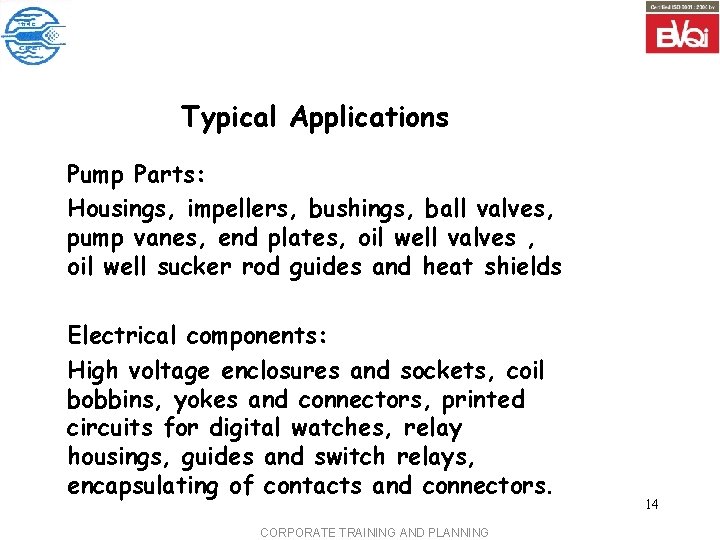
Typical Applications Pump Parts: Housings, impellers, bushings, ball valves, pump vanes, end plates, oil well valves , oil well sucker rod guides and heat shields Electrical components: High voltage enclosures and sockets, coil bobbins, yokes and connectors, printed circuits for digital watches, relay housings, guides and switch relays, encapsulating of contacts and connectors. CORPORATE TRAINING AND PLANNING 14
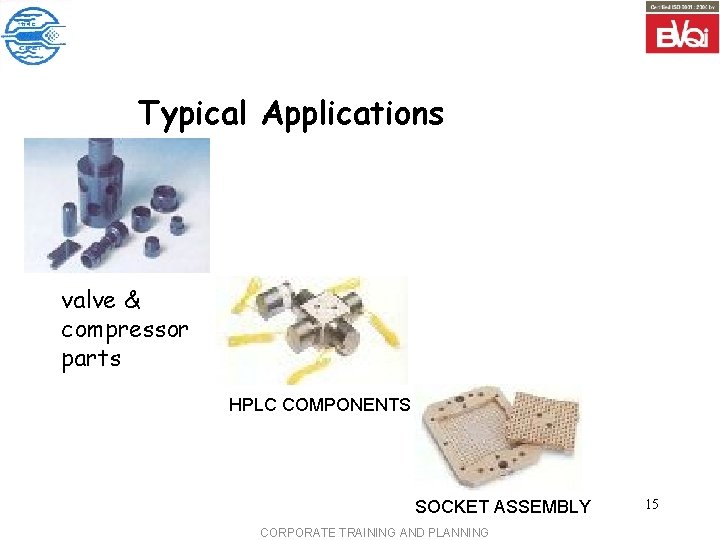
Typical Applications valve & compressor parts HPLC COMPONENTS SOCKET ASSEMBLY CORPORATE TRAINING AND PLANNING 15
New applications: • • • High pressure liquid chromatography components, Wafer retaining rings for CMP polishing, Hydrocarbon pump, valve & compressor parts Oil field parts, Aerospace components Medical and diagnostic device parts Electronic device encapsulation, Microwave cookware, Thick-walled mechanical parts, High arc resistance, High modulus anti-friction devices. 16 CORPORATE TRAINING AND PLANNING
Typical Applications • PPS is also used in the coatings industry. • Slurry coatings can be applied by a spraying and baking operation. • Release coatings are formulated from PPS along with small amounts of PTFE and appropriate pigments and applied by slurry techniques. CORPORATE TRAINING AND PLANNING 17
MANUFACTURERS Celstran® (Ticona) Comshield® (A. Schulman Inc. ) Larton (LATI S. P. A. ) NOVAPPS® (Mitsubishi Engineering-Plastics Corp) RTP Compounds (RTP Company) Ryton® (Chevron Phillips Chemical Co. ) SUPEC* (GE Advanced Materials Asia Pacific) Techtron® (Quadrant Engineering Plastic Products) TEDUR® (Albis Plastics Corporation) Thermotuf* (LNP Engineering Plastics Inc. ) Torelina® Alloy (Toray Resin Company) TOYOBO (TOYOBO America, Inc. ) Xtel(TM) (Chevron Phillips Chemical Co. ) 18 CORPORATE TRAINING AND PLANNING
Further Reading 1. BRYDSON J. A, Plastics Material, Butterworth Heinemann, oxford, New Delhi (2005) 2. DOMININGHAUS H. , Plastics for Engineering, Hanser publishers, Munich, New York (1998) 3. CHARLESS A. HARPER, Modern Plastics Hand Book Mc. Graw –Hill, New York (1999) 4. MARGOLIS J. M. , Engineering Thermoplastics, Marcel-Dekker, New York (1985) 19 CORPORATE TRAINING AND PLANNING
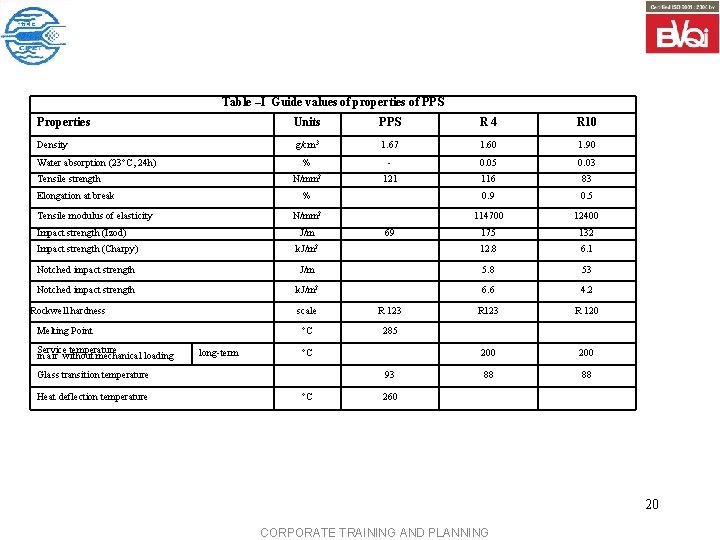
Table –I Guide values of properties of PPS Properties Units PPS R 4 R 10 Density g/cm 3 1. 67 1. 60 1. 90 % - 0. 05 0. 03 N/mm 2 121 116 83 % 0. 9 0. 5 N/mm 2 114700 12400 175 132 Water absorption (23°C, 24 h) Tensile strength Elongation at break Tensile modulus of elasticity Impact strength (Izod) J/m 69 Impact strength (Charpy) k. J/m 2 12. 8 6. 1 Notched impact strength J/m 5. 8 53 Notched impact strength k. J/m 2 6. 6 4. 2 R 123 R 120 200 88 88 Rockwell hardness Melting Point Service temperature in air without mechanical loading long-term scale R 123 °C 285 °C Glass transition temperature Heat deflection temperature 93 °C 260 20 CORPORATE TRAINING AND PLANNING
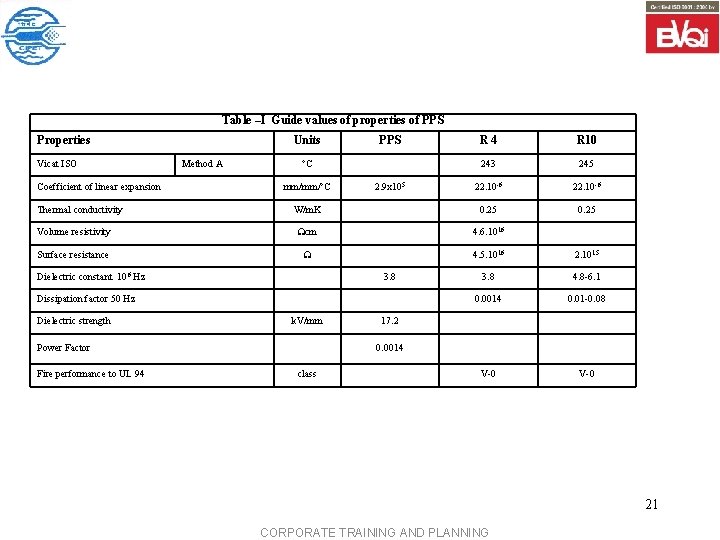
Table –I Guide values of properties of PPS Properties R 4 R 10 243 245 22. 10 -6 W/m. K 0. 25 Volume resistivity Wcm 4. 6. 1016 Surface resistance W 4. 5. 1016 2. 1015 3. 8 4. 8 -6. 1 0. 0014 0. 01 -0. 08 V-0 Vicat ISO Coefficient of linear expansion Thermal conductivity Units Method A PPS °C mm/mm/°C Dielectric constant 10 6 Hz 2. 9 x 10⁵ 3. 8 Dissipation factor 50 Hz Dielectric strength k. V/mm Power Factor Fire performance to UL 94 17. 2 0. 0014 class 21 CORPORATE TRAINING AND PLANNING
22 CORPORATE TRAINING AND PLANNING
23 CORPORATE TRAINING AND PLANNING
24 CORPORATE TRAINING AND PLANNING
25 CORPORATE TRAINING AND PLANNING
26 CORPORATE TRAINING AND PLANNING
27 CORPORATE TRAINING AND PLANNING
28 CORPORATE TRAINING AND PLANNING