
Specialty Courts Recidivism Rates Nationally In a 30

- Slides: 14
Specialty Courts
Recidivism Rates Nationally • In a 30 State study in 2005, about two-thirds (67. 8%) of released prisoners were arrested for a new crime within 3 years, and three-quarters (76. 6%) were arrested within 5 years. • Within 5 years of release, 76. 9% of drug offenders were arrested for a new crime. • More than a third (36. 8%) of all prisoners who were arrested within 5 years of release were arrested within the first 6 months after release, with more than half (56. 7%) arrested by the end of the first year • A sixth (16. 1%) of released prisoners were responsible for almost half (48. 4%) of the nearly 1. 2 million arrests that occurred in the 5 -year follow-up period. Source: Alexia D. Cooper, Ph. D. , Matthew R. Durose, Howard N. Snyder, Ph. D. (April 2014). Recidivism of Prisoners Released in 30 States in 2005: Patterns from 2005 to 2010. Retrieved from http: //www. bjs. gov/index. cfm? ty=pbdetail&iid=4986
What are Specialty Courts? Design: • Specialty Courts are “Drug Courts” or “Problem-Solving Courts, ” using intensive behavioral supervision, judicial monitoring, and treatment for substance abuse and mental health. • Specialty Courts originated in Miami, Florida in 1989, creating a national model. Purpose: • To engage the drug-addicted criminal offender in intensive therapeutic and judicial intervention. • To reduce recidivism and further involvement in the criminal justice system. • Nevada’s Administrative Office of the Courts (AOC) awards grants to pay for mandated drug and alcohol testing, counseling, electronic monitoring, incentives, and other costs associated with Specialty Court programs. Source: Reno Municipal Court Information. Specialty Courts and Programs. Retrieved from http: //www. reno. gov/government/municipal-court/specialty-courts-and-programs
Nevada Specialty Courts Currently, Nevada has 42 Specialty Court Programs: • 27 urban and 15 rural programs, including: • 17 adult drug courts including diversion and child support; 3 family drug courts, 3 mental health courts, 4 juvenile drug courts, 6 DUI courts, 5 hybrid DUI/drug courts, 1 prostitution prevention court, 1 veterans treatment court, and 2 habitual Source Administrative Office of the Courts, Specialty Courts. offender courts. Retrieved from http: //nvcourts. gov/AOC/Programs_and_Services/Specialty_Courts/Overview/
How Specialty Court Programs Work With Offenders • The Specialty Courts engage offenders of all ages and stages in substance abuse as well as their families. • The SJDC contracts with various treatment services to provide drug testing, counseling, and case management for participants, using a multidisciplinary team approach involving the judge, defense and prosecution counsel, treatment, court staff, and parole and probation. • The various specialty courts work with one another closely, transferring offenders to different courts based on circumstances and need.
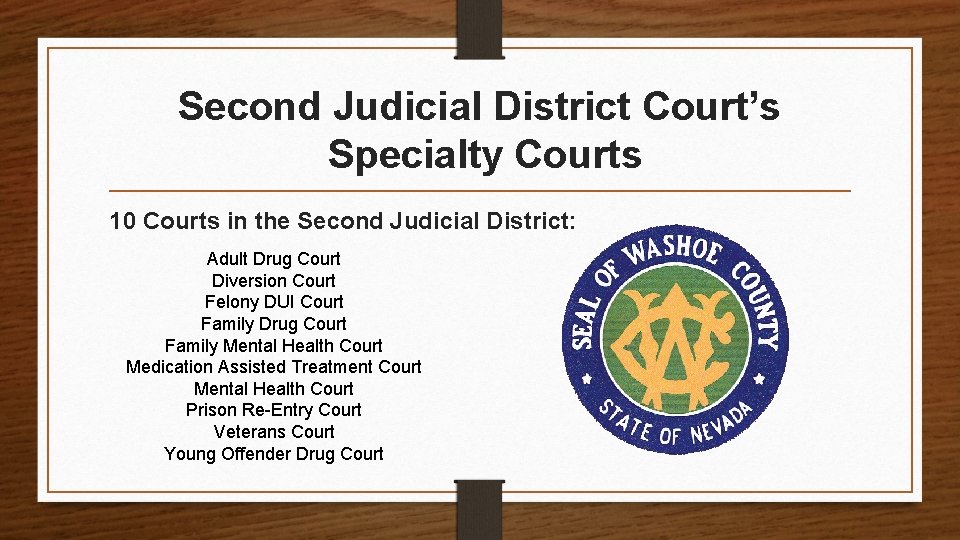
Second Judicial District Court’s Specialty Courts 10 Courts in the Second Judicial District: Adult Drug Court Diversion Court Felony DUI Court Family Drug Court Family Mental Health Court Medication Assisted Treatment Court Mental Health Court Prison Re-Entry Court Veterans Court Young Offender Drug Court
Trends in Specialty Courts: Nevada and Nationwide • Nationally, almost 4, 000 of the existing 16, 000 criminal courts in the US are Specialty Courts. • Nevada implemented the first of its Specialty Courts in 1993 • In 2015, the Second Judicial District Court (SJDC) created the Youth Offender Court as a pilot to allow Medication Assisted Treatment (MAT). • Since then, Nevada Specialty Courts have created MAT programs both in the SJDC and the Western Regional Drug Courts. Source: Reno Municipal Court Information. Specialty Courts and Programs. Retrieved from http: //www. reno. gov/government/municipal-court/specialty-courts-and-programs
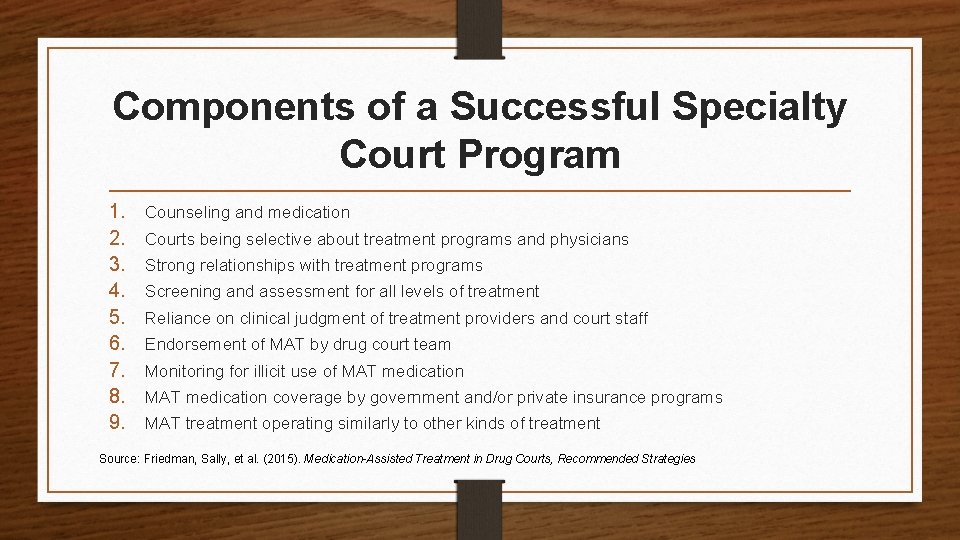
Components of a Successful Specialty Court Program 1. 2. 3. 4. 5. 6. 7. 8. 9. Counseling and medication Courts being selective about treatment programs and physicians Strong relationships with treatment programs Screening and assessment for all levels of treatment Reliance on clinical judgment of treatment providers and court staff Endorsement of MAT by drug court team Monitoring for illicit use of MAT medication coverage by government and/or private insurance programs MAT treatment operating similarly to other kinds of treatment Source: Friedman, Sally, et al. (2015). Medication-Assisted Treatment in Drug Courts, Recommended Strategies
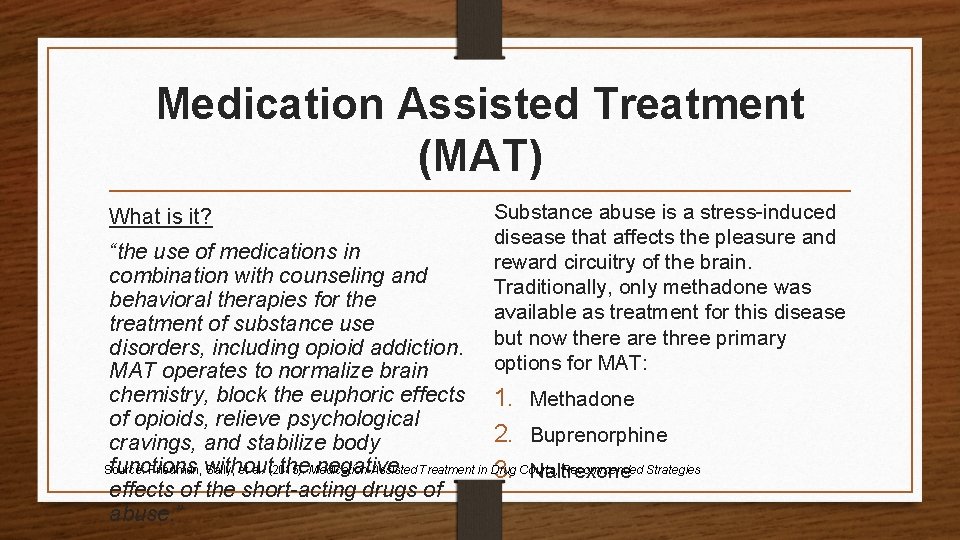
Medication Assisted Treatment (MAT) What is it? Substance abuse is a stress-induced disease that affects the pleasure and reward circuitry of the brain. Traditionally, only methadone was available as treatment for this disease but now there are three primary options for MAT: “the use of medications in combination with counseling and behavioral therapies for the treatment of substance use disorders, including opioid addiction. MAT operates to normalize brain chemistry, block the euphoric effects 1. Methadone of opioids, relieve psychological 2. Buprenorphine cravings, and stabilize body functions without the negative Treatment in Drug Source: Friedman, Sally, et al. (2015). Medication-Assisted Recommended Strategies 3. Courts, Naltrexone effects of the short-acting drugs of abuse. ”
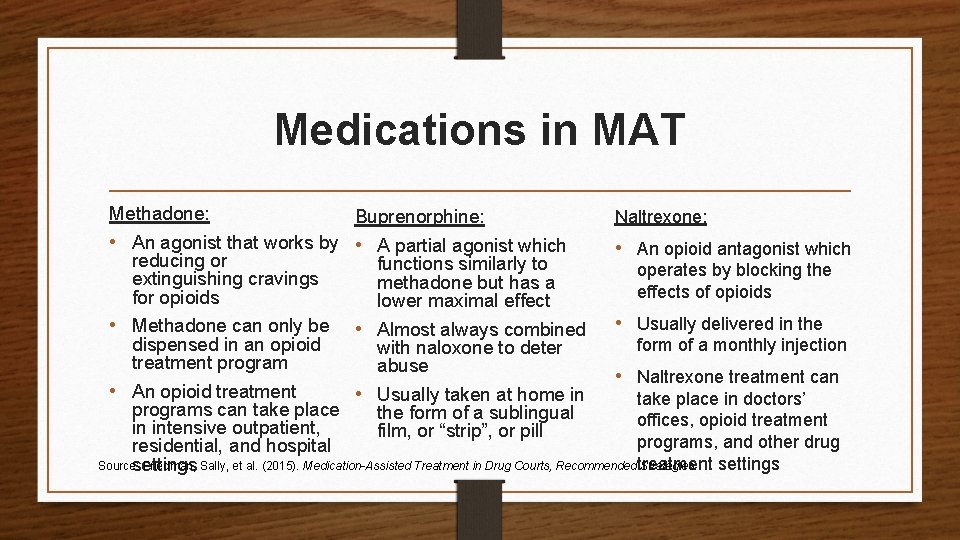
Medications in MAT Methadone: Buprenorphine: • An agonist that works by • A partial agonist which reducing or extinguishing cravings for opioids functions similarly to methadone but has a lower maximal effect • Methadone can only be • Almost always combined dispensed in an opioid treatment program • An opioid treatment with naloxone to deter abuse Naltrexone: • An opioid antagonist which operates by blocking the effects of opioids • Usually delivered in the form of a monthly injection • Naltrexone treatment can • Usually taken at home in take place in doctors’ programs can take place the form of a sublingual offices, opioid treatment in intensive outpatient, film, or “strip”, or pill programs, and other drug residential, and hospital Source: Friedman, Sally, et al. (2015). Medication-Assisted Treatment in Drug Courts, Recommendedtreatment settings Strategies. settings
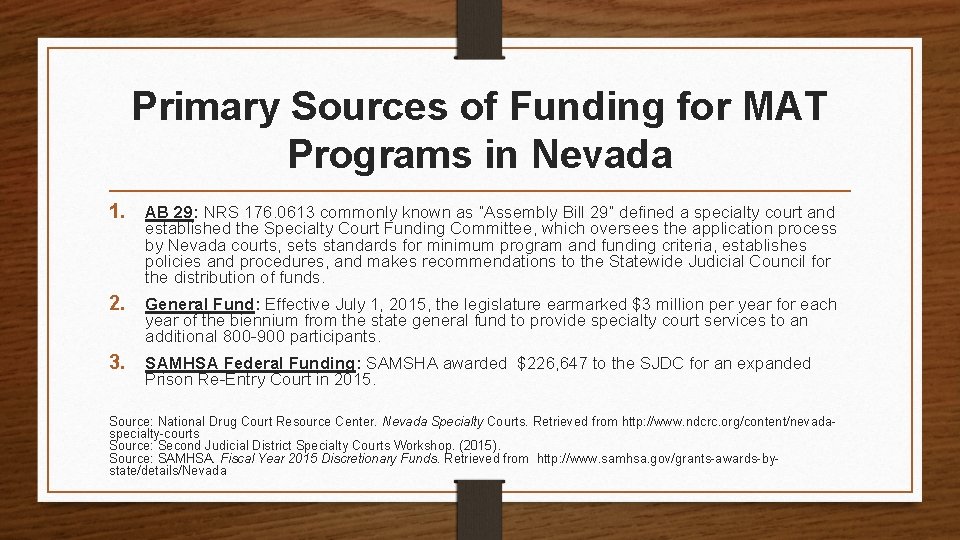
Primary Sources of Funding for MAT Programs in Nevada 1. AB 29: NRS 176. 0613 commonly known as “Assembly Bill 29” defined a specialty court and established the Specialty Court Funding Committee, which oversees the application process by Nevada courts, sets standards for minimum program and funding criteria, establishes policies and procedures, and makes recommendations to the Statewide Judicial Council for the distribution of funds. 2. General Fund: Effective July 1, 2015, the legislature earmarked $3 million per year for each year of the biennium from the state general fund to provide specialty court services to an additional 800 -900 participants. 3. SAMHSA Federal Funding: SAMSHA awarded $226, 647 to the SJDC for an expanded Prison Re-Entry Court in 2015. Source: National Drug Court Resource Center. Nevada Specialty Courts. Retrieved from http: //www. ndcrc. org/content/nevadaspecialty-courts Source: Second Judicial District Specialty Courts Workshop. (2015). Source: SAMHSA. Fiscal Year 2015 Discretionary Funds. Retrieved from http: //www. samhsa. gov/grants-awards-bystate/details/Nevada
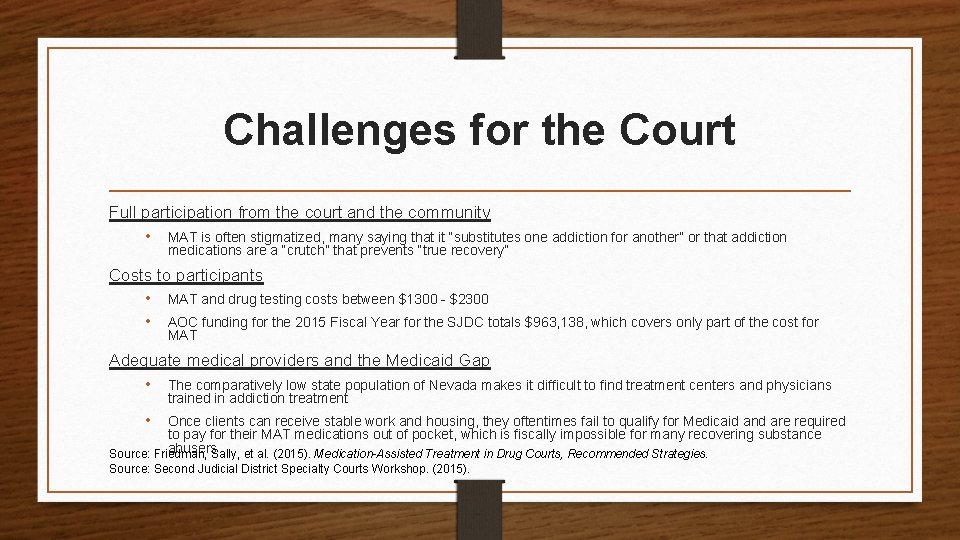
Challenges for the Court Full participation from the court and the community • MAT is often stigmatized, many saying that it “substitutes one addiction for another” or that addiction medications are a “crutch” that prevents “true recovery” Costs to participants • MAT and drug testing costs between $1300 - $2300 • AOC funding for the 2015 Fiscal Year for the SJDC totals $963, 138, which covers only part of the cost for MAT Adequate medical providers and the Medicaid Gap • The comparatively low state population of Nevada makes it difficult to find treatment centers and physicians trained in addiction treatment • Once clients can receive stable work and housing, they oftentimes fail to qualify for Medicaid and are required to pay for their MAT medications out of pocket, which is fiscally impossible for many recovering substance abusers Source: Friedman, Sally, et al. (2015). Medication-Assisted Treatment in Drug Courts, Recommended Strategies. Source: Second Judicial District Specialty Courts Workshop. (2015).
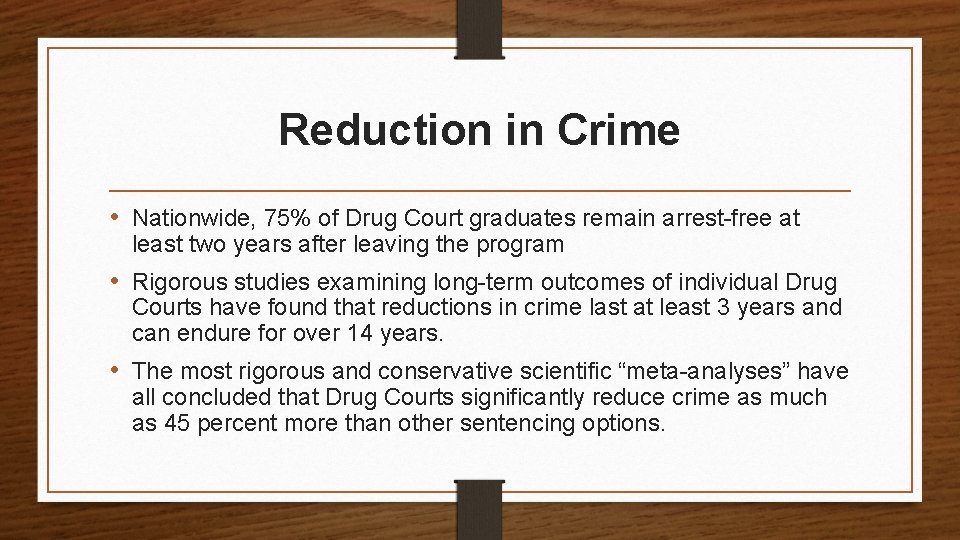
Reduction in Crime • Nationwide, 75% of Drug Court graduates remain arrest-free at least two years after leaving the program • Rigorous studies examining long-term outcomes of individual Drug Courts have found that reductions in crime last at least 3 years and can endure for over 14 years. • The most rigorous and conservative scientific “meta-analyses” have all concluded that Drug Courts significantly reduce crime as much as 45 percent more than other sentencing options.
Fiscal Success of Drug Courts • Nationwide, for every $1. 00 invested in Drug Court, taxpayers save as much as $3. 36 in avoided criminal justice costs alone. • When considering other cost offsets such as savings from reduced victimization and healthcare service utilization, studies have shown benefits range up to $27 for every $1 invested. • In 2007, for every Federal dollar invested in Drug Court, $9. 00 was leveraged in state funding. Source: Marlowe, D. B. (December 2010) Research Update on Adult Drug Courts. Retrieved from http: //www. nadcp. org/learn/facts-and-figures