
Specialist nurse in Europe education regulation and role
- Slides: 20
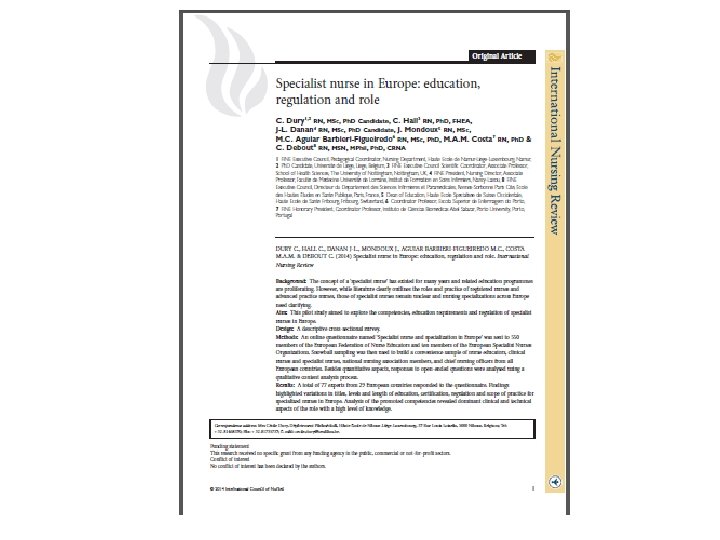
Specialist nurse in Europe: education, regulation and role A descriptive cross-sectional survey C. Dury, RN, MSc, Ph. D Candidate, C. Hall RN, Ph. D, FHEA, J-L. Danan RN, MSc, Ph. D Candidate, J. Mondoux RN, MSc, M. C. Aguiar Barbieri-Figueiredo RN, MSc, Ph. D, M. A. M. Costa RN, Ph. D C. Debout RN, MSN, MPhil, Ph. D, CRNA
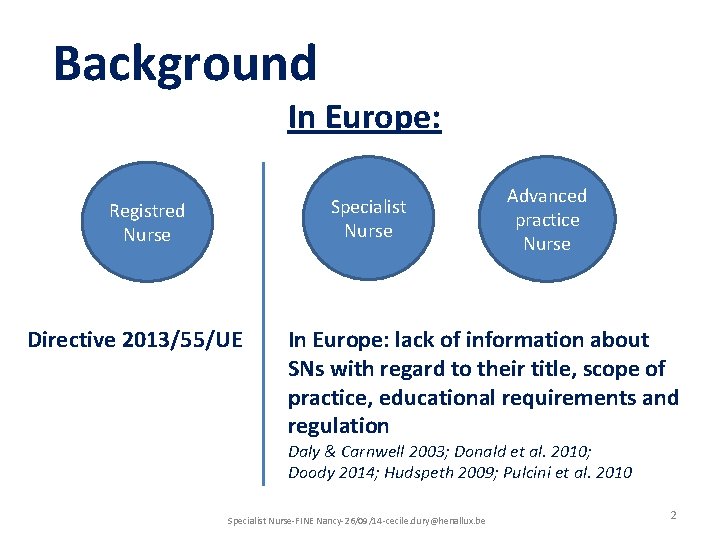
Background In Europe: Specialist Nurse Registred Nurse Directive 2013/55/UE Advanced practice Nurse In Europe: lack of information about SNs with regard to their title, scope of practice, educational requirements and regulation Daly & Carnwell 2003; Donald et al. 2010; Doody 2014; Hudspeth 2009; Pulcini et al. 2010 Specialist Nurse-FINE Nancy-26/09/14 -cecile. dury@henallux. be 2
Aim • To describe and clarify the level of education, regulation, scope of practice and competency requirements for the SN in Europe • To test our questionnaire and study design before undertaking a larger study Design A descriptive cross-sectional survey 3
Methods • An online questionnaire was developped • Snowball sampling was selected to build a convenience sample of nurse educators, clinical nurses and specialist nurses, national nursing association members, and chief nursing officers from all European countries. It was sent to 550 members of the European Federation of Nurse Educators (FINE) and 10 members of the European Specialist Nurses Organizations (ESNO). Specialist Nurse-FINE Nancy-26/09/14 -cecile. dury@henallux. be 4
Data analysis § Excel® was used to analyse the responses to the seven closedended questions. § The two open-ended survey responses were analysed qualitatively using a deductive approach (Elo & Kyngäs 2008). § The open-ended data were read several times and reviewed for content. § They were coded and classified into categories corresponding to a structured matrix based on the ICN Framework of Competencies for the Nurse Specialist (Affara 2009) using NVIVO 10®. Specialist Nurse-FINE Nancy-26/09/14 -cecile. dury@henallux. be 5
Study results The results are structured in four parts: 1. Countries and respondents’ characteristics 2. SN’s education: level, organization, duration, type of specialization 3. Regulation of practice for the SN: title and legal regulation 4. The results present finally a definition of the SNs and their competencies as proposed by respondents. Specialist Nurse-FINE Nancy-26/09/14 -cecile. dury@henallux. be 6
1. Countries and respondents’ characteristics • 85 questionnaires were completed • 8 were rejected • Participants included were from 29 countries. – All EU members were represented but six countries (Austria, Bulgaria, Latvia, Luxembourg, Romania and Slovakia). – Countries working towards accession to EU (Iceland, Serbia and Turkey); potential candidates (Albania, Bosnia and Herzegovina), and Switzerland Armenia were also represented. • Respondents were expert in their domain; they came from various educational backgrounds and positions. Specialist Nurse-FINE Nancy-26/09/14 -cecile. dury@henallux. be 7
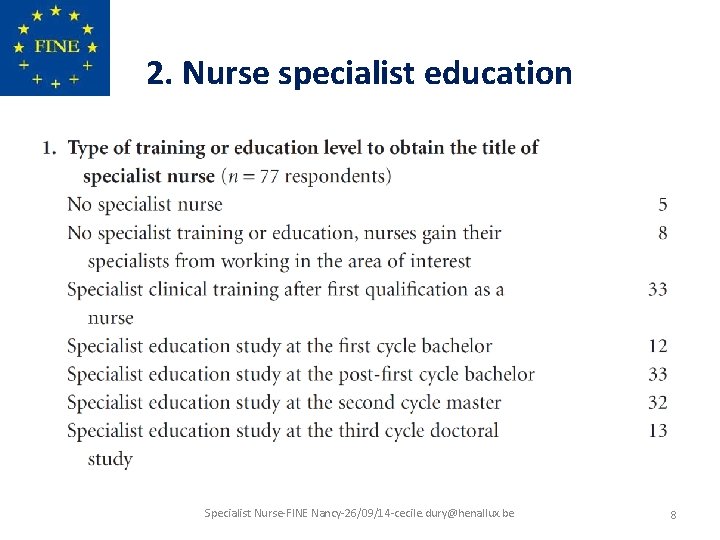
2. Nurse specialist education Specialist Nurse-FINE Nancy-26/09/14 -cecile. dury@henallux. be 8
2. Nurse specialist education 1. Organization of the programmes preparing SN Diversity between academic and non-academic education 2. Type of specialization (top 5) – – – Psychiatric and mental health Paediatric care Intensive care Community health care Operating room 3. Duration of the programmes Diversity between countries and sometimes within the same country Specialist Nurse-FINE Nancy-26/09/14 -cecile. dury@henallux. be 9
3. Regulation: title and legal regulation • 19 countries had protected titles • 10 countries do not recognize titles • Many specializations exist in some countries, with no legally recognized titles • 2 countries had specific requirements to maintain the title (recertification) • Some countries regulate general nurse and APN but not SN • Regulators: diverse even in the same country (eg, Switzerland), regulation operated by professional organizations, national board, hospitals Specialist Nurse-FINE Nancy-26/09/14 -cecile. dury@henallux. be 10
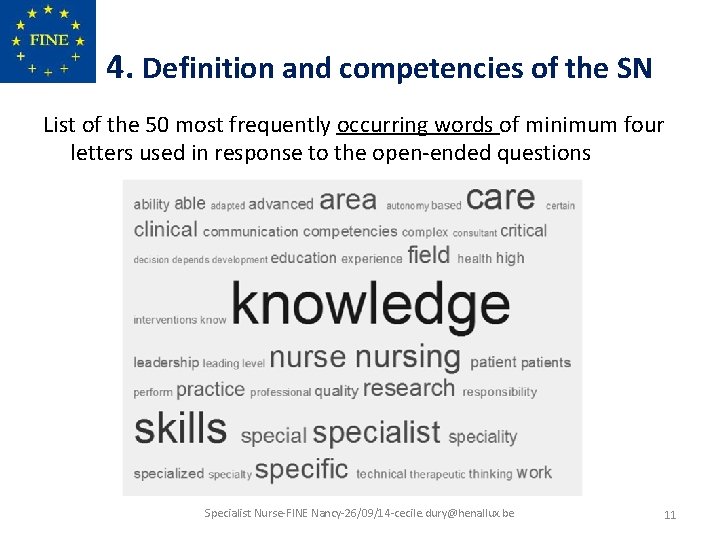
4. Definition and competencies of the SN List of the 50 most frequently occurring words of minimum four letters used in response to the open-ended questions Specialist Nurse-FINE Nancy-26/09/14 -cecile. dury@henallux. be 11
4. Definition and competencies of the SN • The competencies of the SN were mostly described in terms of specific knowledge and skills. • In comparison with the ICN framework for the NS, some competencies were poorly covered: – health promotion and interprofessional health care – delegation and supervision roles • Appeared missing – Promotion of specialist nursing practice – Engagement in advocacy activities through professional organizations Specialist Nurse-FINE Nancy-26/09/14 -cecile. dury@henallux. be 12
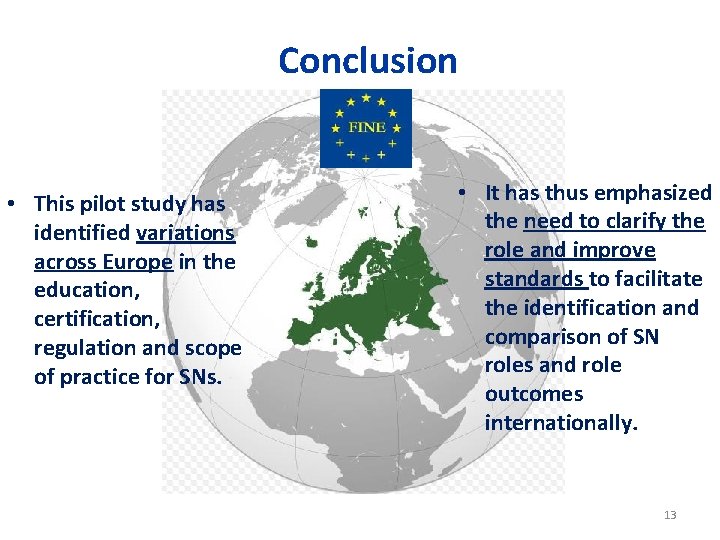
Conclusion • This pilot study has identified variations across Europe in the education, certification, regulation and scope of practice for SNs. • It has thus emphasized the need to clarify the role and improve standards to facilitate the identification and comparison of SN roles and role outcomes internationally. 13
WHAT’S NEXT? IMPLICATIONS FOR NURSING AND HEALTH POLICY FINE’S POSITION Specialist Nurse-FINE Nancy-26/09/14 -cecile. dury@henallux. be 14
Implications for nursing and health policy • The lack of clarity and the diversity of interpretations of the SN between countries do not support the development of a strong professional identity and an harmonized policy engagement to develop the profession. • Educational requirements for the SN need to be regulated at European level in order to harmonize curricula /study programmes and promote lifelong learning: – The education framework and competencies could be matched with the relevant level of the European Qualifications Framework. Specialist Nurse-FINE Nancy-26/09/14 -cecile. dury@henallux. be 15
Implications for nursing and health policy • Considering the absence of mutual recognition of SNs, common education frameworks based on a common set of knowledge, skills and competencies are needed to provide better care to patients and to guaranty their safety. • To achieve an effective development of SNs, the nursing profession must work at European level to obtain equity of titles and regulation of professional development across the EU. Specialist Nurse-FINE Nancy-26/09/14 -cecile. dury@henallux. be 16
Implications for nursing and health policy • MSs and governments are accountable for common policy priorities including sufficient provision of healthcare practitioners with appropriate skills and competencies “to improve the health and wellbeing of populations, reduce health inequities, and ensure a sustainable people-centered health system” (WHO, 2012). • Some issues are critical to consider: – adjustment of specialization areas to the healthcare needs of the population in each region and country, – as well as harmonization of academic degrees Specialist Nurse-FINE Nancy-26/09/14 -cecile. dury@henallux. be 17
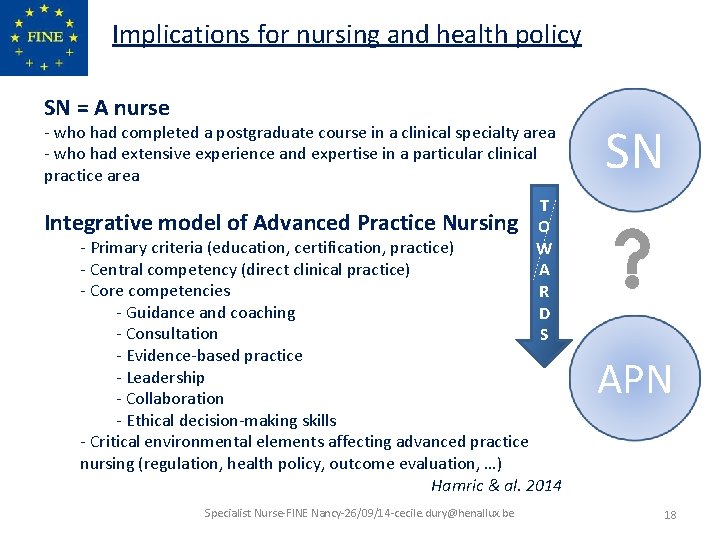
Implications for nursing and health policy SN = A nurse - who had completed a postgraduate course in a clinical specialty area - who had extensive experience and expertise in a particular clinical practice area Integrative model of Advanced Practice Nursing T O W A R D S - Primary criteria (education, certification, practice) - Central competency (direct clinical practice) - Core competencies - Guidance and coaching - Consultation - Evidence-based practice - Leadership - Collaboration - Ethical decision-making skills - Critical environmental elements affecting advanced practice nursing (regulation, health policy, outcome evaluation, …) Hamric & al. 2014 Specialist Nurse-FINE Nancy-26/09/14 -cecile. dury@henallux. be SN APN 18
Thanks to FINE members! 20