
Special Topics Body Structure and Function Cells Tissues
Special Topics Body Structure and Function
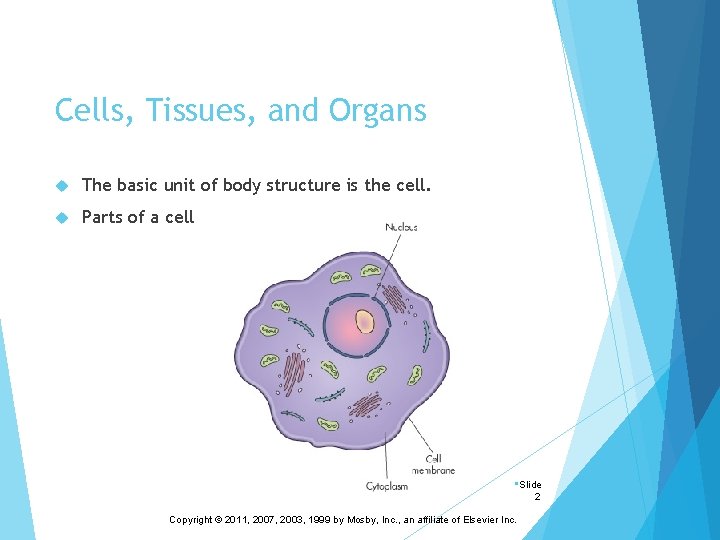
Cells, Tissues, and Organs The basic unit of body structure is the cell. Parts of a cell • Slide 2 Copyright © 2011, 2007, 2003, 1999 by Mosby, Inc. , an affiliate of Elsevier Inc.
Groups of cells with similar functions combine to form tissues. Epithelial tissue Connective tissue Muscle tissue Nerve tissue Groups of tissue with the same function form organs. Organs have one or more functions. Systems are formed by organs that work together to perform special functions. • Slide 3 Copyright © 2011, 2007, 2003, 1999 by Mosby, Inc. , an affiliate of Elsevier Inc.
Epithelial tissue covers internal and external body surfaces. Tissue lining the nose, mouth, respiratory tract, stomach, and intestines is epithelial tissue. So are the skin, hair, nails, and glands. Connective tissue anchors, connects, and supports other tissues. Bones, tendons, ligaments, and cartilage are connective tissue. Blood is a form of connective tissue. Connective tissue is in every part of the body. Muscle tissue stretches and contracts to let the body move. Nerve tissue receives and carries impulses to the brain and back to body parts Slide 4 Copyright © 2011, 2007, 2003, 1999 by Mosby, Inc. , an affiliate of Elsevier Inc.
Genes control the traits children inherit from their parents. The process of cell division is mitosis. • Slide 5 Copyright © 2011, 2007, 2003, 1999 by Mosby, Inc. , an affiliate of Elsevier Inc.

The Integumentary System The integumentary system, or skin, is the largest system. There are two skin layers. • The epidermis • The skin is the largest organ of the immune system. • Slide 6 Copyright © 2011, 2007, 2003, 1999 by Mosby, Inc. , an affiliate of Elsevier Inc.
The skin has many functions. It is the body’s protective covering. It prevents excess amounts of water from leaving the body. It protects organs from injury. Nerve endings in the skin sense both pleasant and unpleasant stimulation. It helps regulate body temperature. • Slide 7 Copyright © 2011, 2007, 2003, 1999 by Mosby, Inc. , an affiliate of Elsevier Inc.
The Musculoskeletal System The musculoskeletal system: Provides the framework for the body Lets the body move Protects and gives the body shape Bones contain bone marrow inside their hollow centers. • Blood cells are formed in the bone marrow. • Slide 8 Copyright © 2011, 2007, 2003, 1999 by Mosby, Inc. , an affiliate of Elsevier Inc.
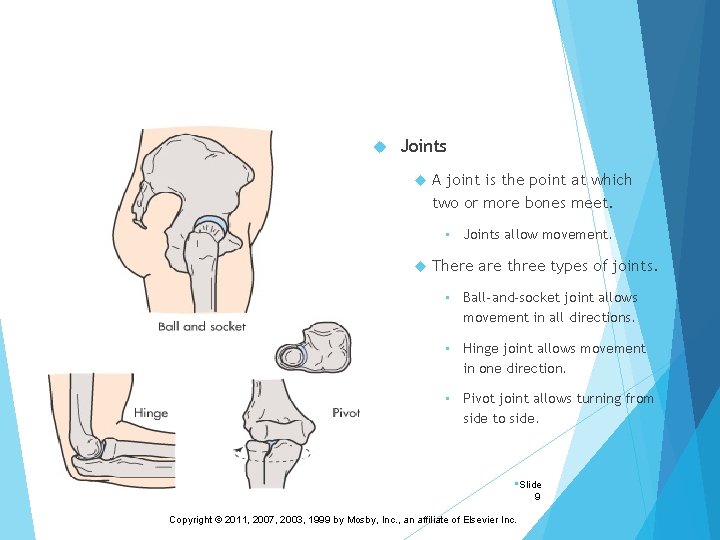
Joints A joint is the point at which two or more bones meet. • Joints allow movement. There are three types of joints. • Ball-and-socket joint allows movement in all directions. • Hinge joint allows movement in one direction. • Pivot joint allows turning from side to side. • Slide 9 Copyright © 2011, 2007, 2003, 1999 by Mosby, Inc. , an affiliate of Elsevier Inc.
Muscles Voluntary muscles can be consciously controlled. Involuntary muscles work automatically. Cardiac muscle is in the heart. • It is an involuntary muscle. Muscles have three functions. • Movement of body parts • Maintenance of posture • Production of body heat • Slide 10 Copyright © 2011, 2007, 2003, 1999 by Mosby, Inc. , an affiliate of Elsevier Inc.

*** Muscles attached to bones (skeletal muscles) are voluntary. Involuntary Cardiac muscles also are called smooth muscles. muscle is in the heart. • Slide 11 Copyright © 2011, 2007, 2003, 1999 by Mosby, Inc. , an affiliate of Elsevier Inc.

The Nervous System The nervous system controls, directs, and coordinates body functions. It has two main divisions: the central nervous system and the peripheral nervous system. • Slide 12 Copyright © 2011, 2007, 2003, 1999 by Mosby, Inc. , an affiliate of Elsevier Inc.
The central nervous system (CNS) consists of the brain and spinal cord. • The brain is covered by the skull. • The spinal cord lies within the spinal column. It contains pathways that conduct messages to and from the brain. The peripheral nervous system has 12 pairs of cranial nerves and 31 pairs of spinal nerves. • Slide 13 Copyright © 2011, 2007, 2003, 1999 by Mosby, Inc. , an affiliate of Elsevier Inc.

Peripheral Nervous System Contains cranial nerves and spinal nerves. Cranial nerves conduct impulses between the brain and the head, neck, chest, and abdomen. • Slide 14 Copyright © 2011, 2007, 2003, 1999 by Mosby, Inc. , an affiliate of Elsevier Inc.

The sense organs The five senses are sight, hearing, taste, smell, and touch. • Receptors for taste are in the tongue (taste buds). • Receptors for smell are in the nose. • Touch receptors are in the dermis, especially in the toes and fingertips. • Slide 15 Copyright © 2011, 2007, 2003, 1999 by Mosby, Inc. , an affiliate of Elsevier Inc.
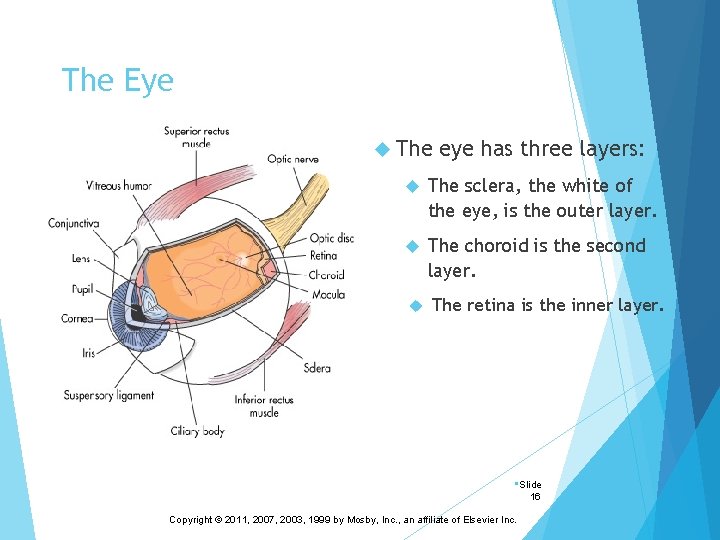
The Eye The eye has three layers: The sclera, the white of the eye, is the outer layer. The choroid is the second layer. The retina is the inner layer. • Slide 16 Copyright © 2011, 2007, 2003, 1999 by Mosby, Inc. , an affiliate of Elsevier Inc.
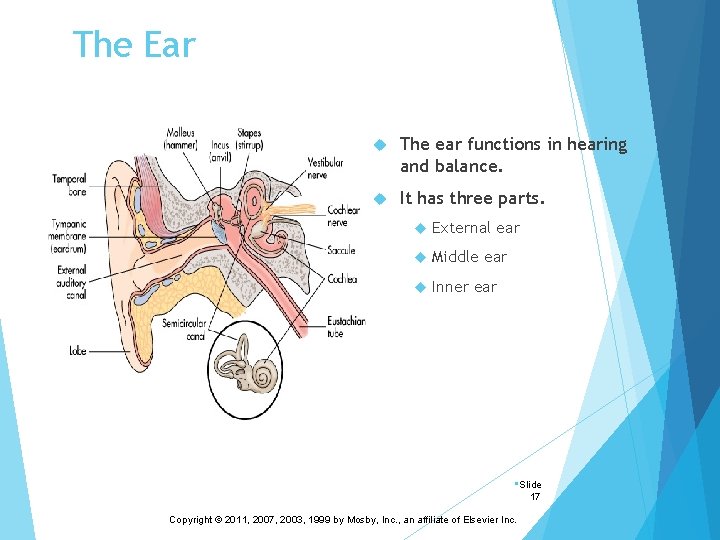
The Ear The ear functions in hearing and balance. It has three parts. External ear Middle ear Inner ear • Slide 17 Copyright © 2011, 2007, 2003, 1999 by Mosby, Inc. , an affiliate of Elsevier Inc.
The Circulatory System The circulatory system is made up of the blood, heart, and blood vessels. The circulatory system has many functions. Blood carries food, oxygen, and other substances to the cells. Blood removes waste products from cells. Blood and blood vessels help regulate body temperature. The system produces and carries cells that defend the body from microbes that cause disease. • Slide 18 Copyright © 2011, 2007, 2003, 1999 by Mosby, Inc. , an affiliate of Elsevier Inc.
Blood The blood consists of blood cells and plasma. Red blood cells (RBCs) are called erythrocytes. White blood cells (WBCs) are called leukocytes. Platelets (thrombocytes) are needed for blood clotting. • Slide 19 Copyright © 2011, 2007, 2003, 1999 by Mosby, Inc. , an affiliate of Elsevier Inc.
The heart: Is a muscle Pumps blood through the blood vessels to the tissues and cells Lies in the middle to lower part of the chest cavity toward the left side • Slide 20 Copyright © 2011, 2007, 2003, 1999 by Mosby, Inc. , an affiliate of Elsevier Inc.
The heart has four chambers. ** Heart action has two phases. Diastole is the resting phase. Systole is the working phase. • Slide 21 Copyright © 2011, 2007, 2003, 1999 by Mosby, Inc. , an affiliate of Elsevier Inc.

Blood vessels Blood flows to body tissues and cells through the blood vessels. There are three groups of blood vessels: arteries, capillaries and veins. • Arteries carry blood away from the heart. • Veins carry waste products back to the heart. • Slide 22 Copyright © 2011, 2007, 2003, 1999 by Mosby, Inc. , an affiliate of Elsevier Inc.
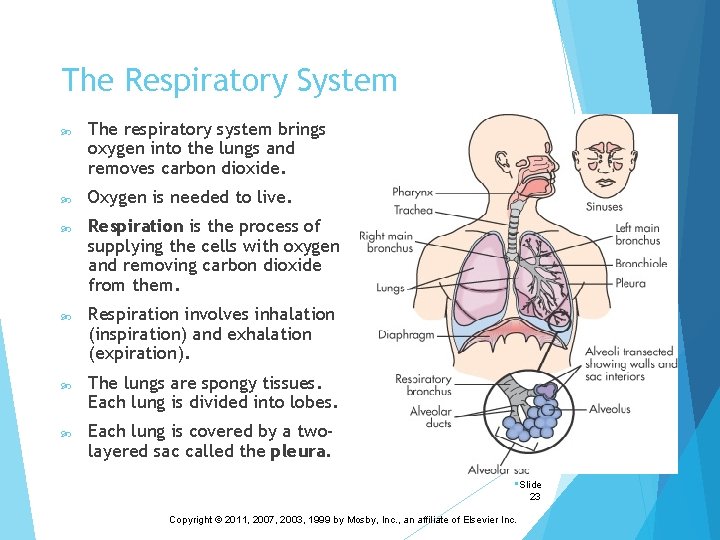
The Respiratory System The respiratory system brings oxygen into the lungs and removes carbon dioxide. Oxygen is needed to live. Respiration is the process of supplying the cells with oxygen and removing carbon dioxide from them. Respiration involves inhalation (inspiration) and exhalation (expiration). The lungs are spongy tissues. Each lung is divided into lobes. Each lung is covered by a twolayered sac called the pleura. • Slide 23 Copyright © 2011, 2007, 2003, 1999 by Mosby, Inc. , an affiliate of Elsevier Inc.
The lungs are filled with alveoli, blood vessels, and nerves. The lungs are separated from the abdominal cavity by the diaphragm. Air enters the body through the nose. The air then passes into the pharynx (throat) and then into the larynx (voice box). • Slide 24 Copyright © 2011, 2007, 2003, 1999 by Mosby, Inc. , an affiliate of Elsevier Inc.
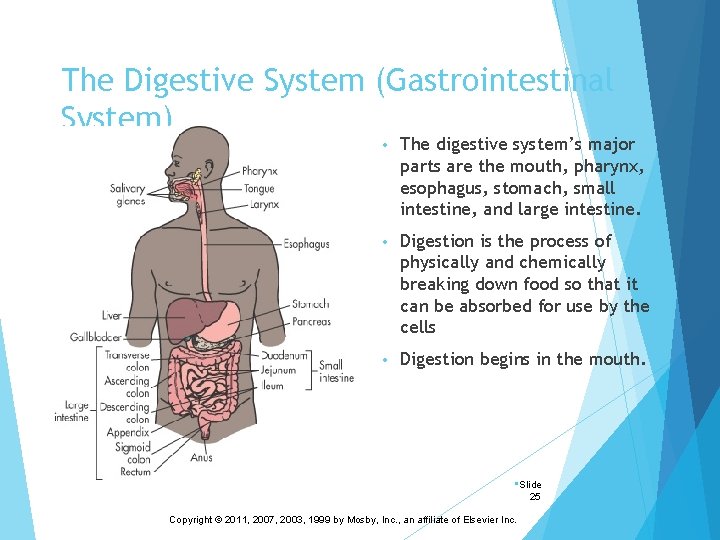
The Digestive System (Gastrointestinal System) • The digestive system’s major parts are the mouth, pharynx, esophagus, stomach, small intestine, and large intestine. • Digestion is the process of physically and chemically breaking down food so that it can be absorbed for use by the cells • Digestion begins in the mouth. • Slide 25 Copyright © 2011, 2007, 2003, 1999 by Mosby, Inc. , an affiliate of Elsevier Inc.

The digestive system: Breaks down food physically and chemically so it can be absorbed for use by the cells (digestion) Removes solid wastes from the body The digestive system involves the alimentary canal (GI tract) and the accessory organs of digestion. The alimentary canal extends from the mouth to the anus. Accessory organs are the teeth, tongue, salivary glands, liver, gallbladder, and pancreas. • Slide 26 Copyright © 2011, 2007, 2003, 1999 by Mosby, Inc. , an affiliate of Elsevier Inc.
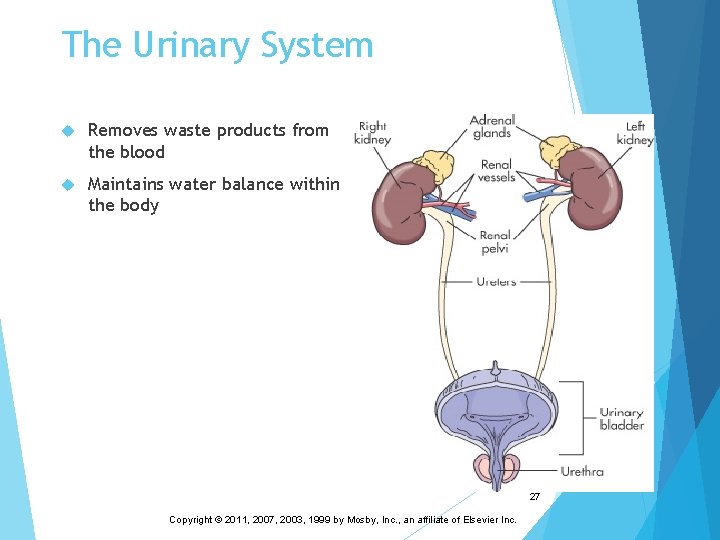
The Urinary System Removes waste products from the blood Maintains water balance within the body • Slide 27 Copyright © 2011, 2007, 2003, 1999 by Mosby, Inc. , an affiliate of Elsevier Inc.

The kidneys: Are two bean-shaped organs in the upper abdomen Are protected by the lower edge of the rib cage Each kidney has over a million tiny nephrons. Each nephron is the basic working unit of the kidney. The ureters carry urine from the kidneys to the bladder. Urine is stored in the bladder until the need to urinate is felt. Urine passes from the bladder through the urethra. Urine passes from the body through the meatus (the opening at the end of the urethra). • Slide 28 Copyright © 2011, 2007, 2003, 1999 by Mosby, Inc. , an affiliate of Elsevier Inc.
The Reproductive System Human reproduction results from the union of a male sex cell and a female sex cell. The differences in the male and female reproductive systems allow for the process of reproduction. • Slide 29 Copyright © 2011, 2007, 2003, 1999 by Mosby, Inc. , an affiliate of Elsevier Inc.
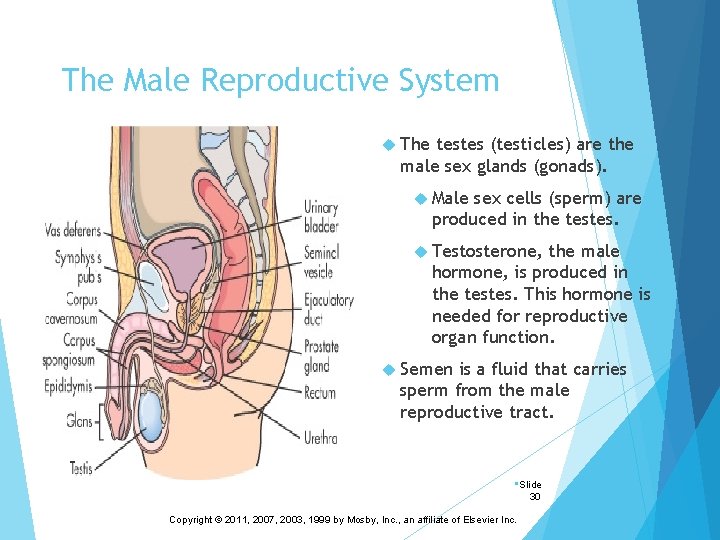
The Male Reproductive System The testes (testicles) are the male sex glands (gonads). Male sex cells (sperm) are produced in the testes. Testosterone, the male hormone, is produced in the testes. This hormone is needed for reproductive organ function. Semen is a fluid that carries sperm from the male reproductive tract. • Slide 30 Copyright © 2011, 2007, 2003, 1999 by Mosby, Inc. , an affiliate of Elsevier Inc.
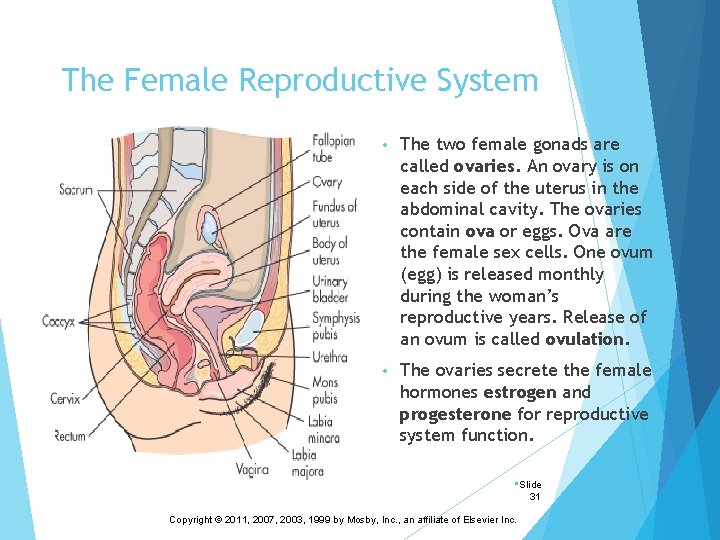
The Female Reproductive System • The two female gonads are called ovaries. An ovary is on each side of the uterus in the abdominal cavity. The ovaries contain ova or eggs. Ova are the female sex cells. One ovum (egg) is released monthly during the woman’s reproductive years. Release of an ovum is called ovulation. • The ovaries secrete the female hormones estrogen and progesterone for reproductive system function. • Slide 31 Copyright © 2011, 2007, 2003, 1999 by Mosby, Inc. , an affiliate of Elsevier Inc.
The Endocrine System The endocrine system is made up of glands called the endocrine glands. The endocrine glands secrete chemical substances called hormones into the bloodstream. Hormones regulate the activities of other organs and glands in the body. • Slide 32 Copyright © 2011, 2007, 2003, 1999 by Mosby, Inc. , an affiliate of Elsevier Inc.
The pituitary gland is called the master gland. It is at the base of the brain behind the eyes. The anterior pituitary lobe secretes: • Growth hormone (GH) • Thyroid-stimulating hormone (TSH) • Adrenocorticotropic hormone (ACTH) • Hormones that regulate growth, development, and function of the male and female reproductive systems The posterior pituitary lobe secretes: • Antidiuretic hormone (ADH) • Oxytocin • Slide 33 Copyright © 2011, 2007, 2003, 1999 by Mosby, Inc. , an affiliate of Elsevier Inc.
The thyroid gland is in the neck in front of the larynx. The thyroid gland secretes thyroid hormone (TH, thyroxin). Thyroid hormone regulates metabolism. The four parathyroid glands secrete parathormone. Two lie on each side of the thyroid gland. Parathormone regulates calcium use. • Slide 34 Copyright © 2011, 2007, 2003, 1999 by Mosby, Inc. , an affiliate of Elsevier Inc.
There are two adrenal glands. One is on the top of each kidney. The adrenal medulla secretes epinephrine and norepinephrine. The adrenal cortex secretes: Glucocorticoids Mineralocorticoids Small amounts of male and female sex hormones • Slide 35 Copyright © 2011, 2007, 2003, 1999 by Mosby, Inc. , an affiliate of Elsevier Inc.

The pancreas secretes insulin. Insulin regulates the amount of sugar in the blood available for use by the cells. The gonads are the glands of human reproduction. Male sex glands (testes) secrete testosterone. Female sex glands (ovaries) secrete estrogen and progesterone. • Slide 36 Copyright © 2011, 2007, 2003, 1999 by Mosby, Inc. , an affiliate of Elsevier Inc.

The Immune/Lymphatic System Protects the body from disease and infection Defends against threats inside and outside the body Gives the body immunity Antigens are substances that cause an immune response. Special cells and substances function to produce immunity: T lymphocytes (T cells) • Killer T cells • Slide 37 Copyright © 2011, 2007, 2003, 1999 by Mosby, Inc. , an affiliate of Elsevier Inc.
• Immunity means that a person has protection against a disease or condition. • The two main types of immunity are specific immunity (the body’s reaction to a certain threat) and nonspecific immunity (the body’s reaction to anything it does not recognize as a normal body substance). • Slide 38 Copyright © 2011, 2007, 2003, 1999 by Mosby, Inc. , an affiliate of Elsevier Inc.
Antibodies—normal body substances that recognize other substances. White blood cells fight infection What would an elevated WBC level indicate? • Slide 39 Copyright © 2011, 2007, 2003, 1999 by Mosby, Inc. , an affiliate of Elsevier Inc.
Basic knowledge of the body’s normal structure and function: Will help you better understand the reasons for the care you give • Slide 40 Copyright © 2011, 2007, 2003, 1999 by Mosby, Inc. , an affiliate of Elsevier Inc.
- Slides: 40