
Special Theory of Relativity Space and Time Inertial
- Slides: 53
Special Theory of Relativity Space and Time
Inertial reference frames • Reference frames in which Newton’s first law is valid. – In other words, a reference frame that is either at rest, or moving at a constant velocity. • Noninertial reference frames are ones in which the reference frame is rotating or vibrating – Objects will tend to move towards the outside of the circle when rotating.
Relativity principle • The basic laws of physics are the same in all inertial reference frames. • Example: You are on a moving train playing Ping-Pong. • All the physics of Ping-Pong will remain the same as long as the train is moving at a constant speed.
Coin Example • Suppose moving down a highway at a constant speed in a car you flip a coin above your head within the car. • How does the motion look to a person in the car? • How does the motion of the coin appear to a person observing the car passing?
Coin Example • For a person in the car, the object falls straight down. • For an observer on Earth watching the car, the coin follows a curved path like parabolic motion. • For each inertial frame of reference, the motion follows the laws of physics.
Velocity in relativity • Suppose your friend is on a flatbed truck throwing a baseball to you at 60 mph. • What is the speed of the ball when you catch it if the truck is – At rest? – Moving towards you at 40 mph? – Moving away from you at 40 mph?
Acceleration in relativity • A train is moving East at 45 mph • A person walking on the train West accelerates from 0 to 5 km/hr in 1 second. • You are an observer at a station the train is passing.
Acceleration in relativity • Train reference frame is accel = 5 km/hr/s • Earth reference frame: a = (45 -40)/1 or a = 5 km/hr/s • The acceleration of a body is the SAME in all inertial reference frames according to classical mechanics.
Other constants • In all reference frames, mass is also constant. • Therefore, if mass and acceleration are constant, then force is constant in all reference frames!
Laws of mechanics • It can be shown that all laws of mechanics are the same in all inertial reference frames. • This is implies that no one inertial frame is special in any sense. Or… • All inertial reference frames are equivalent!
Maxwell messes things up • In the 1870’s Maxwell predicted the speed of light to be 3 x 10⁸ m/s. • But, in what reference frame?
Relativistic Speeds • Suppose a rocket ship travels at a speed of 1. 0 x 108 m/s. • An observer on a rocket ship observes light to be (3 x 10⁸ – 1 x 10⁸) 2 x 10⁸ m/s. • Maxwell stated that c should be constant. • This seemed to imply that there must be some special reference frame where c would have this value.
Another example on a smaller scale • Suppose your friend is still throwing a ball to you from a flatbed truck. • No matter what, moving towards you or not, the ball would be moving at 60 mph. • This means the truck is in its own special inertial reference frame according to Maxwell.
Relativity Principle • So to recap… • All laws of mechanics are the same in all inertial reference frames… • Except laws of electricity and magnetism. • Stupid Maxwell!
Into the Ether • Scientists in the late 1800 s were in search of a reference frame that was absolute. • …A reference frame where light would have different speeds relative to the ether.
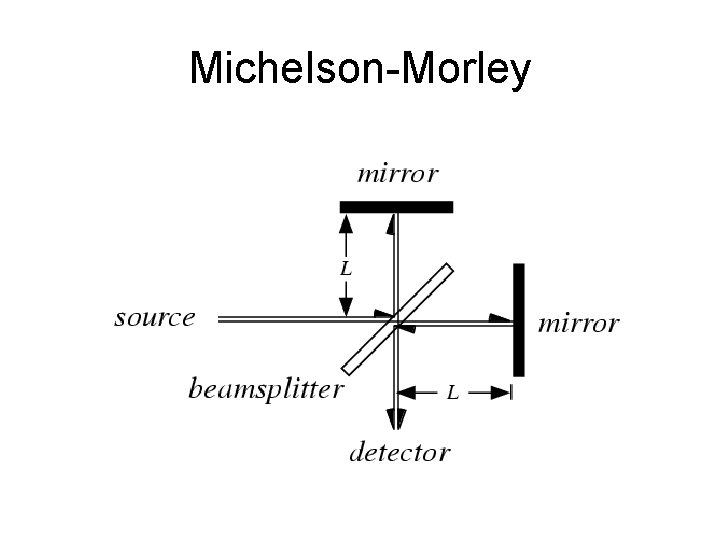
Michelson-Morley
Experiment • Suppose that the “Ether wind” is moving to the right in the diagram just shown. • Then, the velocity of the beam going to the right is c+v. • The velocity of the beam going up will be sqrt(c 2 -v 2)
Interference • If the beams were traveling at different speeds and arrive at the detector at different phases, there should be interference. • By changing the distance of the mirrors, Michelson-Morley can calculate v, the speed of the ether wind.
The null hypothesis • No significant interference pattern was observed! • Tried at different times of day and year (different orientations with the sun), but no interference patterns. • No ether velocity was found!
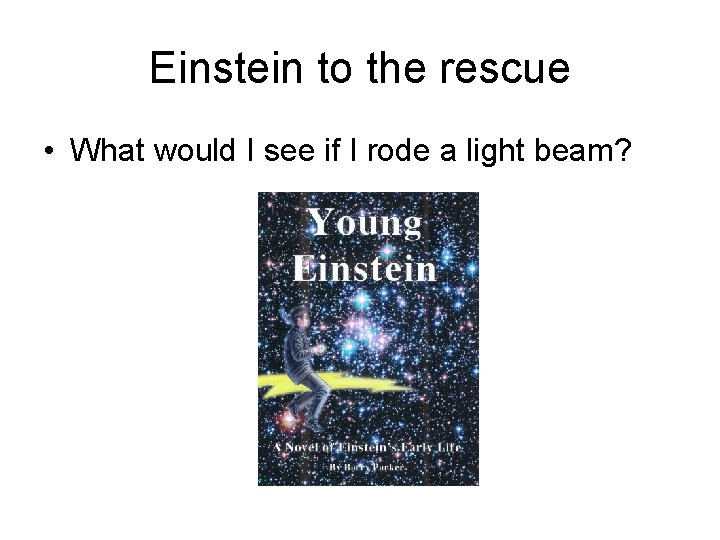
Einstein to the rescue • What would I see if I rode a light beam?
Riding the light • If you are riding a light wave the observer would see more light moving away from the rider at 3 x 10⁸ m/s as well. • There speed of light will be the same in all reference frames.
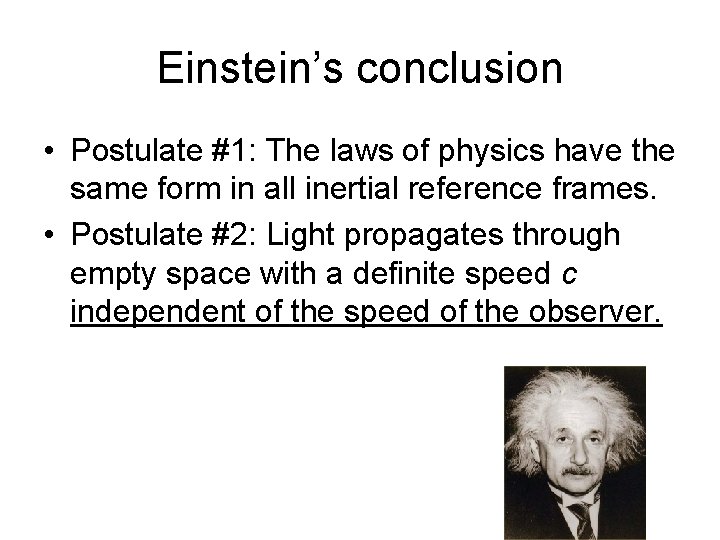
Einstein’s conclusion • Postulate #1: The laws of physics have the same form in all inertial reference frames. • Postulate #2: Light propagates through empty space with a definite speed c independent of the speed of the observer.
Why so special? • Special is in comparison to Einstein’s later theory of “general relativity”. • Special relativity (1905) refers to inertial frames. • General relativity (1916) deals with noninertial reference frames (accelerating, like rotating).
Violating commonsense • The 2 nd postulate means that the speed of light is the same for any observer. • If you are moving toward or away from a source of light, the speed of light will be the same as observed by someone at rest.
Gedanken Experiments • Gedanken is German for “thought”. • Einstein was famous for following up the mathematics with “thought experiments” to explain his theory of special relativity. • We will examine some of these now…
Simultaneity • Simultaneous – two events occur precisely at the same time. • How can we tell if events are simultaneous? • If the events are separated by a large distance, it is difficult since we must account for the time light has to travel to determine if the events are simultaneous.
Simultaneity • If two events appear to occur at the same time, then the one farther from the observer must have occurred earlier.
Thought experiment #1 • 1 st part: assume that an observer is halfway between two events, A and B. • If the observer, halfway between, sees the light from both events at the same time, we can conclude they occurred simultaneously. • illustration 2
The real question • If two events are simultaneous to an observer in one reference frame, are they also simultaneous to another observer moving with respect to the first?
Thinking… • Suppose two observers are fixed in position, but are moving relative to each other (like staying still on a moving train). • Observer 1 can say that observer 2 is moving to the right with speed v • Observer 2 can say that observer 1 is moving to the left with speed v.
Still thinking… • Suppose now two simultaneous events occur that are observed and measured by both observers. • For observer 1, the events appear simultaneous. • For observer 1 looking at observer 2, they will appear to be not simultaneous because they are moving.
Done thinking… • Two events which are simultaneous to one observer are not necessarily simultaneous to a second observer. • Simultaneity is therefore not absolute, it is relative. • illustration 3
2 nd thought experiment • Since simultaneity is different for different reference frames, that means that time is also relative. • This brings a new thought experiment…
Time dilation • Suppose there is an observer on Earth and an observer on a space ship traveling past Earth. • On the space ship, a light source is shined onto a mirror and then reflected back to a receiver connected to a clock.
Time dilation • The observer on the space ship will see the time traveling as t = 2 D/c, where D is the distance from the source to the mirror. • The person on Earth will observe the light traveling over a distance in a 2 nd dimension (not just back and forth from the mirror)
Time dilation • The observer on earth will see the light traveling at a distance of 2*sqrt(D 2+L 2), where L is the distance traveled by the space ship. • Mathematically, we can show that the time traveled between two events is greater for the observer on Earth than for the observer on the space ship. • illustration 4
Evidence for time dilation • Time dilation only works at relativistic speeds. • An experiment in the 1970’s showed that muons will have a longer lifetime when traveling at high speeds than when at rest.
Space Travel • Suppose we want to reach a star 100 light years away. • Even if we can travel at the speed of light, it would take 100 years to reach the star. • But time dilation shows that the time involved would be less for the astronaut.
Time dilation example • Mathematically, we can show that travelling at 0. 999 c, the astronaut would only feel like 4. 5 years have passed. • But, is it just the clocks that would slow down for the astronaut? ?
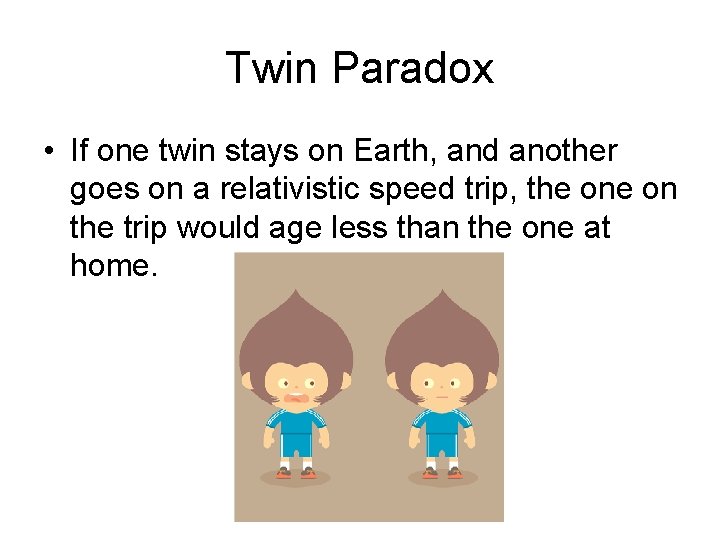
Twin Paradox • The astronaut would experience 4. 5 years of normal sleeping , eating, reading, and so on. • People on Earth would experience 100 years.
Twin Paradox • If one twin stays on Earth, and another goes on a relativistic speed trip, the on the trip would age less than the one at home.
Now for the paradox • What about the view point for the traveling twin? • Earth is moving away at a high speed, so time will pass more slowly on Earth. • So won’t the twin on Earth therefore age less in the reference frame of the traveling twin?
To help solve this paradox… • Let’s have the ship leaving earth send a signal of light every 6 minutes going away from Earth for 1 hour. • Let’s say that the speed of the ship is such that Earth will receive the signals every 12 minutes. • During the hour trip, the ship gives out 10 flashes.
• How many flashes will Earth receive? • How long until Earth receives the last signal? • Suppose the ship left at 12 PM. • It would be 1 PM on the ship, but 2 PM on Earth when the last signal is sent.
Return trip • Now the ship miraculously turns around without decelerating or accelerating and returns to Earth at the same speed… • The return trip, the ship still sends 10 signals, one every 6 minutes. • Earth sees them every 3 minutes. • Earth will see the last one after 30 minutes
Spaceship time vs. Earth time • • On the space ship, it will be 2 PM. On Earth it will be 2: 30 PM There is still a time dilation! The twins will be different ages.
What if Earth sends the signal? • Using the same analysis with the Earth person sending the signal to the Space ship (this is the paradox part) • What time is it for the spaceship twin? What time is it for the Earth twin? • exploration 3
Implications for space travel • Suppose we want to go to Prycon which is 11. 4 light years away. • If we travel at 99% of the speed of light, it would take 23 Earth years to travel there and back (just double it) • But the astronaut would only age 3 years.
• The mission control would welcome back an astronaut 23 years later, but the astronaut would only be 3 years older!
Is this practical? • No, it would take billions of times the energy used to get spaceships just into Earth’s orbit.
But what if we could… • We could time travel forward into the future! • If we travel really fast, we could see some elapse in time for the traveler, but a lot of time elapsed here on Earth.
Length contraction • Similar to time dilation… • The length of an object is measured to be shorter when it is moving relative to the observer that is at rest. • In other words, moving objects are shorter than stationary…. • Think “warp speed”