
Special Relativity graphically explained along with several otherwise

- Slides: 29
Special Relativity graphically explained (along with several otherwise inexplicable features of light) (Powerpoint format) By James R Arnold swprod@sonic. net (mouse-click to advance to the next slide)
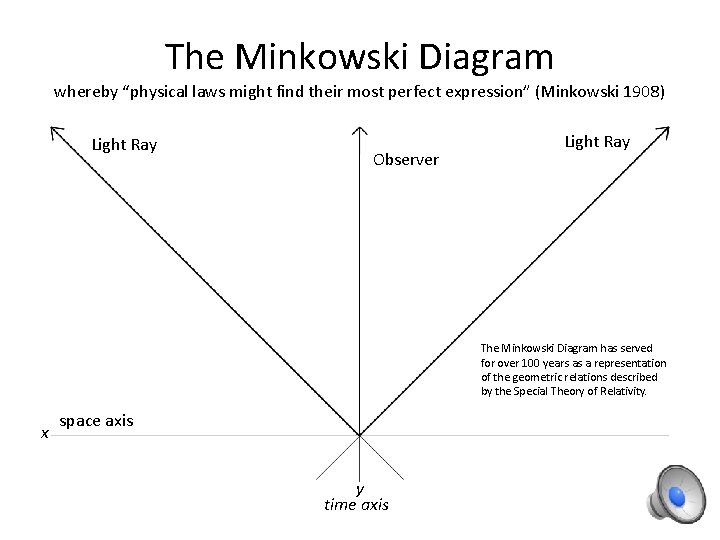
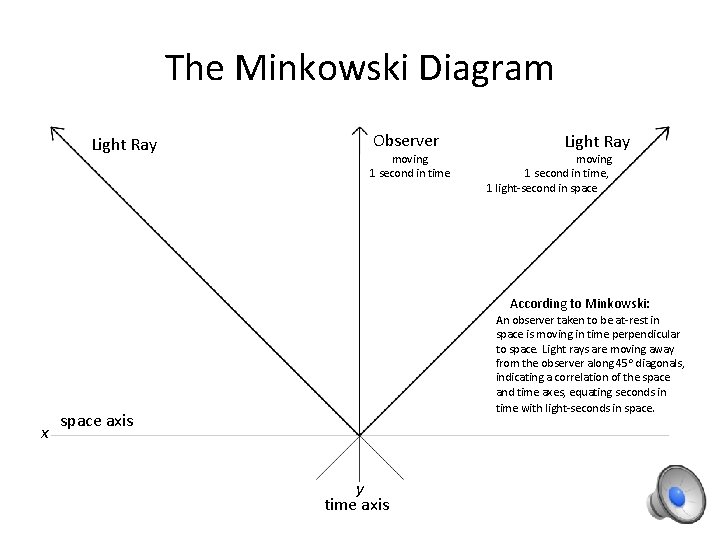
The Minkowski Diagram whereby “physical laws might find their most perfect expression” (Minkowski 1908) Light Ray Observer Light Ray The Minkowski Diagram has served for over 100 years as a representation of the geometric relations described by the Special Theory of Relativity. x space axis y time axis
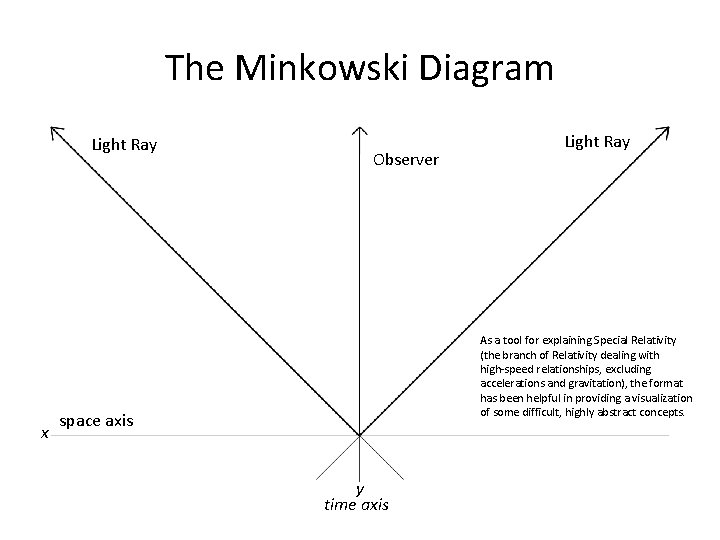
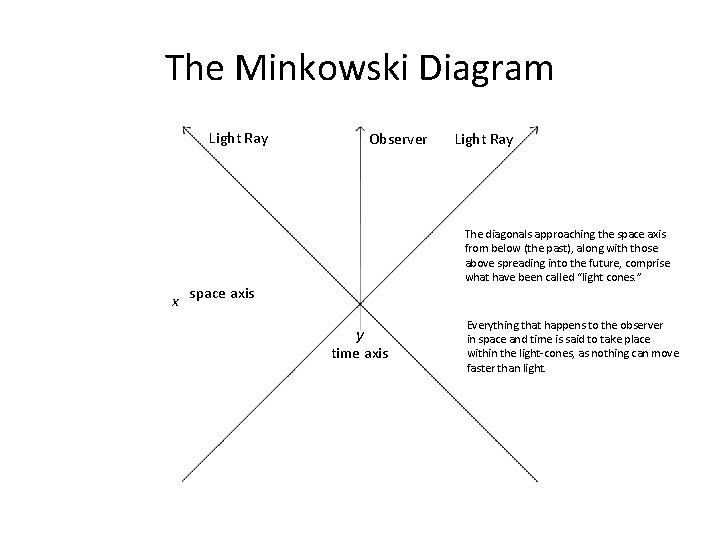
The Minkowski Diagram Light Ray x Observer Light Ray As a tool for explaining Special Relativity (the branch of Relativity dealing with high-speed relationships, excluding accelerations and gravitation), the format has been helpful in providing a visualization of some difficult, highly abstract concepts. space axis y time axis
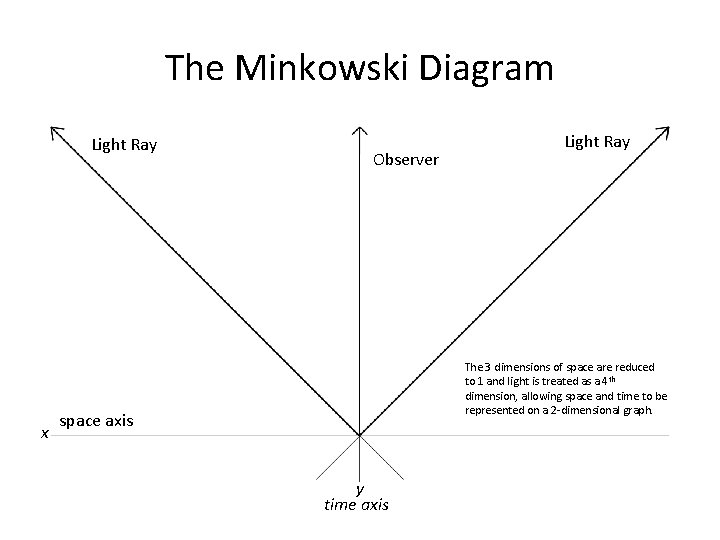
The Minkowski Diagram Light Ray x Observer Light Ray The 3 dimensions of space are reduced to 1 and light is treated as a 4 th dimension, allowing space and time to be represented on a 2 -dimensional graph. space axis y time axis
The Minkowski Diagram Light Ray Observer moving 1 second in time Light Ray moving 1 second in time, 1 light-second in space According to Minkowski: x An observer taken to be at-rest in space is moving in time perpendicular to space. Light rays are moving away from the observer along 45 o diagonals, indicating a correlation of the space and time axes, equating seconds in time with light-seconds in space axis y time axis
The Minkowski Diagram Light Ray Observer Light Ray The diagonals approaching the space axis from below (the past), along with those above spreading into the future, comprise what have been called “light cones. ” x space axis y time axis Everything that happens to the observer in space and time is said to take place within the light-cones, as nothing can move faster than light.
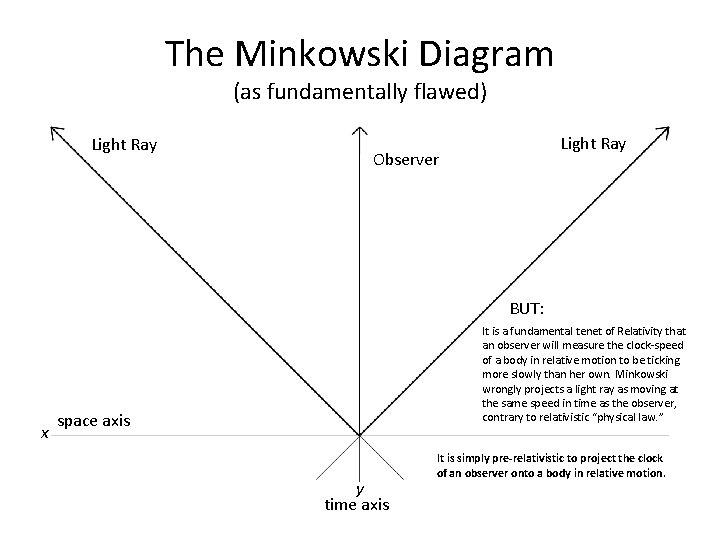
The Minkowski Diagram (as fundamentally flawed) Light Ray Observer BUT: x It is a fundamental tenet of Relativity that an observer will measure the clock-speed of a body in relative motion to be ticking more slowly than her own. Minkowski wrongly projects a light ray as moving at the same speed in time as the observer, contrary to relativistic “physical law. ” space axis y time axis It is simply pre-relativistic to project the clock of an observer onto a body in relative motion.
Minkowski’s contributions Minkowski’s valid contributions to Relativity are nonetheless significant. Building on Einstein’s insight that uniform (un-accelerated) motion is relative, he recognized that: • Relativity is about geometric relationships. • Space and time form a four-dimensional continuum, “Spacetime”, which means that to move in time in one’s own coordinate system is to move partially in space, partially in time in the coordinate system of someone who is in relative motion. (To be illustrated below)
Before considering an alternative to the Minkowski diagram, there is one prerequisite concept to discuss:
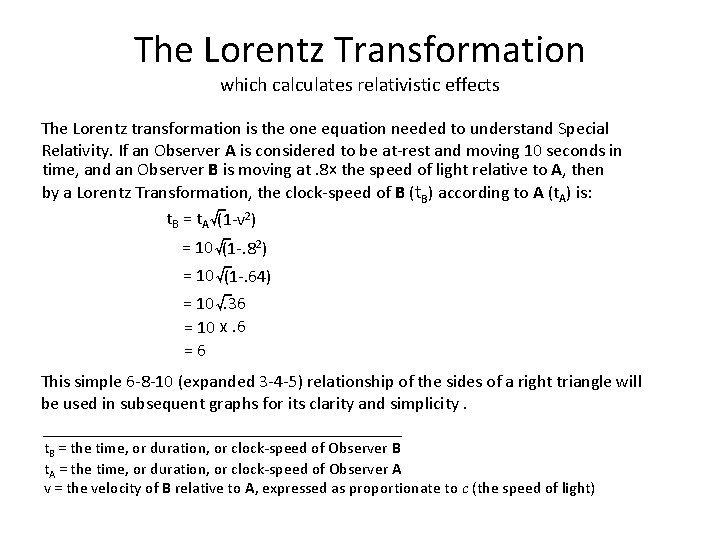
The Lorentz Transformation which calculates relativistic effects The Lorentz transformation is the one equation needed to understand Special Relativity. If an Observer A is considered to be at-rest and moving 10 seconds in time, and an Observer B is moving at. 8 x the speed of light relative to A, then by a Lorentz Transformation, the clock-speed of B (t. B) according to A (t. A) is: t B = t A√ (1 -v 2) = 10√ (1 -. 82) = 10√(1 -. 64) = 10√. 36 = 10 x. 6 =6 This simple 6 -8 -10 (expanded 3 -4 -5) relationship of the sides of a right triangle will be used in subsequent graphs for its clarity and simplicity. ____________________ t. B = the time, or duration, or clock-speed of Observer B t. A = the time, or duration, or clock-speed of Observer A v = the velocity of B relative to A, expressed as proportionate to c (the speed of light)
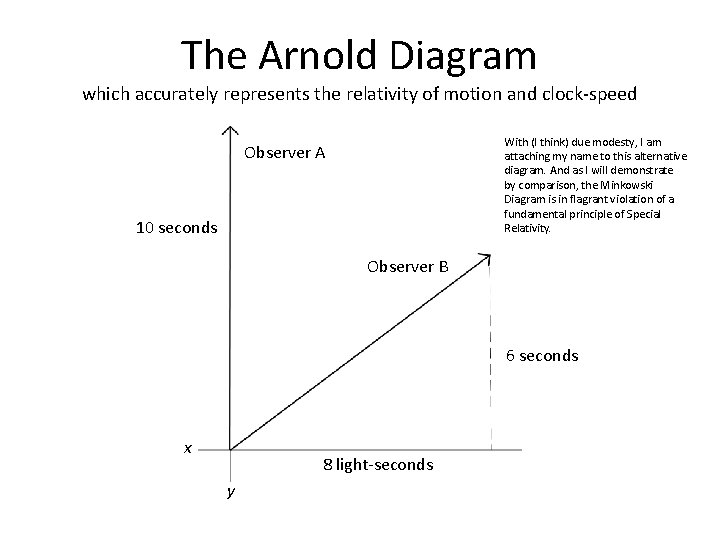
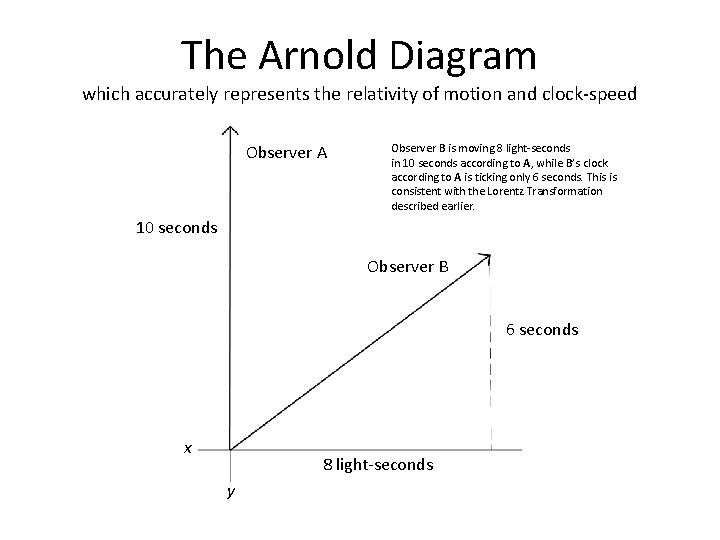
The Arnold Diagram which accurately represents the relativity of motion and clock-speed With (I think) due modesty, I am attaching my name to this alternative diagram. And as I will demonstrate by comparison, the Minkowski Diagram is in flagrant violation of a fundamental principle of Special Relativity. Observer A 10 seconds Observer B 6 seconds x 8 light-seconds y
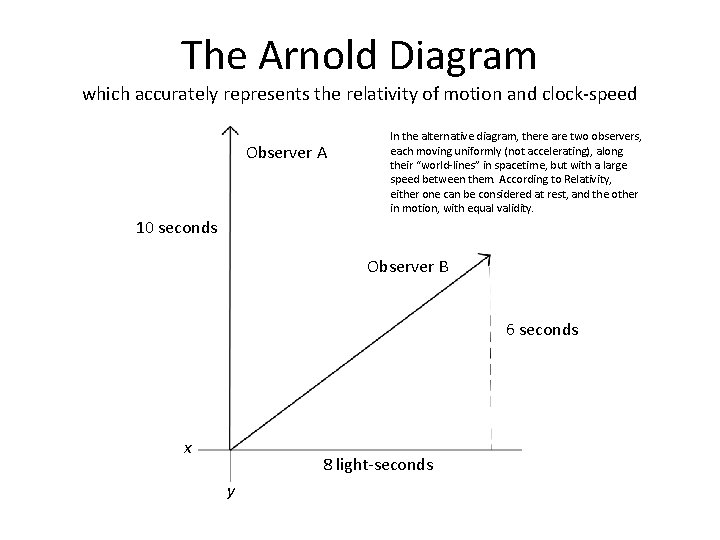
The Arnold Diagram which accurately represents the relativity of motion and clock-speed Observer A In the alternative diagram, there are two observers, each moving uniformly (not accelerating), along their “world-lines” in spacetime, but with a large speed between them. According to Relativity, either one can be considered at rest, and the other in motion, with equal validity. 10 seconds Observer B 6 seconds x 8 light-seconds y
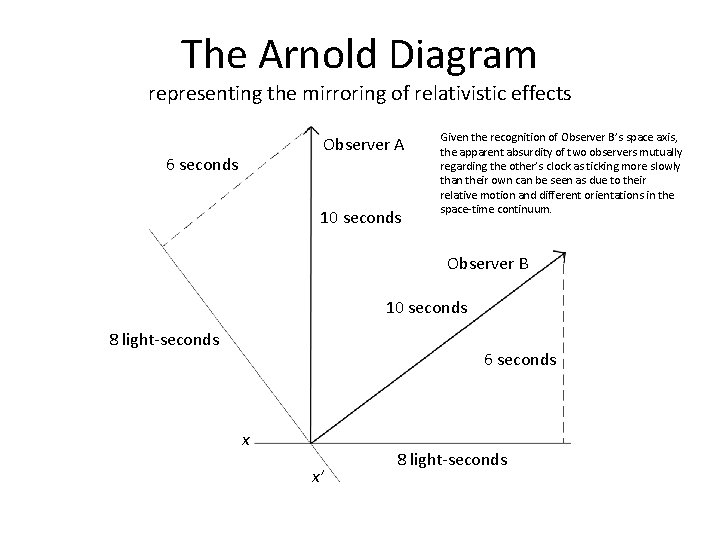
The Arnold Diagram which accurately represents the relativity of motion and clock-speed Observer A Observer B is moving 8 light-seconds in 10 seconds according to A, while B’s clock according to A is ticking only 6 seconds. This is consistent with the Lorentz Transformation described earlier. 10 seconds Observer B 6 seconds x 8 light-seconds y
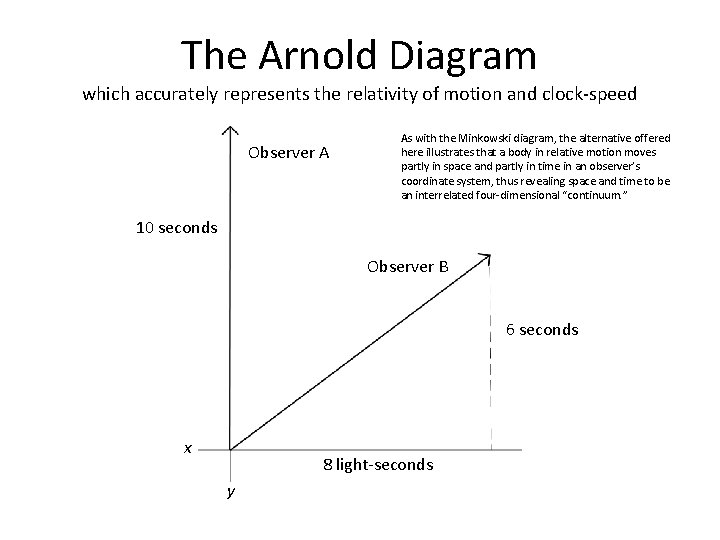
The Arnold Diagram which accurately represents the relativity of motion and clock-speed Observer A As with the Minkowski diagram, the alternative offered here illustrates that a body in relative motion moves partly in space and partly in time in an observer’s coordinate system, thus revealing space and time to be an interrelated four-dimensional “continuum. ” 10 seconds Observer B 6 seconds x 8 light-seconds y
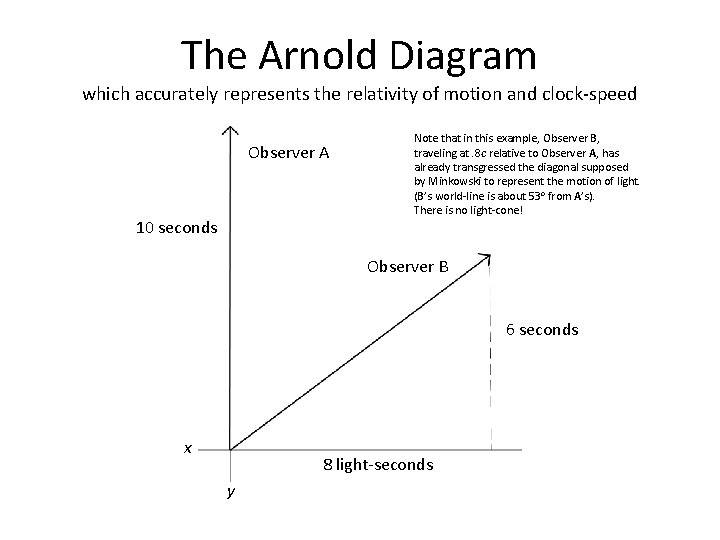
The Arnold Diagram which accurately represents the relativity of motion and clock-speed Observer A 10 seconds Note that in this example, Observer B, traveling at. 8 c relative to Observer A, has already transgressed the diagonal supposed by Minkowski to represent the motion of light. (B’s world-line is about 53 o from A’s). There is no light-cone! Observer B 6 seconds x 8 light-seconds y
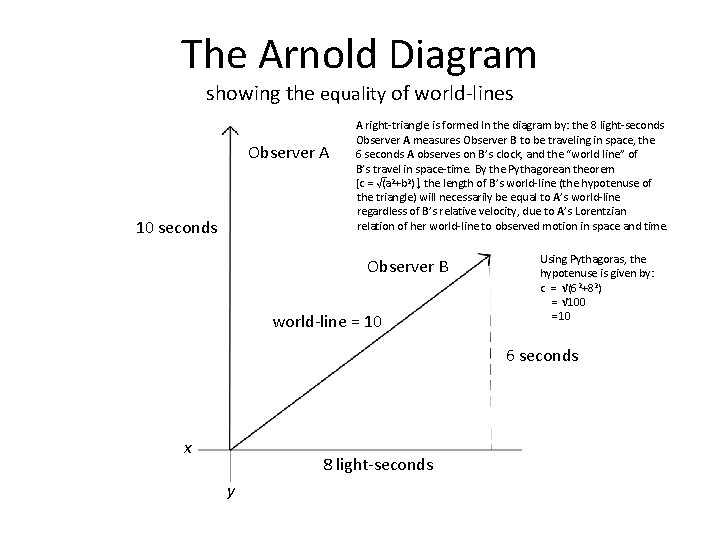
The Arnold Diagram showing the equality of world-lines Observer A 10 seconds A right-triangle is formed In the diagram by: the 8 light-seconds Observer A measures Observer B to be traveling in space, the 6 seconds A observes on B’s clock, and the “world line” of B’s travel in space-time. By the Pythagorean theorem [c = √(a 2+b 2) ], the length of B’s world-line (the hypotenuse of the triangle) will necessarily be equal to A’s world-line regardless of B’s relative velocity, due to A’s Lorentzian relation of her world-line to observed motion in space and time. Observer B world-line = 10 Using Pythagoras, the hypotenuse is given by: c = √(62+82) = √ 100 = 10 6 seconds x 8 light-seconds y
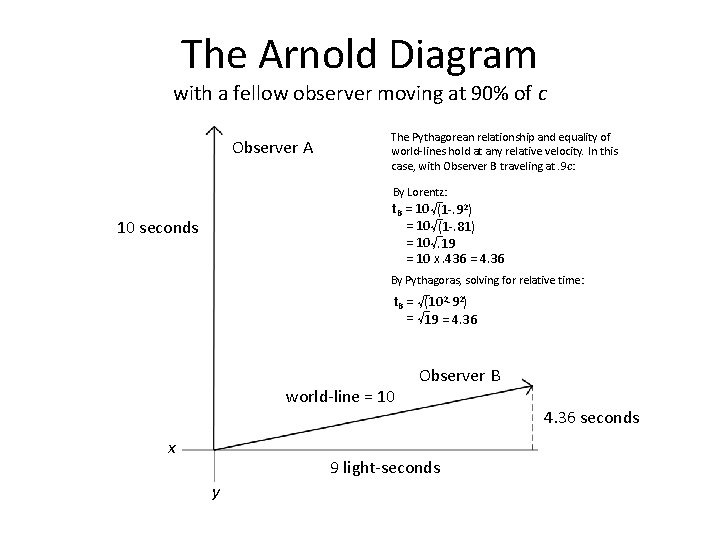
The Arnold Diagram with a fellow observer moving at 90% of c Observer A The Pythagorean relationship and equality of world-lines hold at any relative velocity. In this case, with Observer B traveling at. 9 c: By Lorentz: t. B = 10√(1 -. 92) = 10√(1 -. 81) = 10√. 19 = 10 x. 436 = 4. 36 10 seconds By Pythagoras, solving for relative time: t. B = √(102 -92) = √ 19 = 4. 36 world-line = 10 x Observer B 9 light-seconds y 4. 36 seconds
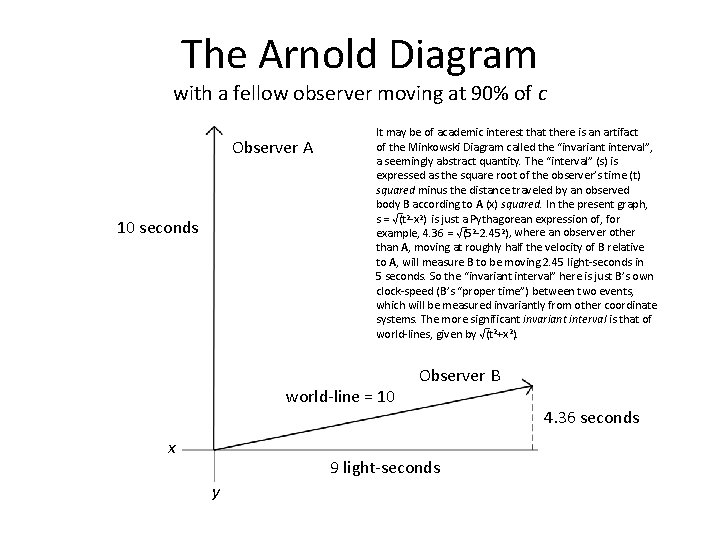
The Arnold Diagram with a fellow observer moving at 90% of c Observer A 10 seconds It may be of academic interest that there is an artifact of the Minkowski Diagram called the “invariant interval”, a seemingly abstract quantity. The “interval” (s) is expressed as the square root of the observer’s time (t) squared minus the distance traveled by an observed body B according to A (x) squared. In the present graph, s = √(t 2 -x 2) is just a Pythagorean expression of, for example, 4. 36 = √(52 -2. 452), where an observer other than A, moving at roughly half the velocity of B relative to A, will measure B to be moving 2. 45 light-seconds in 5 seconds. So the “invariant interval” here is just B’s own clock-speed (B’s “proper time”) between two events, which will be measured invariantly from other coordinate systems. The more significant invariant interval is that of world-lines, given by √(t 2+x 2). world-line = 10 x Observer B 9 light-seconds y 4. 36 seconds
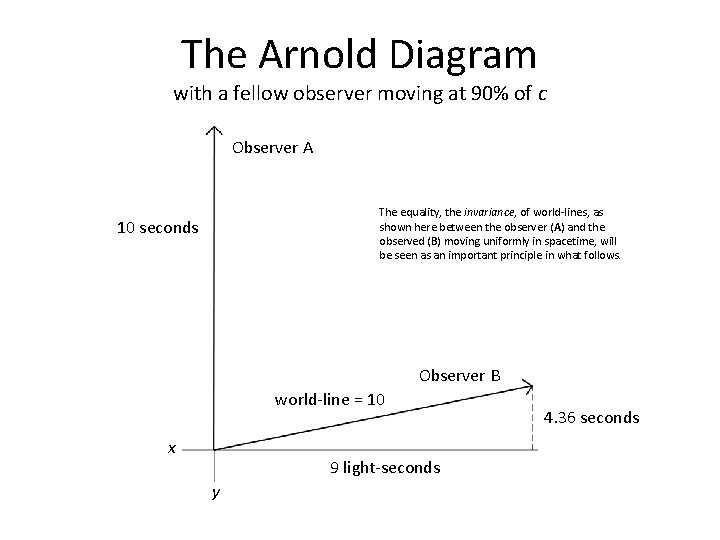
The Arnold Diagram with a fellow observer moving at 90% of c Observer A The equality, the invariance, of world-lines, as shown here between the observer (A) and the observed (B) moving uniformly in spacetime, will be seen as an important principle in what follows. 10 seconds Observer B world-line = 10 x 9 light-seconds y 4. 36 seconds
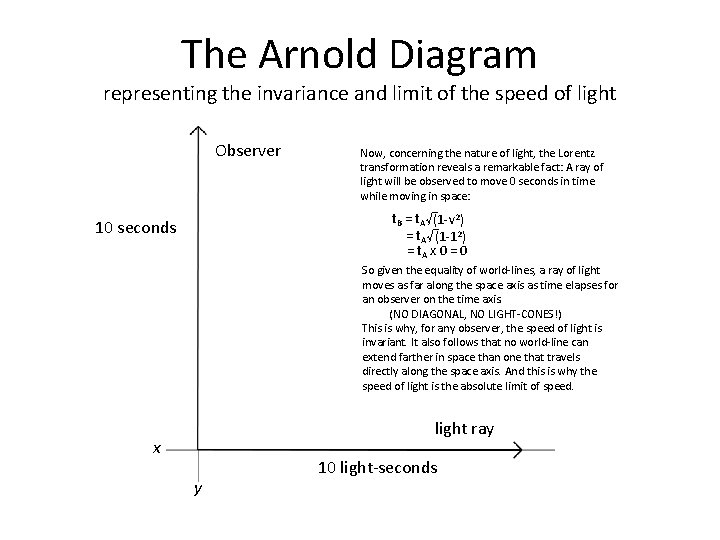
The Arnold Diagram representing the invariance and limit of the speed of light Observer Now, concerning the nature of light, the Lorentz transformation reveals a remarkable fact: A ray of light will be observed to move 0 seconds in time while moving in space: t. B = t. A√(1 -v 2) = t. A√(1 -12) = t. A x 0 = 0 10 seconds So given the equality of world-lines, a ray of light moves as far along the space axis as time elapses for an observer on the time axis. (NO DIAGONAL, NO LIGHT-CONES!) This is why, for any observer, the speed of light is invariant. It also follows that no world-line can extend farther in space than one that travels directly along the space axis. And this is why the speed of light is the absolute limit of speed. light ray x y 10 light-seconds
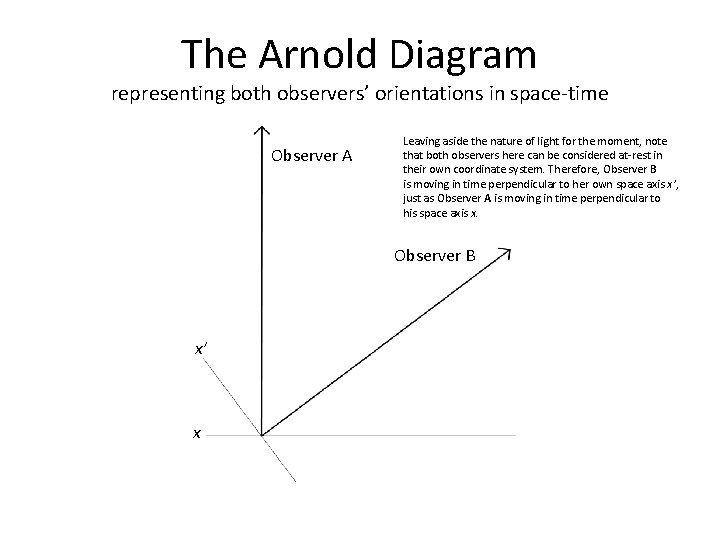
The Arnold Diagram representing both observers’ orientations in space-time Observer A Leaving aside the nature of light for the moment, note that both observers here can be considered at-rest in their own coordinate system. Therefore, Observer B is moving in time perpendicular to her own space axis x’, just as Observer A is moving in time perpendicular to his space axis x. Observer B x’ x
The Arnold Diagram representing the mirroring of relativistic effects Observer A 6 seconds 10 seconds Given the recognition of Observer B’s space axis, the apparent absurdity of two observers mutually regarding the other’s clock as ticking more slowly than their own can be seen as due to their relative motion and different orientations in the space-time continuum. Observer B 10 seconds 8 light-seconds 6 seconds x x’ 8 light-seconds
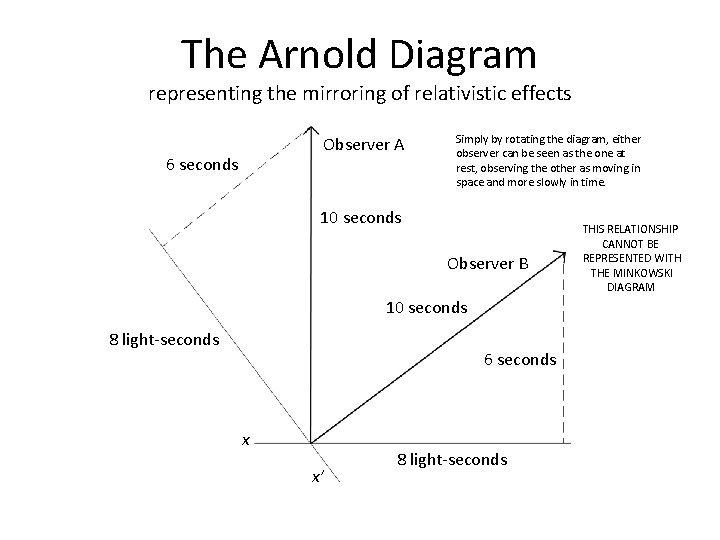
The Arnold Diagram representing the mirroring of relativistic effects Observer A 6 seconds Simply by rotating the diagram, either observer can be seen as the one at rest, observing the other as moving in space and more slowly in time. 10 seconds Observer B 10 seconds 8 light-seconds 6 seconds x x’ 8 light-seconds THIS RELATIONSHIP CANNOT BE REPRESENTED WITH THE MINKOWSKI DIAGRAM
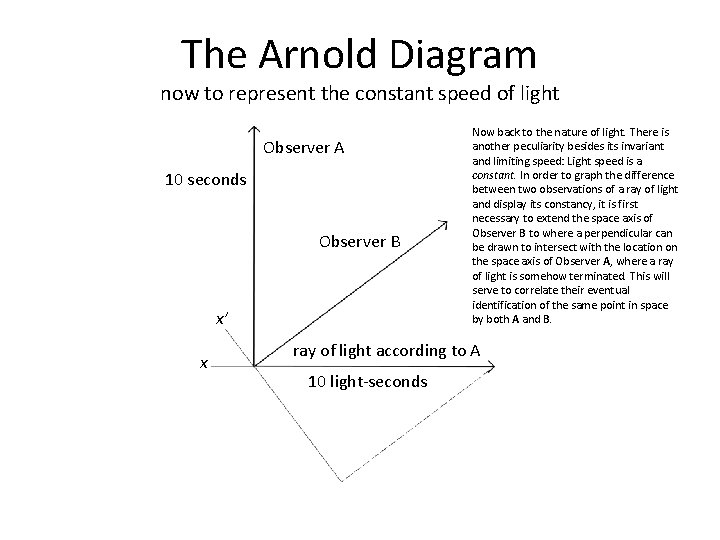
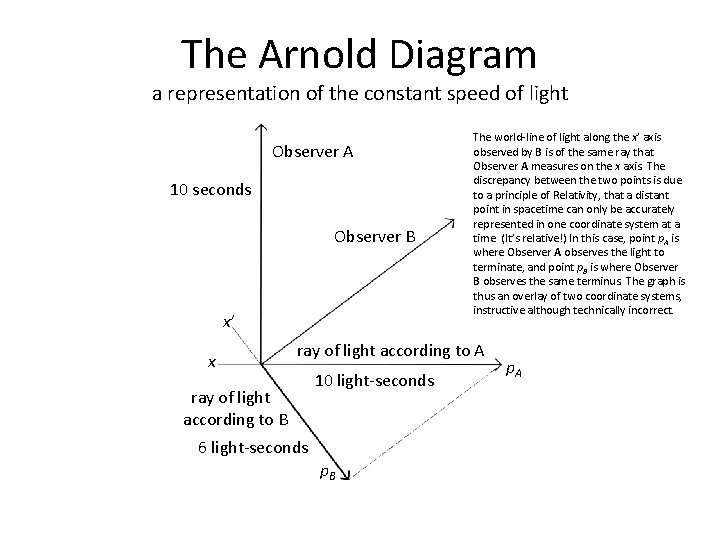
The Arnold Diagram now to represent the constant speed of light Observer A 10 seconds Observer B x’ x Now back to the nature of light. There is another peculiarity besides its invariant and limiting speed: Light speed is a constant. In order to graph the difference between two observations of a ray of light and display its constancy, it is first necessary to extend the space axis of Observer B to where a perpendicular can be drawn to intersect with the location on the space axis of Observer A, where a ray of light is somehow terminated. This will serve to correlate their eventual identification of the same point in space by both A and B. ray of light according to A 10 light-seconds
The Arnold Diagram a representation of the constant speed of light Observer A 10 seconds Observer B x’ x The world-line of light along the x’ axis observed by B is of the same ray that Observer A measures on the x axis. The discrepancy between the two points is due to a principle of Relativity, that a distant point in spacetime can only be accurately represented in one coordinate system at a time. (It’s relative!) In this case, point p. A is where Observer A observes the light to terminate, and point p. B is where Observer B observes the same terminus. The graph is thus an overlay of two coordinate systems, instructive although technically incorrect. ray of light according to A ray of light according to B 10 light-seconds 6 light-seconds p. B p. A
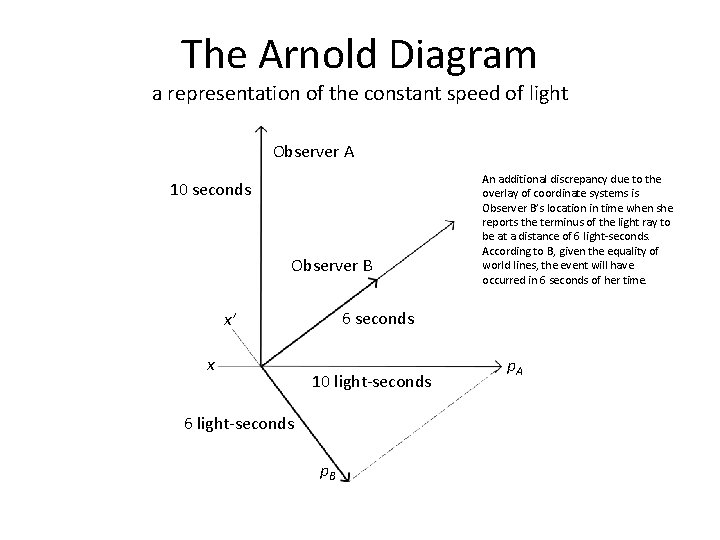
The Arnold Diagram a representation of the constant speed of light Observer A 10 seconds Observer B 6 seconds x’ x An additional discrepancy due to the overlay of coordinate systems is Observer B’s location in time when she reports the terminus of the light ray to be at a distance of 6 light-seconds. According to B, given the equality of world lines, the event will have occurred in 6 seconds of her time. 10 light-seconds 6 light-seconds p. B p. A
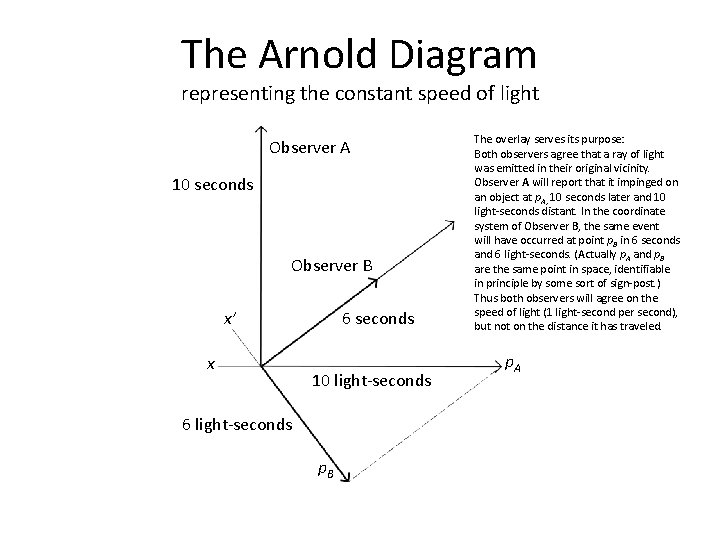
The Arnold Diagram representing the constant speed of light Observer A 10 seconds Observer B 6 seconds x’ x 10 light-seconds 6 light-seconds p. B The overlay serves its purpose: Both observers agree that a ray of light was emitted in their original vicinity. Observer A will report that it impinged on an object at p. A, 10 seconds later and 10 light-seconds distant. In the coordinate system of Observer B, the same event will have occurred at point p. B in 6 seconds and 6 light-seconds. (Actually p. A and p. B are the same point in space, identifiable in principle by some sort of sign-post. ) Thus both observers will agree on the speed of light (1 light-second per second), but not on the distance it has traveled. p. A
The Arnold Diagram Summation The alternative to the Minkowski diagram has demonstrated and clarified the peculiar but real aspects of Special Relativity. It has done so based on the recognition that a projection of an observer’s clock-speed onto the relative spacetime motion of other bodies (as with the light cones) is a fundamental violation of Relativity. Clarifications have included: • How the world-lines of all bodies in uniform motion have the same length in spacetime • That bodies in relative motion have different orientations in space as well as time • How observers with relative motion between them will each observe the other to be moving more slowly in time • Why the speed of light is the absolute limit of speed • That light is a constant, and for any observer, the speed of light is ~300, 000 km (or ~186, 000 miles) per second, because in the continuum of spacetime, the distance it is observed to cover in space is equal in length to one second in time
I hope this presentation has been informative and helpful! Questions and comments are welcome. I can be reached at swprod@sonic. net