
Special Immigrant Juvenile Status SIJS Process and Procedure
- Slides: 63
Special Immigrant Juvenile Status (SIJS) Process and Procedure in VA & MD Presented by: Lauren Vogt, Owner/Attorney at L&L Immigration Law, PLLC Laura Jacobson, Owner/Attorney at L&L Immigration Law, PLLC Michelle Mendez, Senior Attorney at Catholic Charities of the Archdiocese of Washington Immigration Legal Services
SIJS Overview � Immigration benefit available to children who have been abandoned, abused, or neglected by one or both of their parents � Must first obtain a dependency order from a state court with jurisdiction making certain factual findings 11/10/2020 2
History � Created by the Immigration Act of 1990 �SIJS: 8 U. S. C. § 1101(a)(27)(J) �SIJS adjustment: 8 U. S. C. § 1225(h) � Amended by Trafficking Victims Protection Reauthorization Act (TVPRA) of 2008 � Perez-Olano settlement age-out protection (December 2010) 11/10/2020 3
Requirements � Child is unmarried and under the age of 21 � Child is dependent on U. S. juvenile court* or placed into custody of individual/agency in the U. S. � Reunification with one or both parents is not viable due to abuse, neglect, abandonment, or similar basis � Not in child’s best interests to be returned to country of nationality/last habitual residence *Juvenile court is defined as a court with jurisdiction under state law to make determinations about care and custody of child 11/10/2020 4
Examples � A child was living with both parents in El Salvador, but was abused by his mother. He left from El Salvador because of the abuse and because he was scared of the gangs. He is now living with an aunt in the U. S. � A father abandoned the child’s mother when she was pregnant. The mother left from Guatemala for the U. S. when the child was 5 years old. The child now lives with the mother in the U. S. and has never had contact with the father. � Both parents left their daughter in Mexico with her grandparents when she was 4 years old. The mother sent money to Mexico to care for her daughter, but the father remained absent from the child’s life. The child is now living with her mother in the U. S. The father is also in the U. S. , but does not support his daughter. 11/10/2020 5
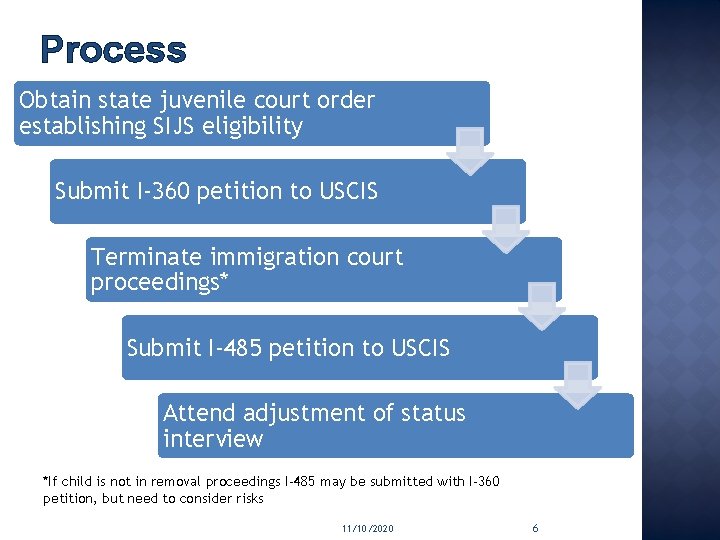
Process Obtain state juvenile court order establishing SIJS eligibility Submit I-360 petition to USCIS Terminate immigration court proceedings* Submit I-485 petition to USCIS Attend adjustment of status interview *If child is not in removal proceedings I-485 may be submitted with I-360 petition, but need to consider risks 11/10/2020 6
Tips on Working with Minors Patience: These minors are often traumatized and therefore shut down. � Schedule Many Meetings for Declaration Drafting: Because these minors often shut down, many meetings will enable you to get an accurate account of the facts. � Consider Counseling: Because the minors are traumatized, consider referring the minor for counseling. If the minor obtained counseling while in ORR custody, obtain those records from ORR. � Obtain In Writing: That the minor understands all the things that could jeopardize the SIJS process and provide a copy of this document to the minor. � Apply for a Passport: Minors will need ID along the process and sometimes the ORR Verification of Release Form does not suffice. If the minor is simultaneously applying for asylum, then the minor should NOT apply for a passport. � L&L Immigration Law, PLLC 11/10/2020 7
Obtaining the Predicate Order: VIRGINIA Juvenile & Domestic Relations Courts 11/10/2020 8
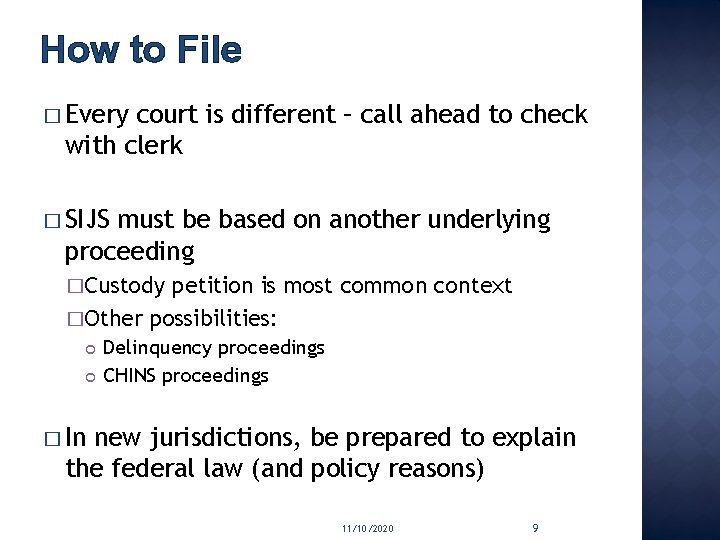
How to File � Every court is different – call ahead to check with clerk � SIJS must be based on another underlying proceeding �Custody petition is most common context �Other possibilities: Delinquency proceedings CHINS proceedings � In new jurisdictions, be prepared to explain the federal law (and policy reasons) 11/10/2020 9
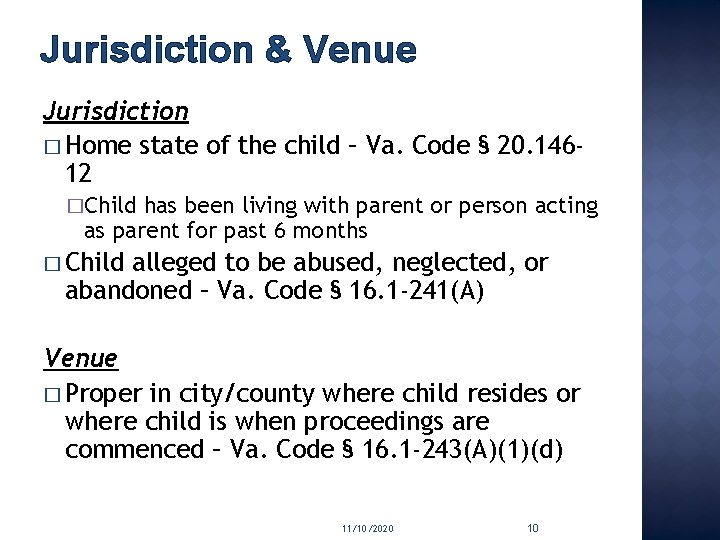
Jurisdiction & Venue Jurisdiction � Home state of the child – Va. Code § 20. 14612 �Child has been living with parent or person acting as parent for past 6 months � Child alleged to be abused, neglected, or abandoned – Va. Code § 16. 1 -241(A) Venue � Proper in city/county where child resides or where child is when proceedings are commenced – Va. Code § 16. 1 -243(A)(1)(d) 11/10/2020 10
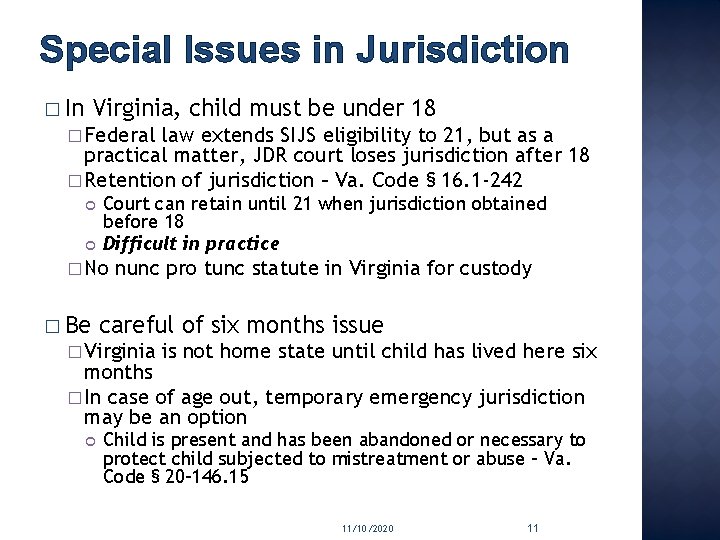
Special Issues in Jurisdiction � In Virginia, child must be under 18 � Federal law extends SIJS eligibility to 21, but as a practical matter, JDR court loses jurisdiction after 18 � Retention of jurisdiction – Va. Code § 16. 1 -242 Court can retain until 21 when jurisdiction obtained before 18 Difficult in practice � No nunc pro tunc statute in Virginia for custody � Be careful of six months issue � Virginia is not home state until child has lived here six months � In case of age out, temporary emergency jurisdiction may be an option Child is present and has been abandoned or necessary to protect child subjected to mistreatment or abuse – Va. Code § 20 -146. 15 11/10/2020 11
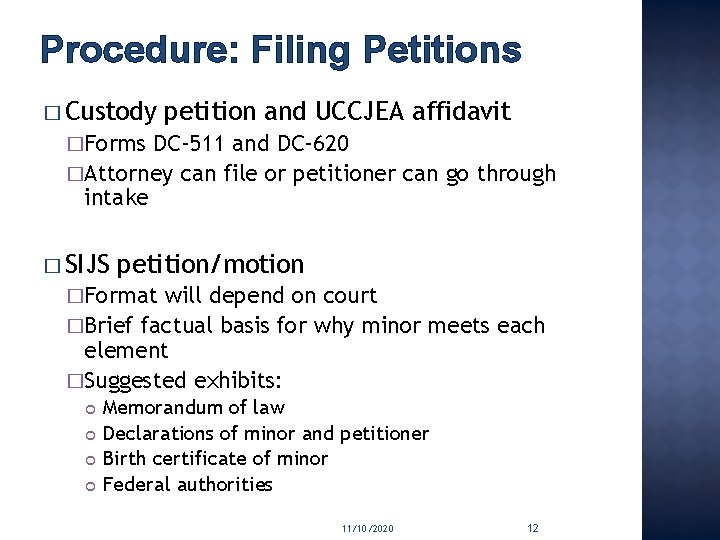
Procedure: Filing Petitions � Custody petition and UCCJEA affidavit �Forms DC-511 and DC-620 �Attorney can file or petitioner can go through intake � SIJS petition/motion �Format will depend on court �Brief factual basis for why minor meets each element �Suggested exhibits: Memorandum of law Declarations of minor and petitioner Birth certificate of minor Federal authorities 11/10/2020 12
Procedure: Service of Process � Parents must have notice of custody proceeding � Notice to persons outside state – Va. Code § 20 -146. 7 �May be by certified or registered mail, return receipt requested, last known address �Service by publication – Va. Code §§ 8. 01 -316, 317 Newspaper Posted at courthouse 11/10/2020 13
Special Issues in Service of Process � Timing issues for publication �Hearing date may be no earlier than 50 days after entry of publication �Must run 4 consecutive weeks � Waiver of service and consent to custody/SIJS �If parent(s) are willing to cooperate �Signed and notarized original �Advisable when served by mail at last-known out of state address 11/10/2020 14
Procedure: Drafting proposed order � Include proposed order with petitions � Recent pushback from USCIS on “boilerplate” orders �More fact-specific is better “Jose cannot be reunified with father due to abandonment at the age of six, father’s lack of support since then, or with mother because of her physical abuse of him since age eight and later abandonment” “Not in his best interest to return – no one to care for him in El Salvador due to abandonment by both parents and recent health problems of his maternal grandmother, who had been caring for him” 11/10/2020 15
Procedure: GAL may be appointed � Guardian ad litem – appointed to represent best interest of child � Depends on the court— �Some courts only appoint GALs when petitioner is not a parent �Some courts always appoint GALs �Some courts never appoint GALs � Use your GAL �Helps credibility GAL likely already has an established relationship with the judge Confirms your story �May be helpful on procedural issues 11/10/2020 16
Substance: Under 21 and Unmarried Federal requirement: � Minor is under the age of 21 and unmarried State considerations: � Usually not an issue at this stage of the process 11/10/2020 17
Substance: Dependent on Court Federal requirement: � Child must be dependent on juvenile court or legally committed to/placed under custody of a State agency or department or an individual or entity appointed by State or juvenile court State considerations: � This element changed under 2008 TVPRA �Be prepared to explain change to judges who may have seen these cases in another context before 2008 11/10/2020 18
Substance: Dependent on Court State considerations cont. : � Custody case – petitioner is “individual appointed by court” �This is why underlying custody petition is necessary � Other options (agency, department, entity) – �Department of Social Services �Child Protective Services �Foster care �Juvenile detention facility 11/10/2020 19
Substance: Abuse, Neglect, Abandonment Federal requirement: � Reunification with one or both parents is not viable due to abuse, neglect, abandonment or similar basis found under State law State considerations – abuse or neglect: � Under Va. law, an abused or neglected child is one whose parent(s) “create or inflict, threaten to create or inflict, or allow to be created or inflicted upon the child, a physical or mental injury” – Va. Code § 16. 1 -228(1) 11/10/2020 20
Substance: Abuse, Neglect, Abandonment State considerations – abuse or neglect cont. : � Also in the definition: �Whose parent(s) neglect or refuse to provide care necessary for health �Whose parent(s) abandon him/her �Whose parent(s) commit or allow to be committed any sexual act upon child in violation of the law �Who is without parental care by unreasonable absence or mental/physical incapacity of child’s parent(s) 11/10/2020 21
Substance: Abuse, Neglect, Abandonment State considerations – abandonment: � Defined as “renunciation or abdication of responsibility over the child…or a voluntary relinquishment of the child without cause. ” – Todd v. Copeland, 55 Va. App. 773, 794 -95 (2010) State considerations – other similar basis: � Family abuse – “any act involving violence, force, or threat that results in bodily injury or places one in reasonable apprehension of death, sexual assault, or bodily injury and that is committed by a person against such person’s family or household member” 22 11/10/2020 � Best interest factor
Substance: One or Both Parents Federal requirement: � Reunification with one or both parents is not viable due to abuse, neglect, abandonment or similar basis found under State law State considerations: � This element also changed under 2008 TVPRA � Be prepared to explain change to judges who may have seen these cases in another context before 2008 � Interpretation problems – one or both ≠ both � If it did, change in TVPRA would have been unnecessary 11/10/2020 23
Substance: Best Interest Federal requirement: � Not in minor’s best interest to be returned to his/her or parent’s previous country of nationality or country of last habitual residence 11/10/2020 24
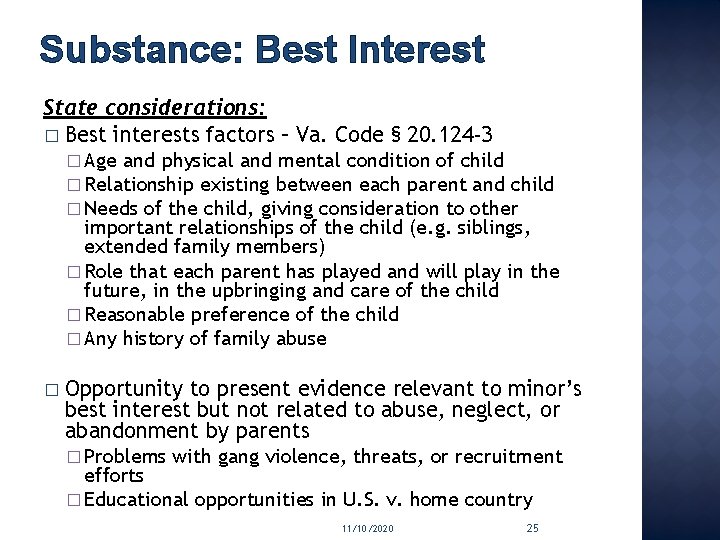
Substance: Best Interest State considerations: � Best interests factors – Va. Code § 20. 124 -3 � Age and physical and mental condition of child � Relationship existing between each parent and child � Needs of the child, giving consideration to other important relationships of the child (e. g. siblings, extended family members) � Role that each parent has played and will play in the future, in the upbringing and care of the child � Reasonable preference of the child � Any history of family abuse � Opportunity to present evidence relevant to minor’s best interest but not related to abuse, neglect, or abandonment by parents � Problems with gang violence, threats, or recruitment efforts � Educational opportunities in U. S. v. home country 11/10/2020 25
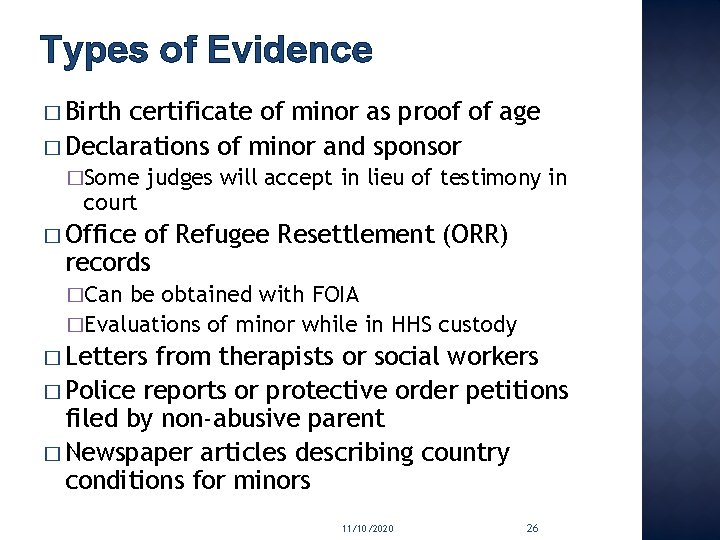
Types of Evidence � Birth certificate of minor as proof of age � Declarations of minor and sponsor �Some court judges will accept in lieu of testimony in � Office of Refugee Resettlement (ORR) records �Can be obtained with FOIA �Evaluations of minor while in HHS custody � Letters from therapists or social workers � Police reports or protective order petitions filed by non-abusive parent � Newspaper articles describing country conditions for minors 11/10/2020 26
Anticipating Policy Arguments � Undocumented � Floodgates petitioner concern � “This is immigration law – I don’t have the authority to do this. ” � What’s in it for the petitioner? 11/10/2020 27
Obtaining the Predicate Order: MARYLAND Circuit Courts 11/10/2020 28
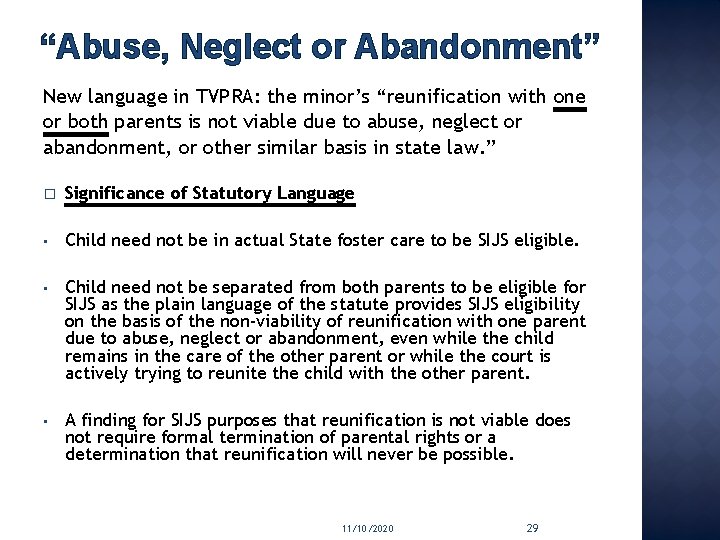
“Abuse, Neglect or Abandonment” New language in TVPRA: the minor’s “reunification with one or both parents is not viable due to abuse, neglect or abandonment, or other similar basis in state law. ” � Significance of Statutory Language • Child need not be in actual State foster care to be SIJS eligible. • Child need not be separated from both parents to be eligible for SIJS as the plain language of the statute provides SIJS eligibility on the basis of the non-viability of reunification with one parent due to abuse, neglect or abandonment, even while the child remains in the care of the other parent or while the court is actively trying to reunite the child with the other parent. • A finding for SIJS purposes that reunification is not viable does not require formal termination of parental rights or a determination that reunification will never be possible. 11/10/2020 29
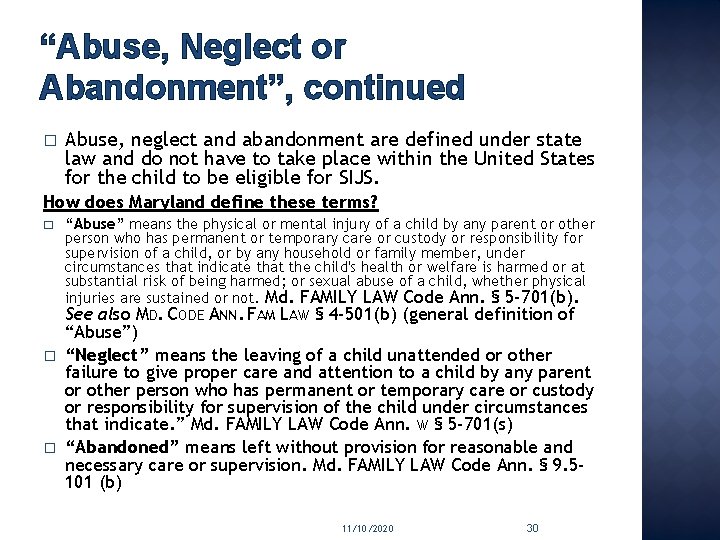
“Abuse, Neglect or Abandonment”, continued � Abuse, neglect and abandonment are defined under state law and do not have to take place within the United States for the child to be eligible for SIJS. How does Maryland define these terms? � � � “Abuse” means the physical or mental injury of a child by any parent or other person who has permanent or temporary care or custody or responsibility for supervision of a child, or by any household or family member, under circumstances that indicate that the child's health or welfare is harmed or at substantial risk of being harmed; or sexual abuse of a child, whether physical injuries are sustained or not. Md. FAMILY LAW Code Ann. § 5 -701(b). See also MD. CODE ANN. FAM LAW § 4 -501(b) (general definition of “Abuse”) “Neglect” means the leaving of a child unattended or other failure to give proper care and attention to a child by any parent or other person who has permanent or temporary care or custody or responsibility for supervision of the child under circumstances that indicate. ” Md. FAMILY LAW Code Ann. W § 5 -701(s) “Abandoned” means left without provision for reasonable and necessary care or supervision. Md. FAMILY LAW Code Ann. § 9. 5101 (b) 11/10/2020 30
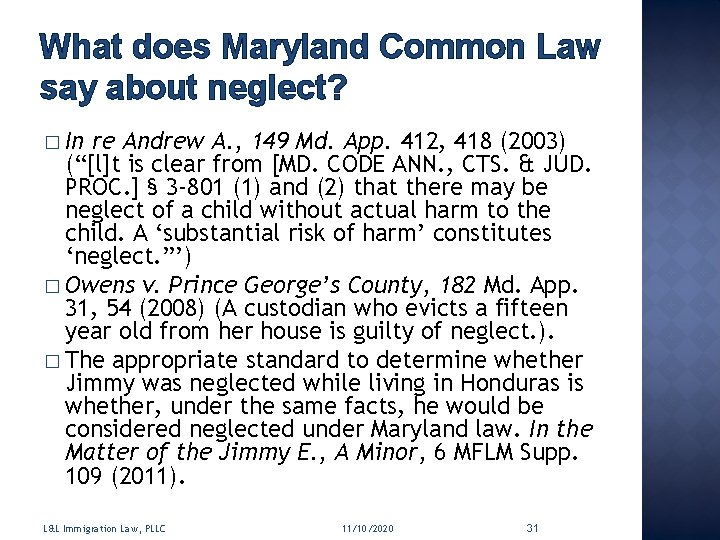
What does Maryland Common Law say about neglect? � In re Andrew A. , 149 Md. App. 412, 418 (2003) (“[l]t is clear from [MD. CODE ANN. , CTS. & JUD. PROC. ] § 3 -801 (1) and (2) that there may be neglect of a child without actual harm to the child. A ‘substantial risk of harm’ constitutes ‘neglect. ”’) � Owens v. Prince George’s County, 182 Md. App. 31, 54 (2008) (A custodian who evicts a fifteen year old from her house is guilty of neglect. ). � The appropriate standard to determine whether Jimmy was neglected while living in Honduras is whether, under the same facts, he would be considered neglected under Maryland law. In the Matter of the Jimmy E. , A Minor, 6 MFLM Supp. 109 (2011). L&L Immigration Law, PLLC 11/10/2020 31
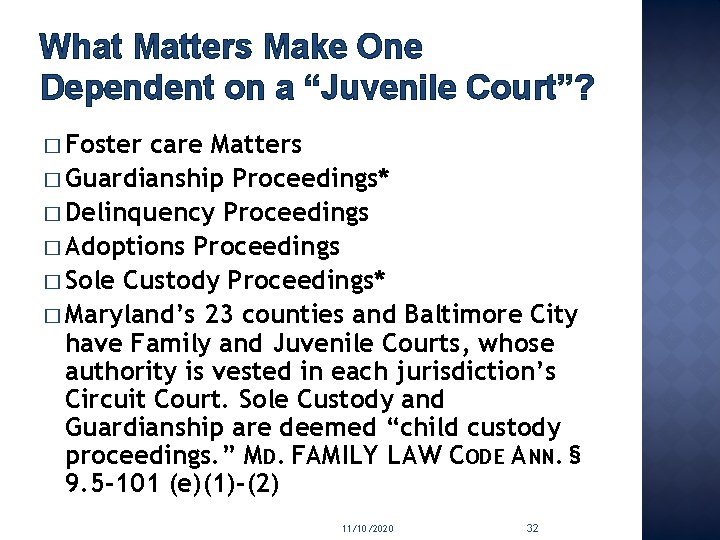
What Matters Make One Dependent on a “Juvenile Court”? � Foster care Matters � Guardianship Proceedings* � Delinquency Proceedings � Adoptions Proceedings � Sole Custody Proceedings* � Maryland’s 23 counties and Baltimore City have Family and Juvenile Courts, whose authority is vested in each jurisdiction’s Circuit Court. Sole Custody and Guardianship are deemed “child custody proceedings. ” MD. FAMILY LAW CODE ANN. § 9. 5 -101 (e)(1)-(2) 11/10/2020 32
When does the Circuit Court’s Jurisdiction end? Federal law allows persons up to 21 to apply for SIJ status. 8 U. S. C. § 1101(a)(27)(J). However and unfortunately, in most states the age of majority is 18 thereby divesting the juvenile courts of jurisdiction at the age of 18. � On April 8, 2014, the Governor O’Malley signed into law HB 315 changing the definition of a child to unmarried individuals under the age of 21 for purposes of custody or guardianship cases filed pursuant to a Motion For Special Immigrant Juvenile Factual Findings requesting a determination that the child was abused, neglected, or abandoned before the age of 18 years for purposes of INA § 101(A)(27)(J). Therefore, the Circuit Court’s jurisdiction for SIJ purposes ends at the age of 21 effective October 1, 2014. � L&L Immigration Law, PLLC 11/10/2020 33
How do I start the process? ESTABLISH CIRCUIT COURT JURISDICTION � If the child already has an open dependency or delinquency case, the court already has jurisdiction and can simply submit SIJS filings to that court. Dependency Court: Ask Legal Aid attorney representing child to file for SIJS with the court. Delinquency Court: Ask the public defender or criminal defense attorney to file for SIJS with the court. � If the child would become SIJS-eligible through guardianship, file for guardianship petition and SIJS filings with the Circuit Court where the child resides. � If the child would become SIJS-eligible through parent seeking sole custody, file complaint for custody and SIJS filings with the Circuit Court where the child resides. 11/10/2020 34
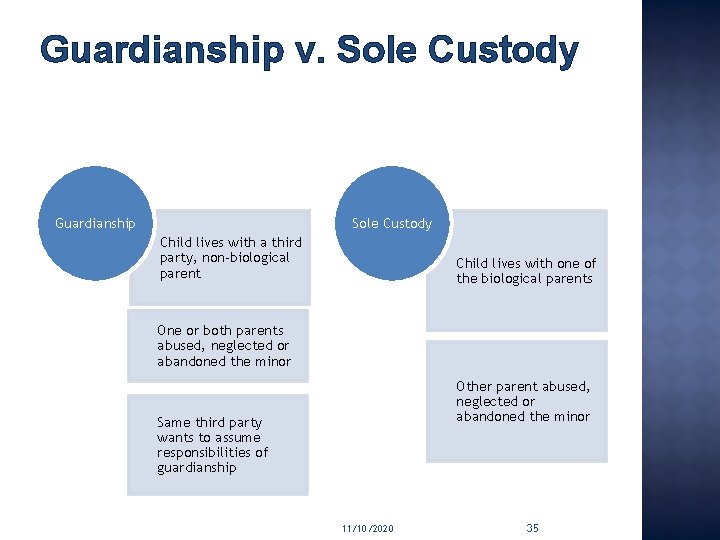
Guardianship v. Sole Custody Guardianship Sole Custody Child lives with a third party, non-biological parent Child lives with one of the biological parents One or both parents abused, neglected or abandoned the minor Other parent abused, neglected or abandoned the minor Same third party wants to assume responsibilities of guardianship 11/10/2020 35
Guardianship Proceedings � Guardianship is less intrusive than custody. � In order to obtain guardianship, a third party should file a petition for guardianship in the name of the minor. Md. FAMILY LAW Code Ann. § 5 -313. �A juvenile court may grant guardianship of a child only if the child does not object and each of the child's living parents consents in writing, knowingly and voluntarily; on the record before the juvenile court; or by failure to file a timely notice of objection after being served with a show-cause order in accordance with this subtitle. Md. FAMILY LAW Code Ann. § 5 -320 11/10/2020 36
Guardianship Proceedings Consents from Parents � Consents from parents should follow Md. FAMILY LAW Code Ann. § 5 -321. � The Court can grant guardianship where parental consent is absent if, after consideration of factors as required in this section, the court finds by clear and convincing evidence that a parent is unfit to remain in a parental relationship with the child or that exceptional circumstances exist that would make a continuation of the parental relationship detrimental to the best interests of the child such that terminating the rights of the parent is in a child's best interests. Md. FAMILY LAW Code Ann. § 5 -323 Service of Order to Show Cause � Maryland Rule 10 -104 provides that, upon the filing of a petition for guardianship, the court shall issue a show cause order which may include the time and date of a hearing on the petition if one is scheduled by the time the show cause order is issued. Advice of rights forms and notices to interested persons are to be served with a copy of the order. Rule 10 -104 further provides that the circuit court shall specify the manner of service in the order. Rule 2 -121 requires service of the show cause/order and other papers by personal service or by restricted delivery mail. L&L Immigration Law, PLLC 11/10/2020 37
I don’t know where the parents are located! If the court is satisfied, by affidavit or testimony, that a petitioner provided all of the parents’ addresses and made reasonable efforts to locate the parents but could not effect service on a parent, the court shall order service through notice by publication as to that parent. Notice shall consist of substantially the following statement: To: (Father's name) To: (Mother's name) To: Unknown parent "You are hereby notified that a guardianship case has been filed in the Circuit Court for (county name), Case No. (number). All persons who believe themselves to be parents of a (male or female) child born on (date of birth) in (city, state) to (mother's and father's names and dates of birth) shall file a written response. A copy of the show-cause order may be obtained from the juvenile clerk's office at (address) and (telephone number). If you do not file a written objection by (deadline), you will have agreed to the permanent loss of your parental rights to this child. " Service shall be by publication at least once in one or more newspapers in general circulation in the county where the parent last resided or, if unknown, where the petition is file Md. FAMILY LAW Code Ann. § 5 -316 (2014) L&L Immigration Law, PLLC 11/10/2020 38
Sole Custody Proceedings � Sole custody usually means that one parent is awarded both legal and physical custody. It is possible for visitation to be granted to the other parent. Legal custody involves the parent making all key long-term decisions such as those affecting the child’s health, education, general welfare and religion. Physical custody involves providing a home for the child and making daily decisions for the child. The court uses the “best interests of the child” standard, Sullivan v. Auslaender, 276 A. 2 d 698, 699 n. 2 (1971), to make custody determinations, which includes the following non-exhaustive list of factors: � The fitness of the parents; � � � The character and reputation of the parties; The desire of the natural parents and any agreements between them; The potential for maintaining natural family relations; The preference of the child, when the child is of sufficient age and capacity to form a rational judgment; Material opportunities affecting the future life of the child; The age, health and sex of the child; Religious considerations; Allegations of abuse; Grounds of divorce that can be shown to have affected the minor child (i. e. , divorce or desertion); The residences of the parents and the opportunity for visitation; The length of the separation of the parents; and, Whethere was prior voluntary abandonment or surrender of custody of the child. 11/10/2020 39
Sole Custody Proceedings, continued �A parent’s rights are superior to a third party unless the third party has a court order establishing guardianship, custody or visitation altering the rights of parents. See, e. g. , Wagner v. Wagener, 109 Md. App. 1, 674 A. 2 d 1 (1996) (parent has a liberty interest in the care and custody of their child and when the State seeks to affect the relationship the due process clause is implicated). The law assumes that the best interests of the child are served by remaining in the custody of the parents unless the parents are unable or unwilling to exercise their custodial rights and obligations. L&L Immigration Law, PLLC 11/10/2020 40
Problems with Parent Petitioning for Guardianship �A parent is the sole natural guardian of the minor child if the other parent: (i) dies; (ii) abandons the family; or (iii) is incapable of acting as a parent. Md. FAMILY LAW Code Ann. 5 - § 203 (a)(2). � Therefore, the parent is already the default guardian so the court does not need to intervene to grant guardianship. In other words, the Circuit Court will lack jurisdiction Look to sole (legal and physical) custody. 11/10/2020 41
Sole Custody Proceedings Notice Requirement � � Notice and an opportunity to be heard are fundamental principles of our judiciary system and thus proper service is required before proceeding to a hearing or trial. See Md. Code Ann. CJP § 6 -301 et seq. , Md. Rule 2 -121, 2 -122. Remember that a parent has a liberty interest in the care and custody of their child and when the State seeks to affect the relationship between a child and parent, the due process clause is implicated and thus where notice to the other parent comes in. Md. Rule 2 -121 (c) requires that a good faith effort be made to locate the party in order to attain legal service of process, either via private process, sheriff, or certified mail (restricted delivery, return receipt requested). The court will almost always require more than a bald statement that the plaintiff or moving party “doesn’t know where defendant is” and will instead require filing of an affidavit of good faith effort to serve the other party. The affidavit must explain all attempts made. When a moving party is unable to locate the opposing party, s/he may file a Motion for Alternate Service. Md. Rule 2 -121 (c). 11/10/2020 42
Difficulties of Sole Custody, continued In a case in which the other parent’s whereabouts are unknown because of long-term abandonment, for example, the notice requirement will require extra steps and additional time. � If the party cannot be located, alternate service may be ordered by the court. Maryland Rule 2 -122 (a)(1)(2) allows for service by posting by the sheriff at the courthouse door or by publication in one or more newspapers of general circulation in the county in which the action is pending. Must be accomplished at least 30 days before the date by which a response to the complains it to be filed. Maryland Rule 2 -122 (b) � This means that in cases where the minor will turn 21 years of age in a couple of months or less, it will be difficult to render proper notice. � 11/10/2020 43
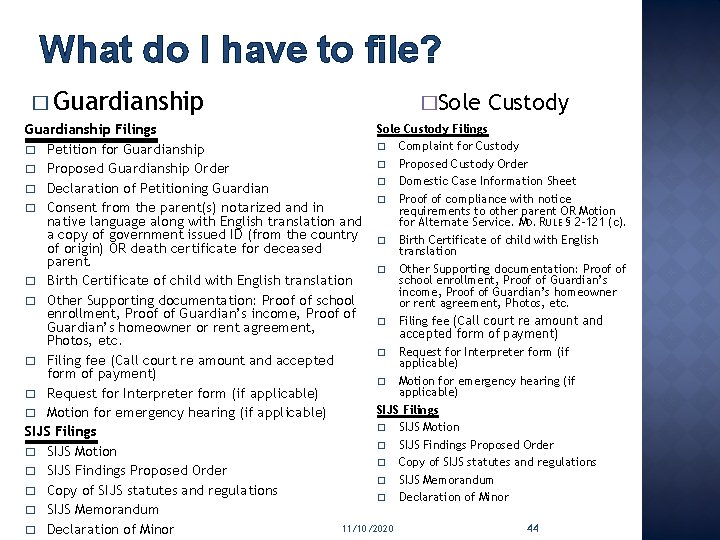
What do I have to file? � Guardianship �Sole Custody Filings Guardianship Filings � Complaint for Custody � Petition for Guardianship � Proposed Custody Order � Proposed Guardianship Order � Domestic Case Information Sheet � Declaration of Petitioning Guardian � Proof of compliance with notice � Consent from the parent(s) notarized and in requirements to other parent OR Motion native language along with English translation and for Alternate Service. MD. RULE § 2 -121 (c). a copy of government issued ID (from the country � Birth Certificate of child with English of origin) OR death certificate for deceased translation parent. � Other Supporting documentation: Proof of school enrollment, Proof of Guardian’s � Birth Certificate of child with English translation income, Proof of Guardian’s homeowner � Other Supporting documentation: Proof of school or rent agreement, Photos, etc. enrollment, Proof of Guardian’s income, Proof of � Filing fee (Call court re amount and Guardian’s homeowner or rent agreement, accepted form of payment) Photos, etc. � Request for Interpreter form (if � Filing fee (Call court re amount and accepted applicable) form of payment) � Motion for emergency hearing (if applicable) � Request for Interpreter form (if applicable) SIJS Filings � Motion for emergency hearing (if applicable) � SIJS Motion SIJS Filings � SIJS Findings Proposed Order � SIJS Motion � Copy of SIJS statutes and regulations � SIJS Findings Proposed Order � SIJS Memorandum � Copy of SIJS statutes and regulations � Declaration of Minor � SIJS Memorandum 44 11/10/2020 � Declaration of Minor
Is there a specific form for any of these filings? � Yes, the following two forms can be obtained from the Maryland Courts website: • Request for Interpreter Form • Domestic Case Information Sheet � http: //www. courts. state. md. us/family/form s/domrellist. html � It is suggested that instead of using the Guardianship and Custody Documents on the website, that the attorney draft original documents tailored to the specific case given the nuances of SIJS cases. 11/10/2020 45
I am ready to file in Circuit Court! Call Circuit Court to ask about general filing procedures in person and via first class mail; it is recommended that you file in person when possible. � Ask Circuit Court about familiarity with SIJS cases and about any other special filing procedures that this particular Circuit Court has designated. If the Circuit Court is unfamiliar with SIJS, do not worry because your SIJS memo of law will educate the Circuit Court. � Montgomery County, Prince George’s County, Frederick Co. , Baltimore City and Baltimore County Circuit Courts are very familiar with SIJS cases. � Once the case is assigned to a Judge (or “Master”), reach out to the clerk with specific non-legal questions or scheduling a time sensitive hearing. � 11/10/2020 46
I have a hearing in Circuit Court! Now what? � If you have a hearing, you know the Judge’s identity! Check MD Judiciary Case Search online � Reach out to family law attorneys and those who regularly handle SIJS cases about what to expect at the hearing before the specific judge. For example, some judges require a short proffer and will ask a couple of questions of the parties while others want full direct examination of both the petitioning guardian or parent seeking sole custody and the minor as well as any additional character witnesses � Prepare both a proffer and direct examinations of all witnesses � Prepare your witnesses for testimony 11/10/2020 47
I-360 Petition 11/10/2020 48
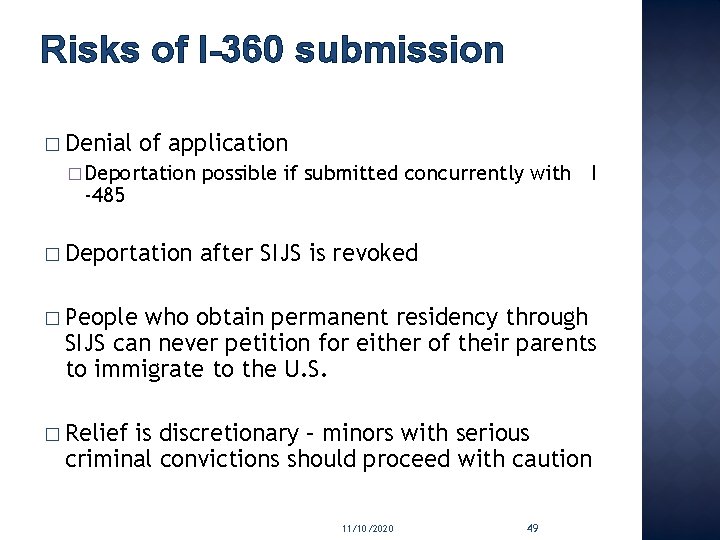
Risks of I-360 submission � Denial of application � Deportation -485 � Deportation possible if submitted concurrently with I after SIJS is revoked � People who obtain permanent residency through SIJS can never petition for either of their parents to immigrate to the U. S. � Relief is discretionary – minors with serious criminal convictions should proceed with caution 11/10/2020 49
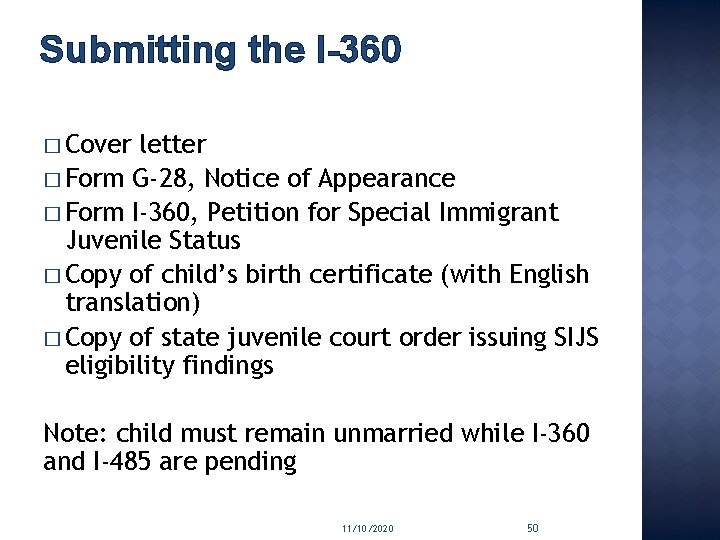
Submitting the I-360 � Cover letter � Form G-28, Notice of Appearance � Form I-360, Petition for Special Immigrant Juvenile Status � Copy of child’s birth certificate (with English translation) � Copy of state juvenile court order issuing SIJS eligibility findings Note: child must remain unmarried while I-360 and I-485 are pending 11/10/2020 50
I-485 Application 11/10/2020 51
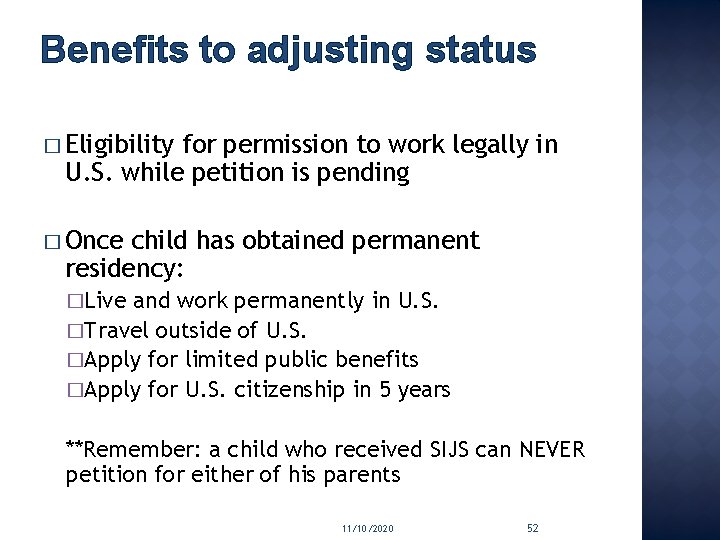
Benefits to adjusting status � Eligibility for permission to work legally in U. S. while petition is pending � Once child has obtained permanent residency: �Live and work permanently in U. S. �Travel outside of U. S. �Apply for limited public benefits �Apply for U. S. citizenship in 5 years **Remember: a child who received SIJS can NEVER petition for either of his parents 11/10/2020 52
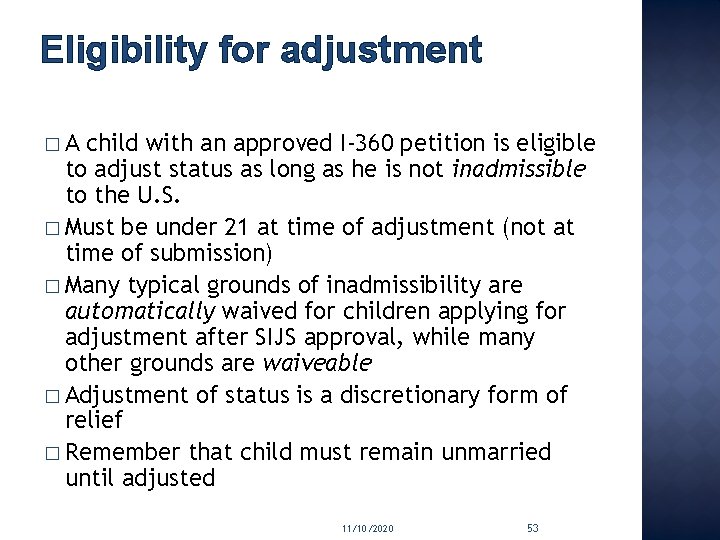
Eligibility for adjustment �A child with an approved I-360 petition is eligible to adjust status as long as he is not inadmissible to the U. S. � Must be under 21 at time of adjustment (not at time of submission) � Many typical grounds of inadmissibility are automatically waived for children applying for adjustment after SIJS approval, while many other grounds are waiveable � Adjustment of status is a discretionary form of relief � Remember that child must remain unmarried until adjusted 11/10/2020 53
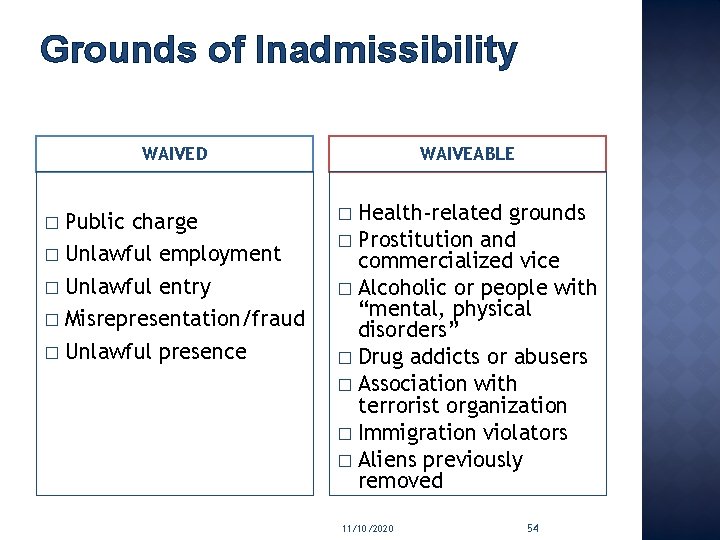
Grounds of Inadmissibility WAIVED Public charge � Unlawful employment � Unlawful entry � Misrepresentation/fraud � Unlawful presence � WAIVEABLE Health-related grounds � Prostitution and commercialized vice � Alcoholic or people with “mental, physical disorders” � Drug addicts or abusers � Association with terrorist organization � Immigration violators � Aliens previously removed � 11/10/2020 54
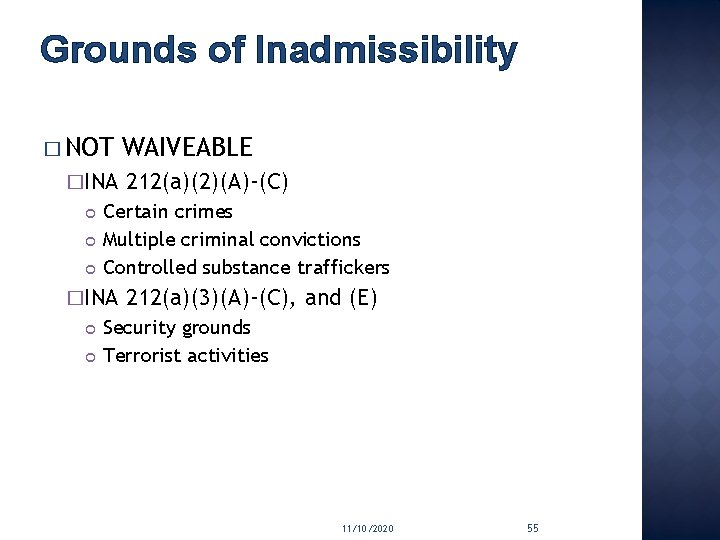
Grounds of Inadmissibility � NOT �INA 212(a)(2)(A)-(C) Certain crimes Multiple criminal convictions Controlled substance traffickers �INA WAIVEABLE 212(a)(3)(A)-(C), and (E) Security grounds Terrorist activities 11/10/2020 55
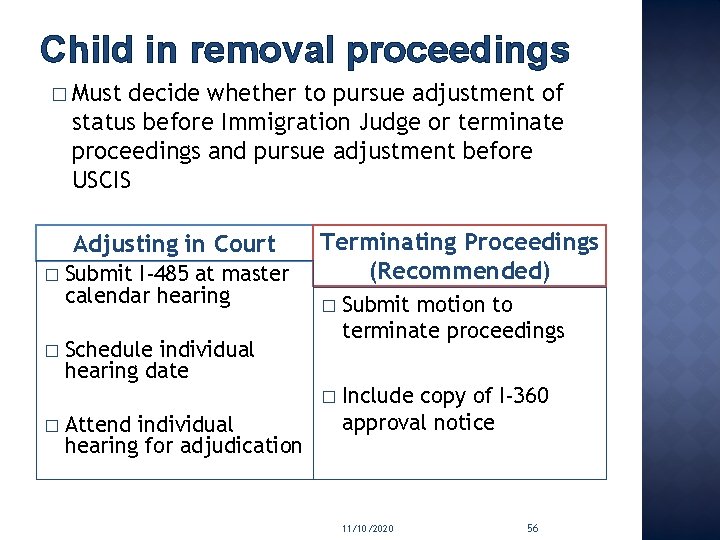
Child in removal proceedings � Must decide whether to pursue adjustment of status before Immigration Judge or terminate proceedings and pursue adjustment before USCIS Adjusting in Court � � � Submit I-485 at master calendar hearing Terminating Proceedings (Recommended) � Submit motion to terminate proceedings � Include copy of I-360 approval notice Schedule individual hearing date Attend individual hearing for adjudication 11/10/2020 56
Child in removal proceedings � Prior removal order— �Under Perez-Olano Settlement Agreement, OCC must join in Motion to Reopen when requested within 60 days of I-360 approval �Benefit for minors with unexecuted removal orders: In absentia orders Accepted voluntary departure but didn’t leave � Must submit I-360 first and then make joint motion to request after approval 11/10/2020 57
Submitting I-485 to USCIS � Cover Letter � Form G-28, Notice of appearance � Form I-485, Application to adjust status (w/ 2 photos) �Form G-325 A, Biometrics �Sealed form I-693, Medical Exam �Copy of birth certificate (w/ English translation) �Approved I-360 � Form I-765, Application for work authorization (w/ 2 photos) � I-912, Fee Waiver (March 2011 USCIS memo PM-602 -0011. 1) 11/10/2020 58
After I-485 submission � Receipt notice � Biometrics appointment �If child does not have passport, he/she should bring: Certified copy of state court order School ID Birth certificate �If suspect child will have problems with ID, call supervisor first � Interview 11/10/2020 59
Interview � Not typical for I-360, but possible � More common for I-485 � If child under 14, can submit request to waive interview � Child should bring birth certificate, passport, or other form of ID � Read interview notice for any additional info requested (including certified juvenile court order if not submitted previously) � Interpreter English necessary if child not fluent in � Interpreter needs to bring ID � Sometimes immigration status of interpreter is questioned 11/10/2020 60
Interview cont. � Questions include: �Verification of current address �Discussion of inadmissibility grounds � Officers should NOT second-guess the juvenile court’s rulings or questions whether the order was properly issued. Ask to speak to supervisor if questions are inappropriate. (2004 USCIS memorandum - HQADN 70/23 ) 11/10/2020 61
Resources � USCIS website – www. uscis. gov � Immigration court practice manual http: //www. justice. gov/eoir � SIJS manual - www. ilrc. org/sijs. php � Immigration benchbook for juvenile and family courts - http: //www. ilrc. org/resources/immigrationbenchbook-for-juvenile-and-family-courts � U. S. Committee for Refugees and Immigrants (including samples) http: //www. refugees. org/resources/forlawyers/special-immigrant-juvenile-status/ 11/10/2020 62
Questions? Lauren Vogt L&L Immigration Law, PLLC lauren@llimmigrationlaw. com Laura Jacobson L&L Immigration Law, PLLC laura@llimmigrationlaw. com Michelle Mendez Catholic Charities of the Archdiocese of Washington Immigration Legal Services michelle. mendez@catholiccharitiesdc. org 11/10/2020 63