
Special Hazards of Hydrogen Gas in the Laboratory
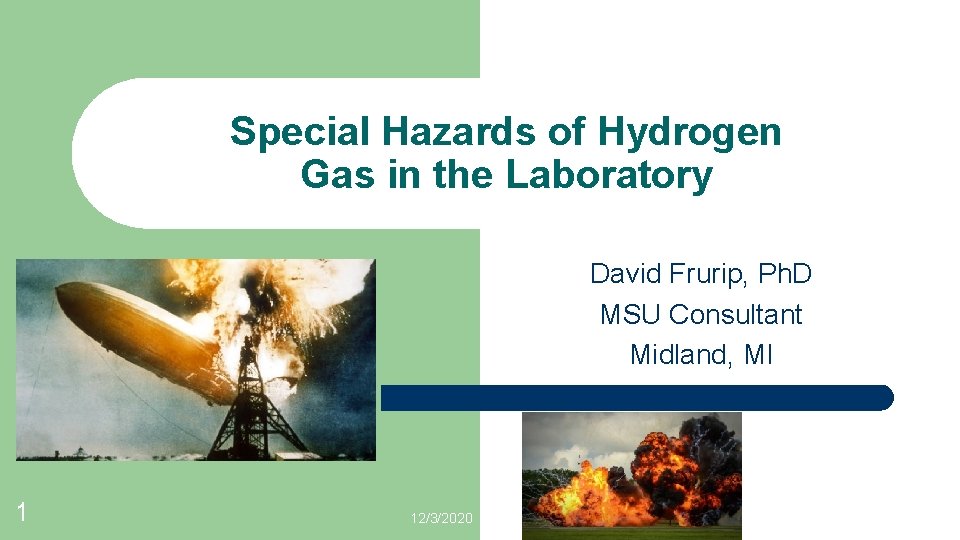
Special Hazards of Hydrogen Gas in the Laboratory David Frurip, Ph. D MSU Consultant Midland, MI 1 12/3/2020
Hydrogen is a Commonly Used Gas in the Chemical Laboratory Fuel in chromatography flame detectors l Chemistry (reduction reactions, hydrogenations) l Activating catalysts l Semiconductor applications l Maintaining anaerobic atmospheres in glove boxes/bags l
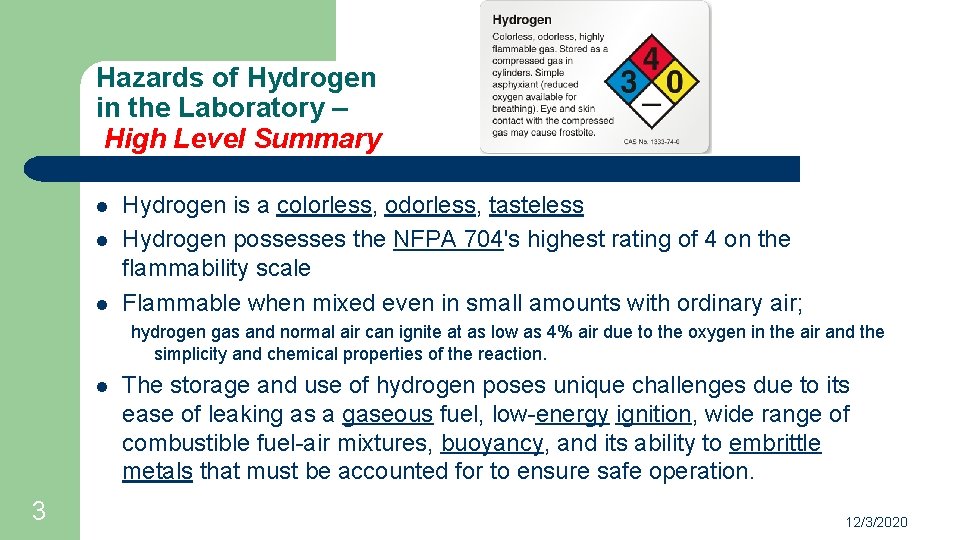
Hazards of Hydrogen in the Laboratory – High Level Summary l l l Hydrogen is a colorless, odorless, tasteless Hydrogen possesses the NFPA 704's highest rating of 4 on the flammability scale Flammable when mixed even in small amounts with ordinary air; hydrogen gas and normal air can ignite at as low as 4% air due to the oxygen in the air and the simplicity and chemical properties of the reaction. l 3 The storage and use of hydrogen poses unique challenges due to its ease of leaking as a gaseous fuel, low-energy ignition, wide range of combustible fuel-air mixtures, buoyancy, and its ability to embrittle metals that must be accounted for to ensure safe operation. 12/3/2020

Unique to Hydrogen: Extremely Easy to Ignite 4 l "Hydrogen-air mixtures can ignite with very low energy input, 1/10 that required igniting a gasoline-air mixture. For reference, an invisible spark or a static spark from a person cause ignition. l "Although the autoignition temperature of hydrogen is higher than those for most hydrocarbons, hydrogen's lower ignition energy makes the ignition of hydrogen–air mixtures more likely. The minimum energy for spark ignition at atmospheric pressure is about 0. 02 millijoules. l For reference methane (natural gas) MIE = 0. 28 m. J 12/3/2020
Unique to Hydrogen: Extraordinarily Wide Range of Flammable Mixtures in Air l The flammability limits based on the volume percent of hydrogen in air at 14. 7 psia (1 atm, 101 k. Pa) are 4. 0 and 75. 0. The flammability limits based on the volume percent of hydrogen in oxygen at 14. 7 psia (1 atm, 101 k. Pa) are 4. 0 and 94. 0. l The limits of detonability of hydrogen in air are 18. 3 to 59 percent by volume Detonations are extremely Violent Explosions!!!! 5 l Flames in and around a collection of pipes or structures can create turbulence that causes a deflagration to evolve into a detonation, even in the absence of gross confinement. l For comparison: Deflagration limit of gasoline in air: 1. 4– 7. 6%; of acetylene in air, 2. 5% to 82% 12/3/2020
Unique to Hydrogen: Exaggerated Hazards from Leaks l l 6 Hydrogen is odorless, colorless and tasteless, so most human senses won’t help to detect a leak. By comparison, natural gas is also odorless, colorless and tasteless, but industry adds a sulfur-containing odorant, called mercaptan, to make it detectable by people. However, given hydrogen’s tendency to rise quickly, a hydrogen leak indoors would briefly collect on the ceiling and eventually move towards the corners and away from where any nose might detect it. Hydrogen leaks can support combustion at very low flow rates, as low as 4 micrograms/s. 12/3/2020
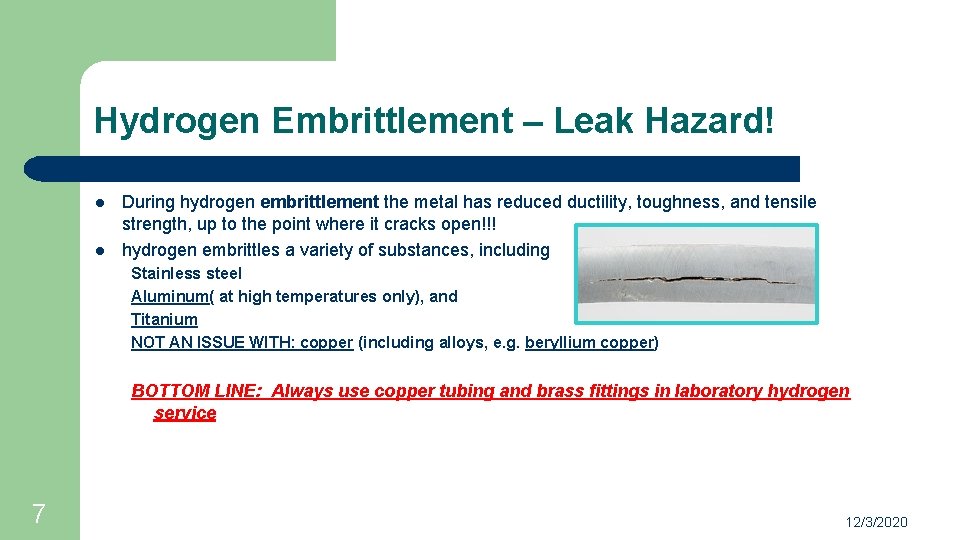
Hydrogen Embrittlement – Leak Hazard! l l During hydrogen embrittlement the metal has reduced ductility, toughness, and tensile strength, up to the point where it cracks open!!! hydrogen embrittles a variety of substances, including Stainless steel Aluminum( at high temperatures only), and Titanium NOT AN ISSUE WITH: copper (including alloys, e. g. beryllium copper) BOTTOM LINE: Always use copper tubing and brass fittings in laboratory hydrogen service 7 12/3/2020
Prevention l l l 8 Ensure hydrogen is never allowed to reach a flammable zone Minimize the quantities of hydrogen in the lab Can a lecture bottle suffice vs a size A cylinder? Minimize electrical equipment near places where a leak might occur Ensure equipment is properly bonded and grounded as appropriate Ensure all hydrogen lines are copper with brass fittings. Where appropriate use hydrogen detectors 12/3/2020
Prevention, cont’d l Hydrogen collects under roofs and overhangs, where it forms an explosion hazard Any building that contains a potential source of hydrogen should have good ventilation Strong ignition suppression systems for all electric devices, Preferably be designed to have a roof that can be safely blown away from the rest of the structure in an explosion. Hydrogen sensors (if appropriate) allow for rapid detection of hydrogen leaks Ensures that the hydrogen can be vented and the source of the leak tracked down. 9 12/3/2020
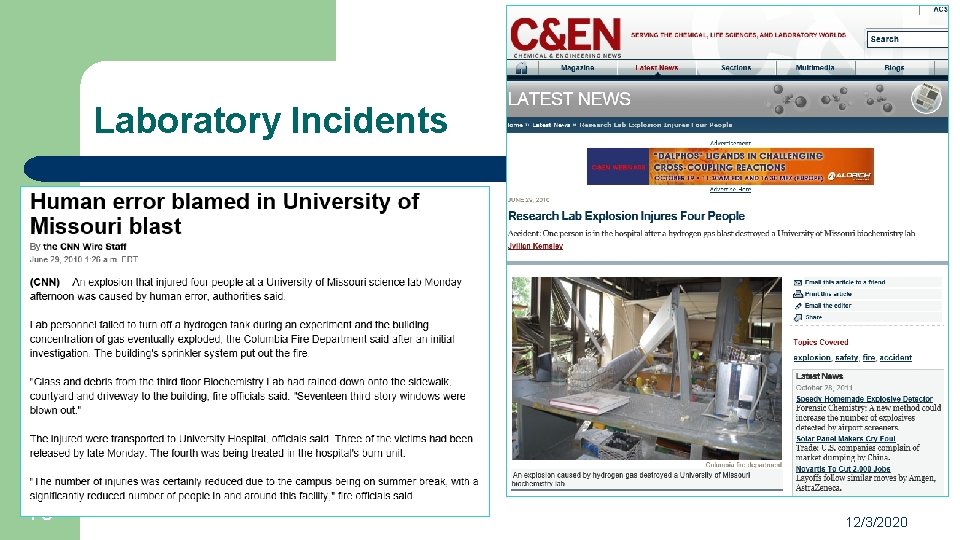
Laboratory Incidents l 10 Univ. of Missouri 12/3/2020
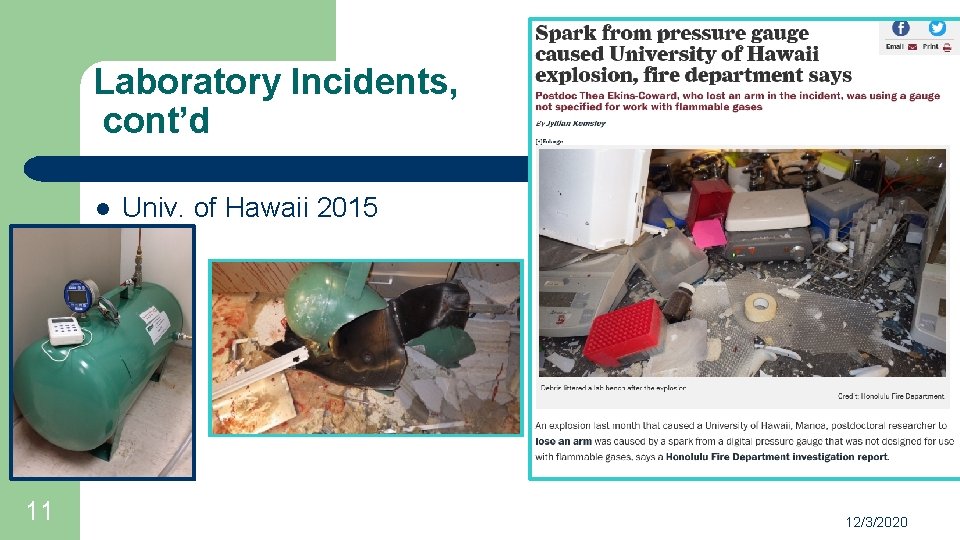
Laboratory Incidents, cont’d l 11 Univ. of Hawaii 2015 12/3/2020
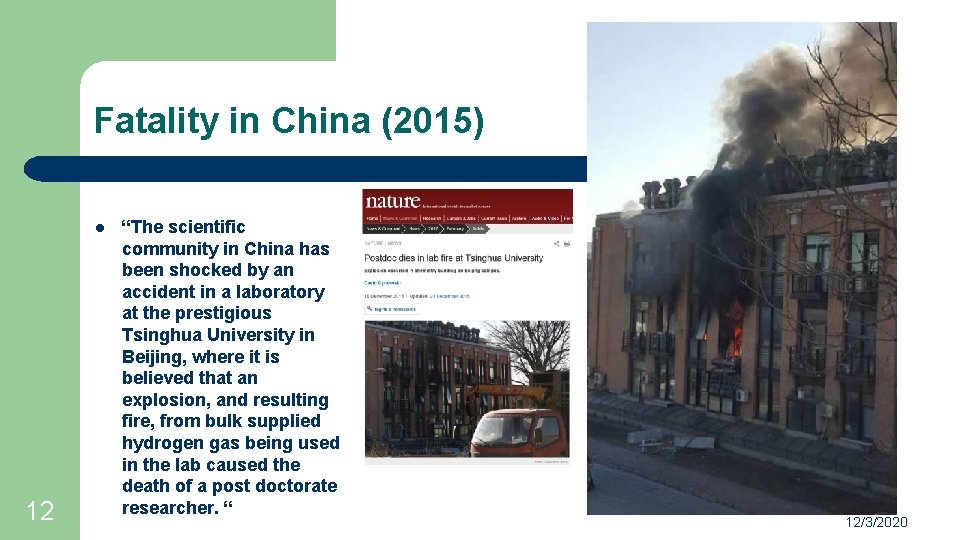
Fatality in China (2015) l 12 “The scientific community in China has been shocked by an accident in a laboratory at the prestigious Tsinghua University in Beijing, where it is believed that an explosion, and resulting fire, from bulk supplied hydrogen gas being used in the lab caused the death of a post doctorate researcher. “ 12/3/2020
Hydrogen Hazards in This Laboratory and How They are Mitigated l This is a placeholder slide (or slides) for the PI and staff to indicate: 1. How hydrogen is used in their lab? 2. What credible scenarios could occur where flammable hydrogen atmospheres might occur? Include normal operation and worst case scenarios 3. What measures are in place to mitigate/prevent the situations in bullet 2. Include engineering controls and operating discipline 13 12/3/2020
Conclusions l l l 14 Hydrogen is a special flammable gas with unique hazardous properties Extra attention and safety evaluation are required using hydrogen in the laboratory Minimize the quantities used in the lab as is practical Always use copper tubing in hydrogen service Involve EHS and other experts to ensure your process does not operate in a flammable zone 12/3/2020
- Slides: 14