
Special Examples of IMFs and Bulk Solids Important

Special Examples of IMFs and Bulk Solids
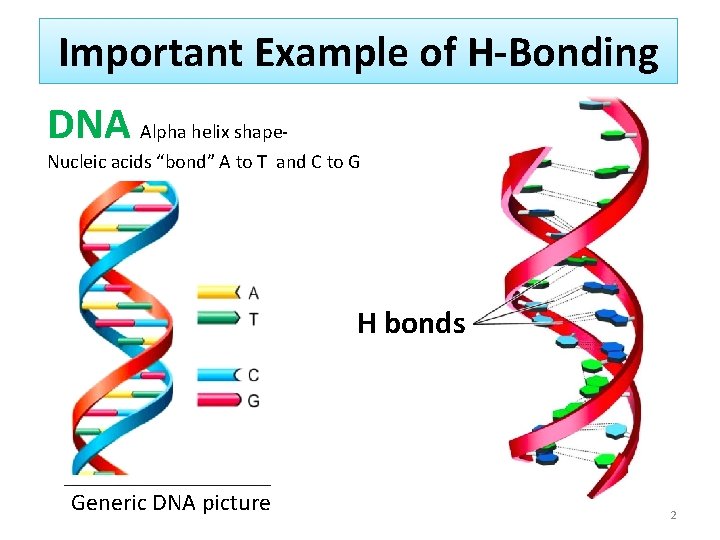
Important Example of H-Bonding DNA Alpha helix shape- Nucleic acids “bond” A to T and C to G H bonds Generic DNA picture 2
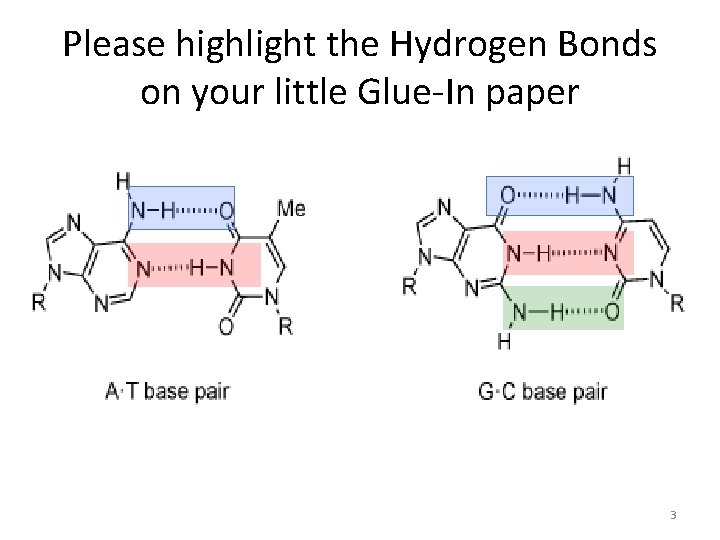
Please highlight the Hydrogen Bonds on your little Glue-In paper 3
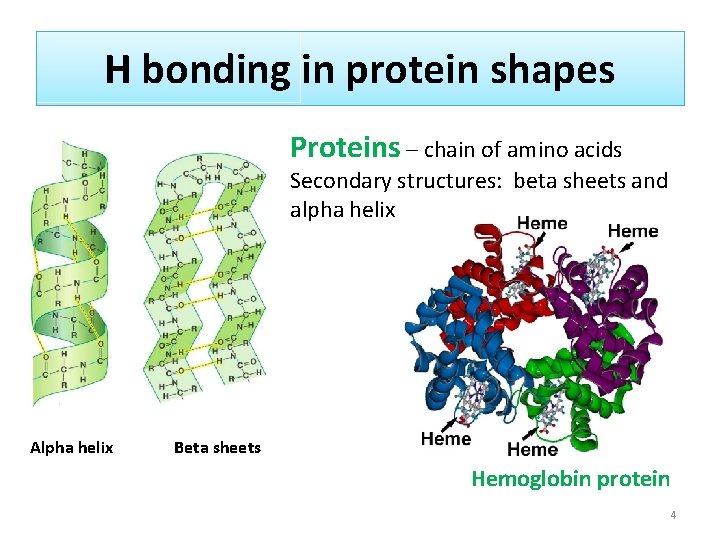
H bonding in protein shapes Proteins – chain of amino acids Secondary structures: beta sheets and alpha helix Alpha helix Beta sheets Hemoglobin protein 4

Bulk Solids
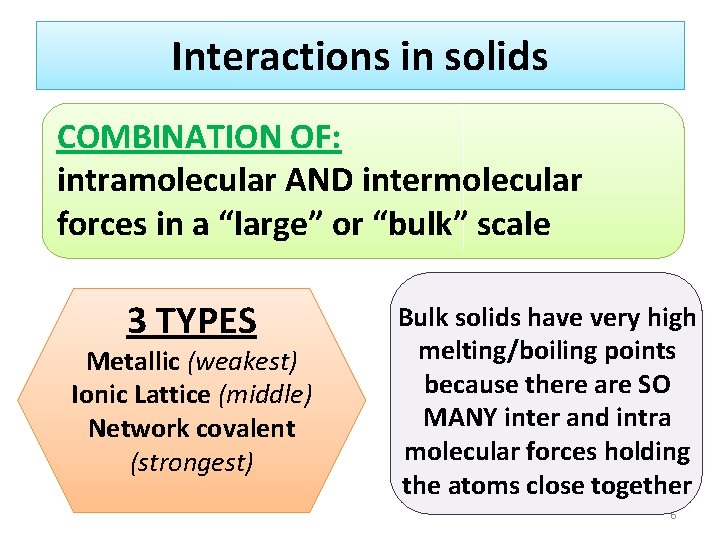
Interactions in solids COMBINATION OF: intramolecular AND intermolecular forces in a “large” or “bulk” scale 3 TYPES Metallic (weakest) Ionic Lattice (middle) Network covalent (strongest) Bulk solids have very high melting/boiling points because there are SO MANY inter and intra molecular forces holding the atoms close together 6

METALLIC Metal ions stack in an ordered fashion held together by the “sea of electrons” and the positive metal ions Example: Fe IONIC LATTICE ions stack in an ordered fashion to form crystals Example: Na. Cl 7

NETWORK COVALENT Examples: Diamond/Graphite = both C, Si. O 2 , W covalently bonded atoms in a continuous network Example: Carbon DIAMONDS GRAPHITE 8
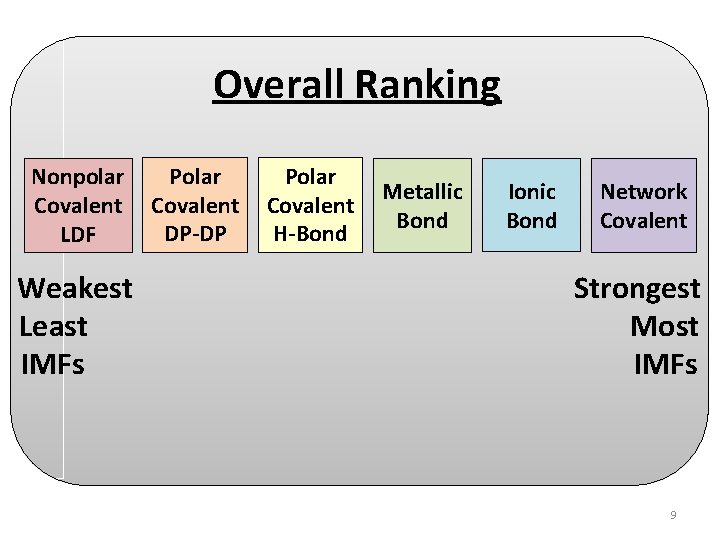
Overall Ranking Nonpolar Covalent LDF Weakest Least IMFs Polar Covalent DP-DP Polar Covalent H-Bond Metallic Bond Ionic Bond Network Covalent Strongest Most IMFs 9
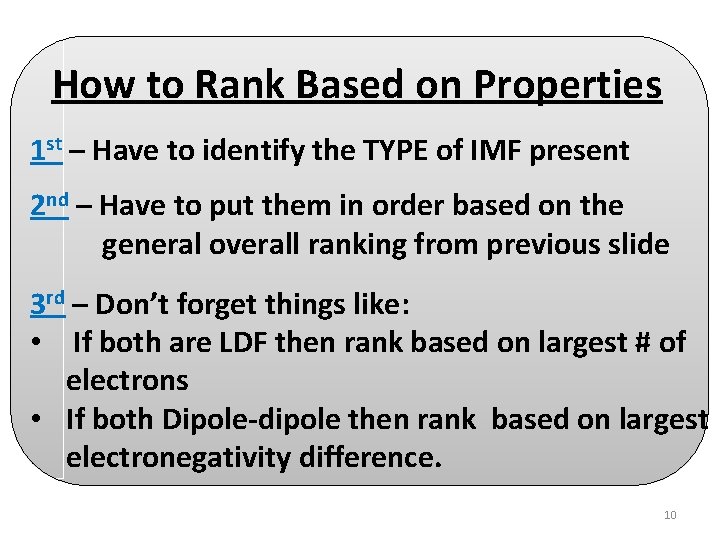
How to Rank Based on Properties 1 st – Have to identify the TYPE of IMF present 2 nd – Have to put them in order based on the general overall ranking from previous slide 3 rd – Don’t forget things like: • If both are LDF then rank based on largest # of electrons • If both Dipole-dipole then rank based on largest electronegativity difference. 10
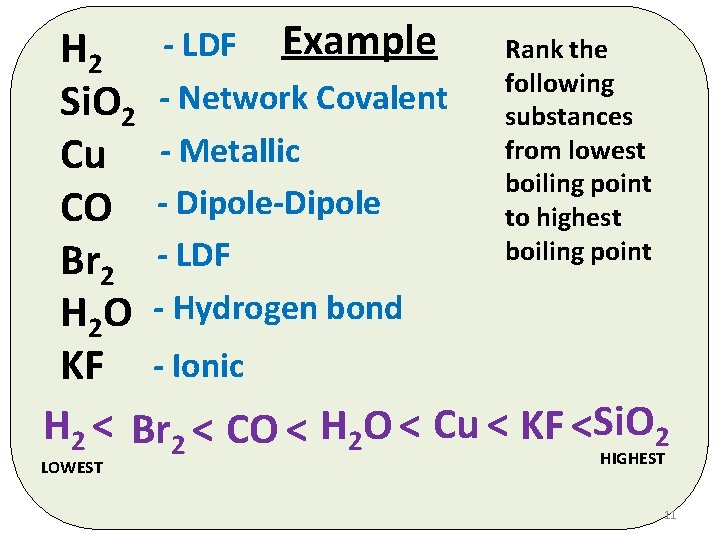
Rank the H 2 - LDF Example following Si. O 2 - Network Covalent substances from lowest Cu - Metallic boiling point CO - Dipole-Dipole to highest boiling point LDF Br 2 H 2 O - Hydrogen bond KF - Ionic H 2 < Br 2 < CO < H 2 O < Cu < KF <Si. O 2 HIGHEST LOWEST 11

Geckos https: //www. youtube. com/watch? v=Ye. Su. Qm 7 Kfa. E 12
Reading - It is a class copy – please don’t write on the paper directly - Divide your paper in half so you have a top half for notes and the bottom half for the next part. - Take notes in your notebook - Talk about what you are reading in your groups. This will make the next part easier! Notes from reading #1 #2 #3 13
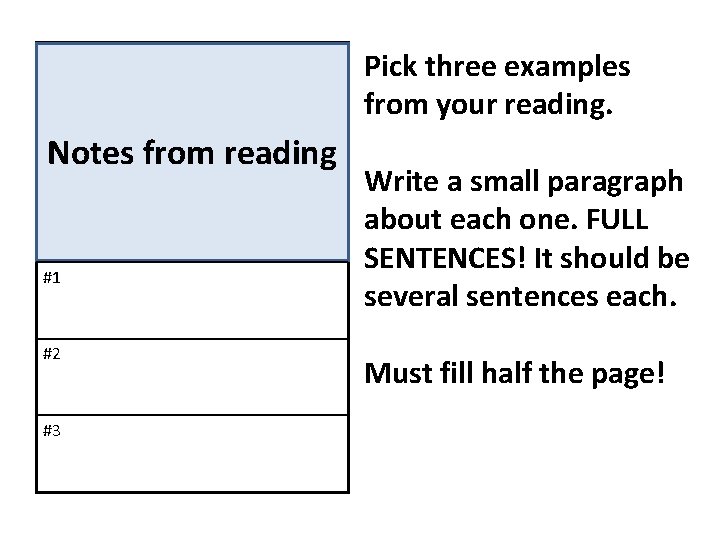
Pick three examples from your reading. Notes from reading #1 #2 #3 Write a small paragraph about each one. FULL SENTENCES! It should be several sentences each. Must fill half the page!

You. Tube Link to Presentation • https: //youtu. be/Tbug. ACq. Gwy. I 15
- Slides: 15