
Special Care for Newborns with Small Size at
Special Care for Newborns with Small Size at Birth
Learning Objectives By the end of this session, learners will be able to: • Discuss the increased risk of preterm and low birth weight babies for hypothermia, infections, hypoxia, poor sucking and hypoglycemia • Discuss KMC, assisted feeding and infection prevention practices to protect babies against problems • Demonstrate KMC and paladai feeding using KMC pouch and primi-natalie 2
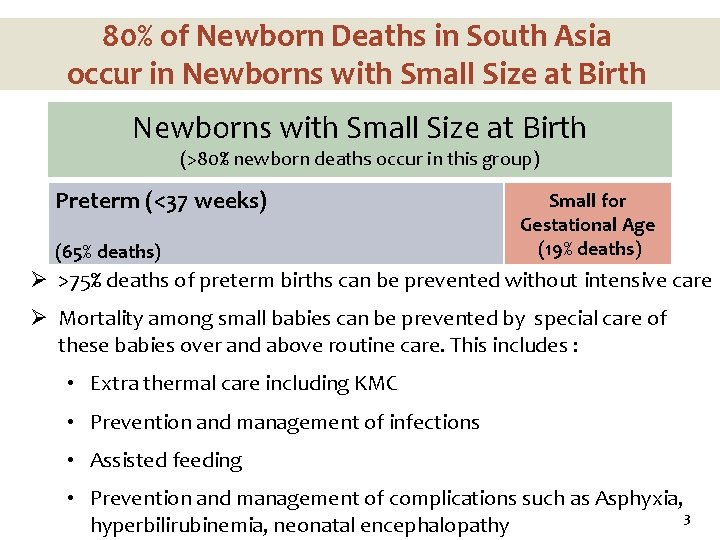
80% of Newborn Deaths in South Asia occur in Newborns with Small Size at Birth (>80% newborn deaths occur in this group) Preterm (<37 weeks) (65% deaths) Small for Gestational Age (19% deaths) Ø >75% deaths of preterm births can be prevented without intensive care Ø Mortality among small babies can be prevented by special care of these babies over and above routine care. This includes : • Extra thermal care including KMC • Prevention and management of infections • Assisted feeding • Prevention and management of complications such as Asphyxia, 3 hyperbilirubinemia, neonatal encephalopathy
Preventing Hypothermia in Newborns with Small Size at Birth • Follow all tips for prevention of hypothermia in newborn (Recap) • Postpone the bathing at least for seven days • Practice Kangaroo Mother Care • In case there is need for transportation, maintain warmth of the baby 4
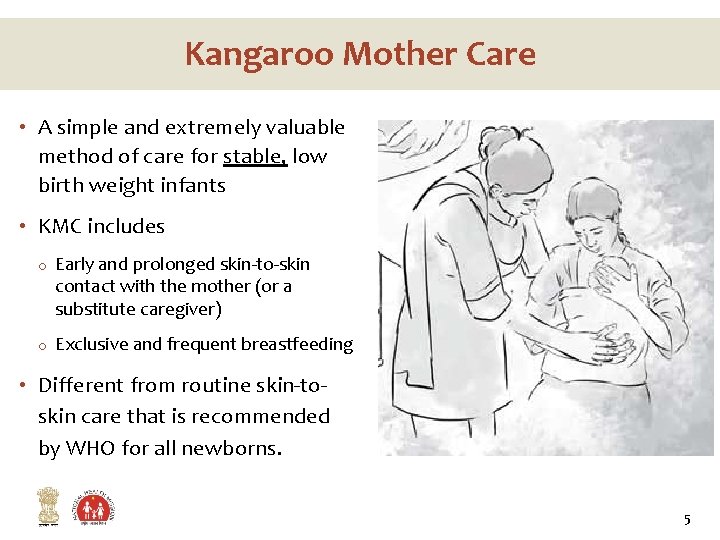
Kangaroo Mother Care • A simple and extremely valuable method of care for stable, low birth weight infants • KMC includes o Early and prolonged skin-to-skin contact with the mother (or a substitute caregiver) o Exclusive and frequent breastfeeding • Different from routine skin-toskin care that is recommended by WHO for all newborns. 5
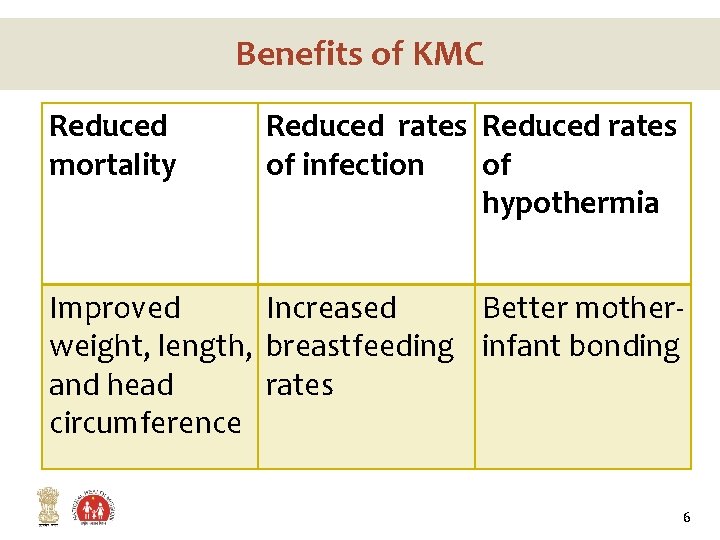
Benefits of KMC Reduced mortality Reduced rates of infection of hypothermia Improved Increased Better motherweight, length, breastfeeding infant bonding and head rates circumference 6
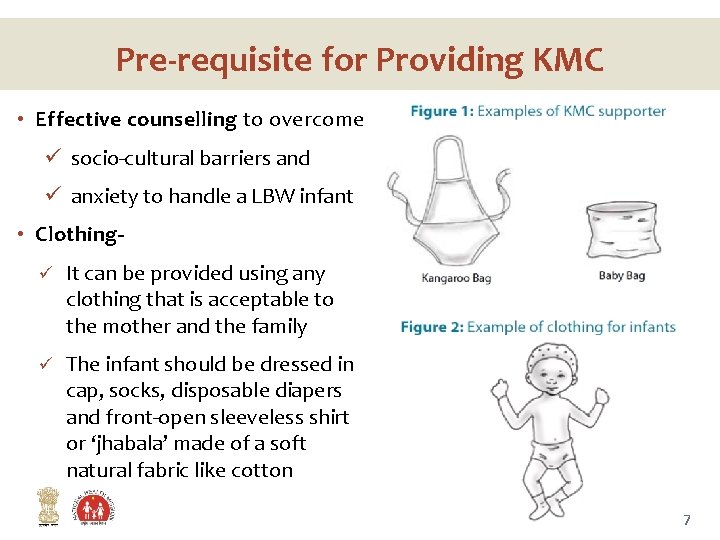
Pre-requisite for Providing KMC • Effective counselling to overcome ü socio-cultural barriers and ü anxiety to handle a LBW infant • Clothingü It can be provided using any clothing that is acceptable to the mother and the family ü The infant should be dressed in cap, socks, disposable diapers and front-open sleeveless shirt or ‘jhabala’ made of a soft natural fabric like cotton 7
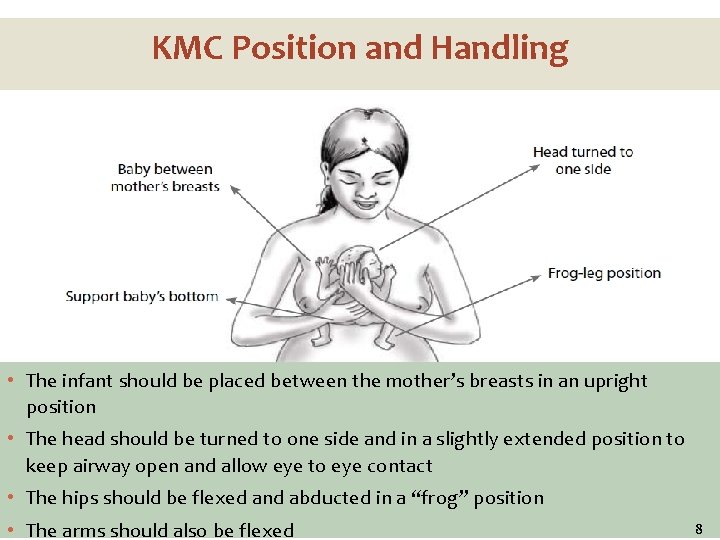
KMC Position and Handling • The infant should be placed between the mother’s breasts in an upright position • The head should be turned to one side and in a slightly extended position to keep airway open and allow eye to eye contact • The hips should be flexed and abducted in a “frog” position • The arms should also be flexed 8 8
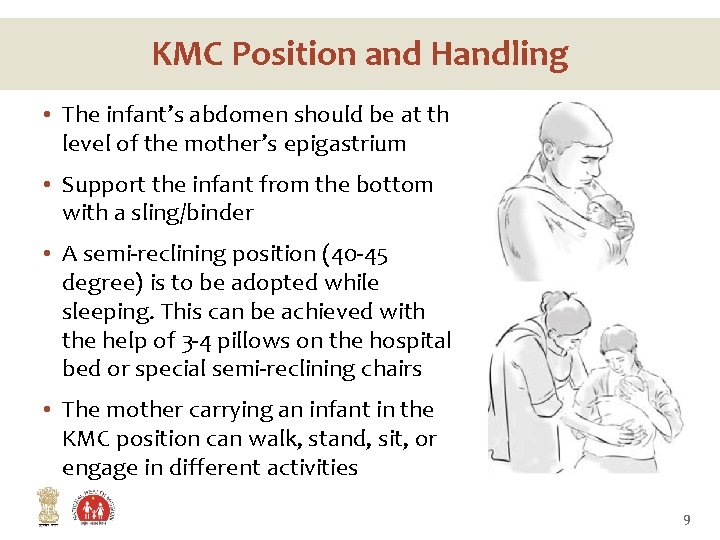
KMC Position and Handling • The infant’s abdomen should be at the level of the mother’s epigastrium • Support the infant from the bottom with a sling/binder • A semi-reclining position (40 -45 degree) is to be adopted while sleeping. This can be achieved with the help of 3 -4 pillows on the hospital bed or special semi-reclining chairs • The mother carrying an infant in the KMC position can walk, stand, sit, or engage in different activities 9
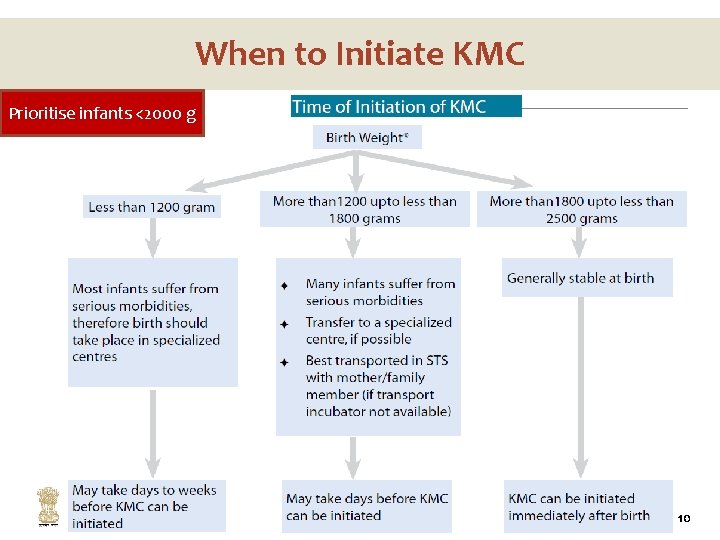
When to Initiate KMC Prioritise infants <2000 g 10
Duration of KMC • Minimum duration of a KMC session: at least one hour • During recovery period: hold the baby in skin-to-skin contact for short periods of time (one to three hours at a time) • Baby stable and doesn’t require special care (e. g. oxygen or IV fluid): begin continuous KMC • Remove infants from skin-to-skin contact only for changing diapers and clinical assessment • When should KMC be discontinued: Often an infant is taken off kangaroo mother care when gestation reaches term or the weight is around 2, 500 grams. 11
Feeding during KMC • Initially, breastfeed is given at fixed intervals of two hours and not on demand, to ensure an adequate and assured minimal intake • The mother should be explained how to breastfeed while the infant is in KMC position • Holding the infant near the breast stimulates milk production • Mother may express milk while the infant is still in KMC position 12
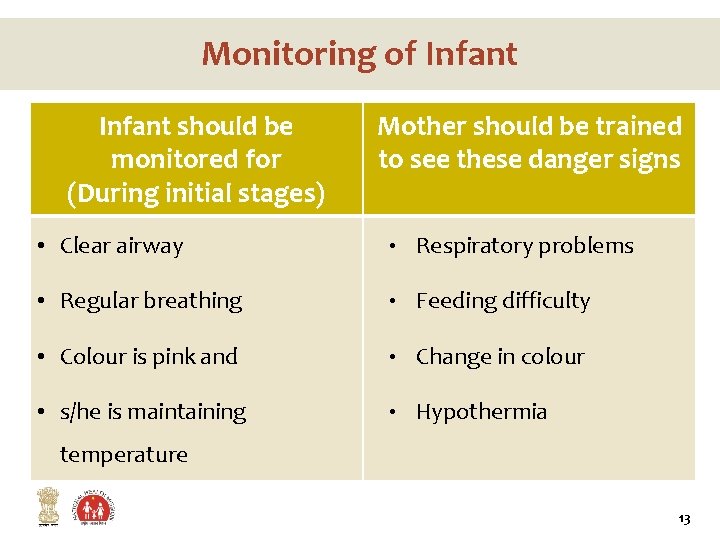
Monitoring of Infant should be monitored for (During initial stages) Mother should be trained to see these danger signs • Clear airway • Respiratory problems • Regular breathing • Feeding difficulty • Colour is pink and • Change in colour • s/he is maintaining • Hypothermia temperature 13
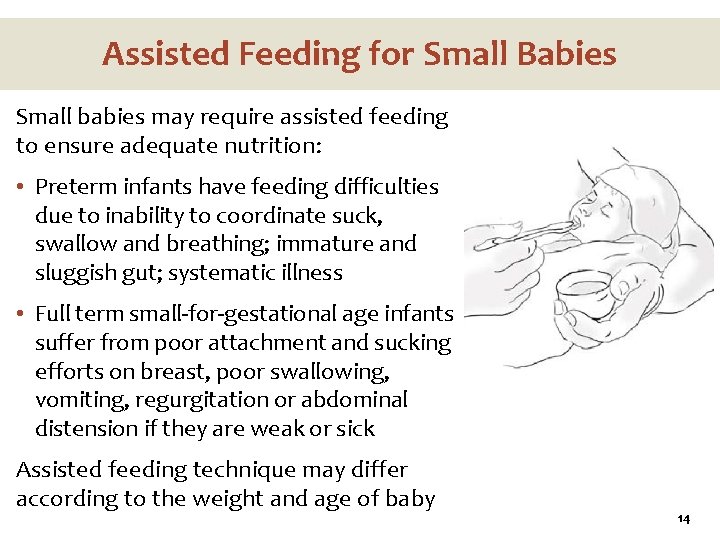
Assisted Feeding for Small Babies Small babies may require assisted feeding to ensure adequate nutrition: • Preterm infants have feeding difficulties due to inability to coordinate suck, swallow and breathing; immature and sluggish gut; systematic illness • Full term small-for-gestational age infants suffer from poor attachment and sucking efforts on breast, poor swallowing, vomiting, regurgitation or abdominal distension if they are weak or sick Assisted feeding technique may differ according to the weight and age of baby 14
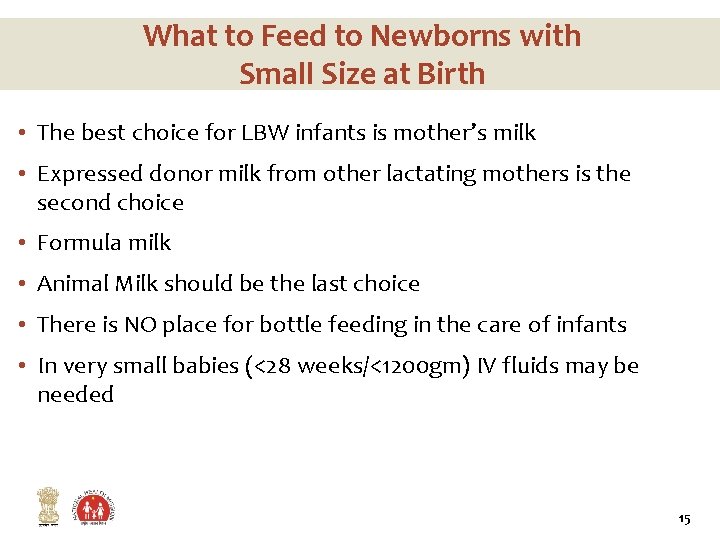
What to Feed to Newborns with Small Size at Birth • The best choice for LBW infants is mother’s milk • Expressed donor milk from other lactating mothers is the second choice • Formula milk • Animal Milk should be the last choice • There is NO place for bottle feeding in the care of infants • In very small babies (<28 weeks/<1200 gm) IV fluids may be needed 15
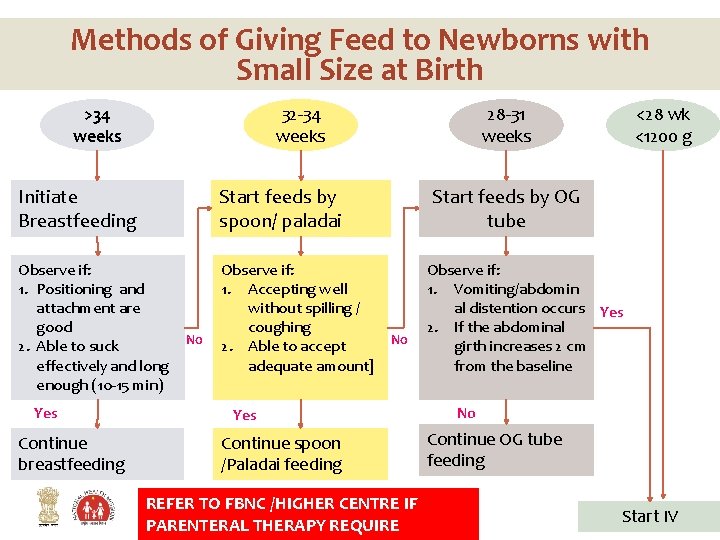
Methods of Giving Feed to Newborns with Small Size at Birth >34 weeks 32 -34 weeks Initiate Breastfeeding Start feeds by spoon/ paladai Observe if: 1. Positioning and attachment are good 2. Able to suck effectively and long enough (10 -15 min) Observe if: 1. Accepting well without spilling / coughing 2. Able to accept adequate amount] Yes Continue breastfeeding No 28 -31 weeks <28 wk <1200 g Start feeds by OG tube No Yes Continue spoon /Paladai feeding REFER TO FBNC /HIGHER CENTRE IF PARENTERAL THERAPY REQUIRE Observe if: 1. Vomiting/abdomin al distention occurs Yes 2. If the abdominal girth increases 2 cm from the baseline No Continue OG tube feeding Start IV
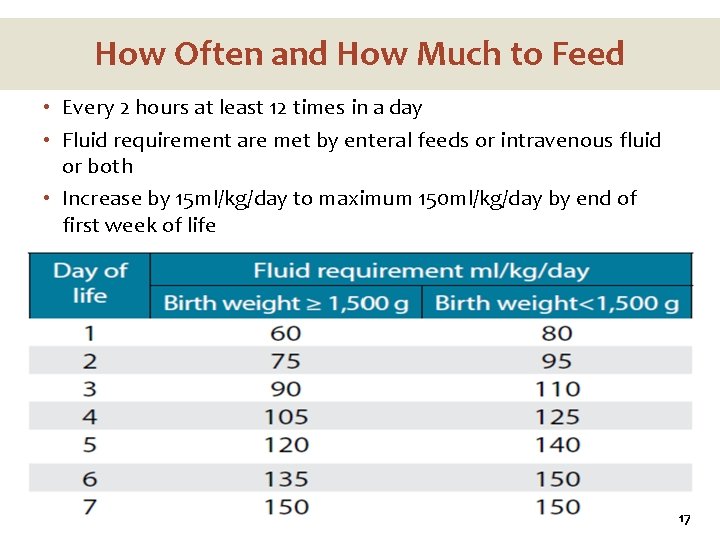
How Often and How Much to Feed • Every 2 hours at least 12 times in a day • Fluid requirement are met by enteral feeds or intravenous fluid or both • Increase by 15 ml/kg/day to maximum 150 ml/kg/day by end of first week of life 17
Expressed Breast Milk (EBM) Infants unable to feed directly on breast can be given EBM by: § Katori-spoon or paladai § Gavage (OG or NG tube) *Refer to EBM and OG tube insertion checklists for demonstration technique Need for Breast Milk Expression: § To maintain milk production, and for feeding the baby who is premature/LBW or sick and can not breast feed § Working mothers, who plan to return to work can express the milk in advance and store it for exclusively breastfed babies § To relieve breast problem e. g. engorgement 18
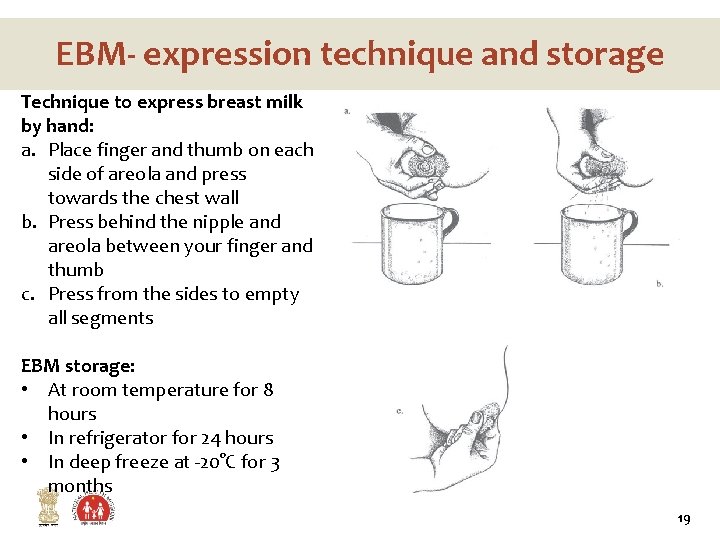
EBM- expression technique and storage Technique to express breast milk by hand: a. Place finger and thumb on each side of areola and press towards the chest wall b. Press behind the nipple and areola between your finger and thumb c. Press from the sides to empty all segments EBM storage: • At room temperature for 8 hours • In refrigerator for 24 hours • In deep freeze at -20°C for 3 months 19
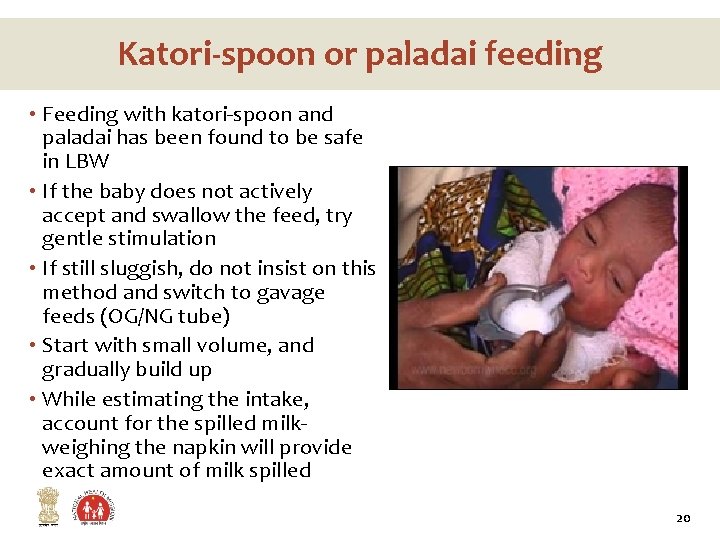
Katori-spoon or paladai feeding • Feeding with katori-spoon and paladai has been found to be safe in LBW • If the baby does not actively accept and swallow the feed, try gentle stimulation • If still sluggish, do not insist on this method and switch to gavage feeds (OG/NG tube) • Start with small volume, and gradually build up • While estimating the intake, account for the spilled milkweighing the napkin will provide exact amount of milk spilled 20
Important Points to Remember for Assisted Feeding • The ultimate aim for feeding of small babies is to ensure direct, exclusive breastfeeding. • An infant given alternative oral feeds (tube, spoon, paladai, cup) should be given frequent opportunity to suckle at the breast before the next feed. • An infant on IV fluids should be given small intragastric feeds. If the infant tolerates these, the volume can be increased and intravenous fluids reduced. • Adequate urine output (8 -12 times for day) and weight gain (15 -20 grams per day) are two parameters to monitor the adequacy of nutrition. 21
Prevention of Infection in Newborns with Small Size at Birth Small babies are at high risk for infection and sepsis. Follow infection prevention practices and look for signs of sepsis. Before Delivery • Appropriately manage maternal infections and use prophylaxis wherever needed • Use of partograph • Do not do un-necessary PV examination during labour • Maintain “Six Cleans” during delivery After Birth • Avoid unnecessary interventions for the baby such as routine suctioning at birth • Perform hand hygiene every time before handling the baby. Avoid frequent handling • Facilitate early and exclusive breastfeeding • Ensure dry cord care 22 • Avoid KMC with infected person
Management of Infection in Small Babies • Give antibiotics and supportive therapy as per the protocols of sepsis management discussed earlier • All newborns with small size at birth with infection should be cared for only at designated FBNCs 23
Key Messages • India has highest number of preterm births and also accounts for maximum number of neonatal deaths due to prematurity • Extra thermal care including KMC, prevention and management of infections and assisted feeding can reduce the chances of neonatal deaths • Small babies may require assisted feeding to ensure adequate nutrition 24
- Slides: 24