
Speaking Test Development in English for Academic Purposes




- Slides: 32
Speaking Test Development in English for Academic Purposes Rupert Williams University of Dundee RLWILLIAMS@DUNDEE. AC. UK
Contents • Overview of study • Overview of test • Student and teacher attitudes towards test • Reflections
The test A diagnostic (formative) speaking test for postgraduate EGAP students • Global summative tests often do not prepare students for university study (Alexander, Argent & Spencer 2008; Schmitt & Hamp-Lyons 2015) • Test development an essential skill for EAP tutors (BALEAP 2008) • Development of formative speaking tests an ongoing process (Schmitt & Hamp-Lyons 2015)
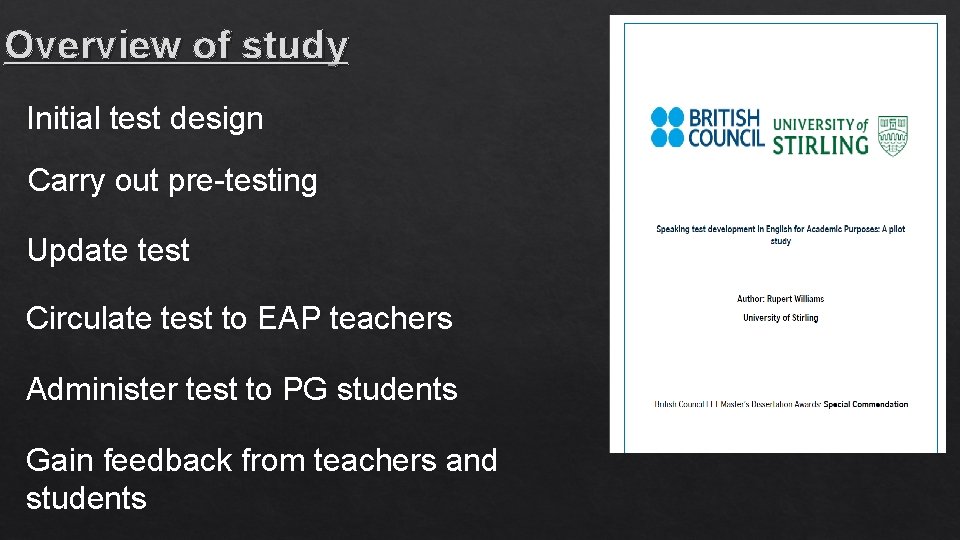
Overview of study Initial test design Carry out pre-testing Update test Circulate test to EAP teachers Administer test to PG students Gain feedback from teachers and students
Approach to speaking test design • Encourage proactive speech • Integrate speaking with listening and reading • Include meaningful content • Reduce stress for students
Test overview • Two candidates, one examiner • 30 minutes • Resources needed: country profile (handouts), paper and pens provided • Tests recorded
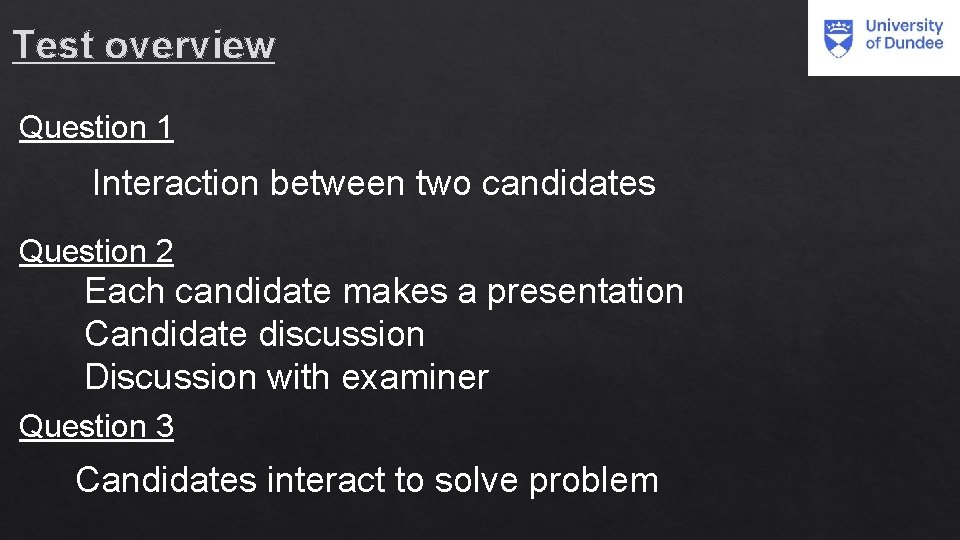
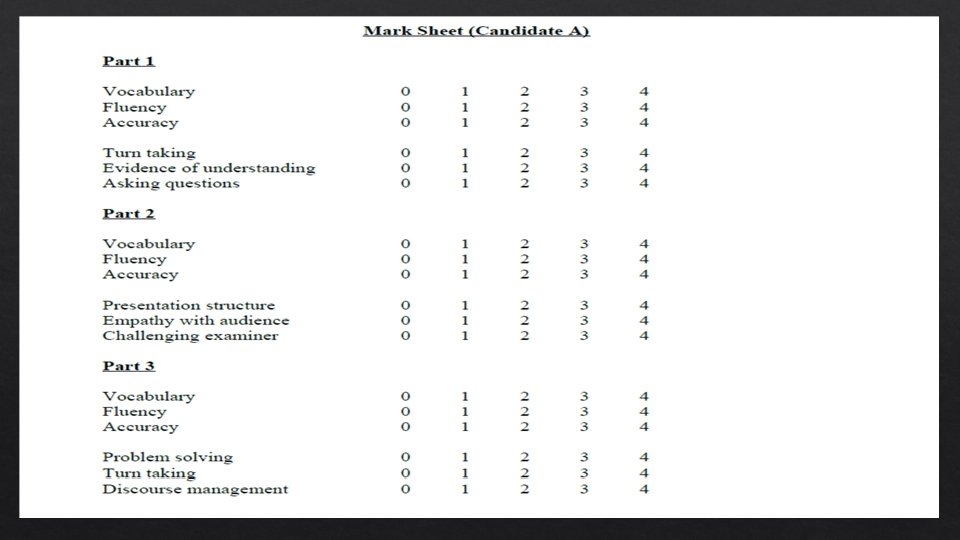
Test overview Question 1 Interaction between two candidates Question 2 Each candidate makes a presentation Candidate discussion Discussion with examiner Question 3 Candidates interact to solve problem
Test procedure • Examiner welcomes candidates • Candidates given 10 minutes to read a country profile - they are told they will deliver a short presentation and have a discussion about the country later.
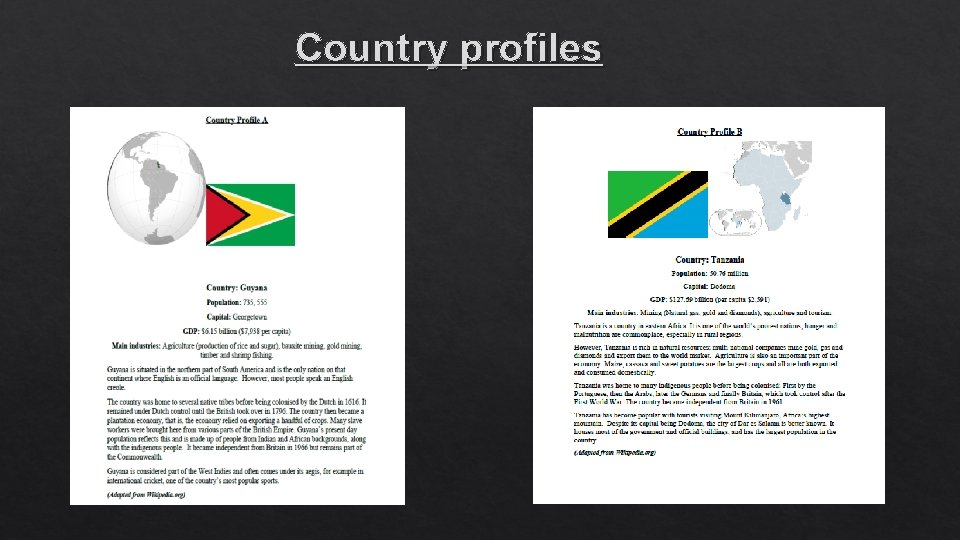
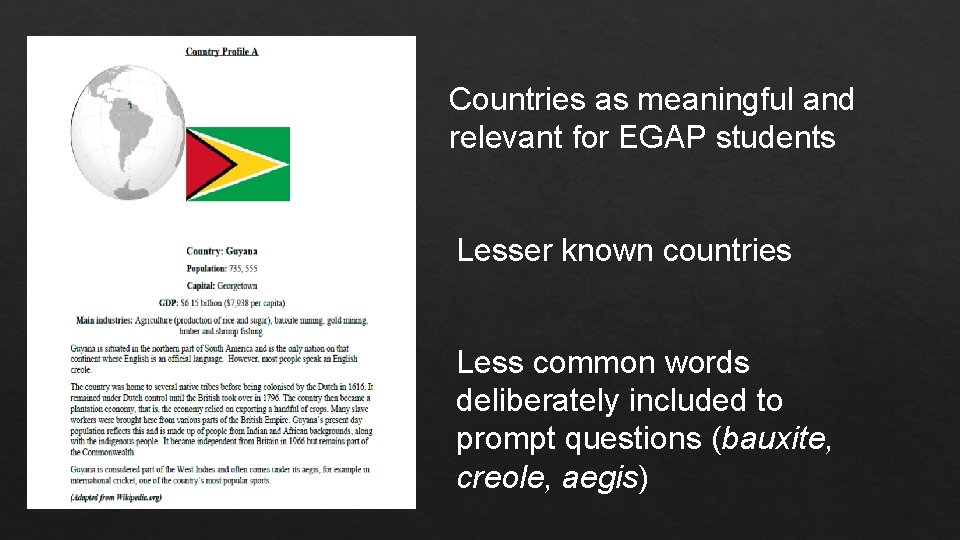
Country profiles
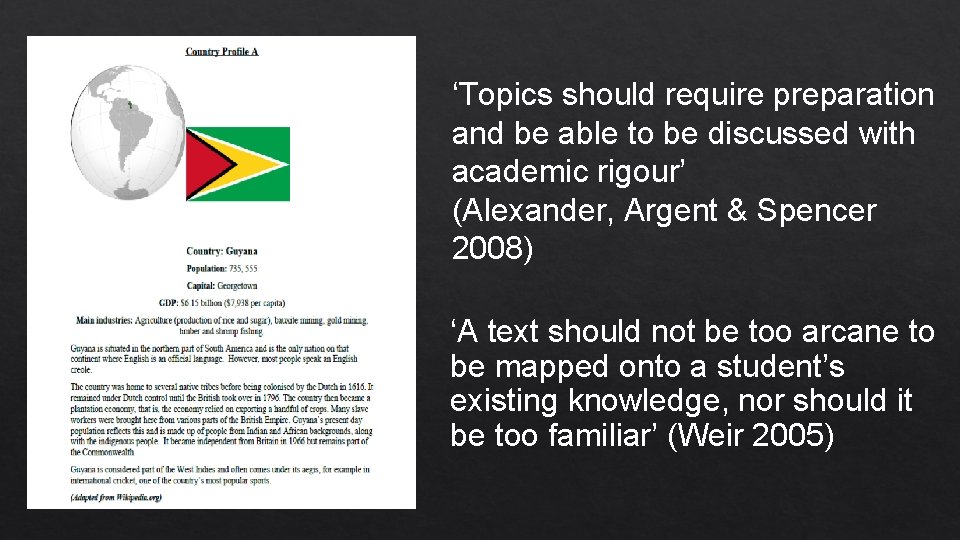
Country: Guyana Population: 735, 555 Capital: Georgetown GDP: $6. 15 billion ($7, 938 per capita) Main industries: Agriculture (production of rice and sugar), bauxite mining, gold mining, timber and shrimp fishing. Guyana is situated in the northern part of South America and is the only nation on that continent where English is an official language. However, most people speak an English creole. The country was home to several native tribes before being colonised by the Dutch in 1616. It remained under Dutch control until the British took over in 1796. The country then became a plantation economy, that is, the economy relied on exporting a handful of crops.
‘Topics should require preparation and be able to be discussed with academic rigour’ (Alexander, Argent & Spencer 2008) ‘A text should not be too arcane to be mapped onto a student’s existing knowledge, nor should it be too familiar’ (Weir 2005)
Countries as meaningful and relevant for EGAP students Lesser known countries Less common words deliberately included to prompt questions (bauxite, creole, aegis)
Question 1 Turn to your partner. Imagine you are both in the same class and are waiting for a lecture to begin. You do not know each other. Introduce yourself and get as much information as possible about your classmate. You have 3 minutes for this. Try to spend about half the time talking about you and the other half talking about your partner. Possible topics include: -Hometown/country of origin. -Current studies. -Today's weather. -Hobbies and interests. -Homework for the class.
Question 1 • Peer to peer interaction • Role play • Hughes (2003) ‘it is especially important to make the initial stages of a test well within the capacities of all reasonable candidates’ • Informal language
Question 2 Candidate A: You were given some information about a country to read. You will now each make a short 2 -minute presentation to the other candidate and examiner about this country. You should include any information you think is interesting or relevant. Try to structure your talk in a clear way, with an introduction, main part and a conclusion. Candidate B: You are going to listen to candidate A talk about a country. You must listen carefully and you may take notes. At the end of candidate A’s talk you must start a discussion about the country. This could include asking a question, clarifying or checking any information, giving opinions, etc.
Question 2 • Candidates may ask examiner any questions about text (negotiation of meaning) • Examiner listens to ad lib presentation a ‘prototypical academic communicative event’ (De Chazal 2014) and monologue. • Candidate B is taking notes to instigate the discussion. Academic speaking and listening are “two sides of the academic communication coin, in other words, totally inseparable in EAP’ (De Chazal 2014) • Examiner enters discussion and at some point drops a ‘false assertion’ in to the conversation
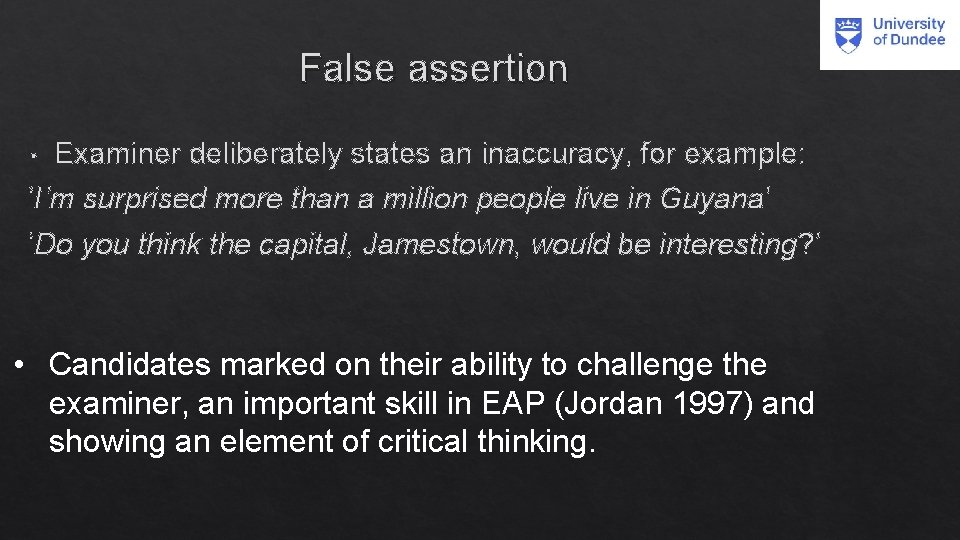
False assertion • Examiner deliberately states an inaccuracy, for example: ‘I’m surprised more than a million people live in Guyana’ ‘Do you think the capital, Jamestown, would be interesting? ’ • Candidates marked on their ability to challenge the examiner, an important skill in EAP (Jordan 1997) and showing an element of critical thinking.
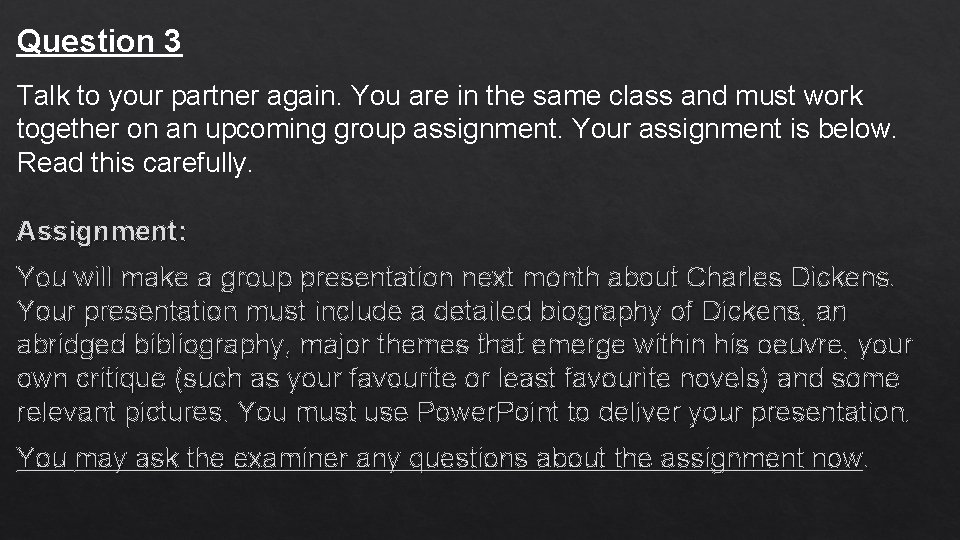
Question 3 Talk to your partner again. You are in the same class and must work together on an upcoming group assignment. Your assignment is below. Read this carefully. Assignment: You will make a group presentation next month about Charles Dickens. Your presentation must include a detailed biography of Dickens, an abridged bibliography, major themes that emerge within his oeuvre, your own critique (such as your favourite or least favourite novels) and some relevant pictures. You must use Power. Point to deliver your presentation. You may ask the examiner any questions about the assignment now.
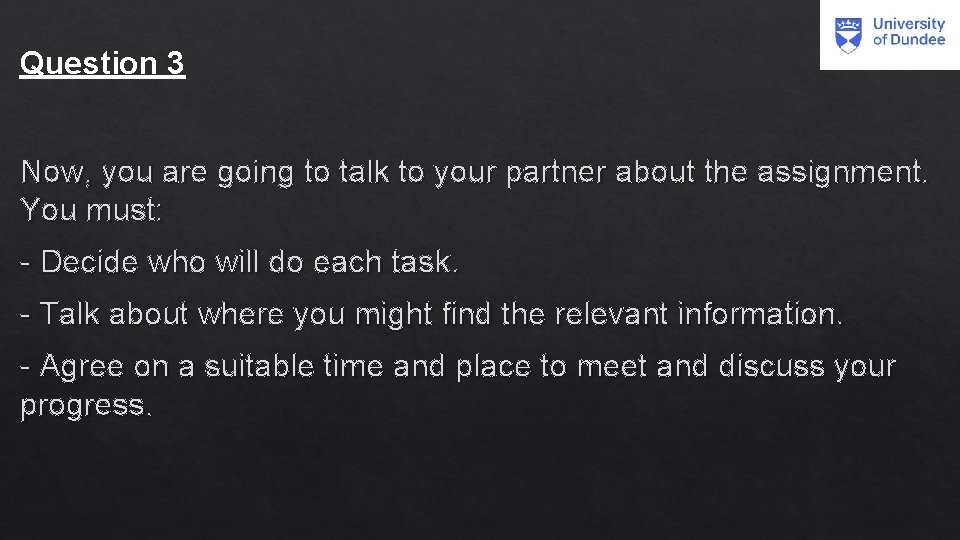
Question 3 Now, you are going to talk to your partner about the assignment. You must: - Decide who will do each task. - Talk about where you might find the relevant information. - Agree on a suitable time and place to meet and discuss your progress.
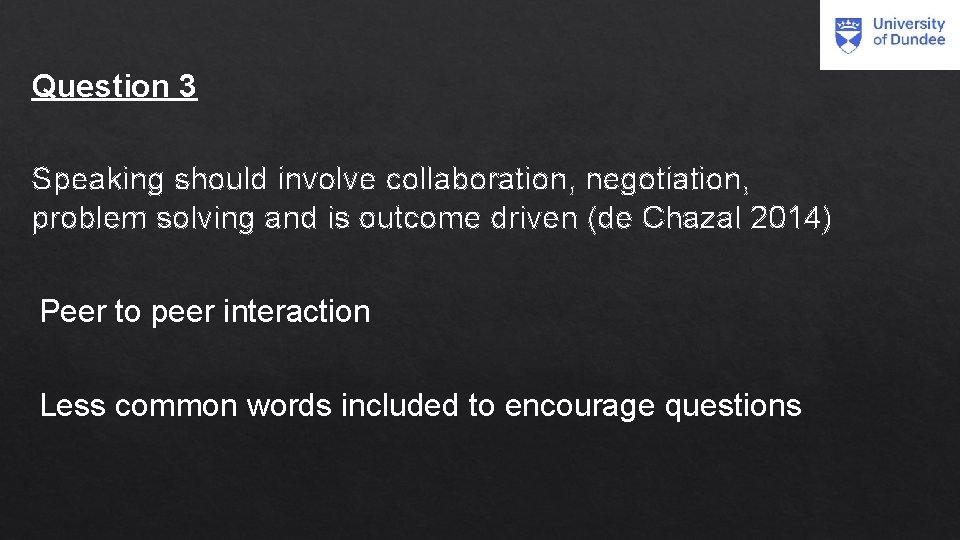
Question 3 Speaking should involve collaboration, negotiation, problem solving and is outcome driven (de Chazal 2014) Peer to peer interaction Less common words included to encourage questions
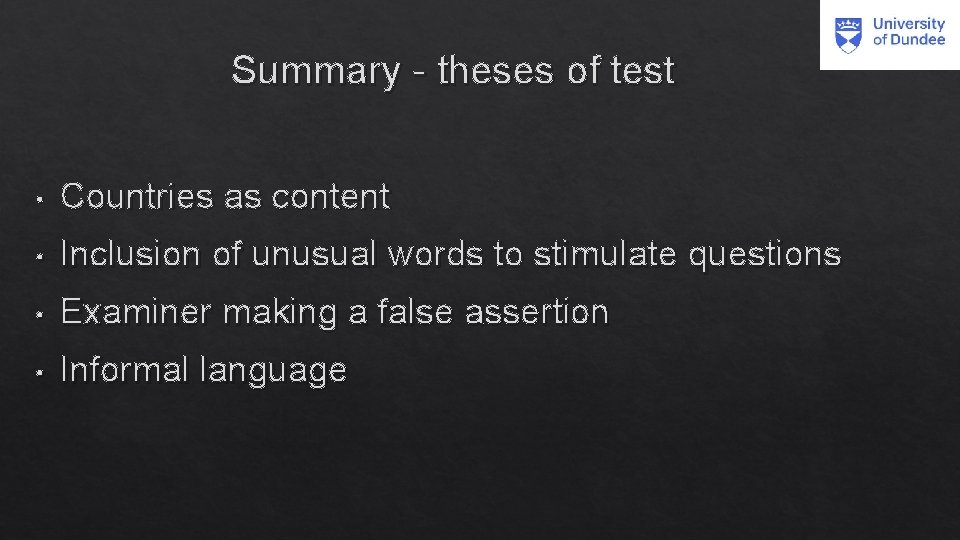
Summary - theses of test • Countries as content • Inclusion of unusual words to stimulate questions • Examiner making a false assertion • Informal language
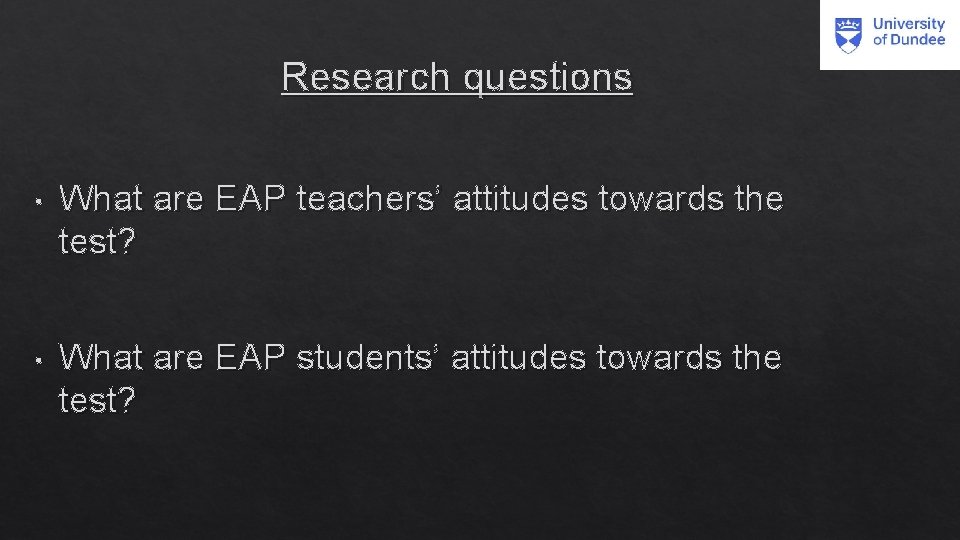
Research questions • What are EAP teachers’ attitudes towards the test? • What are EAP students’ attitudes towards the test?
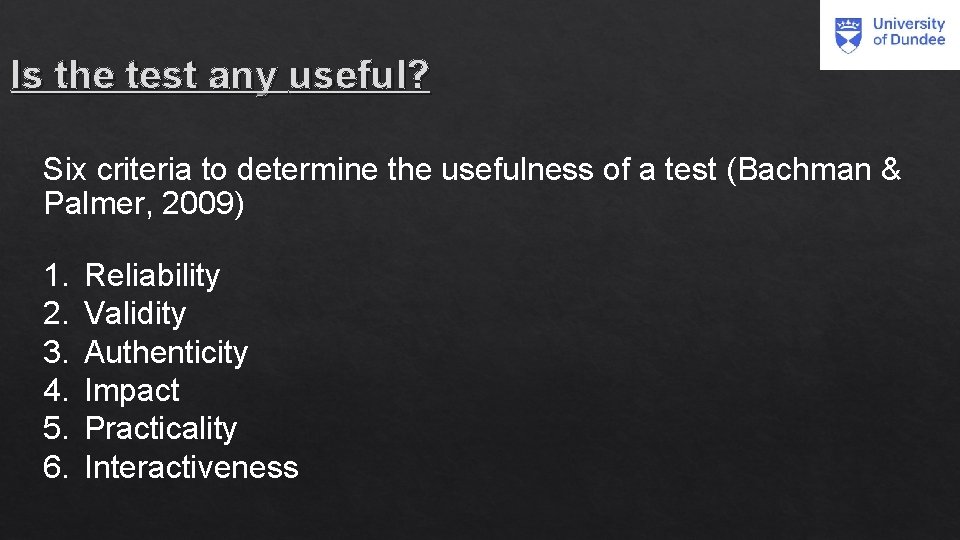
Is the test any useful? Six criteria to determine the usefulness of a test (Bachman & Palmer, 2009) 1. 2. 3. 4. 5. 6. Reliability Validity Authenticity Impact Practicality Interactiveness
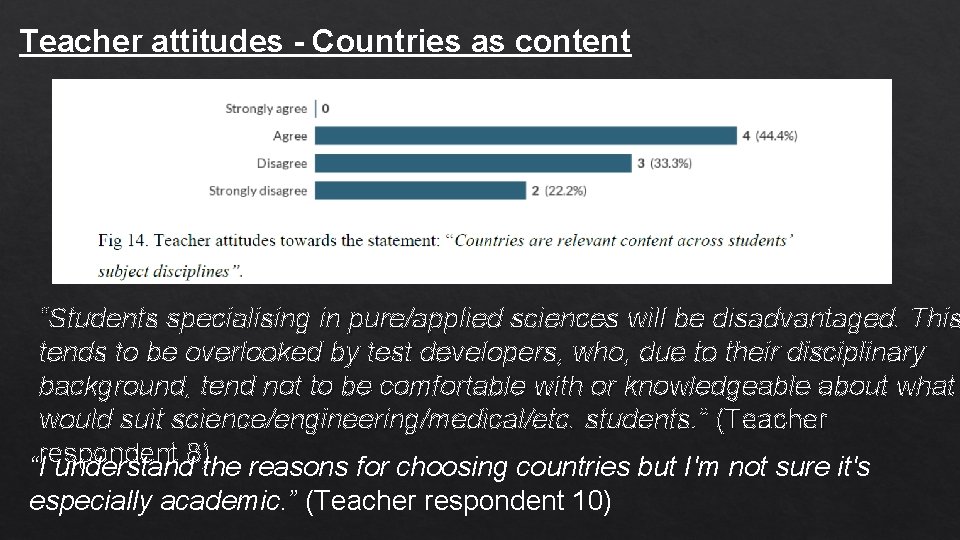
Teacher attitudes - Countries as content “Students specialising in pure/applied sciences will be disadvantaged. This tends to be overlooked by test developers, who, due to their disciplinary background, tend not to be comfortable with or knowledgeable about what would suit science/engineering/medical/etc. students. ” (Teacher respondent 8). “I understand the reasons for choosing countries but I'm not sure it's especially academic. ” (Teacher respondent 10)
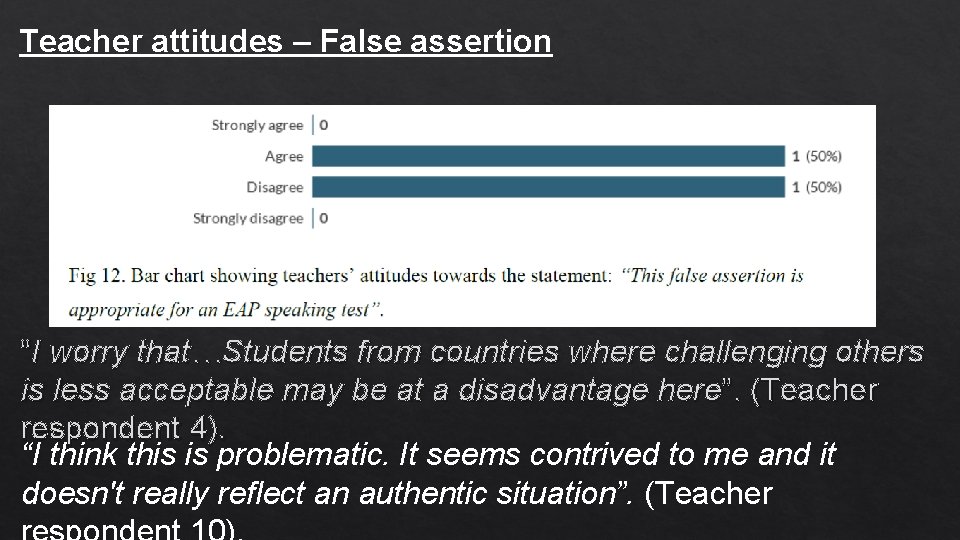
Teacher attitudes – False assertion “I worry that…Students from countries where challenging others is less acceptable may be at a disadvantage here”. (Teacher respondent 4). “I think this is problematic. It seems contrived to me and it doesn't really reflect an authentic situation”. (Teacher
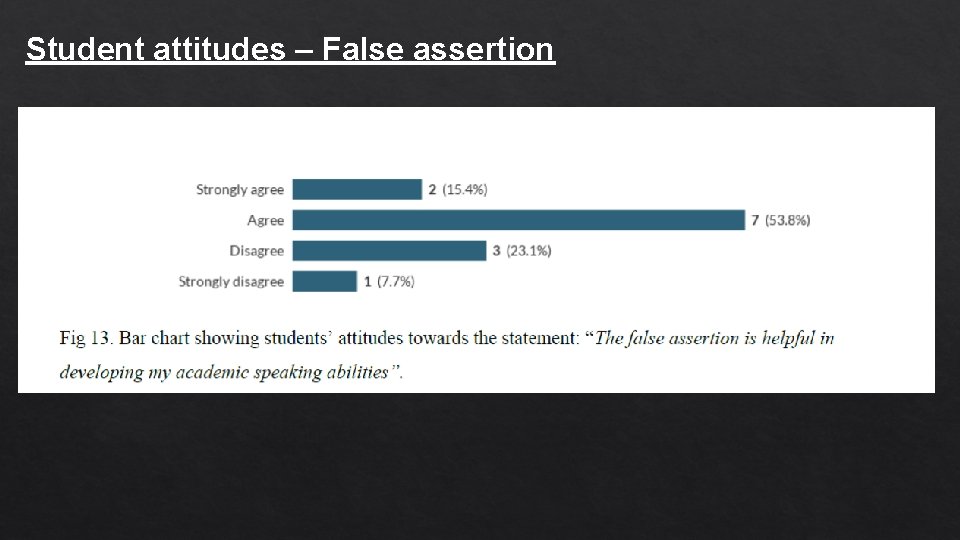
Student attitudes – False assertion
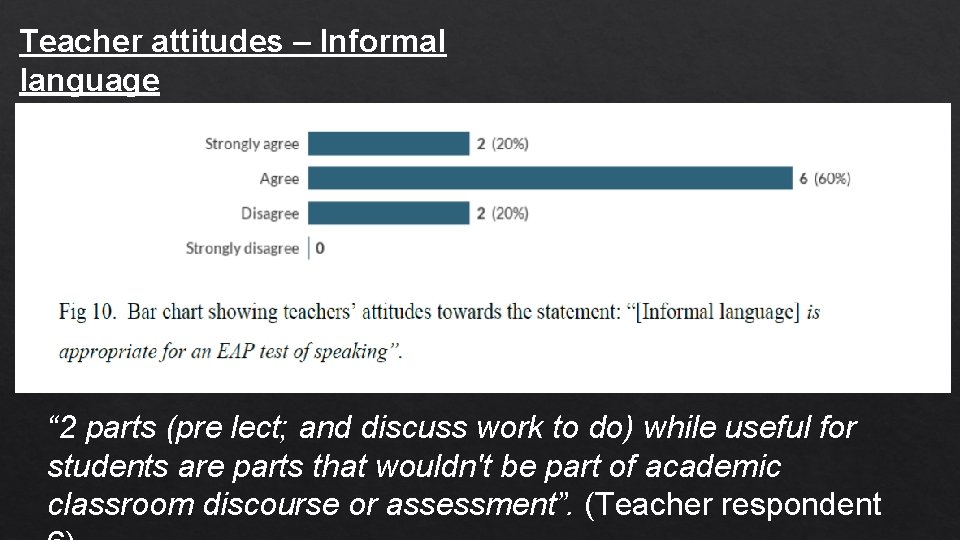
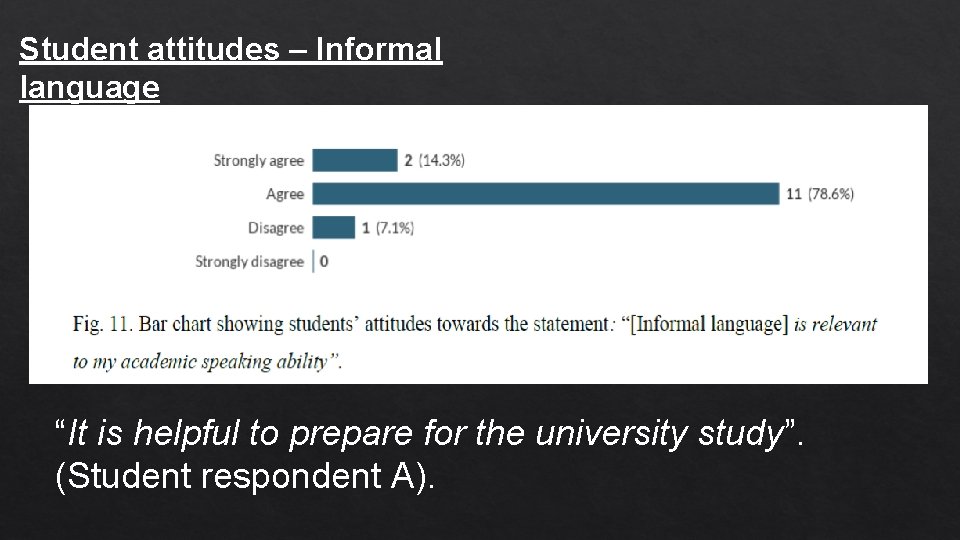
Teacher attitudes – Informal language “ 2 parts (pre lect; and discuss work to do) while useful for students are parts that wouldn't be part of academic classroom discourse or assessment”. (Teacher respondent
Student attitudes – Informal language “It is helpful to prepare for the university study”. (Student respondent A).
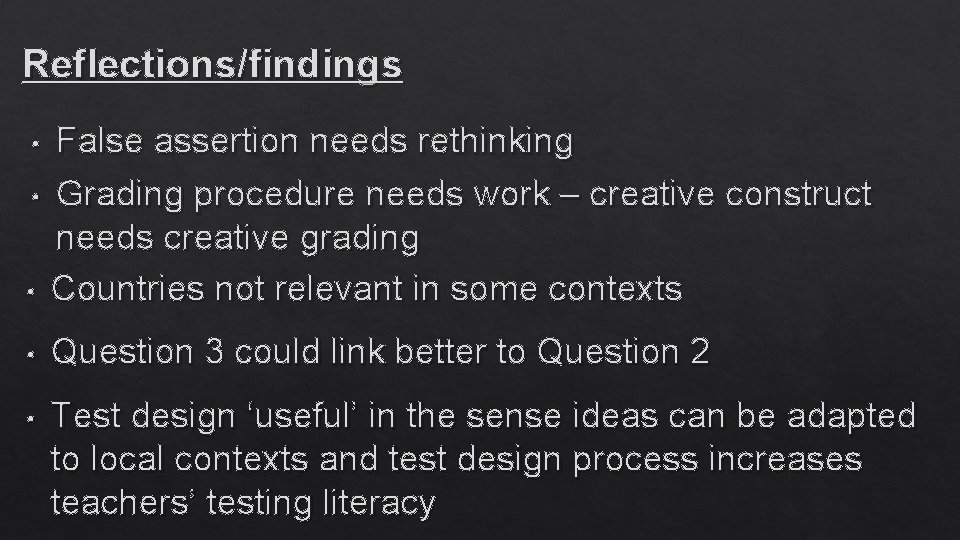
Reflections/findings False assertion needs rethinking • Grading procedure needs work – creative construct needs creative grading • Countries not relevant in some contexts • • Question 3 could link better to Question 2 • Test design ‘useful’ in the sense ideas can be adapted to local contexts and test design process increases teachers’ testing literacy
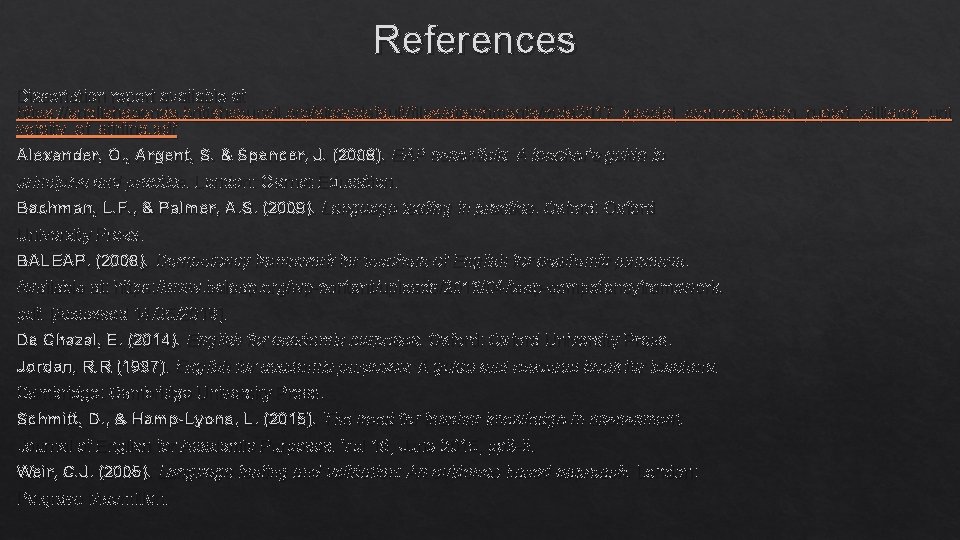
References Dissertation report available at https: //englishagenda. britishcouncil. org/sites/default/files/attachments/mda 2017_special_commendation_rupert_williams_uni versity_of_stirling. pdf Alexander, O. , Argent, S. & Spencer, J. (2008). EAP essentials: A teacher’s guide to principles and practice. London: Garnet Education. Bachman, L. F. , & Palmer, A. S. (2009). Language testing in practice. Oxford: Oxford University Press. BALEAP. (2008). Competency framework for teachers of English for academic purposes. Available at: https: //www. baleap. org/wp-content/uploads/2016/04/teap-competencyframework. pdf. [Accessed 14/05/2016]. De Chazal, E. (2014). English for academic purposes. Oxford: Oxford University Press. Jordan, R. R (1997). English for academic purposes: A guide and resource book for teachers. Cambridge: Cambridge University Press. Schmitt, D. , & Hamp-Lyons, L. (2015). The need for teacher knowledge in assessment. Journal of English for Academic Purposes. Vol 18, June 2015, pp 3 -8. Weir, C. J. (2005). Language testing and validation: An evidence based approach. London: Palgrave Macmillan.
Thanks for listening!