
SPEAKING AND HEARING ABORIGINAL NEWSPAPERS AND THE PUBLIC
SPEAKING AND HEARING: ABORIGINAL NEWSPAPERS AND THE PUBLIC SPHERE IN CANADA AND AUSTRALIA Shannon Avison Michael Meadows Canadian Journal of Communication, 2000, Vol. 25, No. 3 http: //www. cjc-
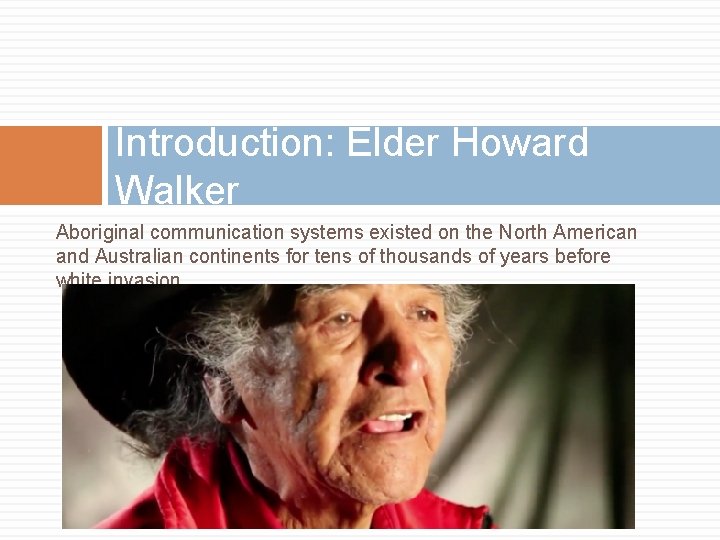
Introduction: Elder Howard Walker Aboriginal communication systems existed on the North American and Australian continents for tens of thousands of years before white invasion.

Communication prior to contact The print media in North America grew from a system of communication covering most of the continent before white contact, 500 years ago. Then, Indian runners (sometimes young women) or tribal messengers were officially recognized by the entrenched governing systems as carriers of information The system began to break down as European settlement encroached more and more on Indian land.
Introduction Aboriginal people wanted their own media for political, educational, and cultural reasons. This is driven by several impulses: • combating stereotypes, • addressing information gaps in non-Aboriginal society, and • reinforcing community cultures.
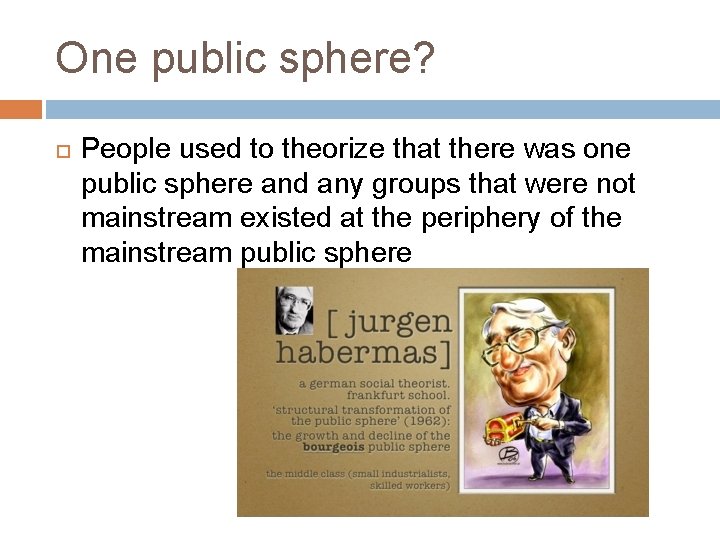
One public sphere? People used to theorize that there was one public sphere and any groups that were not mainstream existed at the periphery of the mainstream public sphere
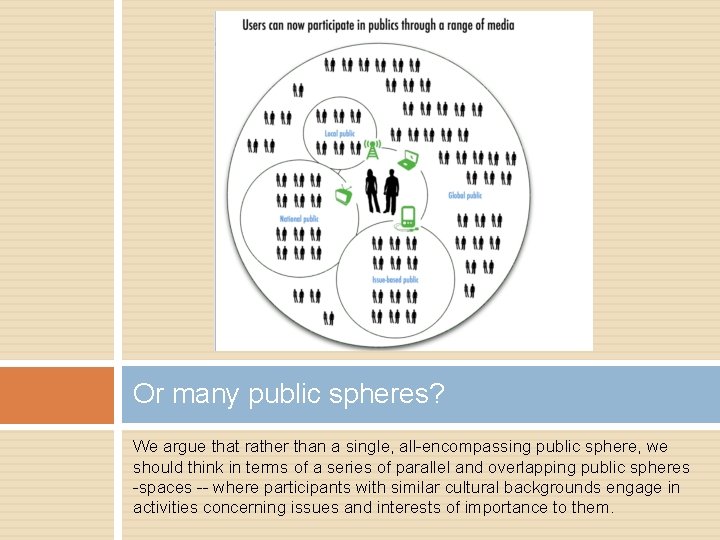
Or many public spheres? We argue that rather than a single, all-encompassing public sphere, we should think in terms of a series of parallel and overlapping public spheres -spaces -- where participants with similar cultural backgrounds engage in activities concerning issues and interests of importance to them.
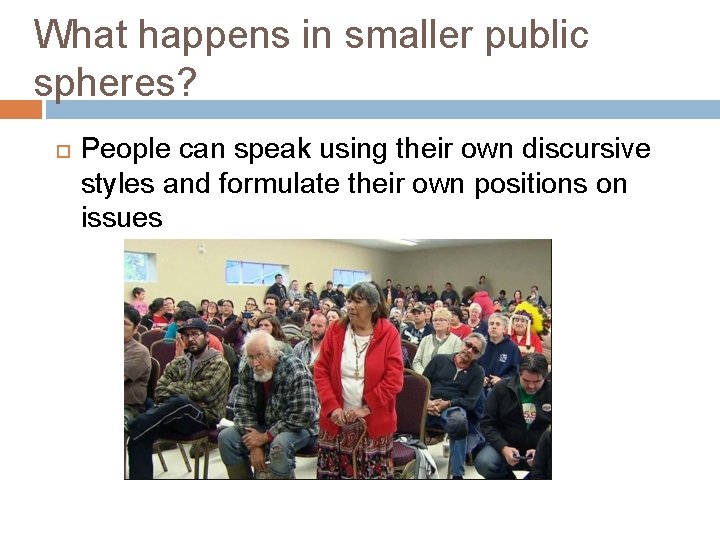
What happens in smaller public spheres? People can speak using their own discursive styles and formulate their own positions on issues
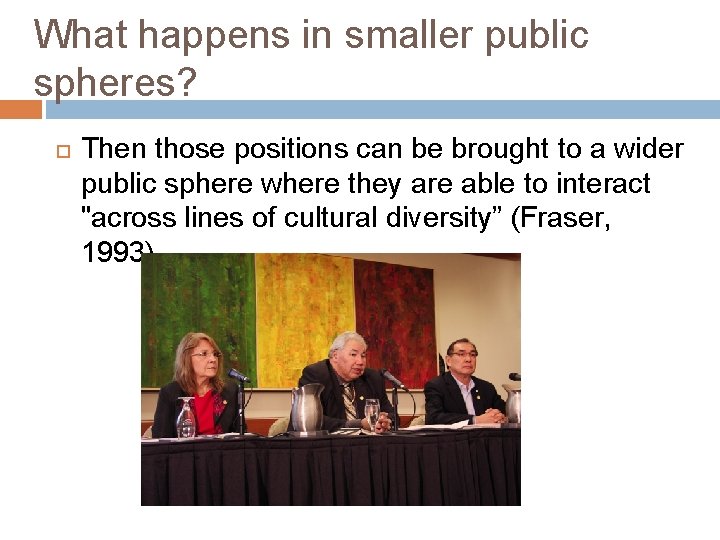
What happens in smaller public spheres? Then those positions can be brought to a wider public sphere where they are able to interact "across lines of cultural diversity” (Fraser, 1993).
Preserving culture and language Behind much of the impetus for the development of Aboriginal media production is the fear of further cultural and language shifts because of the influence of mainstream mediasymbolic of broader public sphere activity.
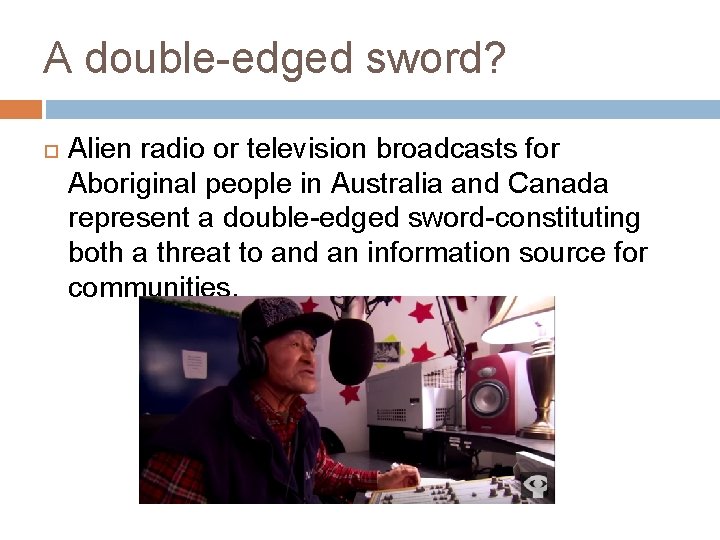
A double-edged sword? Alien radio or television broadcasts for Aboriginal people in Australia and Canada represent a double-edged sword-constituting both a threat to and an information source for communities.
Strategies initiated by Aboriginal communities to overcome the negative elements include varied forms of technical and cultural control, and production (Schmidt, 1993). In this sense, media technologies might be seen as a community cultural resource enabling public sphere activity rather than a harbinger of cultural imperialism (Meadows, 1994, 1995 a).
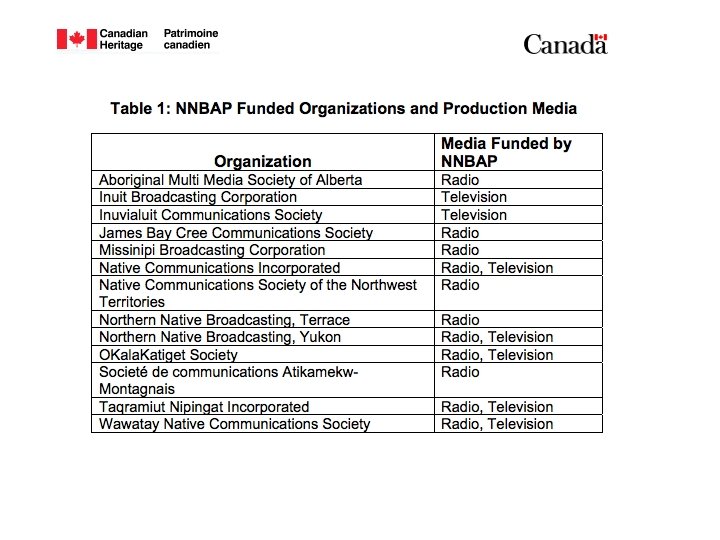
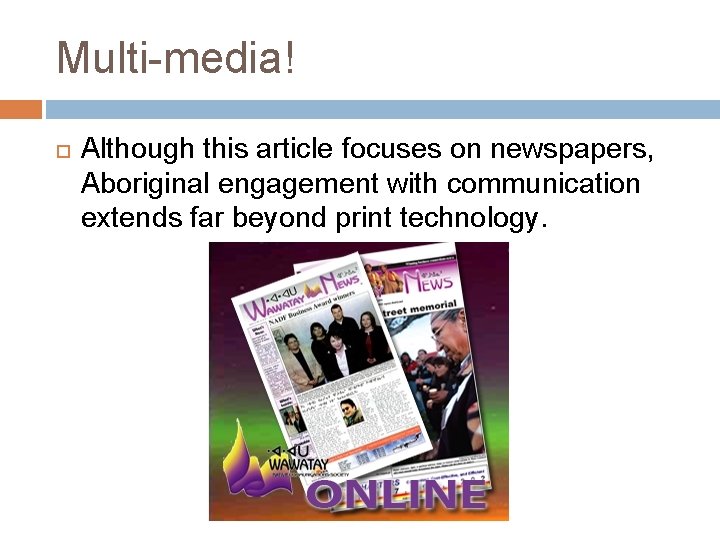
Multi-media! Although this article focuses on newspapers, Aboriginal engagement with communication extends far beyond print technology.
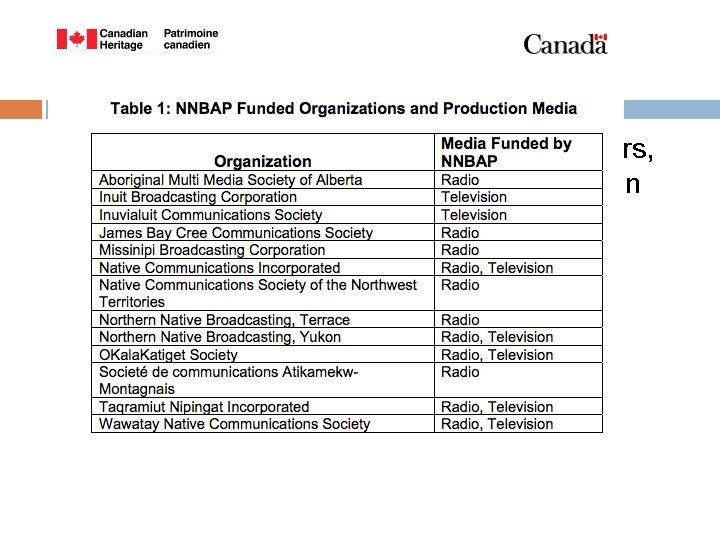
Although this article focuses on newspapers, Aboriginal engagement with communication extends far beyond print technology.
Although this article focuses on newspapers, Aboriginal engagement with communication extends far beyond print technology. The explosion of broadcasting and use of the Internet by Indigenous peoples around the world is evidence of that (Molnar & Meadows, in press). Across Canada, there are numerous magazines produced by Aboriginal people, sometimes by the same organizations that also produce radio and television programs. Some, like Aboriginal Voices, have taken on a key advocacy role in publishing profiles of Aboriginal artists, along with critical discussion of the Aboriginal production environment and related policy issues. Although the Aboriginal print media sector in Australia has a long history-starting in 1836 -it remains small, largely because of a lack of support and encouragement from public sphere institutions.
Ang (1990) reminds us that audience reception has deeply political and cultural implications so it should not be surprising to find that Aboriginal audiences and communities have rejected what they perceive as a misrepresentation of their concerns and issues. Aboriginal people's voices remain suppressed in news coverage of events in which they are deeply implicated. Investigations of mainstream media coverage of Indigenous issues in Australia and Canada reveal Aboriginal voices are still vastly outnumbered by non-Indigenous sources (Meadows, 1993, 1999, 2000). Indigenous people's response has manifested itself in various waysincluding the adoption of print technology. Indigenous agency has been an important element which has enabled Aboriginal people to gain access to a wide range of media technologies and to appropriate them for their own cultural purposes (Meadows, 1994; 1995 a). This article focuses on print and newspapers in particular-the first modern media technology with which Aboriginal people engaged. It is a sector often overlooked by those who are quite naturally drawn to the more popular world of broadcasting and digital production (Rose, 1996).

THE CULTURAL INFLUENCE OF PRINT TECHNOLOGY
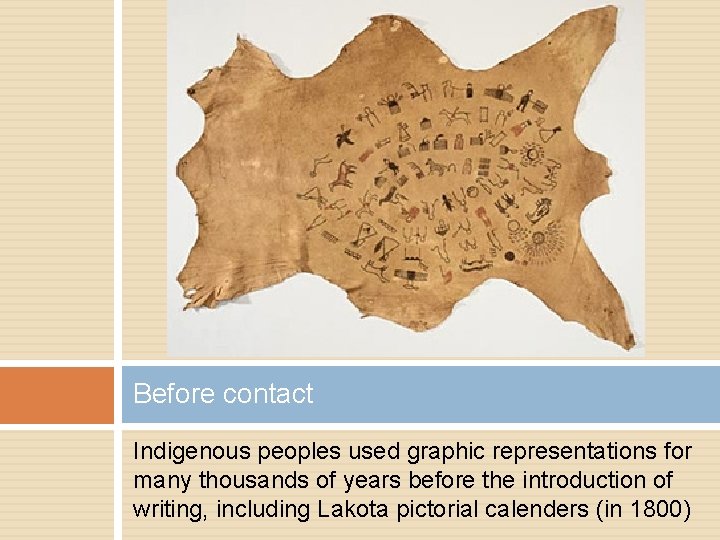
Before contact Indigenous peoples used graphic representations for many thousands of years before the introduction of writing, including Lakota pictorial calenders (in 1800)
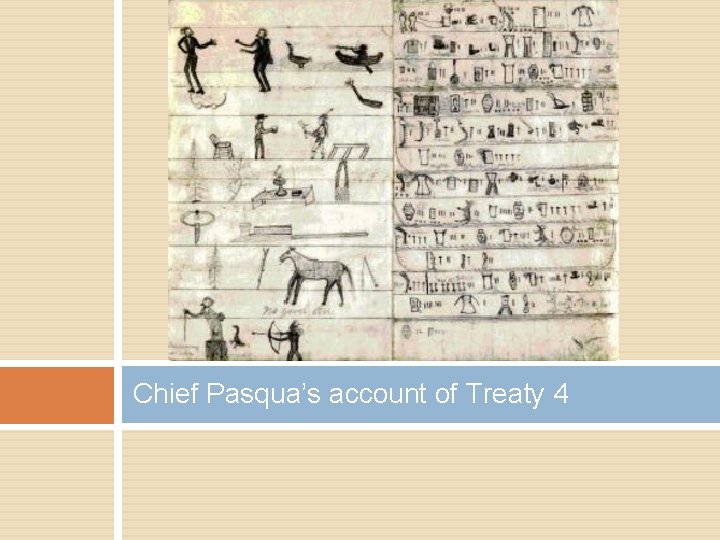
Chief Pasqua’s account of Treaty 4
Before contact The Indigenous peoples of North America and Australia used graphic representations for many thousands of years before the introduction of writing, including, more recently, the use of pictorial calenders (in 1800) by the Ojibway and the Dakota (Goody, 1987). Aboriginal Australians still use iconography in paintings. Inuktitut and Cree existed as languages without a written form until the eighteenth and nineteenth centuries when missionaries introduced a syllabic script into remote northern regions. Cree was not taught as a spoken and written form in schools until 1970 (Bennett, 1988). Similarly, the first Australian policy move to recognize the value of Aboriginal languages did not occur until the election of the Whitlam Labor government in 1972 (Schmidt, 1993). The relatively recent non-Indigenous recognition of the value of Aboriginal languages and the very nature of oral cultures perhaps helps to explain why media which privilege speech and "real time" forms of representation, like broadcasting, are preferred by Indigenous communities. But the Aboriginal print media fulfill a crucial role in public sphere activity.
Before contact Inuktitut and Cree existed as languages without a written form until the eighteenth and nineteenth centuries when missionaries introduced a syllabic script into remote northern regions. Cree was not taught as a spoken and written form in schools until 1970 (Bennett, 1988). Similarly, the first Australian policy move to recognize the value of Aboriginal languages did not occur until the election of the Whitlam Labor government in 1972 (Schmidt, 1993). The relatively recent non-Indigenous recognition of the value of Aboriginal languages and the very nature of oral cultures perhaps helps to explain why media which privilege speech and "real time" forms of representation, like broadcasting, are preferred by Indigenous communities. But the Aboriginal print media fulfill a crucial role in public sphere activity.
Within 50 years of Johan Gutenburg's invention of printing in the 1450 s, the technology had moved into printers' workshops all over Europe. The rise of the press in eighteenth-century Amsterdamfrom the monthly gazette to the weekly, and eventually the daily paper-provided Europeans with their first newspapers (Eisenstein, 1983). In North America and Australia, Aboriginal communities' first regular use of print technology came in 1828 and 1836 respectively. Goody (1986, 1987) suggests that the introduction of writing into such oral cultures tends to create a new class of literates with nonliterates filling the lower positions. He argues that print technologies effectively have "governed the form and language of the discourse" where they have intervened (Goody, 1986, p. 99). The shift to writing, in a general sense, is able to extend the control of time and space away from the limits of the local-a particular feature of many oral cultures. The written word also drives moves towards a more formal concept of evidence and by association, notions of truth. The written word in the form of a story, narrative, or myth, for example, acquires a truth value possessed by no oral version (Goody, 1986, 1987).

HABERMAS AND THE PUBLIC SPHERE
Jürgen Habermas' treatise on the Structural Transformation of the Public Sphere (1989, originally published in 1962) and subsequent discussion around the notion of the public sphere (1974, 1992) provide a useful framework for us in this work-inprogress on the development of the idea of an Aboriginal public sphere. It is useful in that it focuses attention on the role of historical sites of discursive activity-such as Aboriginal newspapers-in the democratization of societies. Although Habermas' later writings (1974) provide more concise accounts, the Structural Transformation is especially helpful because it uses the historical accounts of emerging democracies to develop theoretical elements. These in turn give concrete examples of public spheres in various stages of emergence (and decline) and thus can be compared with the evolution of other historically situated public spheres-including the Aboriginal public spheres in Canada and Australia.
The shift of Habermas’ public sphere mass media shifted from centres of rational-critical discursive activity to commercialized vehicles for advertising and public relations This lead to the decline of the liberal public sphere in the nineteenth century. In later writings, Habermas (1974) describes the public sphere as "a realm of our social life in which something approaching public opinion can be formed" (p. 29). for Habermas (1974), unrestricted access to the public sphere is a defining characteristic with the role of the mass media central in this process. Garnham (1986), for one, sees the strength of this model in its stress on the "materiality" of public spaces where public opinion takes shape (p. 40). This is a key point on which we base our argument here.
The decline of the liberal public sphere was hastened with a shift from the press being a forum for rational critical debate for private citizens assembled to form "a public, " to a privately owned and controlled institution that could be manipulated by publishers. For Habermas (1989), this came about with the collapse of the barrier between editorial and advertising. Despite its flaws and critics, enlisting such ideas incorporated in the public sphere model does offer ways of re-conceptualizing the limits of democracy (Dahlgren & Sparks, 1991; Calhoun, 1992). Much of our argument here relies on the work of Nancy Fraser in doing just this. Fraser's feminist critique of Habermas' model-which excludes women, "plebian" men, and all people of colour-nevertheless prompts a rethinking rather than a rejection of his ideas.
For Fraser (1993), the important theoretical task is to "render visible the ways in which societal inequality infects formally exclusive existing public spheres and taints discursive interactions with them" (p. 13). Her reconceived public sphere model theorizes each public sphere as providing a space where participants with similar cultural backgrounds can engage in discussions about issues and interests important to them, using their own discursive styles-and genres-and formulating their positions on various issues. It is then that these are brought to the wider public sphere in which "members of different more limited publics talk across lines of cultural diversity" (p. 7).
The next step, according to Fraser (1993), is to challenge Habermas' earlier conception of the public sphere as a single entity and to propose the existence and operation of multiple public spheres where members of society who are subordinated or ignored-"subaltern counterpublics"-are able to deliberate amongst themselves (p. 14). Habermas arrived at a conclusion closer to Fraser's in his later writings (Habermas, 1974). Hartley & Mc. Kee (2000) reach a similar conclusion in their discussion of an Indigenous public sphere as a "highly mediated public `space' for developing notions of Indigeneity and putting them to work" in relation to journalism practices in reporting Indigenous affairs (p. viii). However, their conception seems to be more a case of how Indigenousness is made within the broader public sphere. We are concerned with how Indigenous people "make themselves" within their own public sphere and the implications that flow from this.
THE ABORIGINAL PUBLIC SPHERE
As we have outlined, Habermas' broad characterization of the liberal bourgeois public sphere has undergone considerable critique since its inception. The Aboriginal public sphere should not be understood in terms of a non-dominant variant of the broader public sphere. Although it develops in close proximity to and with a great deal of influence from mainstream society, it should be seen as a discrete formation that develops in a unique context. It is the product of contestation with the mainstream public sphere. While it operates within a dominant context, it is its "Aboriginalness" that is its defining characteristic. Extending Fraser's (1993) notion of the existence of multiple public spheres, we suggest that Aboriginal public spheres can be seen as providing opportunities for people who are regularly subordinated and ignored by mainstream public sphere processes. They enable Aboriginal people to deliberate together, to develop their own counter-discourses, and to interpret their own identities and experiences. This highlights the importance of seeing the notion of Aboriginality, or identity formation, as a dynamic process which takes place through dialogue (Langton, 1993).
What is the Aboriginal public sphere? Sites of discursive activity -- like political meetings and newspaper production They can exist on a variety of levels: clan, community/reserve, provincial/territorial, regional, urban, national, and international. “Sites” where Aboriginal people find the information and resources they need to deliberate regarding issues of concern to them.
An ideal public sphere? In keeping with Habermas' principle of publicity… � accessible to all citizens and, ideally, it is � a space where the views of participants are judged on their acceptability and "reasonability" to the Aboriginal community, rather than on the social status of a journalistic source making an argument. Storytelling, art and music, and even silence are important ways in which people make their positions known. An ideal Aboriginal public sphere accommodates these communicative styles.
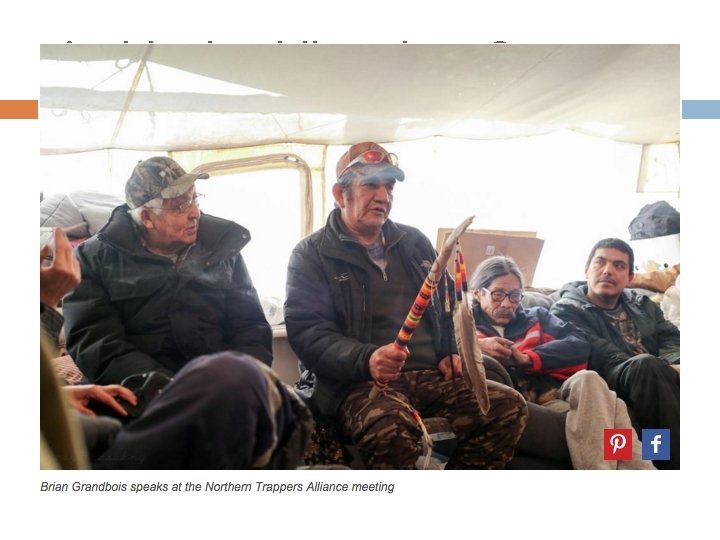
An ideal public sphere? In keeping with Habermas' principle of publicity… � accessible to all citizens and, ideally, it is � a space where the views of participants are judged on their acceptability and "reasonability" to the Aboriginal community, rather than on the social status of a journalistic source making an argument. Storytelling, art and music, and even silence are important ways in which people make their positions known. An ideal Aboriginal public sphere accommodates these communicative styles.
Ideal Aboriginal public sphere a space that can accommodate non-mainstream discursive styles and non-traditional perspectives. a site where collective self-determination can take place. promotes the realization of social equality as a basis for ensuring that self-determination includes all community members, especially less powerful constituencies like women and children. engages in public dialogue where cultural values, political aspirations, and social concerns of its participants are introduced into larger public spheres where they might influence discussions there (Avison, 1996).
Size matters… some "traditional" Aboriginal public spheres conform more closely to the public sphere principles set out by Habermas than the example he used as his ideal type public spheres in Aboriginal societies in Australia and Canada tended to centre on small, clan-based groups. Johansen (1991) explains how the Cherokee "usually split their villages when they became too large to permit each adult a voice in council” Similarly, when communities grew too large in the Nishnawbe-Aski Nation in northern Ontario, people were sent out to start satellite settlements (Johansen, 1991). Smaller numbers enable more effective operation of decision-making processes and public sphere debate.
Along with the physical size of communities, the values and institutions of these oral societies-through practices such as gift exchange and sharing, for example-played a key role in enabling public sphere activity. As with the dynamic notion of identity, the nature of "traditional" Aboriginal public spheres has waxed and waned according to the nature and extent of the dialogue with non-Aboriginal society. We suggest that many traditional Aboriginal public spheres went into decline following European contact as a result of communities being marginalized and disenfranchised through their lack of access to information, and the control and management of their lives by successive governments in Australia and Canada. The enforced gathering of Aboriginal people into settlements and missions played an important part in this (Dyck, 1991; Frideres, 1988; Kidd, 1997).
In the following overview of Aboriginal media in Canada and Australia, we examine the rise of newspapers as mediated public spheres. We examine the problematic role of cultural policy and whether it was developed only to support a non-political Aboriginal public sphere that was, after Habermas, "feudalized" by private and public institutions.

ABORIGINAL NEWSPAPERS: CANADA
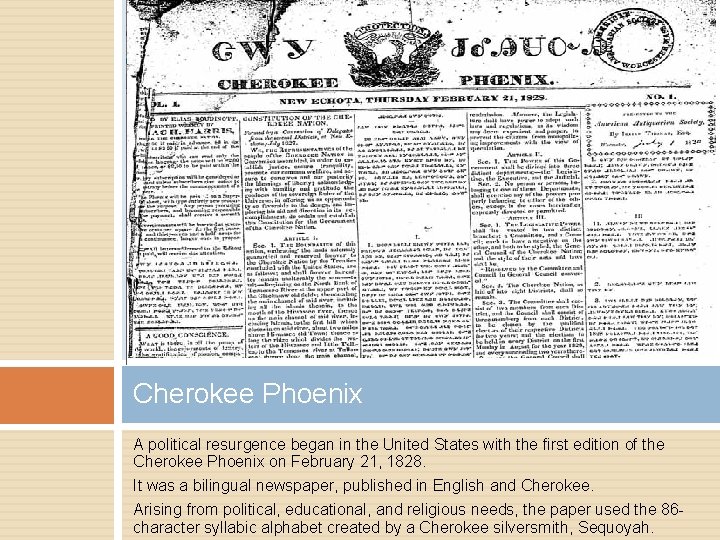
Cherokee Phoenix A political resurgence began in the United States with the first edition of the Cherokee Phoenix on February 21, 1828. It was a bilingual newspaper, published in English and Cherokee. Arising from political, educational, and religious needs, the paper used the 86 character syllabic alphabet created by a Cherokee silversmith, Sequoyah.
Wawatay News This new-found literacy achieved by Aboriginal people in North America attracted varied responses. Around 150 years later, newspapers publishing in their own languages have taken on extraordinary significance for the Cree-Ojibway of northern Ontario. As Harrington (1985) observes, "The Wawatay News is so important to the northern people that it is probably the most read piece of literature that is produced in syllabics, next to the Bible" (p. 12).
Mainstream media mis-representation of Aboriginal people in Canada has compelled them to turn to their own media where they can "define their own identities and legitimise their values and goals" (Raudsepp, 1984, p. 10). Their mission, like their counterparts south of the border, is to provide the context so often missing in the dominant non-Indian press (Murphy, 1983; Weston, 1996). The Department of Indian and Northern Affairs' records in Ottawa reveal around 40 Native publications before 1970, all published by "government agencies or other non-Native groups. " Since then, around 90 Native-produced publications have appeared in Canada, coinciding with a trend towards self-determination (Raudsepp, 1984).
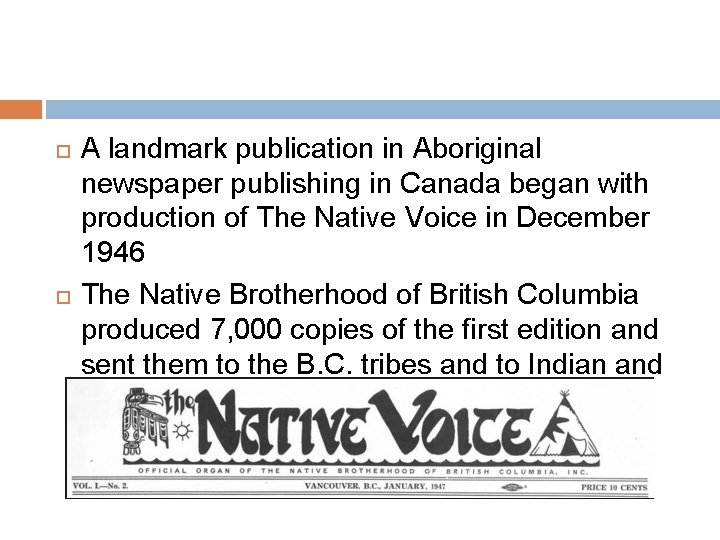
A landmark publication in Aboriginal newspaper publishing in Canada began with production of The Native Voice in December 1946 The Native Brotherhood of British Columbia produced 7, 000 copies of the first edition and sent them to the B. C. tribes and to Indian and non-Indian organizations across Canada (Native Voice, 1947).
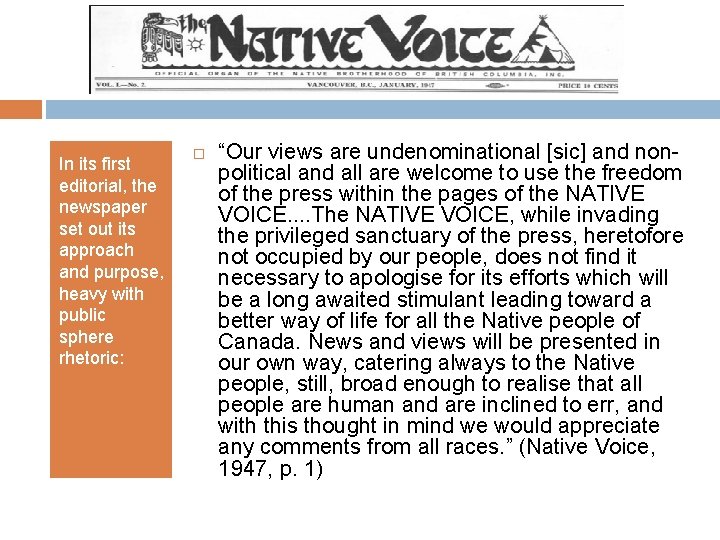
In its first editorial, the newspaper set out its approach and purpose, heavy with public sphere rhetoric: “Our views are undenominational [sic] and nonpolitical and all are welcome to use the freedom of the press within the pages of the NATIVE VOICE. . The NATIVE VOICE, while invading the privileged sanctuary of the press, heretofore not occupied by our people, does not find it necessary to apologise for its efforts which will be a long awaited stimulant leading toward a better way of life for all the Native people of Canada. News and views will be presented in our own way, catering always to the Native people, still, broad enough to realise that all people are human and are inclined to err, and with this thought in mind we would appreciate any comments from all races. ” (Native Voice, 1947, p. 1)
The role of Aboriginal organizations… The producer of the Native Voice was the Native Brotherhood of British Columbia, which was formed in 1931. Over the next few years, other Aboriginal organizations emerged: the first provincial Metis organization in Saskatchewan in 1937; � the Indian Association of Canada in 1939; � the Union of Saskatchewan Indians and the Union of Ontario Indians in 1946; � the Manitoba Indian Brotherhood in the late 1940 s � These organizations and many others which followed acted as communication centres for their communities.
The role of Aboriginal organizations… � Between May 1960 and May 1963, four issues of the Indian Outlook were published by the Federation (formerly Union) of Saskatchewan Indians. � The fourth edition, with a print run of 8, 000 copies, was a mimeographed letter-sized news bulletin with no pictures or advertising. � During 1963, the federal government's Centennial Commissionprovided Native groups with around $150, 000 for such projects. � Administration of funding was transferred to the Department of the Secretary of State in 1966 (Department of Secretary of State, 1967).
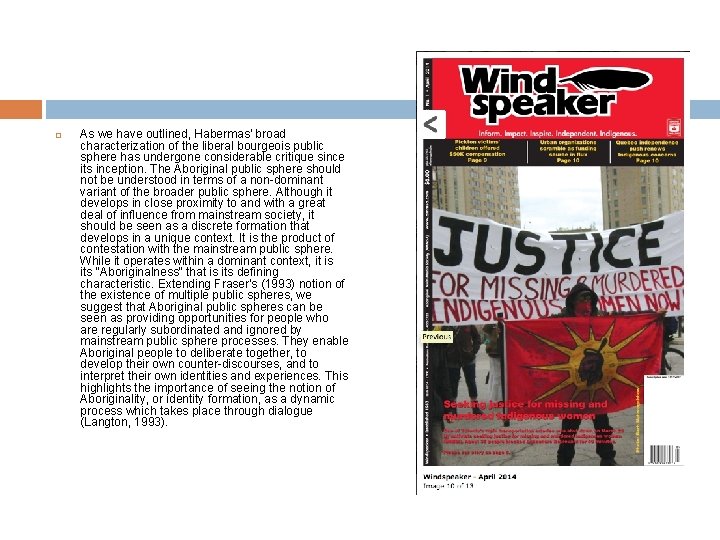
Alberta leads the way… Federal government support for the production of Cree-language programs on commercial radio in Alberta in 1968 expanded with the creation of the Alberta Native Communications Society and publication of a monthly newspaper, Native People. From 1983, it was published as the AMMSA newsletter. It changed its name to Windspeaker in 1986 In the same year in southern Alberta, the Communications Society of Indian News Media launched the Kainai News. The growth of Aboriginal newspapers took a huge leap following the release in 1969 of a White Paper on Indian Policy. The Indian leadership universally condemned it. Although it was formally withdrawn in June 1970, it had reinforced for Aboriginal people the national scope of the colonial experience. But it had also provoked Aboriginal people into identifying their cultural, political, and social commonalities. In the wake of the White Paper, the Micmac News was one of the first new papers to emerge, although an earlier, short-lived version had been published in Nova Scotia in 1932, and again in 1965 -66 (Micmac News, 1990). Other newspapers, some short-lived, which began at this time included Calumet (1968), New Breed (1969), Agenutamagen (1971), Brotherhood Report/Native Press (1971), Kinatuinamot Ilengajuk (1972), Ontario Native Examiner (1972), Ajemoon (1973), and Wawatay News (1974). These newspapers experienced mixed fortunes with some surviving for a year or two and others having greater success. The Saskatchewan Indian, for example, claimed a readership of more than 30, 000 in 1971 but had reached its peak circulation of 10, 000 copies by the late 1980 s (Doug Cuthand, Editor of the Saskatchewan Indian from 1970 to 1990, personal communication, 1995).
CULTURAL POLICY INFLUENCES
The federal government established the Native Communications Program in 1973 ($600, 000) which funded Aboriginal newspapers and other media. However, the program was set up to fund only non -political societies organized to operate at arm's length from political organizations. Funding eligibility criteria demanded that societies had to be registered as voluntary organizations, that they were to be operated by Native people, and that they aimed to serve Native people in the appropriate province or territory (Lougheed & Associates, 1986). By 1983 -84, the Department of the Secretary of State was allocating around $3 million to Native communications societies (Raudsepp, 1984). A program evaluation in 1986 revealed that the combined circulation of Aboriginal newspapers had increased from 27, 000 in 1982 -83 to 46, 000 in 1985 -86 (Lougheed & Associates, 1986). Federal funding continued on a temporary basis-being extended for periods from 12 months to three yearsuntil 1990, when it was suddenly eliminated. The shockwaves rebounded through the mainstream and Aboriginal media alike.
Windspeaker (March 2, 1990) devoted 14 pages to the budget cuts, leading with the headline, "Budget `racist' charges AFN [Assembly of First Nations]: violence could follow, hints Erasmus. " The CBC television program Focus North explained to viewers that the amount of money cut from the budget of the Yukon's only Native magazine, Dan Sha, was $155, 000 slightly more than the hourly cost ($125, 000) of funding Canada's involvement in the Gulf War (CBC, 1991). Just 5 of the 12 newspapers and magazines funded under the Native Communications Program have survived: Windspeaker (Alberta), Saskatchewan Indian (Saskatchewan), Wawatay News (Ontario), Tusaayaksat (Inuvik, Northwest Territories), and Kahtou (Vancouver).
The Native Communications Program in Canada represented a consolidation of the prior ad hoc funding of projects and organizations. The program also represented a consolidation of efforts to control and manipulate Aboriginal newspapers through program criteria, funding formulae, and systems of accountability developed and implemented with little or no input from publishing societies. The subsequent shift to a commercial model-with the conception of readership shifting from citizen to consumer-marked the "feudalisation" of the Aboriginal public sphere by the marketplace (Avison, 1996, p. 196). As we have outlined here, seven regional Aboriginal publications are no longer published, representing a loss not only of the newspapers as sites for regional discussion and public opinion formation, but also the loss of voices in the national Aboriginal public sphere. Thus, the Aboriginal public sphere has become unbalanced, with public opinion formulated and disseminated by those remaining.

CONCLUSION
Accessing democratic institutions Aboriginal people in both Canada and Australia won the right to vote in federal elections in the 1960 s. Until this time, they had not even symbolic access to democratic institutions like the media. Up until then, the Native Voice in Canada provided a forum for Aboriginal people to contribute to public debates and public sphere activity. In a very real sense, the newspapers offered a powerful symbolic reclamation of public sphere "space. ”
The White Paper, 1969 The impetus of the assimilationist Canadian White Paper on Indian Policy in 1969 acted as a catalyst for growth in the Aboriginal print media. By 1973, there were at least 10 regional newspapers published by provincial and territorial organizations representing Indian, Metis, and Inuit (Avison, 1996). Across the Pacific, the emergence of land rights' struggles and protests of the 1960 s and 1970 s had a similar catalytic effect. We suggest that a combination of social and political events, along with particular policy environments, enabled the formation of Aboriginal public spheres through access to media technologiesin this case, the press. While broadcasting and multimedia may dominate the popular imaginary, it was print technology which set the ball rolling.
Democracy and public spheres At the centre of democratic life are the public spheres in which private citizens learn about and comment on issues that concern them. These discursive activities take place in varied settings-classrooms, associations, unions, community meetings, and in provincial and national arenas. While most citizens of Canada and Australia take access to these spaces for granted, a great many "other" citizens are systematically excluded. The advent of mass democracy and mass media has seen Canada and Australia become societies of multiple-connected public spheres. These spheres evolve in unique social, political, economic, and cultural contexts. The emergence of Aboriginal newspapers in Canada and Australia has contributed significantly to this process and, in doing so, has expanded the existing spectrum of public opinion in both countries.
Although the idea to adopt newspapers as part of communication programs was initiated by Aboriginal people in Canada and Australia, development of the print sectors did not take place with the same degree of spontaneity as did creation of newspapers in Habermas' bourgeois public sphere. Crucially, Aboriginal people have had to operate in a broader public sphere much more open to interference and manipulation by external forces such as cultural policy regimes. In Canada, the elimination of the Native Communications Program funding in 1990 -and in Australia, the lack of a dedicated funding program altogether-has forced a shift to commercial models which have impacted adversely on Aboriginal public sphere activity. But perhaps not all is lost. As Raboy (1991) suggests, in liberal democracies, "where the policy making process is still at least partly in the public political arena. . . the policy arena. . . can be said to constitute a new public sphere of communication" (p. 171). In Australia, at least, this had a practical outcome with the first public acknowledgment of the existence of an Indigenous media sector by a 2000 Productivity Commission report on broadcasting. It is a salutory reminder that none of the publications we have alluded to here have been given to Aboriginal people. Each has emerged as the result of a struggle and it seems highly unlikely that they will be easily abandoned. The struggle, of course, is far from over.
The continuing circulation of these publications historically contributes to the development of a national Aboriginal public sphere by enabling the circulation of information regarding common experiences and issues. They provide sites for public opinion formation; sites where citizens can engage in collective efforts to bring their issues to the dominant public sphere; and sites where Aboriginal people can attempt to influence the policies of various governments through the pressure of public opinion. Aboriginal newspapers, along with other media, represent important cultural resources We suggest that Aboriginal newspapers in Canada and Australia have played-and continue to play-a crucial role in the shifting formation of the Aboriginal public sphere.
- Slides: 56