
SPE GULF COAST SECTION CONTINUING EDUCATION COMMITTEE PRESENTS


- Slides: 29
SPE GULF COAST SECTION CONTINUING EDUCATION COMMITTEE PRESENTS ANTICIPATING AND RESOLVING ETHICAL CONFLICTS IN PETROLEUM EXPLORATION AND PRODUCTION PETER R. ROSE AUSTIN, TEXAS OCTOBER 20, 2004
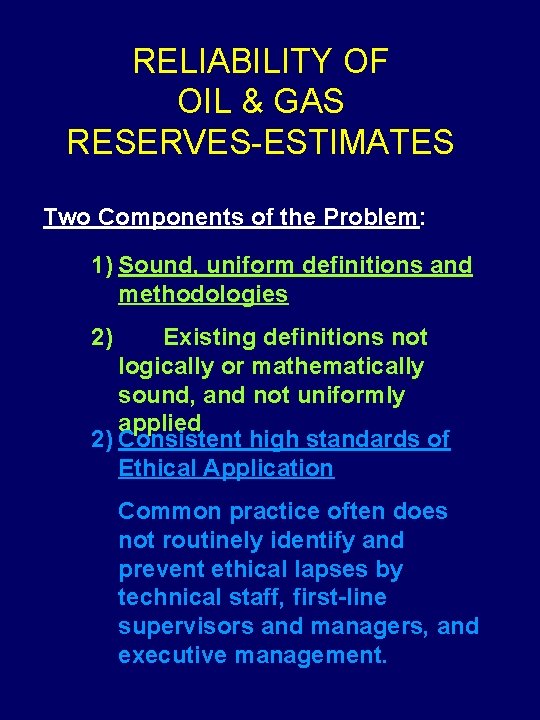
RELIABILITY OF OIL & GAS RESERVES-ESTIMATES Two Components of the Problem: 1) Sound, uniform definitions and methodologies 2) Existing definitions not logically or mathematically sound, and not uniformly applied 2) Consistent high standards of Ethical Application Common practice often does not routinely identify and prevent ethical lapses by technical staff, first-line supervisors and managers, and executive management.
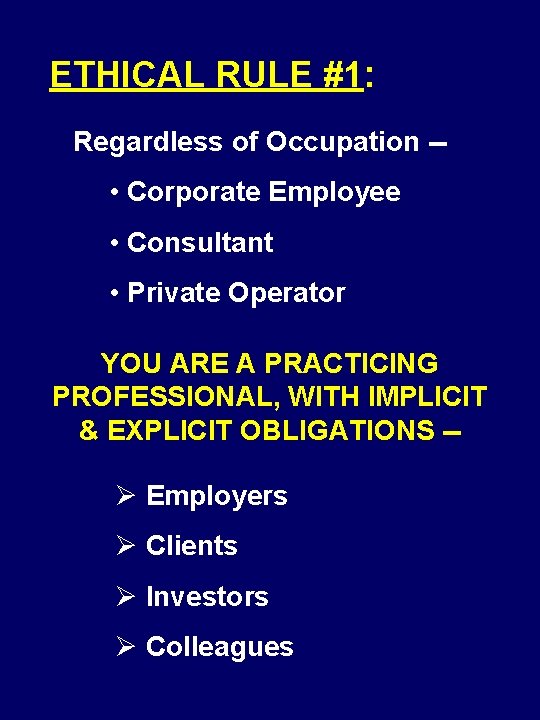
ETHICAL RULE #1: Regardless of Occupation -- • Corporate Employee • Consultant • Private Operator YOU ARE A PRACTICING PROFESSIONAL, WITH IMPLICIT & EXPLICIT OBLIGATIONS -- Ø Employers Ø Clients Ø Investors Ø Colleagues
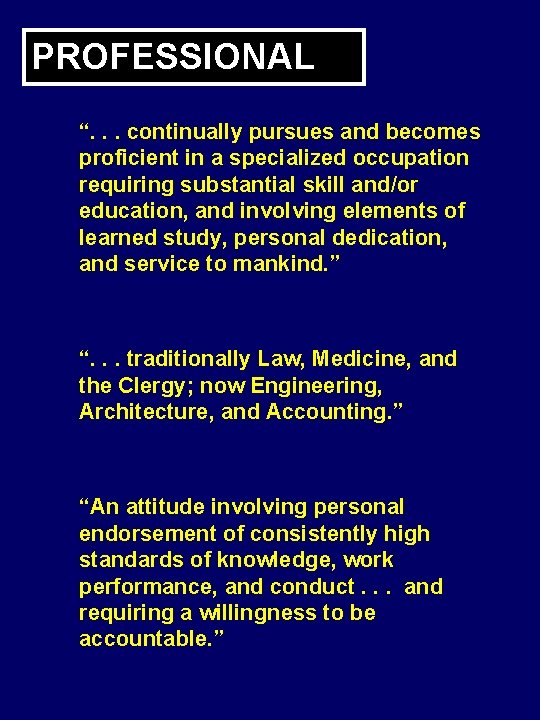
PROFESSIONAL “. . . continually pursues and becomes proficient in a specialized occupation requiring substantial skill and/or education, and involving elements of learned study, personal dedication, and service to mankind. ” “. . . traditionally Law, Medicine, and the Clergy; now Engineering, Architecture, and Accounting. ” “An attitude involving personal endorsement of consistently high standards of knowledge, work performance, and conduct. . . and requiring a willingness to be accountable. ”
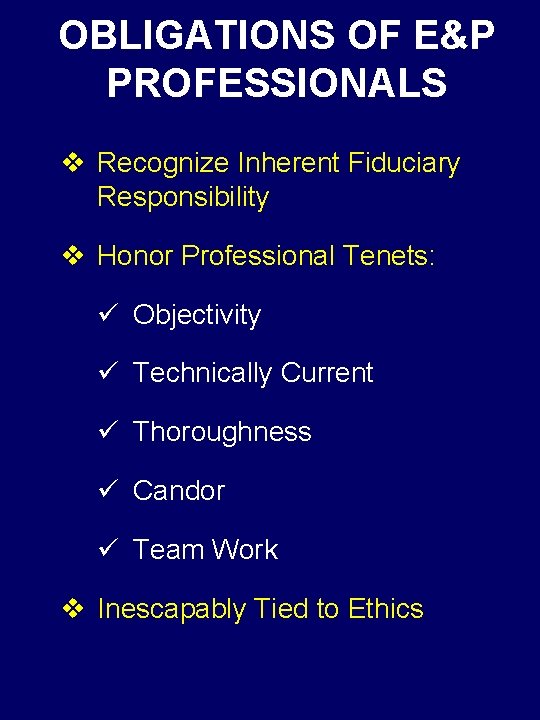
OBLIGATIONS OF E&P PROFESSIONALS v Recognize Inherent Fiduciary Responsibility v Honor Professional Tenets: ü Objectivity ü Technically Current ü Thoroughness ü Candor ü Team Work v Inescapably Tied to Ethics
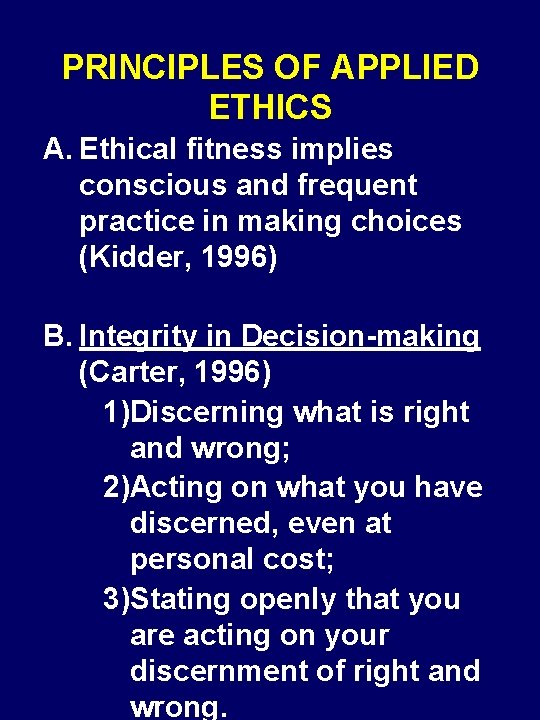
PRINCIPLES OF APPLIED ETHICS A. Ethical fitness implies conscious and frequent practice in making choices (Kidder, 1996) B. Integrity in Decision-making (Carter, 1996) 1)Discerning what is right and wrong; 2)Acting on what you have discerned, even at personal cost; 3)Stating openly that you are acting on your discernment of right and wrong.
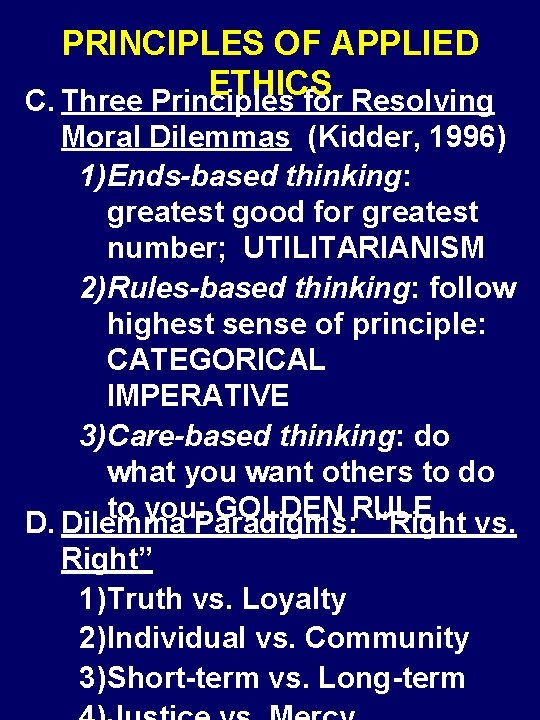
PRINCIPLES OF APPLIED ETHICS C. Three Principles for Resolving Moral Dilemmas (Kidder, 1996) 1)Ends-based thinking: greatest good for greatest number; UTILITARIANISM 2)Rules-based thinking: follow highest sense of principle: CATEGORICAL IMPERATIVE 3)Care-based thinking: do what you want others to do to you: GOLDEN RULE D. Dilemma Paradigms: “Right vs. Right” 1)Truth vs. Loyalty 2)Individual vs. Community 3)Short-term vs. Long-term
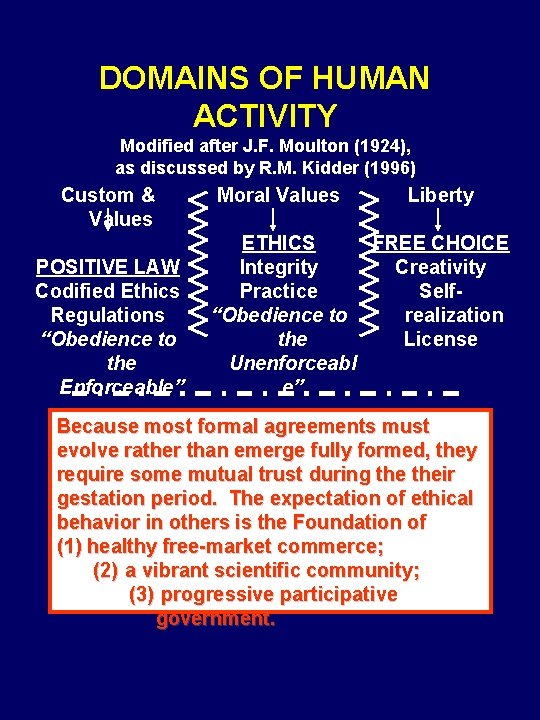
DOMAINS OF HUMAN ACTIVITY Modified after J. F. Moulton (1924), as discussed by R. M. Kidder (1996) Custom & Values POSITIVE LAW Codified Ethics Regulations “Obedience to the Enforceable” Moral Values Liberty ETHICS FREE CHOICE Integrity Creativity Practice Self“Obedience to realization the License Unenforceabl e” Because most formal agreements must evolve rather than emerge fully formed, they require some mutual trust during their gestation period. The expectation of ethical behavior in others is the Foundation of (1) healthy free-market commerce; (2) a vibrant scientific community; (3) progressive participative government.
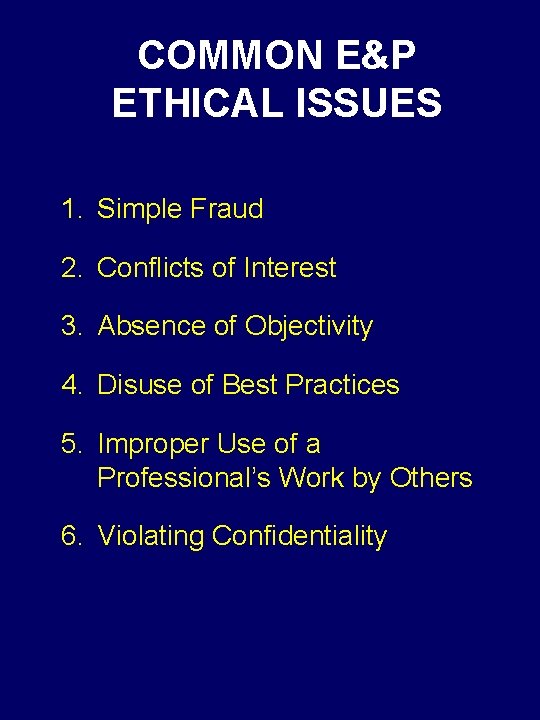
COMMON E&P ETHICAL ISSUES 1. Simple Fraud 2. Conflicts of Interest 3. Absence of Objectivity 4. Disuse of Best Practices 5. Improper Use of a Professional’s Work by Others 6. Violating Confidentiality
COMMON E&P ETHICAL ISSUES 1. Simple Fraud, by knowingly and proactively presenting information that is false, misleading, or significantly incomplete.
COMMON E&P ETHICAL ISSUES 2. Conflicts of Interest, where someone entrusted with privileged knowledge on behalf of employer, client, or associate clandestinely uses such knowledge for personal benefit, risking the welfare of the employer, client, or associate, and compromising the objectivity of one’s recommendations.
COMMON E&P ETHICAL ISSUES 3. Absence of Objectivity, by geotechnical/engineering staff, consultants, or operators, leading to overoptimistic or overconservative estimates of recoverable volumes, rates, costs, construction times, and profitabilities.
COMMON E&P ETHICAL ISSUES 4. Disuse of Best Practices, where company procedures and policies mandate the use of advantageous, but outmoded techniques. Professionals are responsible for using best practices, company policy notwithstanding; deliberate ignorance is not an acceptable excuse.
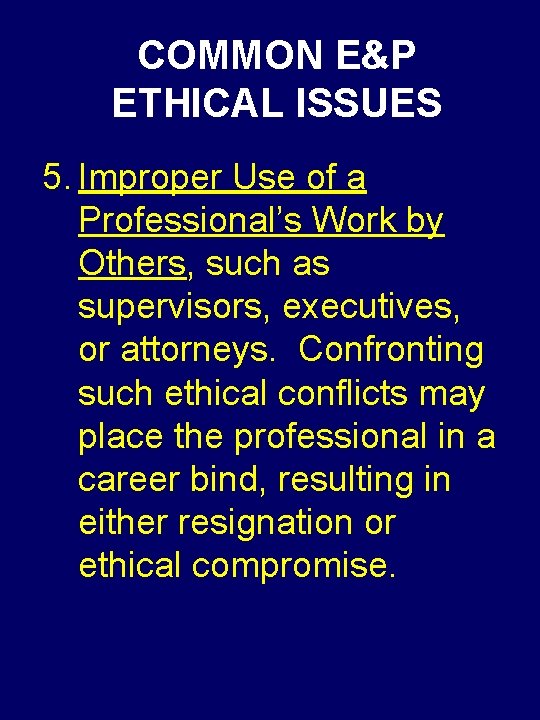
COMMON E&P ETHICAL ISSUES 5. Improper Use of a Professional’s Work by Others, such as supervisors, executives, or attorneys. Confronting such ethical conflicts may place the professional in a career bind, resulting in either resignation or ethical compromise.
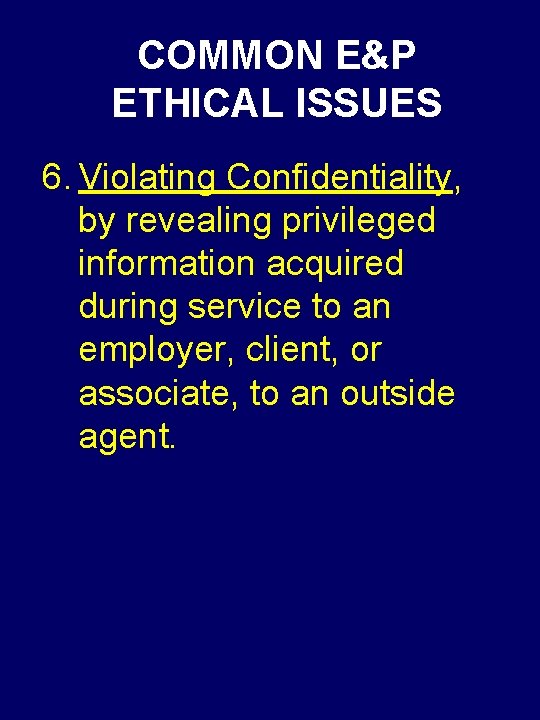
COMMON E&P ETHICAL ISSUES 6. Violating Confidentiality, by revealing privileged information acquired during service to an employer, client, or associate, to an outside agent.
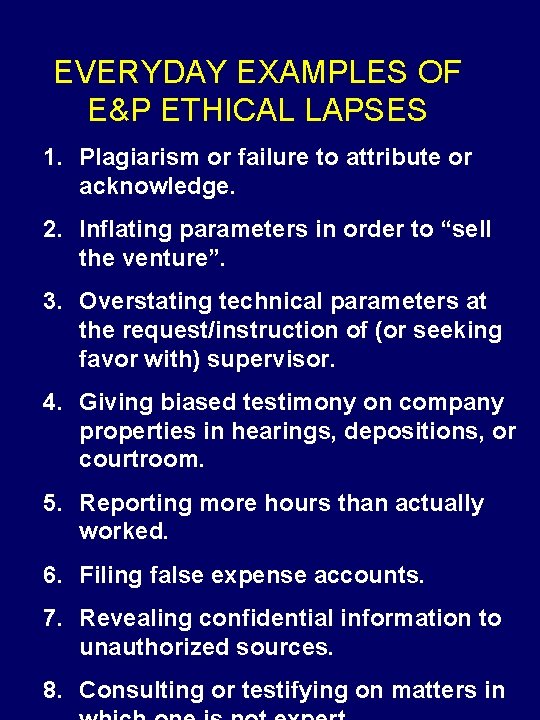
EVERYDAY EXAMPLES OF E&P ETHICAL LAPSES 1. Plagiarism or failure to attribute or acknowledge. 2. Inflating parameters in order to “sell the venture”. 3. Overstating technical parameters at the request/instruction of (or seeking favor with) supervisor. 4. Giving biased testimony on company properties in hearings, depositions, or courtroom. 5. Reporting more hours than actually worked. 6. Filing false expense accounts. 7. Revealing confidential information to unauthorized sources. 8. Consulting or testifying on matters in
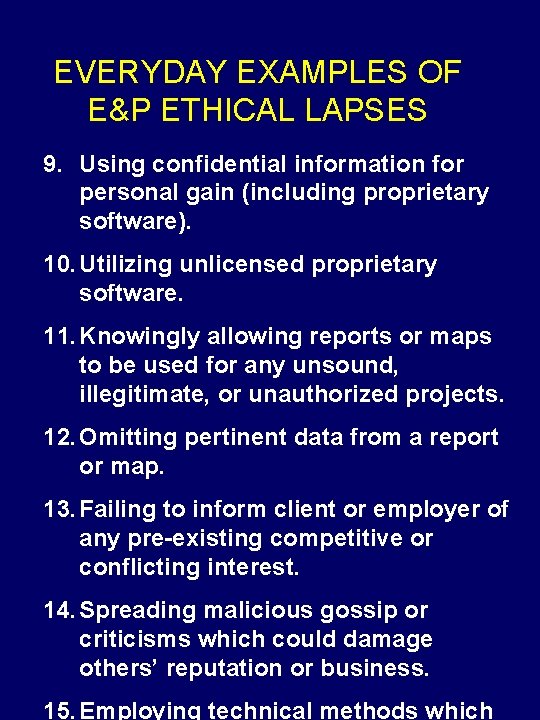
EVERYDAY EXAMPLES OF E&P ETHICAL LAPSES 9. Using confidential information for personal gain (including proprietary software). 10. Utilizing unlicensed proprietary software. 11. Knowingly allowing reports or maps to be used for any unsound, illegitimate, or unauthorized projects. 12. Omitting pertinent data from a report or map. 13. Failing to inform client or employer of any pre-existing competitive or conflicting interest. 14. Spreading malicious gossip or criticisms which could damage others’ reputation or business. 15. Employing technical methods which
ORGANIZATIONAL REMEDIES 1) Are official and unofficial incentivesystems aligned with ethical behavior by professionals and managers? 2) Does the organization have a widely circulated code of ethics? 3) Does the organization have an accessible Independent Reserve Committee or Ombudsman to hear possible conflicts? 4) Does the organization provide training in Ethical Conduct via case examples that focus on anticipation and prevention rather than binary conflicts? 5) Does the organization clearly distinguish between what is Ethical and what is Legal?
PERSONAL REMEDIES 1) Frequent reading on Professionalism and Ethics; 2) Conscious practice in making ethical choices; 3) Cultivate personal and professional candor (get comfortable playing it straight); 4) Recognize that technical, philosophical, and/or competitive differences with others do not necessarily represent their unethical behavior; 5) Learn to sense “ticking time-bombs” and find ways to defuse them before they blow up in your face; 6) Live within your means so you have the financial cushion to retain personal choice of employer or client; 7) Always be willing to vote with your feet.
REAL-LIFE ETHICAL CONFLICTS REAL-LIFE PERSONAL CONSEQUENCES
RECOMMENDED READING Business Ethics -Facing Up to the Issues Chris Moon & Clive Bonny How Good People Make Tough Choices -- Resolving the Dilemmas of Ethical Living 1995 Rushworth M. Kidder Simon & Schuster Integrity Stephen L. Carter Reputation -- Studies in the Voluntary Elicitation of Good Conduct Daniel B. Klein (editor) Reserve Overbooking -- The Problem No One Wants to Talk About Mark A. Mc. Lane & Peter R. Rose Systems of Survival -A Dialogue on the Moral Foundations of Commerce and Politics Jane Jacobs 2001 Profile Books Ltd. 1996 Basic. Books 1997 University of Michigan Press 2001 SPE #68580 1994 Vintage Books
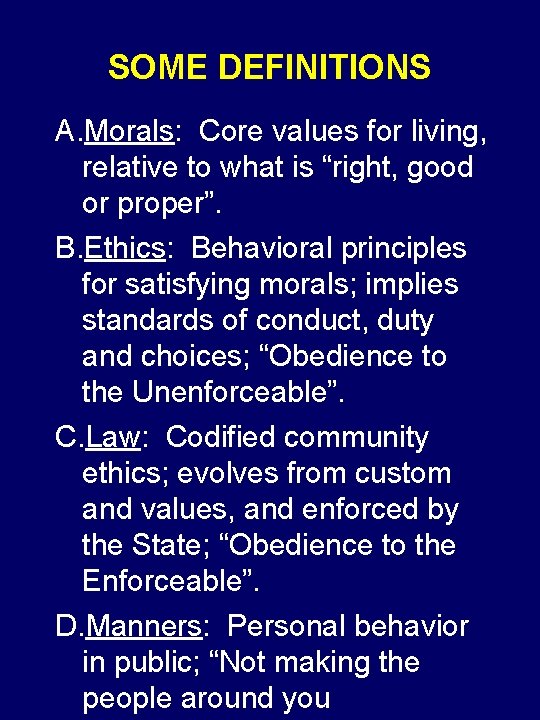
SOME DEFINITIONS A. Morals: Core values for living, relative to what is “right, good or proper”. B. Ethics: Behavioral principles for satisfying morals; implies standards of conduct, duty and choices; “Obedience to the Unenforceable”. C. Law: Codified community ethics; evolves from custom and values, and enforced by the State; “Obedience to the Enforceable”. D. Manners: Personal behavior in public; “Not making the people around you
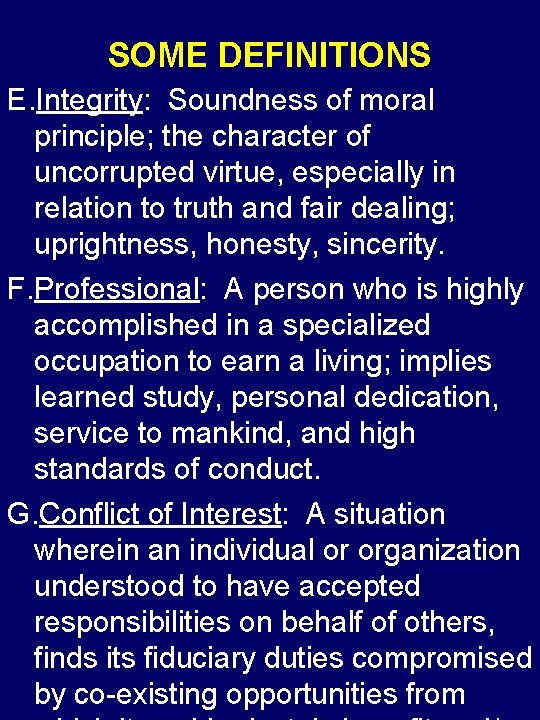
SOME DEFINITIONS E. Integrity: Soundness of moral principle; the character of uncorrupted virtue, especially in relation to truth and fair dealing; uprightness, honesty, sincerity. F. Professional: A person who is highly accomplished in a specialized occupation to earn a living; implies learned study, personal dedication, service to mankind, and high standards of conduct. G. Conflict of Interest: A situation wherein an individual or organization understood to have accepted responsibilities on behalf of others, finds its fiduciary duties compromised by co-existing opportunities from
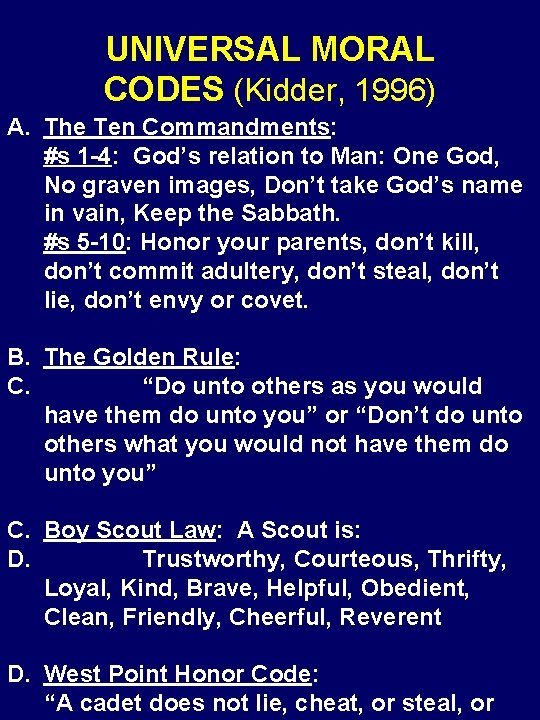
UNIVERSAL MORAL CODES (Kidder, 1996) A. The Ten Commandments: #s 1 -4: God’s relation to Man: One God, No graven images, Don’t take God’s name in vain, Keep the Sabbath. #s 5 -10: Honor your parents, don’t kill, don’t commit adultery, don’t steal, don’t lie, don’t envy or covet. B. The Golden Rule: C. “Do unto others as you would have them do unto you” or “Don’t do unto others what you would not have them do unto you” C. Boy Scout Law: A Scout is: D. Trustworthy, Courteous, Thrifty, Loyal, Kind, Brave, Helpful, Obedient, Clean, Friendly, Cheerful, Reverent D. West Point Honor Code: “A cadet does not lie, cheat, or steal, or
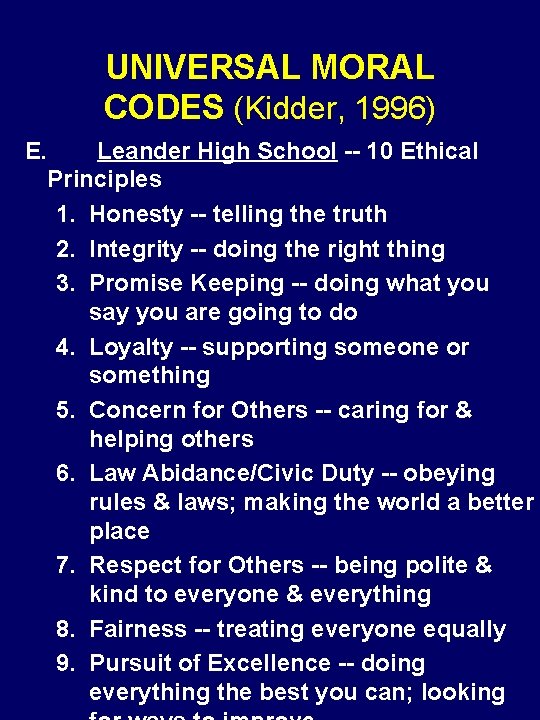
UNIVERSAL MORAL CODES (Kidder, 1996) E. Leander High School -- 10 Ethical Principles 1. Honesty -- telling the truth 2. Integrity -- doing the right thing 3. Promise Keeping -- doing what you say you are going to do 4. Loyalty -- supporting someone or something 5. Concern for Others -- caring for & helping others 6. Law Abidance/Civic Duty -- obeying rules & laws; making the world a better place 7. Respect for Others -- being polite & kind to everyone & everything 8. Fairness -- treating everyone equally 9. Pursuit of Excellence -- doing everything the best you can; looking
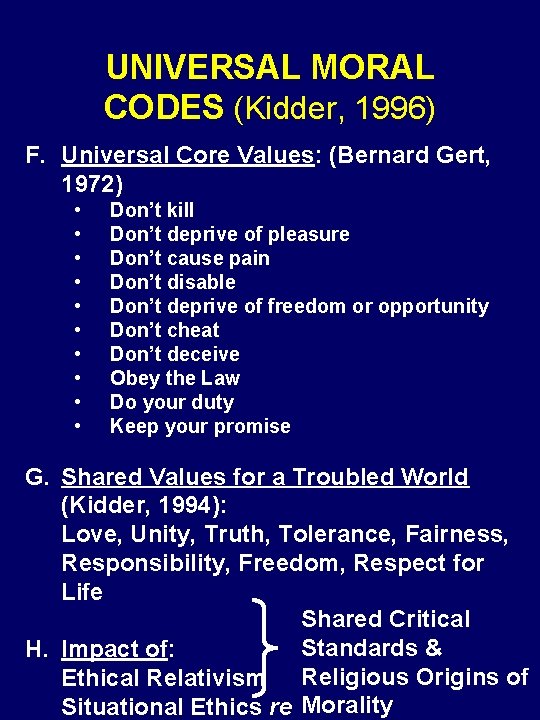
UNIVERSAL MORAL CODES (Kidder, 1996) F. Universal Core Values: (Bernard Gert, 1972) • • • Don’t kill Don’t deprive of pleasure Don’t cause pain Don’t disable Don’t deprive of freedom or opportunity Don’t cheat Don’t deceive Obey the Law Do your duty Keep your promise G. Shared Values for a Troubled World (Kidder, 1994): Love, Unity, Truth, Tolerance, Fairness, Responsibility, Freedom, Respect for Life Shared Critical Standards & H. Impact of: Ethical Relativism Religious Origins of Situational Ethics re Morality
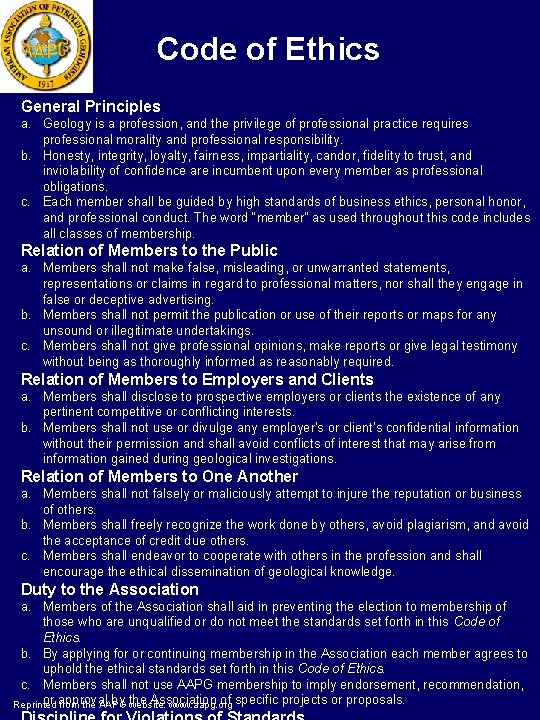
Code of Ethics General Principles a. Geology is a profession, and the privilege of professional practice requires professional morality and professional responsibility. b. Honesty, integrity, loyalty, fairness, impartiality, candor, fidelity to trust, and inviolability of confidence are incumbent upon every member as professional obligations. c. Each member shall be guided by high standards of business ethics, personal honor, and professional conduct. The word “member” as used throughout this code includes all classes of membership. Relation of Members to the Public a. Members shall not make false, misleading, or unwarranted statements, representations or claims in regard to professional matters, nor shall they engage in false or deceptive advertising. b. Members shall not permit the publication or use of their reports or maps for any unsound or illegitimate undertakings. c. Members shall not give professional opinions, make reports or give legal testimony without being as thoroughly informed as reasonably required. Relation of Members to Employers and Clients a. Members shall disclose to prospective employers or clients the existence of any pertinent competitive or conflicting interests. b. Members shall not use or divulge any employer's or client's confidential information without their permission and shall avoid conflicts of interest that may arise from information gained during geological investigations. Relation of Members to One Another a. Members shall not falsely or maliciously attempt to injure the reputation or business of others. b. Members shall freely recognize the work done by others, avoid plagiarism, and avoid the acceptance of credit due others. c. Members shall endeavor to cooperate with others in the profession and shall encourage the ethical dissemination of geological knowledge. Duty to the Association a. Members of the Association shall aid in preventing the election to membership of those who are unqualified or do not meet the standards set forth in this Code of Ethics. b. By applying for or continuing membership in the Association each member agrees to uphold the ethical standards set forth in this Code of Ethics. c. Members shall not use AAPG membership to imply endorsement, recommendation, or approval by the Association of specific projects or proposals. Reprinted from the AAPG website: www. aapg. org
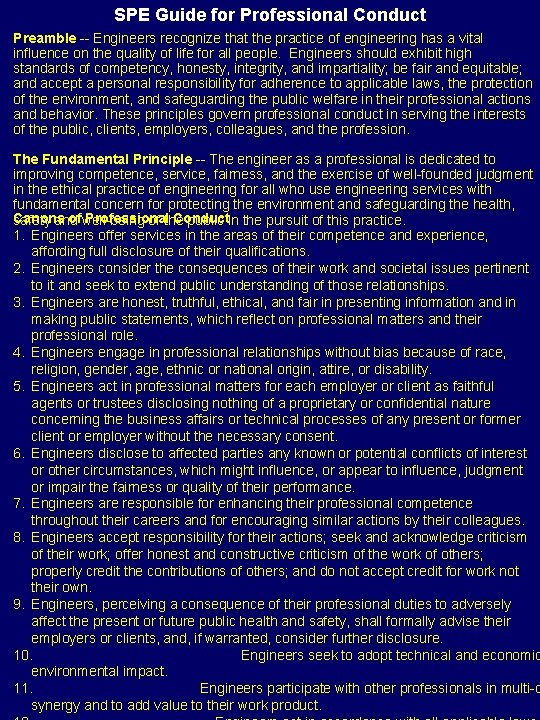
SPE Guide for Professional Conduct Preamble -- Engineers recognize that the practice of engineering has a vital influence on the quality of life for all people. Engineers should exhibit high standards of competency, honesty, integrity, and impartiality; be fair and equitable; and accept a personal responsibility for adherence to applicable laws, the protection of the environment, and safeguarding the public welfare in their professional actions and behavior. These principles govern professional conduct in serving the interests of the public, clients, employers, colleagues, and the profession. The Fundamental Principle -- The engineer as a professional is dedicated to improving competence, service, fairness, and the exercise of well-founded judgment in the ethical practice of engineering for all who use engineering services with fundamental concern for protecting the environment and safeguarding the health, Canons of Professional Conduct safety and well-being of the public in the pursuit of this practice. 1. Engineers offer services in the areas of their competence and experience, affording full disclosure of their qualifications. 2. Engineers consider the consequences of their work and societal issues pertinent to it and seek to extend public understanding of those relationships. 3. Engineers are honest, truthful, ethical, and fair in presenting information and in making public statements, which reflect on professional matters and their professional role. 4. Engineers engage in professional relationships without bias because of race, religion, gender, age, ethnic or national origin, attire, or disability. 5. Engineers act in professional matters for each employer or client as faithful agents or trustees disclosing nothing of a proprietary or confidential nature concerning the business affairs or technical processes of any present or former client or employer without the necessary consent. 6. Engineers disclose to affected parties any known or potential conflicts of interest or other circumstances, which might influence, or appear to influence, judgment or impair the fairness or quality of their performance. 7. Engineers are responsible for enhancing their professional competence throughout their careers and for encouraging similar actions by their colleagues. 8. Engineers accept responsibility for their actions; seek and acknowledge criticism of their work; offer honest and constructive criticism of the work of others; properly credit the contributions of others; and do not accept credit for work not their own. 9. Engineers, perceiving a consequence of their professional duties to adversely affect the present or future public health and safety, shall formally advise their employers or clients, and, if warranted, consider further disclosure. 10. Engineers seek to adopt technical and economic environmental impact. 11. Engineers participate with other professionals in multi-d synergy and to add value to their work product.