
Spatiotemporal Analysis of Beach Morphology using LIDAR RTKGPS

Spatio-temporal Analysis of Beach Morphology using LIDAR, RTK-GPS and Open Source GRASS GIS Helena Mitasova Department of Marine, Earth and Atmospheric Sciences, NCSU, Raleigh, T. Drake, MEAS NCSU, R. Harmon, US Army Research Office, D. Bernstein CMWS, Coastal Carolina Univ. SC, H. C. Miller, USACE FRF Duck http: //www. skagit. meas. ncsu. edu/~helena
Goal - explore the possibilities to gain new insights into short-term coastal topography evolution by combining modern mapping technologies with Open source GRASS GIS - provide methodology for cost effective short-term monitoring and analysis of topographic change to support sustainable coastal management - quantify the spatial and temporal changes in beach morphology before and after human intervention at Bald Head Island, NC
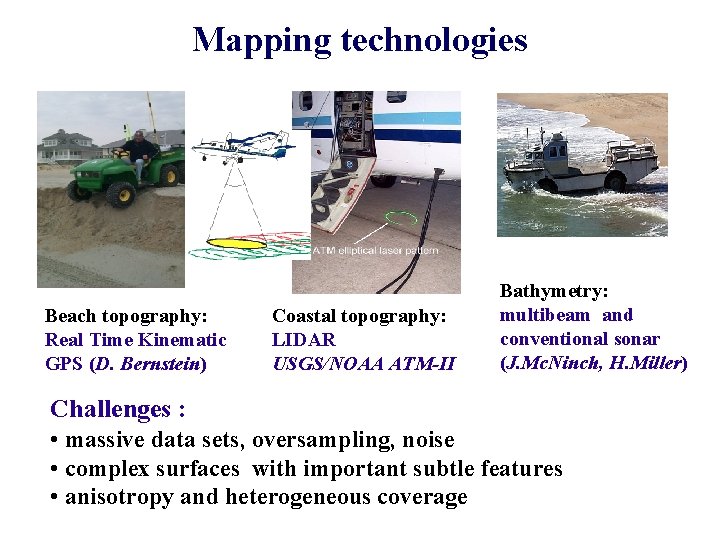
Mapping technologies Beach topography: Real Time Kinematic GPS (D. Bernstein) Coastal topography: LIDAR USGS/NOAA ATM-II Bathymetry: multibeam and conventional sonar (J. Mc. Ninch, H. Miller) Challenges : • massive data sets, oversampling, noise • complex surfaces with important subtle features • anisotropy and heterogeneous coverage
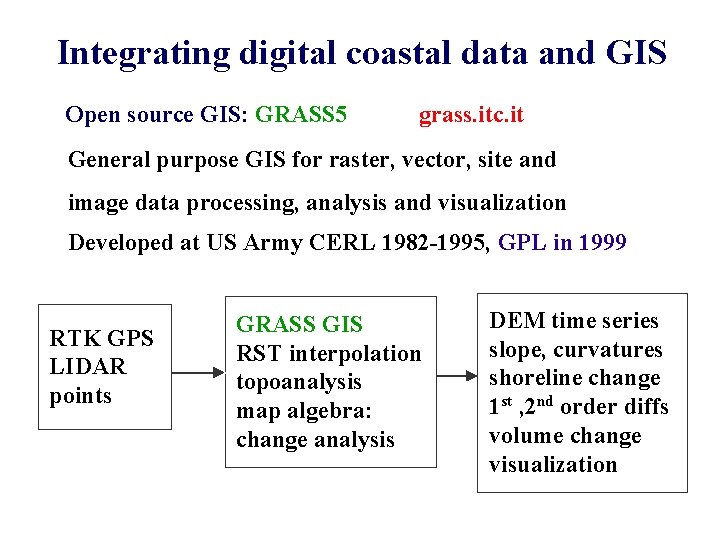
Integrating digital coastal data and GIS Open source GIS: GRASS 5 grass. itc. it General purpose GIS for raster, vector, site and image data processing, analysis and visualization Developed at US Army CERL 1982 -1995, GPL in 1999 RTK GPS LIDAR points GRASS GIS RST interpolation topoanalysis map algebra: change analysis DEM time series slope, curvatures shoreline change 1 st , 2 nd order diffs volume change visualization
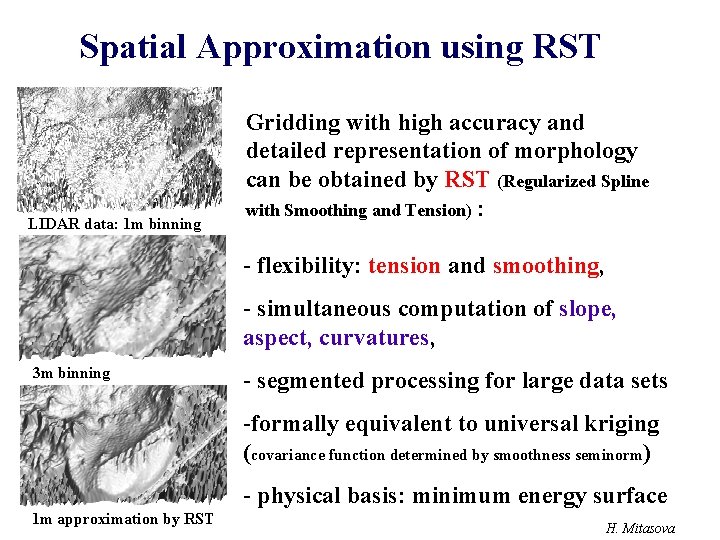
Spatial Approximation using RST LIDAR data: 1 m binning Gridding with high accuracy and detailed representation of morphology can be obtained by RST (Regularized Spline with Smoothing and Tension) : - flexibility: tension and smoothing, - simultaneous computation of slope, aspect, curvatures, 3 m binning - segmented processing for large data sets -formally equivalent to universal kriging (covariance function determined by smoothness seminorm) - physical basis: minimum energy surface 1 m approximation by RST H. Mitasova
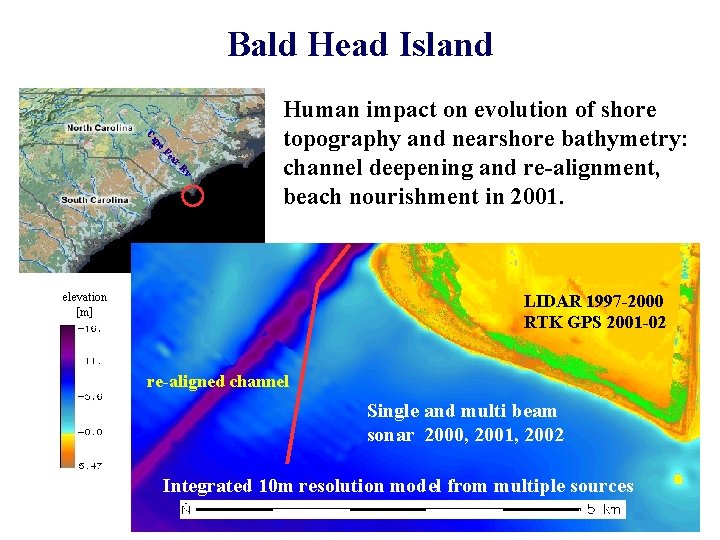
Bald Head Island v r. R ea e. F ap C Human impact on evolution of shore topography and nearshore bathymetry: channel deepening and re-alignment, beach nourishment in 2001. LIDAR 1997 -2000 RTK GPS 2001 -02 elevation [m] re-aligned channel Single and multi beam sonar 2000, 2001, 2002 Integrated 10 m resolution model from multiple sources
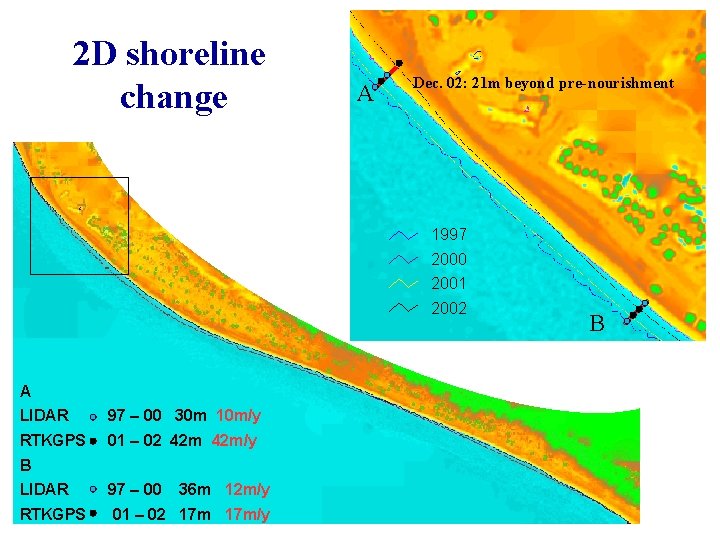
2 D shoreline change A A Dec. 02: 21 m beyond pre-nourishment 1997 2000 2001 2002 A 1998: LIDAR 0 m 97 – 00 30 m 10 m/y 2000: LIDAR 0 m RTKGPS 01 – 02 42 m/y 2001 Dec. : RTK GPS B after nourishment LIDAR 97 – 00 36 m 12 m/y LIDAR RTKGPS 01 – 02 17 m/y B

South Beach evolution 1997 -2000 Overlayed 1997 and 2000 LIDAR surfaces: central section is relatively stable, rest erodes while changing its shape and moving landwards West Annual sand loss rate: 3500 m 3/ha convex -> concave Shoreline erosion rate 10 m/year Center stable pivot area stable East concave -> convex 2000 z>0 m z<0 m 15% of sand was deposited behind the foredune: landward movement
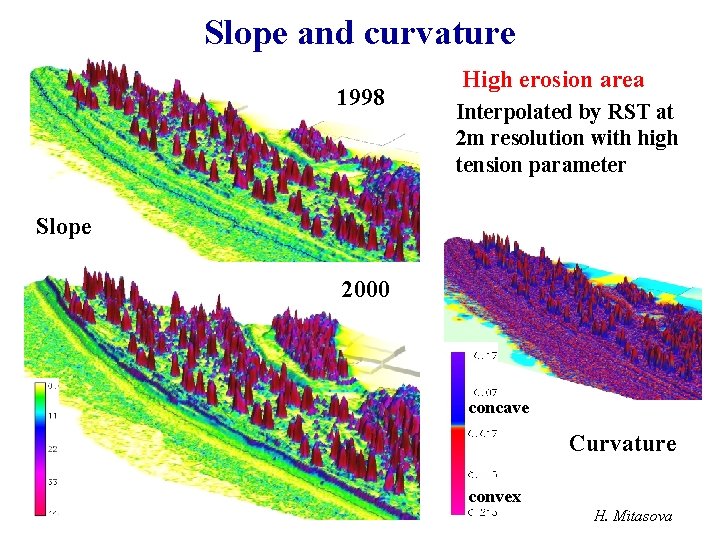
Slope and curvature 1998 High erosion area Interpolated by RST at 2 m resolution with high tension parameter Slope 2000 concave Curvature convex H. Mitasova
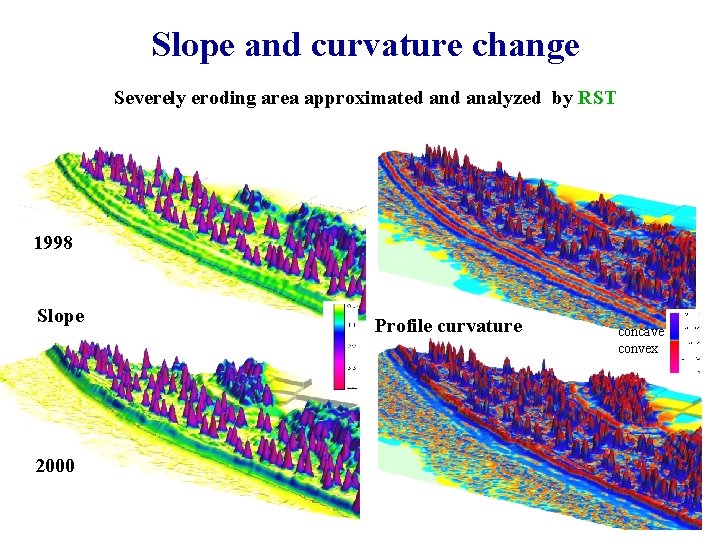
Slope and curvature change Severely eroding area approximated analyzed by RST 1998 Slope 2000 Profile curvature concave convex
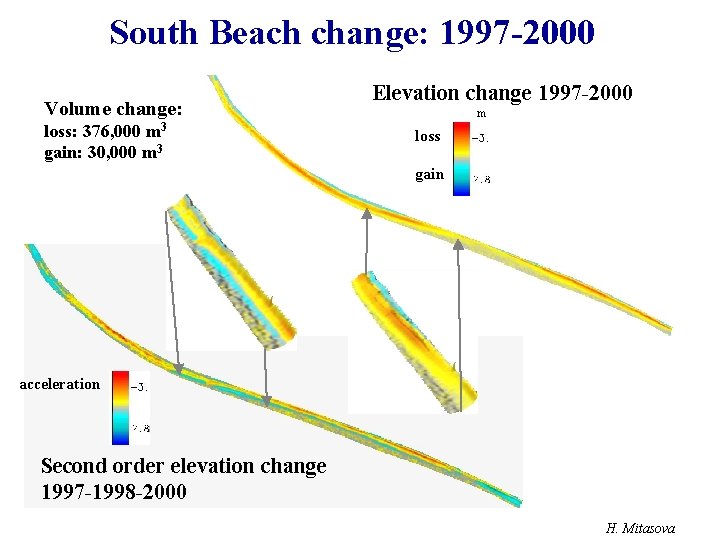
South Beach change: 1997 -2000 Volume change: m 3 loss: 376, 000 gain: 30, 000 m 3 Elevation change 1997 -2000 m loss gain acceleration Second order elevation change 1997 -1998 -2000 H. Mitasova
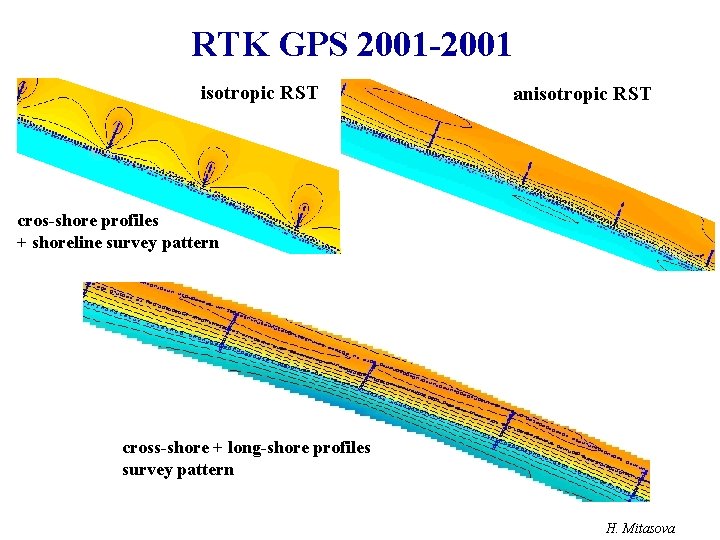
RTK GPS 2001 -2001 isotropic RST 0 m ~2 5 cros-shore profiles + shoreline survey pattern anisotropic RST cross-shore + long-shore profiles RST with anisotropic tension survey pattern H. Mitasova
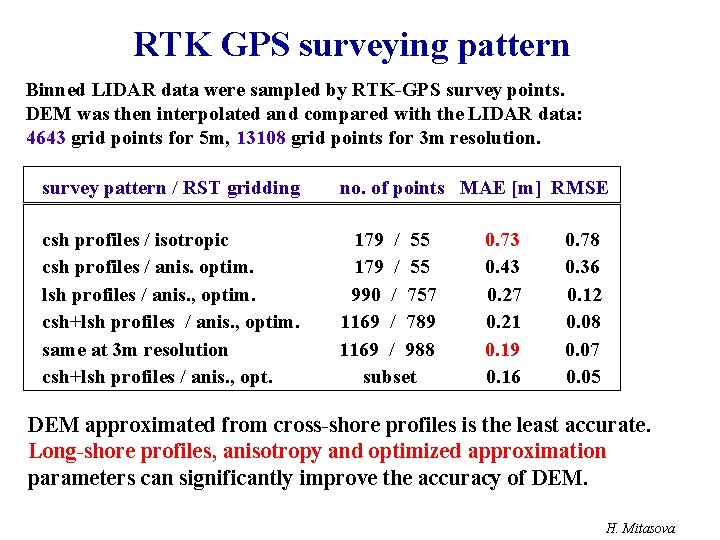
RTK GPS surveying pattern Binned LIDAR data were sampled by RTK-GPS survey points. DEM was then interpolated and compared with the LIDAR data: 4643 grid points for 5 m, 13108 grid points for 3 m resolution. survey pattern / RST gridding no. of points MAE [m] RMSE csh profiles / isotropic csh profiles / anis. optim. lsh profiles / anis. , optim. csh+lsh profiles / anis. , optim. same at 3 m resolution csh+lsh profiles / anis. , opt. 179 / 55 990 / 757 1169 / 789 1169 / 988 subset 0. 73 0. 43 0. 27 0. 21 0. 19 0. 16 0. 78 0. 36 0. 12 0. 08 0. 07 0. 05 DEM approximated from cross-shore profiles is the least accurate. Long-shore profiles, anisotropy and optimized approximation parameters can significantly improve the accuracy of DEM. H. Mitasova
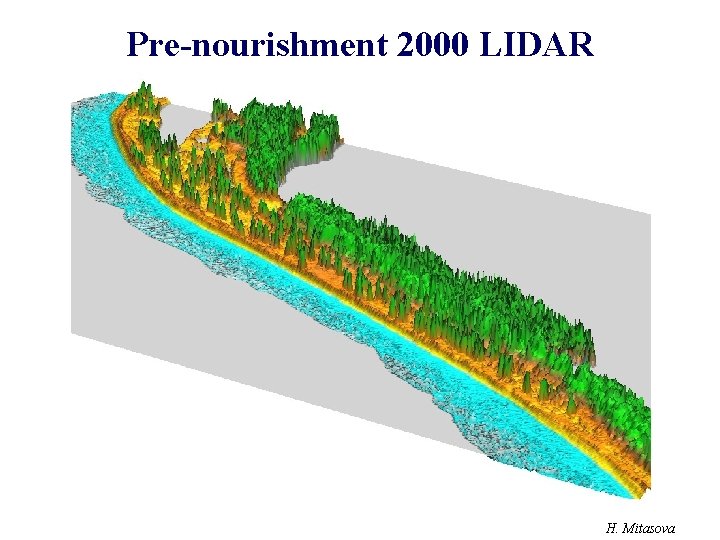
Pre-nourishment 2000 LIDAR 2000 H. Mitasova
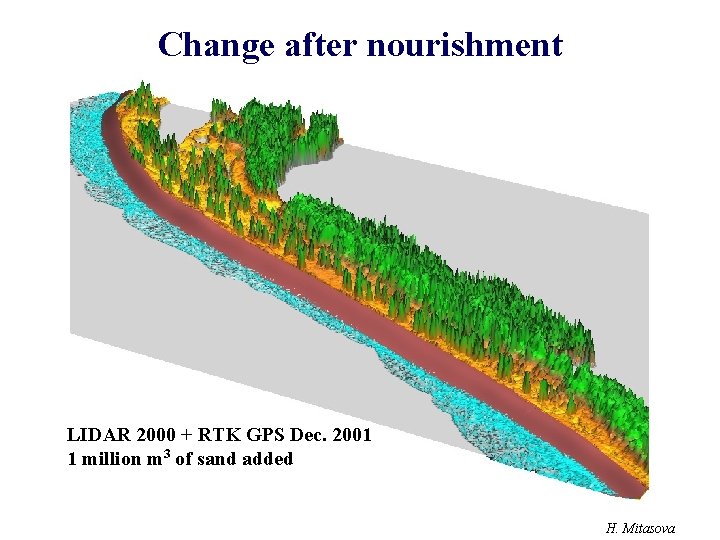
Change after nourishment LIDAR 2000 + RTK GPS Dec. 2001 1 million m 3 of sand added H. Mitasova
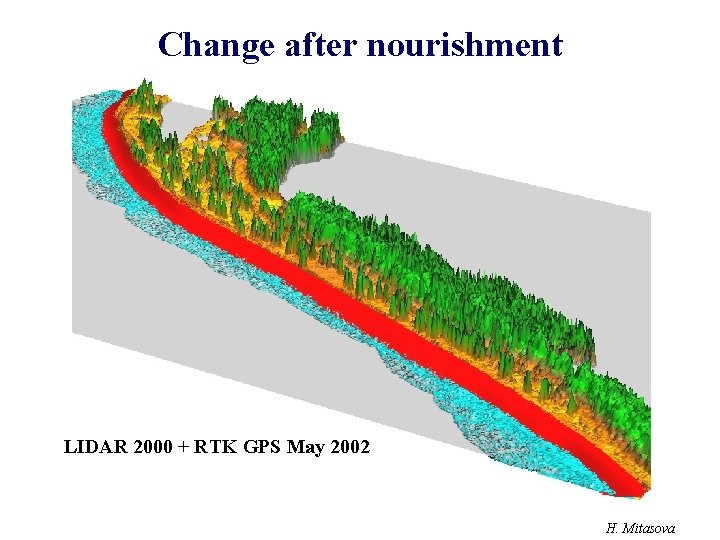
Change after nourishment LIDAR 2000 + RTK GPS May 2002 H. Mitasova
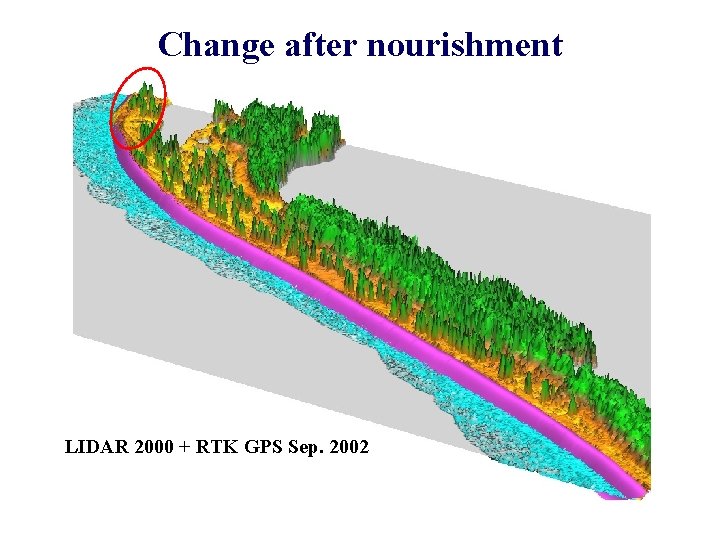
Change after nourishment LIDAR 2000 + RTK GPS Sep. 2002
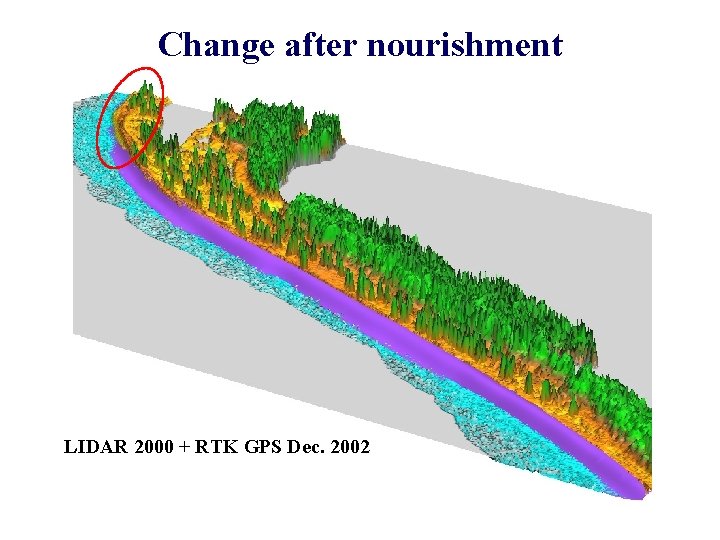
Change after nourishment LIDAR 2000 + RTK GPS Dec. 2002
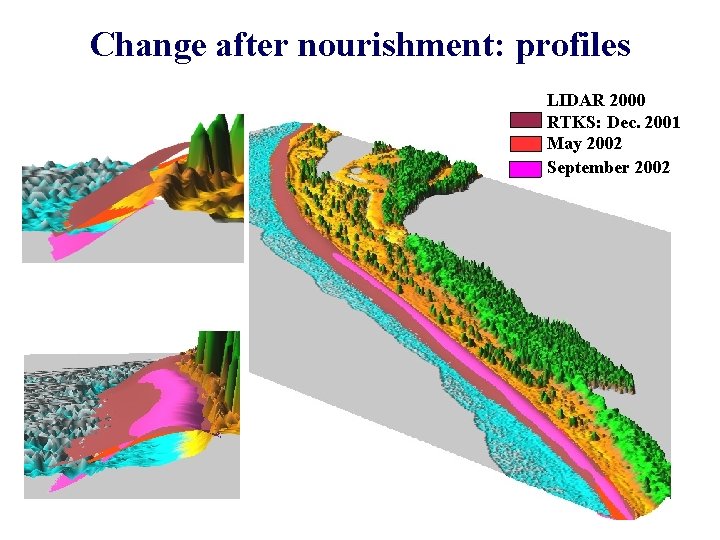
Change after nourishment: profiles LIDAR 2000 RTKS: Dec. 2001 May 2002 September 2002
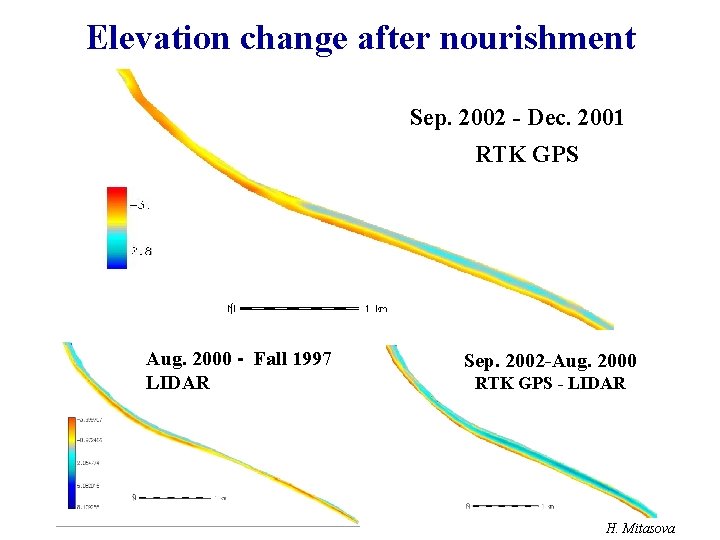
Elevation change after nourishment Sep. 2002 - Dec. 2001 RTK GPS Aug. 2000 - Fall 1997 LIDAR Sep. 2002 -Aug. 2000 RTK GPS - LIDAR H. Mitasova
![Volume and shoreline change time period [m 3] 1 y 2 y 3 y](http://slidetodoc.com/presentation_image_h2/ca2b2dd76234b754fa6dfb1e64cd4b11/image-21.jpg "Volume and shoreline change time period [m 3] 1 y 2 y 3 y")
Volume and shoreline change time period [m 3] 1 y 2 y 3 y loss [m 3/ha. year] 1997 - 1998 - 2000 1997 - 2000 5 mo Dec. 01 - May 02 4 mo May 02 - Sep 02 4 mo Sep 02 - Dec 02 160000 254000 376000 gain 42000 48000 65000 220000 2000 162000 80000 108000 107000 loss rate 4400 3500 13200 12100 8100 H. Mitasova
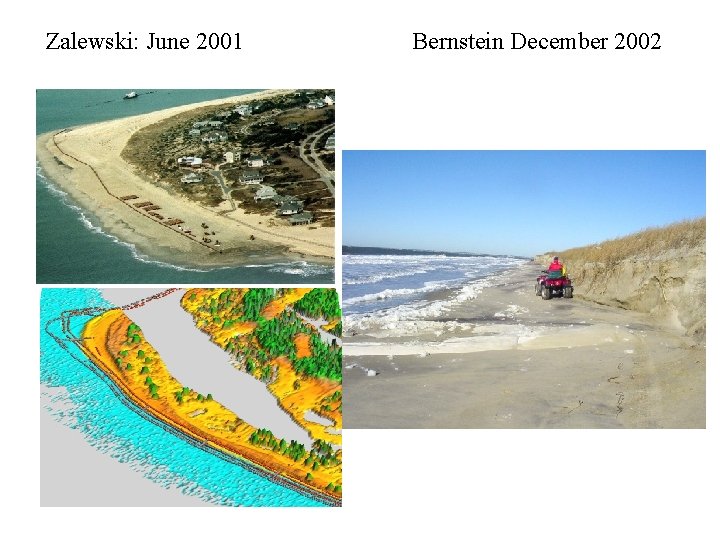
Zalewski: June 2001 Bernstein December 2002
Conclusions I Combination of modern mapping techniques with Open source GIS provides unique insight into 3 D coastal topography evolution at high spatial and temporal resolution. GIS based analysis and visualization allows us to quantify the observed changes (elevation, shoreline, volume, slope and shape) and evaluate effectiveness of stabilization measures. The developed methodology is being further enhanced and applied to other areas. H. Mitasova
Conclusions II Bald Head Island Analysis based on LIDAR and RTK GPS data showed systematic, spatially variable erosion of the beach accompanied with beach shape change. After renourishment the rates increased in the west section and the beach became more stable in the east. Future Analysis of the entire area as a single system: - bathymetry (fate of eroded sand: back to channel, CF shoal, sandbars ? ) - new LIDAR survey - modeling (SBEACH, DELFT 3 D) H. Mitasova
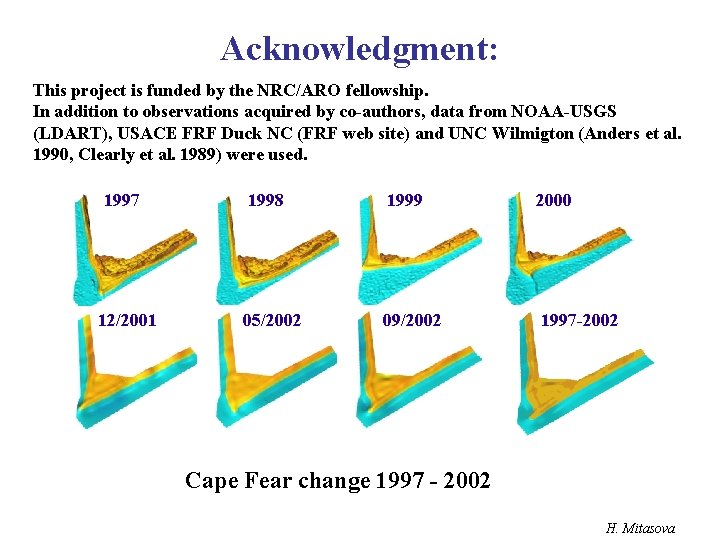
Acknowledgment: This project is funded by the NRC/ARO fellowship. In addition to observations acquired by co-authors, data from NOAA-USGS (LDART), USACE FRF Duck NC (FRF web site) and UNC Wilmigton (Anders et al. 1990, Clearly et al. 1989) were used. 1997 12/2001 1998 1999 2000 05/2002 09/2002 1997 -2002 Cape Fear change 1997 - 2002 H. Mitasova
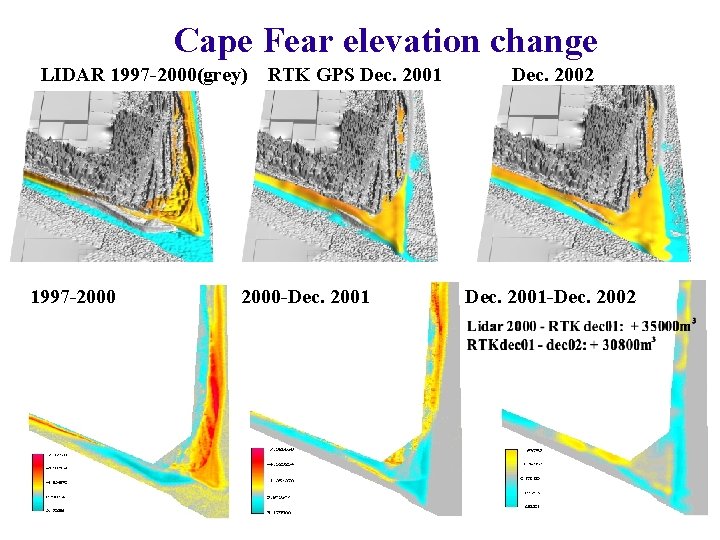
Cape Fear elevation change LIDAR 1997 -2000(grey) 1997 -2000 RTK GPS Dec. 2001 2000 -Dec. 2001 Dec. 2002 Dec. 2001 -Dec. 2002
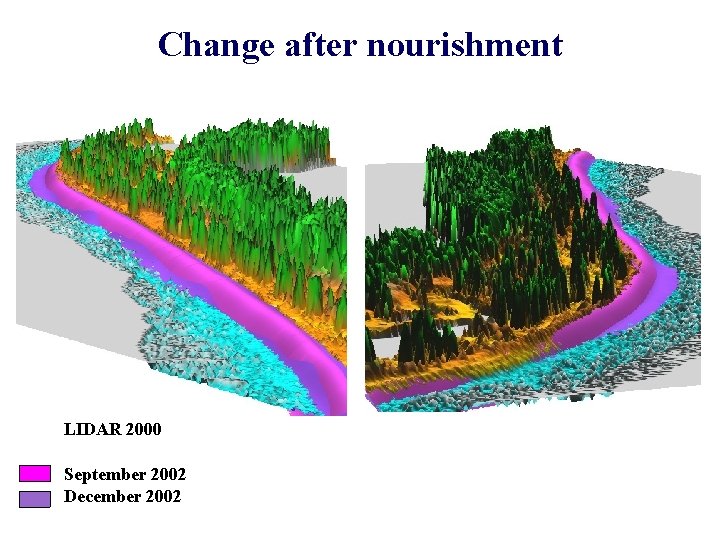
Change after nourishment LIDAR 2000 September 2002 December 2002
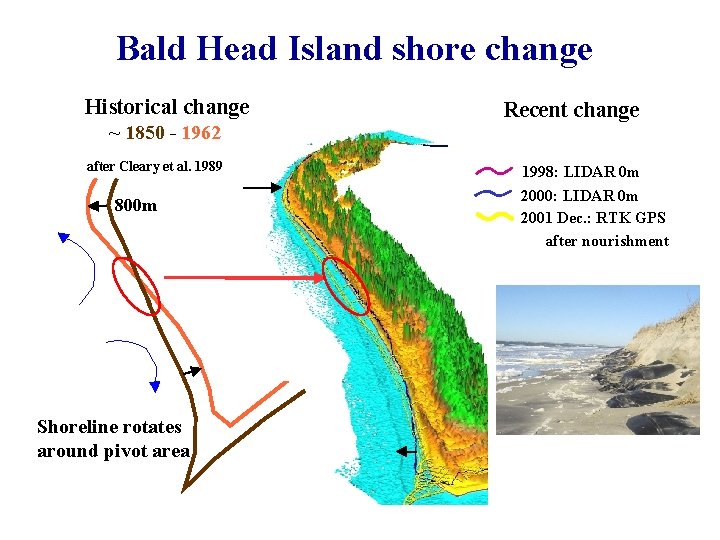
Bald Head Island shore change Historical change ~ 1850 - 1962 after Cleary et al. 1989 800 m Shoreline rotates around pivot area Recent change 1998: LIDAR 0 m 2000: LIDAR 0 m 2001 Dec. : RTK GPS after nourishment
- Slides: 28