
Spatially Variant Apodization Techniques for SAR Image Formation
- Slides: 12
Spatially Variant Apodization Techniques for SAR Image Formation Christian Jones 04 -19 -2021 1
Overview • • LFM Chirp Waveforms Range/Doppler Sidelobes Temporal Tapering and Frequency Domain Windowing Spatially Variant Apodization Power SVA Complex SVA Simulation Results SVA Super Resolution 2
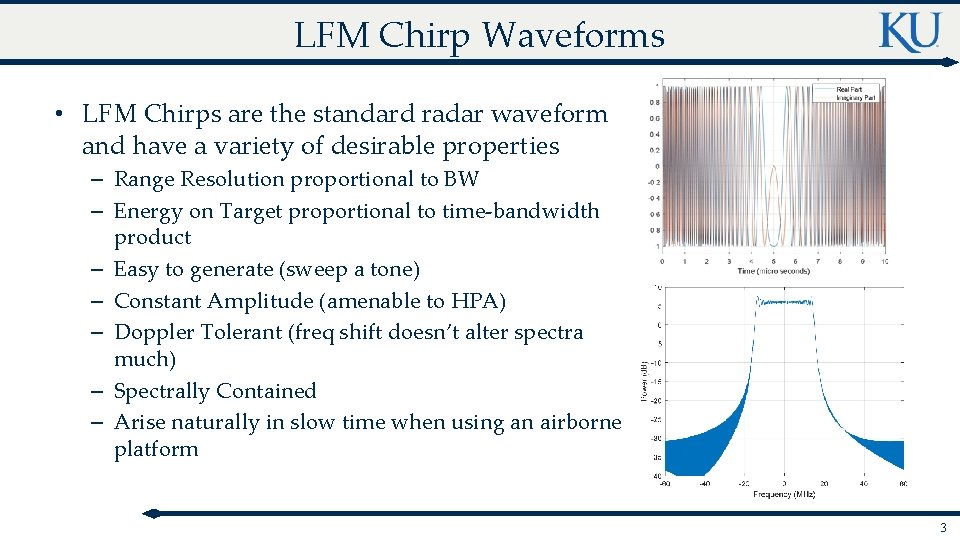
LFM Chirp Waveforms • LFM Chirps are the standard radar waveform and have a variety of desirable properties – Range Resolution proportional to BW – Energy on Target proportional to time-bandwidth product – Easy to generate (sweep a tone) – Constant Amplitude (amenable to HPA) – Doppler Tolerant (freq shift doesn’t alter spectra much) – Spectrally Contained – Arise naturally in slow time when using an airborne platform 3
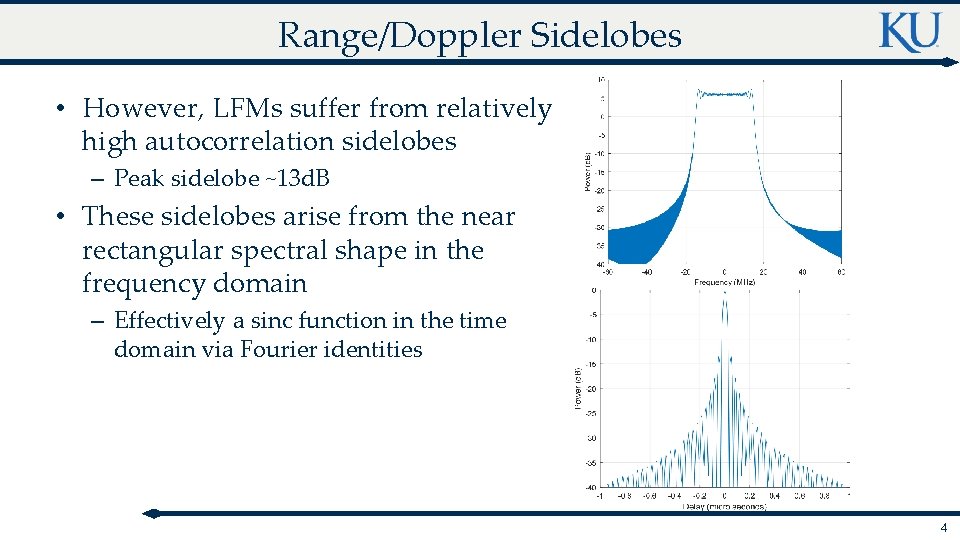
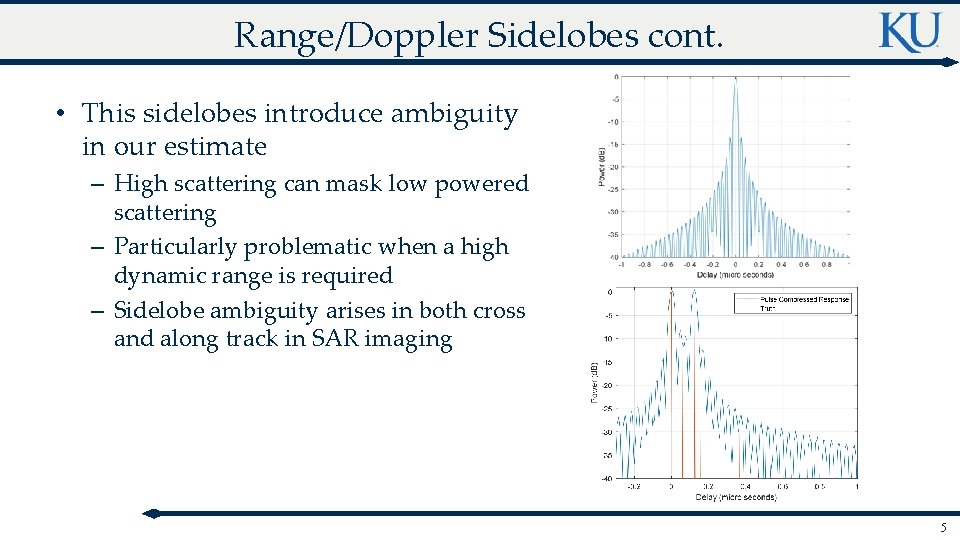
Range/Doppler Sidelobes • However, LFMs suffer from relatively high autocorrelation sidelobes – Peak sidelobe ~13 d. B • These sidelobes arise from the near rectangular spectral shape in the frequency domain – Effectively a sinc function in the time domain via Fourier identities 4
Range/Doppler Sidelobes cont. • This sidelobes introduce ambiguity in our estimate – High scattering can mask low powered scattering – Particularly problematic when a high dynamic range is required – Sidelobe ambiguity arises in both cross and along track in SAR imaging 5
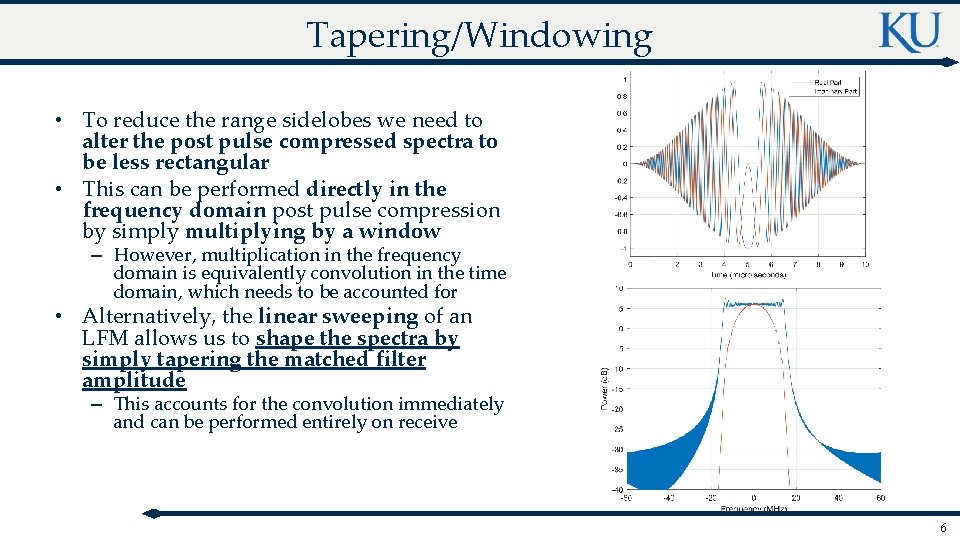
Tapering/Windowing • To reduce the range sidelobes we need to alter the post pulse compressed spectra to be less rectangular • This can be performed directly in the frequency domain post pulse compression by simply multiplying by a window – However, multiplication in the frequency domain is equivalently convolution in the time domain, which needs to be accounted for • Alternatively, the linear sweeping of an LFM allows us to shape the spectra by simply tapering the matched filter amplitude – This accounts for the convolution immediately and can be performed entirely on receive 6
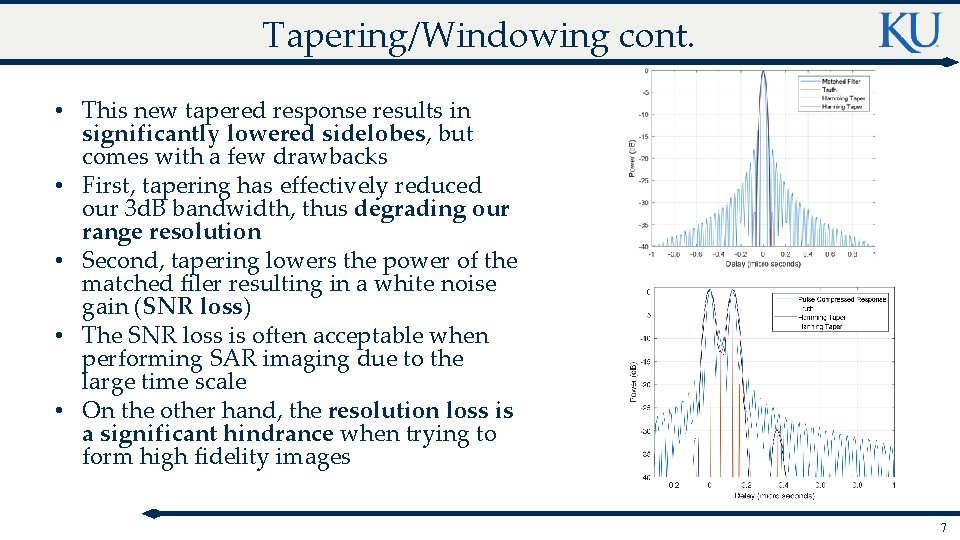
Tapering/Windowing cont. • This new tapered response results in significantly lowered sidelobes, but comes with a few drawbacks • First, tapering has effectively reduced our 3 d. B bandwidth, thus degrading our range resolution • Second, tapering lowers the power of the matched filer resulting in a white noise gain (SNR loss) • The SNR loss is often acceptable when performing SAR imaging due to the large time scale • On the other hand, the resolution loss is a significant hindrance when trying to form high fidelity images 7
Spatially Variant Apodization • To compensate for the resolution loss from tapering a nonlinear post processing technique denoted Spatially Variant Apodization or SVA was developed • The approach was originally developed for SAR, but has since been applied elsewhere • At its core, the approach simply forms multiple images then takes the “best” portion of each through a nonlinear operation • In general, SVA results in the best case resolution, best case sidelobe level and worst case SNR across the images 8
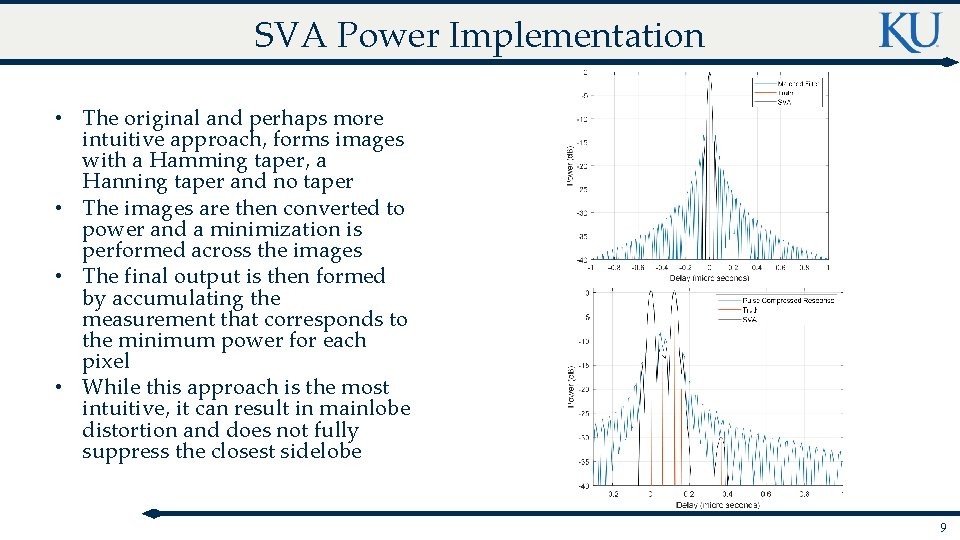
SVA Power Implementation • The original and perhaps more intuitive approach, forms images with a Hamming taper, a Hanning taper and no taper • The images are then converted to power and a minimization is performed across the images • The final output is then formed by accumulating the measurement that corresponds to the minimum power for each pixel • While this approach is the most intuitive, it can result in mainlobe distortion and does not fully suppress the closest sidelobe 9
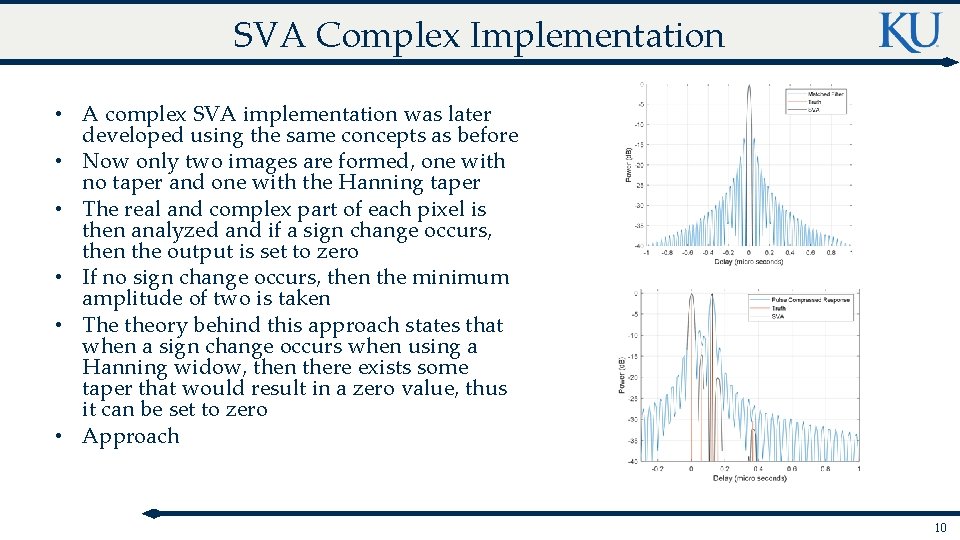
SVA Complex Implementation • A complex SVA implementation was later developed using the same concepts as before • Now only two images are formed, one with no taper and one with the Hanning taper • The real and complex part of each pixel is then analyzed and if a sign change occurs, then the output is set to zero • If no sign change occurs, then the minimum amplitude of two is taken • The theory behind this approach states that when a sign change occurs when using a Hanning widow, then there exists some taper that would result in a zero value, thus it can be set to zero • Approach 10
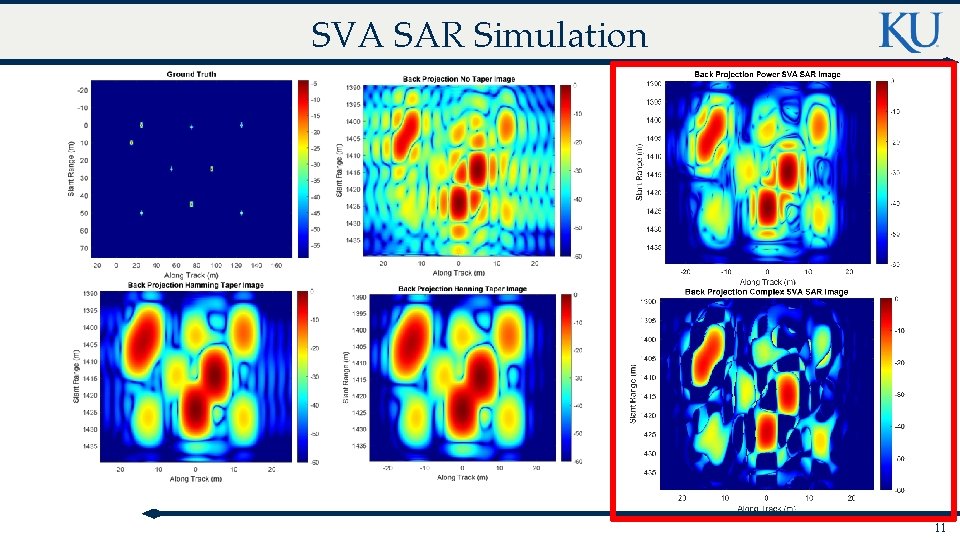
SVA SAR Simulation 11
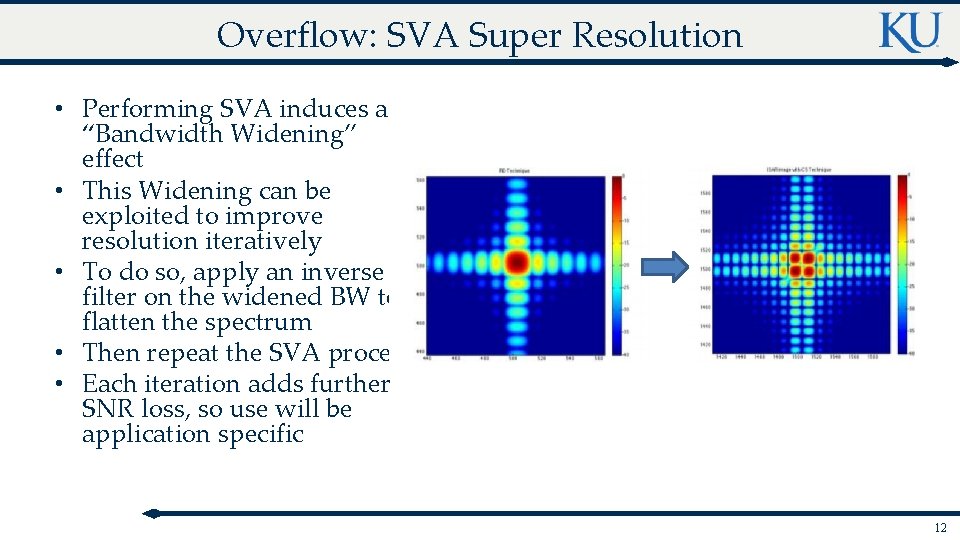
Overflow: SVA Super Resolution • Performing SVA induces a “Bandwidth Widening” effect • This Widening can be exploited to improve resolution iteratively • To do so, apply an inverse filter on the widened BW to flatten the spectrum • Then repeat the SVA process • Each iteration adds further SNR loss, so use will be application specific 12