
Spatially Explicit IndividualBased Models What are they and
Spatially Explicit Individual-Based Models What are they and can they be useful for habitat management? Gina K. Himes Boor Montana State University Christine Damiani Institute for Wildlife Studies March 2018 National Military Fish and Wildlife Association & North American Wildlife & Natural Resource Conference

Spatially Explicit Individual-Based Models SEIBMs Agent-based models Individual-based simulation models Spatially Explicit Population Models (SEPM)
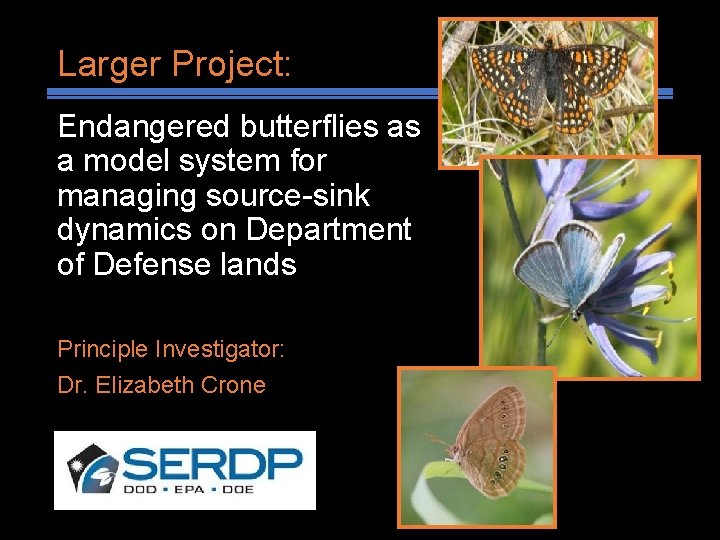
Larger Project: Endangered butterflies as a model system for managing source-sink dynamics on Department of Defense lands Principle Investigator: Dr. Elizabeth Crone
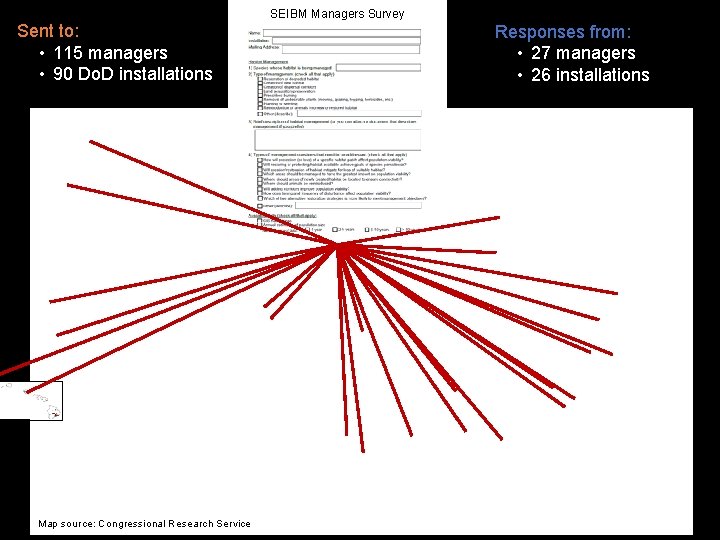
SEIBM Managers Survey Sent to: • 115 managers • 90 Do. D installations Map source: Congressional Research Service Responses from: • 27 managers • 26 installations
Survey Responses: SEIBM Comments/Questions What can they do? Give us some examples! What data do we need? Map source: Congressional Research Service
Population-Level Models vs Individual-Based Models
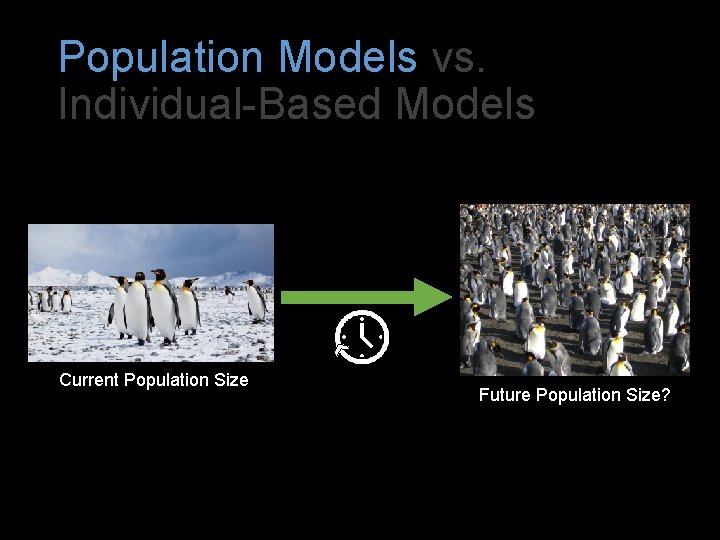
Population Models vs. Individual-Based Models Current Population Size Future Population Size?
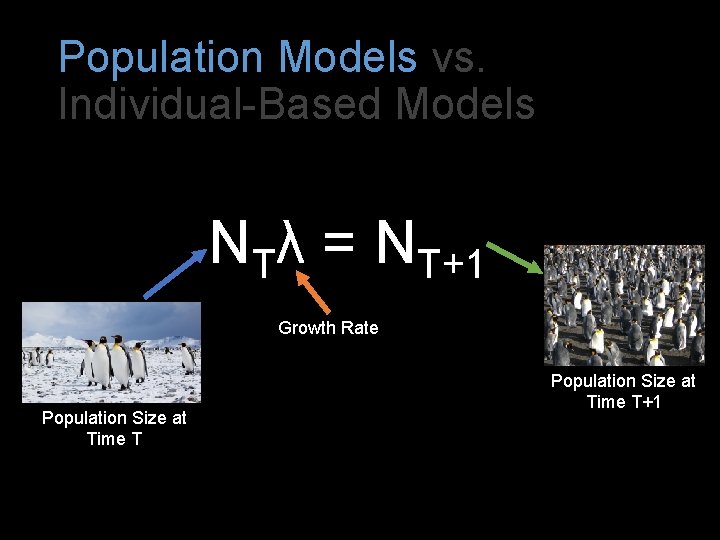
Population Models vs. Individual-Based Models NTλ = NT+1 Growth Rate Population Size at Time T+1
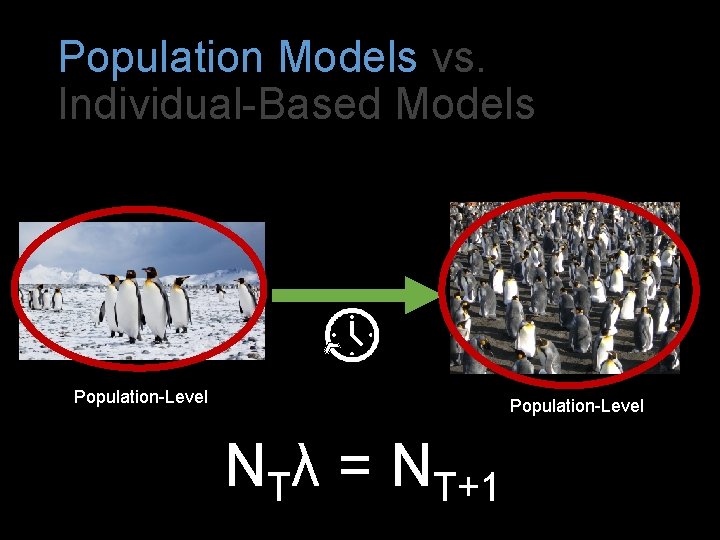
Population Models vs. Individual-Based Models Population-Level NTλ = NT+1
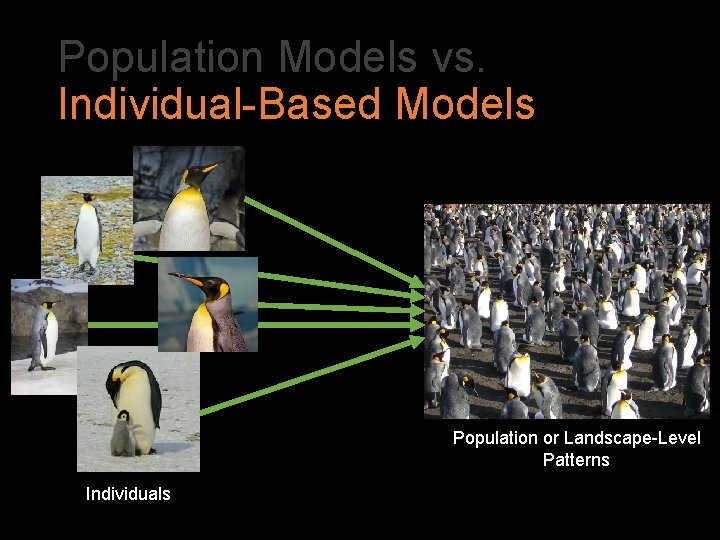
Population Models vs. Individual-Based Models Population or Landscape-Level Patterns Individuals
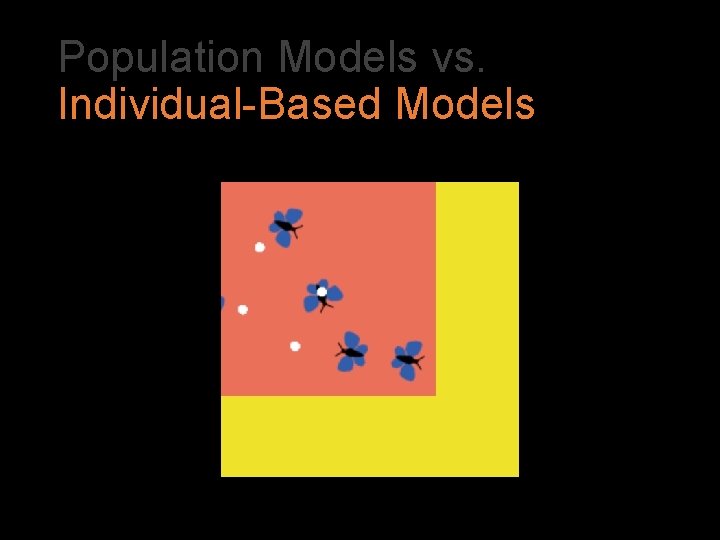
Population Models vs. Individual-Based Models

Population Models vs. Individual-Based Models
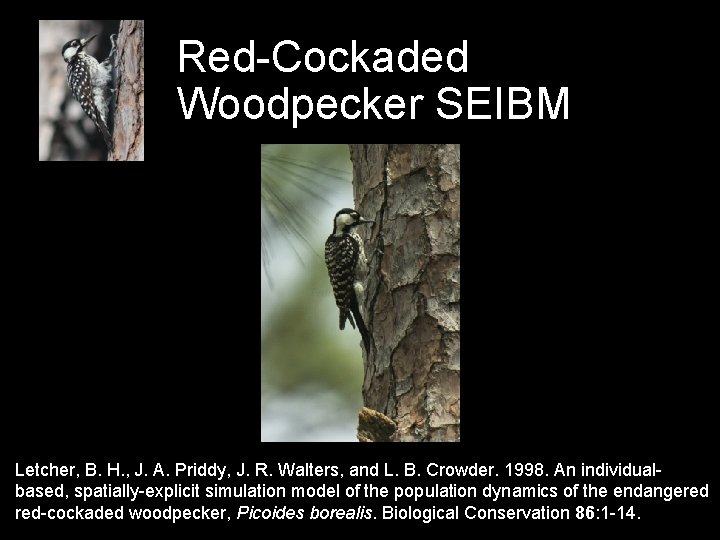
Red-Cockaded Woodpecker SEIBM Letcher, B. H. , J. A. Priddy, J. R. Walters, and L. B. Crowder. 1998. An individualbased, spatially-explicit simulation model of the population dynamics of the endangered red-cockaded woodpecker, Picoides borealis. Biological Conservation 86: 1 -14.
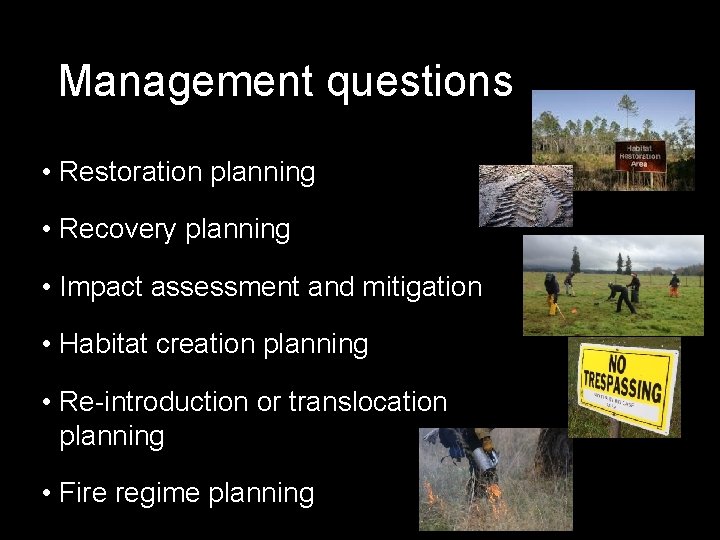
Management questions • Restoration planning • Recovery planning • Impact assessment and mitigation • Habitat creation planning • Re-introduction or translocation planning • Fire regime planning
J Balke More Examples
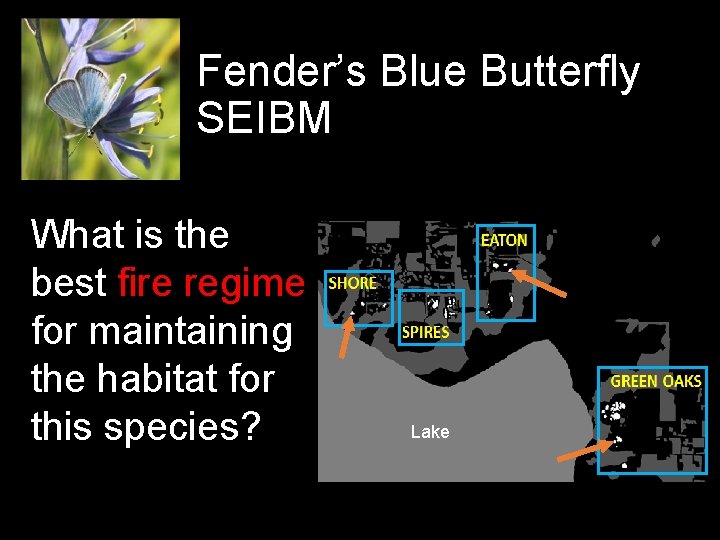
Fender’s Blue Butterfly SEIBM What is the best fire regime for maintaining the habitat for this species? Lake
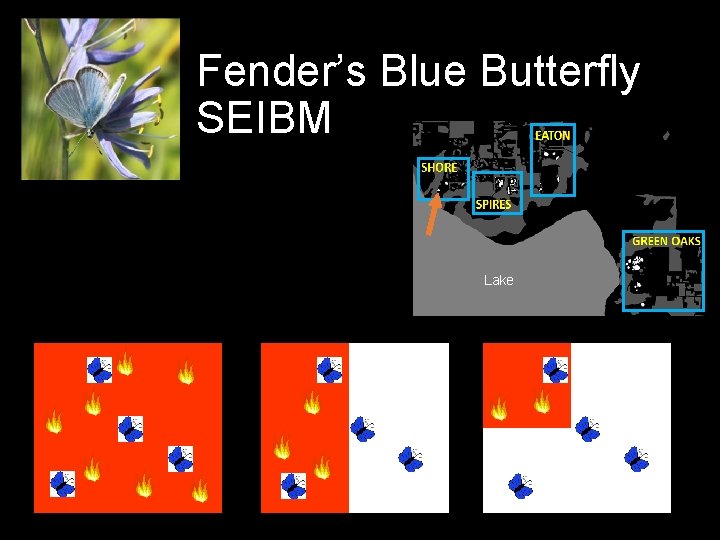
Fender’s Blue Butterfly SEIBM Lake
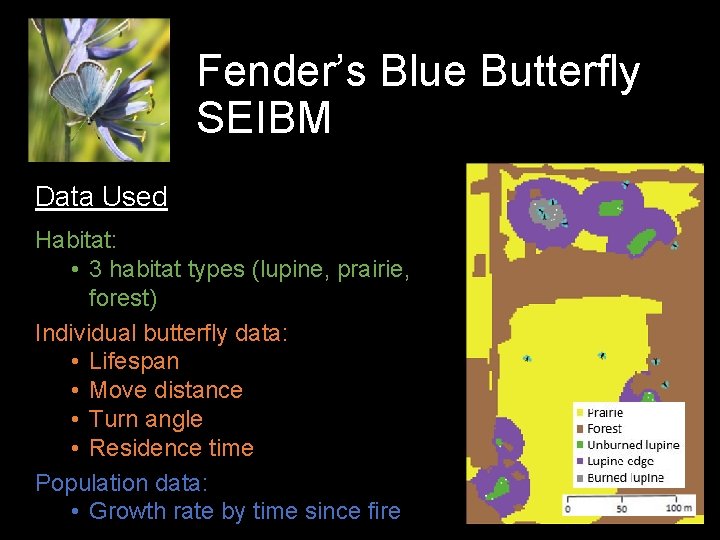
Fender’s Blue Butterfly SEIBM Data Used Habitat: • 3 habitat types (lupine, prairie, forest) Individual butterfly data: • Lifespan • Move distance • Turn angle • Residence time Population data: • Growth rate by time since fire
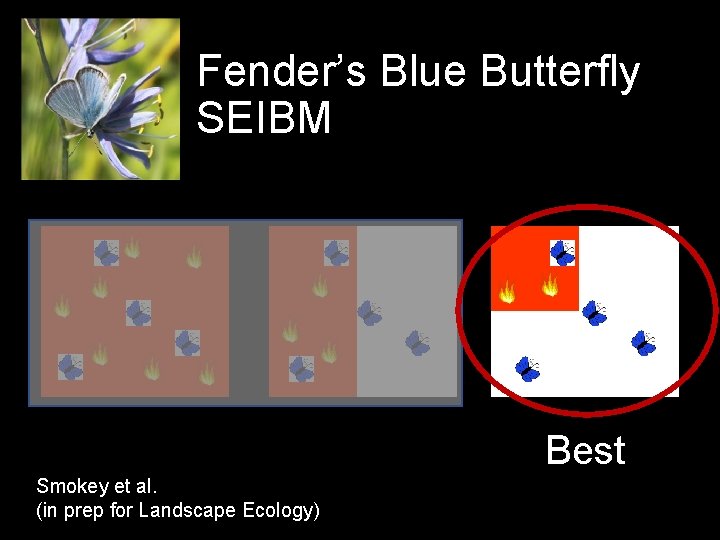
Fender’s Blue Butterfly SEIBM Best Smokey et al. (in prep for Landscape Ecology)
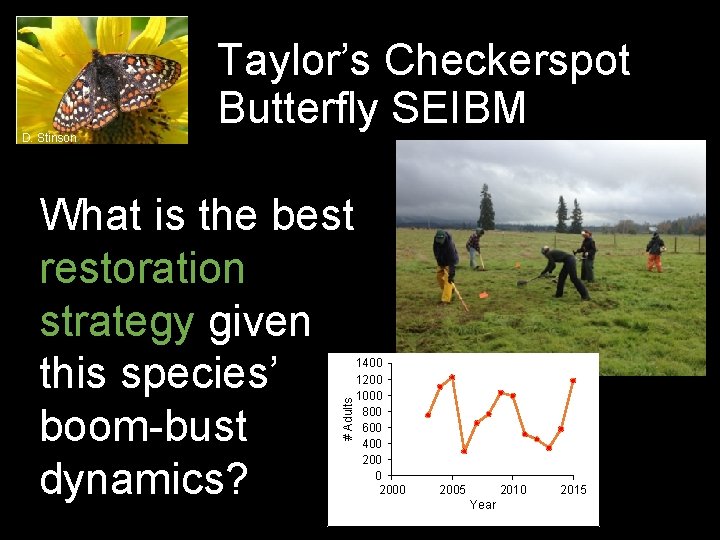
D. Stinson Taylor’s Checkerspot Butterfly SEIBM # Adults What is the best restoration strategy given this species’ boom-bust dynamics? 1400 1200 1000 800 600 400 2005 2010 Year 2015
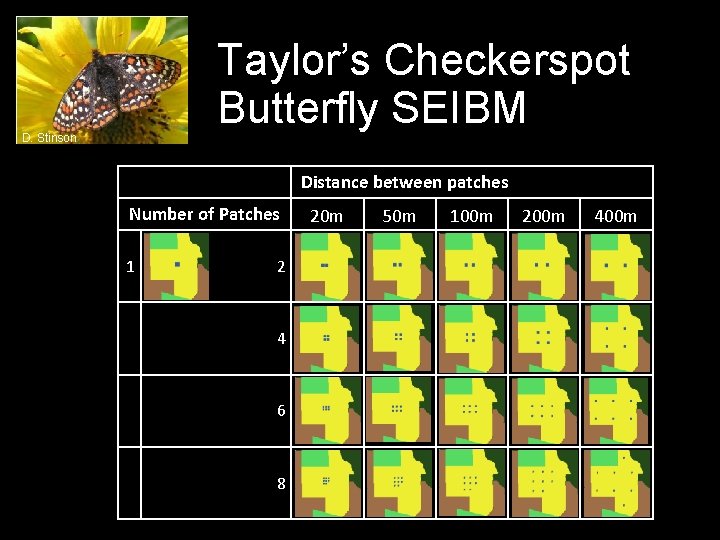
Taylor’s Checkerspot Butterfly SEIBM D. Stinson Distance between patches Number of Patches 1 2 4 6 8 20 m 50 m 100 m 200 m 400 m
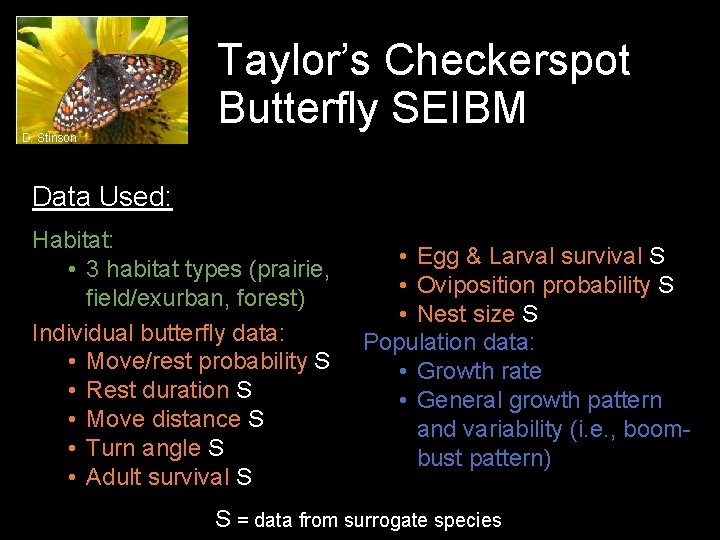
D. Stinson Taylor’s Checkerspot Butterfly SEIBM Data Used: Habitat: • 3 habitat types (prairie, field/exurban, forest) Individual butterfly data: • Move/rest probability S • Rest duration S • Move distance S • Turn angle S • Adult survival S • Egg & Larval survival S • Oviposition probability S • Nest size S Population data: • Growth rate • General growth pattern and variability (i. e. , boombust pattern) S = data from surrogate species
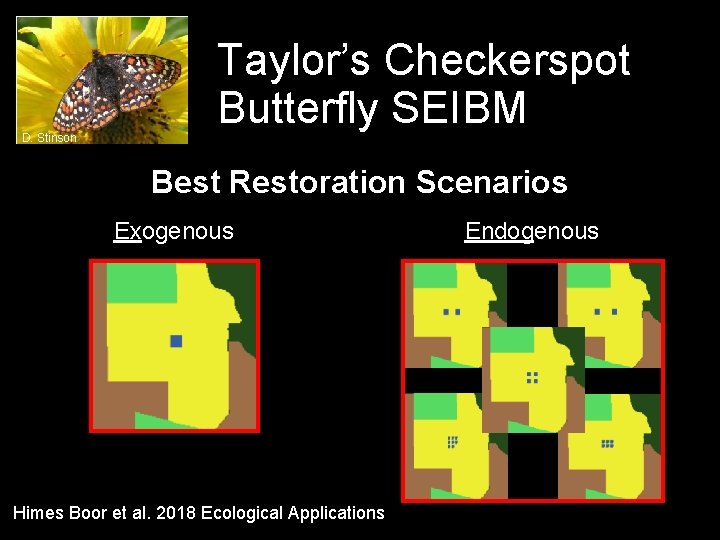
D. Stinson Taylor’s Checkerspot Butterfly SEIBM Best Restoration Scenarios Exogenous Himes Boor et al. 2018 Ecological Applications Endogenous
Can SEIBMs be useful to managers?
Can SEIBMs be useful to managers? Maybe
Can SEIBMs be useful to managers? • Data intensive • Address relevant questions • Becoming more common (lots of examples) • Ideal for species with social and/or spatial structure
Thank you! Gina K. Himes Boor (ghimesboor@montana. edu) Co-Author: Christine Damiani (longicarpus@yahoo. com) Collaborators: Elizabeth Crone (PI), Tufts University William Morris (co-PI), Duke University Cheryl Schultz (co-PI), Washington State University Brian Hudgens (co-PI), Institute for Wildlife Studies Funding:


Saved, not-used slides
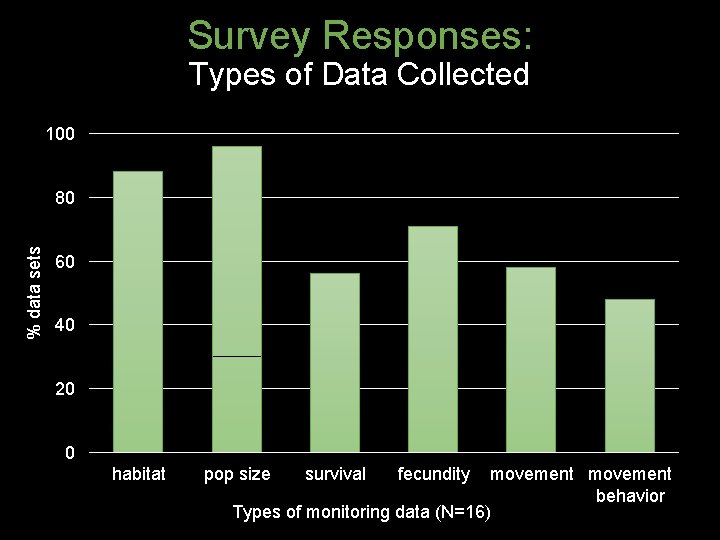
Survey Responses: Types of Data Collected 100 % data sets 80 60 40 20 0 habitat pop size survival fecundity movement behavior Types of monitoring data (N=16)
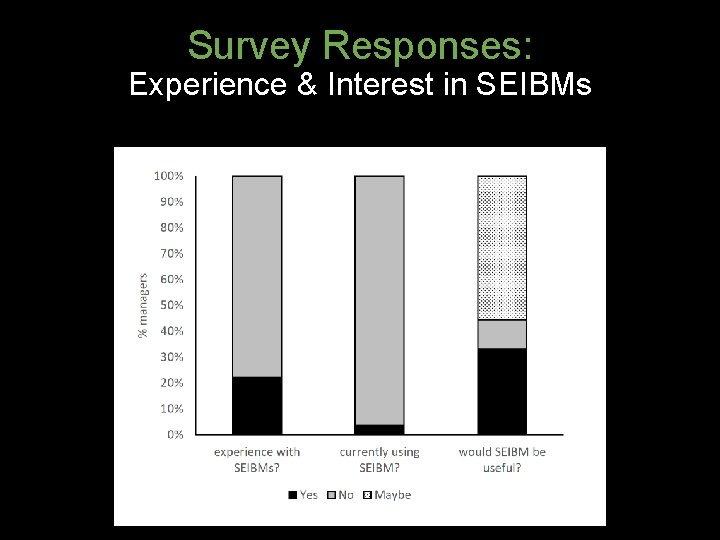
Survey Responses: Experience & Interest in SEIBMs
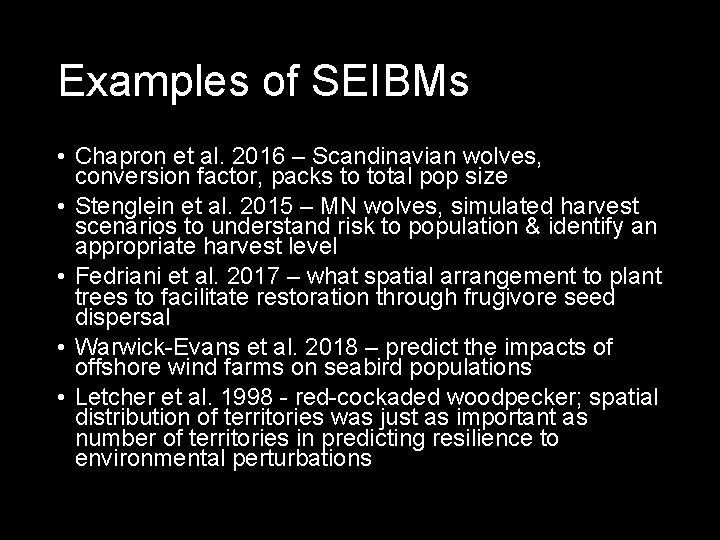
Examples of SEIBMs • Chapron et al. 2016 – Scandinavian wolves, conversion factor, packs to total pop size • Stenglein et al. 2015 – MN wolves, simulated harvest scenarios to understand risk to population & identify an appropriate harvest level • Fedriani et al. 2017 – what spatial arrangement to plant trees to facilitate restoration through frugivore seed dispersal • Warwick-Evans et al. 2018 – predict the impacts of offshore wind farms on seabird populations • Letcher et al. 1998 - red-cockaded woodpecker; spatial distribution of territories was just as important as number of territories in predicting resilience to environmental perturbations
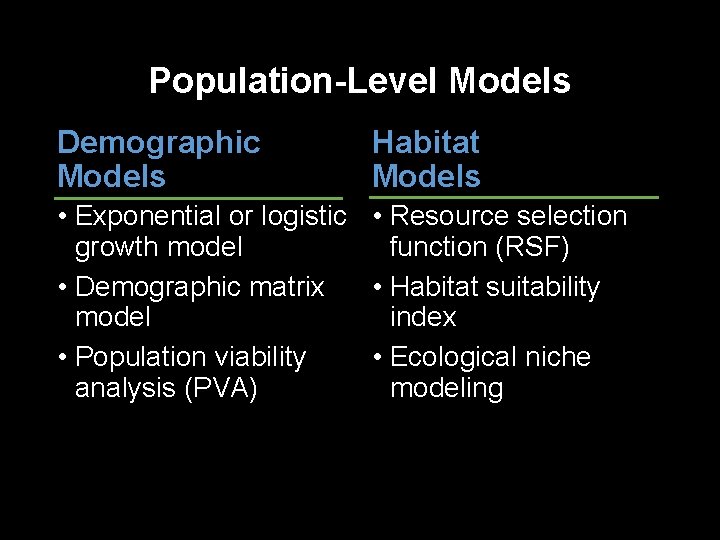
Population-Level Models Demographic Models Habitat Models • Exponential or logistic • Resource selection growth model function (RSF) • Demographic matrix • Habitat suitability model index • Population viability • Ecological niche analysis (PVA) modeling
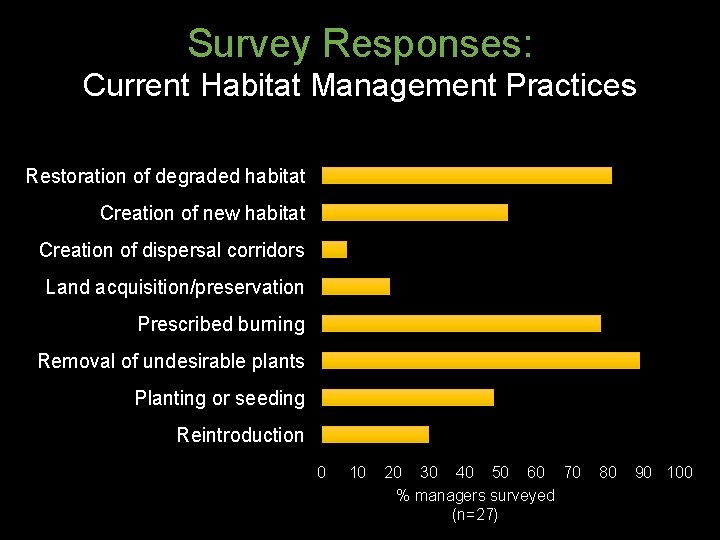
Survey Responses: Current Habitat Management Practices Restoration of degraded habitat Creation of new habitat Creation of dispersal corridors Land acquisition/preservation Prescribed burning Removal of undesirable plants Planting or seeding Reintroduction 0 10 20 30 40 50 60 70 % managers surveyed (n=27) 80 90 100
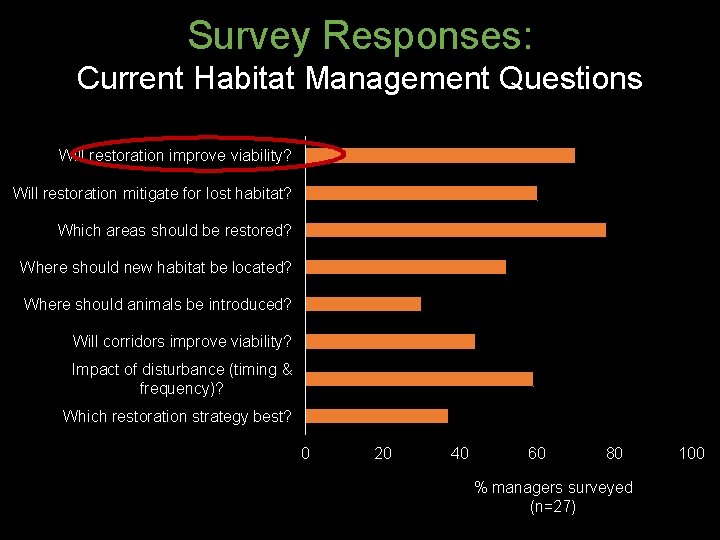
Survey Responses: Current Habitat Management Questions Will restoration improve viability? Will restoration mitigate for lost habitat? Which areas should be restored? Where should new habitat be located? Where should animals be introduced? Will corridors improve viability? Impact of disturbance (timing & frequency)? Which restoration strategy best? 0 20 40 60 80 % managers surveyed (n=27) 100
- Slides: 37