
Spatially Distributed Snowmelt Modeling with the Utah Energy
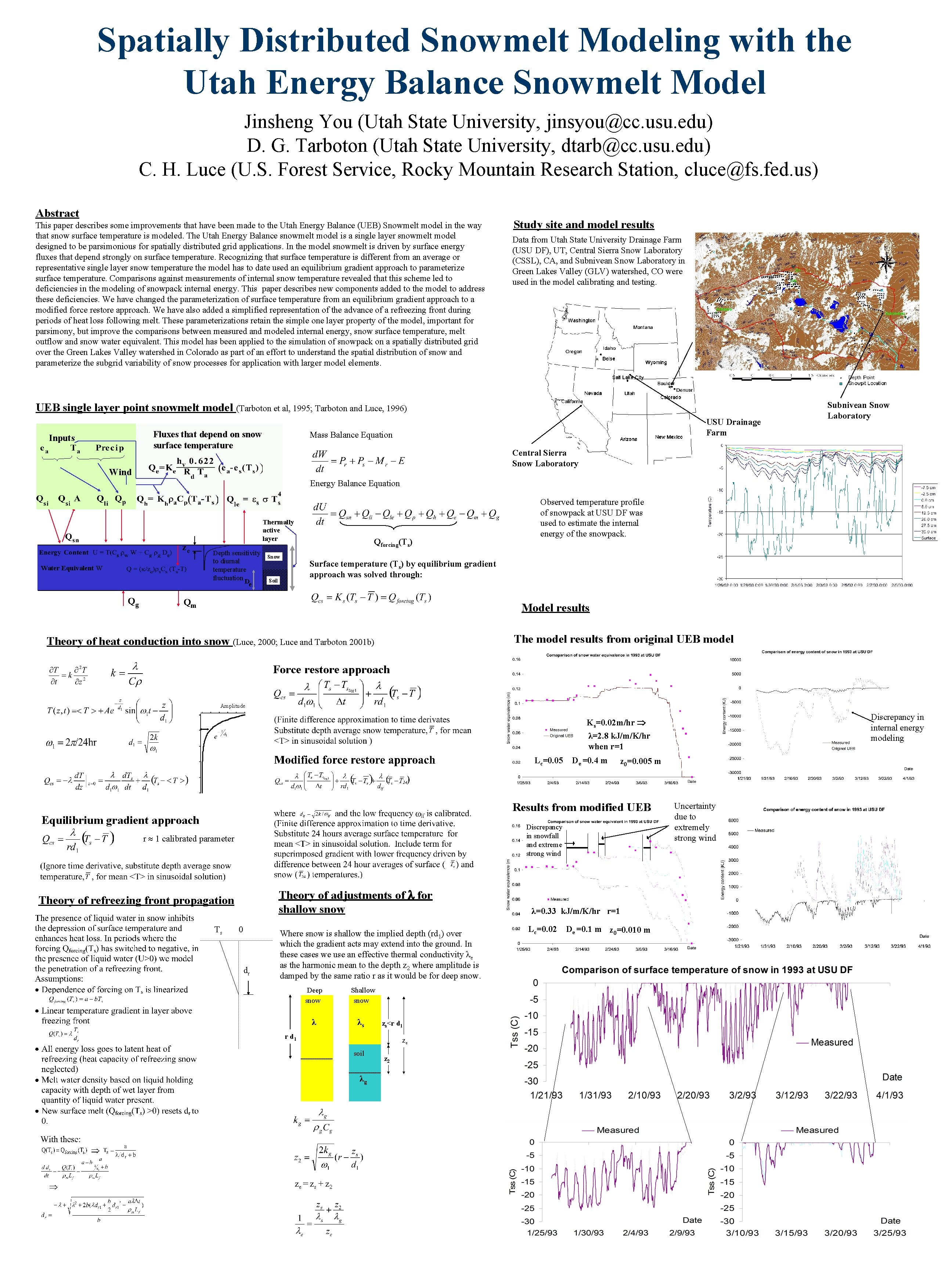
Spatially Distributed Snowmelt Modeling with the Utah Energy Balance Snowmelt Model Jinsheng You (Utah State University, jinsyou@cc. usu. edu) D. G. Tarboton (Utah State University, dtarb@cc. usu. edu) C. H. Luce (U. S. Forest Service, Rocky Mountain Research Station, cluce@fs. fed. us) Abstract This paper describes some improvements that have been made to the Utah Energy Balance (UEB) Snowmelt model in the way that snow surface temperature is modeled. The Utah Energy Balance snowmelt model is a single layer snowmelt model designed to be parsimonious for spatially distributed grid applications. In the model snowmelt is driven by surface energy fluxes that depend strongly on surface temperature. Recognizing that surface temperature is different from an average or representative single layer snow temperature the model has to date used an equilibrium gradient approach to parameterize surface temperature. Comparisons against measurements of internal snow temperature revealed that this scheme led to deficiencies in the modeling of snowpack internal energy. This paper describes new components added to the model to address these deficiencies. We have changed the parameterization of surface temperature from an equilibrium gradient approach to a modified force restore approach. We have also added a simplified representation of the advance of a refreezing front during periods of heat loss following melt. These parameterizations retain the simple one layer property of the model, important for parsimony, but improve the comparisons between measured and modeled internal energy, snow surface temperature, melt outflow and snow water equivalent. This model has been applied to the simulation of snowpack on a spatially distributed grid over the Green Lakes Valley watershed in Colorado as part of an effort to understand the spatial distribution of snow and parameterize the subgrid variability of snow processes for application with larger model elements. Study site and model results Data from Utah State University Drainage Farm (USU DF), UT, Central Sierra Snow Laboratory (CSSL), CA, and Subnivean Snow Laboratory in Green Lakes Valley (GLV) watershed, CO were used in the model calibrating and testing. UEB single layer point snowmelt model (Tarboton et al, 1995; Tarboton and Luce, 1996) Fluxes that depend on snow surface temperature Inputs USU Drainage Farm Mass Balance Equation Subnivean Snow Laboratory Central Sierra Snow Laboratory Wind Energy Balance Equation Thermally active layer Depth sensitivity to diurnal temperature fluctuation D e Water Equivalent W Qg Qforcing(Ts) Snow Observed temperature profile of snowpack at USU DF was used to estimate the internal energy of the snowpack. Surface temperature (Ts) by equilibrium gradient approach was solved through: Soil Qm Model results The model results from original UEB model Theory of heat conduction into snow (Luce, 2000; Luce and Tarboton 2001 b) Force restore approach Amplitude Discrepancy in internal energy modeling Ks=0. 02 m/hr λ=2. 8 k. J/m/K/hr when r=1 Lc=0. 05 De =0. 4 m z 0=0. 005 m Results from modified UEB Equilibrium gradient approach Discrepancy in snowfall and extreme strong wind r » 1 calibrated parameter Theory of adjustments of for shallow snow Theory of refreezing front propagation Ts 0 dr Where snow is shallow the implied depth (rd 1) over which the gradient acts may extend into the ground. In these cases we use an effective thermal conductivity λe as the harmonic mean to the depth z 2 where amplitude is damped by the same ratio r as it would be for deep snow. Deep snow λ Shallow snow λs zs<r d 1 ze soil λg ze = zs + z 2 λ=0. 33 k. J/m/K/hr r=1 Lc=0. 02 De =0. 1 m z 0=0. 010 m Uncertainty due to extremely strong wind
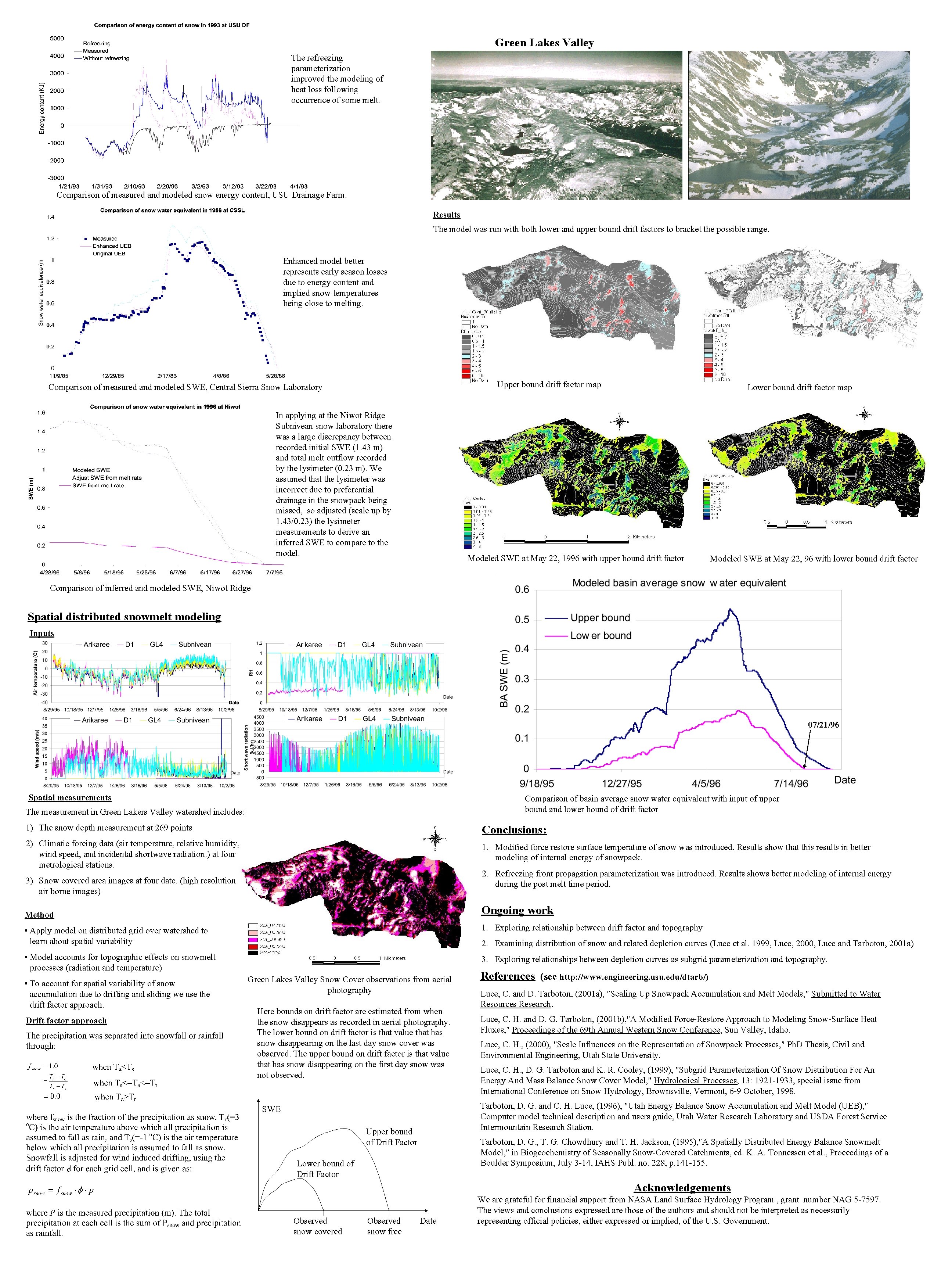
Green Lakes Valley The refreezing parameterization improved the modeling of heat loss following occurrence of some melt. Comparison of measured and modeled snow energy content, USU Drainage Farm. Results The model was run with both lower and upper bound drift factors to bracket the possible range. Enhanced model better represents early season losses due to energy content and implied snow temperatures being close to melting. Upper bound drift factor map Comparison of measured and modeled SWE, Central Sierra Snow Laboratory In applying at the Niwot Ridge Subnivean snow laboratory there was a large discrepancy between recorded initial SWE (1. 43 m) and total melt outflow recorded by the lysimeter (0. 23 m). We assumed that the lysimeter was incorrect due to preferential drainage in the snowpack being missed, so adjusted (scale up by 1. 43/0. 23) the lysimeter measurements to derive an inferred SWE to compare to the model. Lower bound drift factor map Modeled SWE at May 22, 1996 with upper bound drift factor Modeled SWE at May 22, 96 with lower bound drift factor Comparison of inferred and modeled SWE, Niwot Ridge Spatial distributed snowmelt modeling Inputs 07/21/96 Spatial measurements Comparison of basin average snow water equivalent with input of upper bound and lower bound of drift factor The measurement in Green Lakers Valley watershed includes: 1) The snow depth measurement at 269 points Conclusions: 2) Climatic forcing data (air temperature, relative humidity, wind speed, and incidental shortwave radiation. ) at four metrological stations. 1. Modified force restore surface temperature of snow was introduced. Results show that this results in better modeling of internal energy of snowpack. 2. Refreezing front propagation parameterization was introduced. Results shows better modeling of internal energy during the post melt time period. 3) Snow covered area images at four date. (high resolution air borne images) Ongoing work Method • Apply model on distributed grid over watershed to learn about spatial variability 1. Exploring relationship between drift factor and topography • Model accounts for topographic effects on snowmelt processes (radiation and temperature) 3. Exploring relationships between depletion curves as subgrid parameterization and topography. • To account for spatial variability of snow accumulation due to drifting and sliding we use the drift factor approach. Drift factor approach 2. Examining distribution of snow and related depletion curves (Luce et al. 1999, Luce, 2000, Luce and Tarboton, 2001 a) Green Lakes Valley Snow Cover observations from aerial photography Here bounds on drift factor are estimated from when the snow disappears as recorded in aerial photography. The lower bound on drift factor is that value that has snow disappearing on the last day snow cover was observed. The upper bound on drift factor is that value that has snow disappearing on the first day snow was not observed. References (see http: //www. engineering. usu. edu/dtarb/) Luce, C. and D. Tarboton, (2001 a), "Scaling Up Snowpack Accumulation and Melt Models, " Submitted to Water Resources Research. Luce, C. H. and D. G. Tarboton, (2001 b), "A Modified Force-Restore Approach to Modeling Snow-Surface Heat Fluxes, " Proceedings of the 69 th Annual Western Snow Conference, Sun Valley, Idaho. Luce, C. H. , (2000), "Scale Influences on the Representation of Snowpack Processes, " Ph. D Thesis, Civil and Environmental Engineering, Utah State University. Luce, C. H. , D. G. Tarboton and K. R. Cooley, (1999), "Subgrid Parameterization Of Snow Distribution For An Energy And Mass Balance Snow Cover Model, " Hydrological Processes, 13: 1921 -1933, special issue from International Conference on Snow Hydrology, Brownsville, Vermont, 6 -9 October, 1998. Tarboton, D. G. and C. H. Luce, (1996), "Utah Energy Balance Snow Accumulation and Melt Model (UEB), " Computer model technical description and users guide, Utah Water Research Laboratory and USDA Forest Service Intermountain Research Station. SWE Upper bound of Drift Factor Tarboton, D. G. , T. G. Chowdhury and T. H. Jackson, (1995), "A Spatially Distributed Energy Balance Snowmelt Model, " in Biogeochemistry of Seasonally Snow-Covered Catchments, ed. K. A. Tonnessen et al. , Proceedings of a Boulder Symposium, July 3 -14, IAHS Publ. no. 228, p. 141 -155. Lower bound of Drift Factor Acknowledgements Observed snow covered Observed snow free Date We are grateful for financial support from NASA Land Surface Hydrology Program , grant number NAG 5 -7597. The views and conclusions expressed are those of the authors and should not be interpreted as necessarily representing official policies, either expressed or implied, of the U. S. Government.
- Slides: 2