
Spatial Visualization Training Using Interactive Animations Cheryl A
- Slides: 35
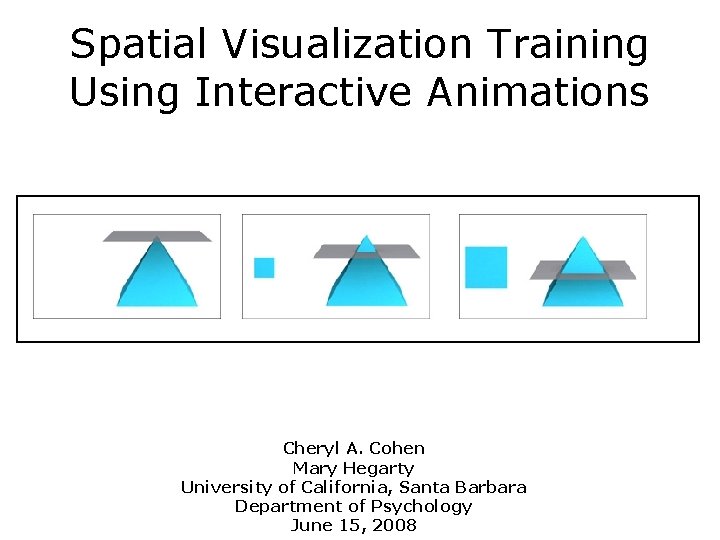
Spatial Visualization Training Using Interactive Animations Cheryl A. Cohen Mary Hegarty University of California, Santa Barbara Department of Psychology June 15, 2008
Research questions • What is the potential for using interactive animation and virtual models to train spatial visualization skill? • To what extent will training transfer?
Evidence for Mutability of Spatial Ability Baenninger & Newcombe (1989) Two meta-analyses examined the contribution of experience to the development of spatial skill: • Correlational studies: participation in spatial activities (sports, crafts and other hobbies) is positively related to scores on spatial ability measures • Experimental studies: performance on spatial ability tests can be improved through training – Pre-postest and practice effect experiments
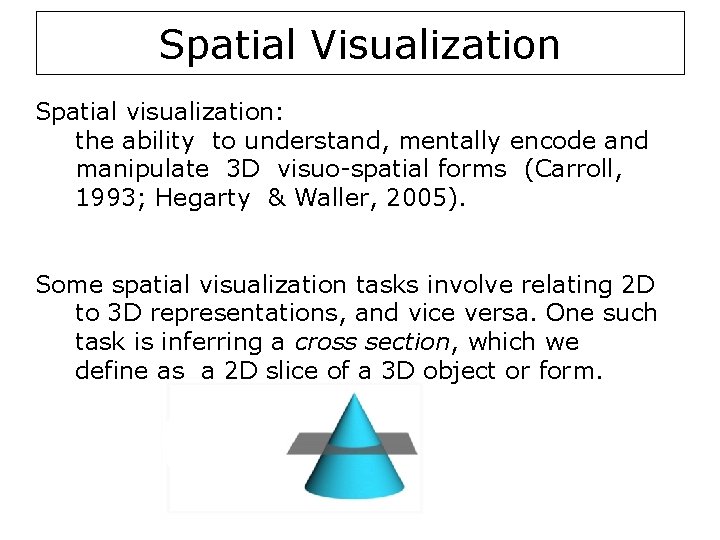
Spatial Visualization Spatial visualization: the ability to understand, mentally encode and manipulate 3 D visuo-spatial forms (Carroll, 1993; Hegarty & Waller, 2005). Some spatial visualization tasks involve relating 2 D to 3 D representations, and vice versa. One such task is inferring a cross section, which we define as a 2 D slice of a 3 D object or form.
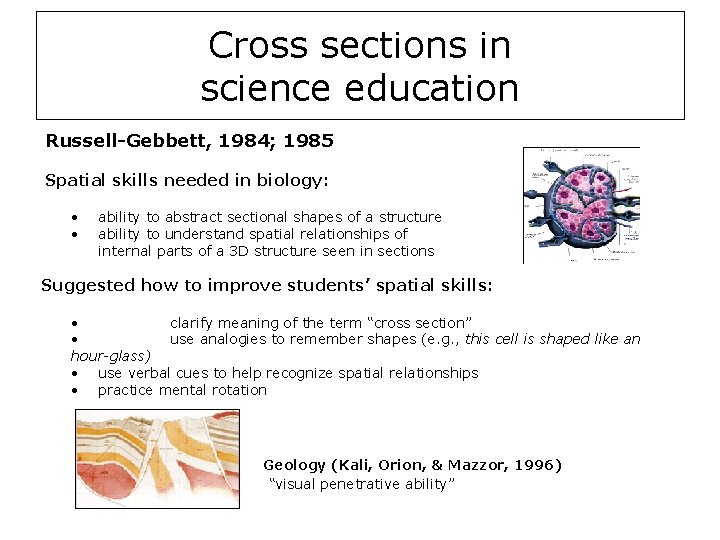
Cross sections in science education Russell-Gebbett, 1984; 1985 Spatial skills needed in biology: • • ability to abstract sectional shapes of a structure ability to understand spatial relationships of internal parts of a 3 D structure seen in sections Suggested how to improve students’ spatial skills: • clarify meaning of the term “cross section” • use analogies to remember shapes (e. g. , this cell is shaped like an hour-glass) • use verbal cues to help recognize spatial relationships • practice mental rotation Geology (Kali, Orion, & Mazzor, 1996) “visual penetrative ability”
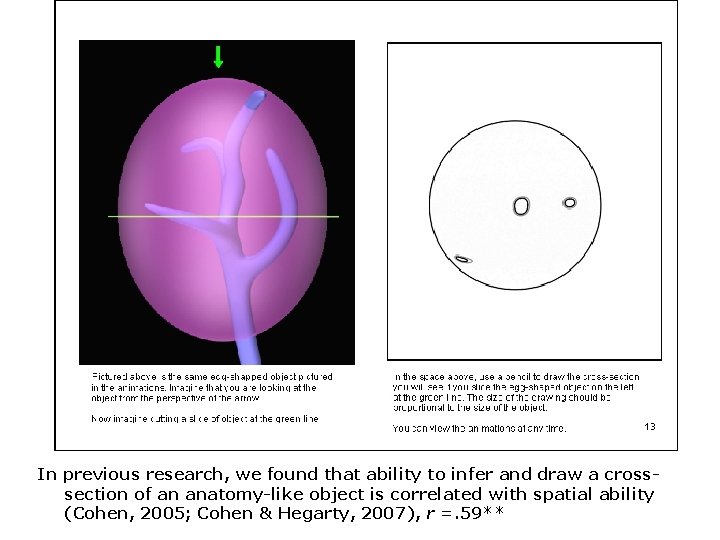
In previous research, we found that ability to infer and draw a crosssection of an anatomy-like object is correlated with spatial ability (Cohen, 2005; Cohen & Hegarty, 2007), r =. 59**
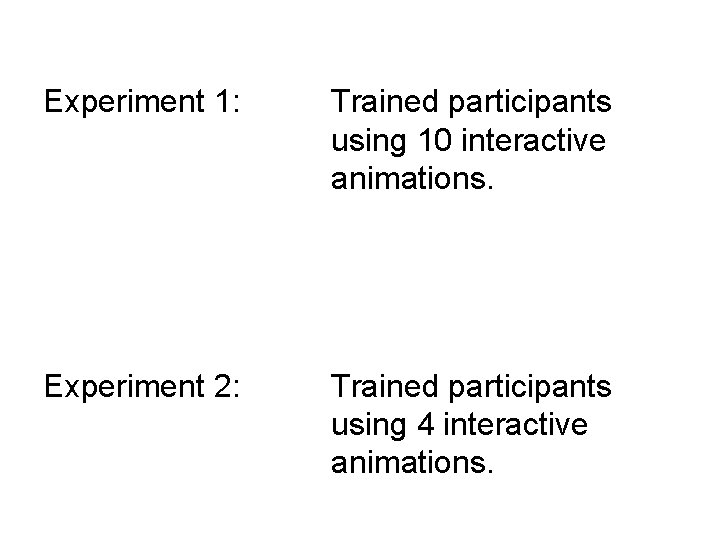
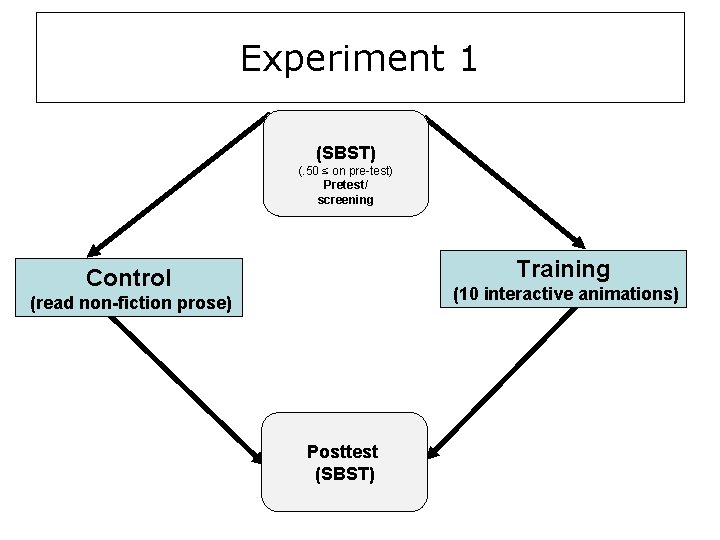
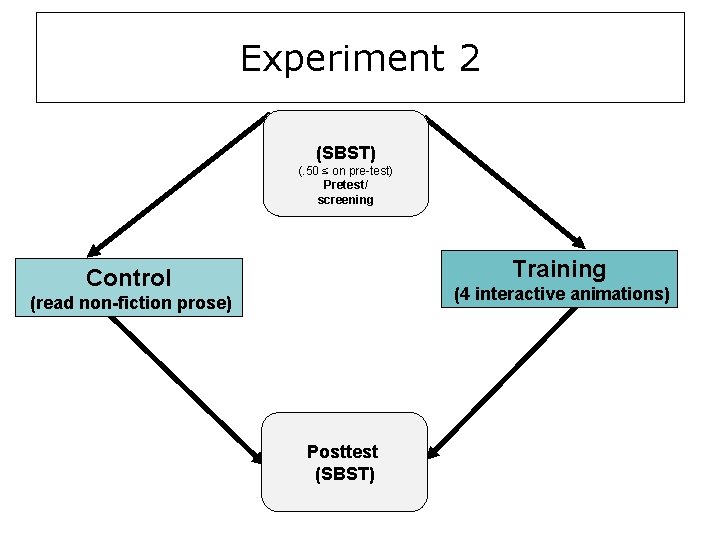
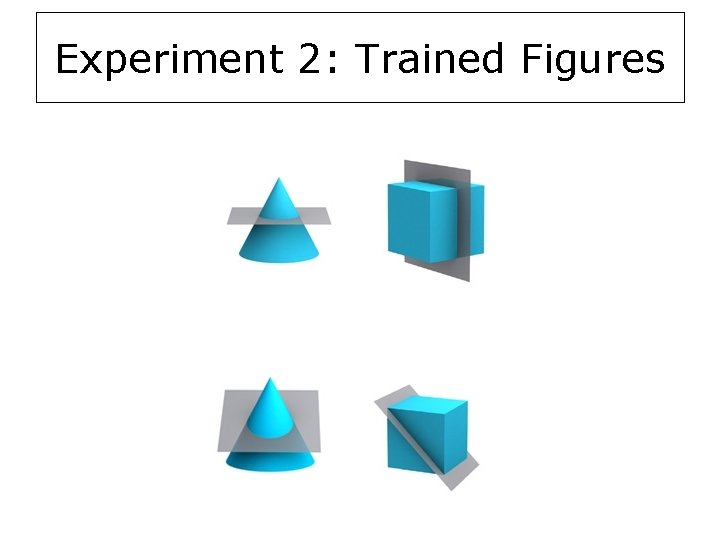
Experiment 1: Trained participants using 10 interactive animations. Experiment 2: Trained participants using 4 interactive animations.
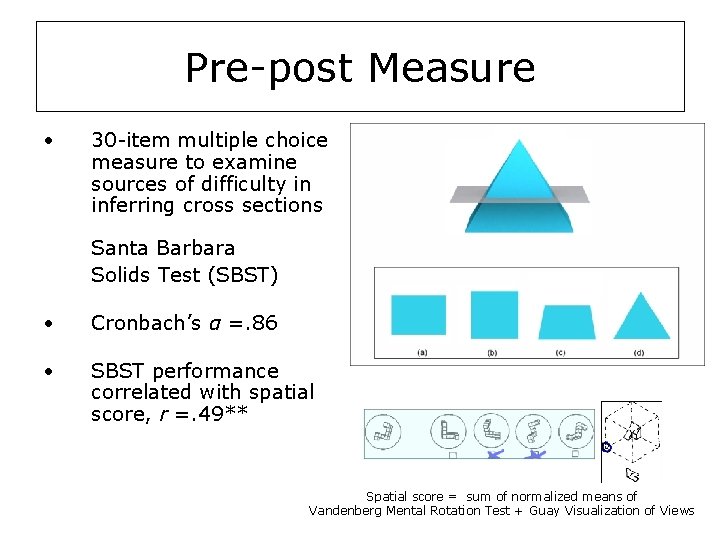
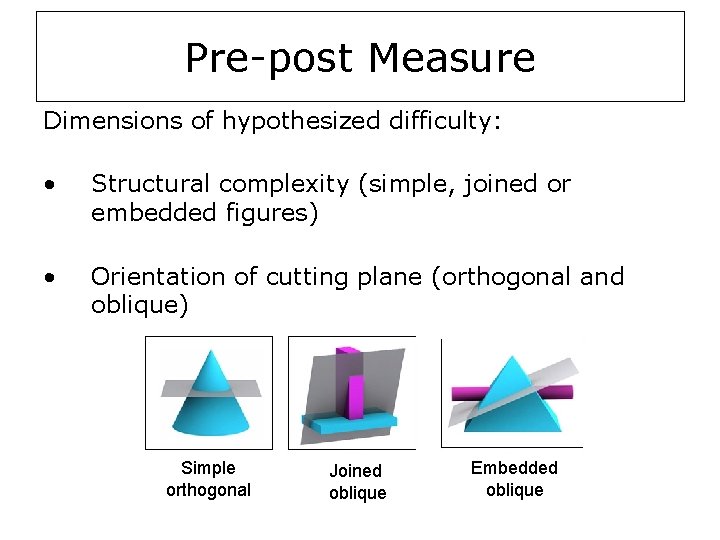
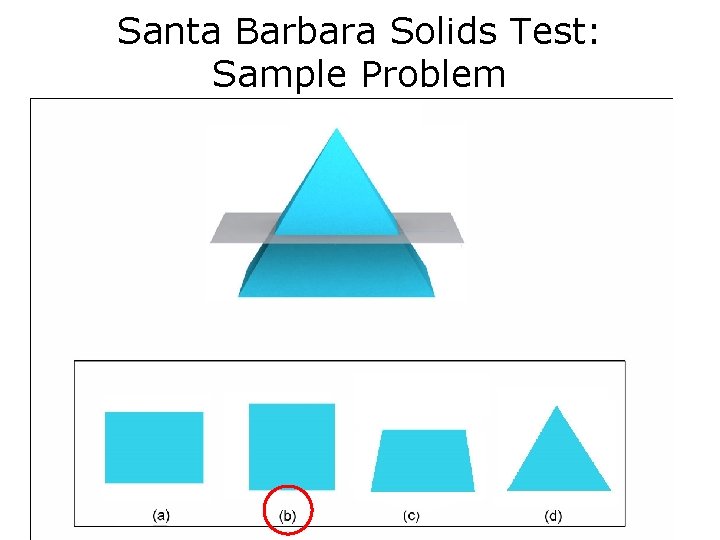
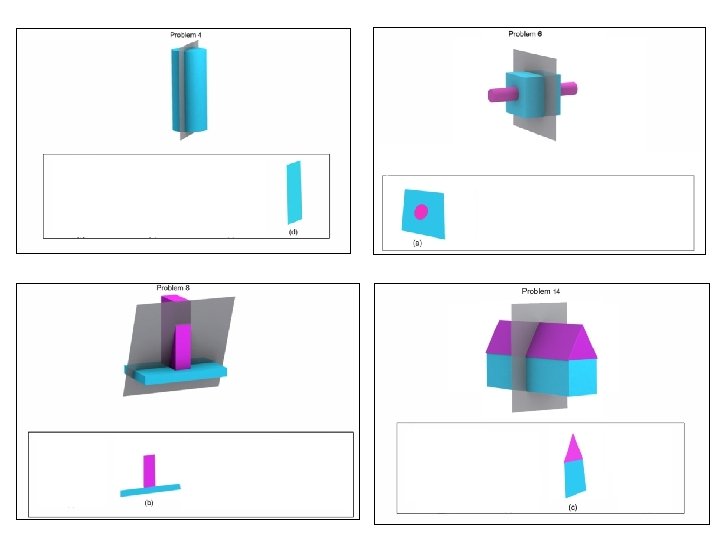
Pre-post Measure • 30 -item multiple choice measure to examine sources of difficulty in inferring cross sections Santa Barbara Solids Test (SBST) • Cronbach’s α =. 86 • SBST performance correlated with spatial score, r =. 49** Spatial score = sum of normalized means of Vandenberg Mental Rotation Test + Guay Visualization of Views
Pre-post Measure Dimensions of hypothesized difficulty: • Structural complexity (simple, joined or embedded figures) • Orientation of cutting plane (orthogonal and oblique) Simple orthogonal Joined oblique Embedded oblique
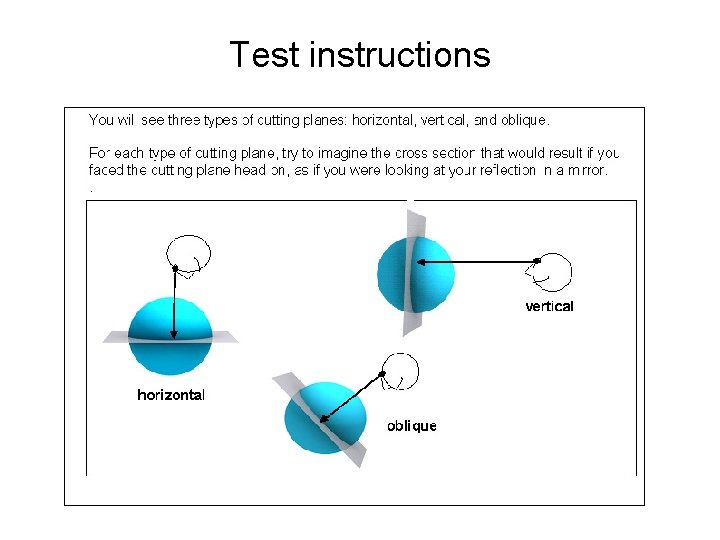
Test instructions
Santa Barbara Solids Test: Sample Problem
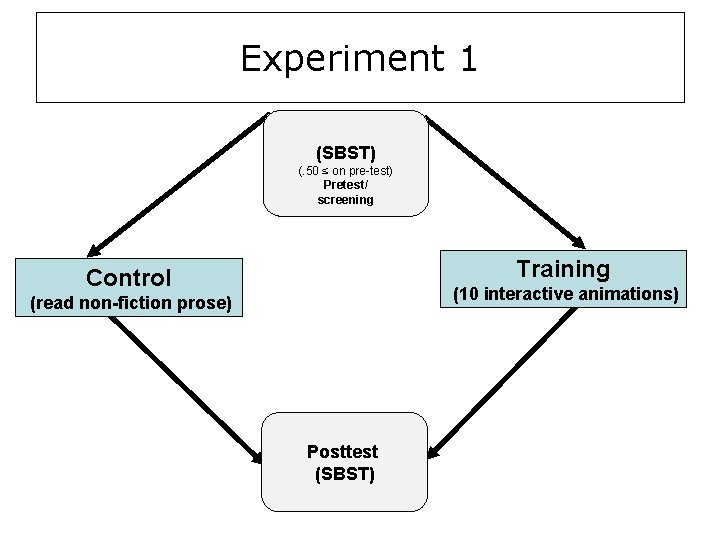
Experiment 1 (SBST) (. 50 ≤ on pre-test) Pretest/ screening Training Control (10 interactive animations) (read non-fiction prose) Posttest (SBST)
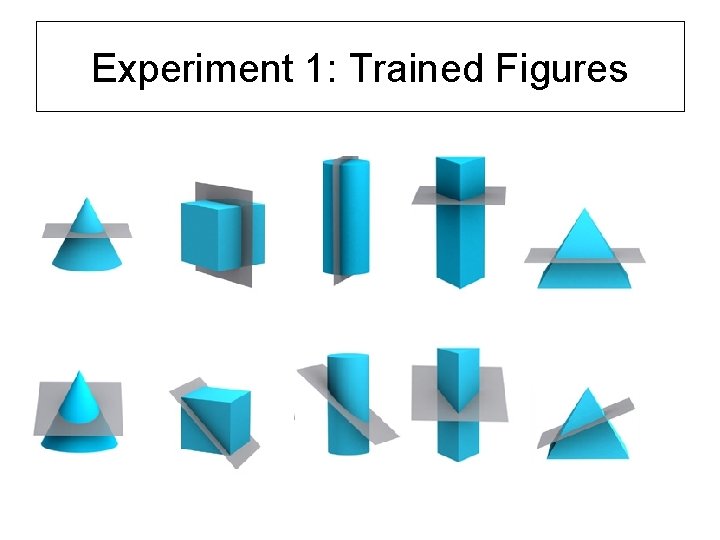
Experiment 1: Trained Figures
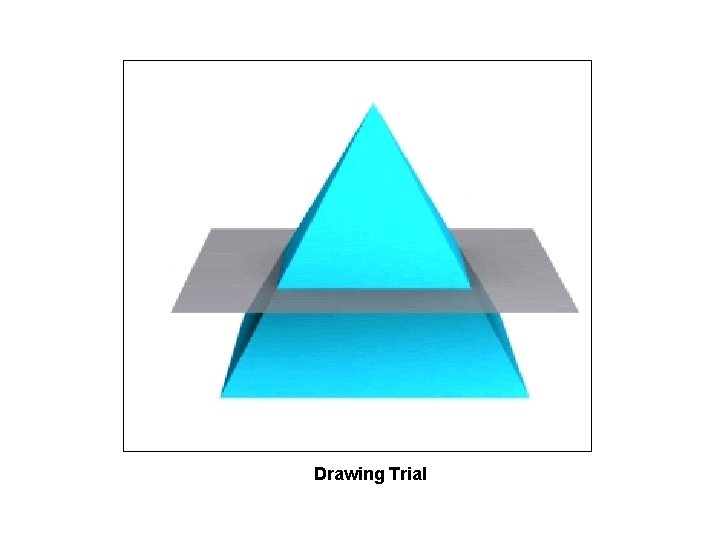
Drawing Trial
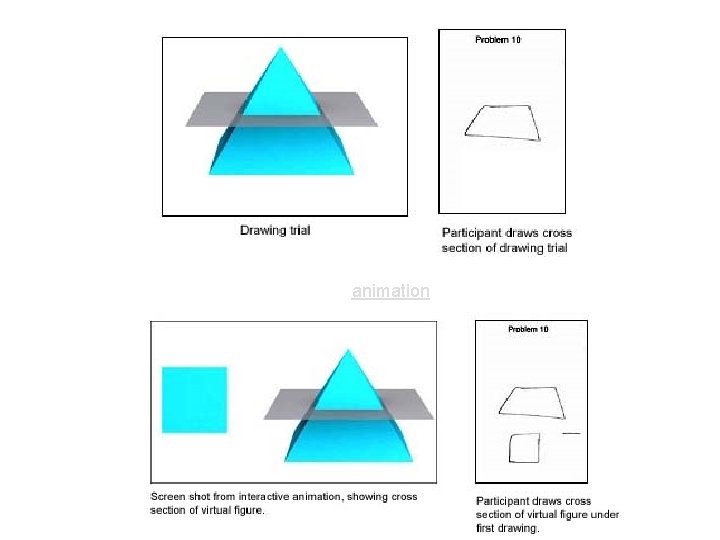
animation
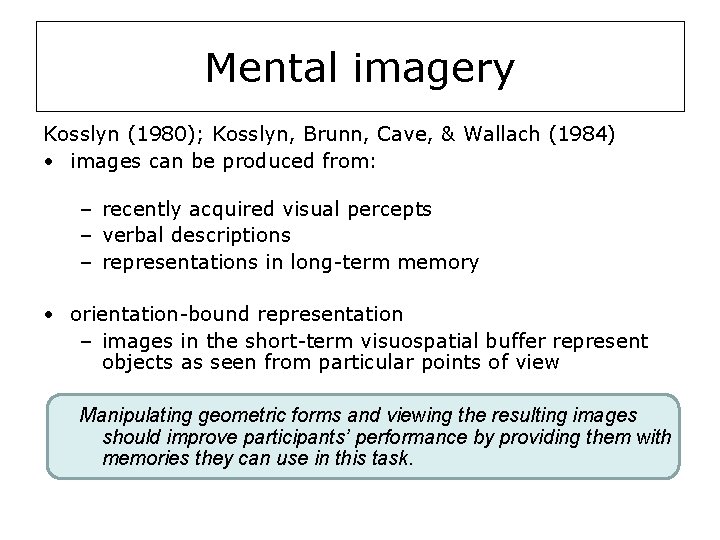
Mental imagery Kosslyn (1980); Kosslyn, Brunn, Cave, & Wallach (1984) • images can be produced from: – recently acquired visual percepts – verbal descriptions – representations in long-term memory • orientation-bound representation – images in the short-term visuospatial buffer represent objects as seen from particular points of view Manipulating geometric forms and viewing the resulting images should improve participants’ performance by providing them with memories they can use in this task.
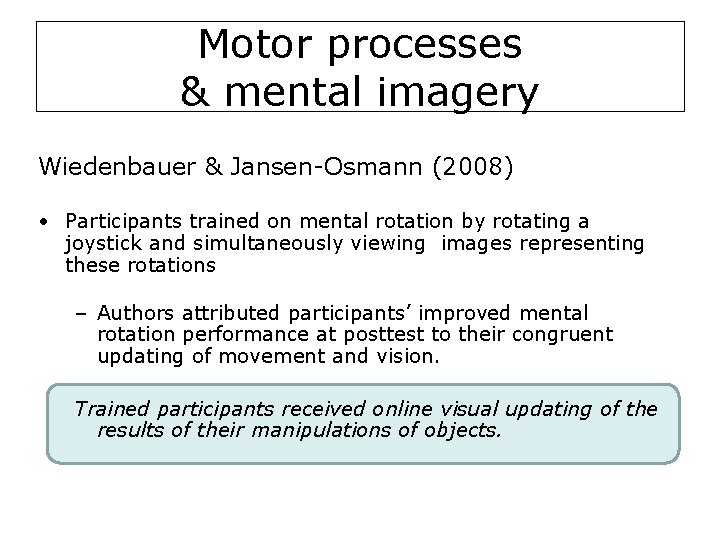
Motor processes & mental imagery Wiedenbauer & Jansen-Osmann (2008) • Participants trained on mental rotation by rotating a joystick and simultaneously viewing images representing these rotations – Authors attributed participants’ improved mental rotation performance at posttest to their congruent updating of movement and vision. Trained participants received online visual updating of the results of their manipulations of objects.
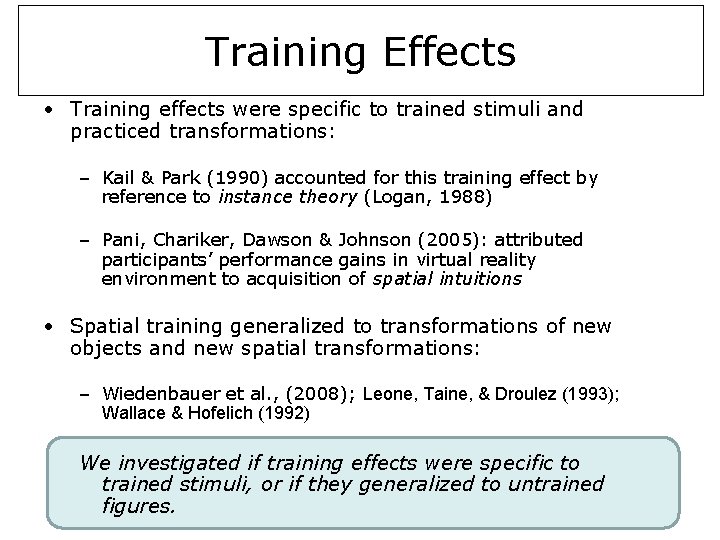
Training Effects • Training effects were specific to trained stimuli and practiced transformations: – Kail & Park (1990) accounted for this training effect by reference to instance theory (Logan, 1988) – Pani, Chariker, Dawson & Johnson (2005): attributed participants’ performance gains in virtual reality environment to acquisition of spatial intuitions • Spatial training generalized to transformations of new objects and new spatial transformations: – Wiedenbauer et al. , (2008); Leone, Taine, & Droulez (1993); Wallace & Hofelich (1992) We investigated if training effects were specific to trained stimuli, or if they generalized to untrained figures.
Experiment 1 (SBST) (. 50 ≤ on pre-test) Pretest/ screening Training Control (10 interactive animations) (read non-fiction prose) Posttest (SBST)
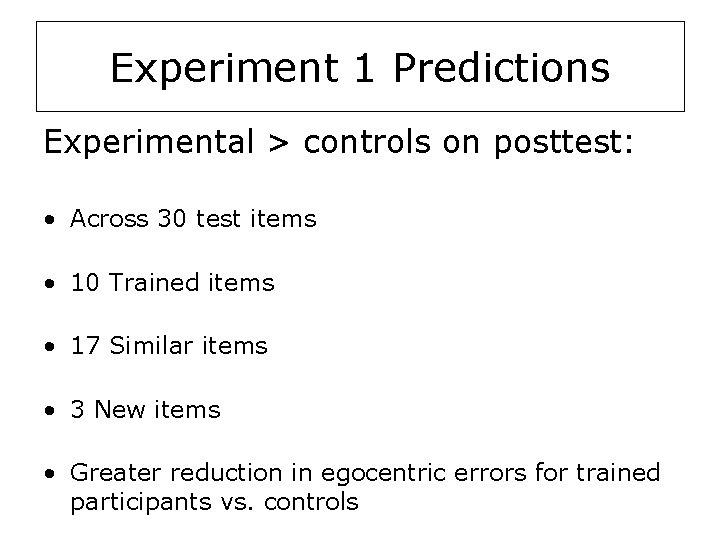
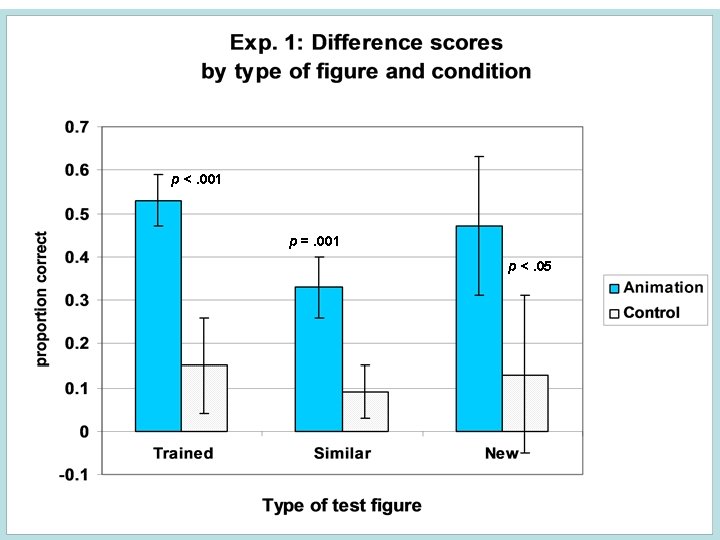
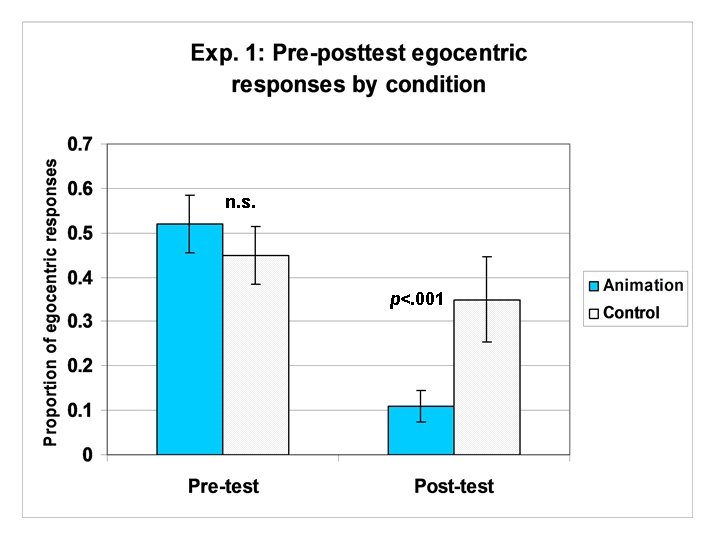
Experiment 1 Predictions Experimental > controls on posttest: • Across 30 test items • 10 Trained items • 17 Similar items • 3 New items • Greater reduction in egocentric errors for trained participants vs. controls
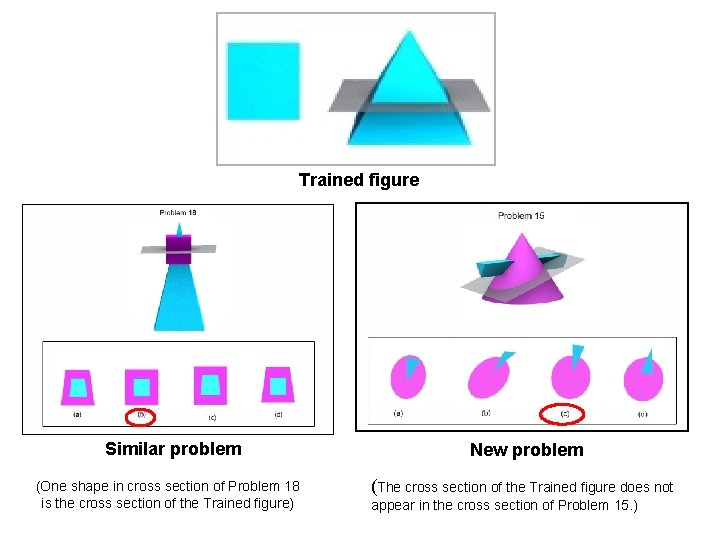
Trained figure Similar problem (One shape in cross section of Problem 18 is the cross section of the Trained figure) New problem (The cross section of the Trained figure does not appear in the cross section of Problem 15. )
p <. 001 p =. 001 p <. 05
n. s. p<. 001
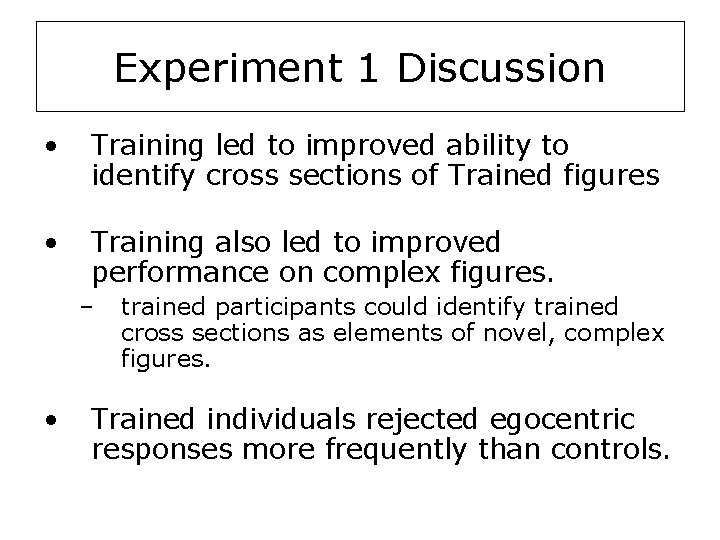
Experiment 1 Discussion • Training led to improved ability to identify cross sections of Trained figures • Training also led to improved performance on complex figures. – • trained participants could identify trained cross sections as elements of novel, complex figures. Trained individuals rejected egocentric responses more frequently than controls.
Experiment 2 (SBST) (. 50 ≤ on pre-test) Pretest/ screening Training Control (4 interactive animations) (read non-fiction prose) Posttest (SBST)
Experiment 2: Trained Figures
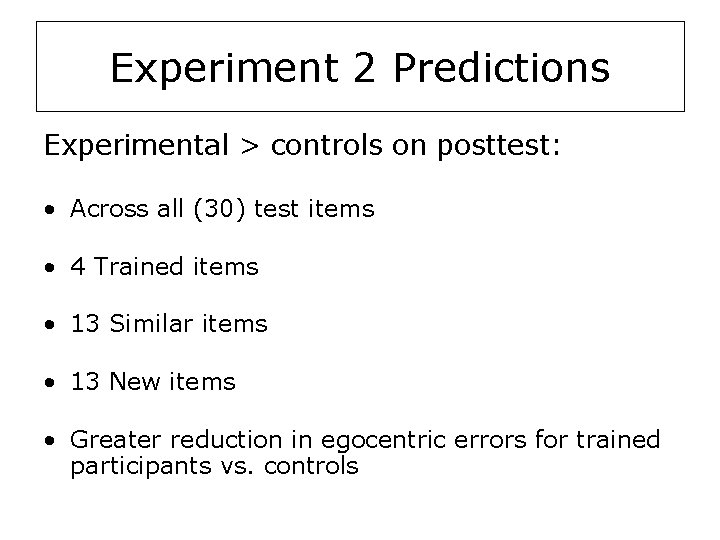
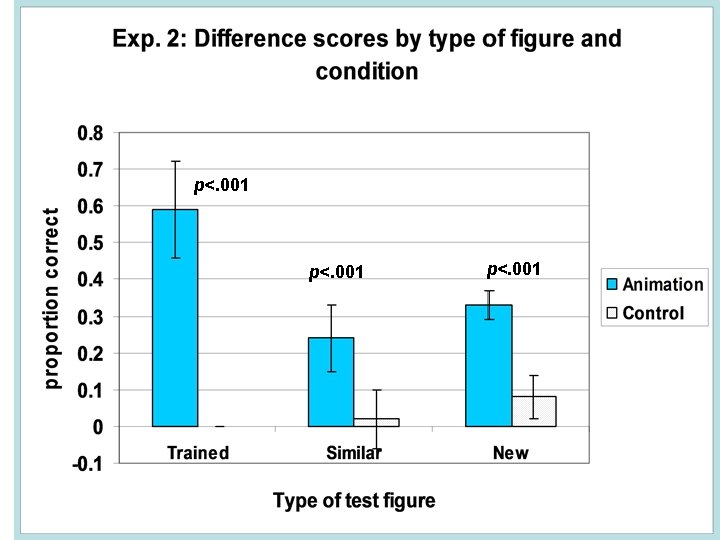
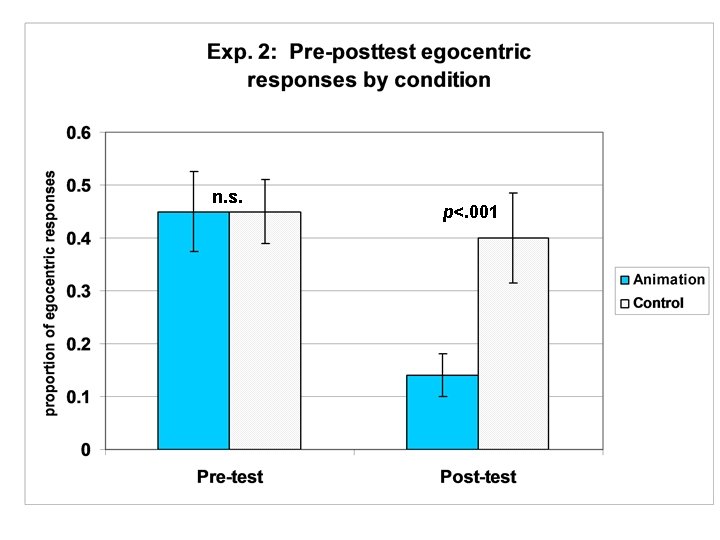
Experiment 2 Predictions Experimental > controls on posttest: • Across all (30) test items • 4 Trained items • 13 Similar items • 13 New items • Greater reduction in egocentric errors for trained participants vs. controls
p<. 001
n. s. p<. 001
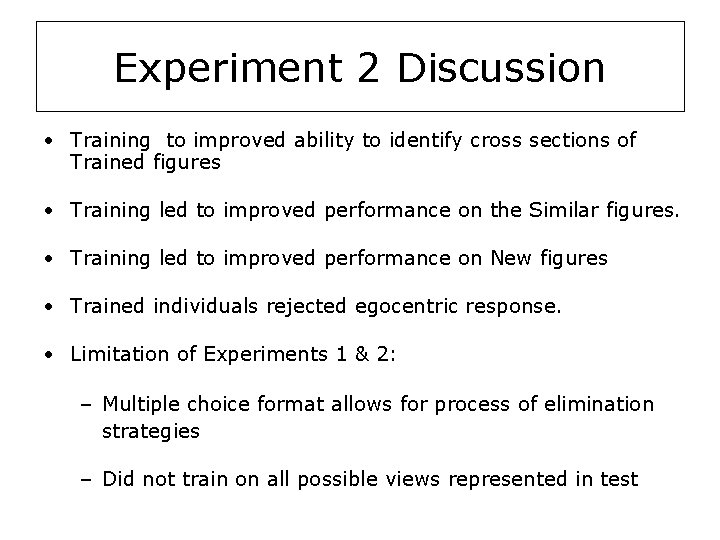
Experiment 2 Discussion • Training to improved ability to identify cross sections of Trained figures • Training led to improved performance on the Similar figures. • Training led to improved performance on New figures • Trained individuals rejected egocentric response. • Limitation of Experiments 1 & 2: – Multiple choice format allows for process of elimination strategies – Did not train on all possible views represented in test
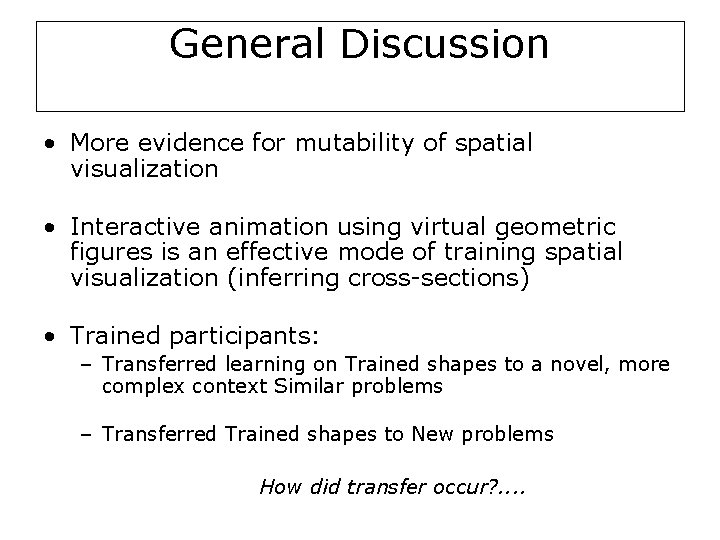
General Discussion • More evidence for mutability of spatial visualization • Interactive animation using virtual geometric figures is an effective mode of training spatial visualization (inferring cross-sections) • Trained participants: – Transferred learning on Trained shapes to a novel, more complex context Similar problems – Transferred Trained shapes to New problems How did transfer occur? . .
General Discussion Possible mechanisms of transfer to New figures: • Learned Trained cross sections (instance theory) • Inferred New cross sections by: – noting similar features among test figures & combining features of their cross sections – process of elimination strategies
Implications & Future Directions • Insight into cognitive processes related to transfer of spatial learning – Instance theory – Comparison and inference – Process of elimination • Applications in science education – Adapt training to specific domains of science education – Level the playing field
Thanks to: Mary Hegarty Jack Loomis Rich Mayer Russ Revlin Jerry Tietz University of California, Santa Barbara Department of Psychology