
Spatial Variability in Precision Agriculture l What is
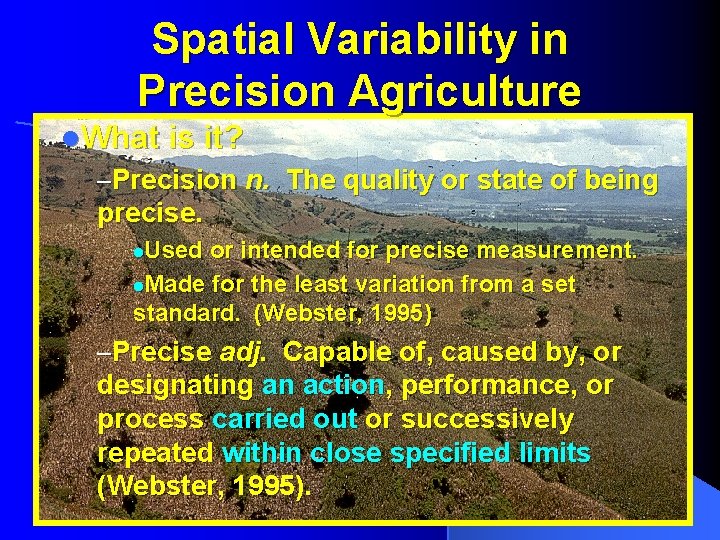
Spatial Variability in Precision Agriculture l. What is it? –Precision n. The quality or state of being precise. Used or intended for precise measurement. l. Made for the least variation from a set standard. (Webster, 1995) l –Precise adj. Capable of, caused by, or designating an action, performance, or process carried out or successively repeated within close specified limits (Webster, 1995).
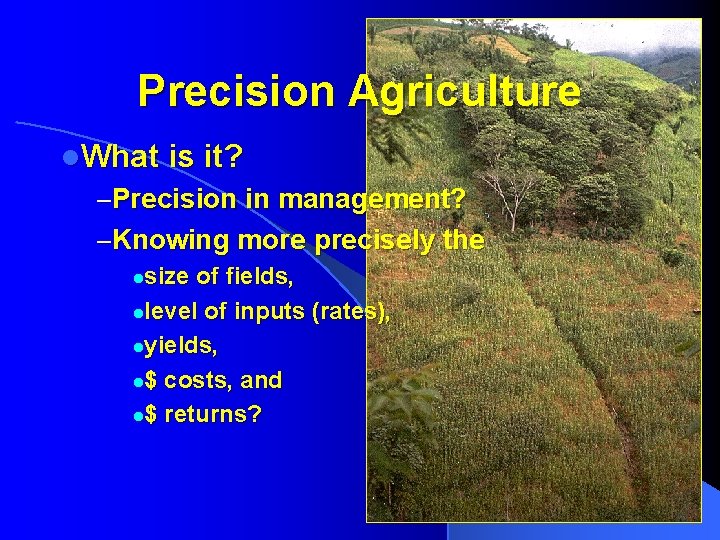
Precision Agriculture l. What is it? –Precision in management? –Knowing more precisely the size of fields, llevel of inputs (rates), lyields, l$ costs, and l$ returns? l
Precision Agriculture l. What is it? –Management of production inputs in relation to more precisely delineated needs (Johnson, 1/18/01). Recognizes spatial variability of production needs within a population of production units, where production units are smaller than they used to be. l
Spatial variability among production units. l What is the size of a production unit? l Depends on the enterprise. – Small dairy = single dairy animal. – Wagoner Ranch, TX = 7, 000 – 8, 000 acre wheat field. l Agronomic units = “fields”
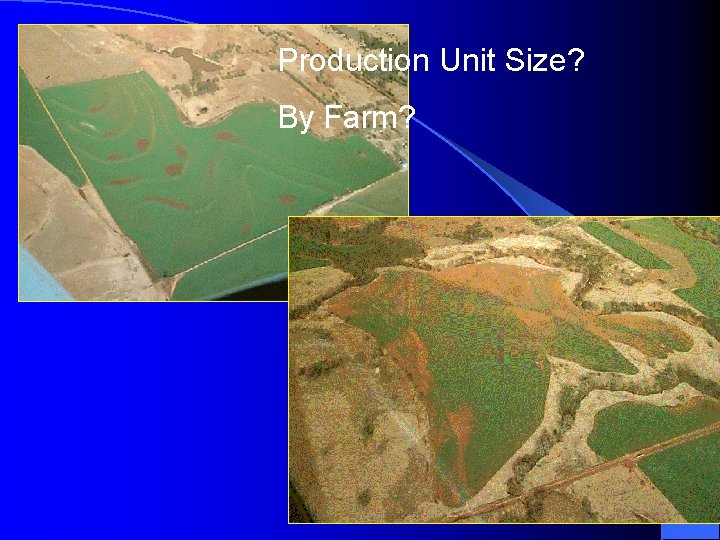
Production Unit Size? By Farm?
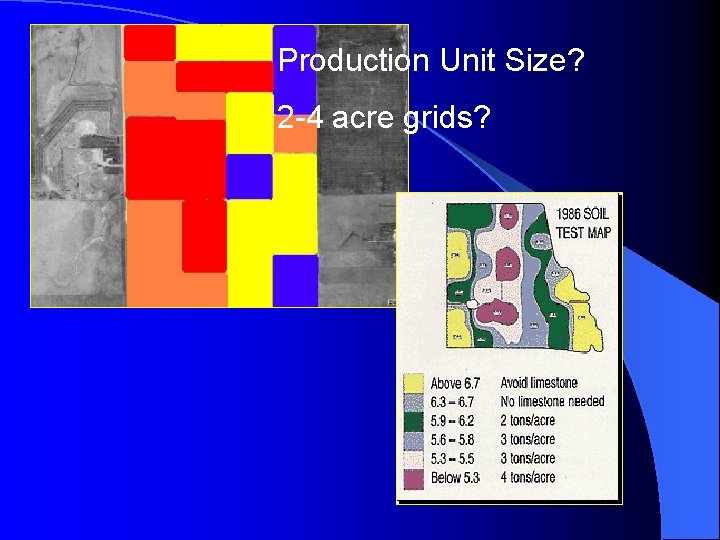
Production Unit Size? 2 -4 acre grids?
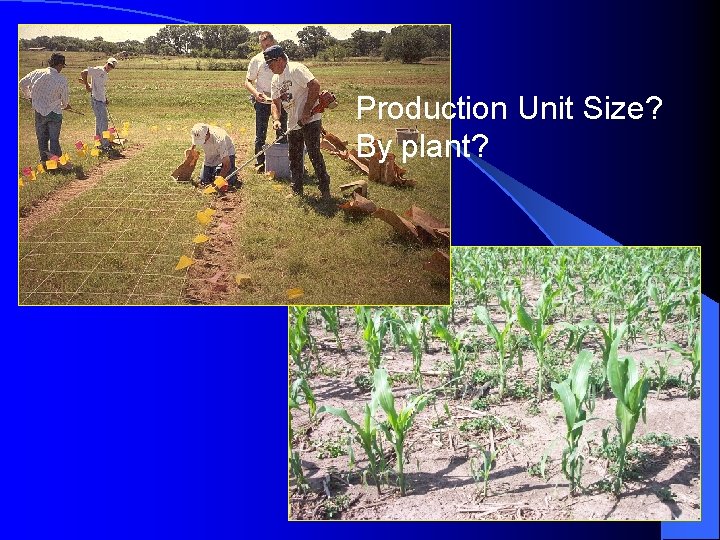
Production Unit Size? By plant?
Spatial variability among production units. l What causes field delineation. – Natural boundaries. Rivers l Rock out-crops l – Political boundaries. Roads l Survey units l – Land ownership l Consolidation
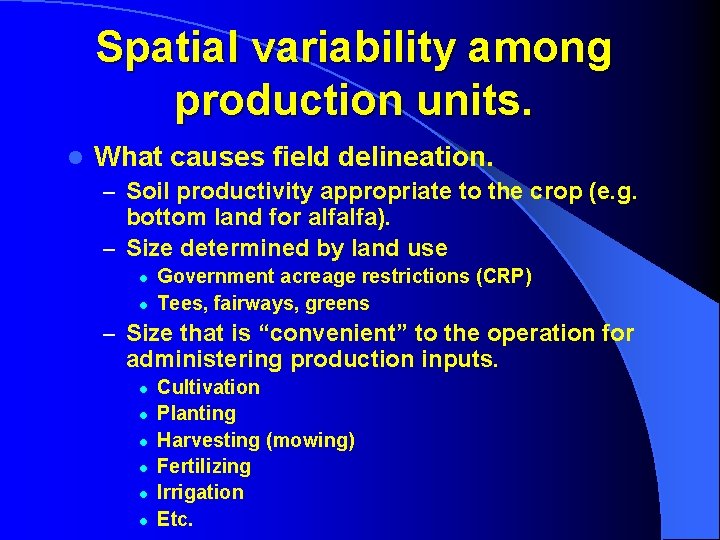
Spatial variability among production units. l What causes field delineation. – Soil productivity appropriate to the crop (e. g. bottom land for alfalfa). – Size determined by land use l l Government acreage restrictions (CRP) Tees, fairways, greens – Size that is “convenient” to the operation for administering production inputs. l l l Cultivation Planting Harvesting (mowing) Fertilizing Irrigation Etc.
Spatial variability (macro) for agronomic land use. l Inherent (natural). – Related to soil productivity and soil forming factors Time l Parent material l Climate l Vegetation l Slope l
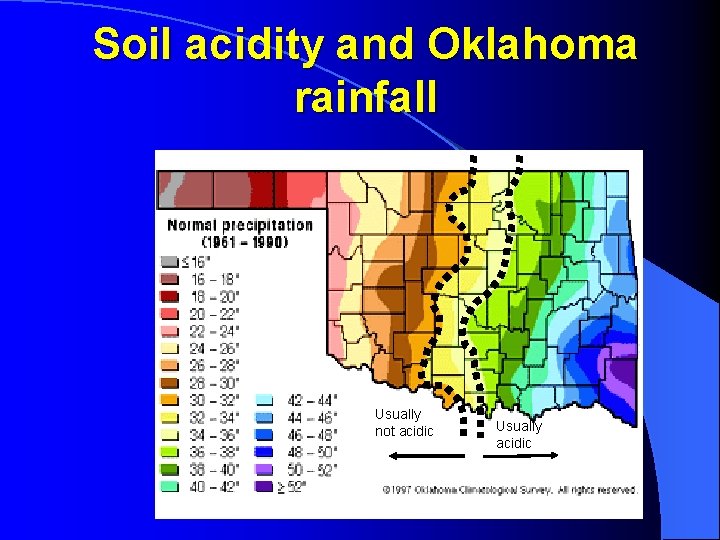
Soil acidity and Oklahoma rainfall Usually not acidic Usually acidic
Spatial variability (macro) for agronomic land use. l Acquired l (use induced). Influence of historical crop production on soil properties. – Alfalfa vs. wheat for acidification and soil organic matter. – Fertilizer use and change in soil fertility (Garfield County).
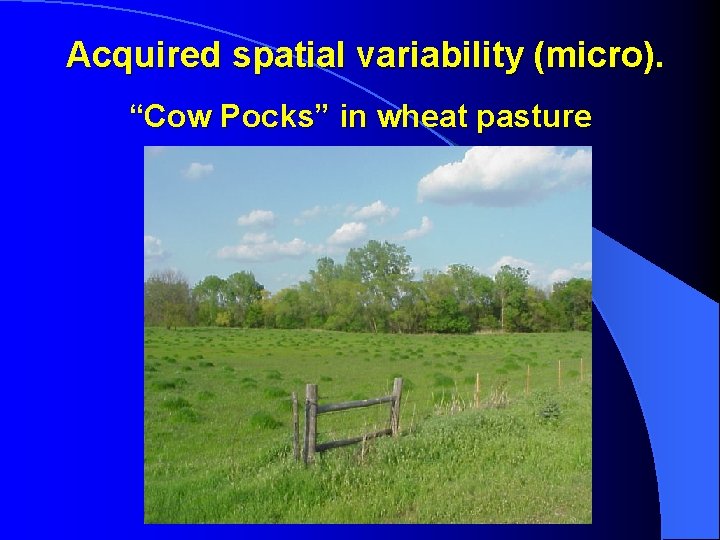
Acquired spatial variability (micro). “Cow Pocks” in wheat pasture
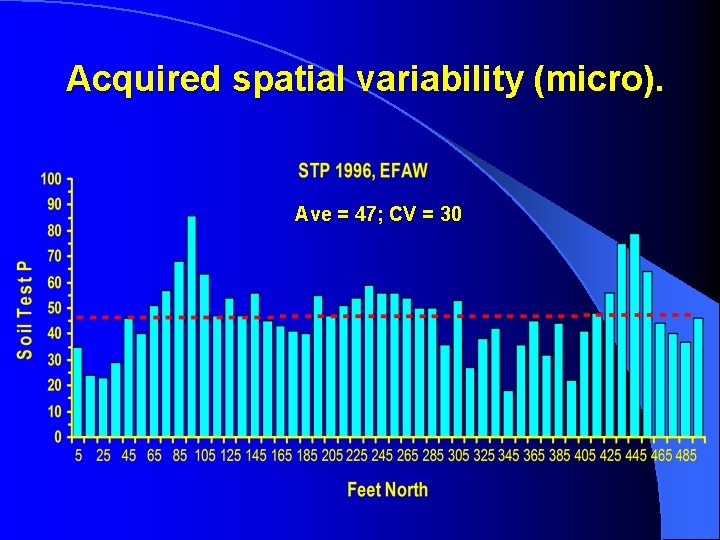
Acquired spatial variability (micro). Ave = 47; CV = 30
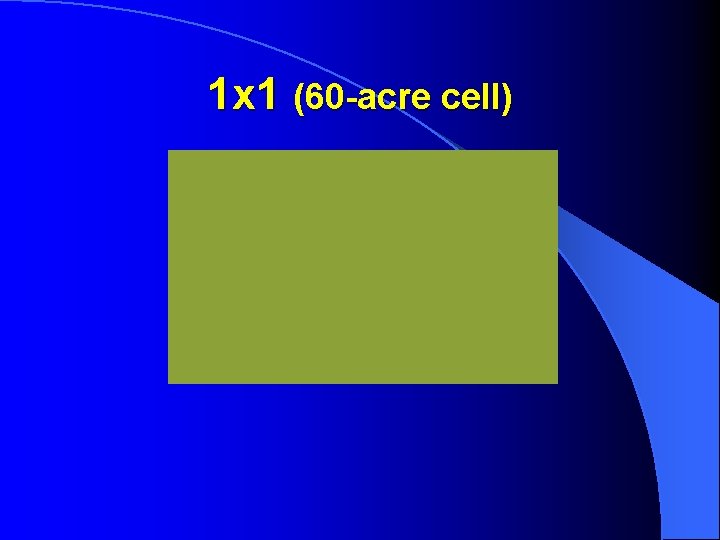
1 x 1 (60 -acre cell)
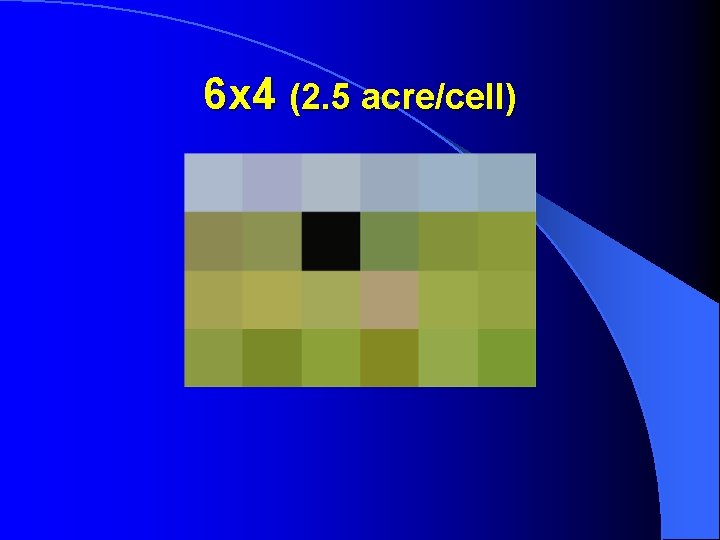
6 x 4 (2. 5 acre/cell)
12 x 8 (0. 625 acre/cell)
25 x 16 (0. 15 acre/cell)
50 x 32 (0. 0375 acre/cell)
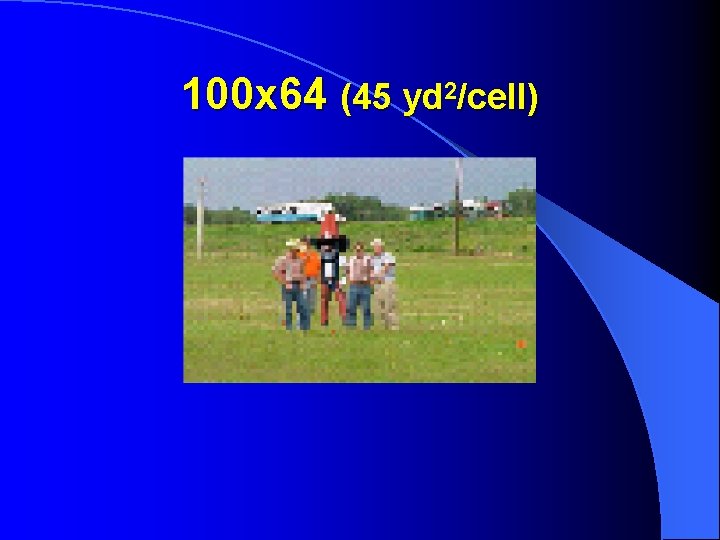
100 x 64 (45 yd 2/cell)
200 x 127 (11 yd 2/cell)
472 x 300 (2 yd 2/cell)
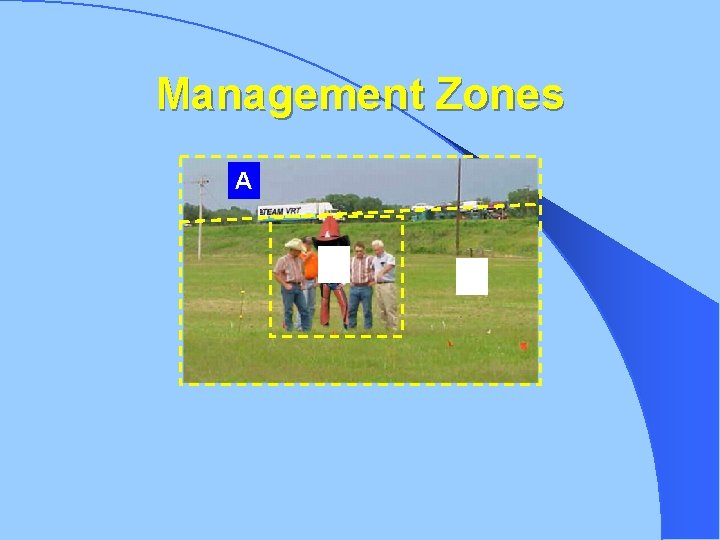
Management Zones A C B

Fundamentals of Nutrient Management
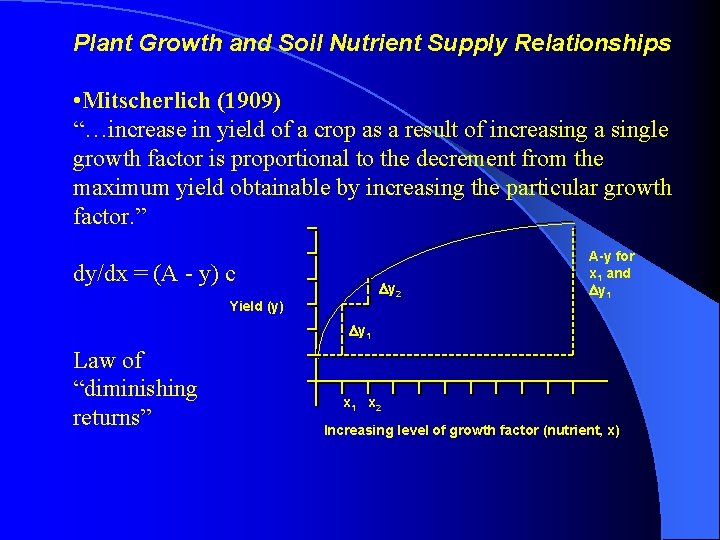
Plant Growth and Soil Nutrient Supply Relationships • Mitscherlich (1909) “…increase in yield of a crop as a result of increasing a single growth factor is proportional to the decrement from the maximum yield obtainable by increasing the particular growth factor. ” dy/dx = (A - y) c Dy 2 Yield (y) A-y for x 1 and Dy 1 Law of “diminishing returns” x 1 x 2 Increasing level of growth factor (nutrient, x)
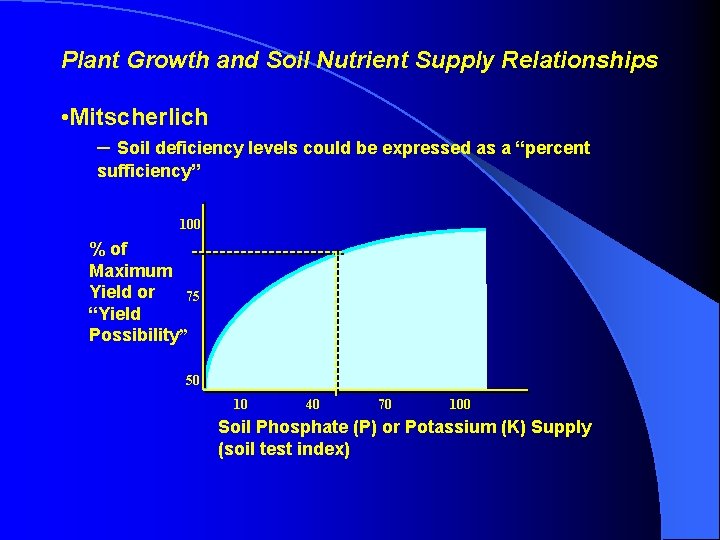
Plant Growth and Soil Nutrient Supply Relationships • Mitscherlich – Soil deficiency levels could be expressed as a “percent sufficiency” 100 % of Maximum Yield or 75 “Yield Possibility” 50 10 40 70 100 Soil Phosphate (P) or Potassium (K) Supply (soil test index)
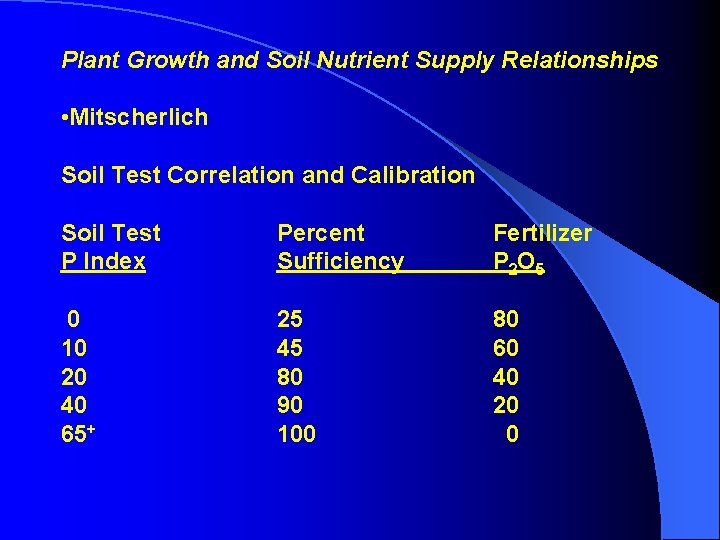
Plant Growth and Soil Nutrient Supply Relationships • Mitscherlich Soil Test Correlation and Calibration Soil Test P Index Percent Sufficiency Fertilizer P 2 O 5 0 10 20 40 65+ 25 45 80 90 100 80 60 40 20 0
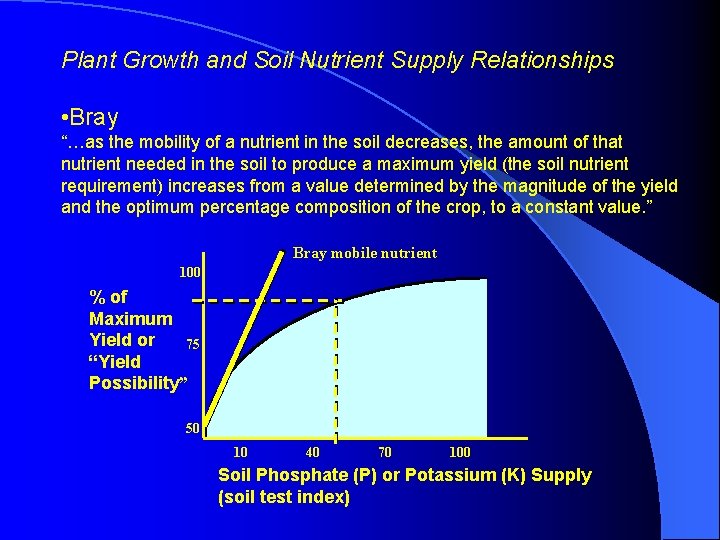
Plant Growth and Soil Nutrient Supply Relationships • Bray “…as the mobility of a nutrient in the soil decreases, the amount of that nutrient needed in the soil to produce a maximum yield (the soil nutrient requirement) increases from a value determined by the magnitude of the yield and the optimum percentage composition of the crop, to a constant value. ” Bray mobile nutrient 100 % of Maximum Yield or 75 “Yield Possibility” 50 10 40 70 100 Soil Phosphate (P) or Potassium (K) Supply (soil test index)
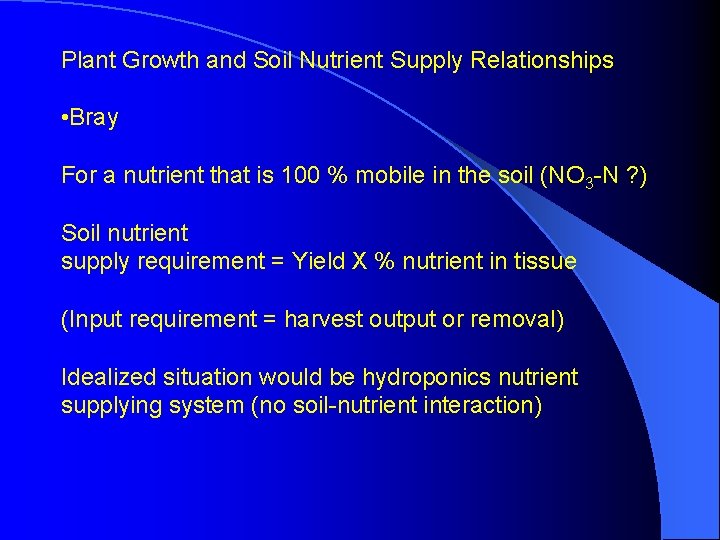
Plant Growth and Soil Nutrient Supply Relationships • Bray For a nutrient that is 100 % mobile in the soil (NO 3 -N ? ) Soil nutrient supply requirement = Yield X % nutrient in tissue (Input requirement = harvest output or removal) Idealized situation would be hydroponics nutrient supplying system (no soil-nutrient interaction)
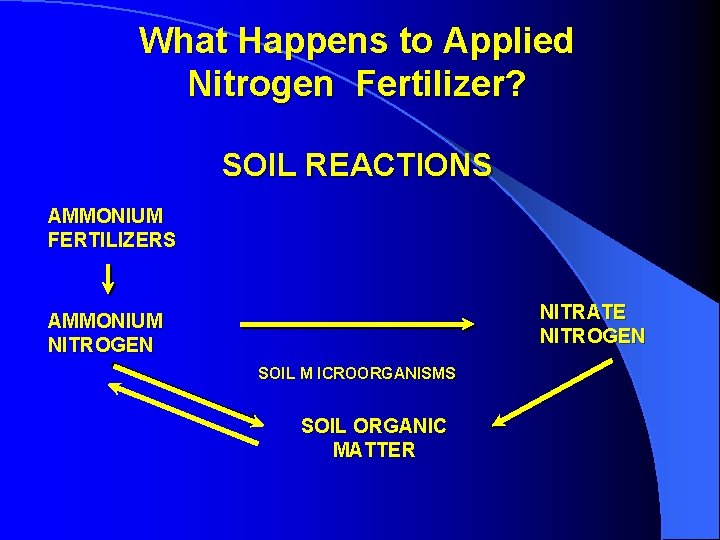
What Happens to Applied Nitrogen Fertilizer? SOIL REACTIONS AMMONIUM FERTILIZERS NITRATE NITROGEN AMMONIUM NITROGEN SOIL M ICROORGANISMS SOIL ORGANIC MATTER
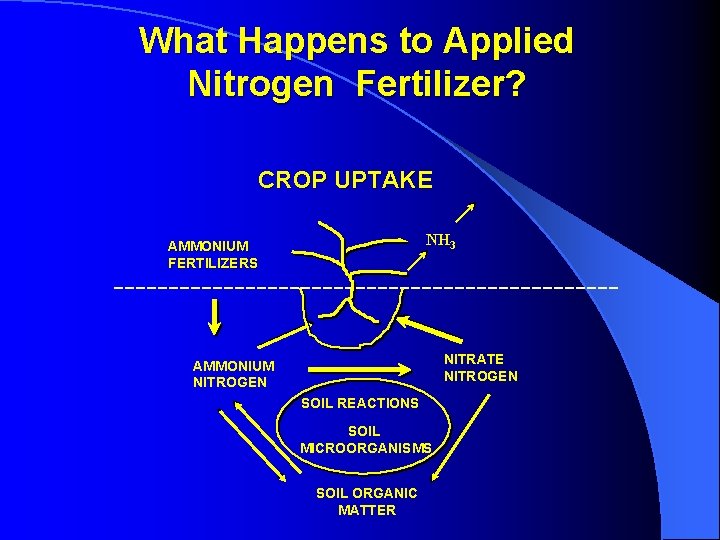
What Happens to Applied Nitrogen Fertilizer? CROP UPTAKE NH 3 AMMONIUM FERTILIZERS NITRATE NITROGEN AMMONIUM NITROGEN SOIL REACTIONS SOIL MICROORGANISMS SOIL ORGANIC MATTER
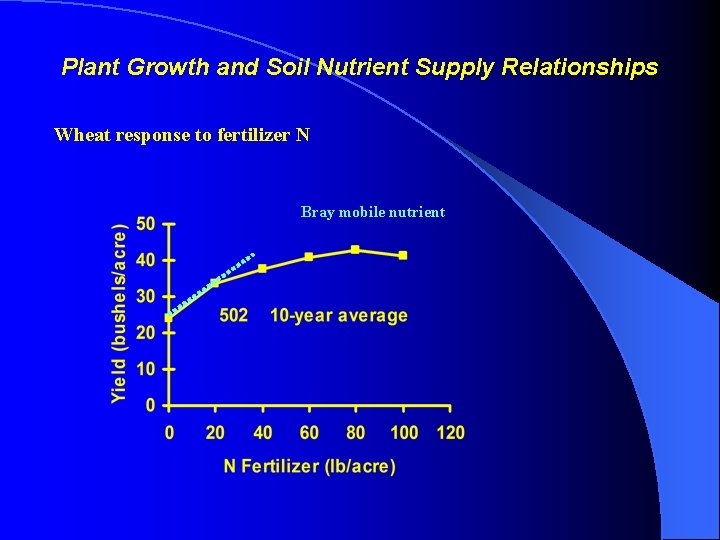
Plant Growth and Soil Nutrient Supply Relationships Wheat response to fertilizer N Bray mobile nutrient
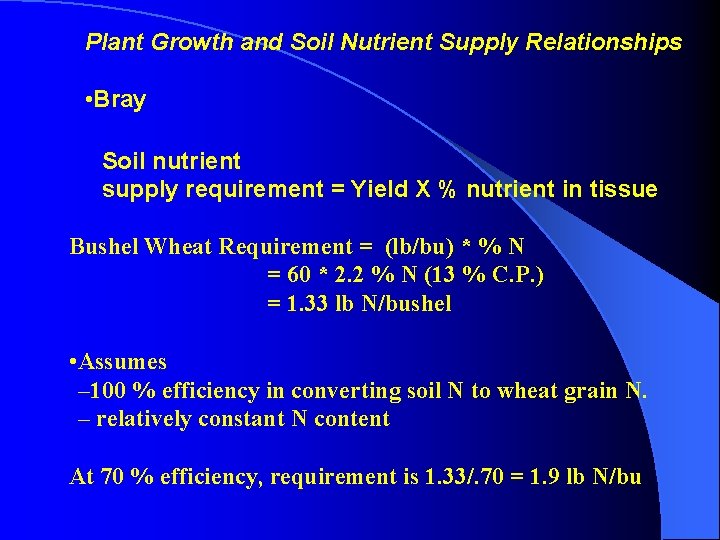
Plant Growth and Soil Nutrient Supply Relationships • Bray Soil nutrient supply requirement = Yield X % nutrient in tissue Bushel Wheat Requirement = (lb/bu) * % N = 60 * 2. 2 % N (13 % C. P. ) = 1. 33 lb N/bushel • Assumes – 100 % efficiency in converting soil N to wheat grain N. – relatively constant N content At 70 % efficiency, requirement is 1. 33/. 70 = 1. 9 lb N/bu
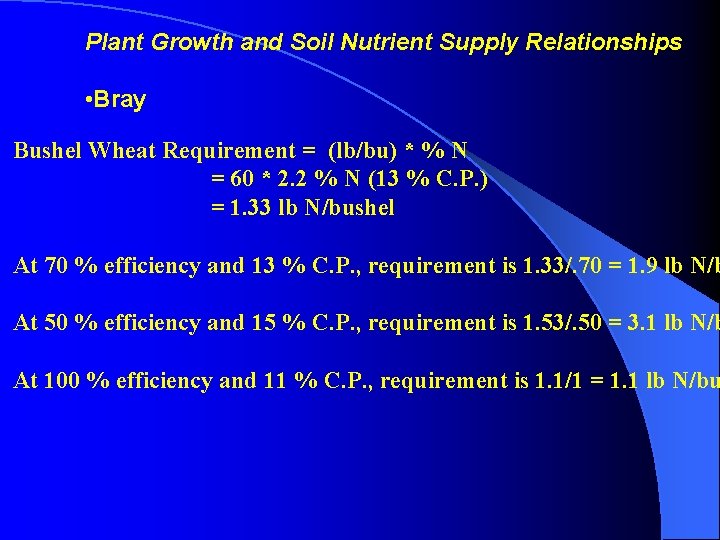
Plant Growth and Soil Nutrient Supply Relationships • Bray Bushel Wheat Requirement = (lb/bu) * % N = 60 * 2. 2 % N (13 % C. P. ) = 1. 33 lb N/bushel At 70 % efficiency and 13 % C. P. , requirement is 1. 33/. 70 = 1. 9 lb N/b At 50 % efficiency and 15 % C. P. , requirement is 1. 53/. 50 = 3. 1 lb N/b At 100 % efficiency and 11 % C. P. , requirement is 1. 1/1 = 1. 1 lb N/bu
Fate of Inorganic N in Soils
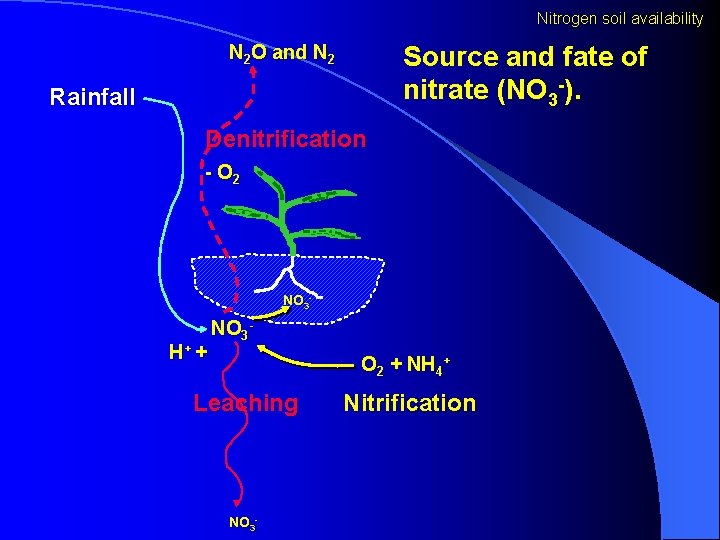
Nitrogen soil availability Source and fate of nitrate (NO 3 -). N 2 O and N 2 Rainfall Denitrification - O 2 NO 3 - H+ + NO 3 O 2 + NH 4+ Leaching NO 3 - Nitrification
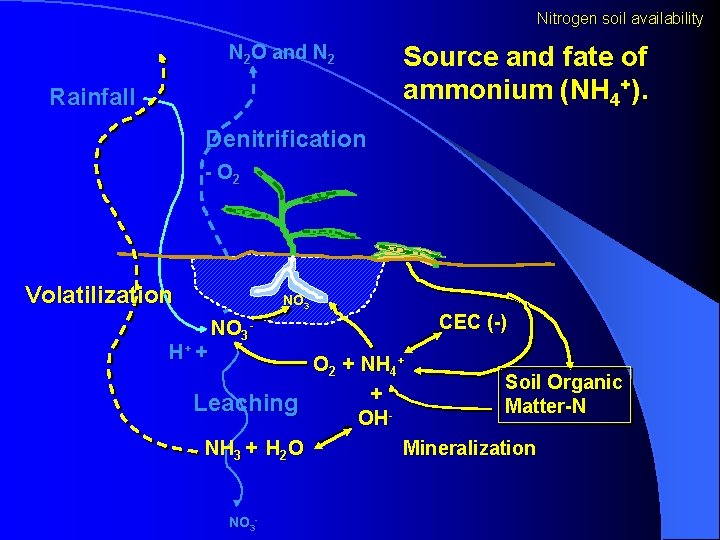
Nitrogen soil availability N 2 O and N 2 Rainfall Source and fate of ammonium (NH 4+). Denitrification - O 2 Volatilization NO 3 - H+ + NO 3 - CEC (-) O 2 + NH 4+ Soil Organic + Leaching Matter-N OHNH 3 + H 2 O Mineralization NO 3 -
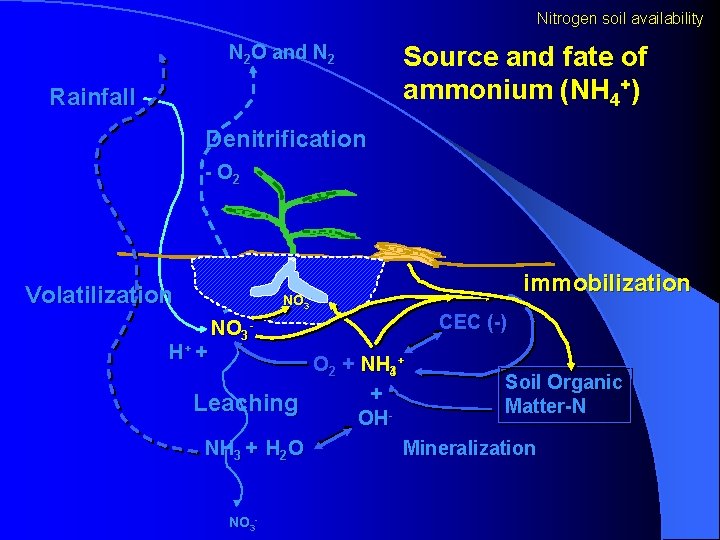
Nitrogen soil availability N 2 O and N 2 Rainfall Source and fate of ammonium (NH 4+) Denitrification - O 2 Volatilization NO 3 - H+ + NO 3 - immobilization CEC (-) O 2 + NH 43+ Soil Organic + Leaching Matter-N OHNH 3 + H 2 O Mineralization NO 3 -
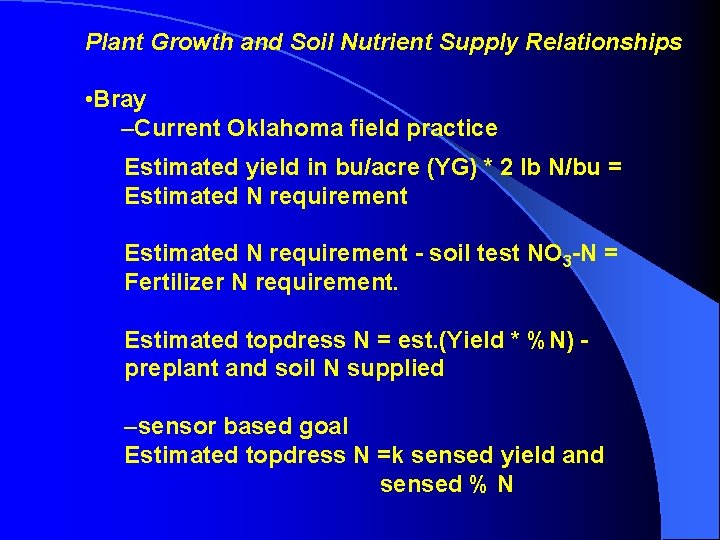
Plant Growth and Soil Nutrient Supply Relationships • Bray –Current Oklahoma field practice Estimated yield in bu/acre (YG) * 2 lb N/bu = Estimated N requirement - soil test NO 3 -N = Fertilizer N requirement. Estimated topdress N = est. (Yield * %N) preplant and soil N supplied –sensor based goal Estimated topdress N =k sensed yield and sensed % N
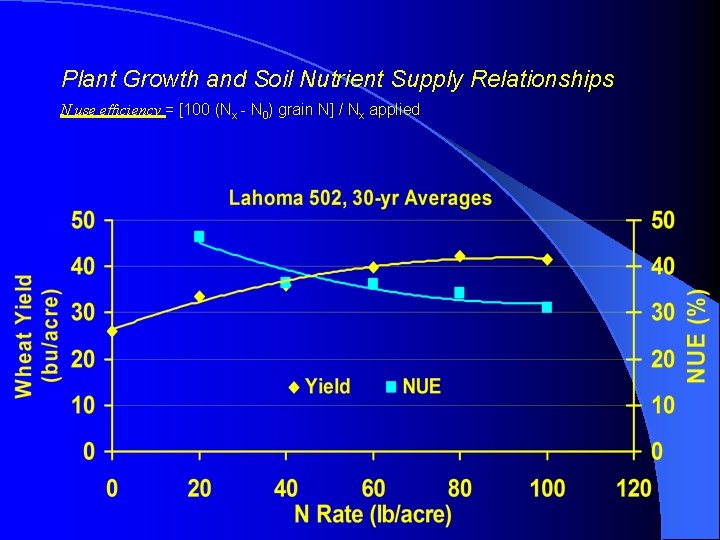
Plant Growth and Soil Nutrient Supply Relationships N use efficiency = [100 (Nx - N 0) grain N] / Nx applied
- Slides: 40