
Spatial STEM A MathematicalStatistical Framework for Understanding and
- Slides: 10
Spatial. STEM: A Mathematical/Statistical Framework for Understanding and Communicating Map Analysis and Modeling Premise: There a “map-ematics” that extends math/stat concepts Premise: There is ais“map-ematics” extendstraditional math/stat concepts and procedures quantitative analysis of (spatial data) and procedures forfor thethe quantitative ofmap mapvariables (spatial data) This presentation provides a fresh perspective on interdisciplinary instruction at the college level by combining the philosophy and approach of STEM with the spatial reasoning and analytical power of grid-based Map Analysis and Modeling This Power. Point with notes and online links to further reading is posted at www. innovativegis. com/basis/Courses/Spatial. STEM/Workshop/ Presented by Joseph K. Berry Adjunct Faculty in Geosciences, Department of Geography, University of Denver Adjunct Faculty in Natural Resources, Warner College of Natural Resources, Colorado State University Principal, Berry & Associates // Spatial Information Systems Email: jberry@innovativegis. com — Website: www. innovativegis. com/basis
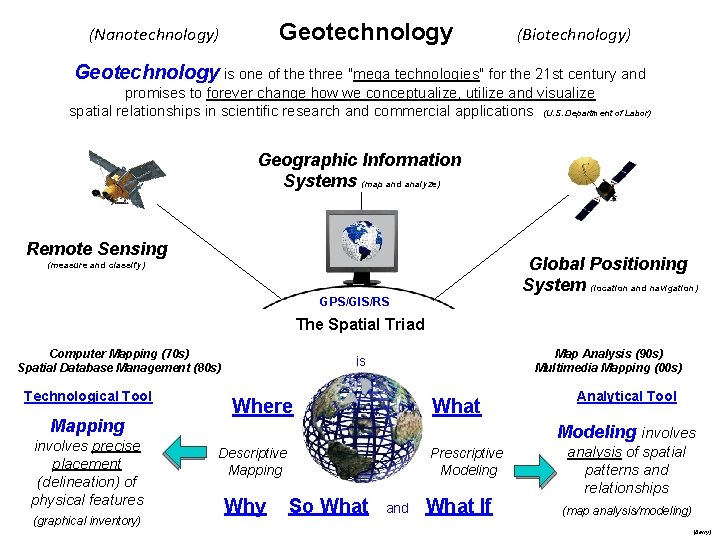
Geotechnology (Nanotechnology) (Biotechnology) Geotechnology is one of the three "mega technologies" for the 21 st century and promises to forever change how we conceptualize, utilize and visualize spatial relationships in scientific research and commercial applications (U. S. Department of Labor) Geographic Information Systems (map and analyze) Remote Sensing Global Positioning System (location and navigation) (measure and classify) GPS/GIS/RS The Spatial Triad Computer Mapping (70 s) Spatial Database Management (80 s) Technological Tool Mapping involves precise placement (delineation) of physical features (graphical inventory) Map Analysis (90 s) Multimedia Mapping (00 s) is Where What Analytical Tool Modeling involves Descriptive Mapping Why Prescriptive Modeling So What and What If analysis of spatial patterns and relationships (map analysis/modeling) (Berry)
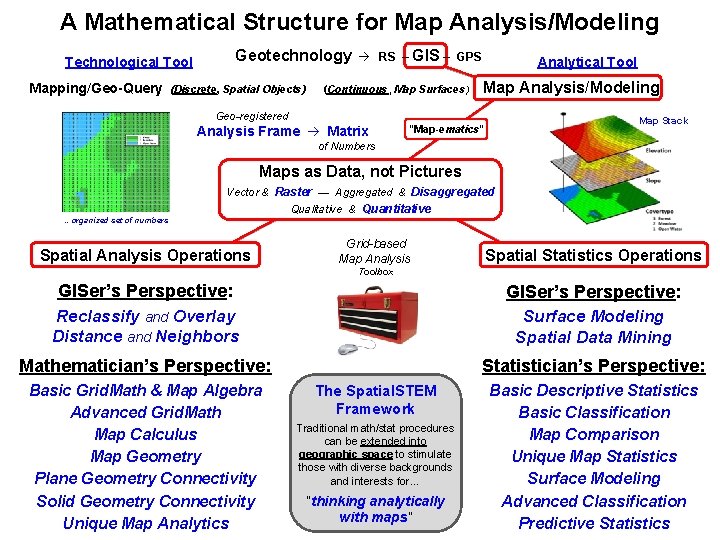
A Mathematical Structure for Map Analysis/Modeling Geotechnology Technological Tool Mapping/Geo-Query (Discrete, Spatial Objects) RS – GIS – GPS (Continuous, Map Surfaces) Analytical Tool Map Analysis/Modeling Geo-registered Analysis Frame Matrix Map Stack “Map-ematics” of Numbers Maps as Data, not Pictures Vector & Raster — Aggregated & Disaggregated Qualitative & Quantitative …organized set of numbers Spatial Analysis Operations Grid-based Map Analysis Spatial Statistics Operations Toolbox GISer’s Perspective: Reclassify and Overlay Distance and Neighbors Surface Modeling Spatial Data Mining Mathematician’s Perspective: Statistician’s Perspective: Basic Grid. Math & Map Algebra Advanced Grid. Math Map Calculus Map Geometry Plane Geometry Connectivity Solid Geometry Connectivity Unique Map Analytics The Spatial. STEM Framework Traditional math/stat procedures can be extended into geographic space to stimulate those with diverse backgrounds and interests for… “thinking analytically with maps” Basic Descriptive Statistics Basic Classification Map Comparison Unique Map Statistics Surface Modeling Advanced Classification Predictive Statistics
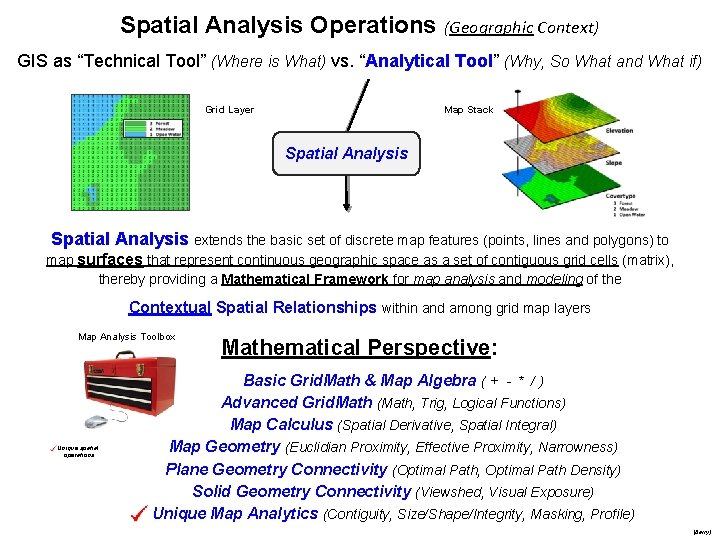
Spatial Analysis Operations (Geographic Context) GIS as “Technical Tool” (Where is What) vs. “Analytical Tool” (Why, So What and What if) Map Stack Grid Layer Spatial Analysis extends the basic set of discrete map features (points, lines and polygons) to map surfaces that represent continuous geographic space as a set of contiguous grid cells (matrix), thereby providing a Mathematical Framework for map analysis and modeling of the Contextual Spatial Relationships within and among grid map layers Map Analysis Toolbox Unique spatial operations Mathematical Perspective: Basic Grid. Math & Map Algebra ( + - * / ) Advanced Grid. Math (Math, Trig, Logical Functions) Map Calculus (Spatial Derivative, Spatial Integral) Map Geometry (Euclidian Proximity, Effective Proximity, Narrowness) Plane Geometry Connectivity (Optimal Path, Optimal Path Density) Solid Geometry Connectivity (Viewshed, Visual Exposure) Unique Map Analytics (Contiguity, Size/Shape/Integrity, Masking, Profile) (Berry)
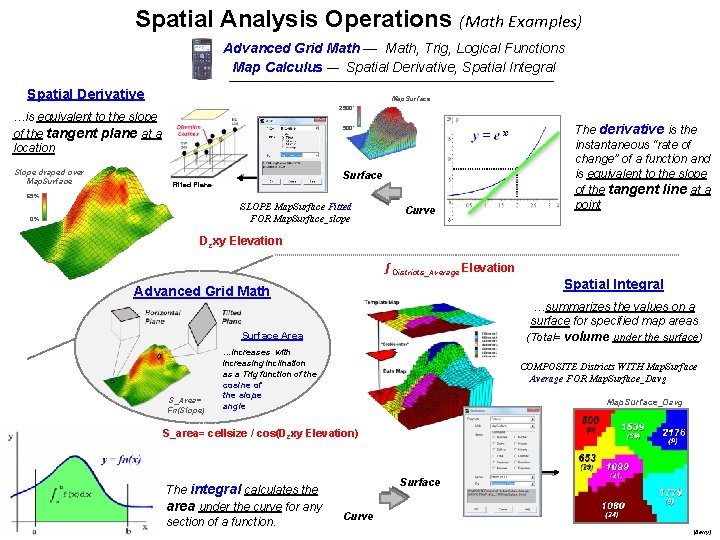
Spatial Analysis Operations (Math Examples) Advanced Grid Math — Math, Trig, Logical Functions Map Calculus — Spatial Derivative, Spatial Integral Spatial Derivative Map. Surface 2500’ …is equivalent to the slope of the tangent plane at a location Slope draped over Map. Surface 500’ Surface Fitted Plane 65% SLOPE Map. Surface Fitted FOR Map. Surface_slope 0% Curve The derivative is the instantaneous “rate of change” of a function and is equivalent to the slope of the tangent line at a point Dzxy Elevation ʃ Districts_Average Elevation Spatial Integral Advanced Grid Math …summarizes the values on a surface for specified map areas (Total= volume under the surface) Surface Area S_Area= Fn(Slope) …increases with increasing inclination as a Trig function of the cosine of the slope angle COMPOSITE Districts WITH Map. Surface Average FOR Map. Surface_Davg S_area= cellsize / cos(Dzxy Elevation) The integral calculates the area under the curve for any section of a function. Surface Curve (Berry)
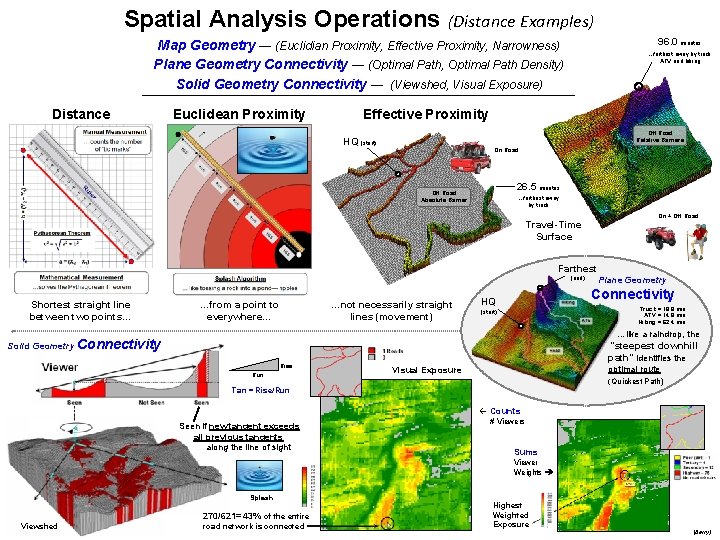
Spatial Analysis Operations (Distance Examples) 96. 0 minutes Map Geometry — (Euclidian Proximity, Effective Proximity, Narrowness) Plane Geometry Connectivity — (Optimal Path, Optimal Path Density) Solid Geometry Connectivity — (Viewshed, Visual Exposure) Distance Euclidean Proximity …farthest away by truck, ATV and hiking Effective Proximity Off Road Relative Barriers HQ (start) On Road 26. 5 minutes Off Road Absolute Barrier …farthest away by truck On + Off Road Travel-Time Surface Farthest (end) Shortest straight line between two points… …from a point to everywhere… …not necessarily straight lines (movement) Plane Geometry Connectivity HQ Truck = 18. 8 min ATV = 14. 8 min Hiking = 62. 4 min (start) …like a raindrop, the Solid Geometry Connectivity Rise Run “steepest downhill path” identifies the optimal route Visual Exposure (Quickest Path) Tan = Rise/Run ß Counts Seen if new tangent exceeds all previous tangents along the line of sight # Viewers Sums Viewer Weights Splash 270/621= 43% of the entire Viewshed road network is connected Highest Weighted Exposure (Berry)
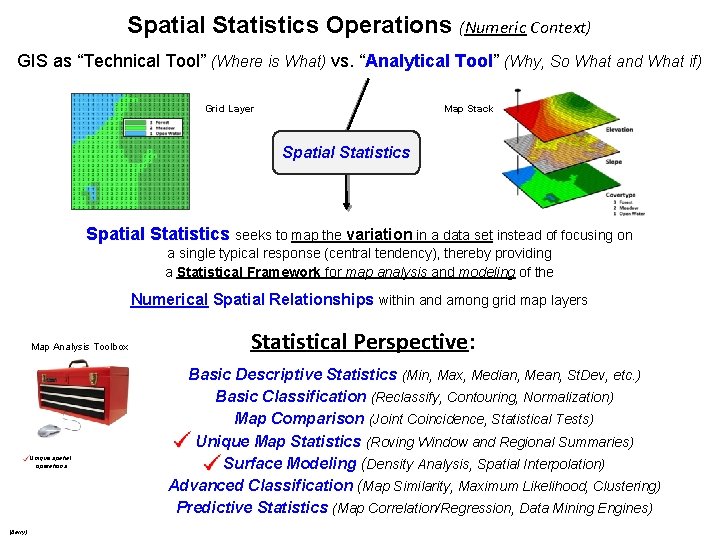
Spatial Statistics Operations (Numeric Context) GIS as “Technical Tool” (Where is What) vs. “Analytical Tool” (Why, So What and What if) Map Stack Grid Layer Spatial Statistics seeks to map the variation in a data set instead of focusing on a single typical response (central tendency), thereby providing a Statistical Framework for map analysis and modeling of the Numerical Spatial Relationships within and among grid map layers Map Analysis Toolbox Unique spatial operations (Berry) Statistical Perspective: Basic Descriptive Statistics (Min, Max, Median, Mean, St. Dev, etc. ) Basic Classification (Reclassify, Contouring, Normalization) Map Comparison (Joint Coincidence, Statistical Tests) Unique Map Statistics (Roving Window and Regional Summaries) Surface Modeling (Density Analysis, Spatial Interpolation) Advanced Classification (Map Similarity, Maximum Likelihood, Clustering) Predictive Statistics (Map Correlation/Regression, Data Mining Engines)
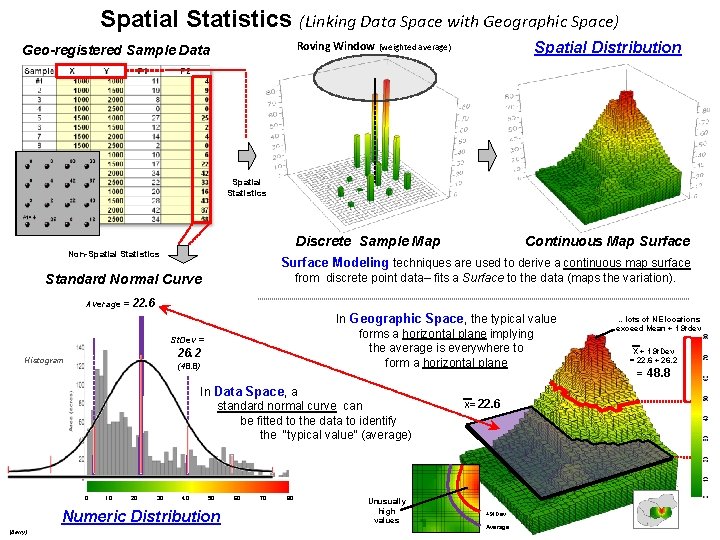
Spatial Statistics (Linking Data Space with Geographic Space) Roving Window (weighted average) Geo-registered Sample Data Spatial Distribution Spatial Statistics Discrete Sample Map Non-Spatial Statistics Continuous Map Surface Modeling techniques are used to derive a continuous map surface from discrete point data– fits a Surface to the data (maps the variation). Standard Normal Curve Average = 22. 6 In Geographic Space , the typical value forms a horizontal plane implying the average is everywhere to form a horizontal plane St. Dev = 26. 2 Histogram (48. 8) In Data Space, a standard normal curve can be fitted to the data to identify the “typical value” (average) 0 10 20 30 40 50 Numeric Distribution (Berry) 60 70 80 Unusually high values X= 22. 6 +St. Dev Average …lots of NE locations exceed Mean + 1 Stdev X + 1 St. Dev = 22. 6 + 26. 2 = 48. 8
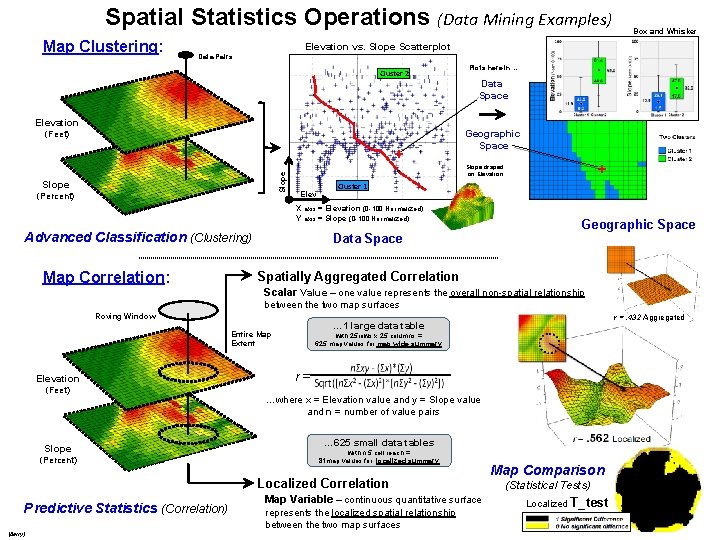
Spatial Statistics Operations (Data Mining Examples) Map Clustering: Box and Whisker Elevation vs. Slope Scatterplot Data Pairs Cluster 2 Plots here in… Data Space Elevation (Feet) Slope + Slope (Percent) Geographic Space Elev Cluster 1 X axis = Elevation (0 -100 Normalized) Y axis = Slope (0 -100 Normalized) Advanced Classification (Clustering) Map Correlation: + Slope draped on Elevation Data Space Geographic Space Spatially Aggregated Correlation Scalar Value – one value represents the overall non-spatial relationship between the two map surfaces Roving Window Entire Map Extent Elevation (Feet) Slope (Percent) with 25 rows x 25 columns = 625 map values for map wide summary r= …where x = Elevation value and y = Slope value and n = number of value pairs … 625 small data tables within 5 cell reach = 81 map values for localized summary Localized Correlation Predictive Statistics (Correlation) (Berry) r =. 432 Aggregated … 1 large data table Map Variable – continuous quantitative surface represents the localized spatial relationship between the two map surfaces Map Comparison T-statistic Map Localized T_test (Statistical Tests)
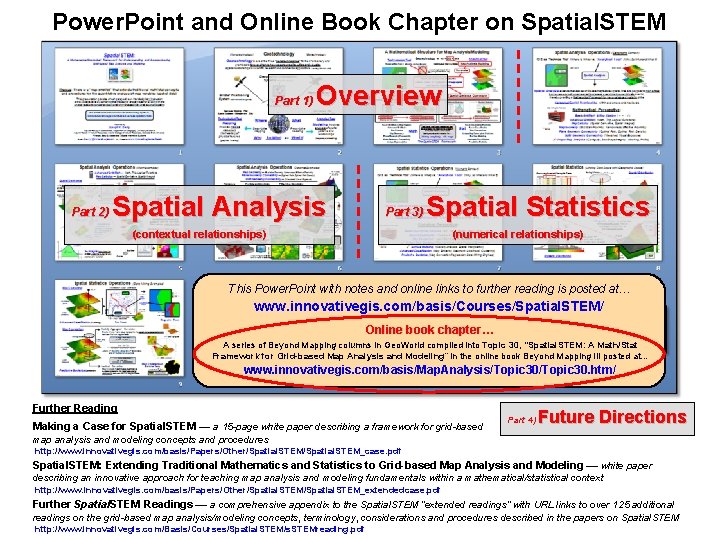
Power. Point and Online Book Chapter on Spatial. STEM Part 1) Part 2) Overview Spatial Analysis Part 3) Spatial Statistics (contextual relationships) (numerical relationships) This Power. Point with notes and online links to further reading is posted at… www. innovativegis. com/basis/Courses/Spatial. STEM/ Online book chapter… A series of Beyond Mapping columns in Geo. World compiled into Topic 30, “Spatial. STEM: A Math/Stat Framework for Grid-based Map Analysis and Modeling” in the online book Beyond Mapping III posted at… www. innovativegis. com/basis/Map. Analysis/Topic 30. htm/ Further Reading Making a Case for Spatial. STEM — a 15 -page white paper describing a framework for grid-based Part 4) Future Directions map analysis and modeling concepts and procedures http: //www. innovativegis. com/basis/Papers/Other/Spatial. STEM_case. pdf Spatial. STEM: Extending Traditional Mathematics and Statistics to Grid-based Map Analysis and Modeling — white paper describing an innovative approach for teaching map analysis and modeling fundamentals within a mathematical/statistical context http: //www. innovativegis. com/basis/Papers/Other/Spatial. STEM_extendedcase. pdf Further Spatial. STEM Readings — a comprehensive appendix to the Spatial. STEM “extended readings” with URL links to over 125 additional readings on the grid-based map analysis/modeling concepts, terminology, considerations and procedures described in the papers on Spatial. STEM http: //www. innovativegis. com/Basis/Courses/Spatial. STEM/s. STEMreading. pdf