
Spatial Smoothing Multiple Comparisons Correction for Dummies Acknowledgements

- Slides: 13
Spatial Smoothing & Multiple Comparisons Correction (for Dummies) Acknowledgements: Jon Simons, Alexa Morcom, Matthew Brett
Overview • Spatial Smoothing – What does it do? – Why do you want to do it? – How is it done? • Correction for Multiple Comparisons – – – Bonferroni correction Random field theory Uncorrected thresholds False discovery rate Which correction method to use?
Overview • Spatial Smoothing – What does it do? – Why do you want to do it? – How is it done? • Correction for Multiple Comparisons – – – Bonferroni correction Random field theory Uncorrected thresholds False discovery rate Which correction method to use?
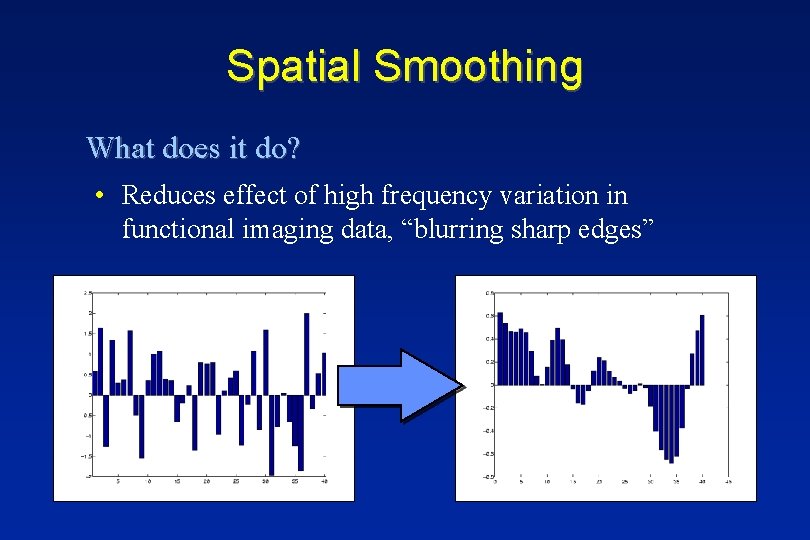
Spatial Smoothing What does it do? • Reduces effect of high frequency variation in functional imaging data, “blurring sharp edges”
Spatial Smoothing
Spatial Smoothing
Spatial Smoothing Why do you want to do it? • Increases signal-to-noise ratio • Enables averaging across subjects • Allows use of Gaussian Field Theory for thresholding
Spatial Smoothing Why do you want to do it? • Increases signal-to-noise ratio – Depends on relative size of smoothing kernel and effects to be detected – Matched filter theorem: smoothing kernel = expected signal – Practically, rule of thumb: FWHM ≥ 3 x voxel size – May consider varying kernel size if interested in different brain regions, e. g. hippocampus vs. parietal cortex
Spatial Smoothing Why do you want to do it? • Enables averaging across subjects – Reduces influence of functional and/or anatomical differences between subjects – Even after realignment and normalisation, residual betweensubject variability may remain – Smoothing data improves probability of identifying commonalities in activation between subjects, but trade-off with anatomical specificity
Spatial Smoothing Why do you want to do it? • Allows use of Gaussian Field Theory for thresholding – Assumes error terms are roughly Gaussian in form – Requires FWHM to be substantially greater than voxel size – Enables hypothesis testing and dealing with multiple comparison problem in functional imaging …
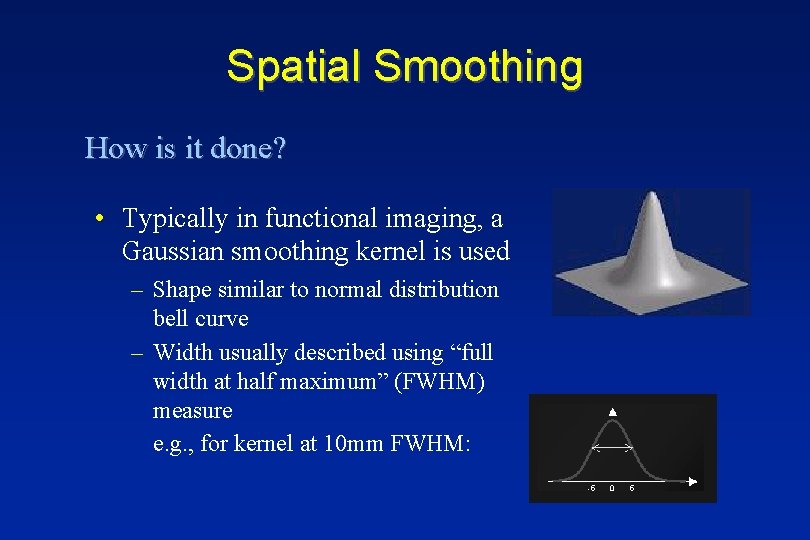
Spatial Smoothing How is it done? • Typically in functional imaging, a Gaussian smoothing kernel is used – Shape similar to normal distribution bell curve – Width usually described using “full width at half maximum” (FWHM) measure e. g. , for kernel at 10 mm FWHM: -5 0 5
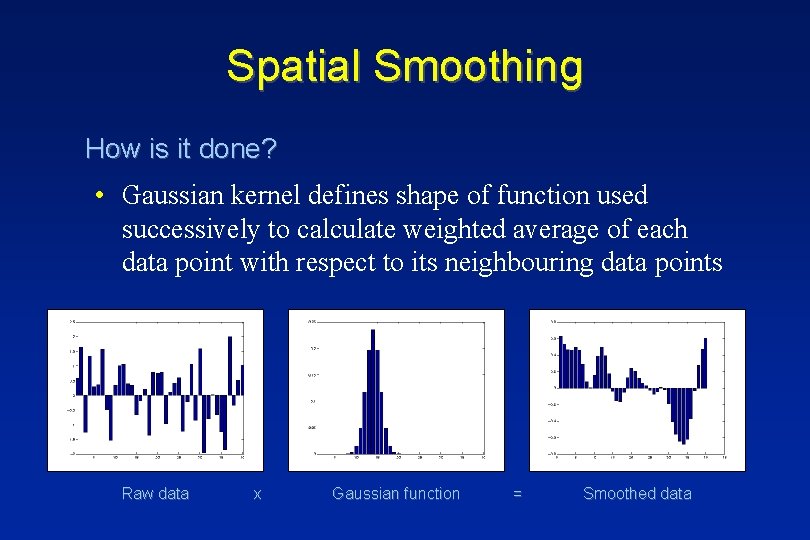
Spatial Smoothing How is it done? • Gaussian kernel defines shape of function used successively to calculate weighted average of each data point with respect to its neighbouring data points Raw data x Gaussian function = Smoothed data
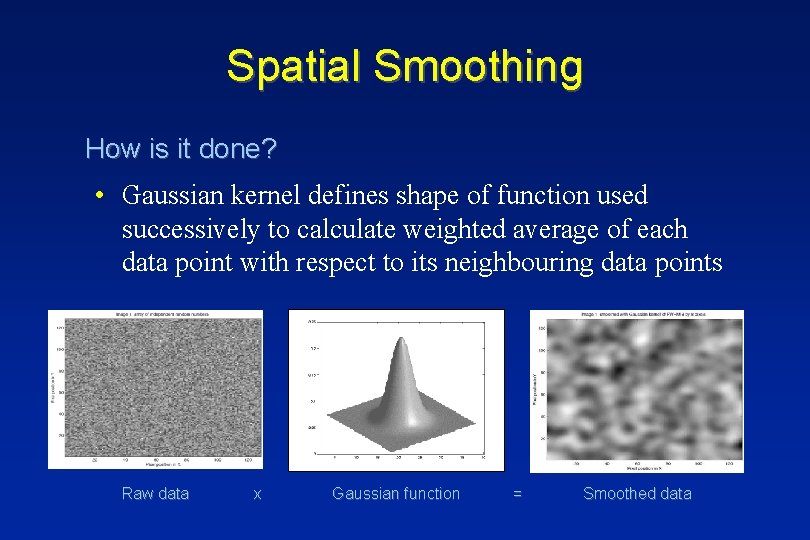
Spatial Smoothing How is it done? • Gaussian kernel defines shape of function used successively to calculate weighted average of each data point with respect to its neighbouring data points Raw data x Gaussian function = Smoothed data