
SPATIAL REASONING REVIEW Educational implications of modern neuroscience
- Slides: 34
SPATIAL REASONING REVIEW Educational implications of modern neuroscience: a review of research for social studies teachers P Gersmehl Michigan Geographic Alliance 2014
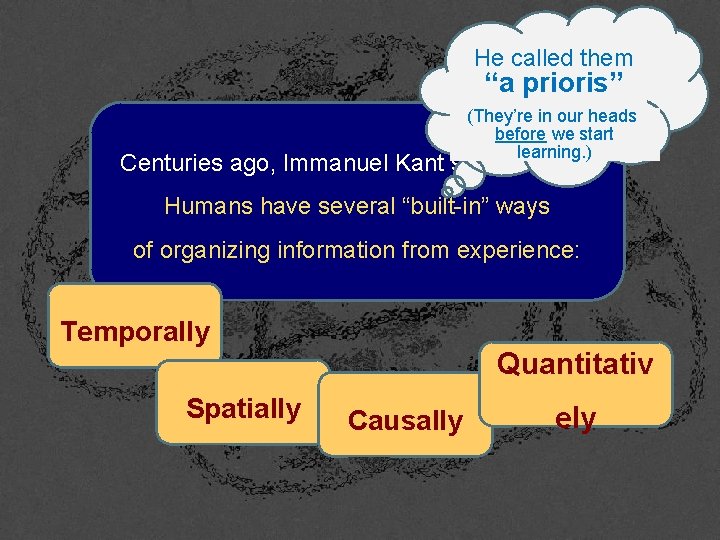
He called them “a prioris” (They’re in our heads before we start learning. ) Centuries ago, Immanuel Kant said: Humans have several “built-in” ways of organizing information from experience: Temporally Spatially Quantitativ Causally ely
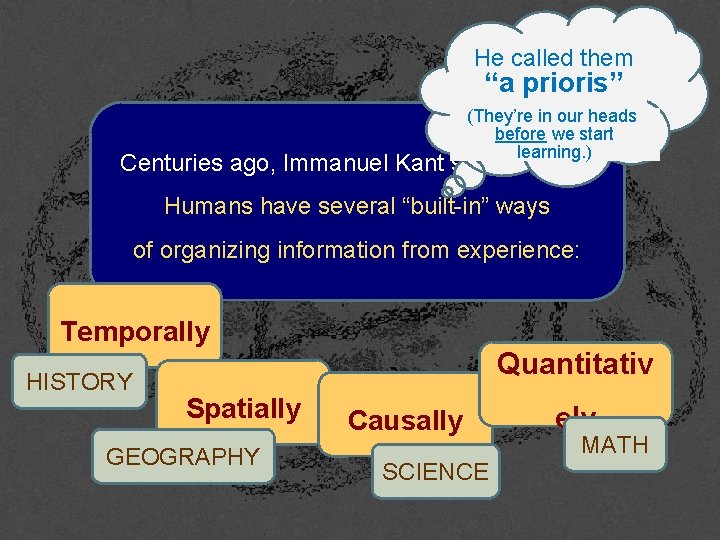
He called them “a prioris” (They’re in our heads before we start learning. ) Centuries ago, Immanuel Kant said: Humans have several “built-in” ways of organizing information from experience: Temporally HISTORY Spatially GEOGRAPHY Quantitativ Causally SCIENCE ely MATH
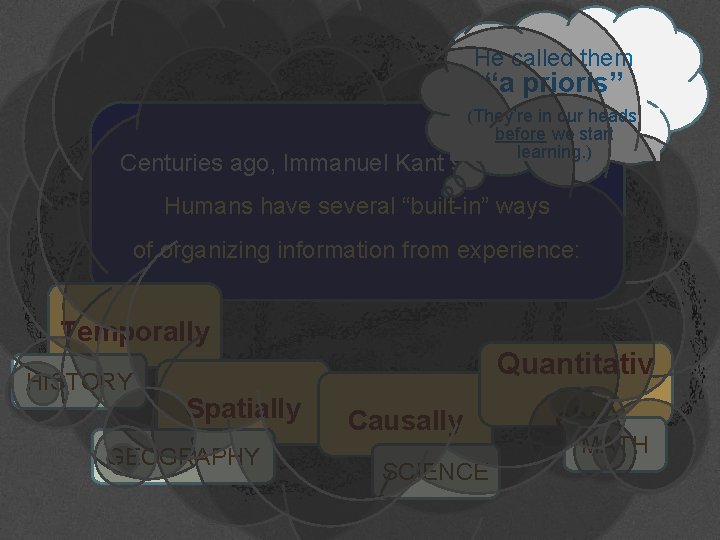
He called them “a prioris” (They’re in our heads before we start learning. ) Centuries ago, Immanuel Kant said: Humans have several “built-in” ways of organizing information from experience: Temporally HISTORY Spatially GEOGRAPHY Quantitativ Causally SCIENCE ely MATH
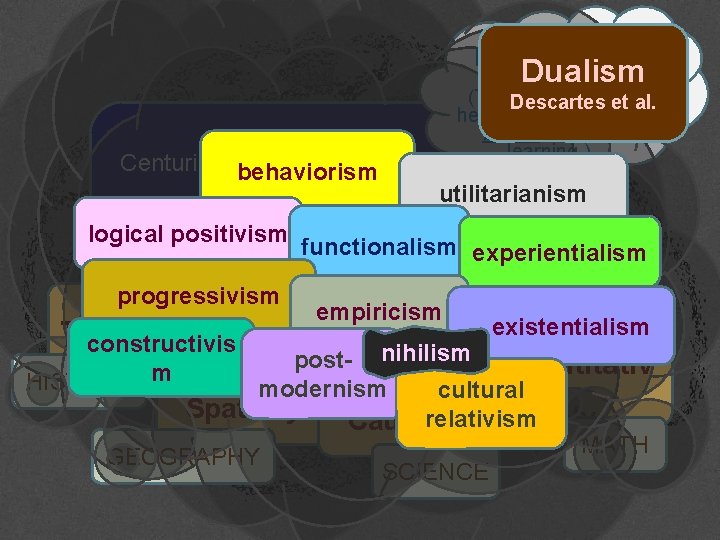
He called them Dualism “a prioris” (They’re in our Descartes et al. heads before we start learning. ) Centuries ago, Immanuel Kant said: behaviorism utilitarianism Humans have several “built-in” ways logical positivism functionalism of organizing information from experience: experientialism progressivism Temporally constructivis empiricism existentialism post- nihilism Quantitativ HISTORY m modernism cultural Spatially relativism ely Causally MATH GEOGRAPHY SCIENCE
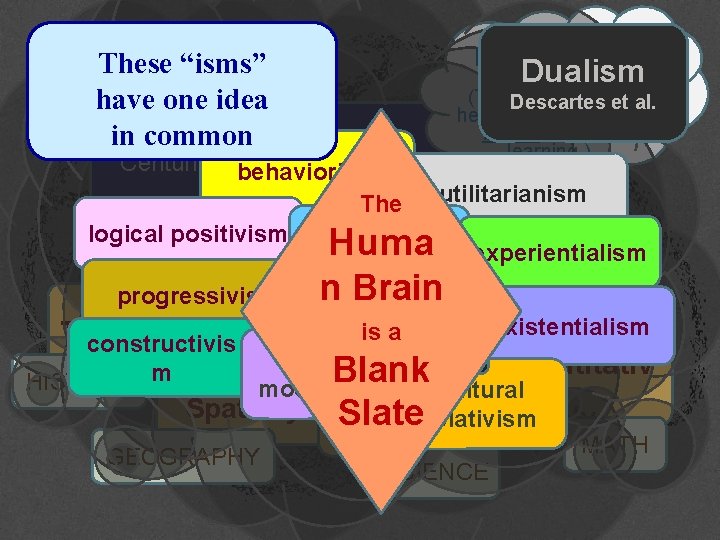
He called them These “isms” have one idea in common Dualism “a prioris” (They’re in our Descartes et al. heads before we start learning. ) Centuries ago, Immanuel Kant said: behaviorism utilitarianism The“built-in” Humans have several ways logical positivism Huma functionalism of organizing information from experience: experientialism progressivism n Brain empiricism existentialism is a Temporally constructivis post- nihilism Quantitativ Blank HISTORY m modernism cultural Spatially Slate relativism ely Causally MATH GEOGRAPHY SCIENCE
Then, . . . along came new brain-scanning technologies. They changed Unfortunately, how wescience” look “brain at human brains. has become a kind of buzzword.
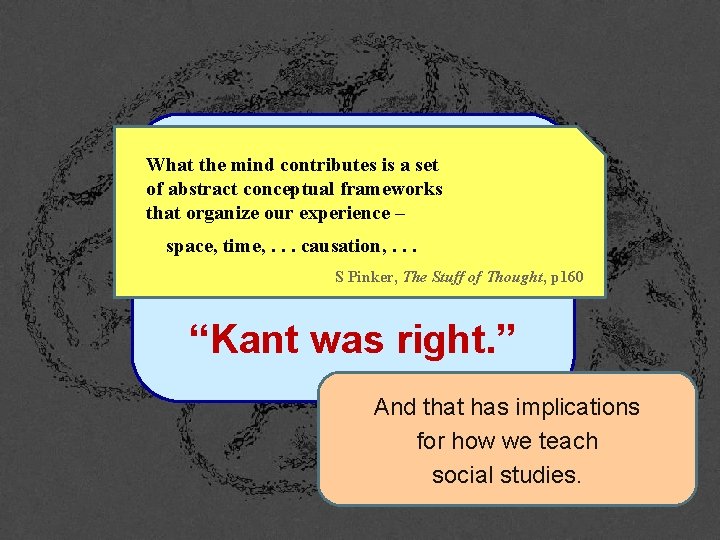
What the mind contributes is a set But if we look at of abstract conceptual frameworks that organize our experience – research the brain-scanning space, time, . . . the causation, . . . (not just opinion blogs) Pinker, The Stuff of Thought, p 160 it Ssays “Kant was right. ” And that has implications for how we teach social studies.
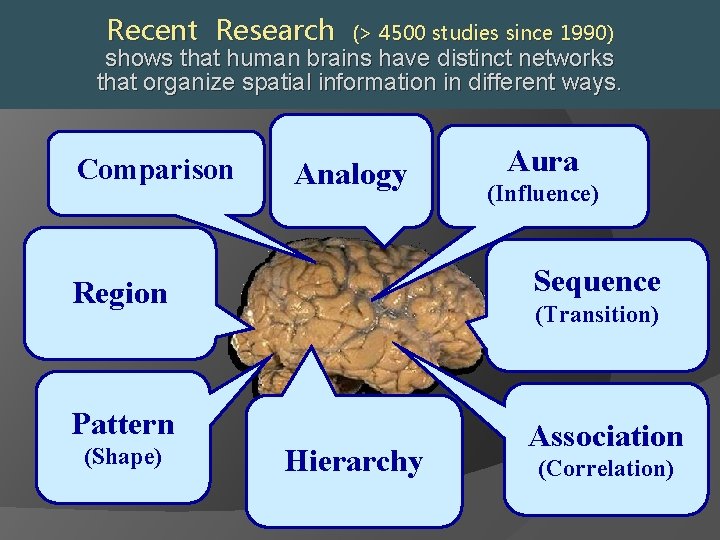
Recent Research (> 4500 studies since 1990) shows brains have distinct networks shows that thehuman brain has several distinct networks that organize spatial information in different that do specific kinds of spatial thinking. ways. Comparison Analogy Aura (Influence) Region Sequence Pattern Association (Shape) (Transition) Hierarchy (Correlation)
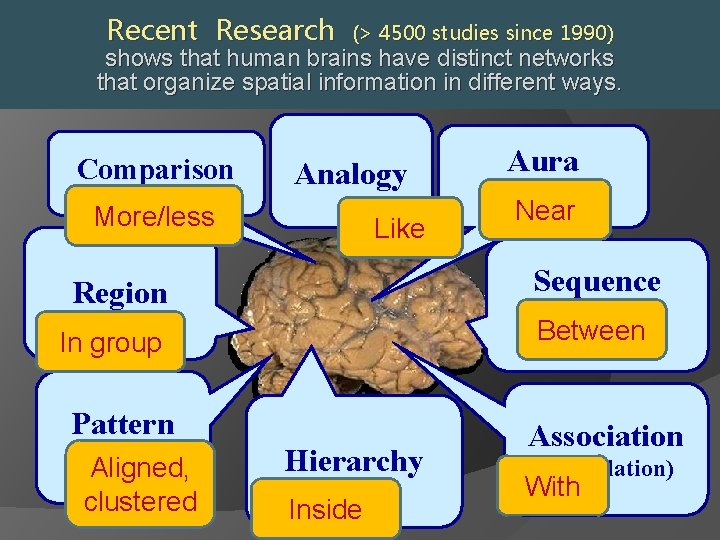
Recent Research (> 4500 studies since 1990) shows brains have distinct networks shows that thehuman brain has several distinct networks that organize spatial information in different that do specific kinds of spatial thinking. ways. Comparison Analogy More/less Like Near (Transition) Between In group Pattern Aligned, clustered (Influence) Sequence Region (Shape) Aura Hierarchy Inside Association (Correlation) With
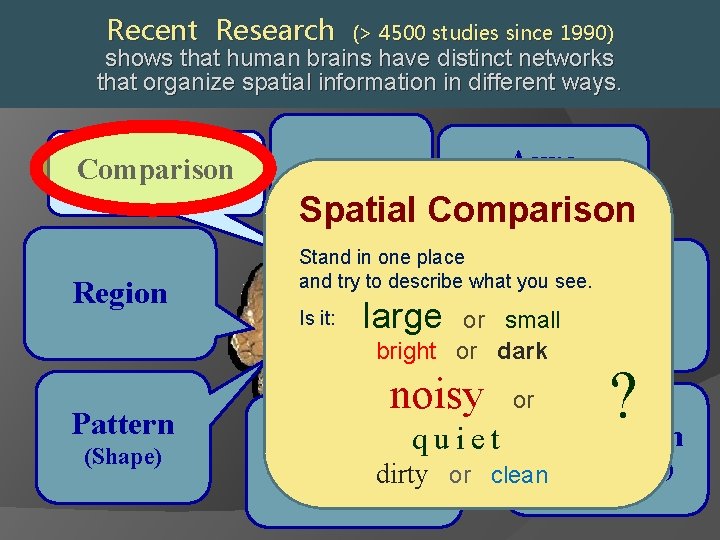
Recent Research (> 4500 studies since 1990) shows that human brains have distinct networks that organize spatial information in different ways. Comparison Analogy Aura (Influence) Spatial Comparison Region Pattern (Shape) Stand in one place and try to describe what you see. Is it: large Sequence (Transition) or small bright or dark noisy ? Association or quiet Hierarchy dirty or clean(Correlation)
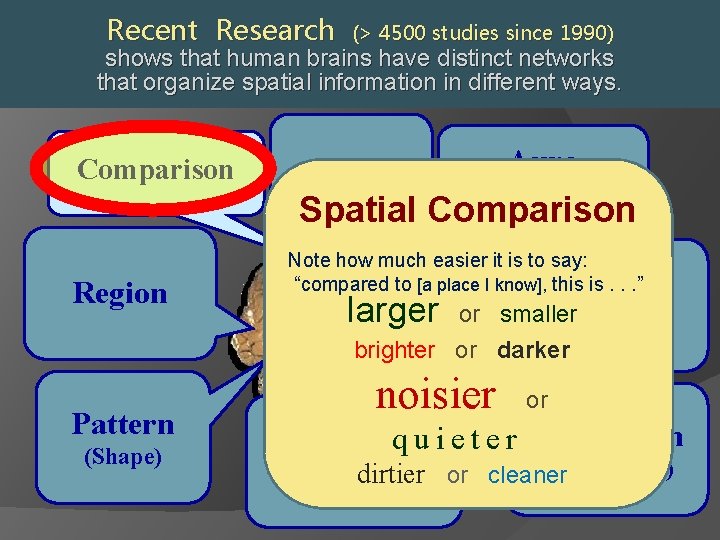
Recent Research (> 4500 studies since 1990) shows that human brains have distinct networks that organize spatial information in different ways. Comparison Analogy Aura (Influence) Spatial Comparison Region Pattern (Shape) Note how much easier it is to say: “compared to [a place I know], this is. . . ” larger Sequence or smaller (Transition) brighter or darker noisier or q u i e t e r Association Hierarchy (Correlation) dirtier or cleaner
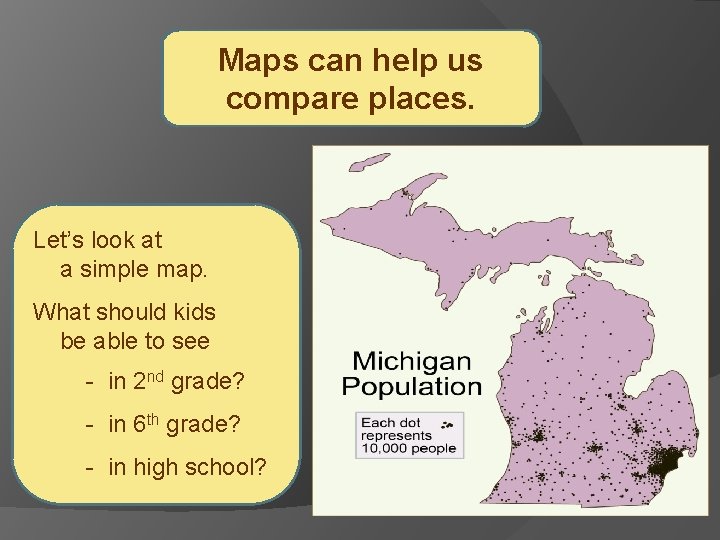
Maps can help us compare places. Let’s look at a simple map. What should kids be able to see - in 2 nd grade? - in 6 th grade? - in high school?
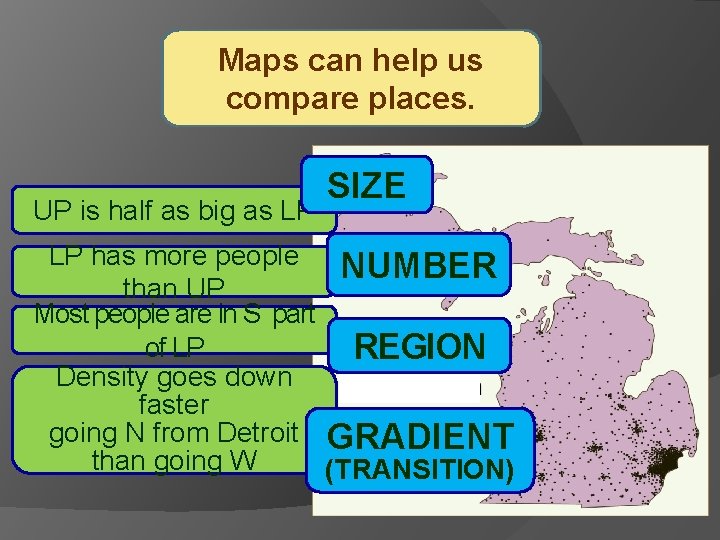
Maps can help us compare places. Compare UP is halfthe as peninsulas big as LP SIZE LP has more people NUMBER than UP Most people are in S part of LP REGION Density goes down faster going N from Detroit GRADIENT than going W (TRANSITION)
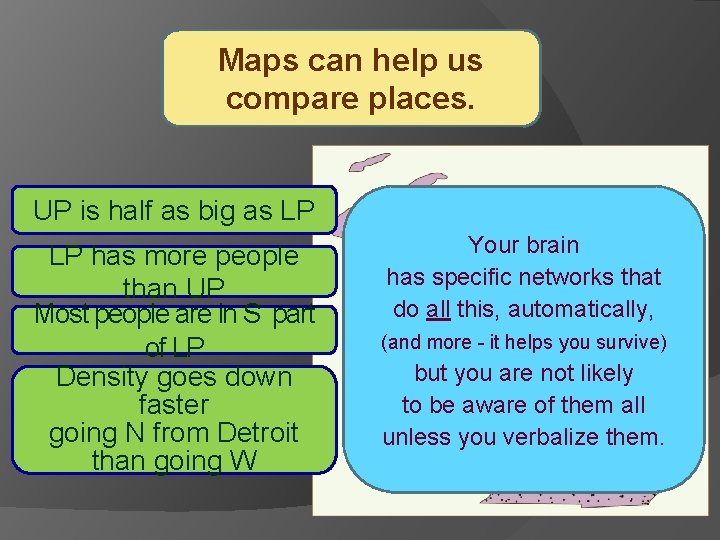
Maps can help us compare places. UP is half as big as LP LP has more people than UP Most people are in S part of LP Density goes down faster going N from Detroit than going W Your brain has specific networks that do all this, automatically, (and more - it helps you survive) but you are not likely to be aware of them all unless you verbalize them.
Students have to learn how to use those networks. Let’s look at a middle-school current-events topic with deep historic roots.
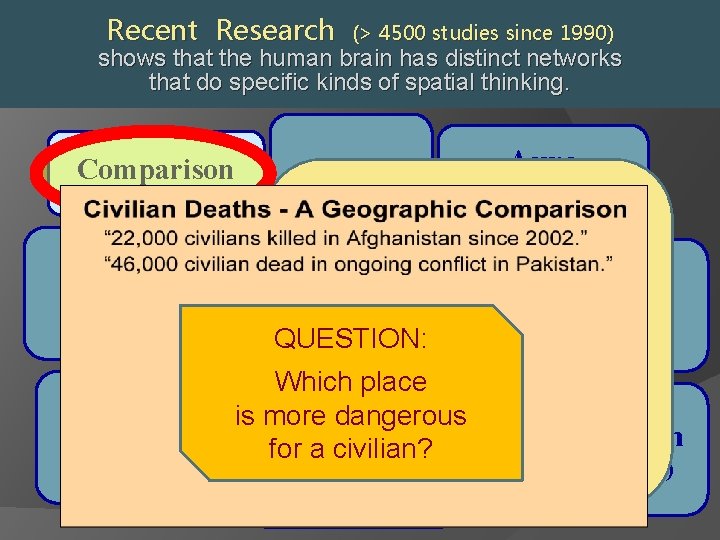
Recent Research (> 4500 studies since 1990) shows that the human brain has distinct networks that do specific kinds of spatial thinking. Comparison Analogy Aura (Influence) Spatial Comparison bigger, more, colder, etc. Sequence Region QUESTION: Pattern (Shape) Which place is more dangerous for a civilian? Hierarchy (Transition) Association (Correlation)
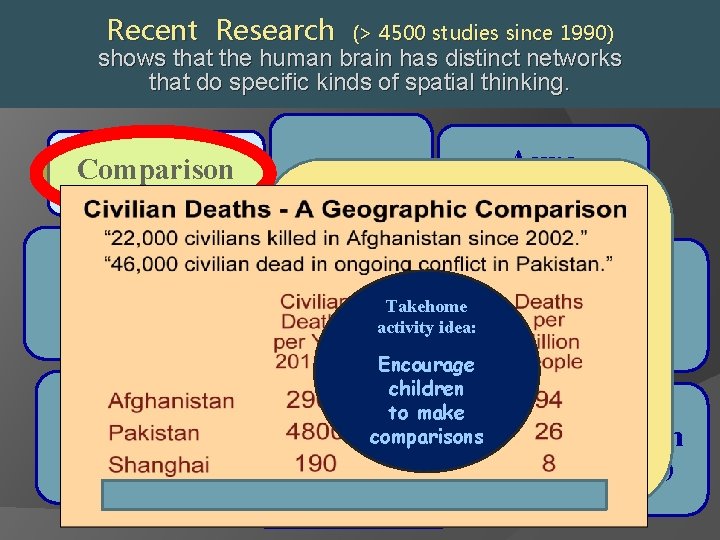
Recent Research (> 4500 studies since 1990) shows that the human brain has distinct networks that do specific kinds of spatial thinking. Comparison Analogy Aura (Influence) Spatial Comparison bigger, more, colder, etc. Region Pattern (Shape) Takehome activity idea: Encourage children to make comparisons Hierarchy Sequence (Transition) Association (Correlation)
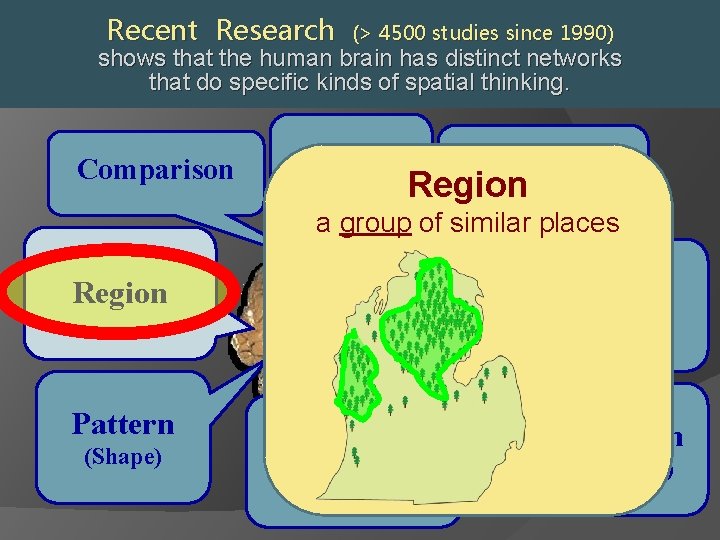
Recent Research (> 4500 studies since 1990) shows that the human brain has distinct networks that do specific kinds of spatial thinking. Comparison Aura Analogy. Region (Influence) a group of similar places Region Sequence Pattern Association (Shape) (Transition) Hierarchy (Correlation)
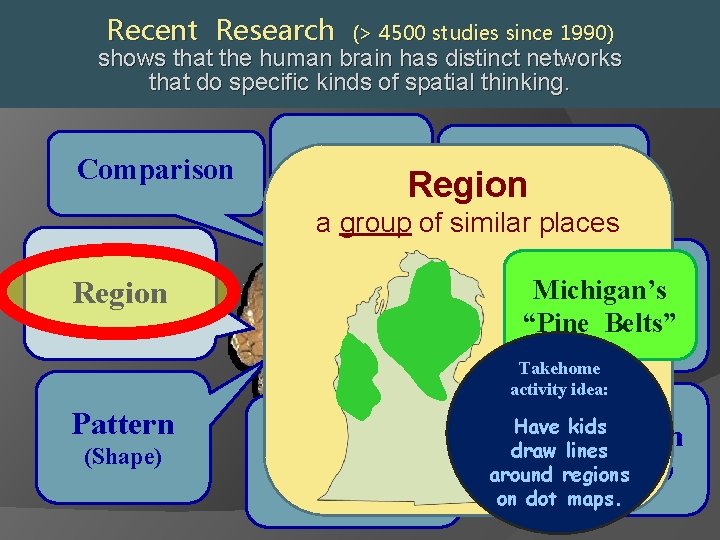
Recent Research (> 4500 studies since 1990) shows that the human brain has distinct networks that do specific kinds of spatial thinking. Comparison Aura Analogy. Region (Influence) a group of similar places Sequence Michigan’s Region (Transition) “Pine Belts” Takehome activity idea: Pattern (Shape) Hierarchy Have kids draw lines (Correlation) around regions on dot maps. Association
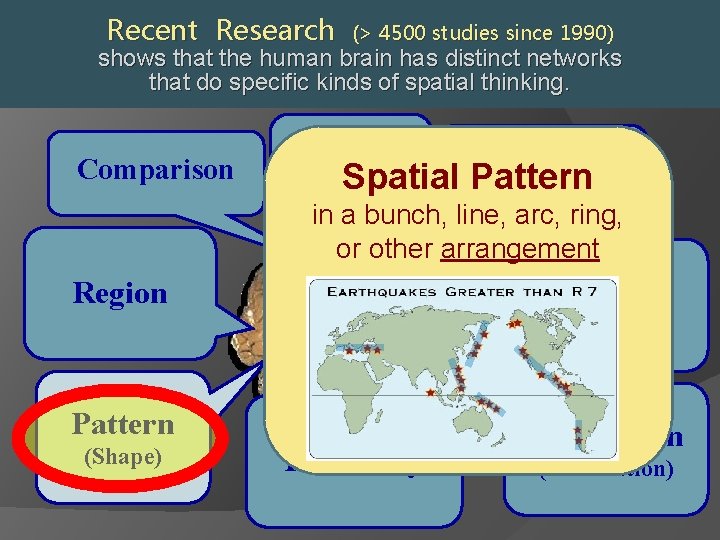
Recent Research (> 4500 studies since 1990) shows that the human brain has distinct networks that do specific kinds of spatial thinking. Comparison Aura Analogy Spatial Pattern (Influence) in a bunch, line, arc, ring, or other arrangement Region Sequence Pattern Association (Shape) (Transition) Hierarchy (Correlation)
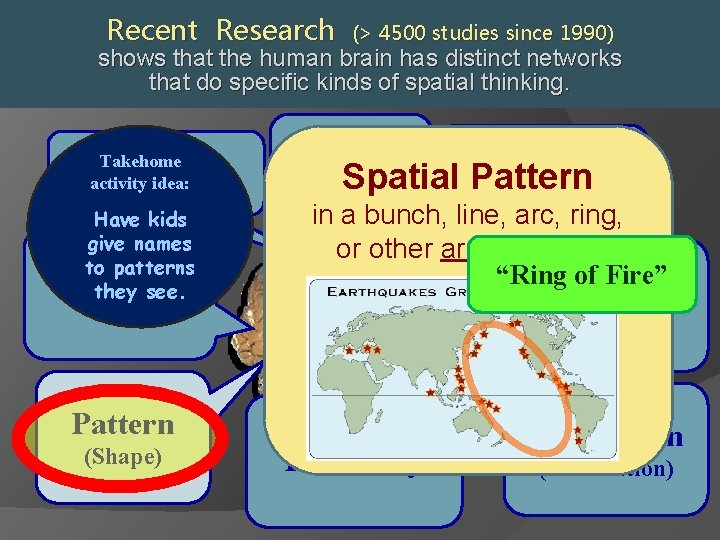
Recent Research (> 4500 studies since 1990) shows that the human brain has distinct networks that do specific kinds of spatial thinking. Takehome Comparison activity idea: Have kids give names to patterns they see. Region Aura Analogy Spatial Pattern (Influence) in a bunch, line, arc, ring, or other arrangement “Ring of Fire” Sequence (Transition) Pattern (Shape) Hierarchy Association (Correlation)
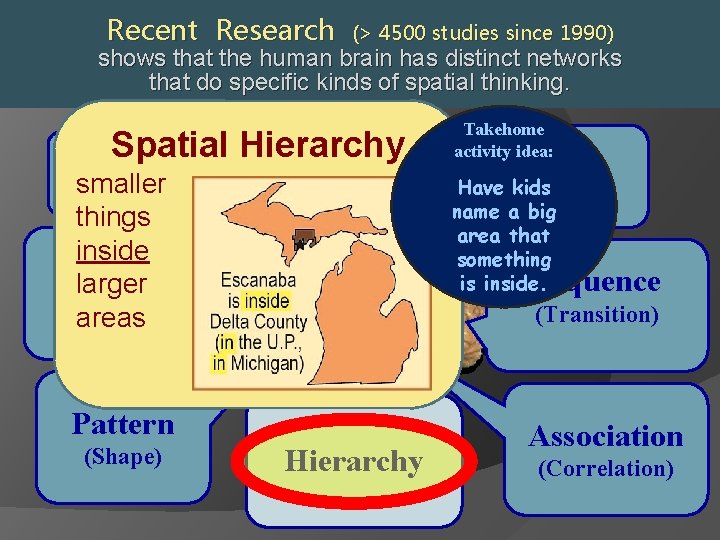
Recent Research (> 4500 studies since 1990) shows that the human brain has distinct networks that do specific kinds of spatial thinking. Spatial Hierarchy Comparison smaller Analogy things inside larger Region areas Aura Have kids (Influence) “Inside name a big the that UP” area something is inside. Sequence (Transition) Pattern (Shape) Takehome activity idea: Hierarchy Association (Correlation)
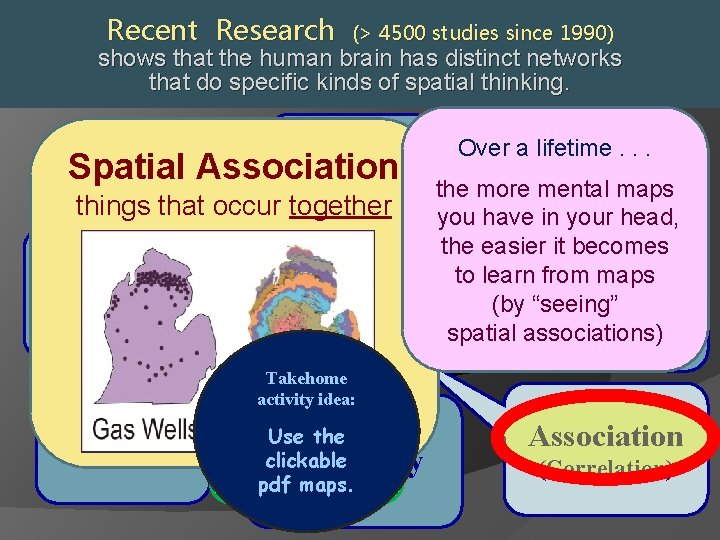
Recent Research (> 4500 studies since 1990) shows that the human brain has distinct networks that do specific kinds of spatial thinking. Comparison Spatial Association Analogy things that occur together Region Pattern (Shape) Takehome activity idea: “with the Use the Antrim clickable Hierarchy Shale” pdf maps. Over a lifetime. . . Aura the more mental maps (Influence) you have in your head, the easier it becomes to learn. Sequence from maps (by “seeing” (Transition) spatial associations) Association (Correlation)
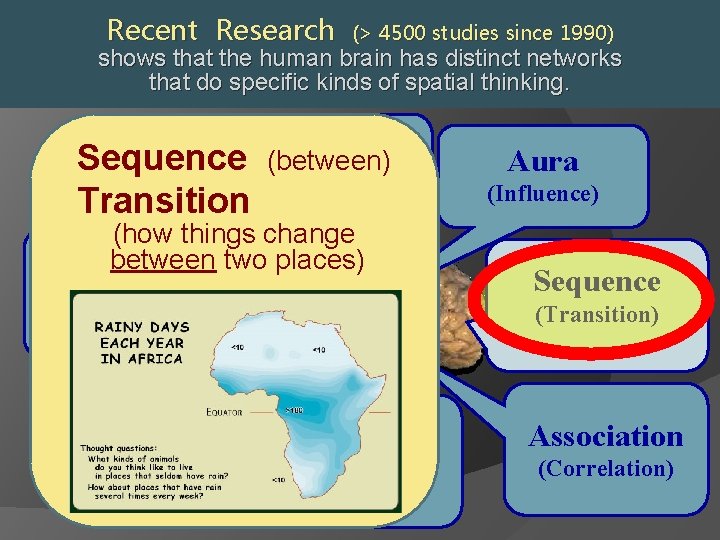
Recent Research (> 4500 studies since 1990) shows that the human brain has distinct networks that do specific kinds of spatial thinking. Sequence Comparison Transition (between) Analogy (how things change between two places) Aura (Influence) Region Sequence Pattern Association (Shape) (Transition) Hierarchy (Correlation)
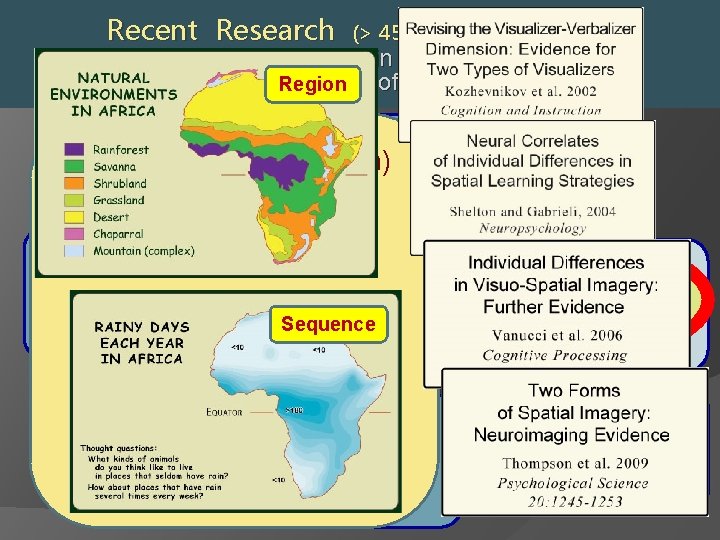
Recent Research (> 4500 studies since 1990) shows that the human brain has distinct networks that do specific kinds of spatial thinking. Region Sequence Comparison Transition (between) Analogy (how things change between two places) Region Sequence Pattern (Shape) Hierarchy Aura (Influence) Sequence (Transition) Association (Correlation)
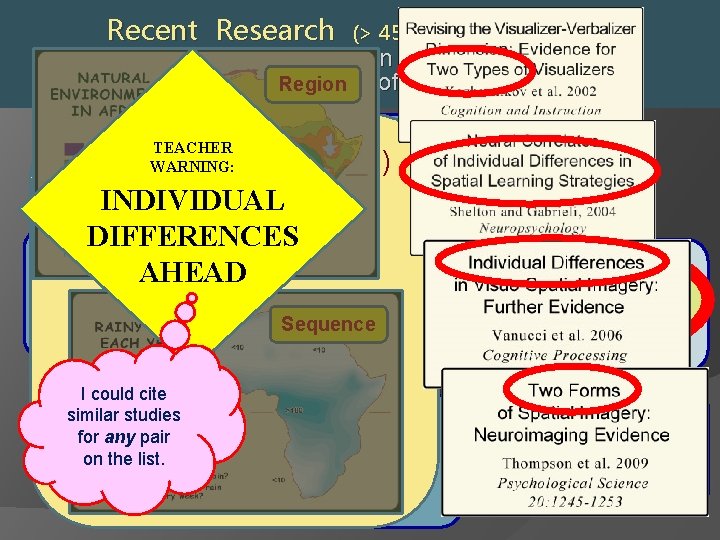
Recent Research (> 4500 studies since 1990) shows that the human brain has distinct networks that do specific kinds of spatial thinking. Region Sequence Comparison (between) Analogy INDIVIDUAL Transition TEACHER WARNING: (how things change DIFFERENCES between two places) AHEAD Region Sequence I could cite similar studies for any pair (Shape) on the list. Pattern Hierarchy Aura (Influence) Sequence (Transition) Association (Correlation)
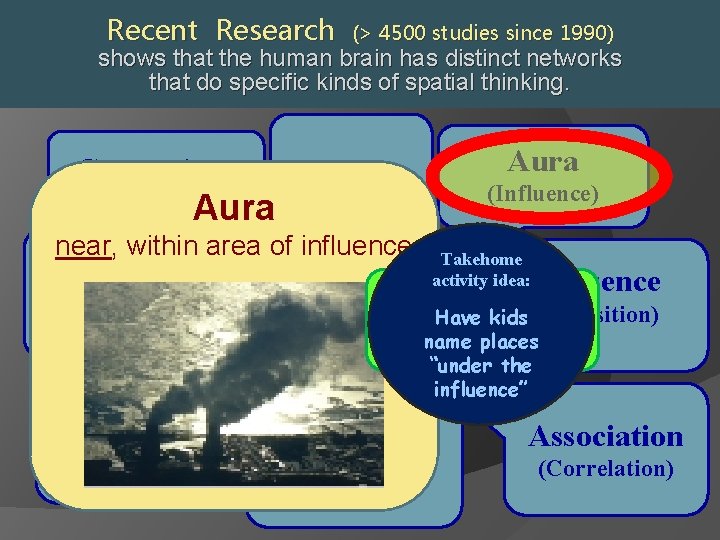
Recent Research (> 4500 studies since 1990) shows that the human brain has distinct networks that do specific kinds of spatial thinking. Comparison Aura Analogy (Influence) near, within area of influence Region Takehome activity idea: Sequence “close to the Have kids (Transition) powerplant” name places “under the influence” Pattern (Shape) Hierarchy Association (Correlation)
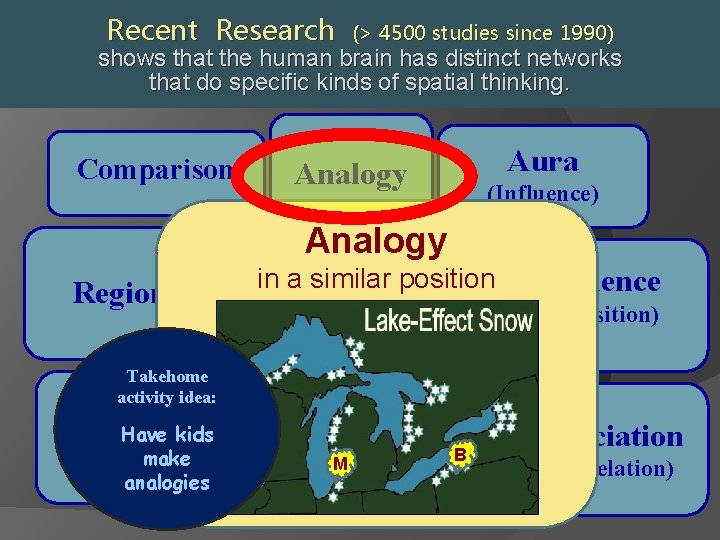
Recent Research (> 4500 studies since 1990) shows that the human brain has distinct networks that do specific kinds of spatial thinking. Comparison Aura Analogy (Influence) Analogy Region in a similar position Sequence (Transition) Takehome activity idea: “like Pattern Have kids Buffalo” (Shape) make analogies M Hierarchy B Association (Correlation)
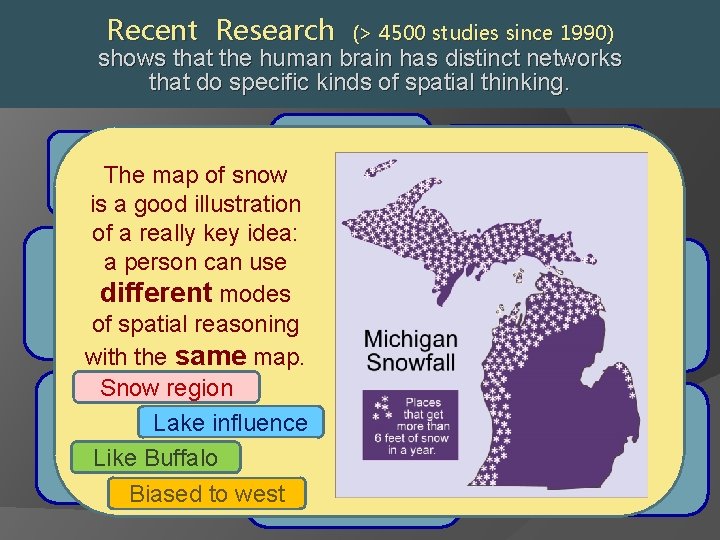
Recent Research (> 4500 studies since 1990) shows that the human brain has distinct networks that do specific kinds of spatial thinking. Comparison The map of snow Analogy is a good illustration of a really key idea: a person can use different modes Region of spatial reasoning with the same map. Snow region Lake influence Pattern (Shape) Like Buffalo Hierarchy Biased to west Aura (Influence) Sequence (Transition) Association (Correlation)
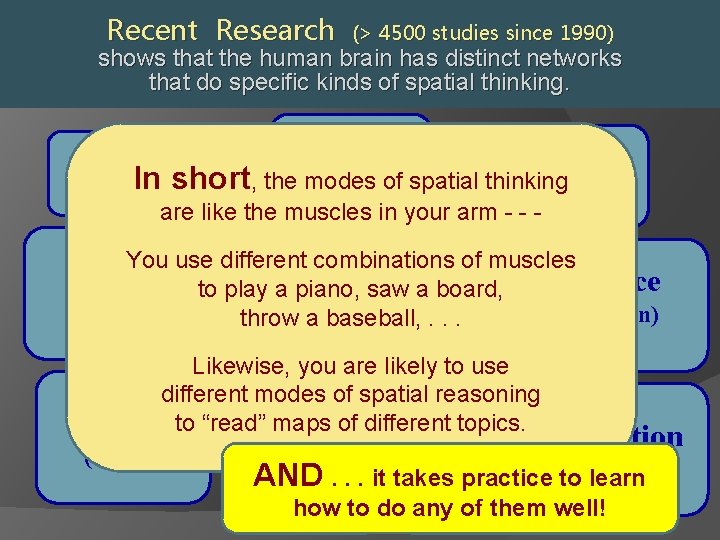
Recent Research (> 4500 studies since 1990) shows that the human brain has distinct networks that do specific kinds of spatial thinking. Aura Comparison In short, the. Analogy modes of spatial thinking (Influence) are like the muscles in your arm - - - You use different combinations of muscles Region to play a piano, saw a board, Sequence (Transition) throw a baseball, . . . Likewise, you are likely to use different modes of spatial reasoning Patternto “read” maps of different topics. Association B (Shape) Hierarchy AND. . . it takes practice(Correlation) to learn how to do any of them well!
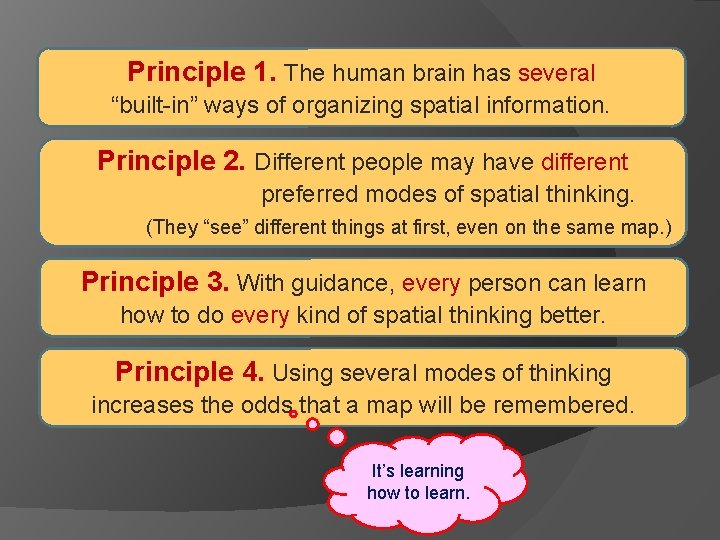
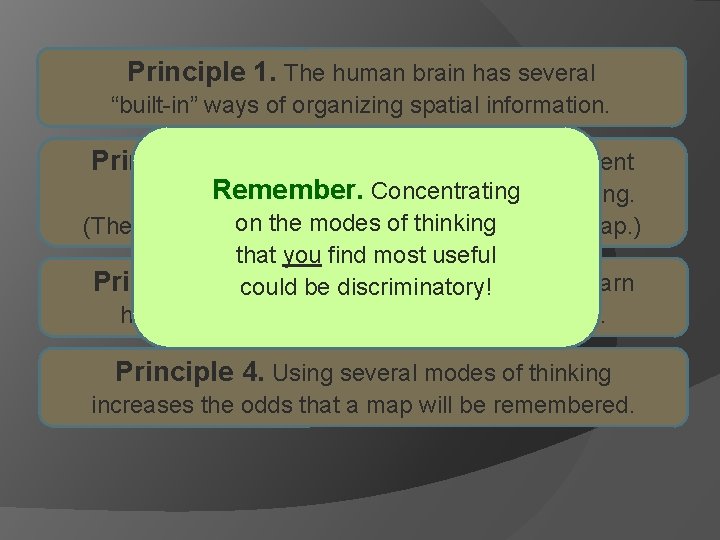
Principle 1. The human brain has several “built-in” ways of organizing spatial information. Principle 2. Different people may have different preferred modes of spatial thinking. (They “see” different things at first, even on the same map. ) Principle 3. With guidance, every person can learn how to do every kind of spatial thinking better. Principle 4. Using several modes of thinking increases the odds that a map will be remembered. It’s learning how to learn.
Principle 1. The human brain has several “built-in” ways of organizing spatial information. Principle 2. Different children may have different Remember. Concentrating preferred modes of spatial thinking. on the things, modes even of thinking (They “see” different on the same map. ) that you find most useful Principle 3. could With guidance, every child can learn be discriminatory! how to do every kind of spatial thinking better. Principle 4. Using several modes of thinking increases the odds that a map will be remembered.
Copyright 2015, Phil Gersmehl Teachers who saw this presentation at a workshop or downloaded it from our internet site have permission to make a copy on their own computers for these purposes: 1. to help them review the workshop, 2. to show to colleagues or administrators, 3. to show the presentation in their own classrooms or at sessions they lead at teacher conferences, 4. to use individual frames (with attribution) in their own class or conference presentations. For permission for any other use, including posting frames on a personal blog or uploading to any network or website, contact pgersmehl@gmail. com