
Spatial processes and statistical modelling Peter Green University






- Slides: 69
Spatial processes and statistical modelling Peter Green University of Bristol, UK IMS/ISBA, San Juan, 24 July 2003 1
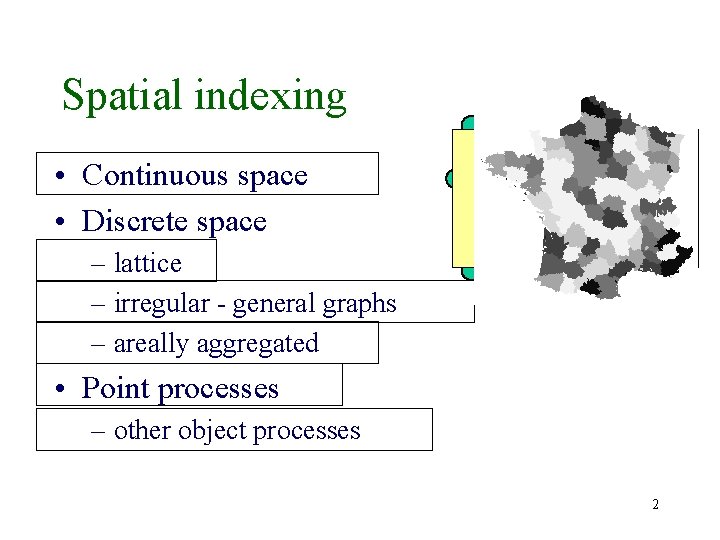
Spatial indexing • Continuous space • Discrete space – lattice – irregular - general graphs – areally aggregated • Point processes – other object processes 2
Purpose of overview • setting the scene for 8 invited talks on spatial statistics • particularly for specialists in the other 2 areas 3
Perspective of overview • someone interested in the development of methodology – for the analysis of spatially-indexed data – probably Bayesian • models and frameworks, not applications • personal, selective, eclectic 4
Genesis of spatial statistics • • adaptation of time series ideas ‘applied probability’ modelling geostatistics application-led 5
Space vs. time • apparently slight difference • profound implications for mathematical formulation and computational tractability 6
Requirements of particular application domains • • • agriculture (design) ecology (sparse point pattern, poor data? ) environmetrics (space/time) climatology (huge physical models) epidemiology (multiple indexing) image analysis (huge size) 7
Key themes • conditional independence – graphical/hierarchical modelling • aggregation – analysing dependence between differently indexed data – opportunities and obstacles • literal credibility of models • Bayes/non-Bayes distinction blurred 8
A big subject…. Noel Cressie: “This may be the last time spatial statistics is squeezed between two covers” (Preface to Statistics for Spatial Data, 900 pp. , Wiley, 1991) 9
Why build spatial dependence into a model? • No more reason to suppose independence in spatially-indexed data than in a time-series • However, substantive basis form of spatial dependent sometimes slight - very often space is a surrogate for missing covariates that are correlated with location 10
Discretely indexed data 11
Modelling spatial dependence in discretely-indexed fields • Direct • Indirect – Hidden Markov models – Hierarchical models 12
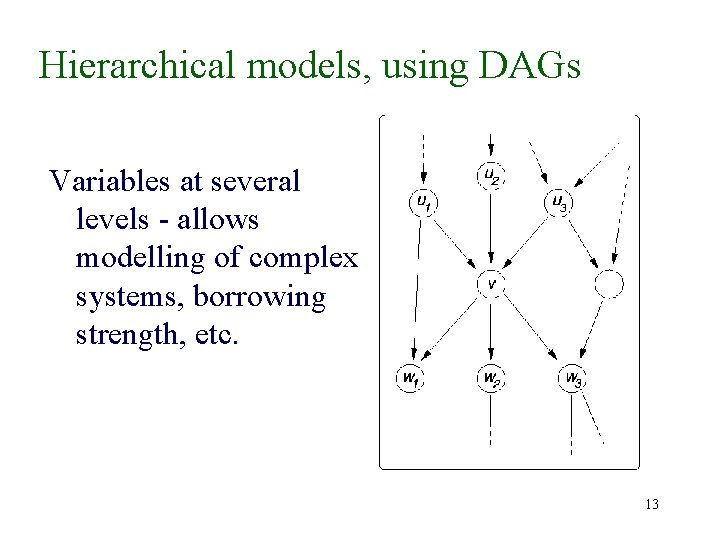
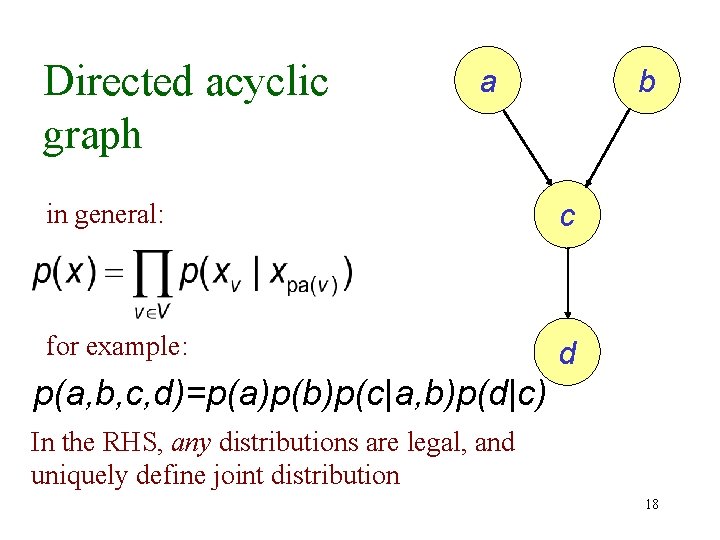
Hierarchical models, using DAGs Variables at several levels - allows modelling of complex systems, borrowing strength, etc. 13
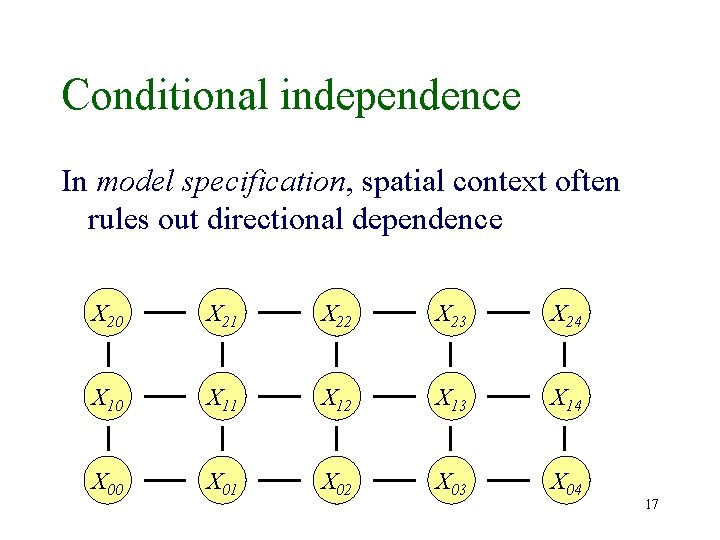
Modelling with undirected graphs Directed acyclic graphs are a natural representation of the way we usually specify a statistical model directionally: • disease symptom • past future • parameters data …… whether or not causality is understood. But sometimes (e. g. spatial models) there is no natural direction 14
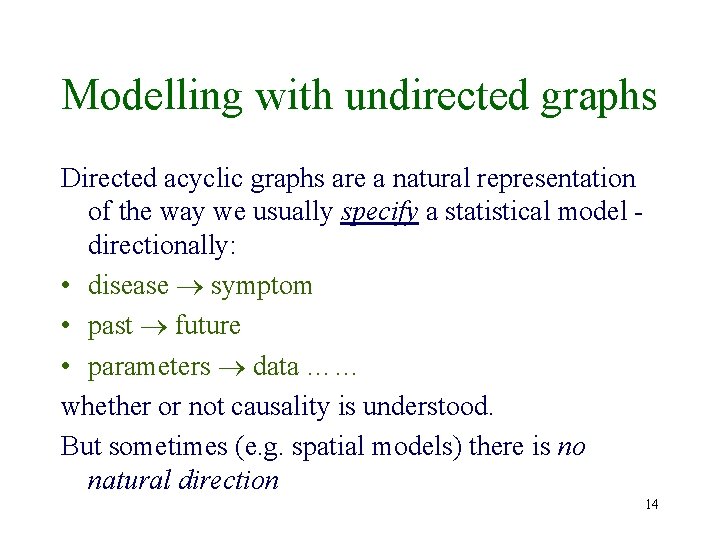
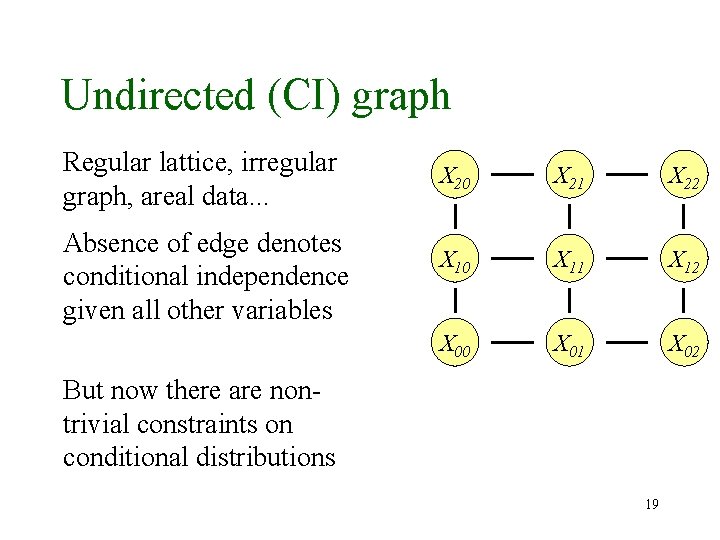
Conditional independence In model specification, spatial context often rules out directional dependence (that would have been acceptable in time series context) X 0 X 1 X 2 X 3 X 4 15
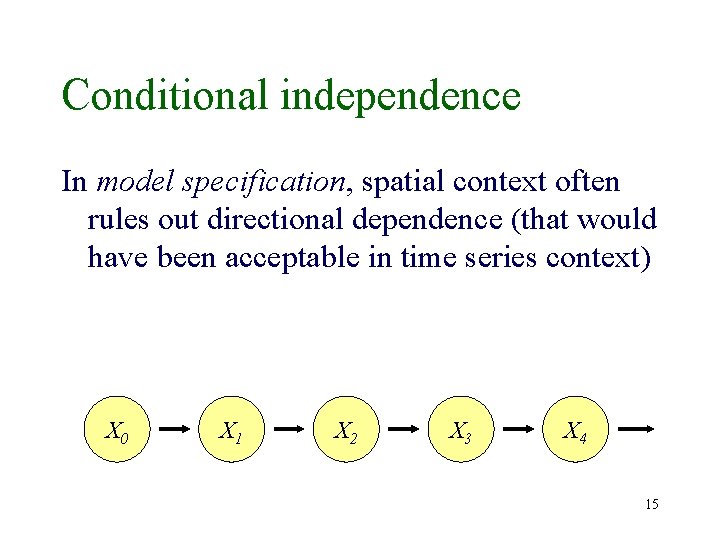
Conditional independence In model specification, spatial context often rules out directional dependence X 20 X 21 X 22 X 23 X 24 X 10 X 11 X 12 X 13 X 14 X 00 X 01 X 02 X 03 X 04 16
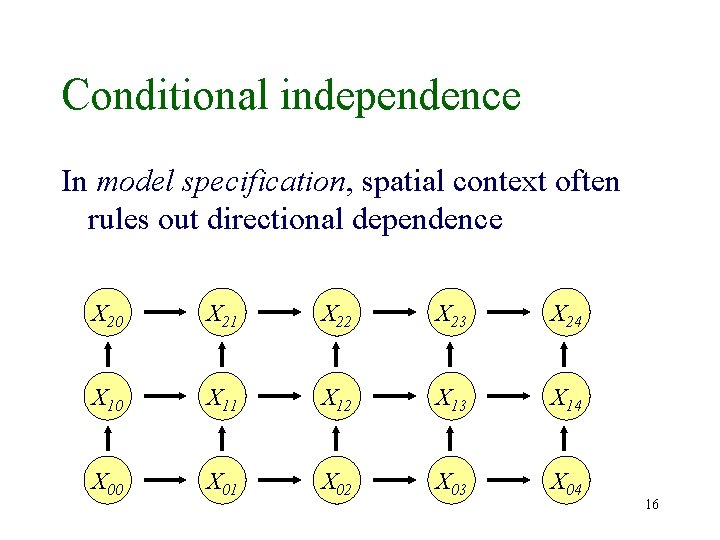
Conditional independence In model specification, spatial context often rules out directional dependence X 20 X 21 X 22 X 23 X 24 X 10 X 11 X 12 X 13 X 14 X 00 X 01 X 02 X 03 X 04 17
Directed acyclic graph a b in general: c for example: d p(a, b, c, d)=p(a)p(b)p(c|a, b)p(d|c) In the RHS, any distributions are legal, and uniquely define joint distribution 18
Undirected (CI) graph Regular lattice, irregular graph, areal data. . . Absence of edge denotes conditional independence given all other variables X 20 X 21 X 22 X 10 X 11 X 12 X 00 X 01 X 02 But now there are nontrivial constraints on conditional distributions 19
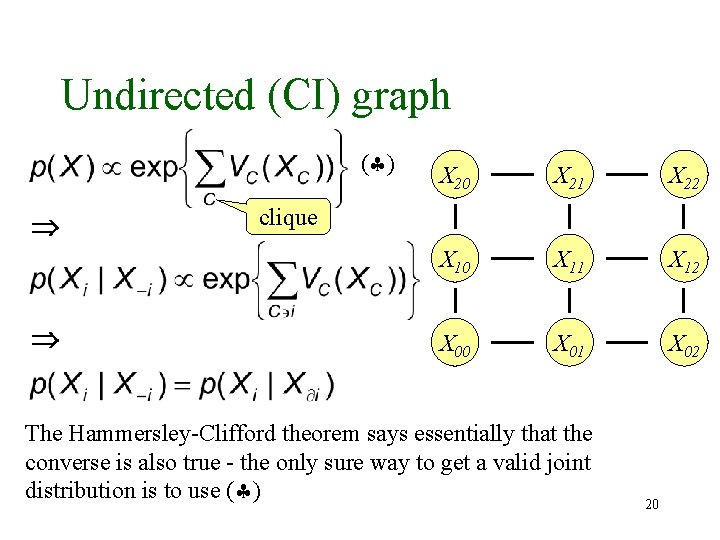
Undirected (CI) graph ( ) X 20 X 21 X 22 X 10 X 11 X 12 X 00 X 01 X 02 clique The Hammersley-Clifford theorem says essentially that the converse is also true - the only sure way to get a valid joint distribution is to use ( ) 20
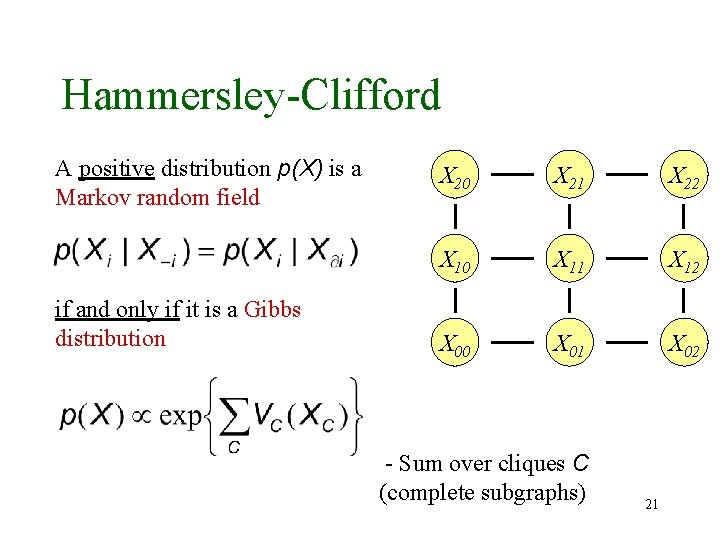
Hammersley-Clifford A positive distribution p(X) is a Markov random field if and only if it is a Gibbs distribution X 20 X 21 X 22 X 10 X 11 X 12 X 00 X 01 X 02 - Sum over cliques C (complete subgraphs) 21
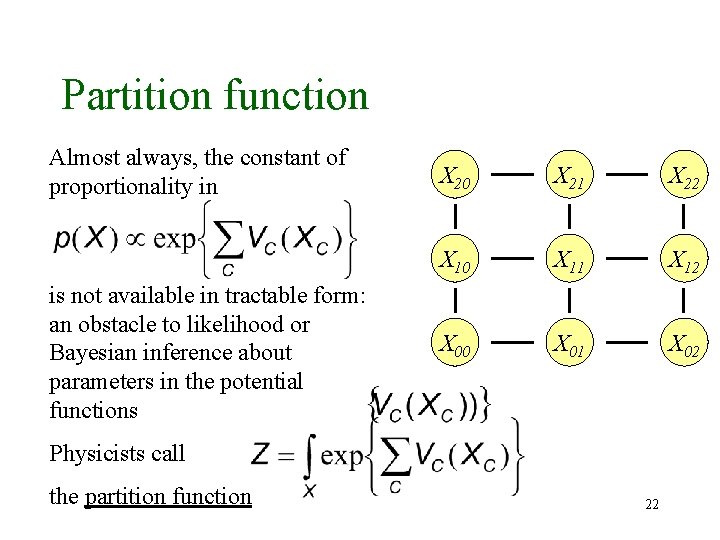
Partition function Almost always, the constant of proportionality in is not available in tractable form: an obstacle to likelihood or Bayesian inference about parameters in the potential functions X 20 X 21 X 22 X 10 X 11 X 12 X 00 X 01 X 02 Physicists call the partition function 22
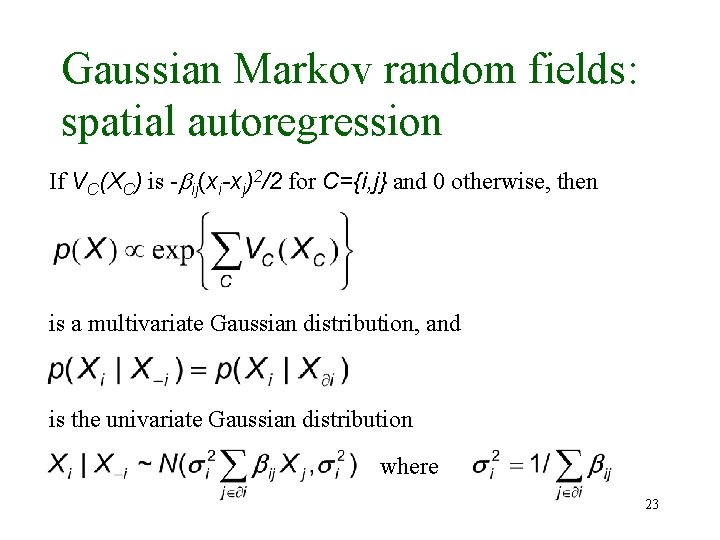
Gaussian Markov random fields: spatial autoregression If VC(XC) is - ij(xi-xj)2/2 for C={i, j} and 0 otherwise, then is a multivariate Gaussian distribution, and is the univariate Gaussian distribution where 23
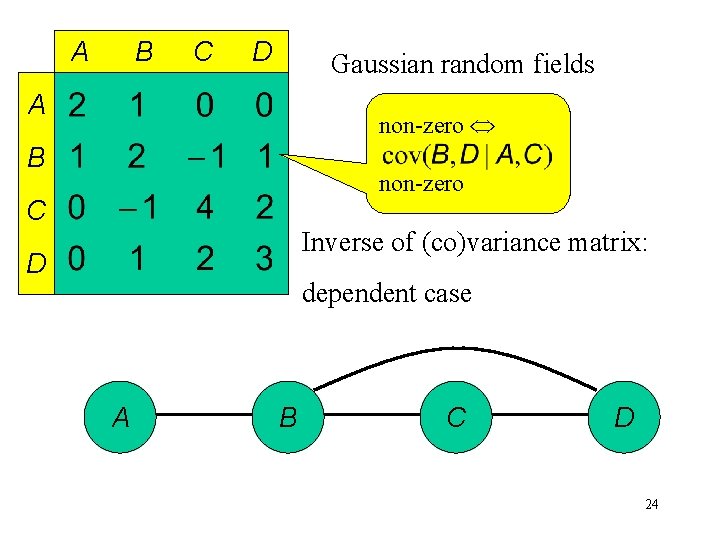
A B C D Gaussian random fields A non-zero B non-zero C Inverse of (co)variance matrix: D dependent case A B C D 24
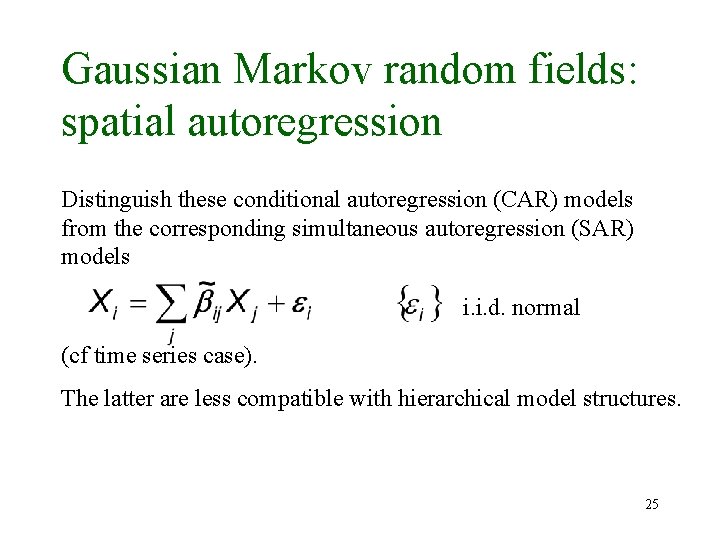
Gaussian Markov random fields: spatial autoregression Distinguish these conditional autoregression (CAR) models from the corresponding simultaneous autoregression (SAR) models i. i. d. normal (cf time series case). The latter are less compatible with hierarchical model structures. 25
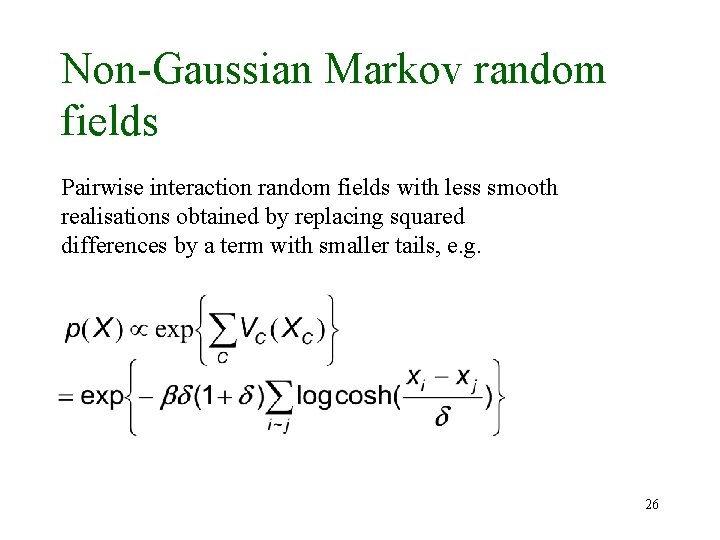
Non-Gaussian Markov random fields Pairwise interaction random fields with less smooth realisations obtained by replacing squared differences by a term with smaller tails, e. g. 26
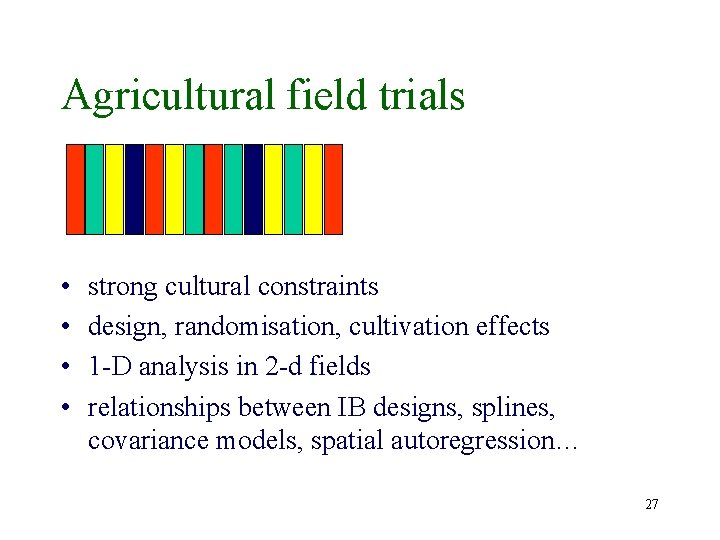
Agricultural field trials • • strong cultural constraints design, randomisation, cultivation effects 1 -D analysis in 2 -d fields relationships between IB designs, splines, covariance models, spatial autoregression… 27
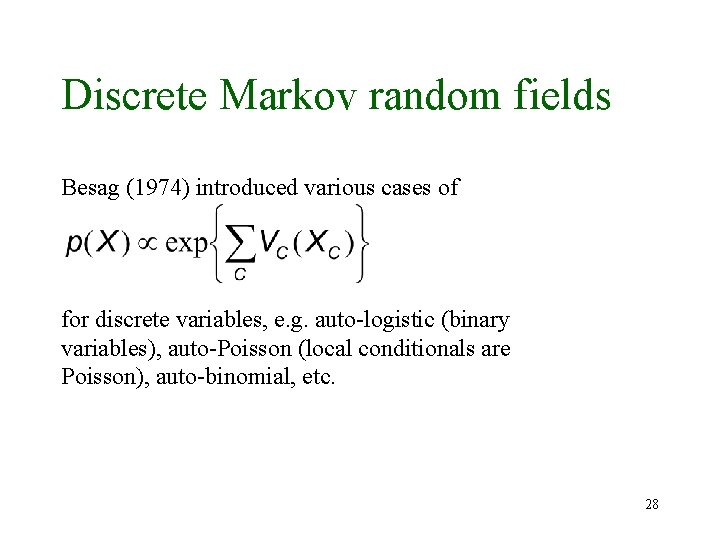
Discrete Markov random fields Besag (1974) introduced various cases of for discrete variables, e. g. auto-logistic (binary variables), auto-Poisson (local conditionals are Poisson), auto-binomial, etc. 28
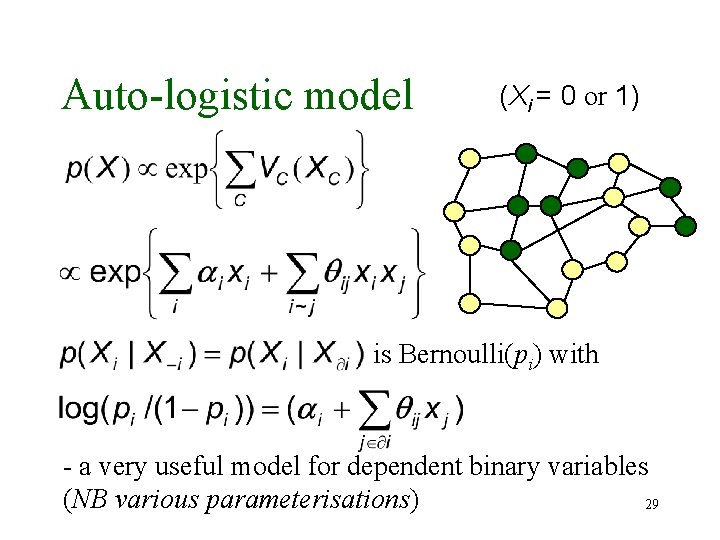
Auto-logistic model (Xi = 0 or 1) is Bernoulli(pi) with - a very useful model for dependent binary variables (NB various parameterisations) 29
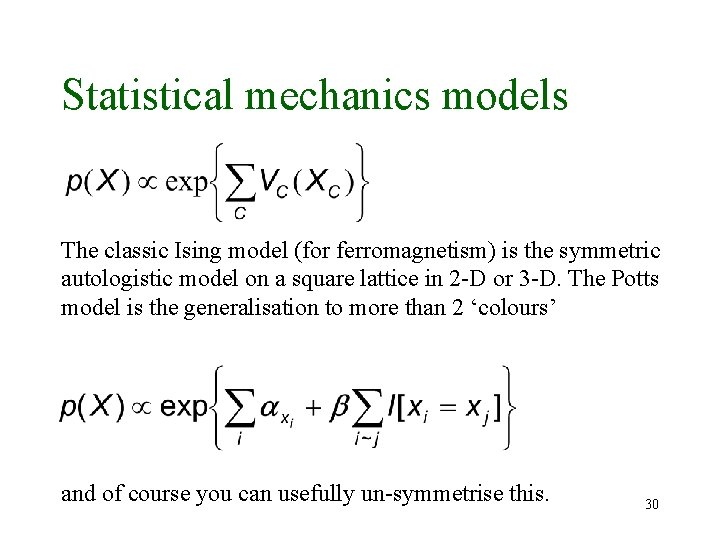
Statistical mechanics models The classic Ising model (for ferromagnetism) is the symmetric autologistic model on a square lattice in 2 -D or 3 -D. The Potts model is the generalisation to more than 2 ‘colours’ and of course you can usefully un-symmetrise this. 30
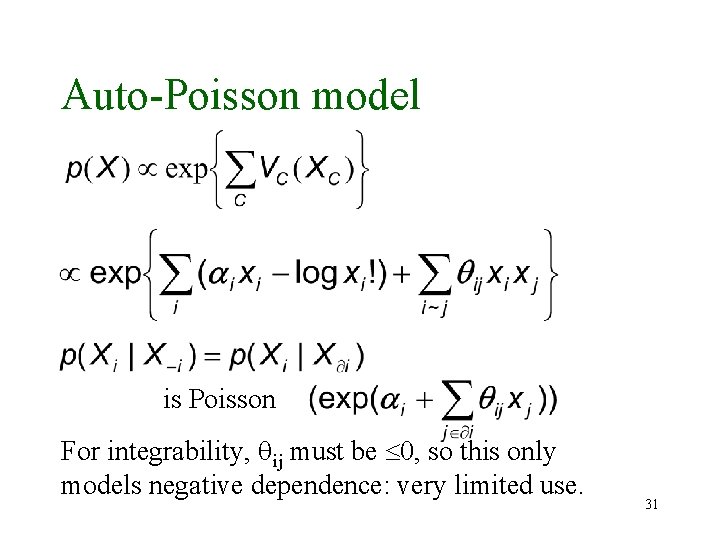
Auto-Poisson model is Poisson For integrability, ij must be 0, so this only models negative dependence: very limited use. 31
Hierarchical models and hidden Markov processes 32
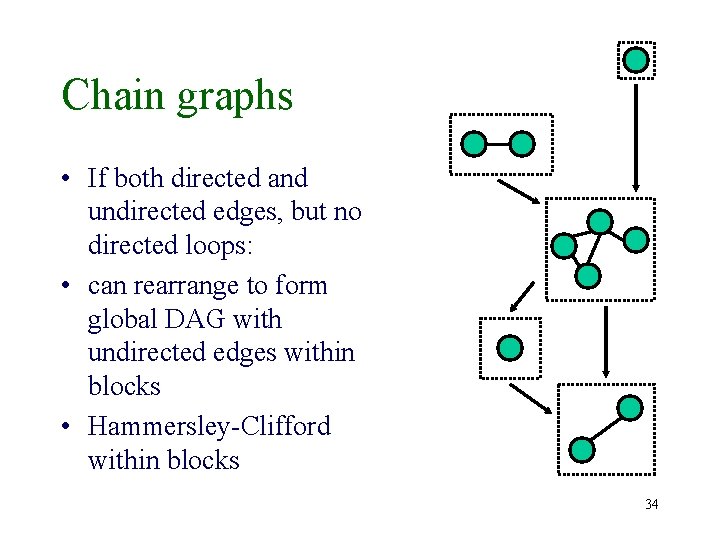
Chain graphs • If both directed and undirected edges, but no directed loops: • can rearrange to form global DAG with undirected edges within blocks 33
Chain graphs • If both directed and undirected edges, but no directed loops: • can rearrange to form global DAG with undirected edges within blocks • Hammersley-Clifford within blocks 34
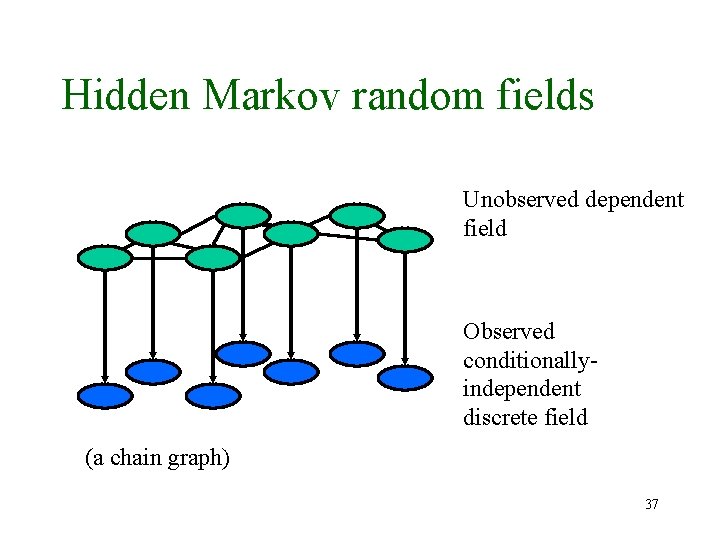
Hidden Markov random fields • We have a lot of freedom modelling spatiallydependent continuously-distributed random fields on regular or irregular graphs • But very little freedom with discretely distributed variables • use hidden random fields, continuous or discrete • compatible with introducing covariates, etc. 35
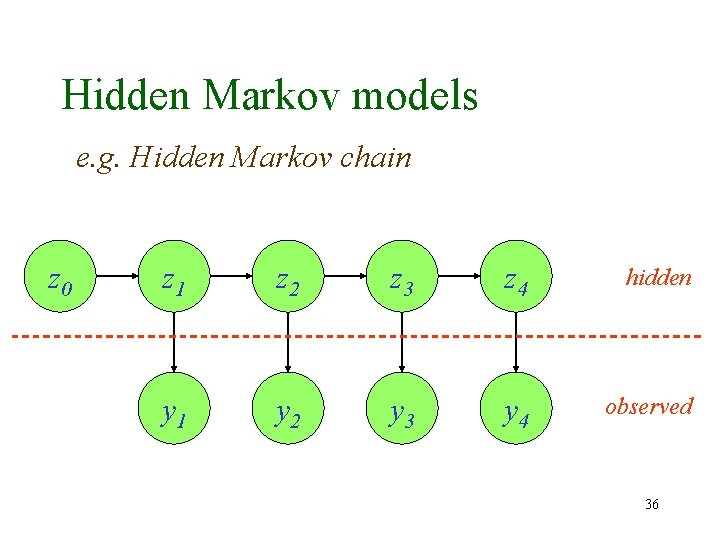
Hidden Markov models e. g. Hidden Markov chain z 0 z 1 z 2 z 3 z 4 hidden y 1 y 2 y 3 y 4 observed 36
Hidden Markov random fields Unobserved dependent field Observed conditionallyindependent discrete field (a chain graph) 37
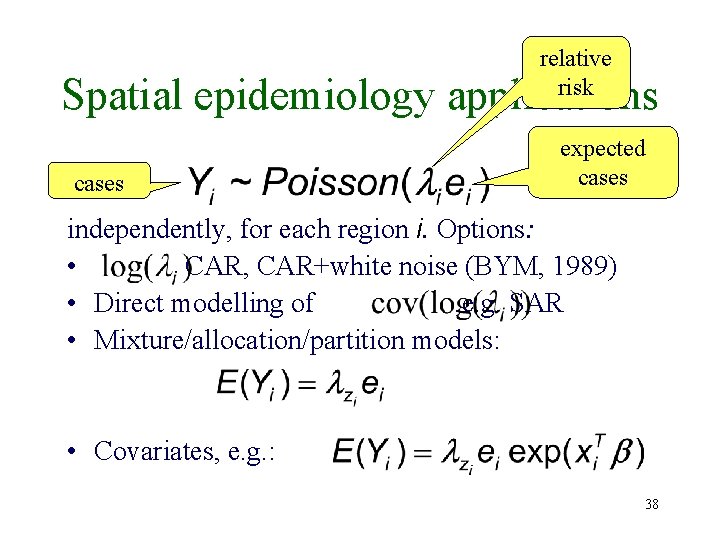
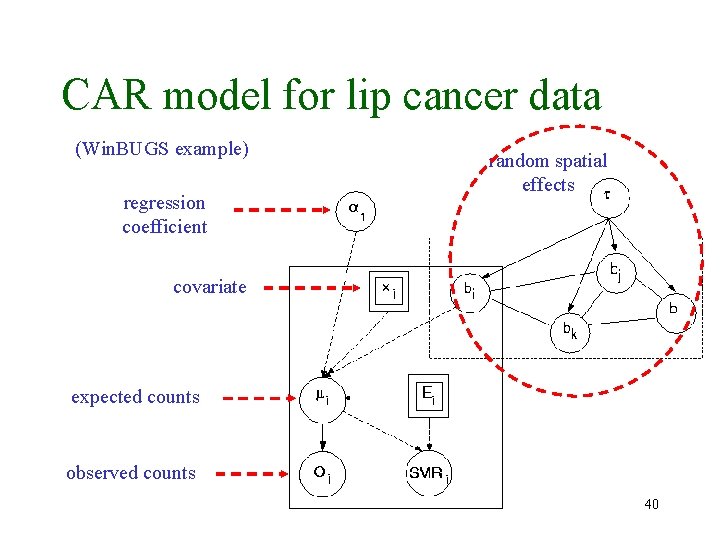
relative risk Spatial epidemiology applications cases expected cases independently, for each region i. Options: • CAR, CAR+white noise (BYM, 1989) • Direct modelling of , e. g. SAR • Mixture/allocation/partition models: • Covariates, e. g. : 38
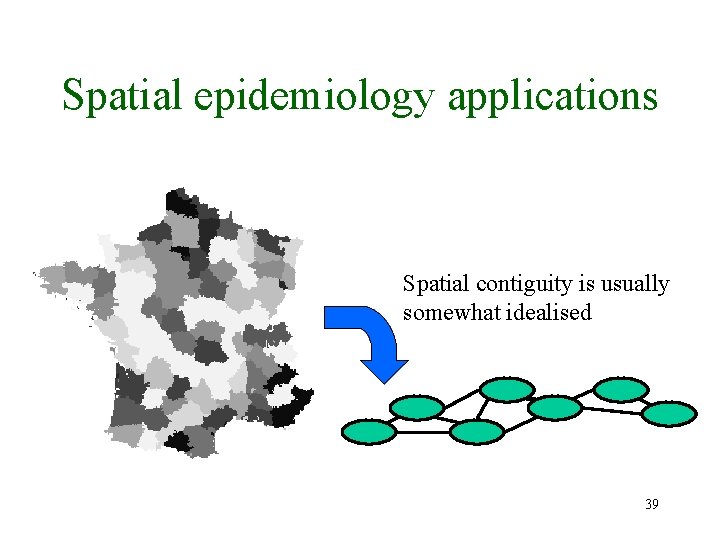
Spatial epidemiology applications Spatial contiguity is usually somewhat idealised 39
CAR model for lip cancer data (Win. BUGS example) regression coefficient random spatial effects covariate expected counts observed counts 40
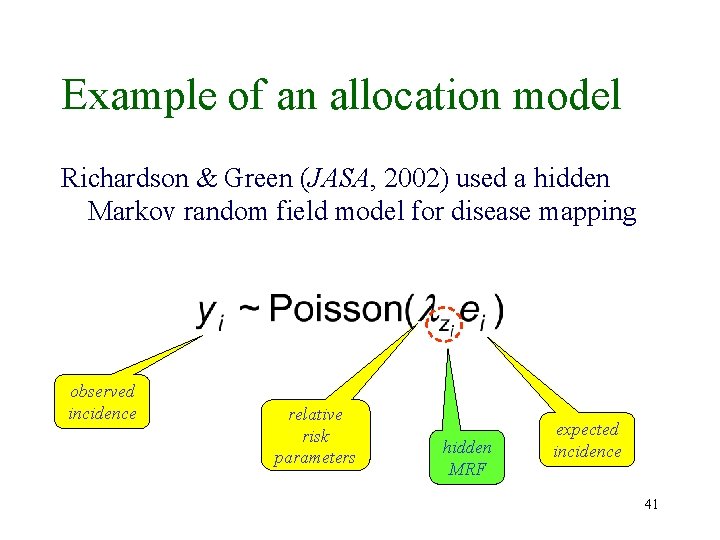
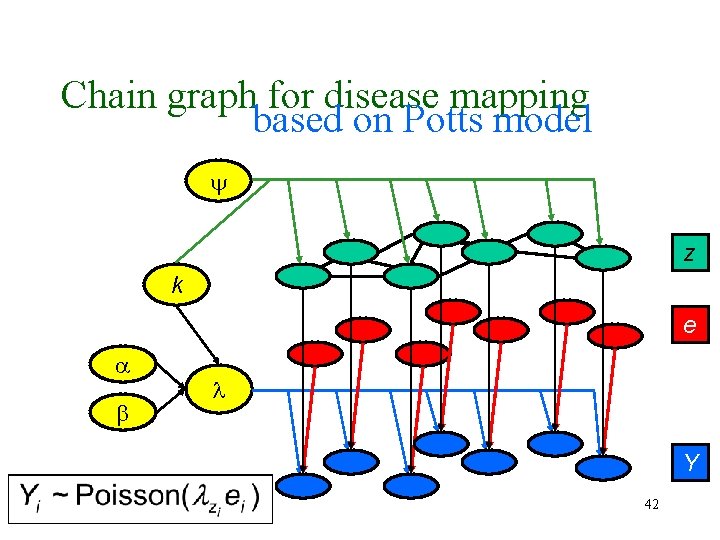
Example of an allocation model Richardson & Green (JASA, 2002) used a hidden Markov random field model for disease mapping observed incidence relative risk parameters hidden MRF expected incidence 41
Chain graph for disease mapping based on Potts model z k e Y 42
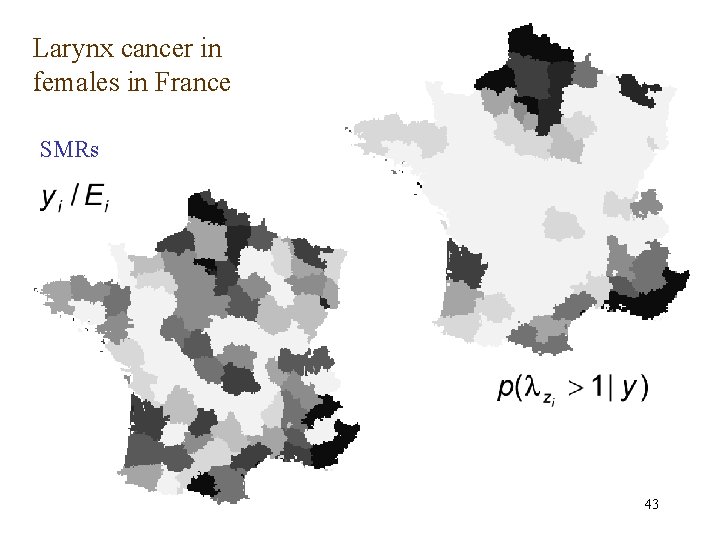
Larynx cancer in females in France SMRs 43
Continuously indexed data 44
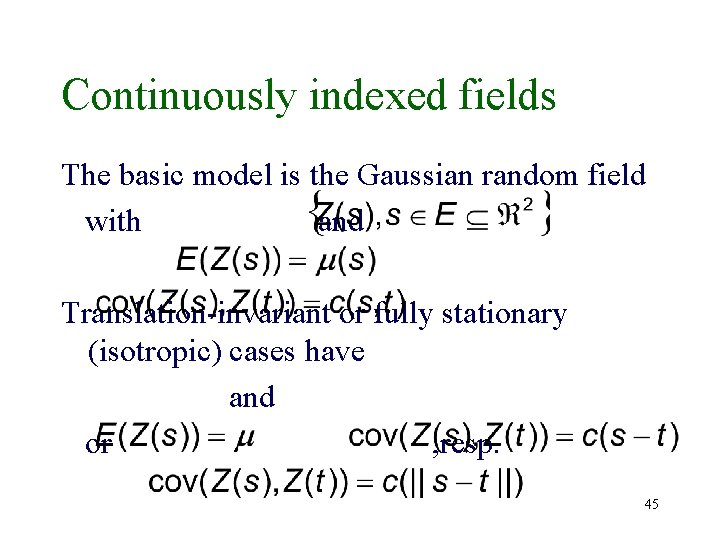
Continuously indexed fields The basic model is the Gaussian random field with and Translation-invariant or fully stationary (isotropic) cases have and or , resp. 45
Geostatistics and kriging • There is a huge literature on a group of methodologies originally developed for geographical and geological data • The main theme is prediction of (functionals of) a random field based on observations at a finite set of locations 46
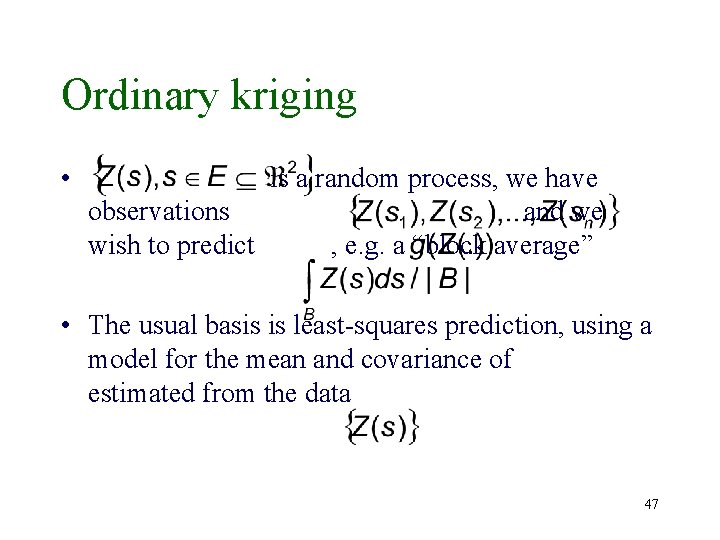
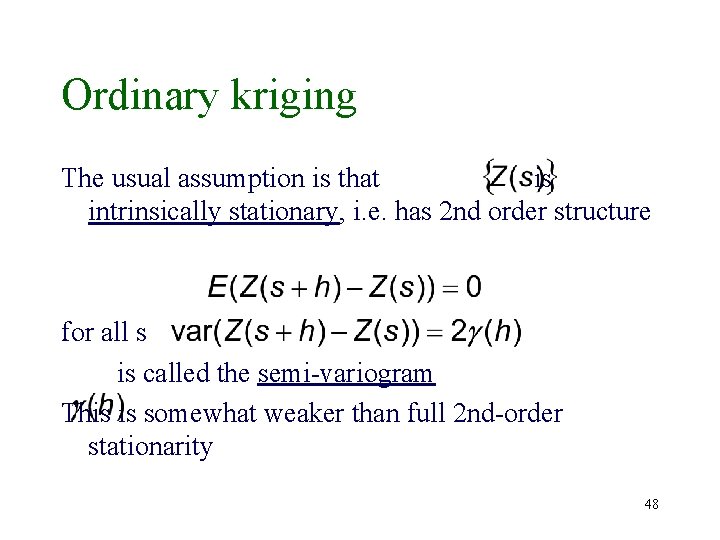
Ordinary kriging • is a random process, we have observations and we wish to predict , e. g. a “block average” • The usual basis is least-squares prediction, using a model for the mean and covariance of estimated from the data 47
Ordinary kriging The usual assumption is that is intrinsically stationary, i. e. has 2 nd order structure for all s is called the semi-variogram This is somewhat weaker than full 2 nd-order stationarity 48
Ordinary kriging The optimal solution to the prediction problem in terms of the semivariogram follows from standard linear algebra arguments; an empirical estimate of the semivariogram is then plugged in. 49
Variants of kriging Kriging without intrinsic stationarity (& a model instead of empirical estimates) Co-kriging (multivariate) Robust kriging Universal kriging (kriging with regression) Disjunctive (nonlinear) kriging Indicator kriging Connections with splines 50
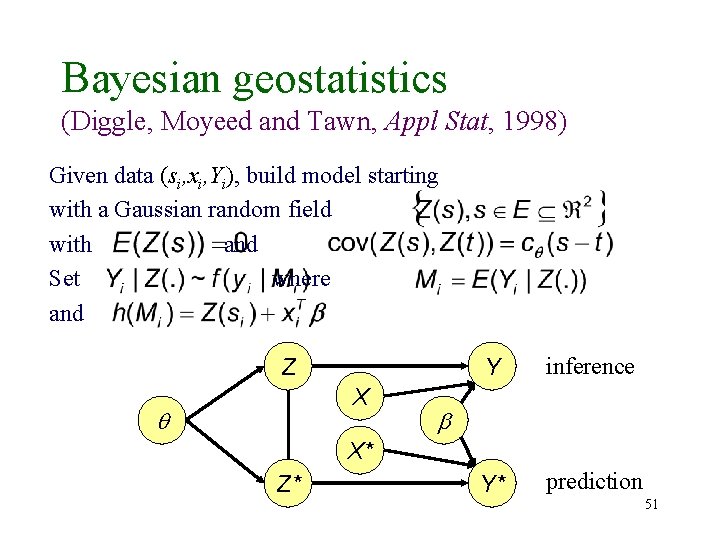
Bayesian geostatistics (Diggle, Moyeed and Tawn, Appl Stat, 1998) Given data (si, xi, Yi), build model starting with a Gaussian random field with and Set where and Z X Y inference Y* prediction X* Z* 51
Point data 52
Point processes • • • (inhomogeneous) Poisson process Neyman-Scott process (log Gaussian) Cox process Gibbs point process Markov point process Area-interaction process 53
Analysis of spatial point pattern • Very strong early emphasis on modelling clustering and repelling alternatives to homogeneous Poisson process (complete spatial randomness) • May be different effects at different scales • Interpretations in terms of mechanisms, e. g. in ecology, forestry 54
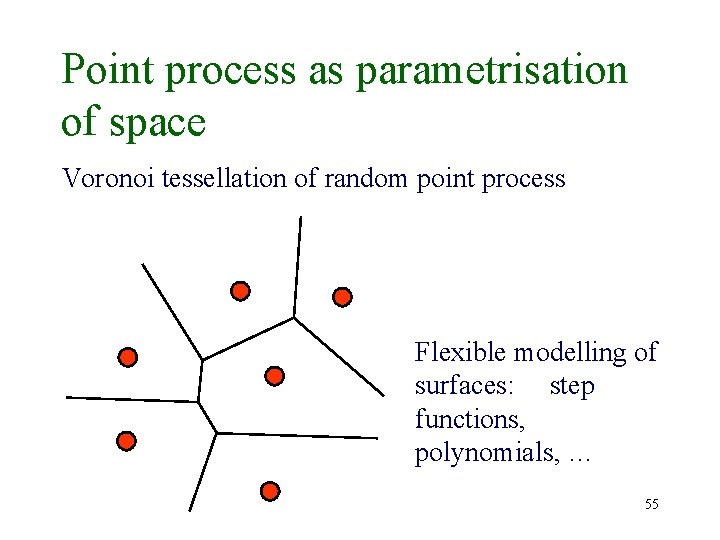
Point process as parametrisation of space Voronoi tessellation of random point process Flexible modelling of surfaces: step functions, polynomials, … 55
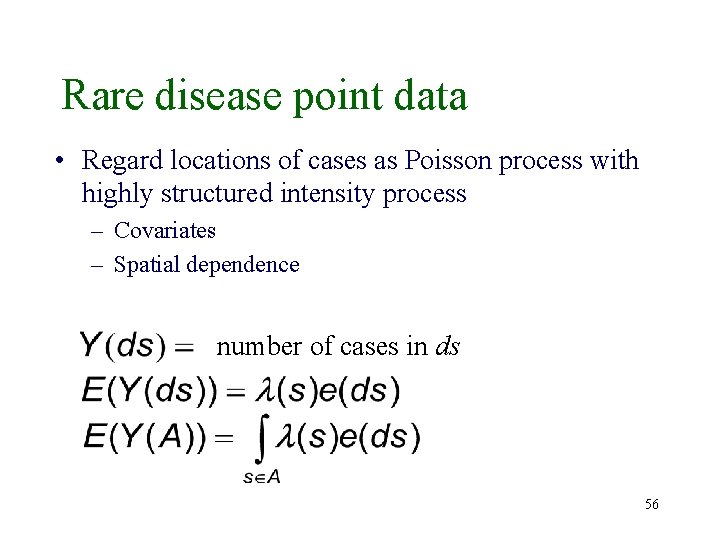
Rare disease point data • Regard locations of cases as Poisson process with highly structured intensity process – Covariates – Spatial dependence number of cases in ds 56
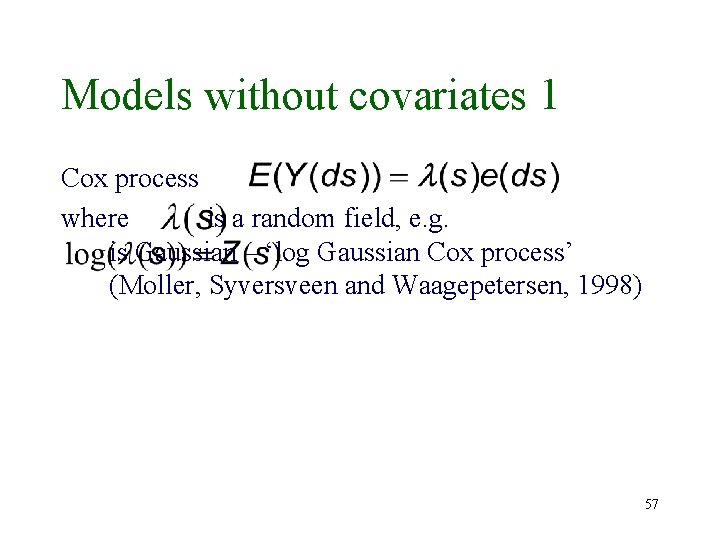
Models without covariates 1 Cox process where is a random field, e. g. is Gaussian – ‘log Gaussian Cox process’ (Moller, Syversveen and Waagepetersen, 1998) 57
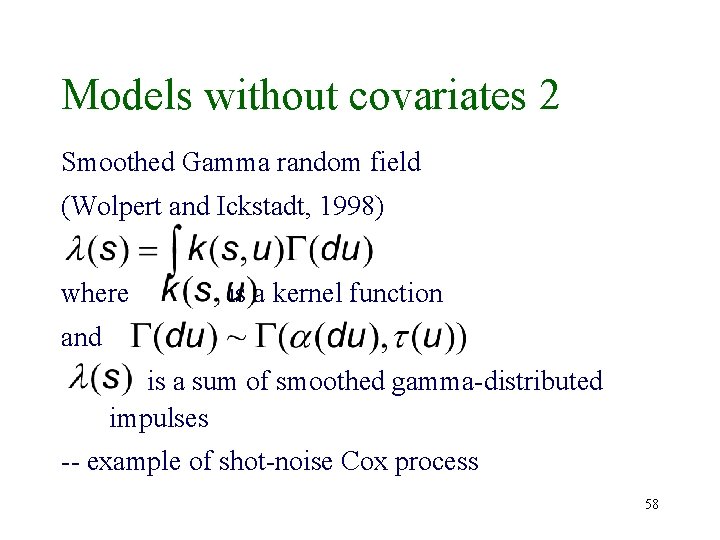
Models without covariates 2 Smoothed Gamma random field (Wolpert and Ickstadt, 1998) where is a kernel function and is a sum of smoothed gamma-distributed impulses -- example of shot-noise Cox process 58
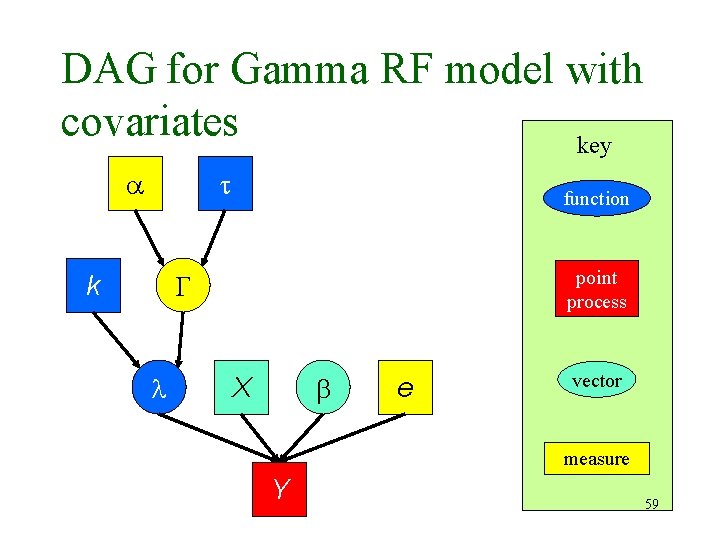
DAG for Gamma RF model with covariates key function point process k X e vector measure Y 59
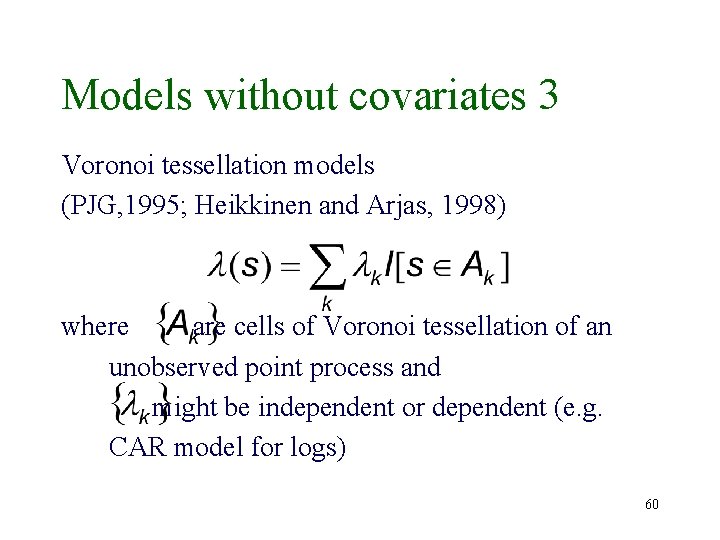
Models without covariates 3 Voronoi tessellation models (PJG, 1995; Heikkinen and Arjas, 1998) where are cells of Voronoi tessellation of an unobserved point process and might be independent or dependent (e. g. CAR model for logs) 60
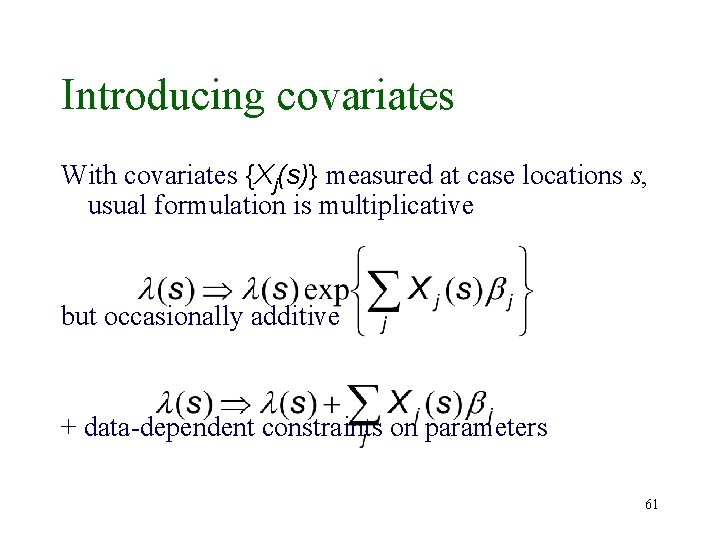
Introducing covariates With covariates {Xj(s)} measured at case locations s, usual formulation is multiplicative but occasionally additive + data-dependent constraints on parameters 61
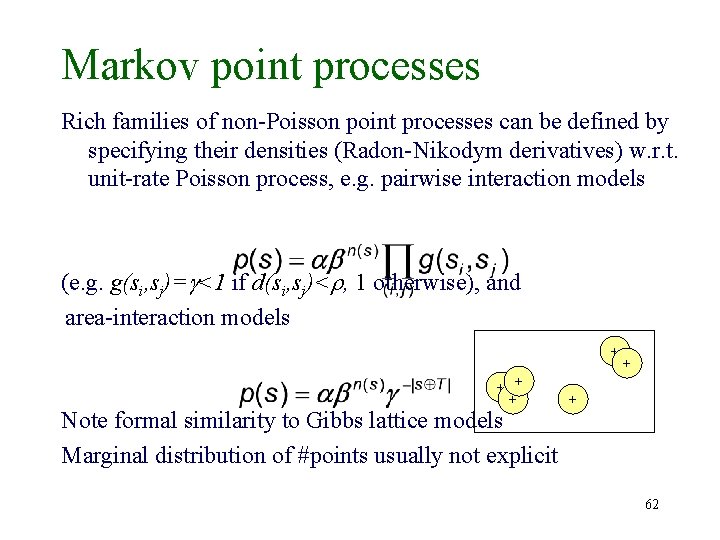
Markov point processes Rich families of non-Poisson point processes can be defined by specifying their densities (Radon-Nikodym derivatives) w. r. t. unit-rate Poisson process, e. g. pairwise interaction models (e. g. g(si, sj)= <1 if d(si, sj)< , 1 otherwise), and area-interaction models + + Note formal similarity to Gibbs lattice models Marginal distribution of #points usually not explicit + + 62
Object processes • Poisson processes of objects (lines, planes, flats, …. ) • Coloured triangulations…. 63
Aggregation 64
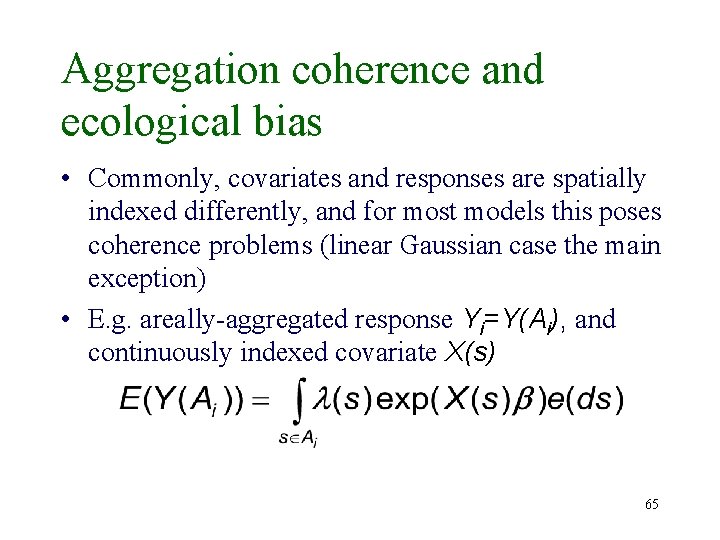
Aggregation coherence and ecological bias • Commonly, covariates and responses are spatially indexed differently, and for most models this poses coherence problems (linear Gaussian case the main exception) • E. g. areally-aggregated response Yi=Y(Ai), and continuously indexed covariate X(s) 65
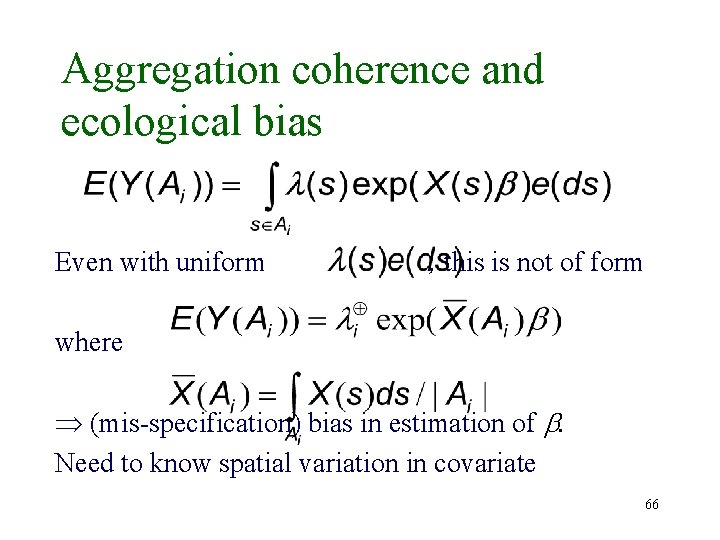
Aggregation coherence and ecological bias Even with uniform , this is not of form where (mis-specification) bias in estimation of . Need to know spatial variation in covariate 66
Aggregation coherence and ecological bias Additive formulation avoids this problem, as does the Ickstadt and Wolpert approach, to some extent 67
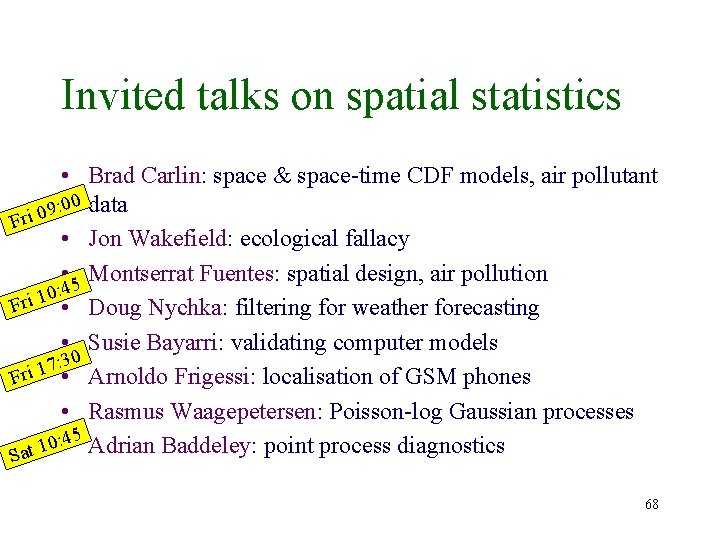
Invited talks on spatial statistics • Brad Carlin: space & space-time CDF models, air pollutant : 00 data 9 0 i Fr • Jon Wakefield: ecological fallacy • 5 Montserrat Fuentes: spatial design, air pollution : 4 0 1 i Fr • Doug Nychka: filtering for weather forecasting • Susie Bayarri: validating computer models : 30 7 1 i • Arnoldo Frigessi: localisation of GSM phones Fr • Rasmus Waagepetersen: Poisson-log Gaussian processes 45 Adrian Baddeley: point process diagnostics : 0 1 • Sat 68
Spatial processes and statistical modelling Peter Green University of Bristol, UK IMS/ISBA, San Juan, 24 July 2003 P. J. Green@bristol. ac. uk http: //www. stats. bris. ac. uk/~peter/PR 69