
Spatial NLI A Spatial Domain Natural Language Interface
- Slides: 19
Spatial. NLI A Spatial Domain Natural Language Interface to Databases Using Spatial Comprehension Wenlu Wang, Jingjing Li
01 Motivation 03 Implementation Details 02 Challenges 04 Experiments 2
Motivation • It requires certain knowledge to query a database. Ø Relational DBMS uses SQL. Ø Mongo. DB uses Java. Script. • We aim to eliminate the need for users to possess knowledge about query languages. • We want to bridge the gap between humans and machine intelligence. 3
01 03 Motivation Implementation Details 02 Challenges 04 Experiments 4
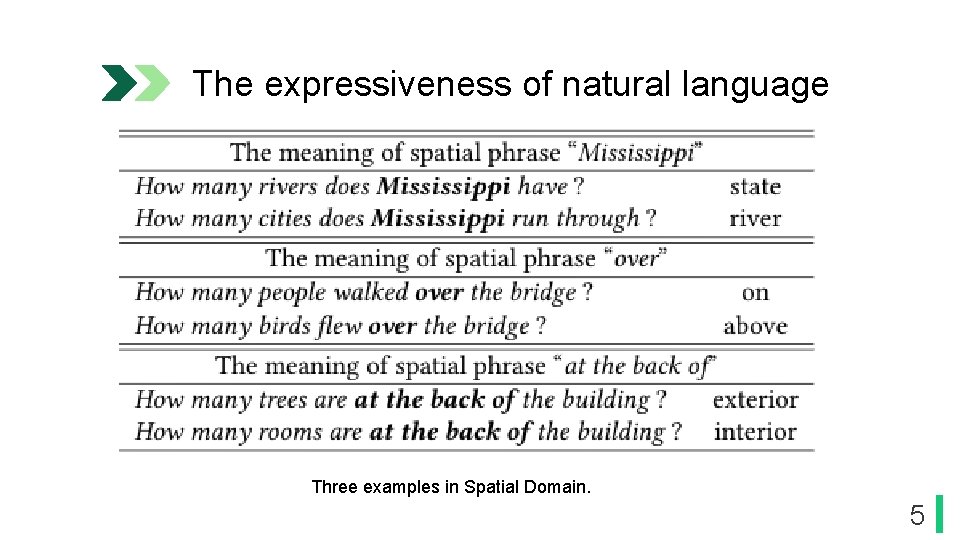
The expressiveness of natural language Three examples in Spatial Domain. 5
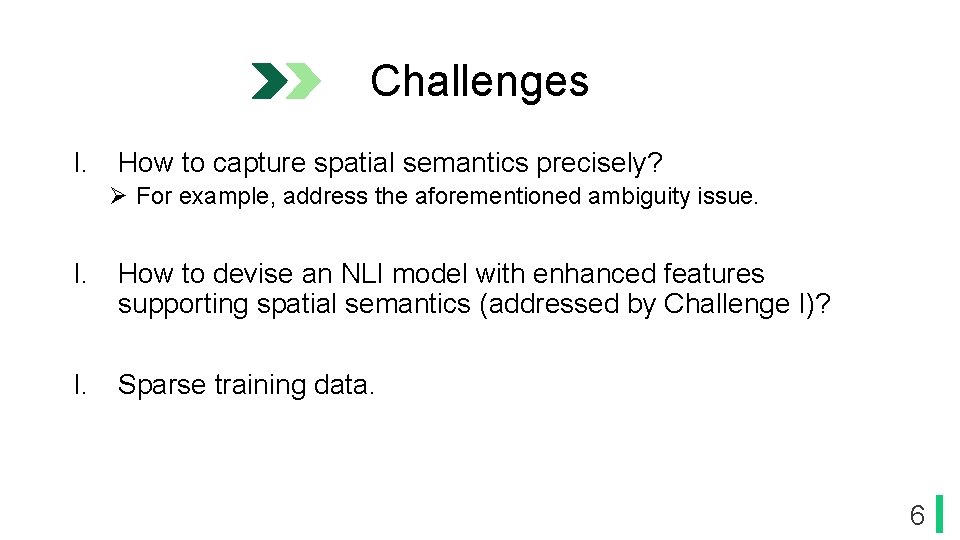
Challenges I. How to capture spatial semantics precisely? Ø For example, address the aforementioned ambiguity issue. I. How to devise an NLI model with enhanced features supporting spatial semantics (addressed by Challenge I)? I. Sparse training data. 6
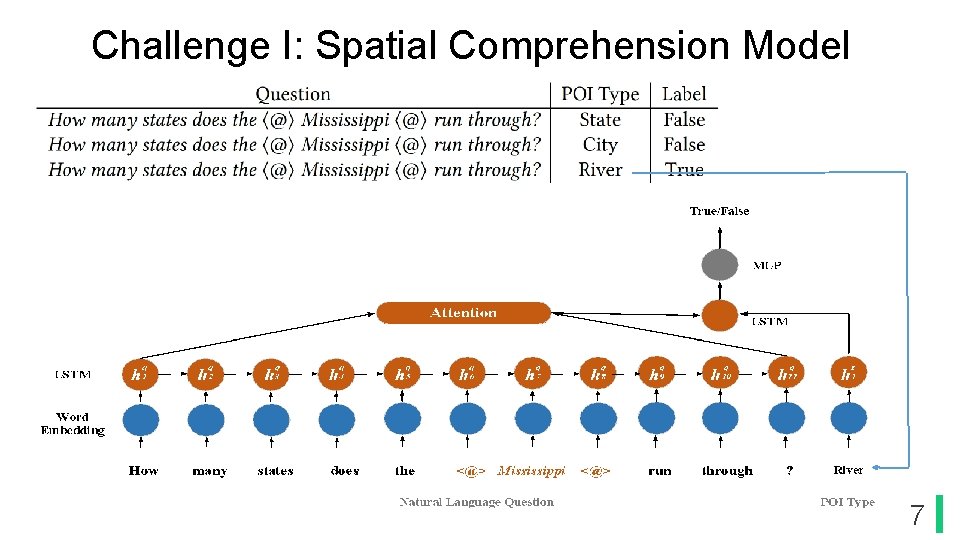
Challenge I: Spatial Comprehension Model 7
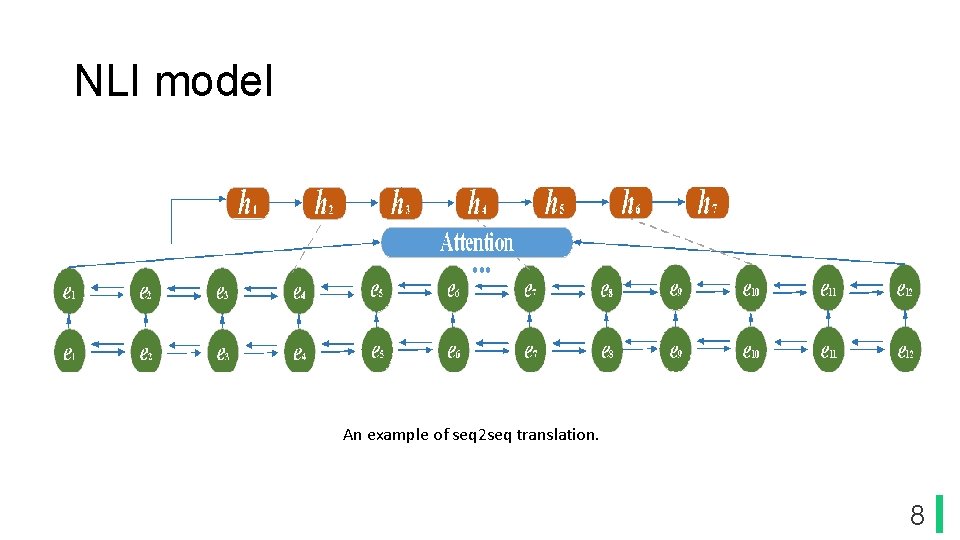
NLI model An example of seq 2 seq translation. 8
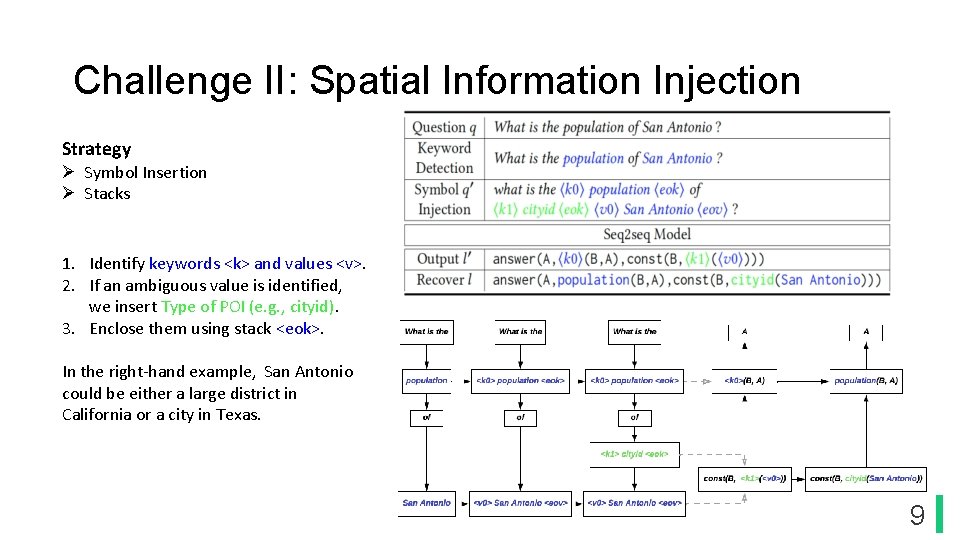
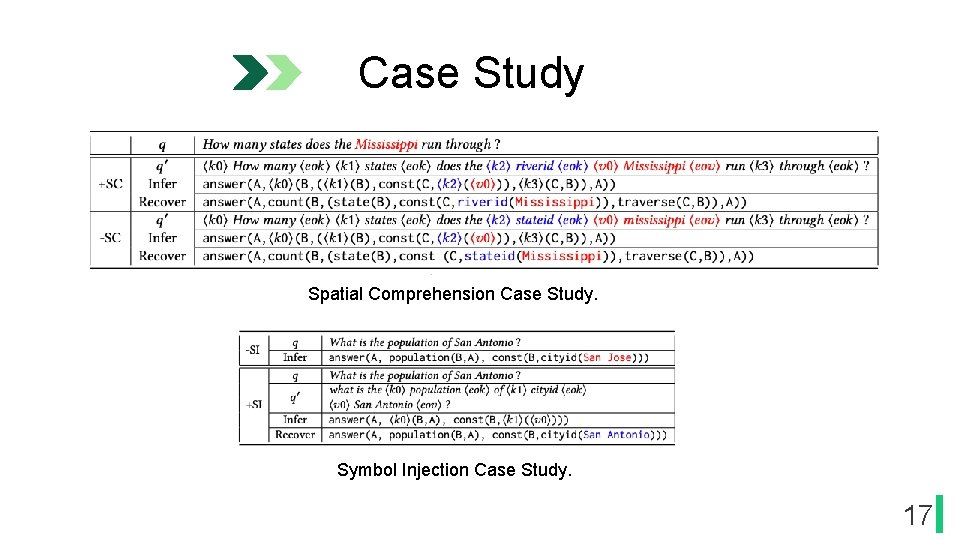
Challenge II: Spatial Information Injection Strategy Ø Symbol Insertion Ø Stacks 1. Identify keywords <k> and values <v>. 2. If an ambiguous value is identified, we insert Type of POI (e. g. , cityid). 3. Enclose them using stack <eok>. In the right-hand example, San Antonio could be either a large district in California or a city in Texas. 9
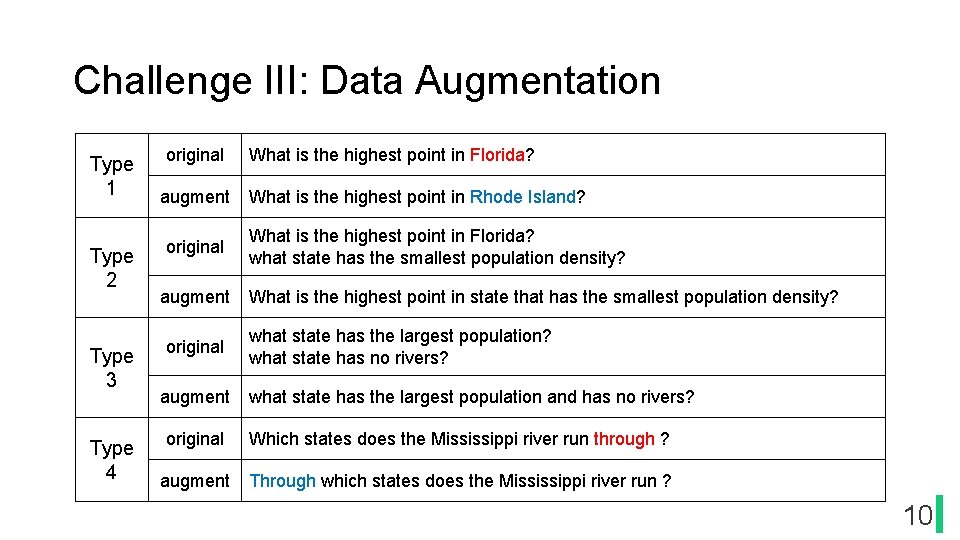
Challenge III: Data Augmentation Type 1 Type 2 Type 3 Type 4 original augment What is the highest point in Florida? What is the highest point in Rhode Island? What is the highest point in Florida? what state has the smallest population density? What is the highest point in state that has the smallest population density? what state has the largest population? what state has no rivers? what state has the largest population and has no rivers? original Which states does the Mississippi river run through ? augment Through which states does the Mississippi river run ? 10
01 03 Motivation Implementation Details 02 04 Challenges Experiments 11
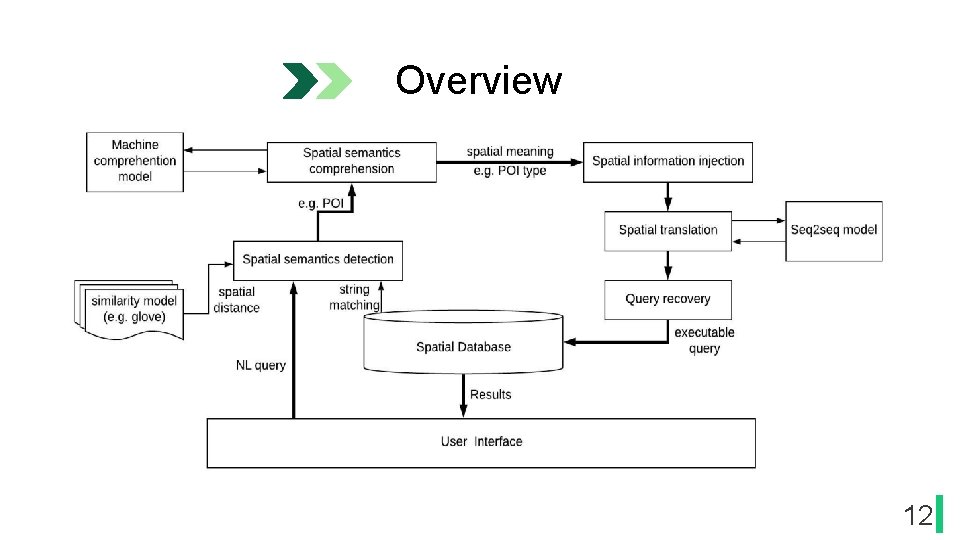
Overview 12
01 Motivation 03 Implementation Details 02 4 Challenges Experiments 13
Datasets • Geoquery A collection of 880 natural language questions and corresponding executable database query pairs about U. S. geography. • Restaurant A dataset with 251 question-answer pairs about restaurants, their food types, and locations 14
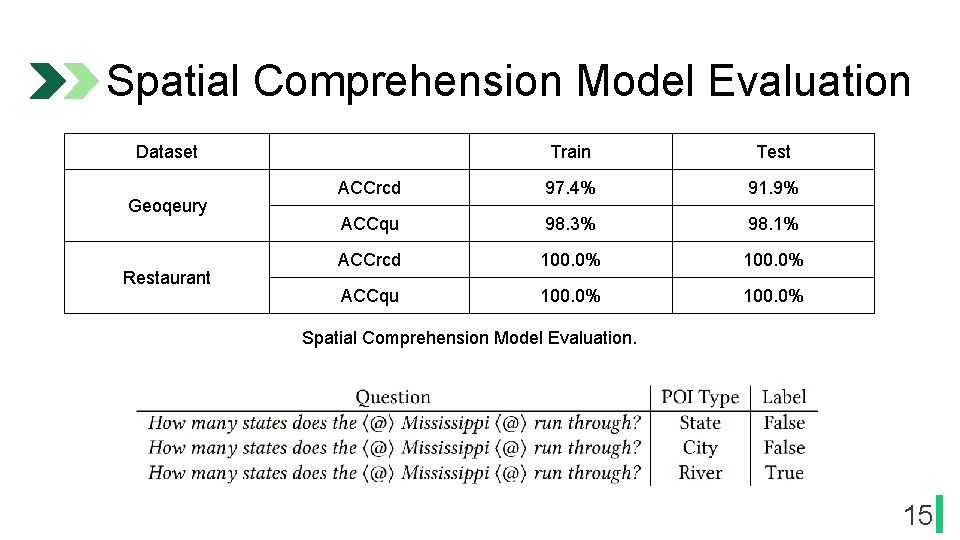
Spatial Comprehension Model Evaluation Dataset Geoqeury Restaurant Train Test ACCrcd 97. 4% 91. 9% ACCqu 98. 3% 98. 1% ACCrcd 100. 0% ACCqu 100. 0% Spatial Comprehension Model Evaluation. 15
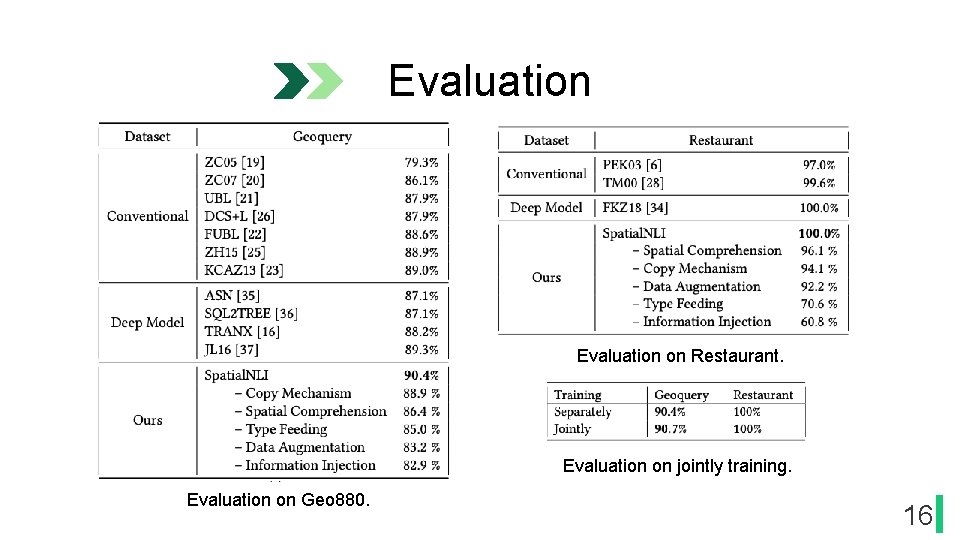
Evaluation on Restaurant. Evaluation on jointly training. Evaluation on Geo 880. 16
Case Study Spatial Comprehension Case Study. Symbol Injection Case Study. 17
Conclusion • We propose a spatial comprehension model that is able to recognize the meaning of an ambiguous spatial phrase based on contextual interpretation. • After injecting spatial semantics learned from spatial comprehension into the question, our model outperforms the state-of-the-art. • We evaluate our strategies systematically and show that our spatial comprehension model and injection format perform well as expected. 18
Thank you 19