
Spatial Interpretation 1 Definition A procedure of estimating


- Slides: 32
Spatial Interpretation
1. Definition ► A procedure of estimating the values of properties at un-sampled sites ► The property may be interval/ratio values, can be nominal and ordinal ► The rational behind is that points close together in space are more likely to have similar values than points far apart
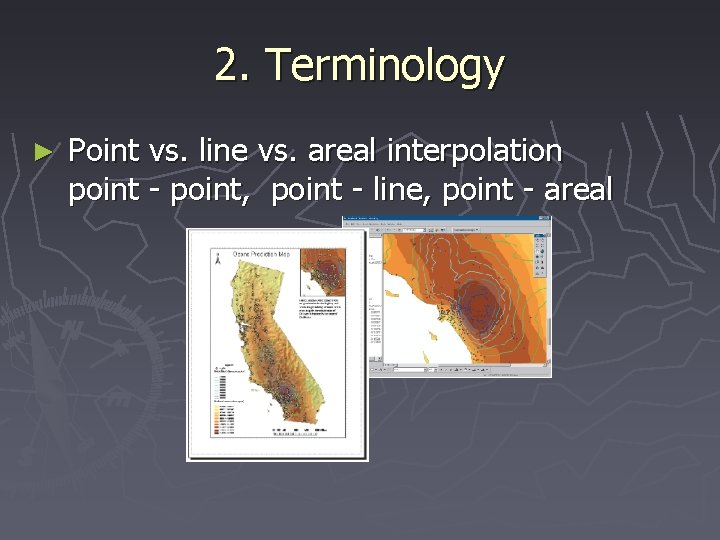
2. Terminology ► Point vs. line vs. areal interpolation point - point, point - line, point - areal
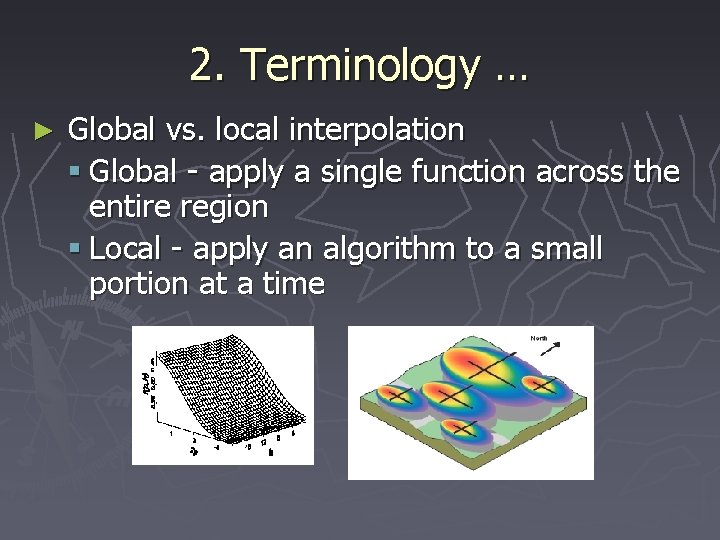
2. Terminology … ► Global vs. local interpolation § Global - apply a single function across the entire region § Local - apply an algorithm to a small portion at a time
2. Terminology … ► Exact vs. approximate interpolation § exact - honor the original points § approximate - when uncertainty is involved in the data ► Gradual vs. abrupt
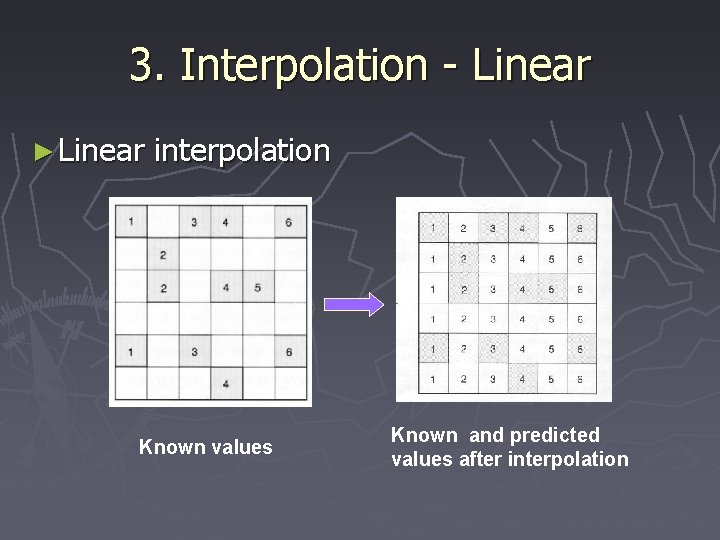
3. Interpolation - Linear ► Linear interpolation Known values Known and predicted values after interpolation
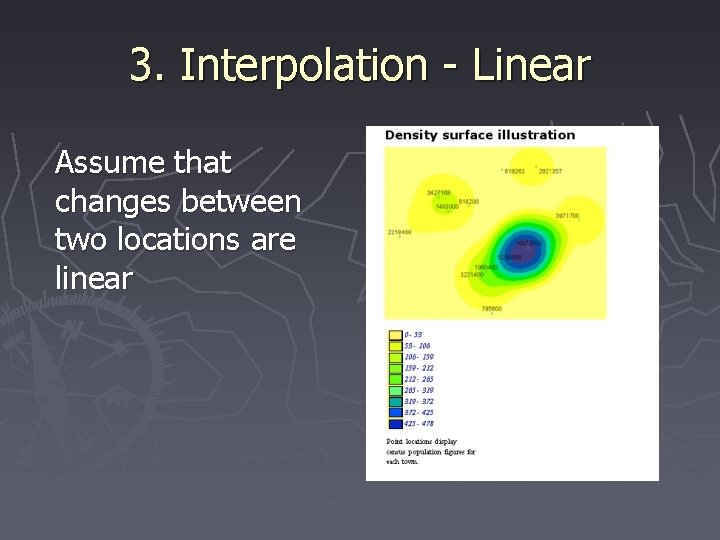
3. Interpolation - Linear Assume that changes between two locations are linear
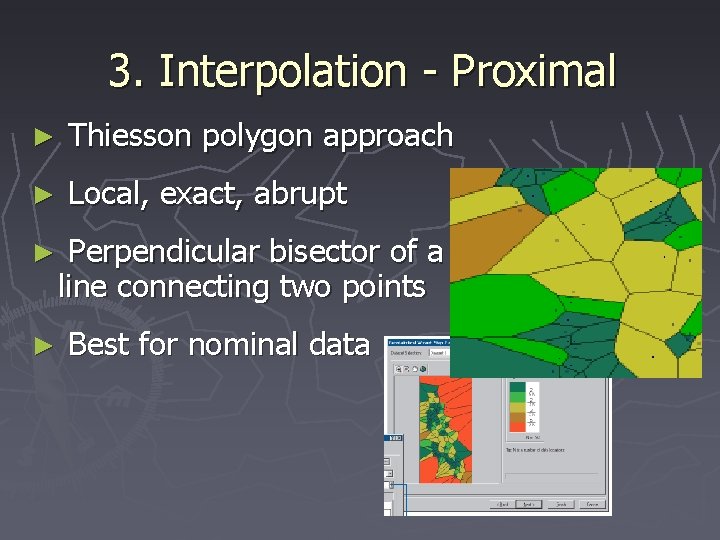
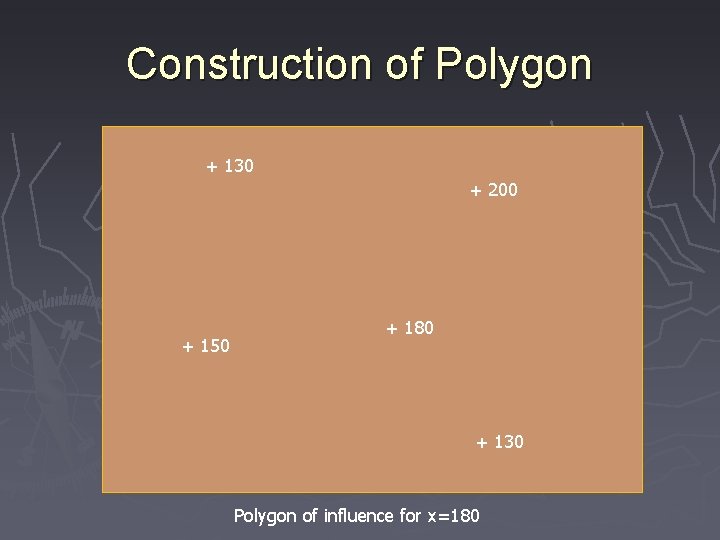
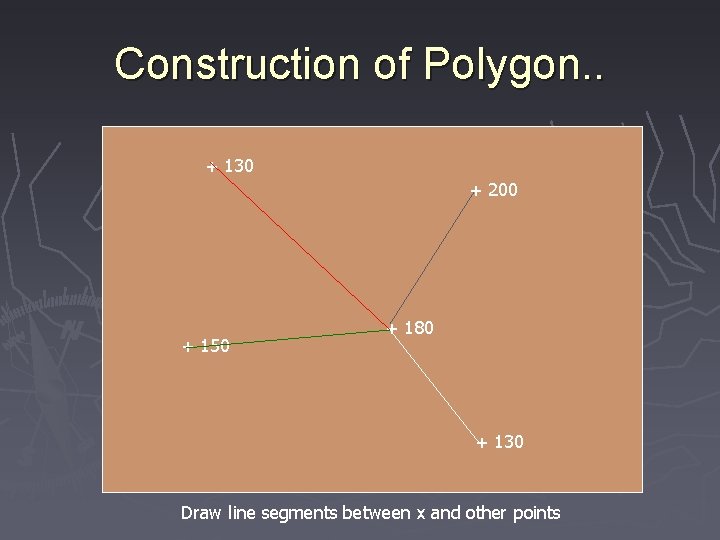
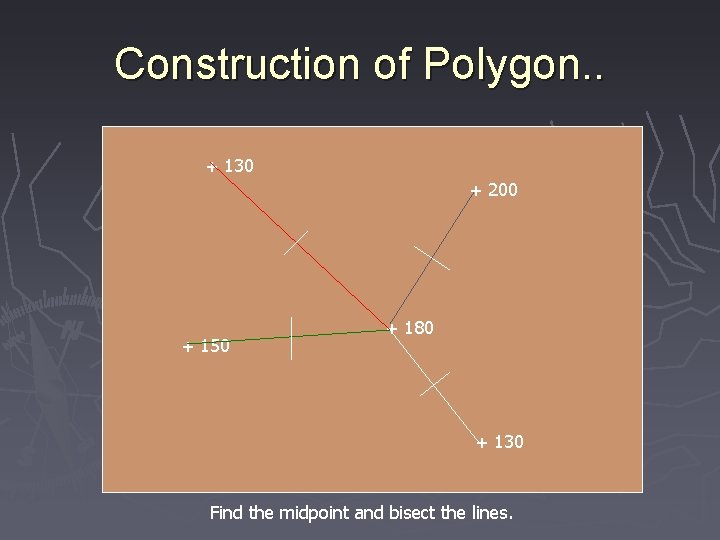
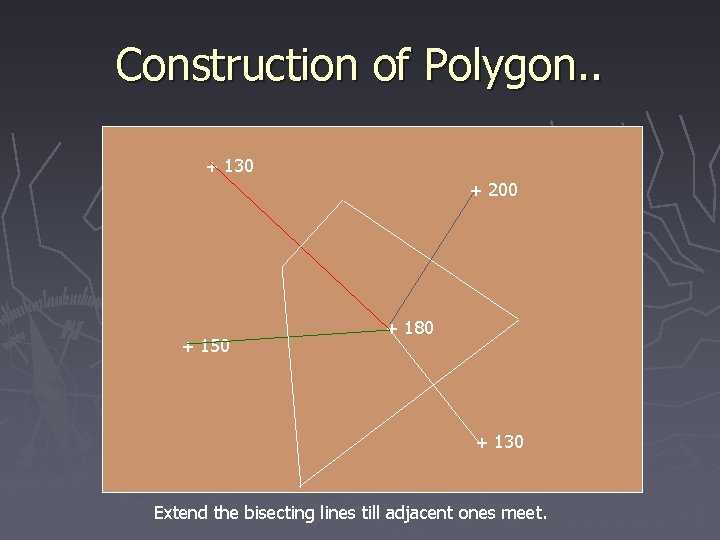
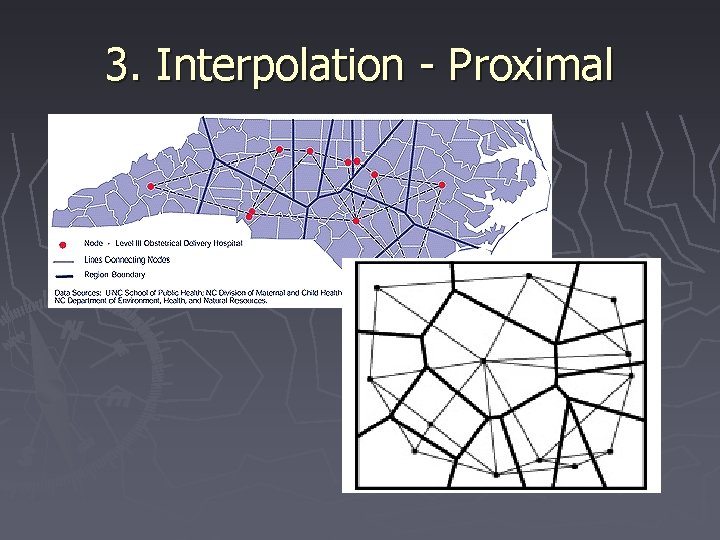
3. Interpolation - Proximal ► Thiesson polygon approach ► Local, exact, abrupt ► ► Perpendicular bisector of a line connecting two points Best for nominal data
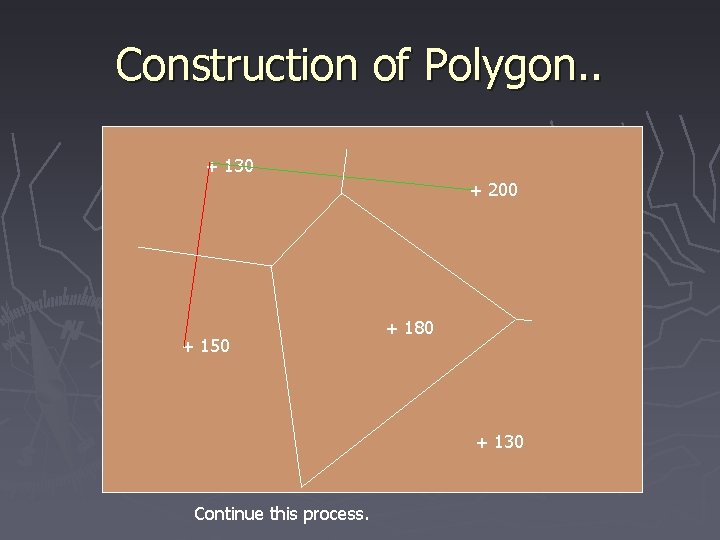
Construction of Polygon + 130 + 200 + 150 + 180 + 130 Polygon of influence for x=180
Construction of Polygon. . + 130 + 200 + 150 + 180 + 130 Draw line segments between x and other points
Construction of Polygon. . + 130 + 200 + 150 + 180 + 130 Find the midpoint and bisect the lines.
Construction of Polygon. . + 130 + 200 + 150 + 180 + 130 Extend the bisecting lines till adjacent ones meet.
Construction of Polygon. . + 130 + 200 + 150 + 180 + 130 Continue this process.
3. Interpolation - Proximal
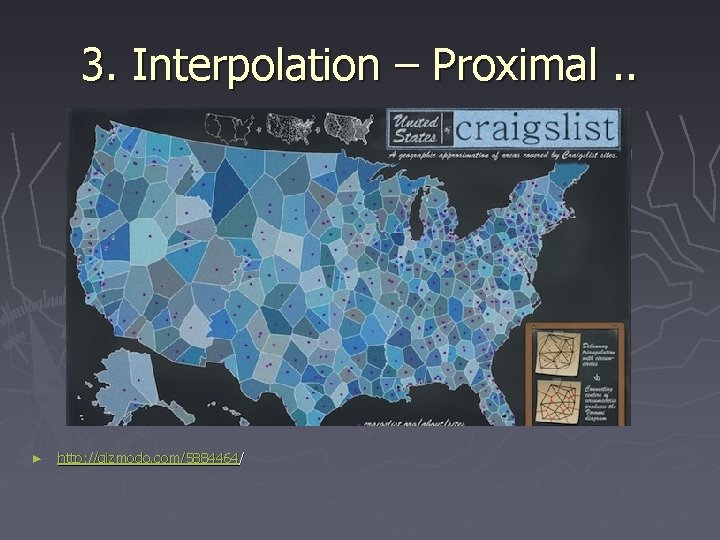
3. Interpolation – Proximal. . ► http: //gizmodo. com/5884464/
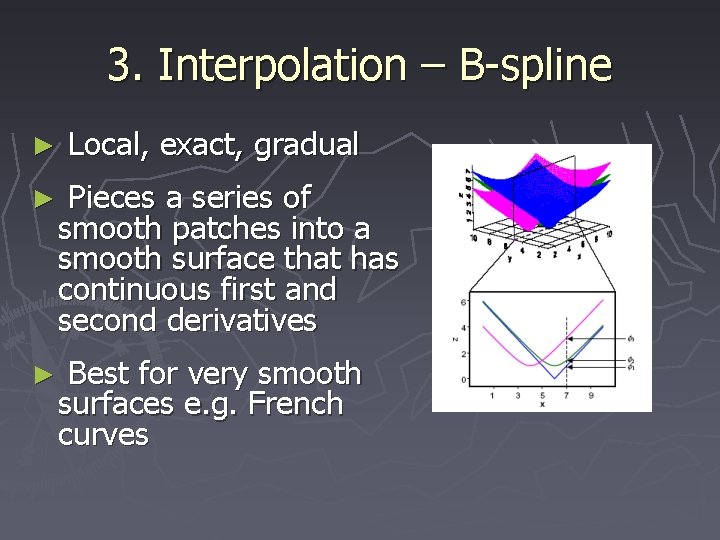
3. Interpolation – B-spline ► Local, exact, gradual ► Pieces a series of smooth patches into a smooth surface that has continuous first and second derivatives ► Best for very smooth surfaces e. g. French curves
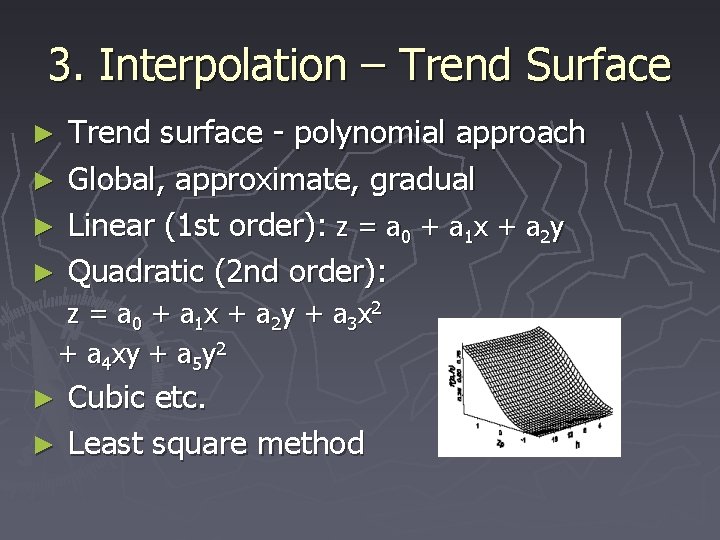
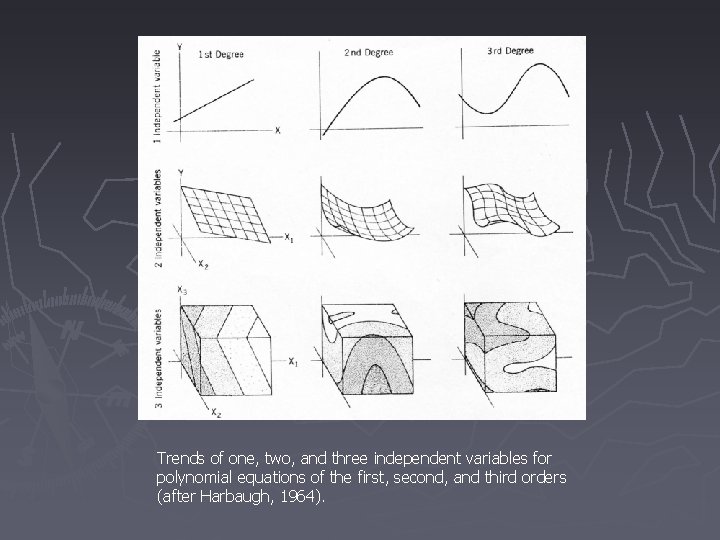
3. Interpolation – Trend Surface ► ► Trend surface - polynomial approach Global, approximate, gradual Linear (1 st order): z = a 0 + a 1 x + a 2 y Quadratic (2 nd order): z = a 0 + a 1 x + a 2 y + a 3 x 2 + a 4 xy + a 5 y 2 Cubic etc. ► Least square method ►
Trends of one, two, and three independent variables for polynomial equations of the first, second, and third orders (after Harbaugh, 1964).
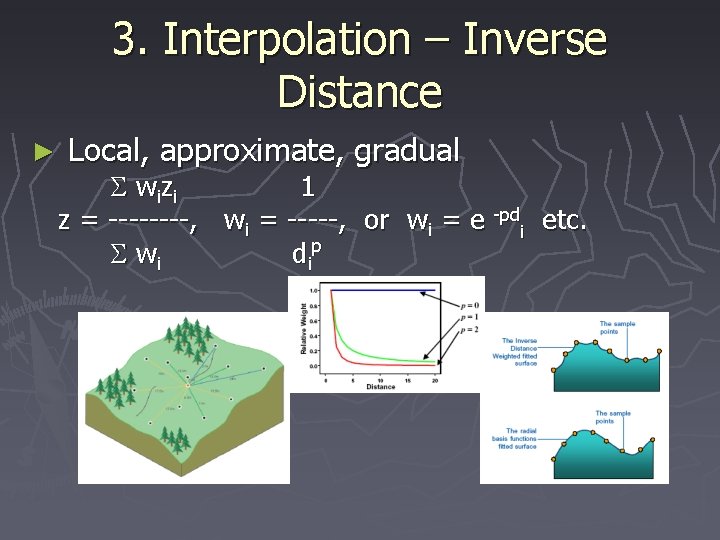
3. Interpolation – Inverse Distance ► Local, approximate, gradual S w izi 1 z = ----, wi = -----, or wi = e -pdi etc. S wi d ip
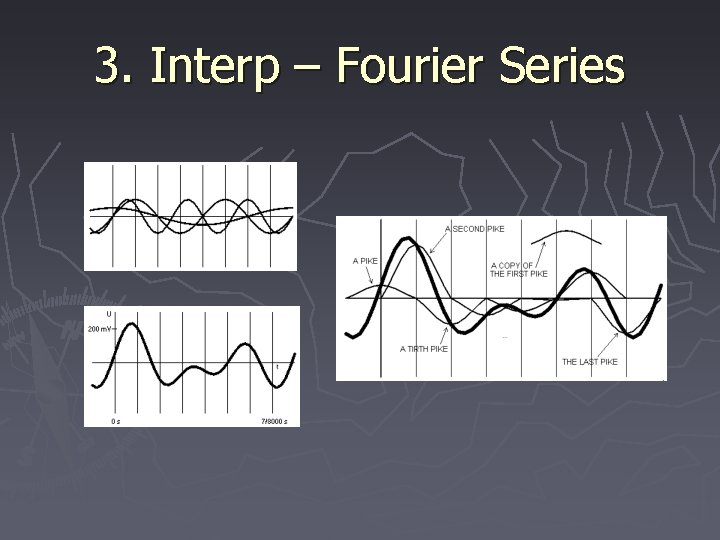
3. Interp – Fourier Series Sine and cosine approach ► Global, approximate, gradual ► Overlay of a series of sine and cosine curves ► Best for data showing periodicity ►
3. Interp – Fourier Series
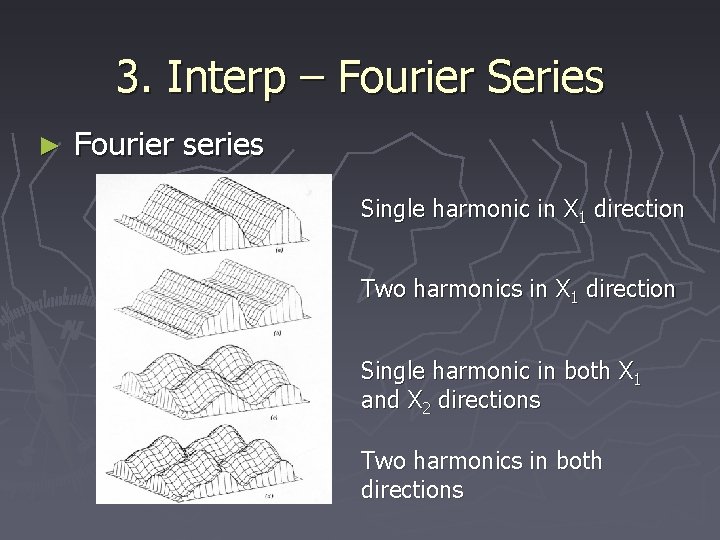
3. Interp – Fourier Series ► Fourier series Single harmonic in X 1 direction Two harmonics in X 1 direction Single harmonic in both X 1 and X 2 directions Two harmonics in both directions
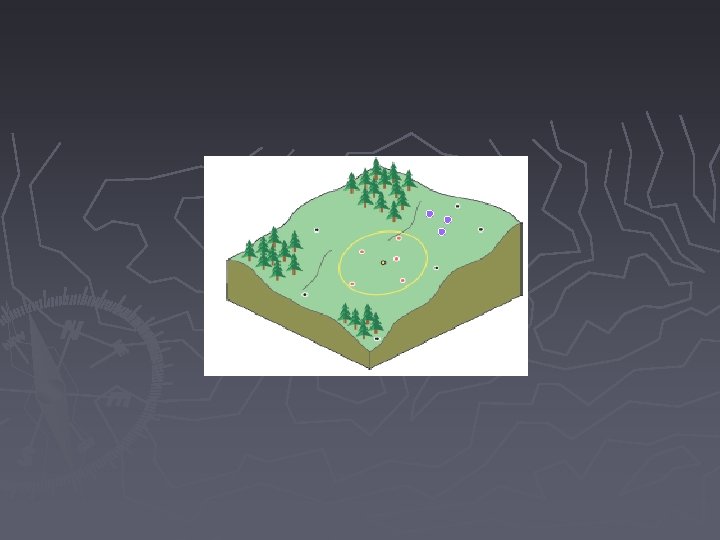
3. Interp - Kriging - semivariogram approach, D. G. Krige ► Local, exact, gradual ► Spatial dependence (spatial autocorrelation) ► Regionalized variable theory, by Georges Matheron ► A situation between truly random and deterministic ► Stationary vs. non-stationary ►
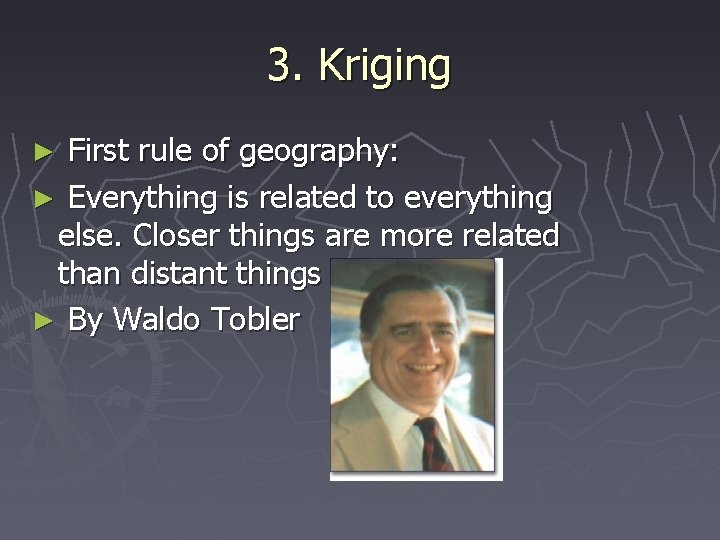
3. Kriging First rule of geography: ► Everything is related to everything else. Closer things are more related than distant things ► By Waldo Tobler ►
3. Interp - Kriging ► Semivariogram 1 n g(h) = ------ S (Zi - Zi+h)2 2 n i=1 Sill, range, nugget Semivariance ► Sill Range Lag distance (h)
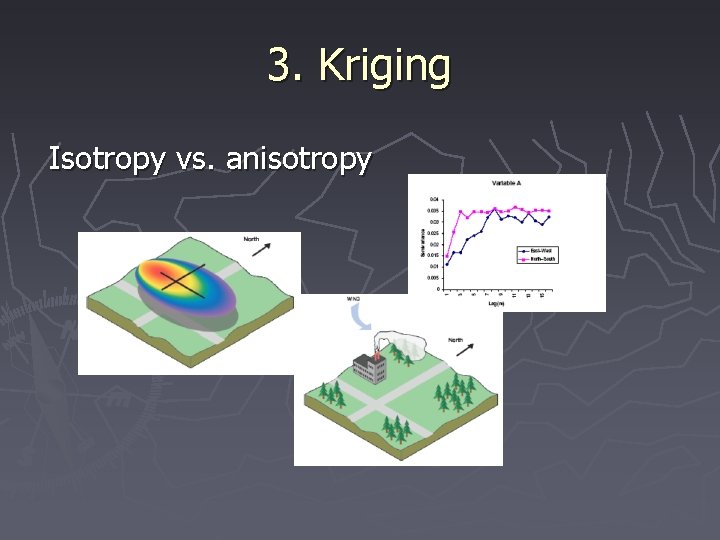
3. Kriging Isotropy vs. anisotropy
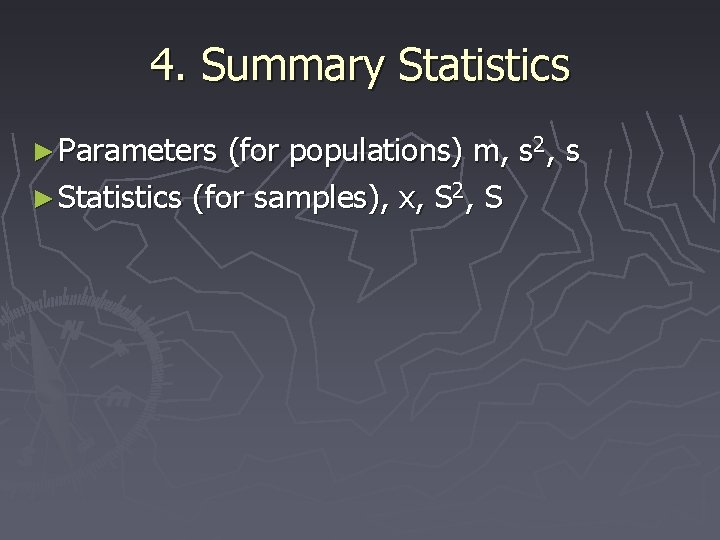
4. Summary Statistics ► Parameters (for populations) m, s 2, s ► Statistics (for samples), x, S 2, S
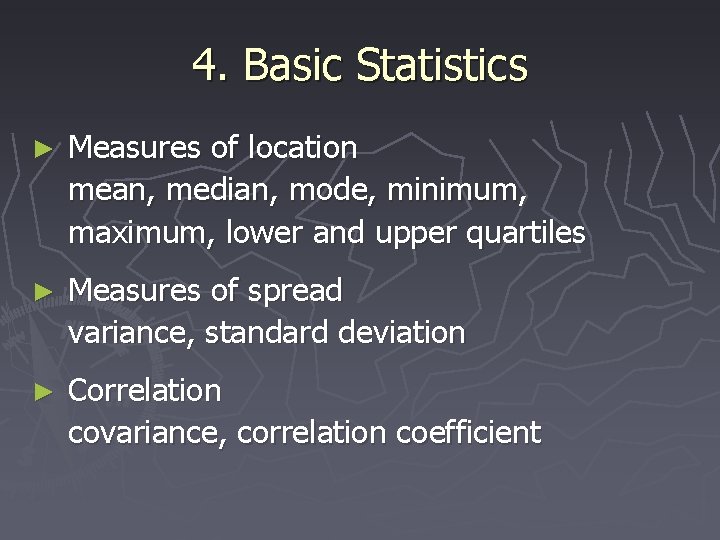
4. Basic Statistics ► Measures of location mean, median, mode, minimum, maximum, lower and upper quartiles ► Measures of spread variance, standard deviation ► Correlation covariance, correlation coefficient