
Spatial heterogeneity and environmental controllers of soil organic
- Slides: 1
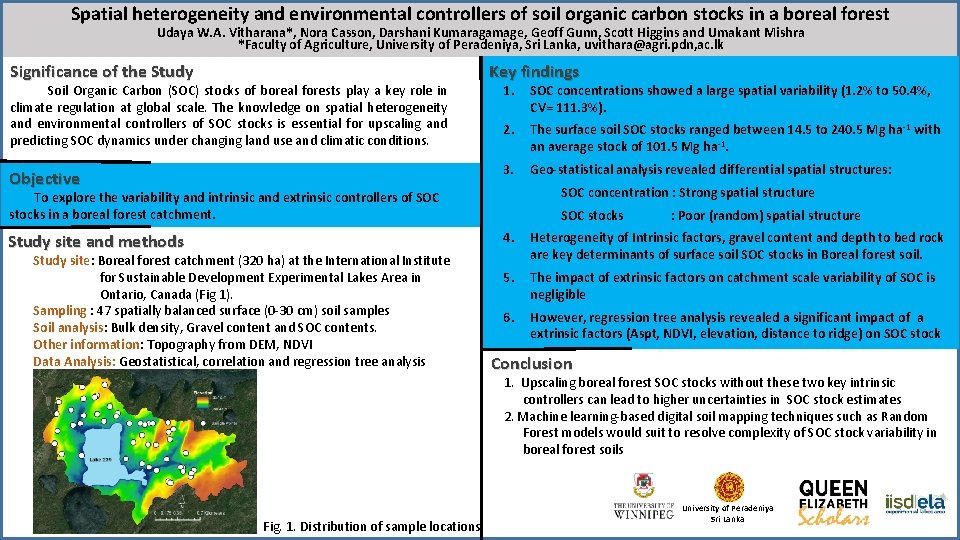
Spatial heterogeneity and environmental controllers of soil organic carbon stocks in a boreal forest Udaya W. A. Vitharana*, Nora Casson, Darshani Kumaragamage, Geoff Gunn, Scott Higgins and Umakant Mishra *Faculty of Agriculture, University of Peradeniya, Sri Lanka, uvithara@agri. pdn, ac. lk Significance of the Study Soil Organic Carbon (SOC) stocks of boreal forests play a key role in climate regulation at global scale. The knowledge on spatial heterogeneity and environmental controllers of SOC stocks is essential for upscaling and predicting SOC dynamics under changing land use and climatic conditions. Objective Key findings 1. SOC concentrations showed a large spatial variability (1. 2% to 50. 4%, CV= 111. 3%). 2. The surface soil SOC stocks ranged between 14. 5 to 240. 5 Mg ha-1 with an average stock of 101. 5 Mg ha-1. 3. Geo-statistical analysis revealed differential spatial structures: SOC concentration : Strong spatial structure To explore the variability and intrinsic and extrinsic controllers of SOC stocks in a boreal forest catchment. Study site and methods Study site: Boreal forest catchment (320 ha) at the International Institute for Sustainable Development Experimental Lakes Area in Ontario, Canada (Fig 1). Sampling : 47 spatially balanced surface (0 -30 cm) soil samples Soil analysis: Bulk density, Gravel content and SOC contents. Other information: Topography from DEM, NDVI Data Analysis: Geostatistical, correlation and regression tree analysis SOC stocks : Poor (random) spatial structure 4. Heterogeneity of Intrinsic factors, gravel content and depth to bed rock are key determinants of surface soil SOC stocks in Boreal forest soil. 5. The impact of extrinsic factors on catchment scale variability of SOC is negligible 6. However, regression tree analysis revealed a significant impact of a extrinsic factors (Aspt, NDVI, elevation, distance to ridge) on SOC stock Conclusion 1. Upscaling boreal forest SOC stocks without these two key intrinsic controllers can lead to higher uncertainties in SOC stock estimates 2. Machine learning-based digital soil mapping techniques such as Random Forest models would suit to resolve complexity of SOC stock variability in boreal forest soils Fig. 1. Distribution of sample locations University of Peradeniya Sri Lanka