
Spatial Data Analysis Intro to Spatial Statistical Concepts
- Slides: 11
Spatial Data Analysis: Intro to Spatial Statistical Concepts Scott Bell GIS Institute
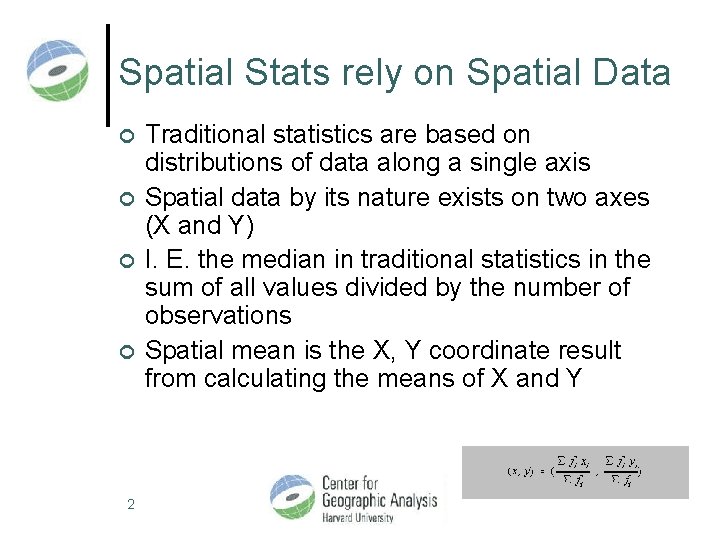
Spatial Stats rely on Spatial Data ¢ ¢ 2 Traditional statistics are based on distributions of data along a single axis Spatial data by its nature exists on two axes (X and Y) I. E. the median in traditional statistics in the sum of all values divided by the number of observations Spatial mean is the X, Y coordinate result from calculating the means of X and Y
Exploratory Spatial Data Analysis Used like descriptive statistics ¢ Potentially more options ¢ Related to Thematic Mapping and Geo-visualization ¢ Pattern identification/Hypothesis generation ¢ 3
Traditional vs Spatial “Independence of observations” Assumption ¢ Spatial Statistics operate on data that are assumed to be spatially dependent ¢ Spatial statistics (Spatial autocorrelation(SA)) have been developed to account for SA so distribution theory can be applied ¢ 4
Traditional vs Spatial ¢ “Replication” l ¢ ¢ In ability to replicate (and size and complexity of system) usually means our sample spatial data is the universe Distribution under null can be obtained by creating an experiment (environment) in which the null is true l 5 Spatial (and other systems) are complex and hard to replicate Precise Data Samples drawn from hypothetical universe l ¢ Assumption due to sample being universe it is virtually impossible to obtain the distribution under null hypothesis conditions
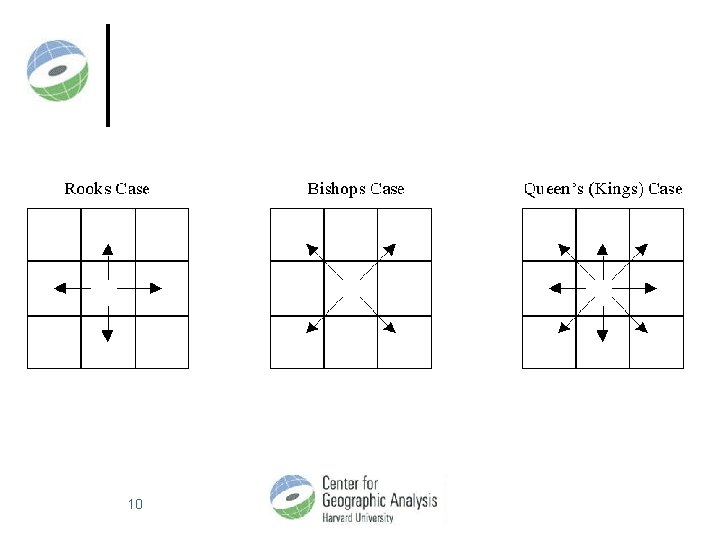
Spatial Autocorrelation ¢ ¢ ¢ What is it? Uses of spatial autocorrelation Types of spatial dependence l l l Distance K-nearest neighbors Contiguity • Rooks, bishops, and Kings cases “Everything is related to everything, but near things are more related. ” (Tobler, 1976) 6
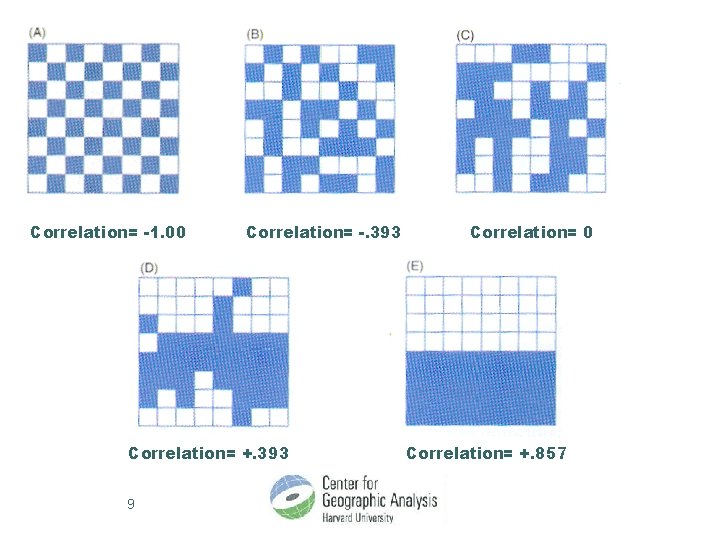
Spatial Autocorrelation Deal simultaneously with similarities in the location (space) of objects and their (non-spatial) attributes. (Goodchild, et. al. 2001) ¢ Similar location/Similar attribute = high spatial autocorrelation ¢ Similar location/dissimilar attributes = negative spatial autocorrelation ¢ Attributes are independent of location = zero/low correlation ¢ 7
8
Correlation= -1. 00 Correlation= -. 393 Correlation= +. 393 9 Correlation= 0 Correlation= +. 857
10
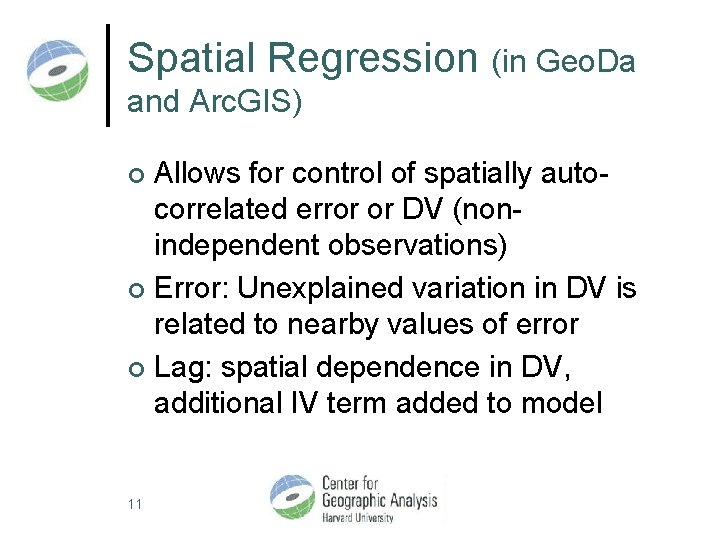
Spatial Regression (in Geo. Da and Arc. GIS) Allows for control of spatially autocorrelated error or DV (nonindependent observations) ¢ Error: Unexplained variation in DV is related to nearby values of error ¢ Lag: spatial dependence in DV, additional IV term added to model ¢ 11