
Spatial coding of the Predicted Impact Location of
- Slides: 15
Spatial coding of the Predicted Impact Location of a Looming* Object M. Neppi-Mòdona D. Auclair A. Sirigu B. J. -R. Duhamel
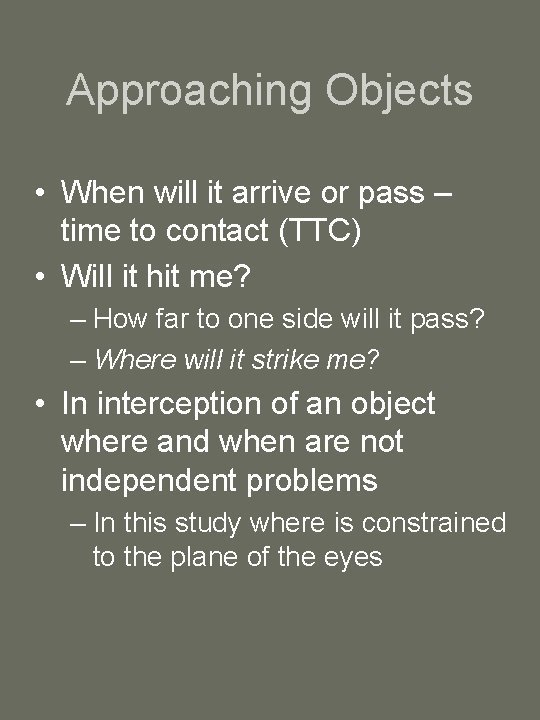
Approaching Objects • When will it arrive or pass – time to contact (TTC) • Will it hit me? – How far to one side will it pass? – Where will it strike me? • In interception of an object where and when are not independent problems – In this study where is constrained to the plane of the eyes
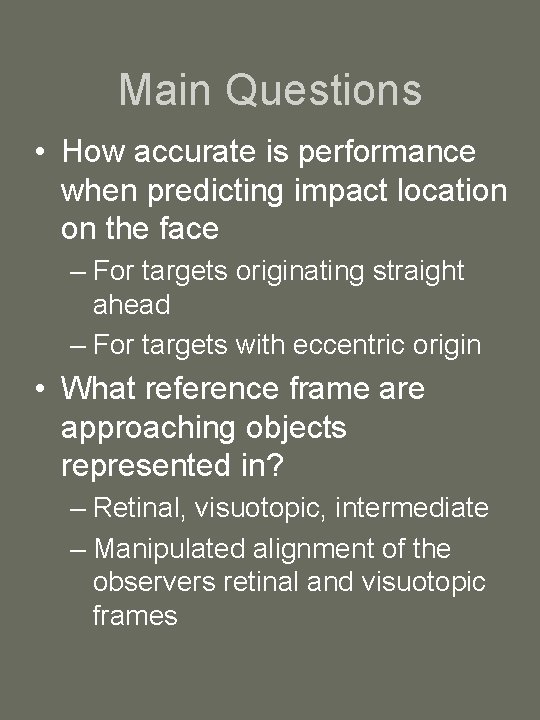
Main Questions • How accurate is performance when predicting impact location on the face – For targets originating straight ahead – For targets with eccentric origin • What reference frame are approaching objects represented in? – Retinal, visuotopic, intermediate – Manipulated alignment of the observers retinal and visuotopic frames
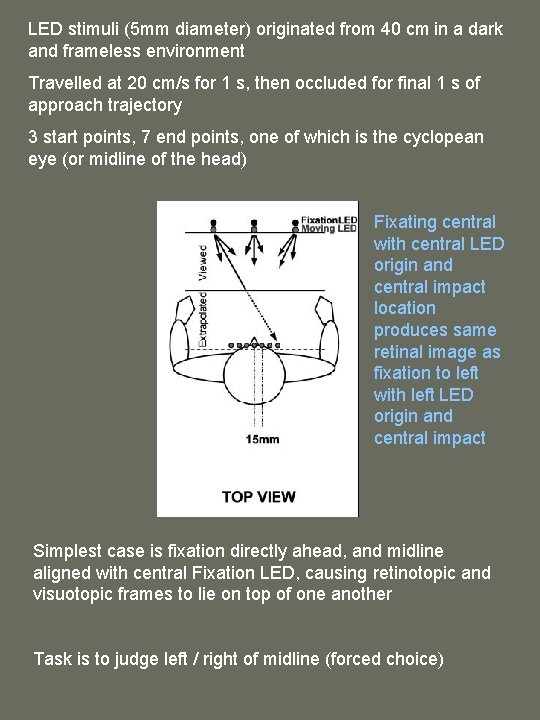
LED stimuli (5 mm diameter) originated from 40 cm in a dark and frameless environment Travelled at 20 cm/s for 1 s, then occluded for final 1 s of approach trajectory 3 start points, 7 end points, one of which is the cyclopean eye (or midline of the head) Fixating central with central LED origin and central impact location produces same retinal image as fixation to left with left LED origin and central impact Simplest case is fixation directly ahead, and midline aligned with central Fixation LED, causing retinotopic and visuotopic frames to lie on top of one another Task is to judge left / right of midline (forced choice)
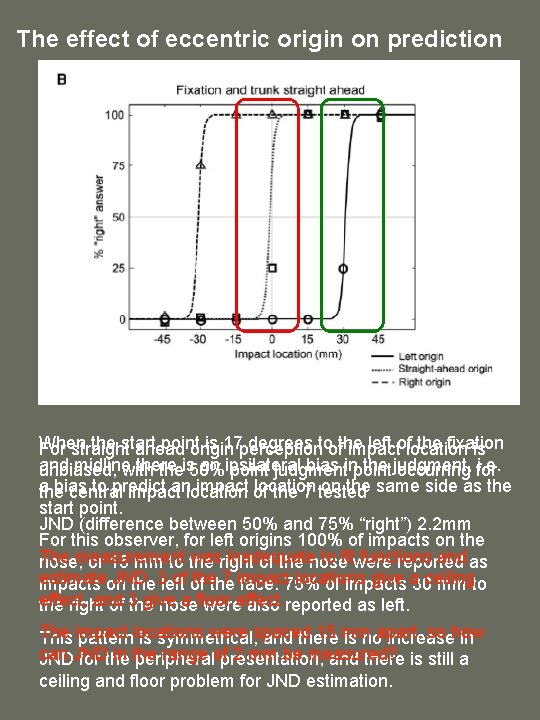
The effect of eccentric origin on prediction When the start point is 17 perception degrees toofthe left oflocation the fixation For straight ahead origin impact is and midlinewith there an ipsilateral bias inpoint the judgment, i. e. unbiased, theis 50% point judgment occurring for a bias to predict anlocation impact of location on the same side as the central impact the 7 tested start point. JND (difference between 50% and 75% “right”) 2. 2 mm For this observer, for left origins 100% of impacts on the The wasright inadequate to fitwere functions and as nose, measurement or 15 mm to the of the nose reported estimate JND. of of thethe 7 impact locations give a 30 ceiling impacts on the 3 left face. 75% of impacts mm to effect, and give a floor the right of 3 the nose wereeffect. also reported as left. The were spaced 15 mm so how This impact patternlocations is symmetrical, and there is noapart, increase in can in the range ofpresentation, 2 mm be measured? JNDJND for the peripheral and there is still a ceiling and floor problem for JND estimation.
Why ipsilateral bias? • The bias occurs because the judgment is made under conditions of uncertainty, forcing the use of a heuristic strategy – The level of uncertainty is greater than in normal interception conditions because the “where” judgment must be made at TTC 1000 msec, whereas TTC 500 msec would be a more natural point to initiate an action. (See handout) – At TTC 1000 all stimuli starting on the left are still on the left (with 2 degrees separating each of them), all from the right are still on the right, and those from the centre are split 3/1/3
– At TTC 500 the separation is more like 5 degrees between each stimulus, and one of them has crossed the midline – Between TTC 1000 and 500 whether angle alpha is growing, shrinking, or constant is above threshold, and this gives unambiguous information about the destination of the stimulus. (See Table) – Authors do not discuss this optical variable, which is also available, but may be below threshold in the portion of the trajectory they do show. • Allowing spatial vision of background would help bring it above threshold – Given the impoverished information at TTC 1000, a simple heuristic is to respond left if it is on the left, and right if it is on the right. For the 18 stimuli that don’t hit the nose this strategy performs at 66% (100% for straight origin), and produces the observed biases.
Why ipsilateral bias? • A more general point is that natural selection would favour a mechanism to intercept impacts, not predict where they will occur, which is has less adaptive value. • Those objects observers judged incorrectly as “left” would not have crossed the midline until very late in their trajectory (see diagram), so actual interception would occur on the left.
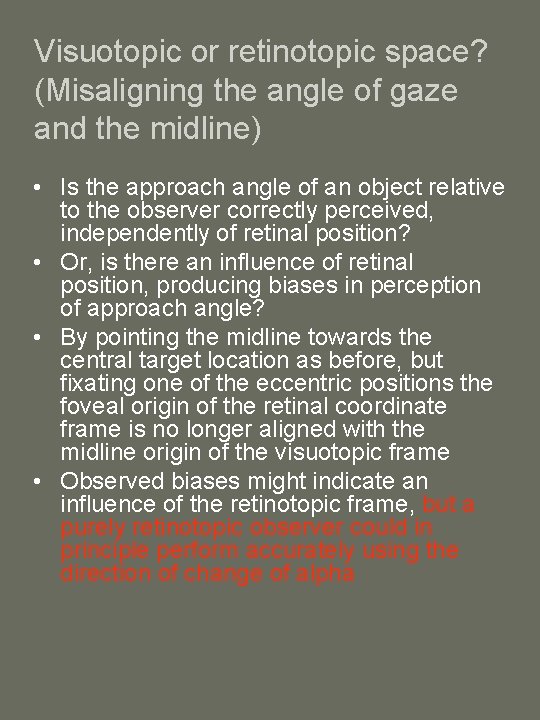
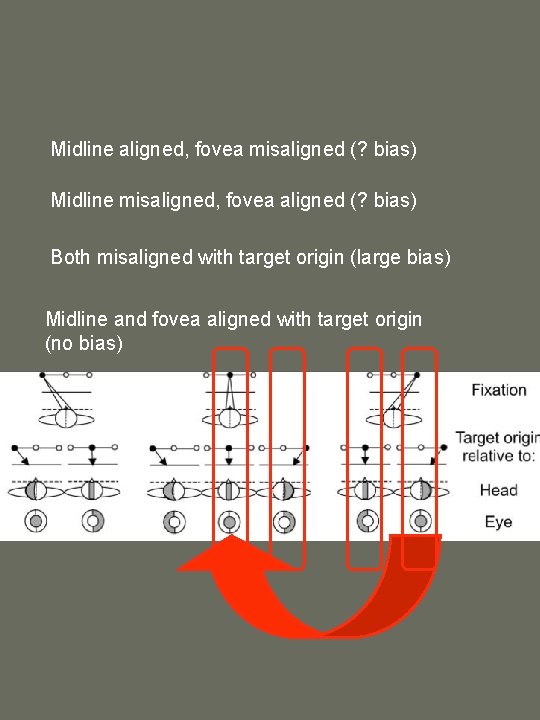
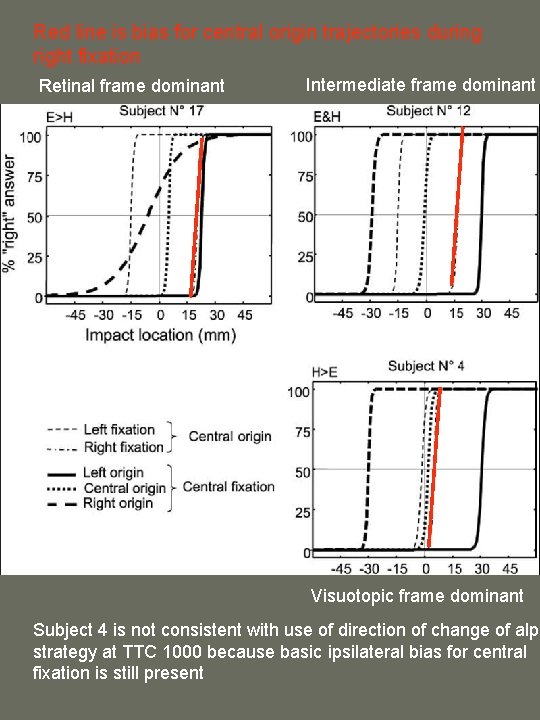
Visuotopic or retinotopic space? (Misaligning the angle of gaze and the midline) • Is the approach angle of an object relative to the observer correctly perceived, independently of retinal position? • Or, is there an influence of retinal position, producing biases in perception of approach angle? • By pointing the midline towards the central target location as before, but fixating one of the eccentric positions the foveal origin of the retinal coordinate frame is no longer aligned with the midline origin of the visuotopic frame • Observed biases might indicate an influence of the retinotopic frame, but a purely retinotopic observer could in principle perform accurately using the direction of change of alpha
Midline aligned, fovea misaligned (? bias) Midline misaligned, fovea aligned (? bias) Both misaligned with target origin (large bias) Midline and fovea aligned with target origin (no bias)
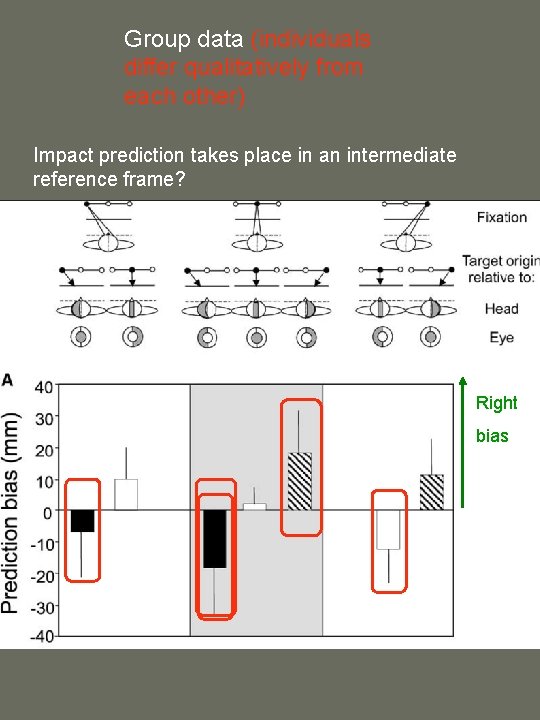
Group data (individuals differ qualitatively from each other) Impact prediction takes place in an intermediate reference frame? Right bias
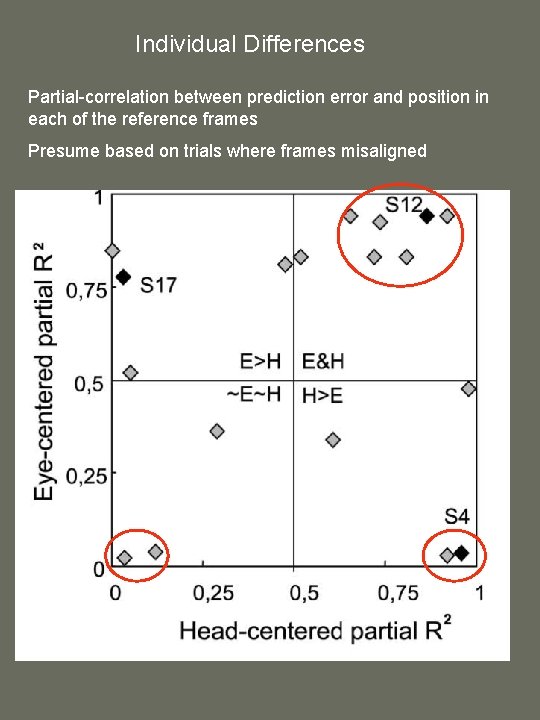
Individual Differences Partial-correlation between prediction error and position in each of the reference frames Presume based on trials where frames misaligned
Red line is bias for central origin trajectories during right fixation Retinal frame dominant Intermediate frame dominant Visuotopic frame dominant Subject 4 is not consistent with use of direction of change of alph strategy at TTC 1000 because basic ipsilateral bias for central fixation is still present
Conclusions • I predict that all the observed biases, whether they are ipsilateral with straight ahead fixation or related to the misalignment of retinal frame from visuotopic frame would disappear if the stimulus was allowed to develop to a more realistic value of TTC 500 msec – This is because direction of change of alpha would be well above threshold. Note that this would allow observers to behave independently of eye position as if they had a visuotopic representation, without actually having one at all. • I predict that allowing spatial vision of the background would bring change of alpha above threshold for earlier TTC values – Deletion and accretion of texture as alpha changes would be a powerful cue, and would certainly make it obvious when alpha was unchanging, specifying a central impact ( in the presented data central impacts are sometimes mistaken for lateral ones)
Conclusions • Authors agree with me that one explanation for the ipsilateral bias is covert interception • I think the question of reference frames for this task is interesting, but I don’t believe the conditions tested establish that a visuotopic frame is needed for this task under more natural viewing conditions • To convince me, authors need to show effects under more natural viewing, and rule out the alpha explanation