
Spasticity Management for Transverse Myelitis R Samuel Mayer
- Slides: 21
Spasticity Management for Transverse Myelitis R. Samuel Mayer, MD, Associate Professor and Vice Chair for Education, Department of Physical Medicine and Rehabilitation
CME Disclosure • Abobotulinum toxin A, incobotulinum toxin A, botulinum toxin B and phenol are not US Food and Drug Administration (FDA) approved for use in spasticity • Onabotulinum toxin A is only indicated for spasticity of the upper limb • I have received no direct honoraria, speakers’ fees, or other financial incentives, from industry, relevant to this talk. My department has received unrestricted educational funds from Allergan and Merz.
Objectives • How do you assess spasticity? • Distinguish between generalized and localized impairments • Discuss treatment options for specific upper motor neuron syndromes
Consequences of Spasticity • May interfere with mobility, exercise, joint range of motion • May interfere with activities of daily living • May cause pain and sleep disturbance • Can make patient care more difficult
Possible Advantages of Spasticity • Maintains muscle tone • Helps support circulatory function • May prevent formation of deep vein thrombosis • May assist in activities of daily living • May assist in maintaining erect posture • May assist in gait
Mechanical vs. Spastic Contracture Fixed Dynamic • Tendon and/or ligament • Slow stretch • Charcot joint • Palpable antagonistic muscle action • Heterotopic ossification • Increased reflexes Most often, both mechanical and spastic factors
Key Questions in History • Location? • Time of day, aggravating/alleviating factors? (diary) • Painful spasms? • Functional limitations? • Need for extensor tone in legs for standing?
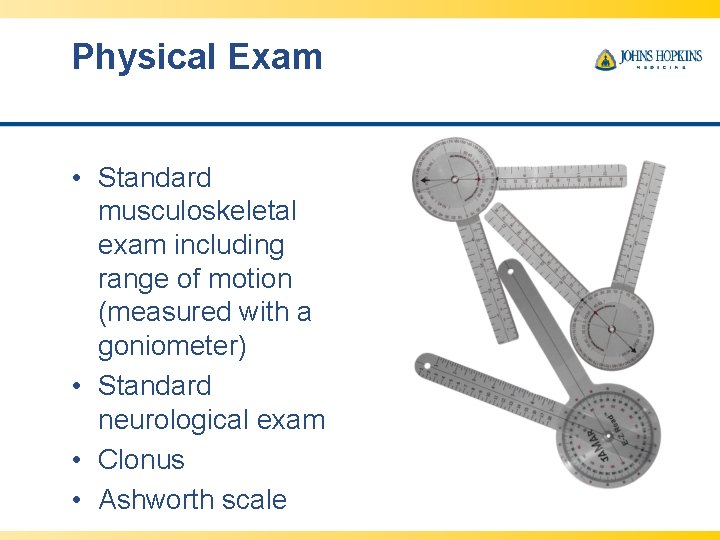
Physical Exam • Standard musculoskeletal exam including range of motion (measured with a goniometer) • Standard neurological exam • Clonus • Ashworth scale
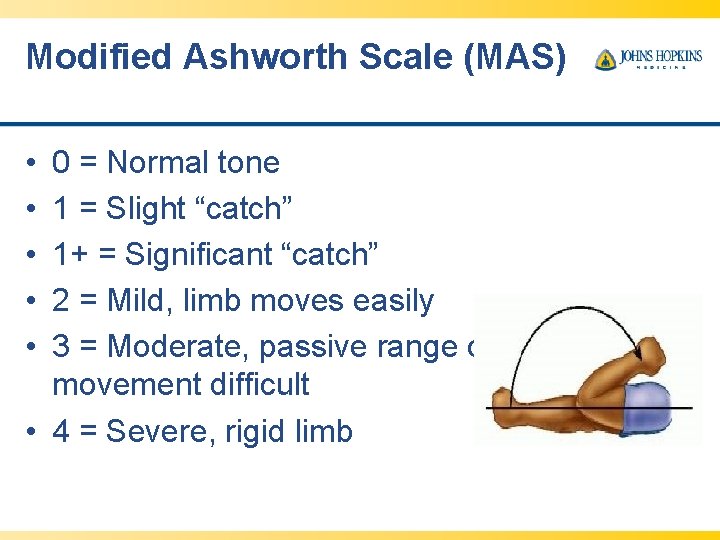
Modified Ashworth Scale (MAS) • • • 0 = Normal tone 1 = Slight “catch” 1+ = Significant “catch” 2 = Mild, limb moves easily 3 = Moderate, passive range of movement difficult • 4 = Severe, rigid limb
Goal Attainment Scales • Select 2 SMART (specific, measurable, achievable, realistic, time-frame) goals with patient – – – -2 did not achieve by a lot -1 did not achieve by a little 0 achieved +1 exceeded by a little +2 exceeded by a lot
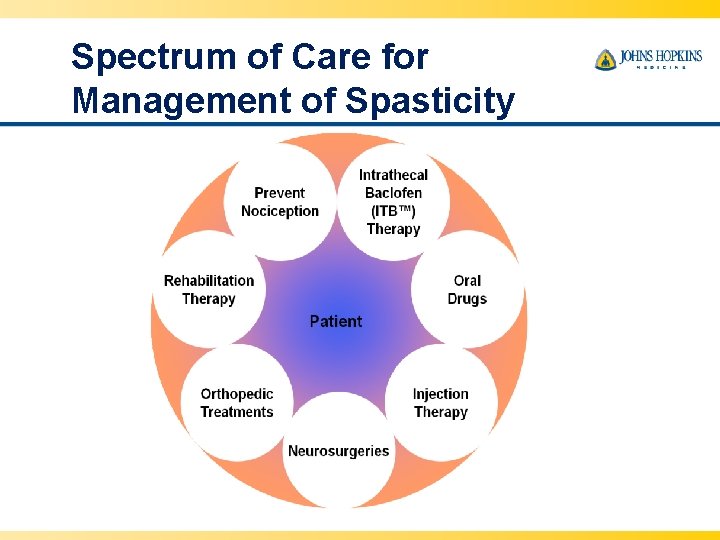
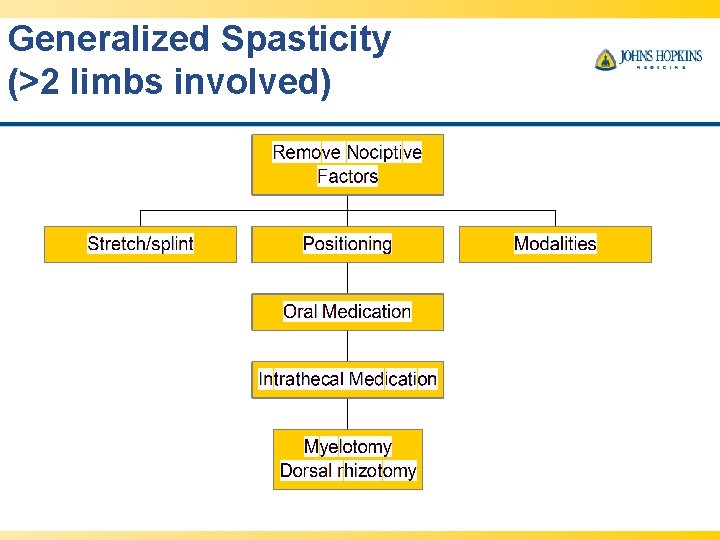
Spectrum of Care for Management of Spasticity
Generalized Spasticity (>2 limbs involved)
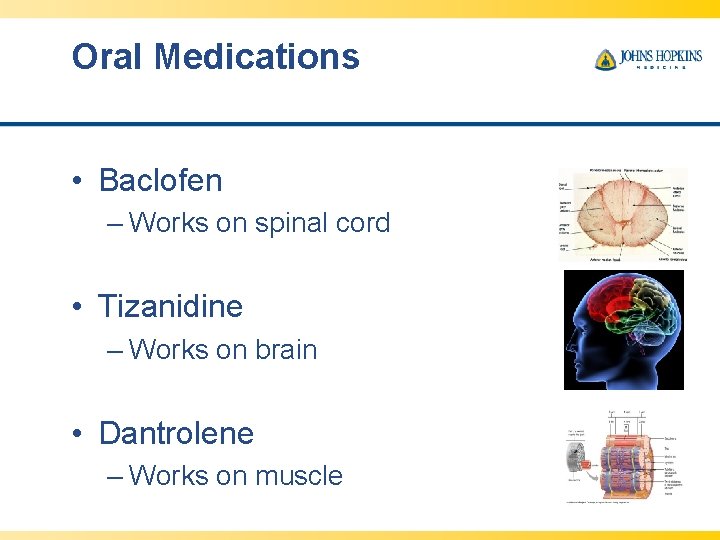
Oral Medications • Baclofen – Works on spinal cord • Tizanidine – Works on brain • Dantrolene – Works on muscle
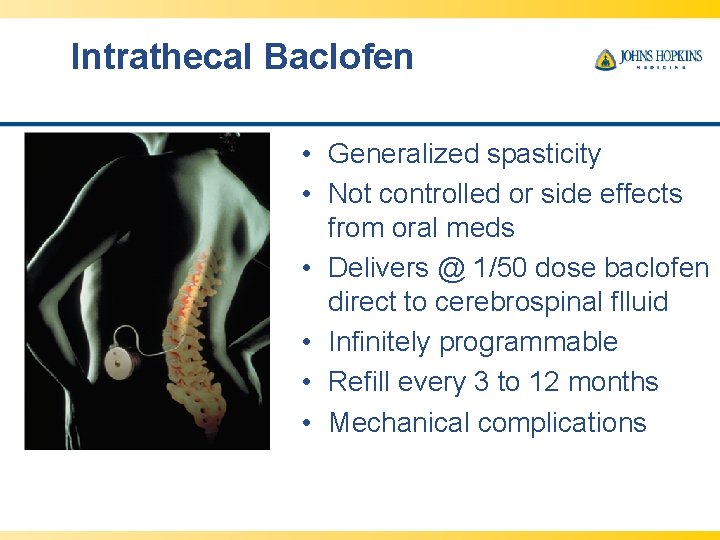
Intrathecal Baclofen • Generalized spasticity • Not controlled or side effects from oral meds • Delivers @ 1/50 dose baclofen direct to cerebrospinal flluid • Infinitely programmable • Refill every 3 to 12 months • Mechanical complications
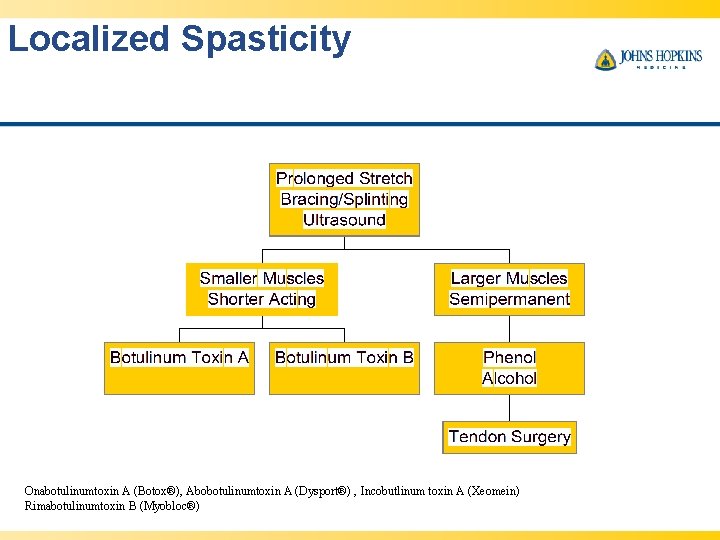
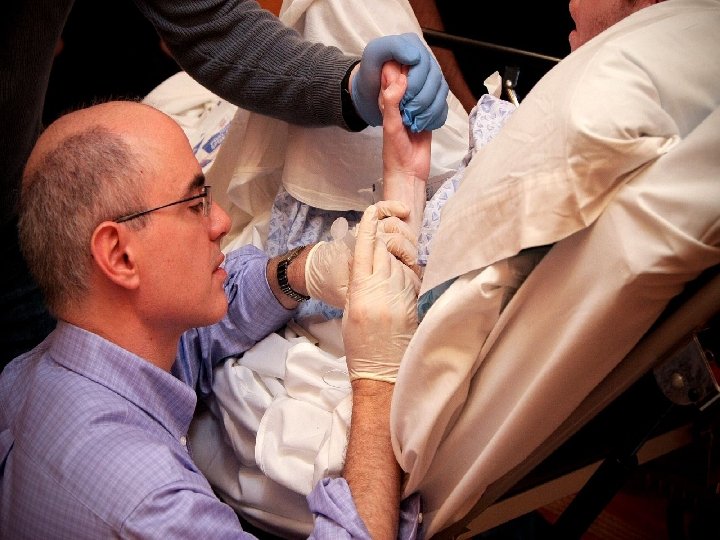
Localized Spasticity Onabotulinumtoxin A (Botox®), Abobotulinumtoxin A (Dysport®) , Incobutlinum toxin A (Xeomein) Rimabotulinumtoxin B (Myobloc®)
17
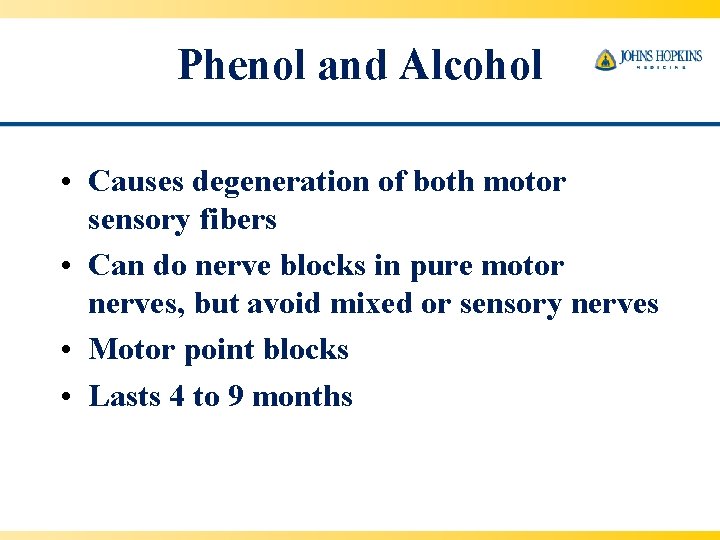
Phenol and Alcohol • Causes degeneration of both motor sensory fibers • Can do nerve blocks in pure motor nerves, but avoid mixed or sensory nerves • Motor point blocks • Lasts 4 to 9 months
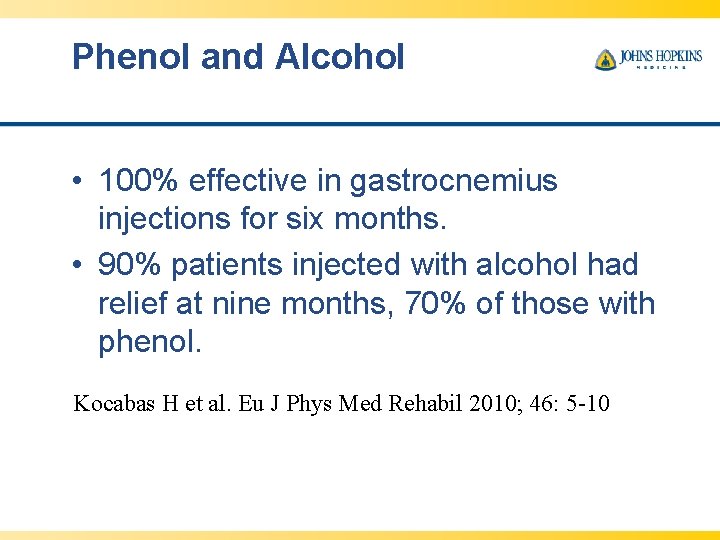
Phenol and Alcohol • 100% effective in gastrocnemius injections for six months. • 90% patients injected with alcohol had relief at nine months, 70% of those with phenol. Kocabas H et al. Eu J Phys Med Rehabil 2010; 46: 5 -10
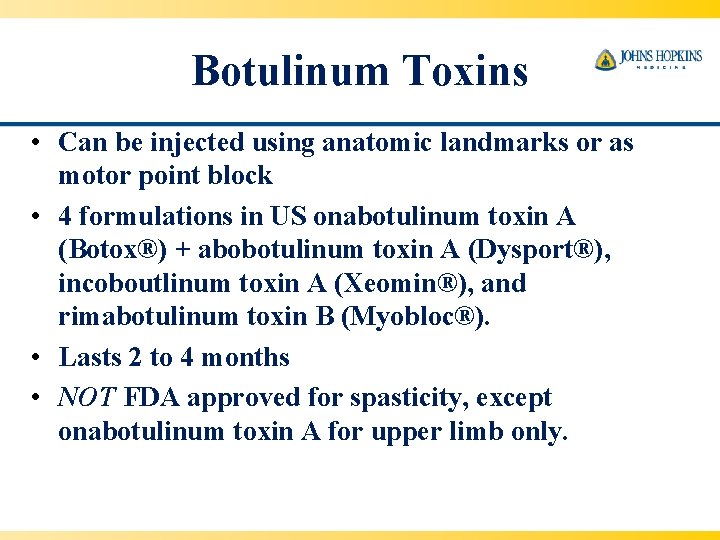
Botulinum Toxins • Can be injected using anatomic landmarks or as motor point block • 4 formulations in US onabotulinum toxin A (Botox®) + abobotulinum toxin A (Dysport®), incoboutlinum toxin A (Xeomin®), and rimabotulinum toxin B (Myobloc®). • Lasts 2 to 4 months • NOT FDA approved for spasticity, except onabotulinum toxin A for upper limb only.
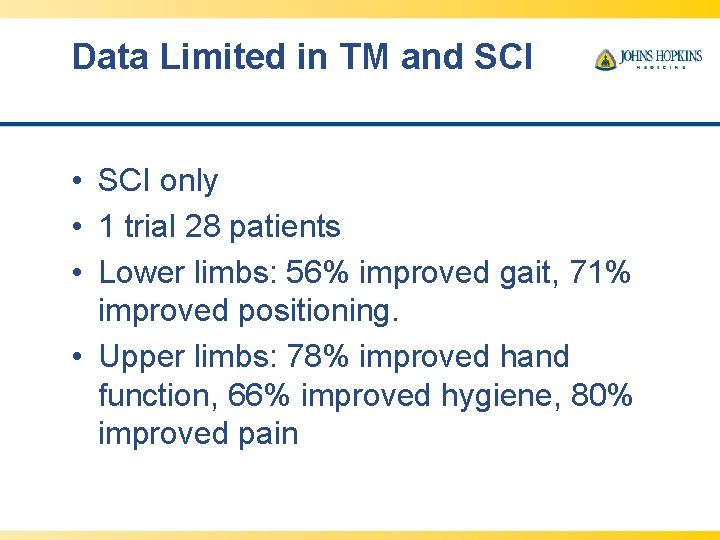
Data Limited in TM and SCI • SCI only • 1 trial 28 patients • Lower limbs: 56% improved gait, 71% improved positioning. • Upper limbs: 78% improved hand function, 66% improved hygiene, 80% improved pain