
SPASMODIC DYSPHONIA ALLY BRYAN STASIA JACKSON SPASMODIC DYSPHONIA
SPASMODIC DYSPHONIA ALLY BRYAN & STASIA JACKSON

SPASMODIC DYSPHONIA Laryngeal dystonia Most often affects connected speech 2 main types: Adductor SD Abductor SD No cure, but several treatment options
BOTULINUM TOXIN (BOTOX) Frequently recommended treatment for SD Involves repeated unilateral or bilateral injections of small doses of Botox into the muscles of the VFs Weakens laryngeal muscles, resulting in “a smoother, less effortful voice because of less forceful closing of the vocal cords” (ASHA, n. d. ) Adductor SD – injections in the thyroarytenoid muscle Abductor SD – injections in the posterior cricoarytenoid muscle (National Spasmodic Dysphonia Association, 2016)
SELECTIVE LARYNGEAL ADDUCTION DENERVATION AND REINNERVATION (SLAD-R) SURGERY Bilateral operation Dr. Gerald Berke 1. Surgeon cuts nerves to muscles on both sides of the larynx, weakening the muscles (denervation) Involves the RLN being cut from the TA and LCA muscles II. Surgeon connects unaffected nerve to stumps of the nerves severed in denervation (reinnervation) Prevents weakened muscles from atrophy Prevents denervated nerve branch from reconnecting (causing spasms to return) (National Spasmodic Dysphonia Association, 2016)
ARTICLE #1 Blitzer, A. (2010). Spasmodic dysphonia and botulinum toxin: Experience from the largest treatment series. European Journal of Neurology, 17(1), 28 -30. Aim of Study: Determine if botox is effective in treating laryngeal dystonias? Reason for Study: According to Blitzer, convincing long-term data is not yet available for SLAD-R and the surgery should be reserved for the rare patient who does not benefit from botulinum toxin therapy. Hypothesis: Botox will reduce the symptoms of spasmodic dysphonia. Design: Review of laryngeal dystonia (1984– 2007) includes 1300 patients. Of this group, 82% had adductor spasmodic dysphonia while 17% had abductor spasmodic dysphonia. • Adductor spasmodic dysphonia results in a strain-strangled voice while abductor spasmodic dysphonia causes stridor, dyspnea, breathy breaks or a whisper. § Method: Muscle injections given via a hollow-bore 27 gauge Teflon coated EMG needle with EMG control
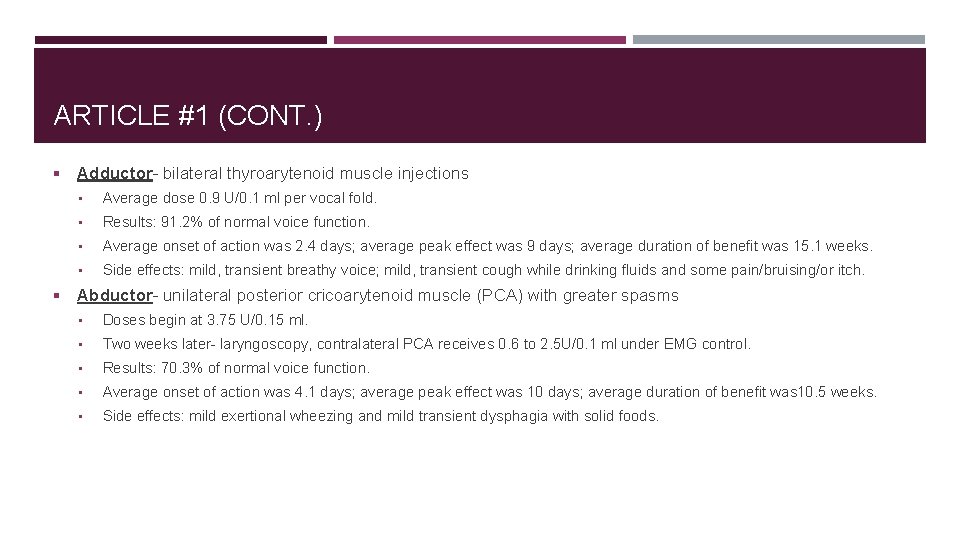
ARTICLE #1 (CONT. ) § § Adductor- bilateral thyroarytenoid muscle injections • Average dose 0. 9 U/0. 1 ml per vocal fold. • Results: 91. 2% of normal voice function. • Average onset of action was 2. 4 days; average peak effect was 9 days; average duration of benefit was 15. 1 weeks. • Side effects: mild, transient breathy voice; mild, transient cough while drinking fluids and some pain/bruising/or itch. Abductor- unilateral posterior cricoarytenoid muscle (PCA) with greater spasms • Doses begin at 3. 75 U/0. 15 ml. • Two weeks later- laryngoscopy, contralateral PCA receives 0. 6 to 2. 5 U/0. 1 ml under EMG control. • Results: 70. 3% of normal voice function. • Average onset of action was 4. 1 days; average peak effect was 10 days; average duration of benefit was 10. 5 weeks. • Side effects: mild exertional wheezing and mild transient dysphagia with solid foods.
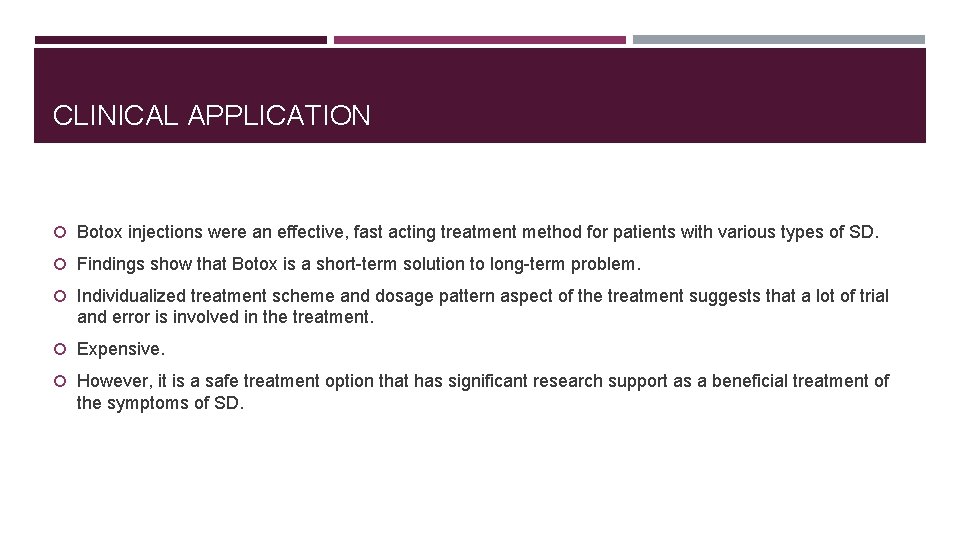
CLINICAL APPLICATION Botox injections were an effective, fast acting treatment method for patients with various types of SD. Findings show that Botox is a short-term solution to long-term problem. Individualized treatment scheme and dosage pattern aspect of the treatment suggests that a lot of trial and error is involved in the treatment. Expensive. However, it is a safe treatment option that has significant research support as a beneficial treatment of the symptoms of SD.
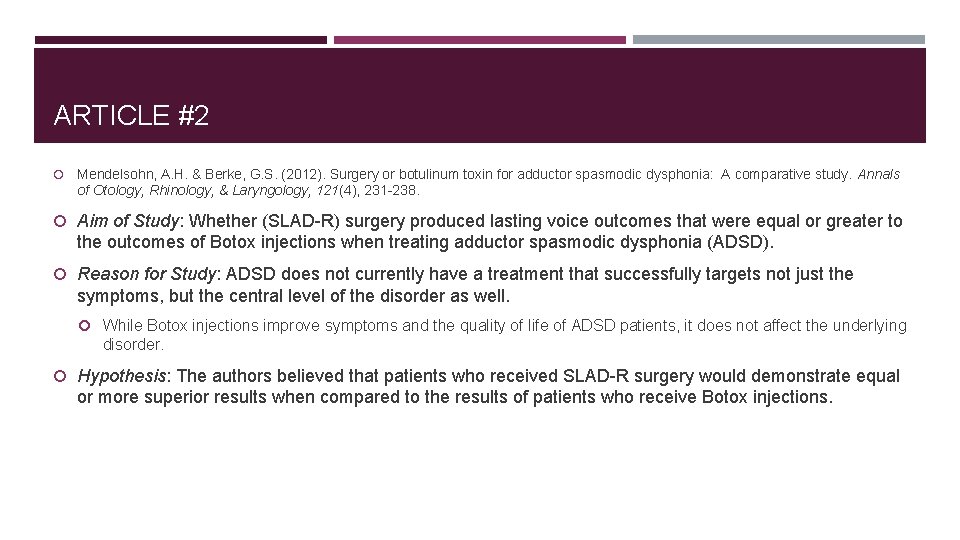
ARTICLE #2 Mendelsohn, A. H. & Berke, G. S. (2012). Surgery or botulinum toxin for adductor spasmodic dysphonia: A comparative study. Annals of Otology, Rhinology, & Laryngology, 121(4), 231 -238. Aim of Study: Whether (SLAD-R) surgery produced lasting voice outcomes that were equal or greater to the outcomes of Botox injections when treating adductor spasmodic dysphonia (ADSD). Reason for Study: ADSD does not currently have a treatment that successfully targets not just the symptoms, but the central level of the disorder as well. While Botox injections improve symptoms and the quality of life of ADSD patients, it does not affect the underlying disorder. Hypothesis: The authors believed that patients who received SLAD-R surgery would demonstrate equal or more superior results when compared to the results of patients who receive Botox injections.
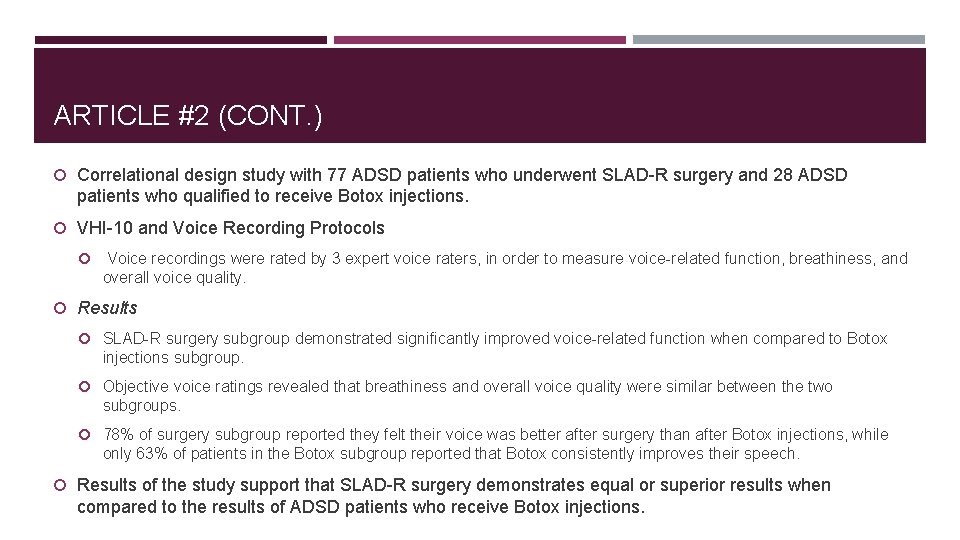
ARTICLE #2 (CONT. ) Correlational design study with 77 ADSD patients who underwent SLAD-R surgery and 28 ADSD patients who qualified to receive Botox injections. VHI-10 and Voice Recording Protocols Voice recordings were rated by 3 expert voice raters, in order to measure voice-related function, breathiness, and overall voice quality. Results SLAD-R surgery subgroup demonstrated significantly improved voice-related function when compared to Botox injections subgroup. Objective voice ratings revealed that breathiness and overall voice quality were similar between the two subgroups. 78% of surgery subgroup reported they felt their voice was better after surgery than after Botox injections, while only 63% of patients in the Botox subgroup reported that Botox consistently improves their speech. Results of the study support that SLAD-R surgery demonstrates equal or superior results when compared to the results of ADSD patients who receive Botox injections.
CLINICAL APPLICATION Findings provide support for SLAD-R surgery as an alternative treatment method for ADSD. Patients seeking more enduring, long-term results would benefit from being informed of the SLAD-R treatment option. Duration of improvement in symptoms following Botox injections varied by individual and last on average 3 -6 months, while positive voice outcomes were seen at an average of 7. 5 years following SLAD-R surgery. Ratings of vocal quality did not differ significantly between those who received Botox injections and those who underwent SLAD-R surgery.
CASE EXAMPLE Case: 33 -year-old woman with classic adductor SD symptoms of 6 months duration, including strained, squeezed voice, dyspnea, stridor, and difficulty sustaining phonation. Secondary behaviors were noted, including grimacing and eye blinks. Patient was referred to an ENT and began receiving Botox injections every 4 months. Patient attended voice therapy in conjunction with Botox treatment. Therapy following Botox may extend the benefits of the Botox injections (Murray and Woodsen, 1995)
CASE EXAMPLE TREATMENT PLAN 6 -8 sessions over 8 -10 weeks Reduce effort associated with voice onset by using gliding phonation with fricatives or vowels Laryngeal manipulation to reduce laryngeal tension Respiration Modification Relaxation techniques Yawn-sigh (Pitman, Baredes, & Kamat, 2011) (Glaze, 1996)
REFERENCES American Speech-Language-Hearing Association. (n. d. ). Spasmodic dysphonia. Retrieved from http: //www. asha. org/public/speech/disorders/Spasmodic. Dysphonia/ Blitzer, A. (2010). Spasmodic dysphonia and botulinum toxin: Experience from the largest treatment series. European Journal of Neurology, 17(1), 28 -30. Glaze, L. E. (1996). Treatment of voice hyperfunction in the pre-adolescent. Language, Speech, & Hearing Services In Schools, 27(3), 244 -250. Mendelsohn, A. H. & Berke, G. S. (2012). Surgery or botulinum toxin for adductor spasmodic dysphonia: A comparative study. Annals of Otology, Rhinology, & Laryngology, 121(4), 231 -238. National Spasmodic Dysphonia Association. (2016). Botulinum toxin. Retrieved from https: //www. dysphonia. org/botulinum-toxin. php National Spasmodic Dysphonia Association. (2016). Surgery. Retrieved from https: //www. dysphonia. org/surgery. php Pearson, E. J. , & Sapienza, C. M. (2003). Historical approaches to the treatment of adductor-type spasmodic dysphonia (ADSD): Review and tutorial. Neurorehabilitation, 18(4), 325 -332. Pitman, M. , Baredes, S. , & Kamat, A. (2011). Spasmodic dysphonia treatment & management. Retrieved from http: //emedicine. medscape. com/article/864079 -treatment
- Slides: 13