
Sparse Matrix Operator Kernel Emissions SMOKE Modeling System
- Slides: 20
Sparse Matrix Operator Kernel Emissions SMOKE Modeling System Zac Adelman and Andy Holland Carolina Environmental Program http: //smoke-model. org http: //www. cmascenter. org © 2005, 2006 Carolina Environmental Program
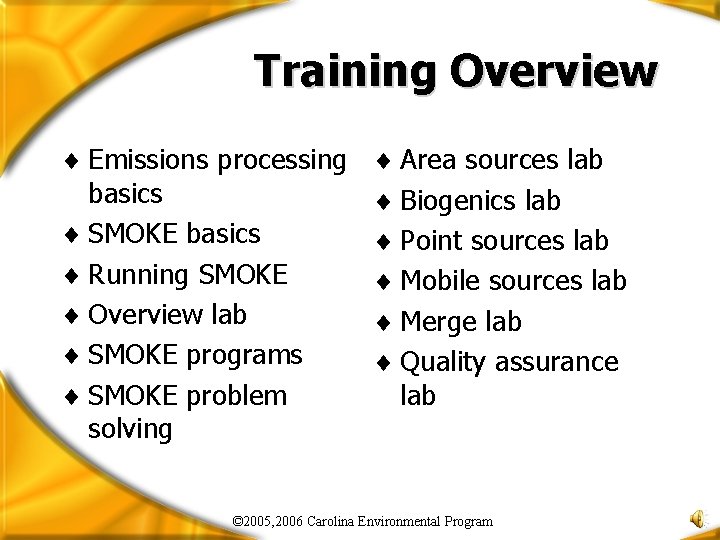
Training Overview ¨ Emissions processing basics ¨ SMOKE basics ¨ Running SMOKE ¨ Overview lab ¨ SMOKE programs ¨ SMOKE problem solving ¨ Area sources lab ¨ Biogenics lab ¨ Point sources lab ¨ Mobile sources lab ¨ Merge lab ¨ Quality assurance lab © 2005, 2006 Carolina Environmental Program
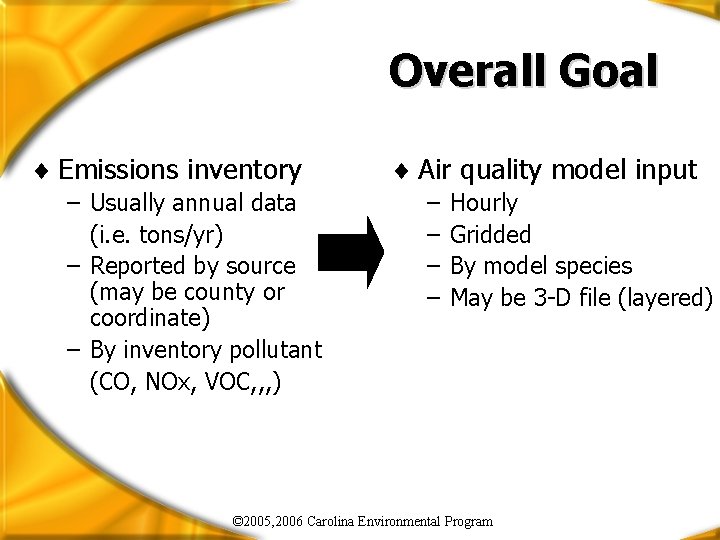
Overall Goal ¨ Emissions inventory – Usually annual data (i. e. tons/yr) – Reported by source (may be county or coordinate) – By inventory pollutant (CO, NOx, VOC, , , ) ¨ Air quality model input – – Hourly Gridded By model species May be 3 -D file (layered) © 2005, 2006 Carolina Environmental Program
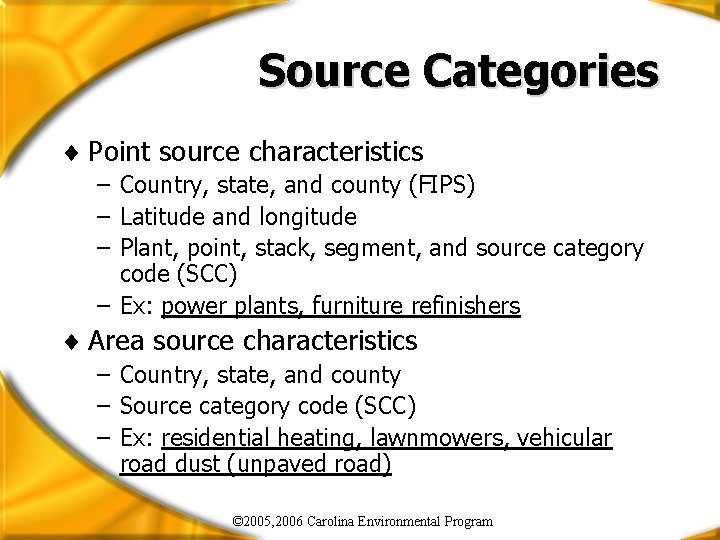
Source Categories ¨ Point source characteristics – Country, state, and county (FIPS) – Latitude and longitude – Plant, point, stack, segment, and source category code (SCC) – Ex: power plants, furniture refinishers ¨ Area source characteristics – Country, state, and county – Source category code (SCC) – Ex: residential heating, lawnmowers, vehicular road dust (unpaved road) © 2005, 2006 Carolina Environmental Program
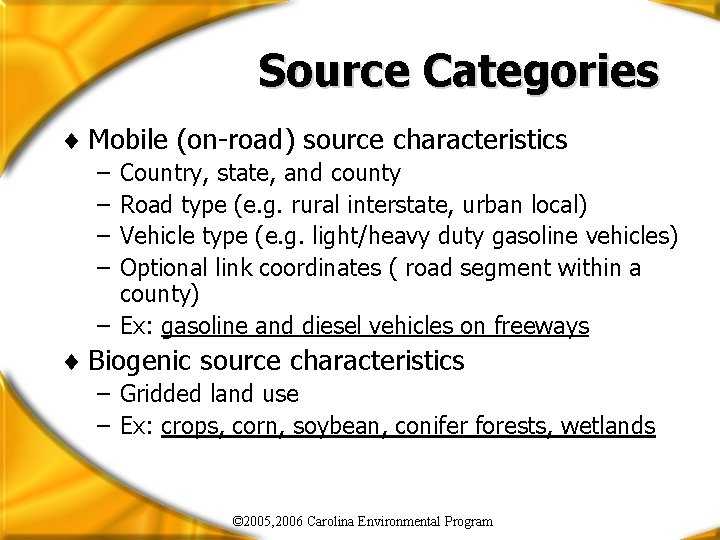
Source Categories ¨ Mobile (on-road) source characteristics – – Country, state, and county Road type (e. g. rural interstate, urban local) Vehicle type (e. g. light/heavy duty gasoline vehicles) Optional link coordinates ( road segment within a county) – Ex: gasoline and diesel vehicles on freeways ¨ Biogenic source characteristics – Gridded land use – Ex: crops, corn, soybean, conifer forests, wetlands © 2005, 2006 Carolina Environmental Program
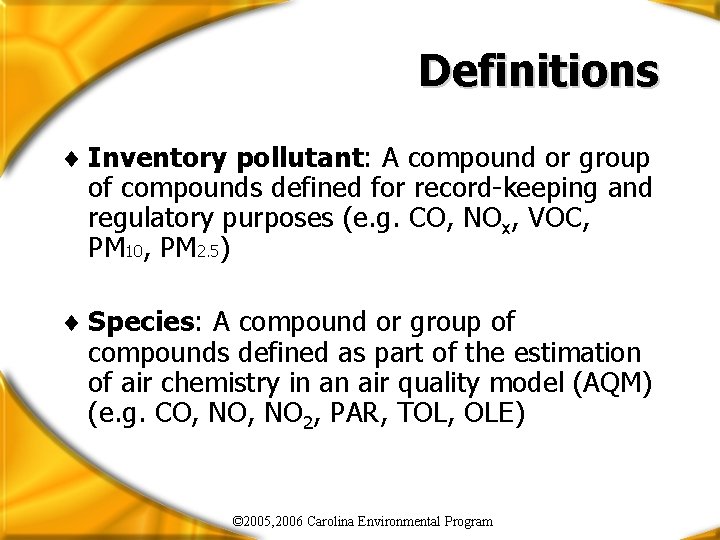
Definitions ¨ Inventory pollutant: A compound or group of compounds defined for record-keeping and regulatory purposes (e. g. CO, NOx, VOC, PM 10, PM 2. 5) ¨ Species: A compound or group of compounds defined as part of the estimation of air chemistry in an air quality model (AQM) (e. g. CO, NO 2, PAR, TOL, OLE) © 2005, 2006 Carolina Environmental Program
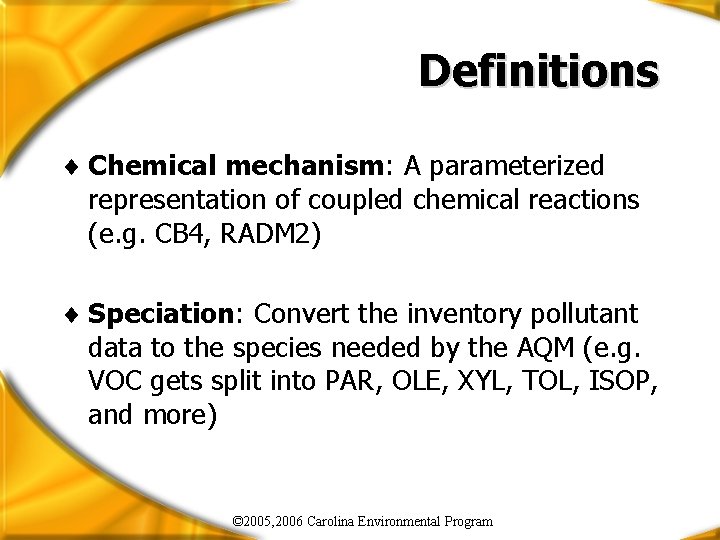
Definitions ¨ Chemical mechanism: A parameterized representation of coupled chemical reactions (e. g. CB 4, RADM 2) ¨ Speciation: Convert the inventory pollutant data to the species needed by the AQM (e. g. VOC gets split into PAR, OLE, XYL, TOL, ISOP, and more) © 2005, 2006 Carolina Environmental Program
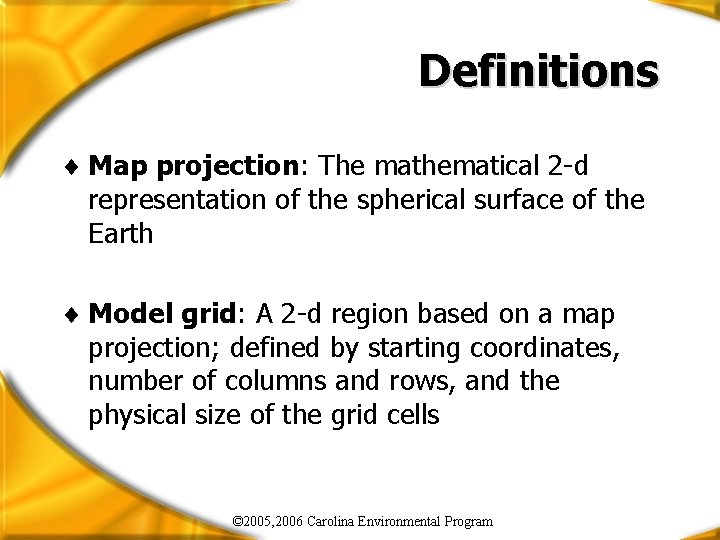
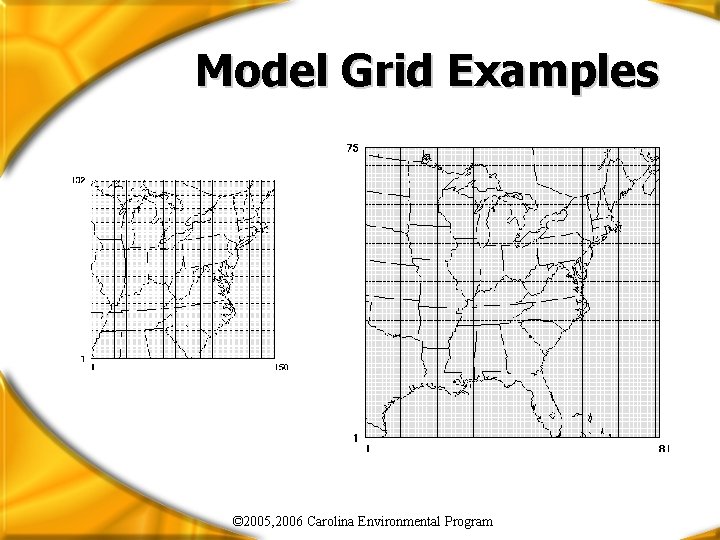
Definitions ¨ Map projection: The mathematical 2 -d representation of the spherical surface of the Earth ¨ Model grid: A 2 -d region based on a map projection; defined by starting coordinates, number of columns and rows, and the physical size of the grid cells © 2005, 2006 Carolina Environmental Program
Model Grid Examples © 2005, 2006 Carolina Environmental Program
Definitions ¨ Spatial allocation: Convert the source spatial extent to the grid cell resolution needed by the air quality model ¨ Gridding surrogates: A dataset used to spatially allocate the emissions to the grid cells; developed from data at a finer resolution than the emissions (e. g. population, housing, airports, roads) © 2005, 2006 Carolina Environmental Program
Definitions ¨ Model layers: Vertical spatial divisions of the atmosphere defined by an air quality model; used to model variations in the atmosphere at different vertical positions ¨ Plume rise: The rising of exhaust from point sources due to the velocity and temperature of the exhaust gases © 2005, 2006 Carolina Environmental Program
Definitions ¨ Elevated source: A point source in which emissions extend beyond the first model layer due to plume rise ¨ Plume-in-grid: A special treatment of elevated sources in which the plume rise is modeled with extra detail by the AQM © 2005, 2006 Carolina Environmental Program
Definitions ¨ Temporal allocation: Convert the annual or daily inventory data to the hourly data needed by the AQM ¨ Profile data: Factors used for converting inventory emissions data to AQM data ¨ Cross-reference: A dataset used to match sources in the inventory with profile data © 2005, 2006 Carolina Environmental Program
Area Emissions Processing ¨ Import data ¨ Spatial allocation ¨ Speciation ¨ Temporal allocation ¨ Growth (to a future or past year) and controls © 2005, 2006 Carolina Environmental Program
Point Emissions Processing ¨ Import, speciation, temporal allocation, growth/controls, plus… ¨ No surrogates needed for spatial allocation ¨ May have day- and hour-specific emissions ¨ Determine elevated and Pin. G sources ¨ Special processing for elevated and Pin. G sources – CMAQ: Create 3 -d emissions files and optional Pin. G files – CAMx: Create 2 -d emissions files and special elevated (Pin. G optional) files © 2005, 2006 Carolina Environmental Program
Mobile Emissions Processing ¨ Same steps as area emissions processing, plus… ¨ May start with VMT instead of emissions – Create emission factors using MOBILE 6 with meteorology and speed data – Emissions = emission factors x VMT ¨ Spatial allocation may include county base link sources © 2005, 2006 Carolina Environmental Program
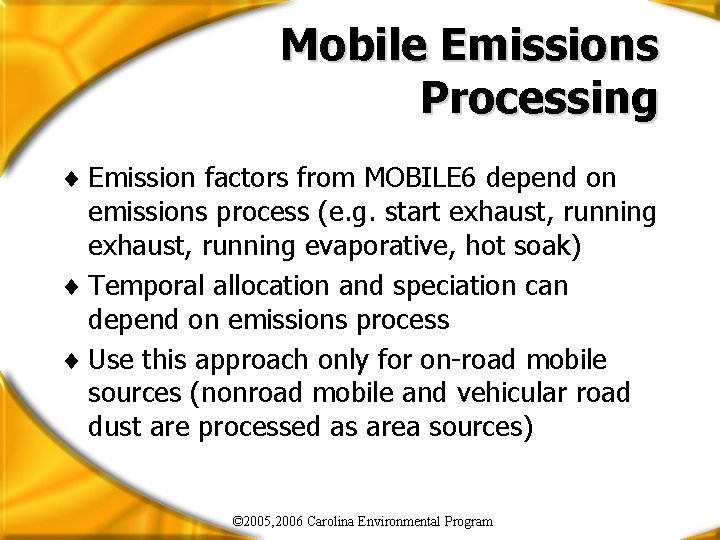
Mobile Emissions Processing ¨ Emission factors from MOBILE 6 depend on emissions process (e. g. start exhaust, running evaporative, hot soak) ¨ Temporal allocation and speciation can depend on emissions process ¨ Use this approach only for on-road mobile sources (nonroad mobile and vehicular road dust are processed as area sources) © 2005, 2006 Carolina Environmental Program
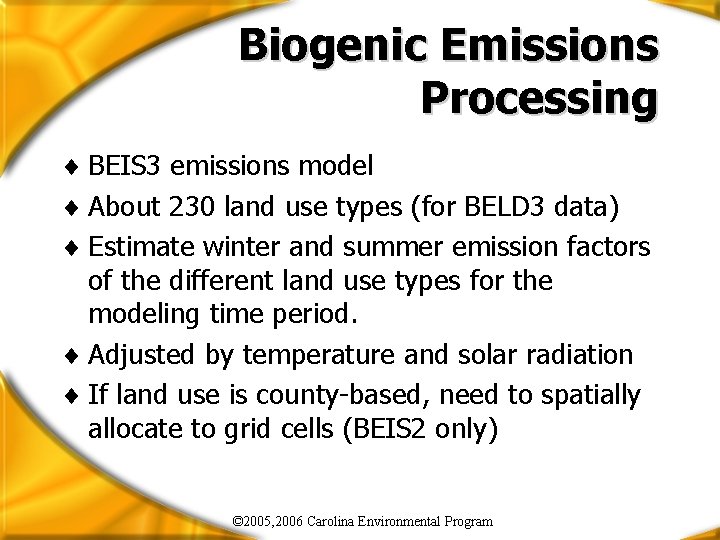
Biogenic Emissions Processing ¨ BEIS 3 emissions model ¨ About 230 land use types (for BELD 3 data) ¨ Estimate winter and summer emission factors of the different land use types for the modeling time period. ¨ Adjusted by temperature and solar radiation ¨ If land use is county-based, need to spatially allocate to grid cells (BEIS 2 only) © 2005, 2006 Carolina Environmental Program
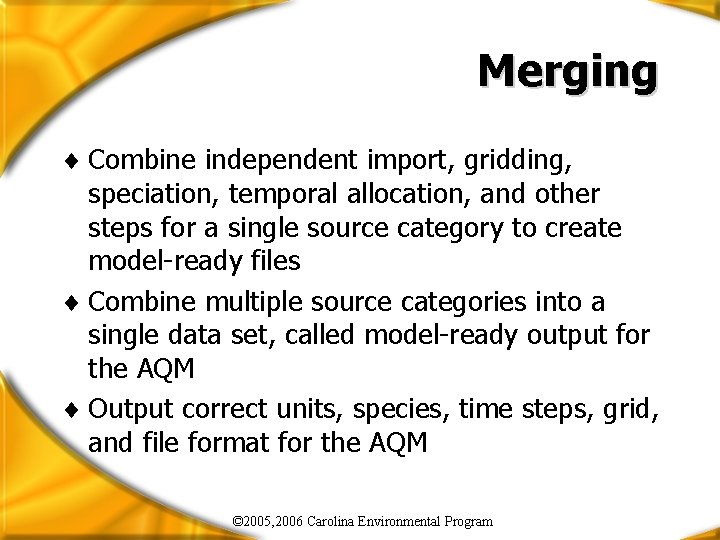
Merging ¨ Combine independent import, gridding, speciation, temporal allocation, and other steps for a single source category to create model-ready files ¨ Combine multiple source categories into a single data set, called model-ready output for the AQM ¨ Output correct units, species, time steps, grid, and file format for the AQM © 2005, 2006 Carolina Environmental Program
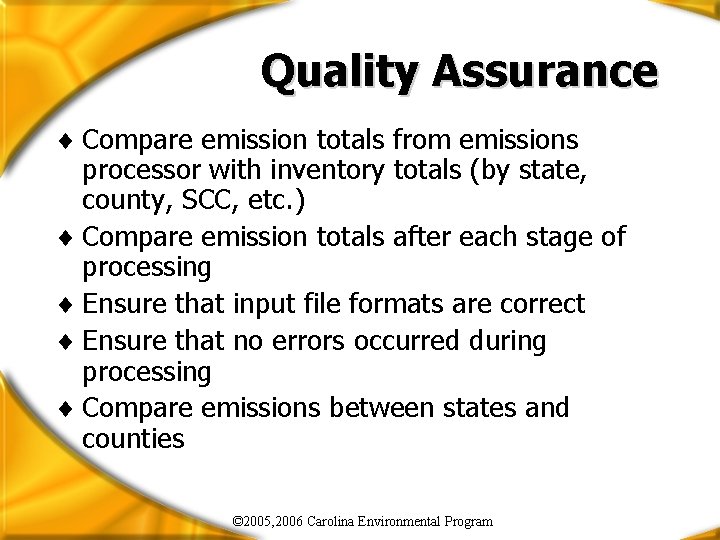
Quality Assurance ¨ Compare emission totals from emissions processor with inventory totals (by state, county, SCC, etc. ) ¨ Compare emission totals after each stage of processing ¨ Ensure that input file formats are correct ¨ Ensure that no errors occurred during processing ¨ Compare emissions between states and counties © 2005, 2006 Carolina Environmental Program