
Sparse matrices hash tables cell arrays CS 1114
Sparse matrices, hash tables, cell arrays CS 1114 Section http: //www. cs. cornell. edu/courses/cs 1114
Useful new data types § Matlab has many useful data structures for handling different scenarios § We’ll cover a few that will be useful for A 6: – Sparse matrices – Hash tables – Cell arrays 2
Transition matrices § For A 6, you’ll be creating very large matrices § Storing these in memory will be an issue 3
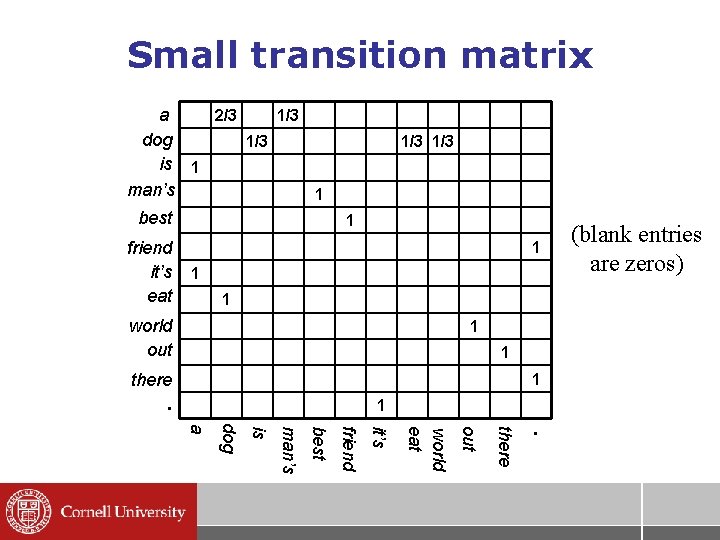
Small transition matrix 2/3 1/3 a dog 1/3 is 1 man’s 1 best friend it’s eat 1/3 1 1 world out 1 1 there out world eat it’s friend best man’s is dog a . (blank entries are zeros)
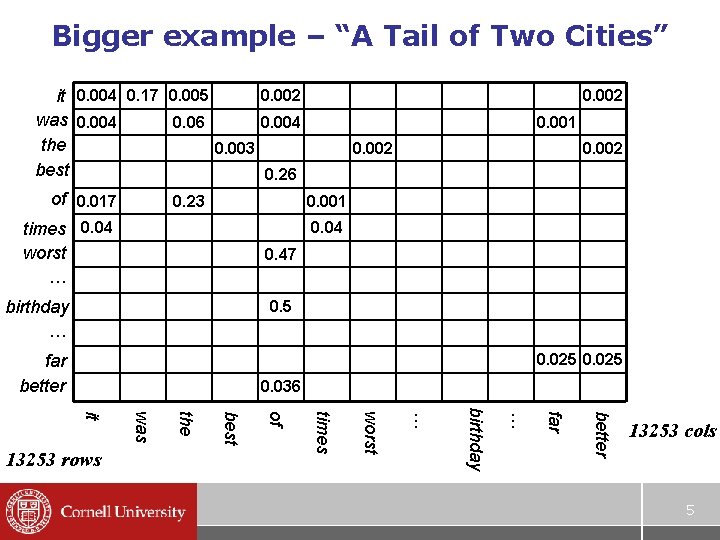
Bigger example – “A Tail of Two Cities” 0. 002 it 0. 004 0. 17 0. 005 was 0. 004 0. 06 0. 004 the 0. 003 0. 002 best 0. 26 of 0. 017 0. 23 0. 001 times 0. 04 worst … 0. 002 0. 001 0. 002 0. 04 0. 47 birthday … 0. 5 far better 0. 025 0. 036 better far … birthday … worst times of best the was it 13253 rows 13253 cols 5
Very large matrices § Jane Austen’s Pride and Prejudice: – 8, 828 unique words 8, 828 x 8, 828 transition matrix (77, 933, 584 entries) § What about 1, 000 words? – Matlab runs out of memory (1 M x 1 M = 1 T entries) – Try this: >> zeros(1000000, 1000000); § But the matrix is mostly empty – Most pairs (e. g. “and and”) have zero probability 6
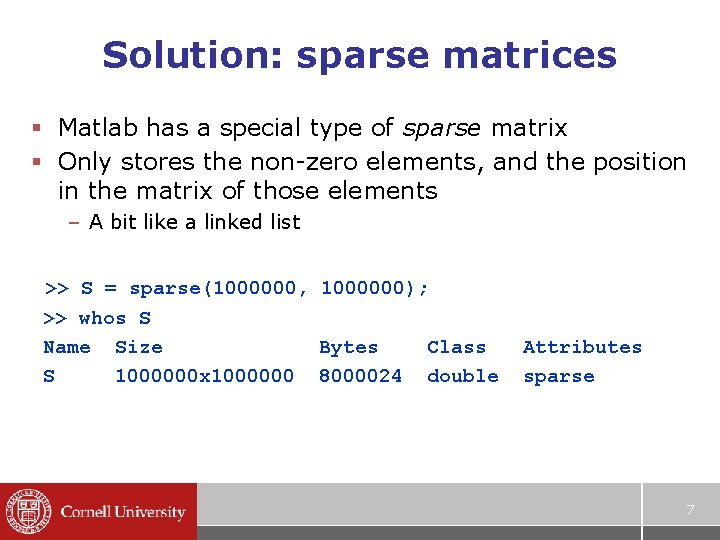
Solution: sparse matrices § Matlab has a special type of sparse matrix § Only stores the non-zero elements, and the position in the matrix of those elements – A bit like a linked list >> S = sparse(1000000, 1000000); >> whos S Name Size S 1000000 x 1000000 Bytes 8000024 Class double Attributes sparse 7
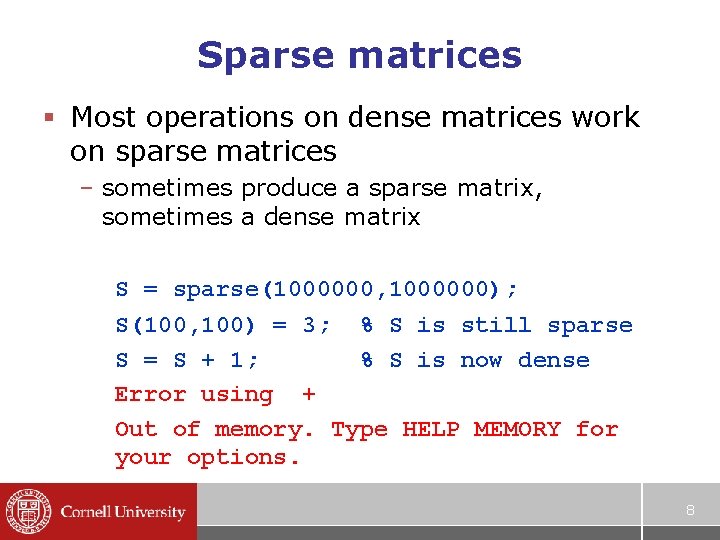
Sparse matrices § Most operations on dense matrices work on sparse matrices – sometimes produce a sparse matrix, sometimes a dense matrix S = sparse(1000000, 1000000); S(100, 100) = 3; % S is still sparse S = S + 1; % S is now dense Error using + Out of memory. Type HELP MEMORY for your options. 8
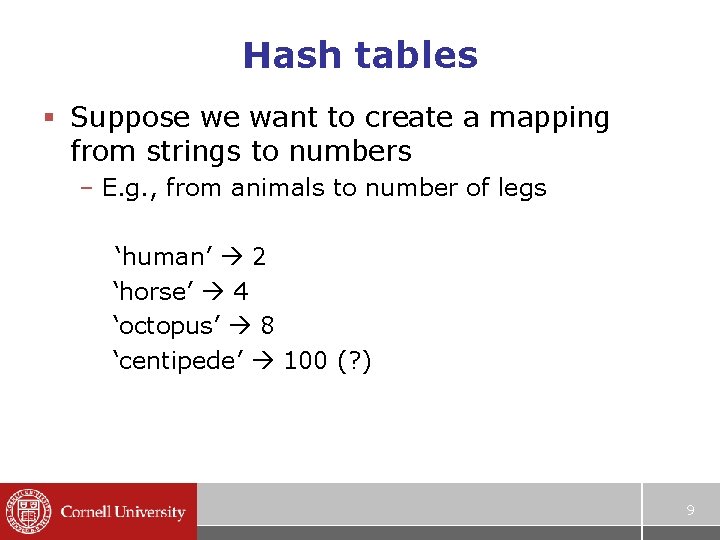
Hash tables § Suppose we want to create a mapping from strings to numbers – E. g. , from animals to number of legs ‘human’ 2 ‘horse’ 4 ‘octopus’ 8 ‘centipede’ 100 (? ) 9

Hash tables § We can use a hash table for this – (Also called dictionary or associative array) § Maps keys (e. g. `horse’) to values (e. g. 4) § Hash tables are interesting to implement, but we’ll just use them as a tool § In Matlab: >> hash = java. util. Hashtable; % For some reason in Matlab, % you can create Java objects 10
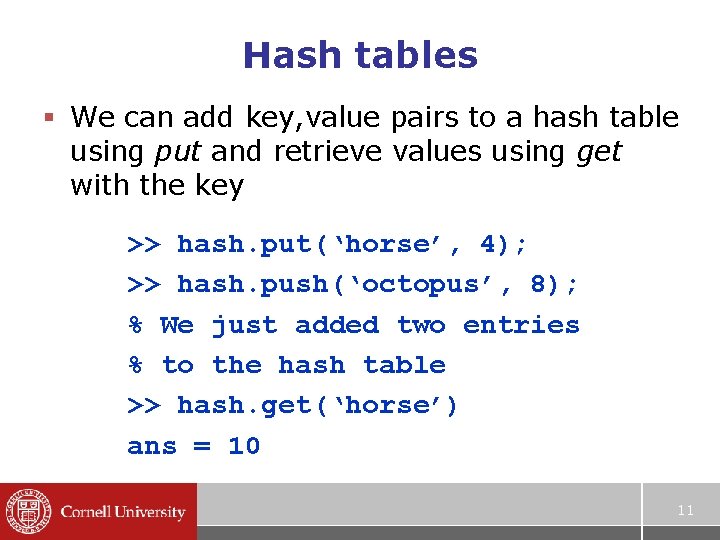
Hash tables § We can add key, value pairs to a hash table using put and retrieve values using get with the key >> hash. put(‘horse’, 4); >> hash. push(‘octopus’, 8); % We just added two entries % to the hash table >> hash. get(‘horse’) ans = 10 11
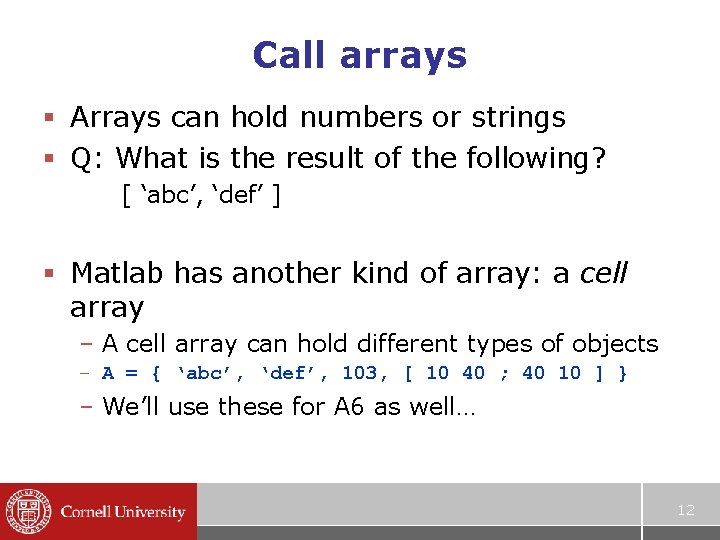
Call arrays § Arrays can hold numbers or strings § Q: What is the result of the following? [ ‘abc’, ‘def’ ] § Matlab has another kind of array: a cell array – A cell array can hold different types of objects – A = { ‘abc’, ‘def’, 103, [ 10 40 ; 40 10 ] } – We’ll use these for A 6 as well… 12
- Slides: 12