
Sparse Linear Solver for Power System Analysis using

- Slides: 16
Sparse Linear Solver for Power System Analysis using FPGA Jeremy Johnson, Prawat Nagvajara, Chika Nwankpa Drexel University HPEC 2004
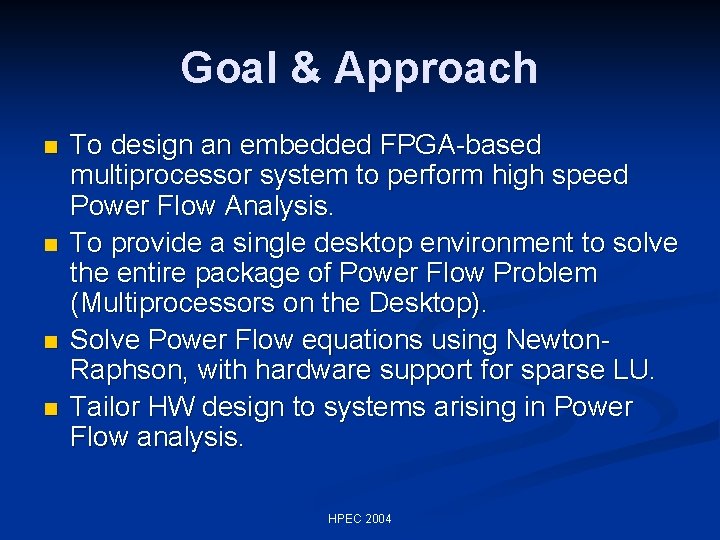
Goal & Approach n n To design an embedded FPGA-based multiprocessor system to perform high speed Power Flow Analysis. To provide a single desktop environment to solve the entire package of Power Flow Problem (Multiprocessors on the Desktop). Solve Power Flow equations using Newton. Raphson, with hardware support for sparse LU. Tailor HW design to systems arising in Power Flow analysis. HPEC 2004
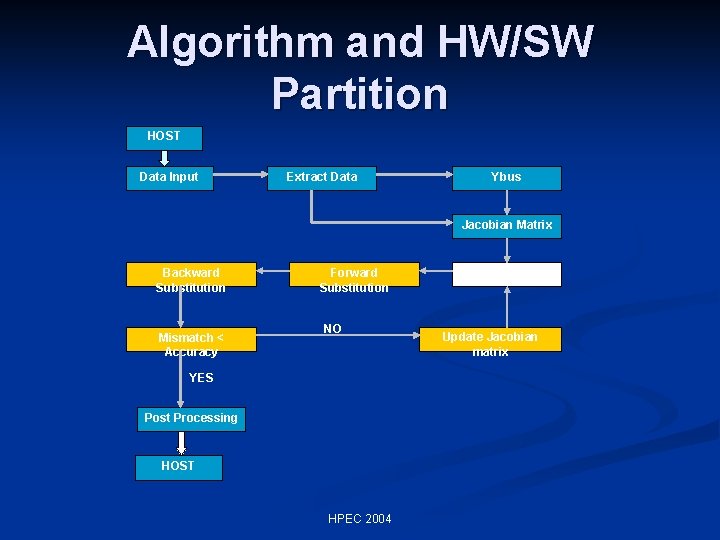
Algorithm and HW/SW Partition HOST Data Input Extract Data Ybus Jacobian Matrix Backward Substitution Mismatch < Accuracy Forward Substitution NO YES Post Processing HOST HPEC 2004 LU Factorization Update Jacobian matrix
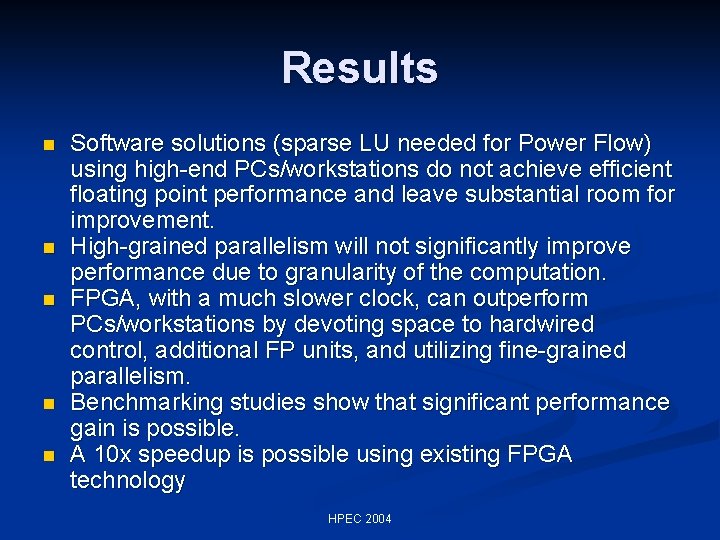
Results n n n Software solutions (sparse LU needed for Power Flow) using high-end PCs/workstations do not achieve efficient floating point performance and leave substantial room for improvement. High-grained parallelism will not significantly improve performance due to granularity of the computation. FPGA, with a much slower clock, can outperform PCs/workstations by devoting space to hardwired control, additional FP units, and utilizing fine-grained parallelism. Benchmarking studies show that significant performance gain is possible. A 10 x speedup is possible using existing FPGA technology HPEC 2004
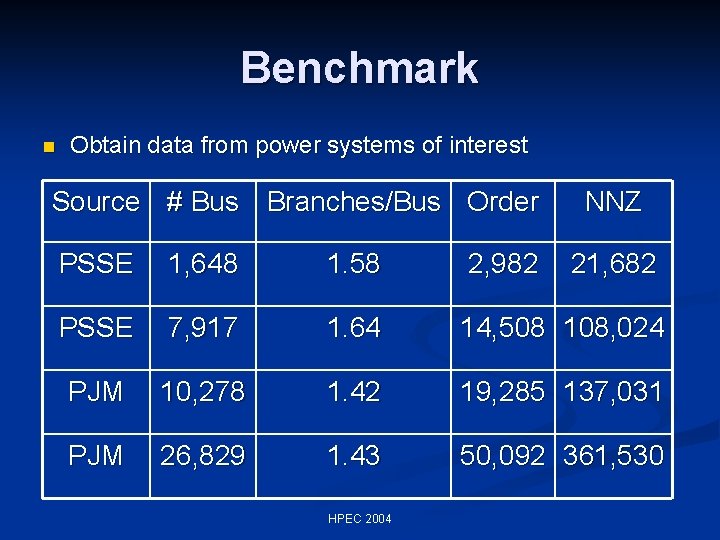
Benchmark n Obtain data from power systems of interest Source # Bus Branches/Bus Order NNZ PSSE 1, 648 1. 58 2, 982 PSSE 7, 917 1. 64 14, 508 108, 024 PJM 10, 278 1. 42 19, 285 137, 031 PJM 26, 829 1. 43 50, 092 361, 530 HPEC 2004 21, 682
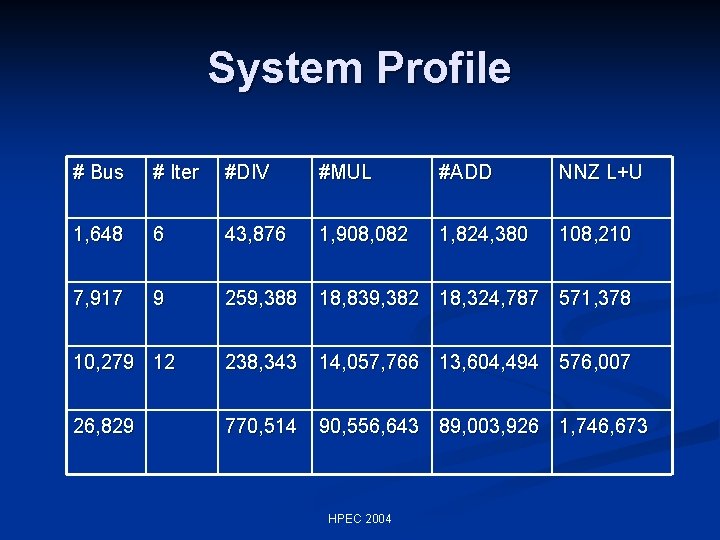
System Profile # Bus # Iter #DIV #MUL #ADD NNZ L+U 1, 648 6 43, 876 1, 908, 082 1, 824, 380 108, 210 7, 917 9 259, 388 18, 839, 382 18, 324, 787 571, 378 10, 279 12 238, 343 14, 057, 766 13, 604, 494 576, 007 26, 829 770, 514 90, 556, 643 89, 003, 926 1, 746, 673 HPEC 2004
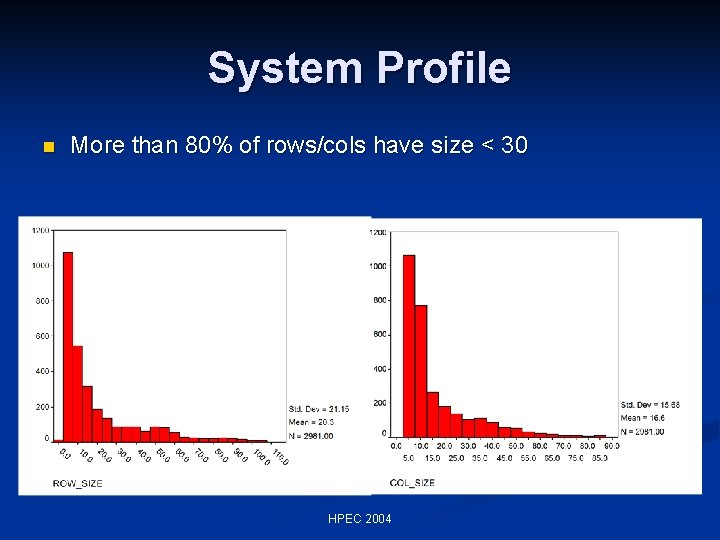
System Profile n More than 80% of rows/cols have size < 30 HPEC 2004
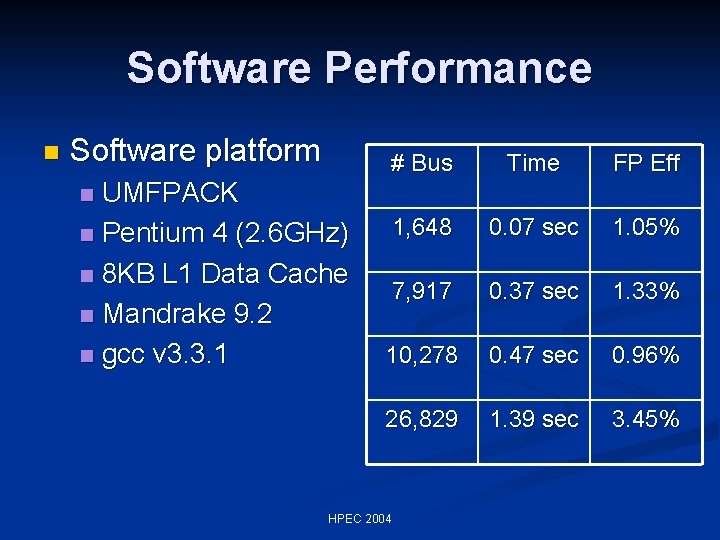
Software Performance n Software platform UMFPACK n Pentium 4 (2. 6 GHz) n 8 KB L 1 Data Cache n Mandrake 9. 2 n gcc v 3. 3. 1 # Bus Time FP Eff 1, 648 0. 07 sec 1. 05% 7, 917 0. 37 sec 1. 33% 10, 278 0. 47 sec 0. 96% 26, 829 1. 39 sec 3. 45% n HPEC 2004
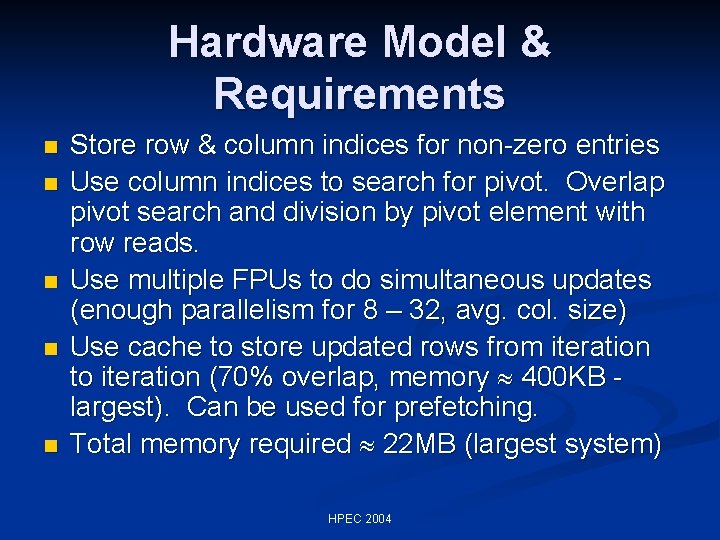
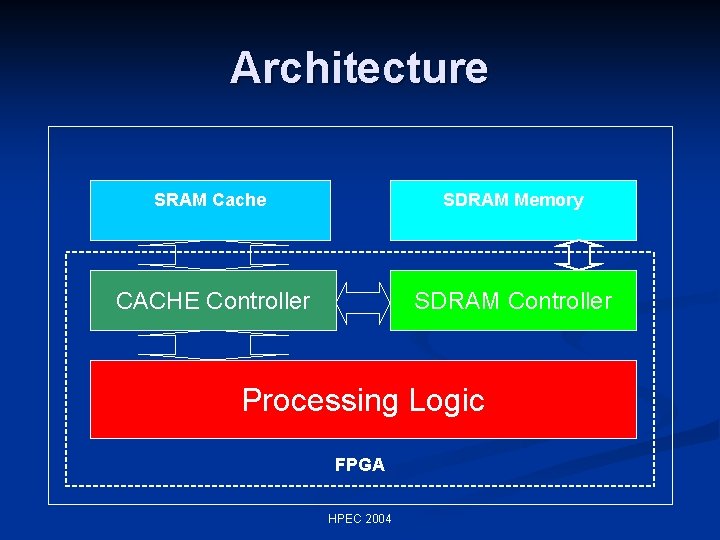
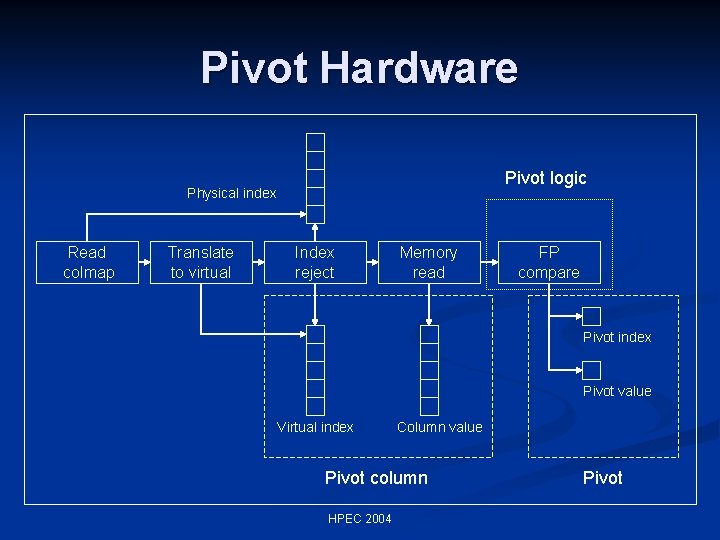
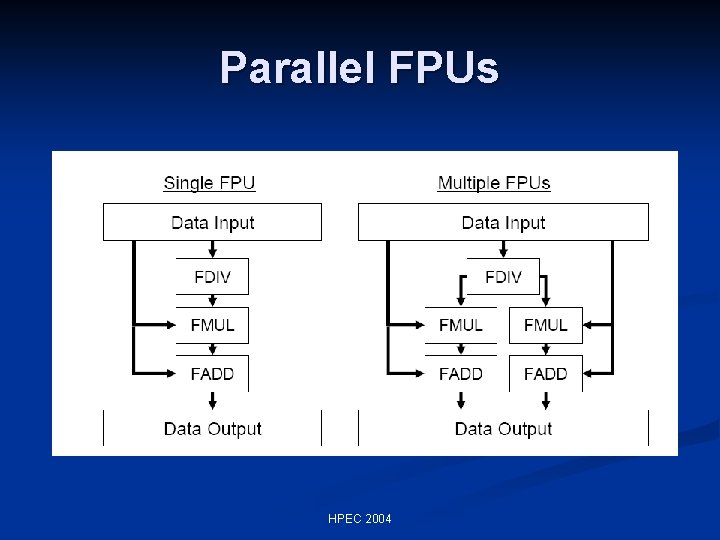
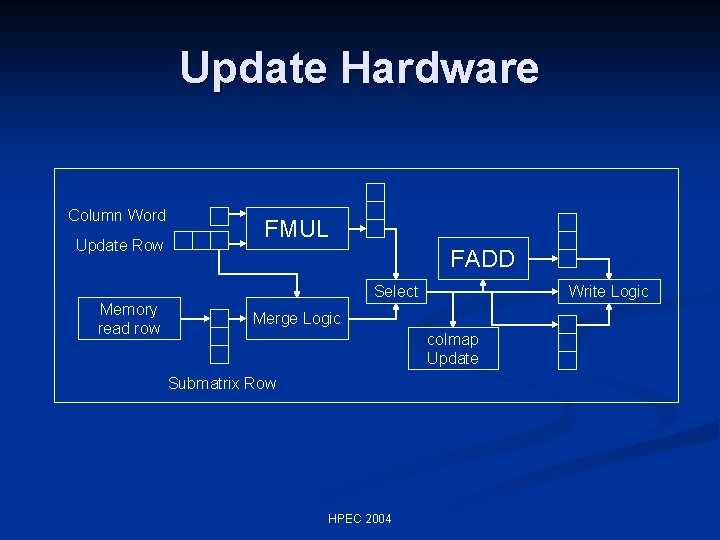
Hardware Model & Requirements n n n Store row & column indices for non-zero entries Use column indices to search for pivot. Overlap pivot search and division by pivot element with row reads. Use multiple FPUs to do simultaneous updates (enough parallelism for 8 – 32, avg. col. size) Use cache to store updated rows from iteration to iteration (70% overlap, memory 400 KB largest). Can be used for prefetching. Total memory required 22 MB (largest system) HPEC 2004
Architecture SRAM Cache SDRAM Memory CACHE Controller SDRAM Controller Processing Logic FPGA HPEC 2004
Pivot Hardware Pivot logic Physical index Read colmap Translate to virtual Index reject Memory read FP compare Pivot index Pivot value Virtual index Column value Pivot column HPEC 2004 Pivot
Parallel FPUs HPEC 2004
Update Hardware Column Word Update Row Memory read row FMUL FADD Select Write Logic Merge Logic colmap Update Submatrix Row HPEC 2004
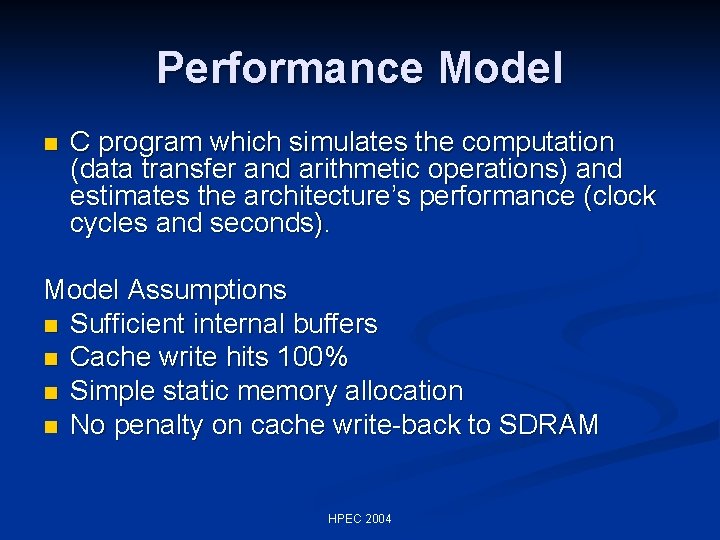
Performance Model n C program which simulates the computation (data transfer and arithmetic operations) and estimates the architecture’s performance (clock cycles and seconds). Model Assumptions n Sufficient internal buffers n Cache write hits 100% n Simple static memory allocation n No penalty on cache write-back to SDRAM HPEC 2004
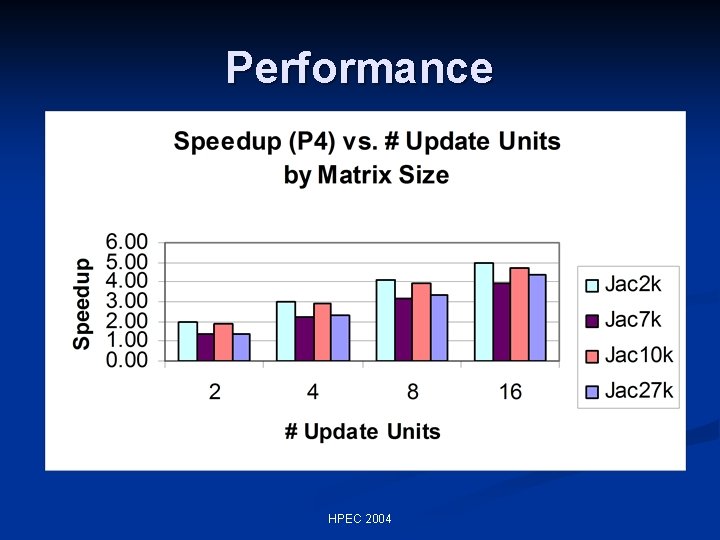
Performance n … HPEC 2004
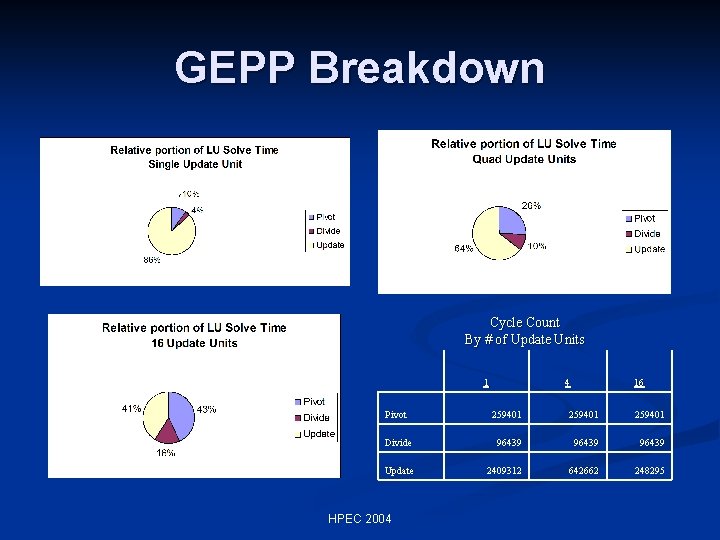
GEPP Breakdown Cycle Count By # of Update Units 1 Pivot 4 16 259401 Divide 96439 Update 2409312 642662 248295 HPEC 2004