
sparked by just the right combination of physical
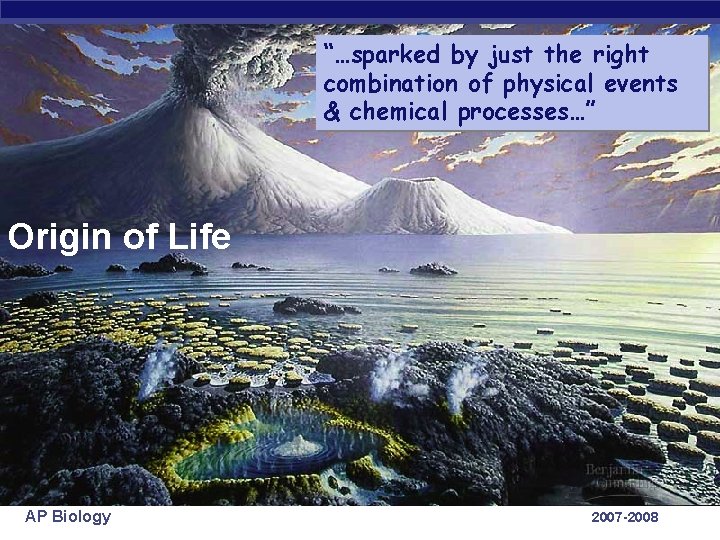
“…sparked by just the right combination of physical events & chemical processes…” Origin of Life AP Biology 2007 -2008
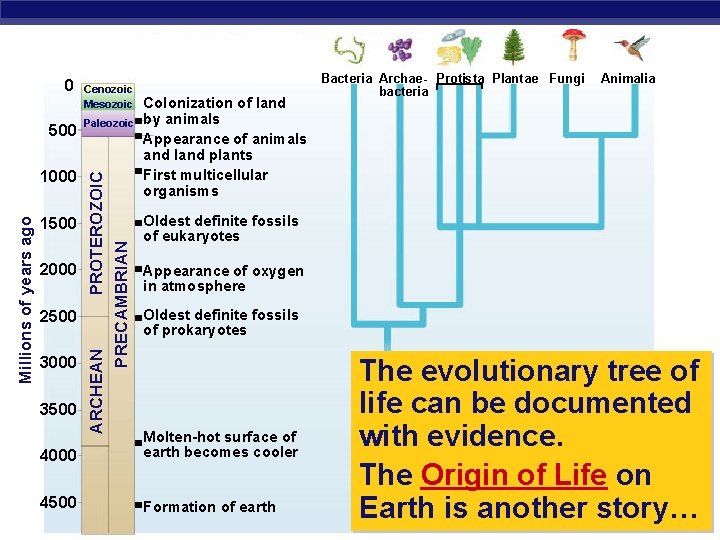
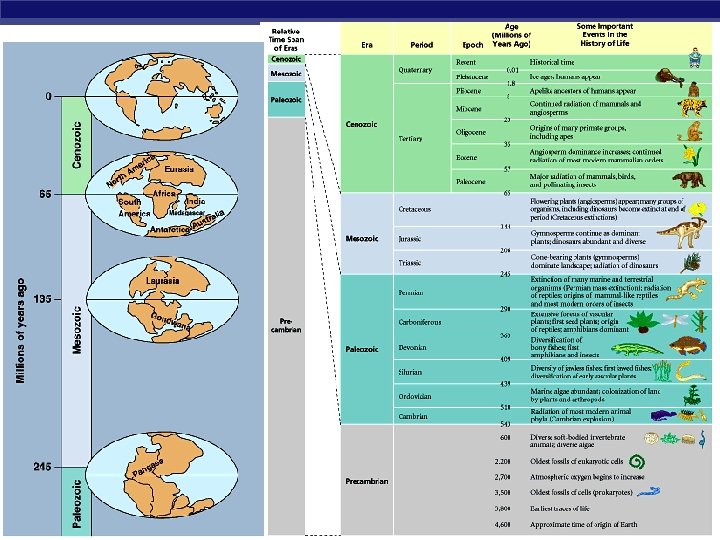
1500 2000 2500 3000 3500 ARCHEAN Millions of years ago 1000 Paleozoic PRECAMBRIAN 500 Cenozoic Mesozoic PROTEROZOIC 0 Colonization of land by animals Appearance of animals and land plants First multicellular organisms Animalia Oldest definite fossils of eukaryotes Appearance of oxygen in atmosphere Oldest definite fossils of prokaryotes 4000 Molten-hot surface of earth becomes cooler 4500 Formation of earth AP Biology Bacteria Archae- Protista Plantae Fungi bacteria The evolutionary tree of life can be documented with evidence. The Origin of Life on Earth is another story…
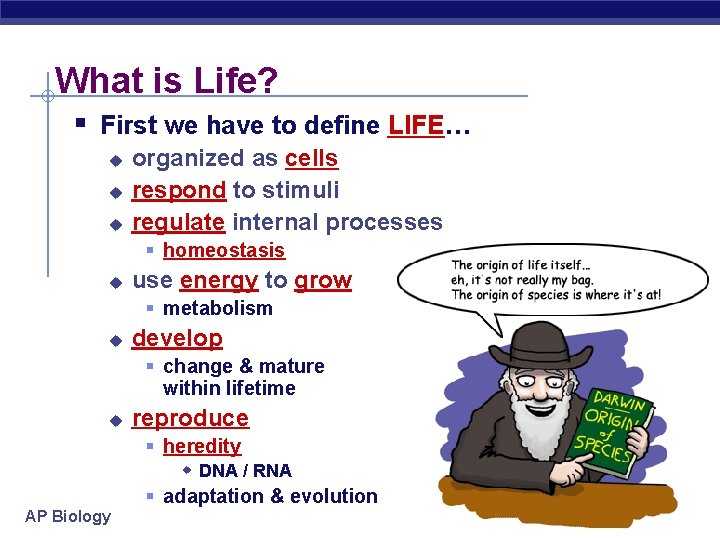
What is Life? § First we have to define LIFE… u u u organized as cells respond to stimuli regulate internal processes § homeostasis u use energy to grow § metabolism u develop § change & mature within lifetime u reproduce § heredity w DNA / RNA § adaptation & evolution AP Biology
The Origin of Life is Hypothesis § Special Creation u u Was life created by a supernatural or divine force? not testable § Extraterrestrial Origin u u Was the original source of organic (carbon) materials comets & meteorites striking early Earth? testable § Spontaneous Abiotic Origin u AP Biologyu Did life evolve spontaneously from inorganic molecules? testable
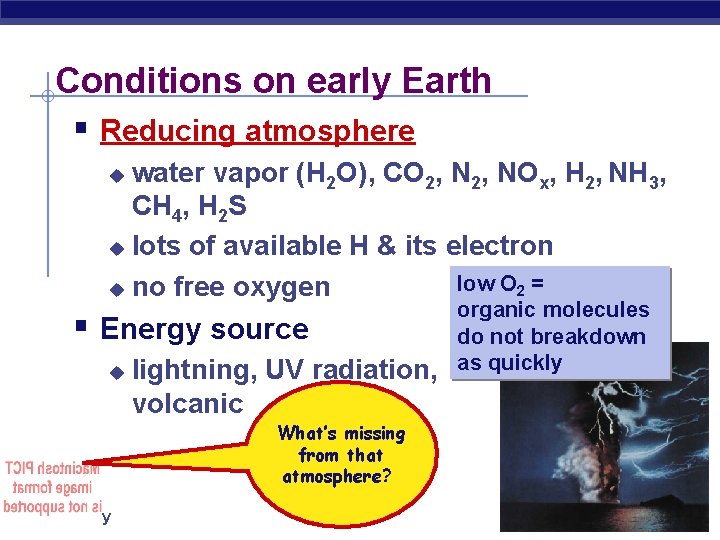
Conditions on early Earth § Reducing atmosphere water vapor (H 2 O), CO 2, NOx, H 2, NH 3, CH 4, H 2 S u lots of available H & its electron low O 2 = u no free oxygen u § Energy source u lightning, UV radiation, volcanic What’s missing from that atmosphere? AP Biology organic molecules do not breakdown as quickly
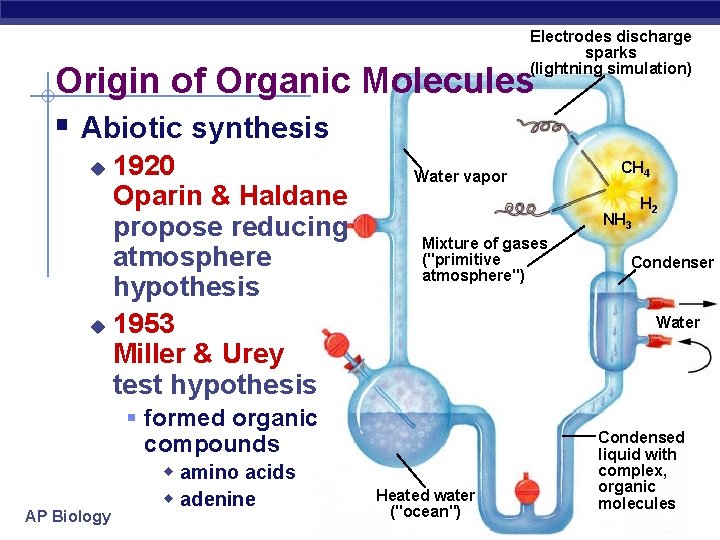
Electrodes discharge sparks (lightning simulation) Origin of Organic Molecules § Abiotic synthesis 1920 Oparin & Haldane propose reducing atmosphere hypothesis u 1953 Miller & Urey test hypothesis u AP Biology § formed organic compounds w amino acids w adenine Water vapor CH 4 NH 3 Mixture of gases ("primitive atmosphere") H 2 Condenser Water Heated water ("ocean") Condensed liquid with complex, organic molecules
Stanley Miller University of Chicago produced -amino acids -hydrocarbons -nitrogen bases -other organics It’s ALIVE! AP Biology
Origin of Cells (Protobionts) § Bubbles separate inside from outside metabolism & reproduction Bubbles… Tiny bubbles… AP Biology
Dawn of natural selection Origin of Genetics § RNA is likely first genetic material multi-functional u codes information u § self-replicating molecule § makes inheritance possible § natural selection & evolution u enzyme functions § ribozymes § replication regulatory molecule u transport molecule u AP Biology § t. RNA & m. RNA
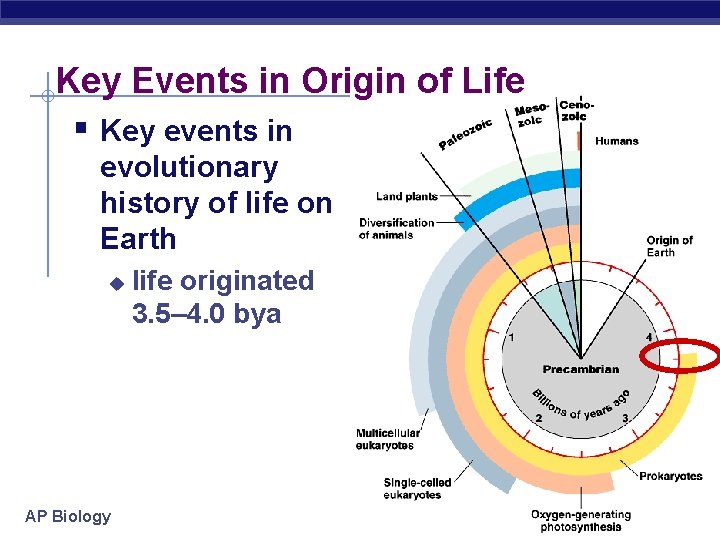
Key Events in Origin of Life § Key events in evolutionary history of life on Earth u AP Biology life originated 3. 5– 4. 0 bya
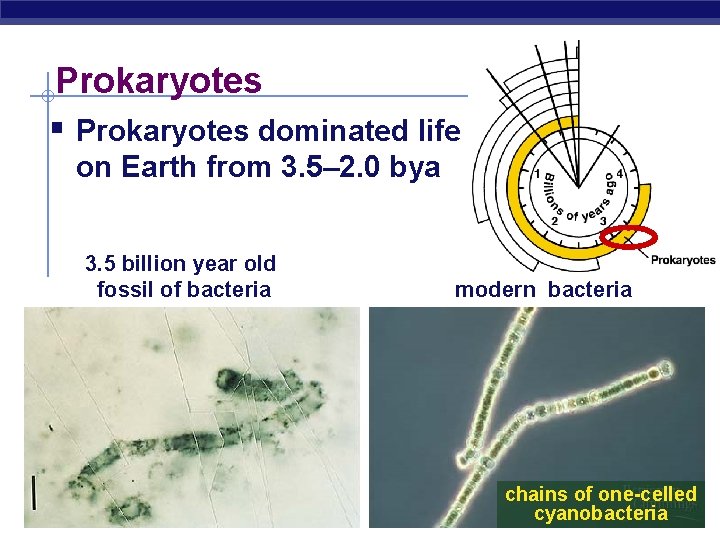
Prokaryotes § Prokaryotes dominated life on Earth from 3. 5– 2. 0 bya 3. 5 billion year old fossil of bacteria AP Biology modern bacteria chains of one-celled cyanobacteria
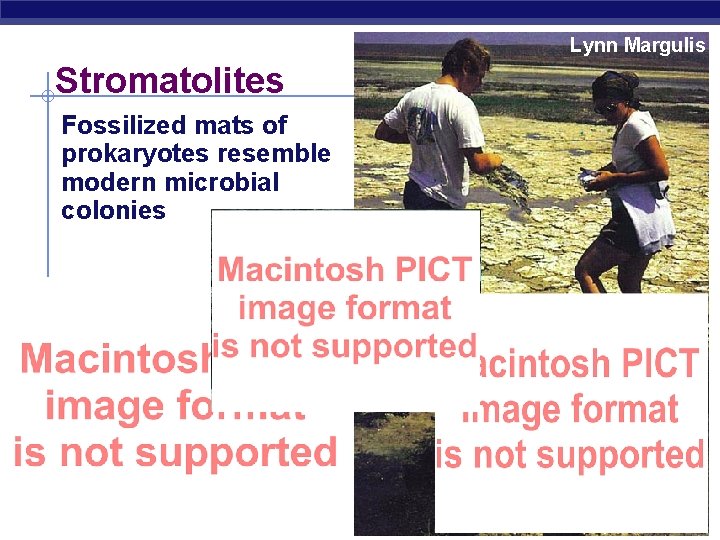
Lynn Margulis Stromatolites Fossilized mats of prokaryotes resemble modern microbial colonies AP Biology
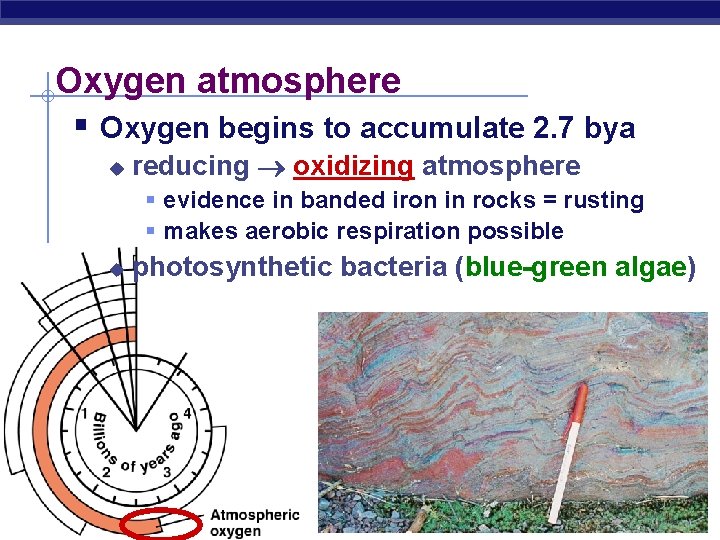
Oxygen atmosphere § Oxygen begins to accumulate 2. 7 bya u reducing oxidizing atmosphere § evidence in banded iron in rocks = rusting § makes aerobic respiration possible u AP Biology photosynthetic bacteria (blue-green algae)
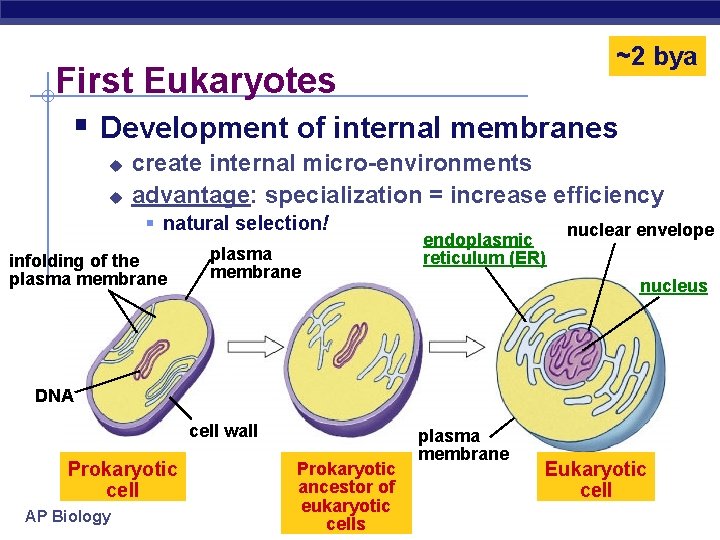
~2 bya First Eukaryotes § Development of internal membranes u u create internal micro-environments advantage: specialization = increase efficiency § natural selection! infolding of the plasma membrane endoplasmic reticulum (ER) nuclear envelope nucleus DNA cell wall Prokaryotic cell AP Biology Prokaryotic ancestor of eukaryotic cells plasma membrane Eukaryotic cell
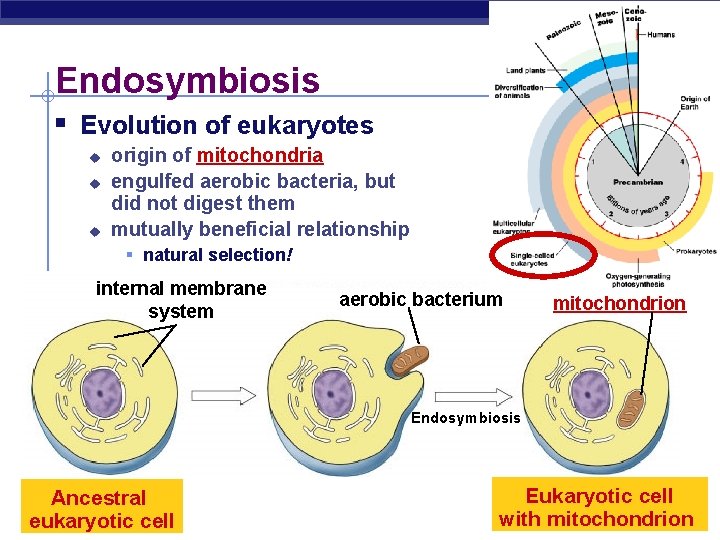
Endosymbiosis § Evolution of eukaryotes u u u origin of mitochondria engulfed aerobic bacteria, but did not digest them mutually beneficial relationship § natural selection! internal membrane system aerobic bacterium mitochondrion Endosymbiosis Ancestral AP Biology eukaryotic cell Eukaryotic cell with mitochondrion
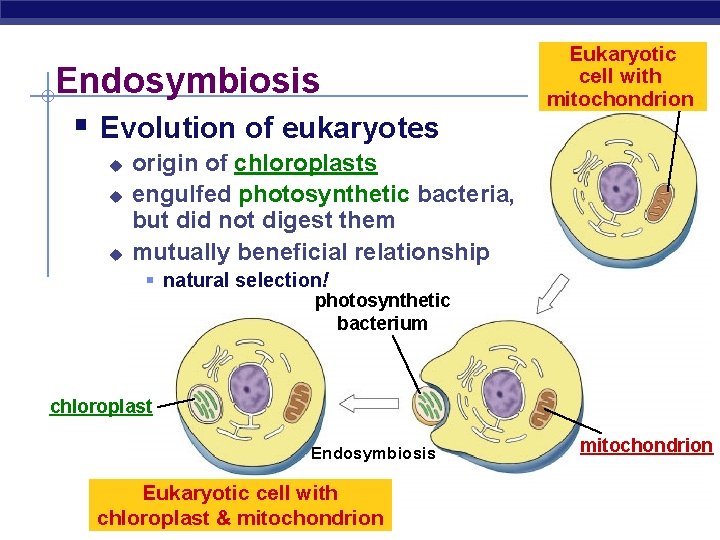
Endosymbiosis § Evolution of eukaryotes u u u Eukaryotic cell with mitochondrion origin of chloroplasts engulfed photosynthetic bacteria, but did not digest them mutually beneficial relationship § natural selection! photosynthetic bacterium chloroplast Endosymbiosis Eukaryotic cell with AP Biology chloroplast & mitochondrion
Theory of Endosymbiosis § Evidence u structural § mitochondria & chloroplasts resemble bacterial structure u genetic Lynn Margulis § mitochondria & chloroplasts have their own circular DNA, like bacteria u AP Biology functional § mitochondria & chloroplasts move freely within the cell § mitochondria & chloroplasts reproduce independently from the cell
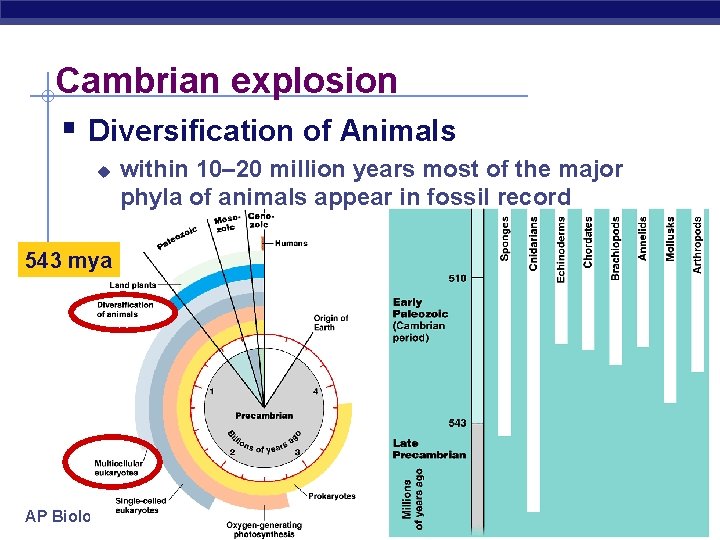
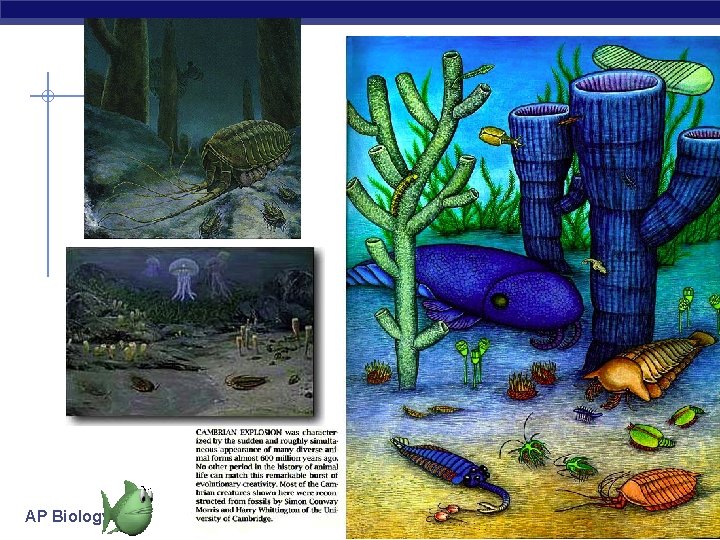
Cambrian explosion § Diversification of Animals u 543 mya AP Biology within 10– 20 million years most of the major phyla of animals appear in fossil record
AP Biology
AP Biology
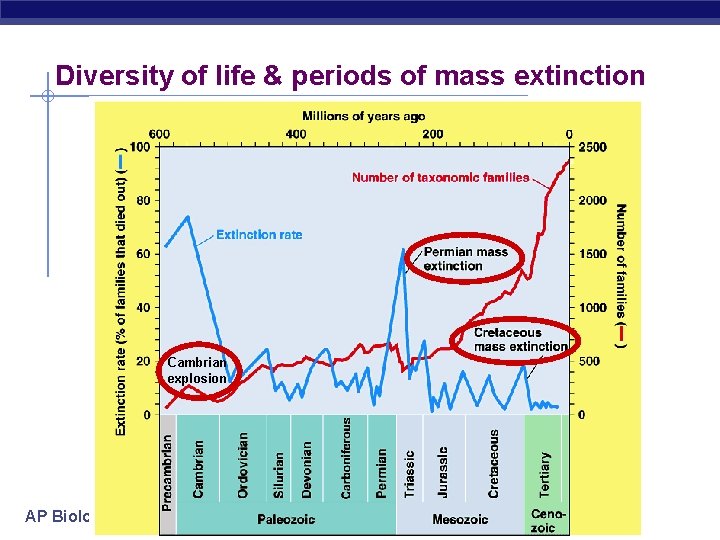
Diversity of life & periods of mass extinction Cambrian explosion AP Biology
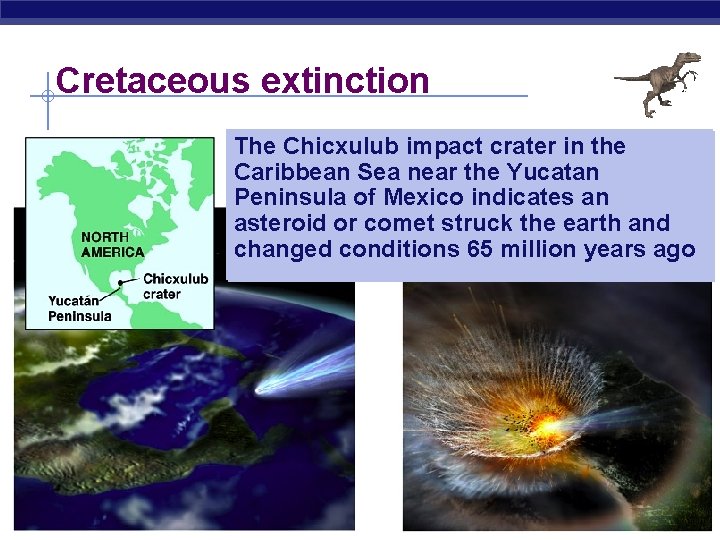
Cretaceous extinction The Chicxulub impact crater in the Caribbean Sea near the Yucatan Peninsula of Mexico indicates an asteroid or comet struck the earth and changed conditions 65 million years ago AP Biology
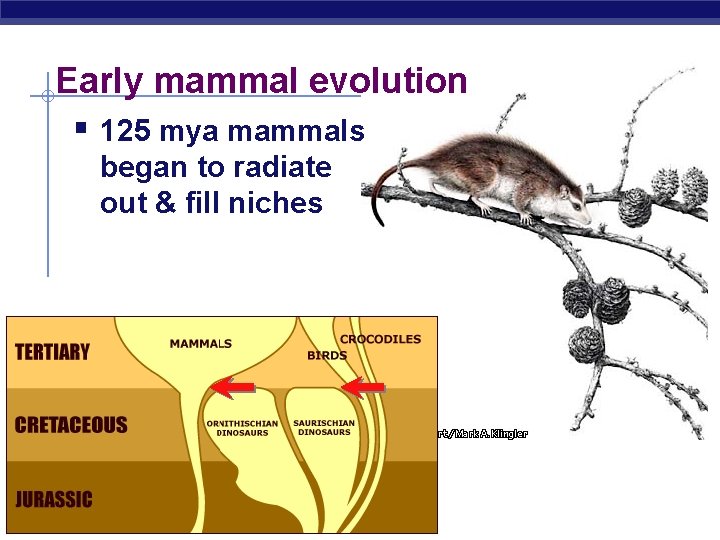
Early mammal evolution § 125 mya mammals began to radiate out & fill niches AP Biology
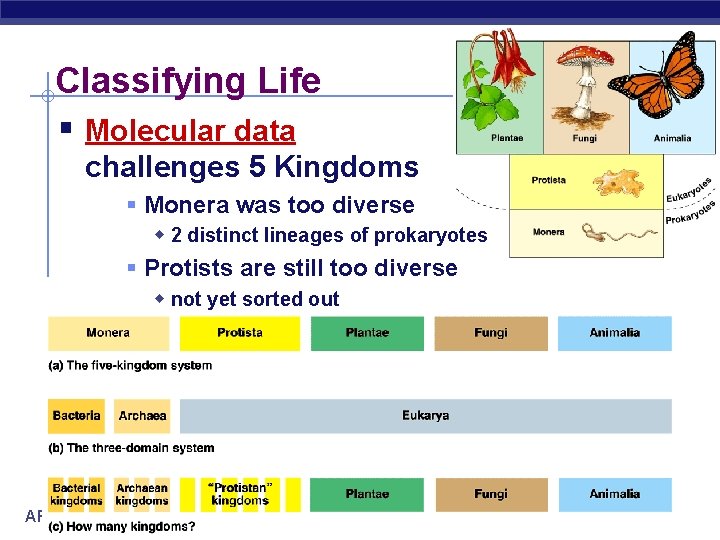
Classifying Life § Molecular data challenges 5 Kingdoms § Monera was too diverse w 2 distinct lineages of prokaryotes § Protists are still too diverse w not yet sorted out AP Biology
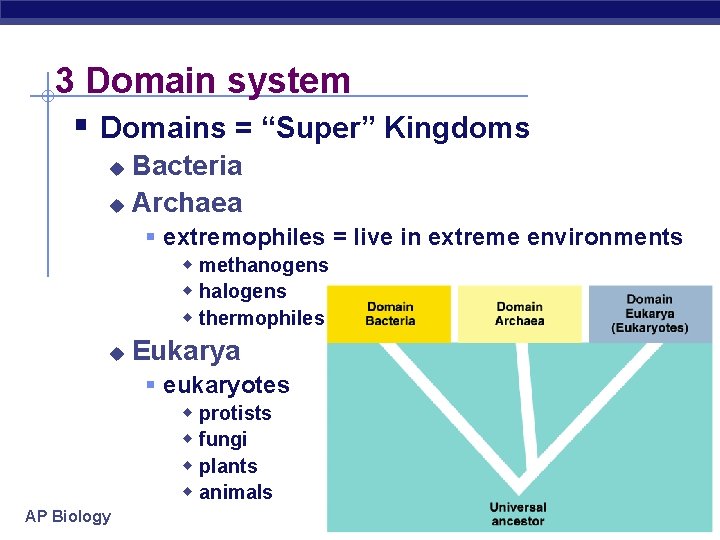
3 Domain system § Domains = “Super” Kingdoms Bacteria u Archaea u § extremophiles = live in extreme environments w methanogens w halogens w thermophiles u Eukarya § eukaryotes w protists w fungi w plants w animals AP Biology
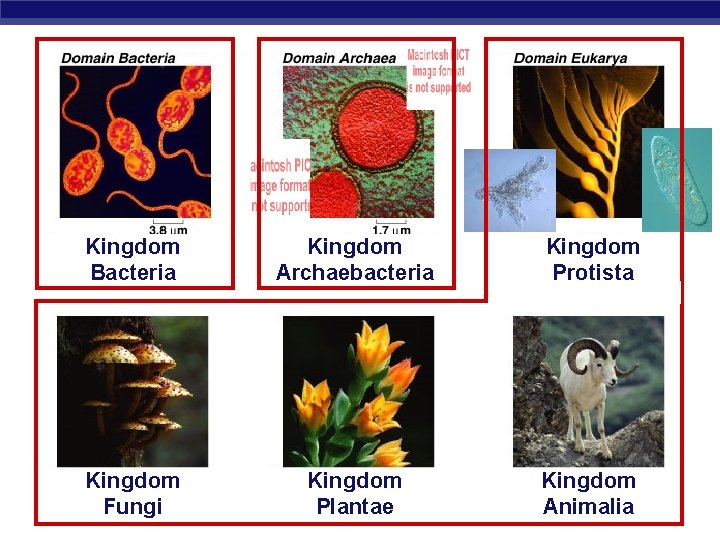
Kingdom Bacteria Kingdom AP Biology. Fungi Kingdom Archaebacteria Kingdom Protista Kingdom Plantae Kingdom Animalia
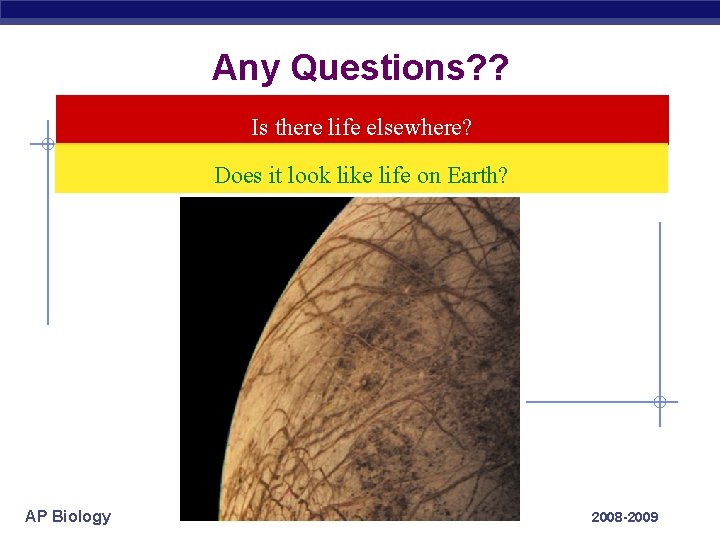
Any Questions? ? Is there life elsewhere? Does it look like life on Earth? AP Biology 2008 -2009
- Slides: 27