
Spark plasma sintering of boron carbide ceramics densification
Spark plasma sintering of boron carbide ceramics: densification mechanisms and thermomechanical properties G. Antou, R. Belon, M. Georges, N. Pradeilles, A. Maître University of Limoges, IRCER - UMR CNRS 7315, France
Outline 1. Boron carbide: properties and applications - UHTCs 2. Spark Plasma Sintering ability of B 4 C-based ceramics a. Commercial raw powder b. Sintering map c. Densification mechanism 3. Thermomechanical properties of B 4 C-based ceramics a. Effect of the impurity content at RT b. Mechanical behavior up to 1600°C 4. Conclusions and perspectives 2
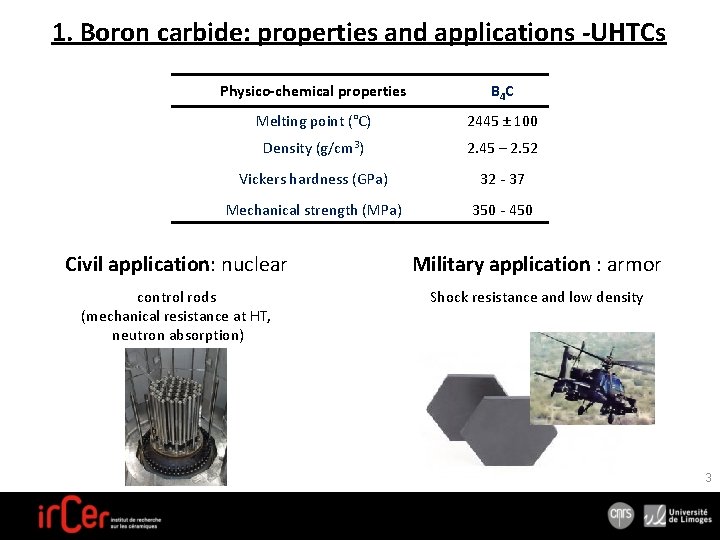
1. Boron carbide: properties and applications -UHTCs Physico-chemical properties B 4 C Melting point (°C) 2445 ± 100 Density (g/cm 3) 2. 45 – 2. 52 Vickers hardness (GPa) 32 - 37 Mechanical strength (MPa) 350 - 450 Civil application: nuclear Military application : armor control rods (mechanical resistance at HT, neutron absorption) Shock resistance and low density 3
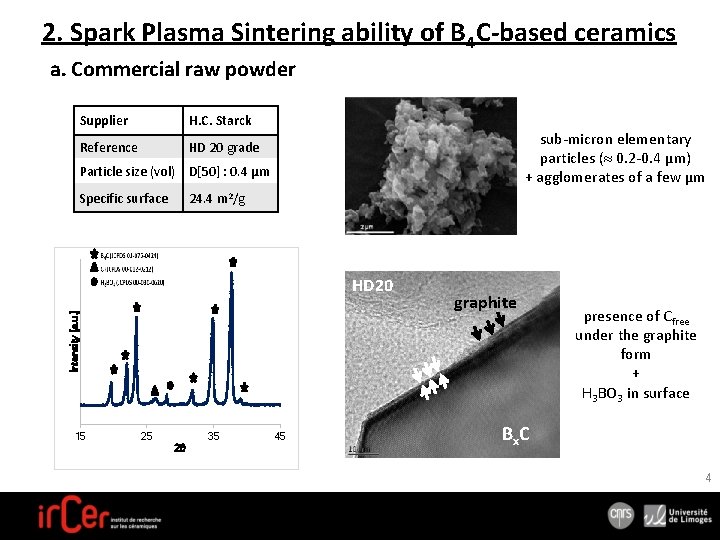
2. Spark Plasma Sintering ability of B 4 C-based ceramics a. Commercial raw powder Supplier H. C. Starck Reference HD 20 grade sub-micron elementary particles ( 0. 2 -0. 4 µm) + agglomerates of a few μm Particle size (vol) D[50] : 0. 4 µm Specific surface 24. 4 m 2/g Intensity [a. u. ] HD 20 15 25 35 2θ 45 graphite presence of Cfree under the graphite form + H 3 BO 3 in surface Bx C 4
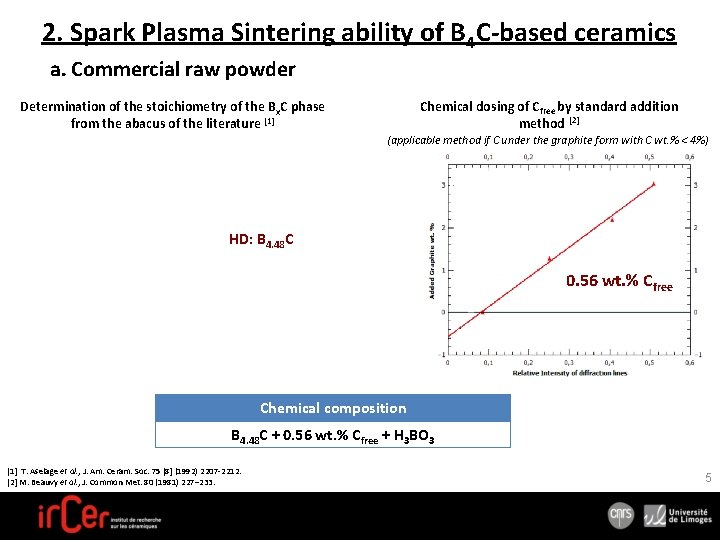
2. Spark Plasma Sintering ability of B 4 C-based ceramics a. Commercial raw powder Determination of the stoichiometry of the Bx. C phase from the abacus of the literature [1] Chemical dosing of Cfree by standard addition method [2] (applicable method if C under the graphite form with C wt. % < 4%) HD: B 4. 48 C 0. 56 wt. % Cfree Chemical composition B 4. 48 C + 0. 56 wt. % Cfree + H 3 BO 3 [1] T. Aselage et al. , J. Am. Ceram. Soc. 75 [8] (1992) 2207 -2212. [2] M. Beauvy et al. , J. Common Met. 80 (1981) 227– 233. 5
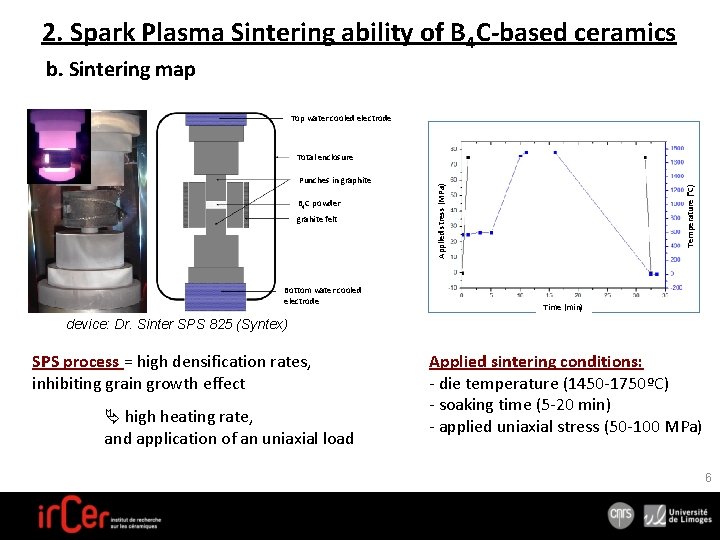
2. Spark Plasma Sintering ability of B 4 C-based ceramics b. Sintering map Top water cooled electrode B 4 C powder grahite felt Bottom water cooled electrode Temperature (°C) Punches in graphite Applied stress (MPa) Total enclosure Time (min) device: Dr. Sinter SPS 825 (Syntex) SPS process = high densification rates, inhibiting grain growth effect high heating rate, and application of an uniaxial load Applied sintering conditions: - die temperature (1450 -1750ºC) - soaking time (5 -20 min) - applied uniaxial stress (50 -100 MPa) 6
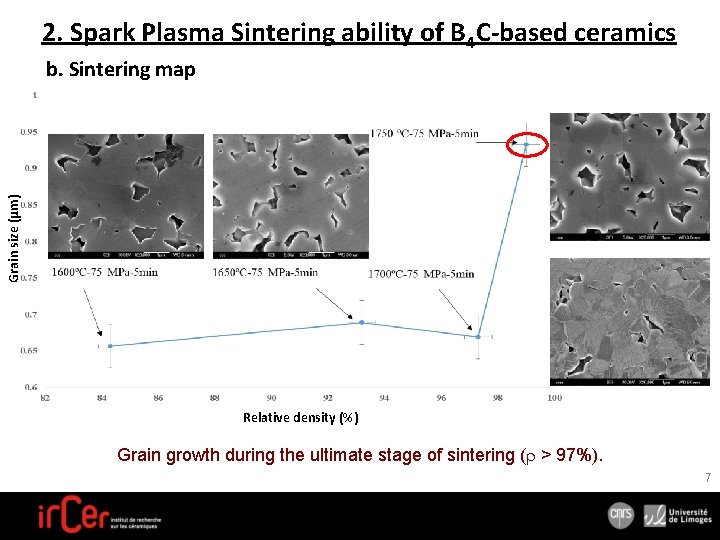
2. Spark Plasma Sintering ability of B 4 C-based ceramics Grain size (µm) b. Sintering map Relative density (%) Grain growth during the ultimate stage of sintering ( > 97%). 7
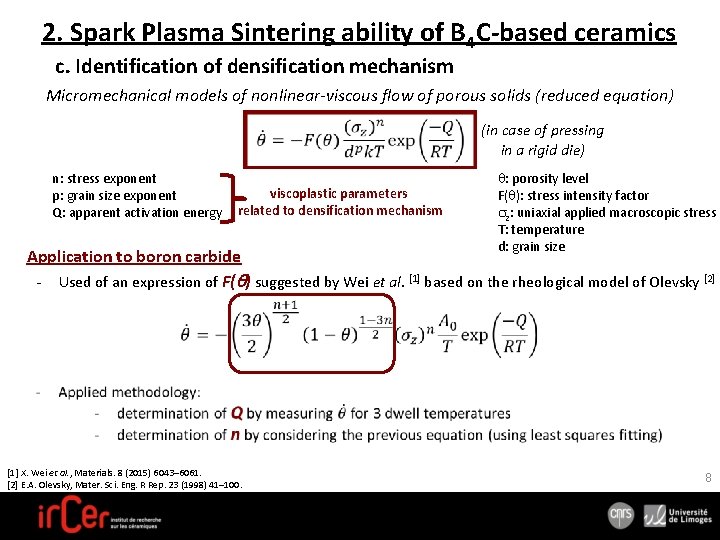
2. Spark Plasma Sintering ability of B 4 C-based ceramics c. Identification of densification mechanism Micromechanical models of nonlinear-viscous flow of porous solids (reduced equation) n: stress exponent p: grain size exponent Q: apparent activation energy viscoplastic parameters related to densification mechanism (in case of pressing in a rigid die) : porosity level F( ): stress intensity factor z: uniaxial applied macroscopic stress T: temperature d: grain size Application to boron carbide - Used of an expression of F( ) suggested by Wei et al. [1] based on the rheological model of Olevsky [2] [1] X. Wei et al. , Materials. 8 (2015) 6043– 6061. [2] E. A. Olevsky, Mater. Sci. Eng. R Rep. 23 (1998) 41– 100. 8
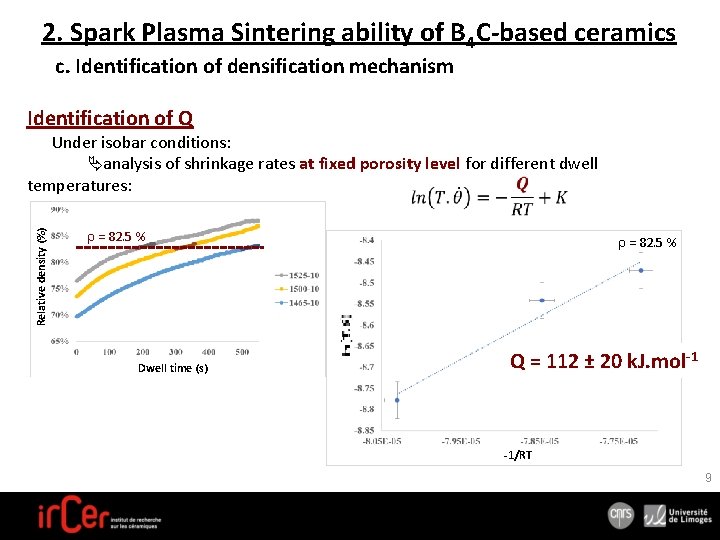
2. Spark Plasma Sintering ability of B 4 C-based ceramics c. Identification of densification mechanism Identification of Q = 82. 5 % Dwell time (s) = 82. 5 % Relative density (%) Under isobar conditions: analysis of shrinkage rates at fixed porosity level for different dwell temperatures: Q = 112 ± 20 k. J. mol-1 -1/RT 9
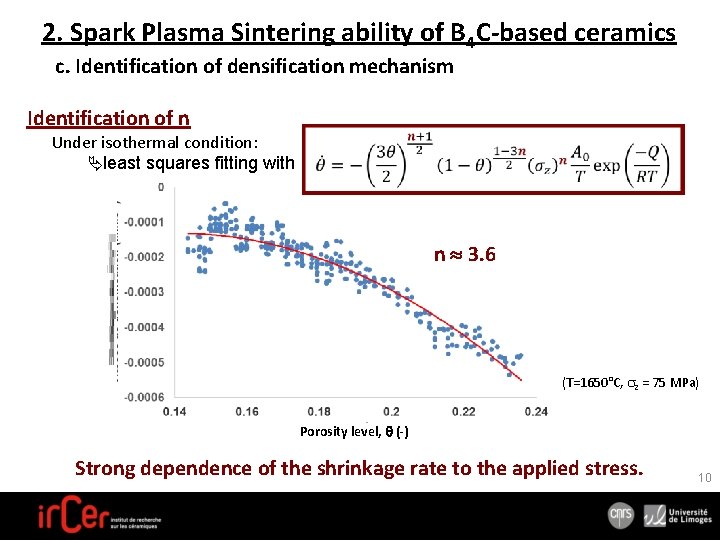
2. Spark Plasma Sintering ability of B 4 C-based ceramics c. Identification of densification mechanism Identification of n Under isothermal condition: least squares fitting with n 3. 6 (T=1650°C, z = 75 MPa) Porosity level, (-) Strong dependence of the shrinkage rate to the applied stress. 10
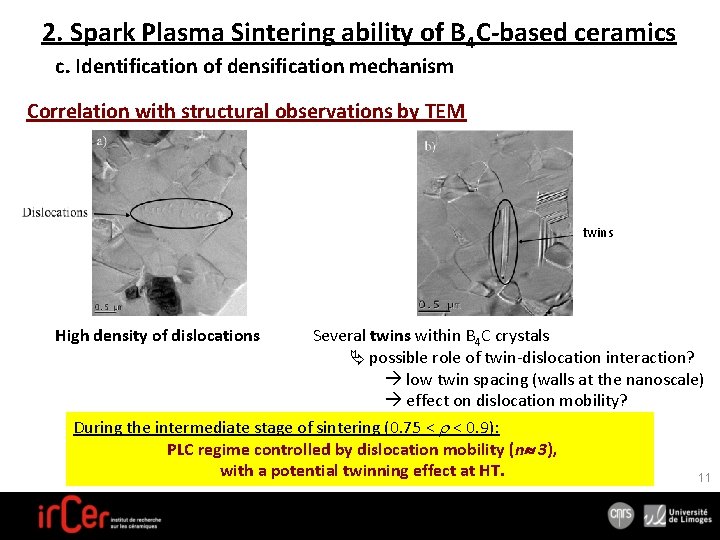
2. Spark Plasma Sintering ability of B 4 C-based ceramics c. Identification of densification mechanism Correlation with structural observations by TEM twins High density of dislocations Several twins within B 4 C crystals possible role of twin-dislocation interaction? low twin spacing (walls at the nanoscale) effect on dislocation mobility? During the intermediate stage of sintering (0. 75 < < 0. 9): PLC regime controlled by dislocation mobility (n 3), with a potential twinning effect at HT. 11
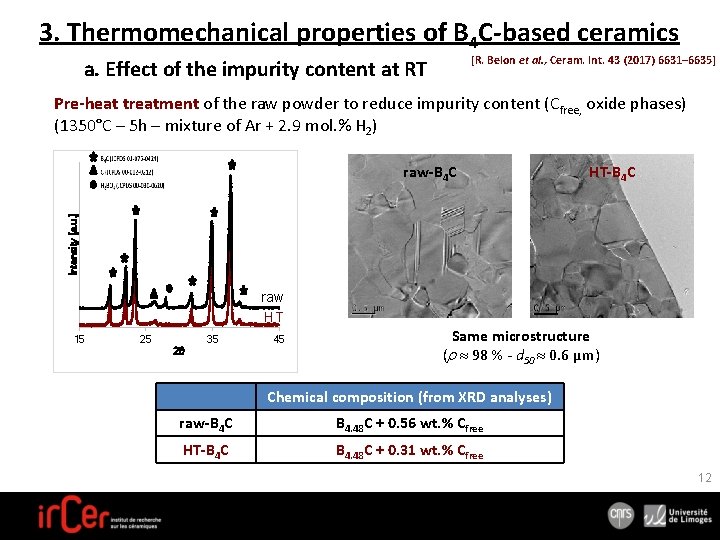
3. Thermomechanical properties of B 4 C-based ceramics [R. Belon et al. , Ceram. Int. 43 (2017) 6631– 6635] a. Effect of the impurity content at RT Pre-heat treatment of the raw powder to reduce impurity content (Cfree, oxide phases) (1350°C – 5 h – mixture of Ar + 2. 9 mol. % H 2) HT-B 4 C Intensity [a. u. ] raw-B 4 C raw HT 15 25 35 2θ 45 Same microstructure ( 98 % - d 50 0. 6 µm) Chemical composition (from XRD analyses) raw-B 4 C B 4. 48 C + 0. 56 wt. % Cfree HT-B 4 C B 4. 48 C + 0. 31 wt. % Cfree 12
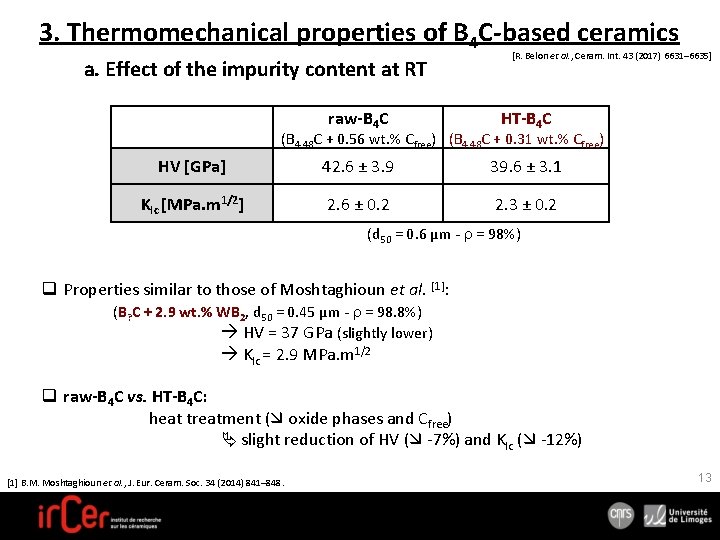
3. Thermomechanical properties of B 4 C-based ceramics a. Effect of the impurity content at RT [R. Belon et al. , Ceram. Int. 43 (2017) 6631– 6635] raw-B 4 C HT-B 4 C HV [GPa] 42. 6 ± 3. 9 39. 6 ± 3. 1 KIc [MPa. m 1/2] 2. 6 ± 0. 2 2. 3 ± 0. 2 (B 4. 48 C + 0. 56 wt. % Cfree) (B 4. 48 C + 0. 31 wt. % Cfree) (d 50 = 0. 6 µm - = 98%) q Properties similar to those of Moshtaghioun et al. [1]: (B? C + 2. 9 wt. % WB 2, d 50 = 0. 45 µm - = 98. 8%) HV = 37 GPa (slightly lower) KIc = 2. 9 MPa. m 1/2 q raw-B 4 C vs. HT-B 4 C: heat treatment ( oxide phases and Cfree) slight reduction of HV ( -7%) and KIc ( -12%) [1] B. M. Moshtaghioun et al. , J. Eur. Ceram. Soc. 34 (2014) 841– 848. 13
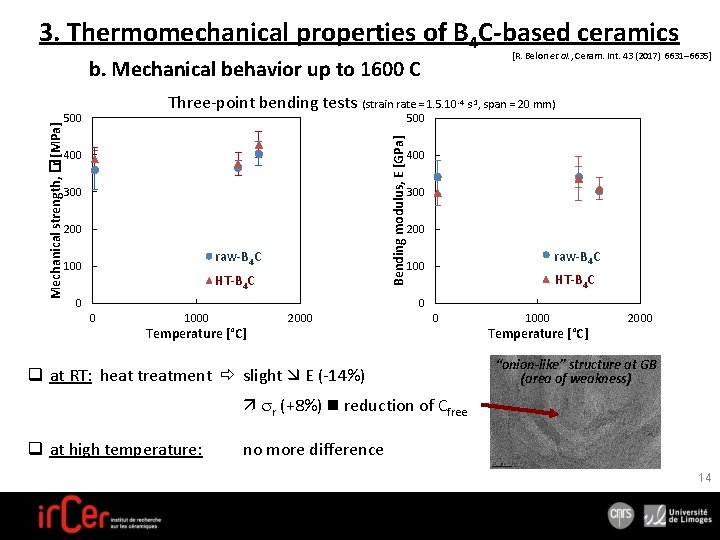
3. Thermomechanical properties of B 4 C-based ceramics [R. Belon et al. , Ceram. Int. 43 (2017) 6631– 6635] Three-point bending tests (strain rate = 1. 5. 10 -4 s-1, span = 20 mm) 500 Bending modulus, E [GPa] Mechanical strength, �r [MPa] b. Mechanical behavior up to 1600 C 400 300 200 HD 20 brute raw-B 4 C 100 HT-B 4 C HD 20 traitée 0 0 1000 Temperature [°C] 2000 0 q at RT: heat treatment slight E (-14%) 1000 Temperature [°C] 2000 “onion-like” structure at GB (area of weakness) r (+8%) reduction of Cfree q at high temperature: no more difference 14
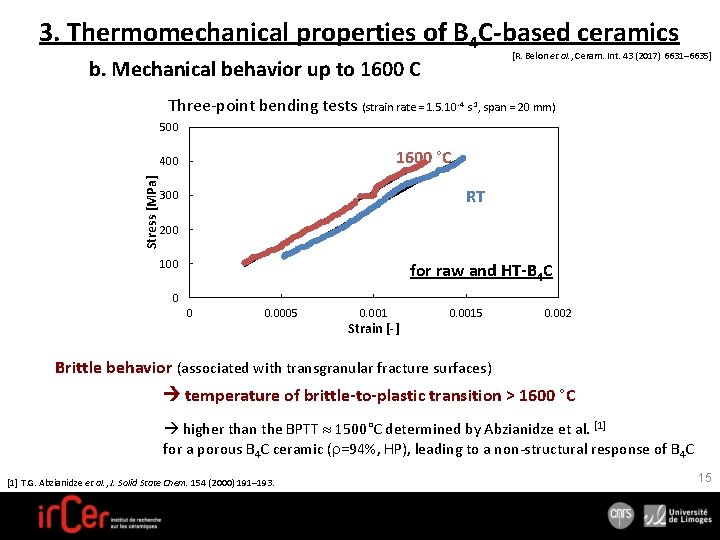
3. Thermomechanical properties of B 4 C-based ceramics [R. Belon et al. , Ceram. Int. 43 (2017) 6631– 6635] b. Mechanical behavior up to 1600 C Three-point bending tests (strain rate = 1. 5. 10 -4 s-1, span = 20 mm) 500 1600 °C Stress [MPa] 400 RT 300 200 100 for raw and HT-B 4 C 0 0 0. 0005 0. 001 Strain [-] 0. 0015 0. 002 Brittle behavior (associated with transgranular fracture surfaces) temperature of brittle-to-plastic transition > 1600 °C higher than the BPTT 1500°C determined by Abzianidze et al. [1] for a porous B 4 C ceramic ( =94%, HP), leading to a non-structural response of B 4 C [1] T. G. Abzianidze et al. , J. Solid State Chem. 154 (2000) 191– 193. 15
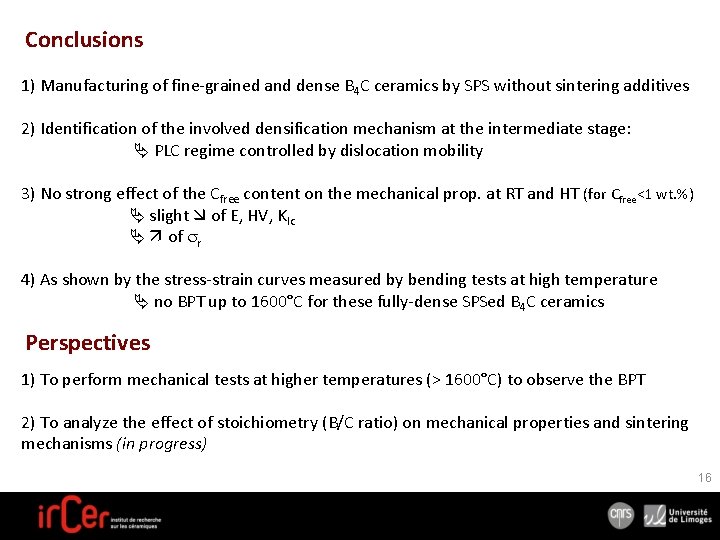
Conclusions 1) Manufacturing of fine-grained and dense B 4 C ceramics by SPS without sintering additives 2) Identification of the involved densification mechanism at the intermediate stage: PLC regime controlled by dislocation mobility 3) No strong effect of the Cfree content on the mechanical prop. at RT and HT (for Cfree<1 wt. %) slight of E, HV, KIc of r 4) As shown by the stress-strain curves measured by bending tests at high temperature no BPT up to 1600°C for these fully-dense SPSed B 4 C ceramics Perspectives 1) To perform mechanical tests at higher temperatures (> 1600°C) to observe the BPT 2) To analyze the effect of stoichiometry (B/C ratio) on mechanical properties and sintering mechanisms (in progress) 16
Financial support through PF NEEDS “Matériaux” Thanks for your attention G. Antou *, R. Belon, M. Georges, N. Pradeilles, A. Maître IRCER Institute (UMR CNRS 7315), Univ. of Limoges, France * guy. antou@unilim. fr
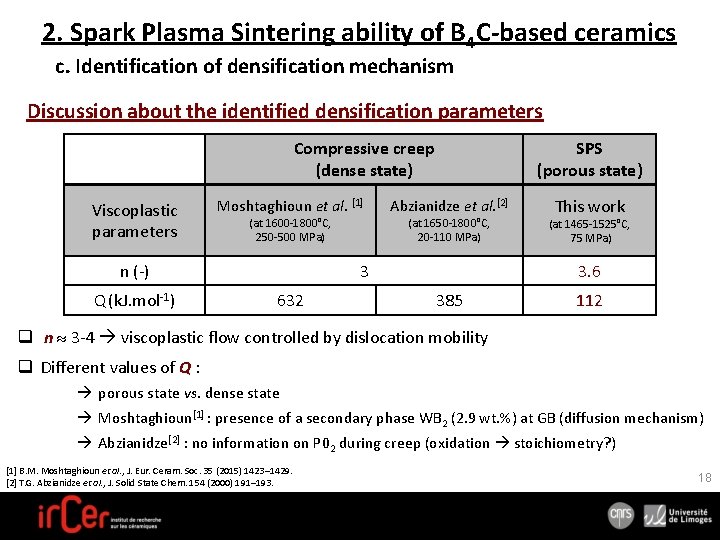
2. Spark Plasma Sintering ability of B 4 C-based ceramics c. Identification of densification mechanism Discussion about the identified densification parameters Compressive creep (dense state) Viscoplastic parameters Moshtaghioun et al. [1] (at 1600 -1800°C, 250 -500 MPa) n (-) Q (k. J. mol-1) SPS (porous state) Abzianidze et al. [2] (at 1650 -1800°C, 20 -110 MPa) 3 632 This work (at 1465 -1525°C, 75 MPa) 3. 6 385 112 q n 3 -4 viscoplastic flow controlled by dislocation mobility q Different values of Q : porous state vs. dense state Moshtaghioun[1] : presence of a secondary phase WB 2 (2. 9 wt. %) at GB (diffusion mechanism) Abzianidze[2] : no information on P 02 during creep (oxidation stoichiometry? ) [1] B. M. Moshtaghioun et al. , J. Eur. Ceram. Soc. 35 (2015) 1423– 1429. [2] T. G. Abzianidze et al. , J. Solid State Chem. 154 (2000) 191– 193. 18
- Slides: 18