
Spanning Trees Thomas Schwarz SJ Problem Networking LAN
Spanning Trees Thomas Schwarz, SJ
Problem • Networking: LAN • Switches are connected by links • Cycles can create problems: • Broadcast radiation • A broadcast or multicast message is repeatedly received by the same switch and resend …
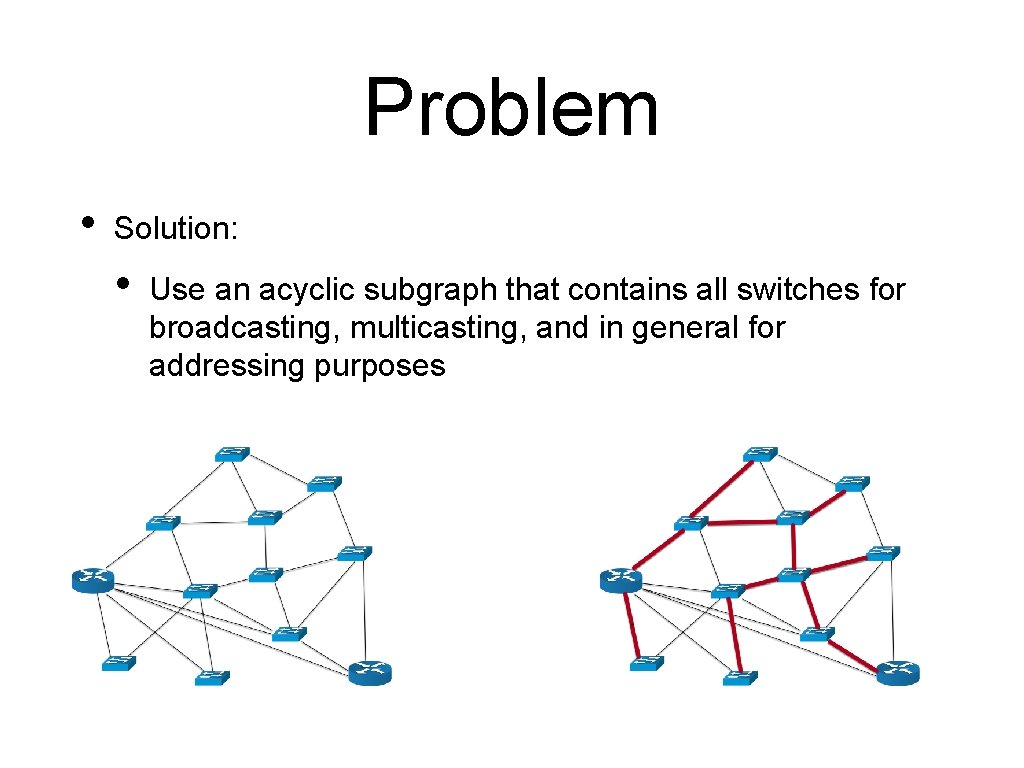
Problem • Solution: • Use an acyclic subgraph that contains all switches for broadcasting, multicasting, and in general for addressing purposes
Trees • A tree is a graph that is: • • acyclic connects all vertices
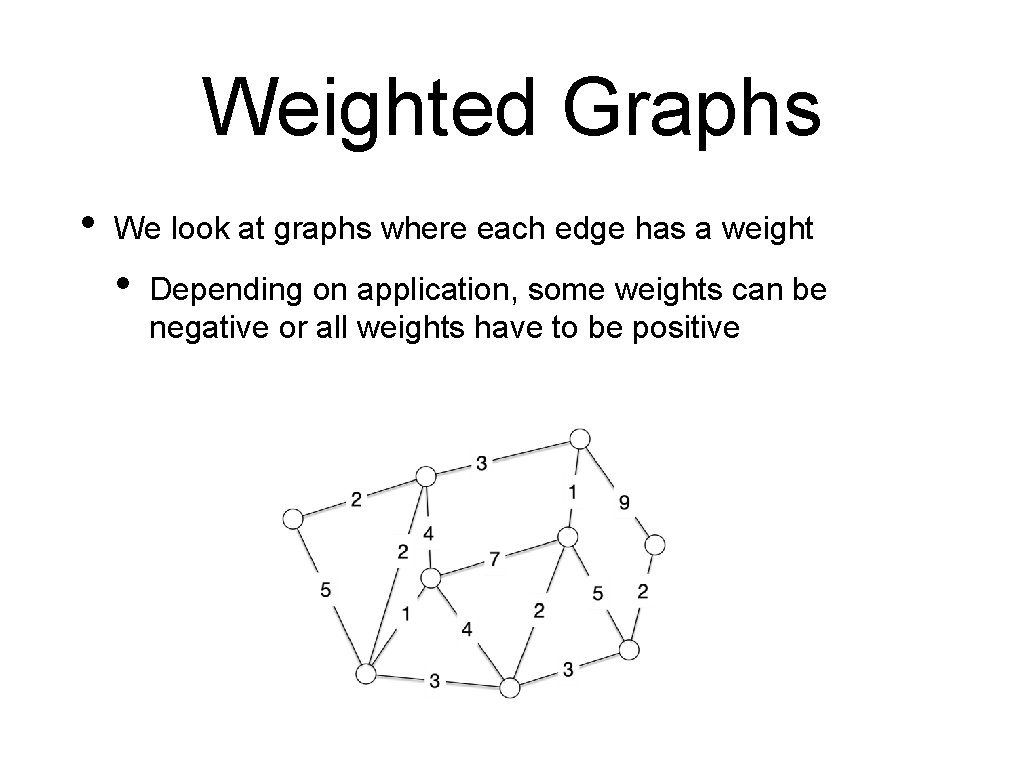
Weighted Graphs • We look at graphs where each edge has a weight • Depending on application, some weights can be negative or all weights have to be positive

Weighted Graphs • Other example:
Minimum Spanning Trees • Given a weighted graph: • Find a subset of edges such that • • • connects all vertices • Called a minimum weight spanning tree, but "weight" is usually omitted is acyclic Total weight is minimal
Minimum Spanning Trees • • Two greedy algorithms, Kruskal's and Prim's Use a loop invariant: • • • Let be the set of edges currently selected • Such an edge is a safe edge Invariant: is a subset of some minimum spanning tree At each step of the algorithm: only add an edge if the invariant remains true after inserting the edge
Minimum Spanning Trees • Generic MST algorithm 1. 2. While is not a spanning tree 1. Find a safe edge 2. Add the safe edge to A 3. Return A
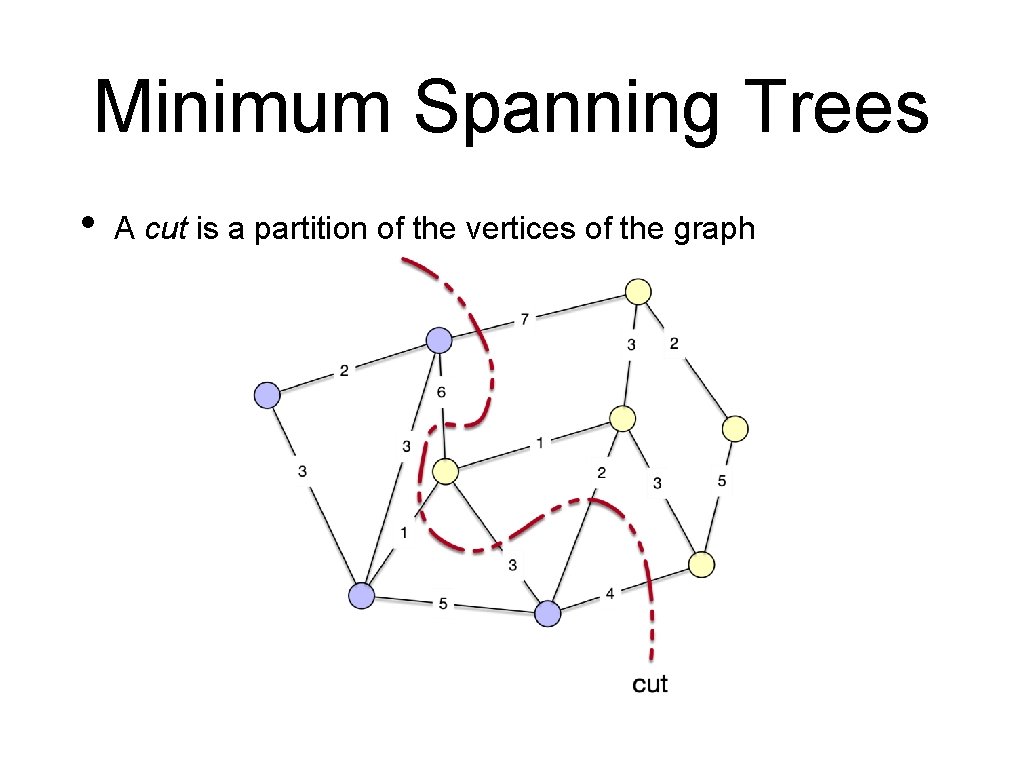
Minimum Spanning Trees • A cut is a partition of the vertices of the graph
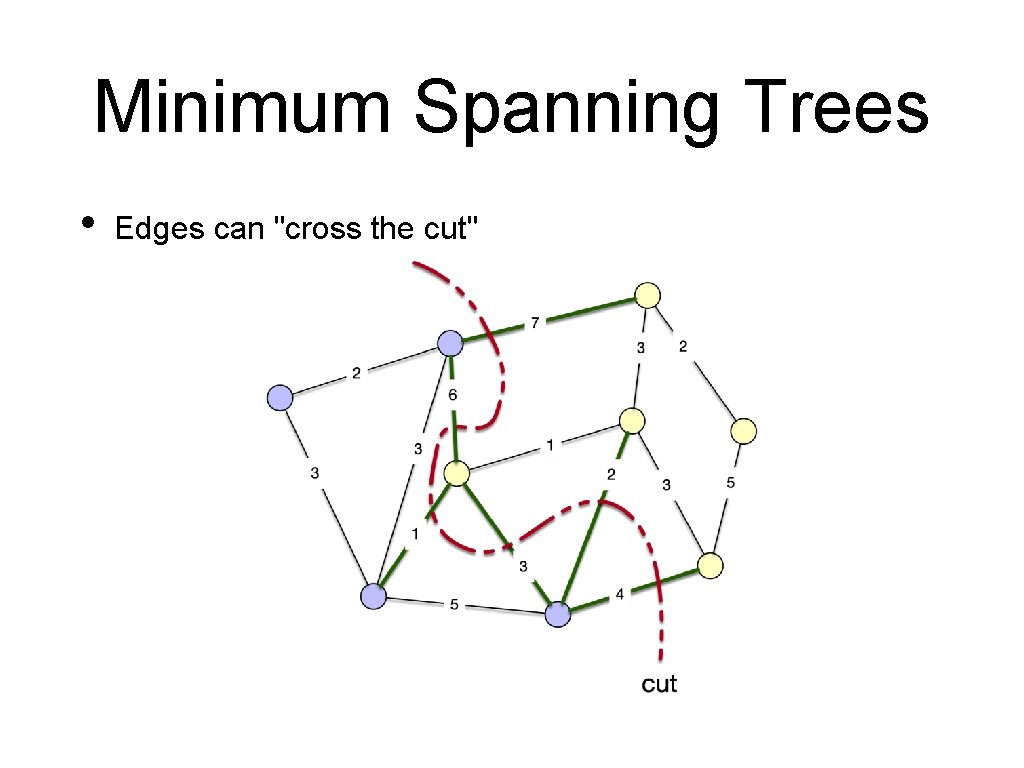
Minimum Spanning Trees • Edges can "cross the cut"
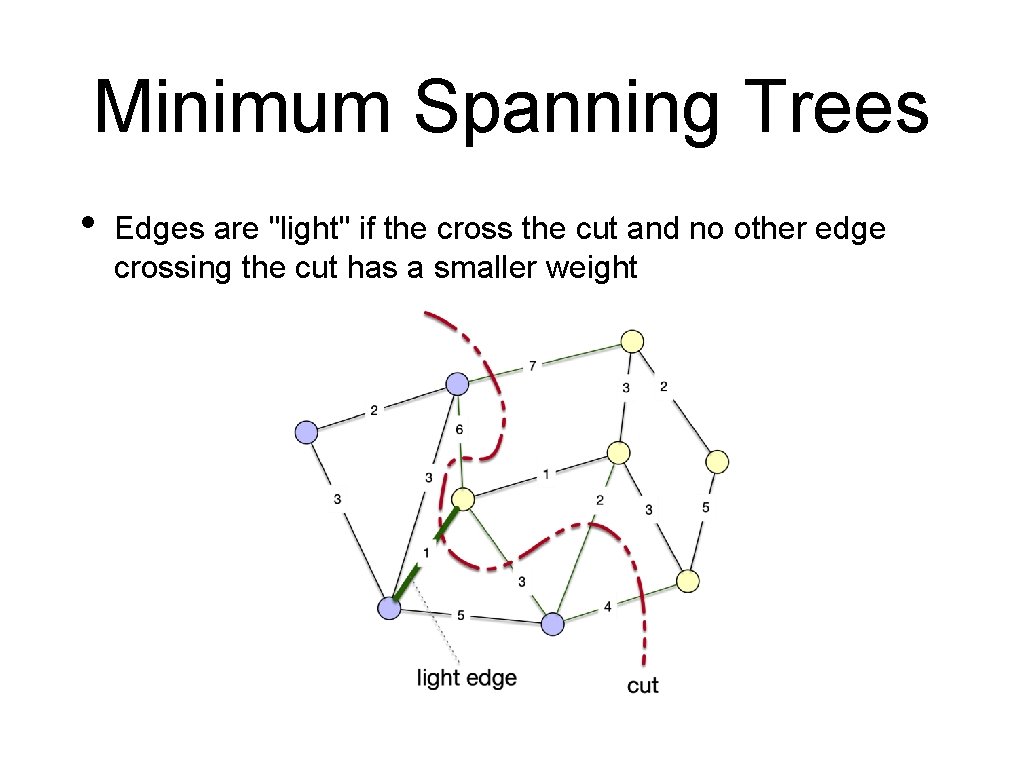
Minimum Spanning Trees • Edges are "light" if the cross the cut and no other edge crossing the cut has a smaller weight
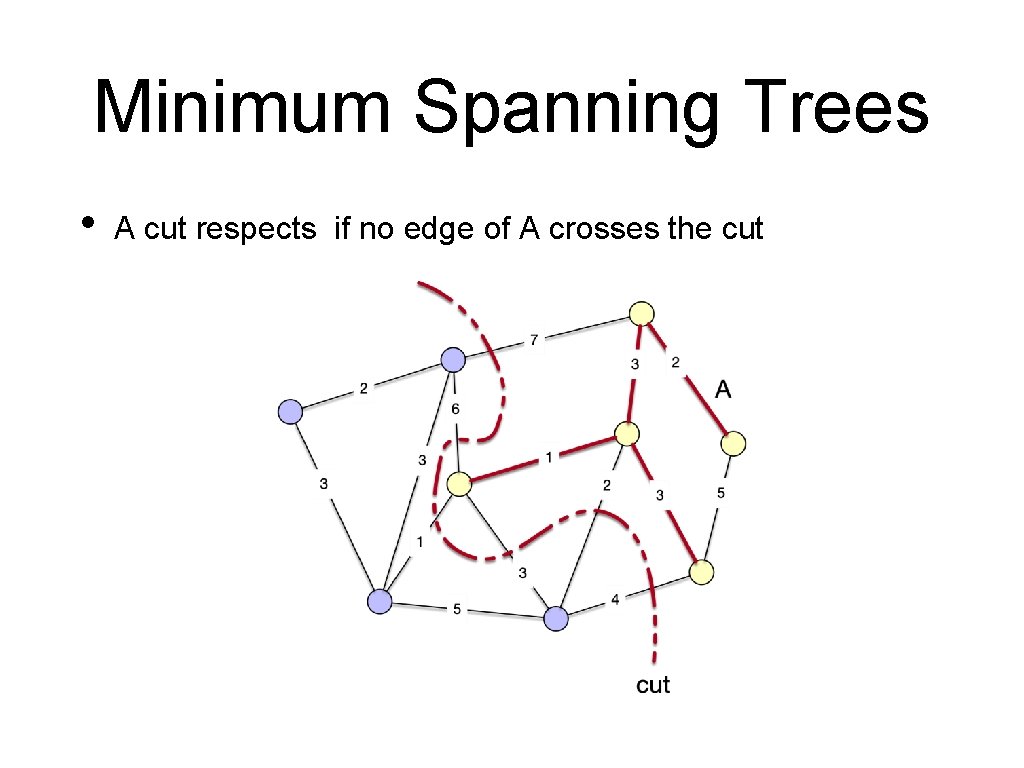
Minimum Spanning Trees • A cut respects if no edge of A crosses the cut
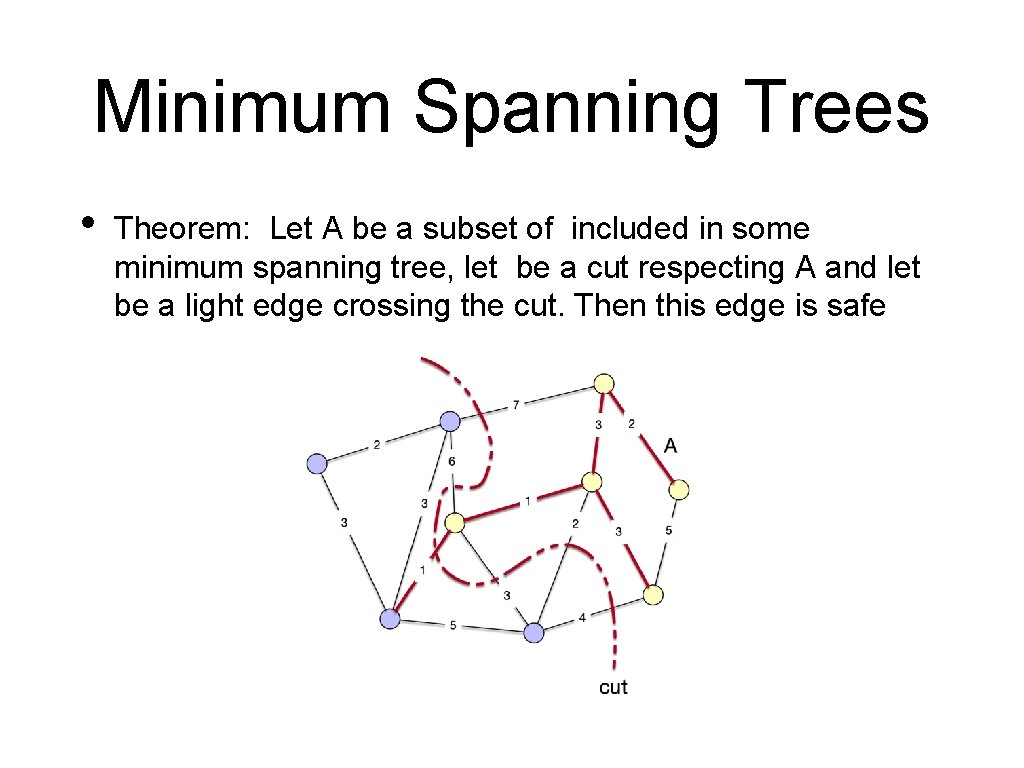
Minimum Spanning Trees • Theorem: Let A be a subset of included in some minimum spanning tree, let be a cut respecting A and let be a light edge crossing the cut. Then this edge is safe
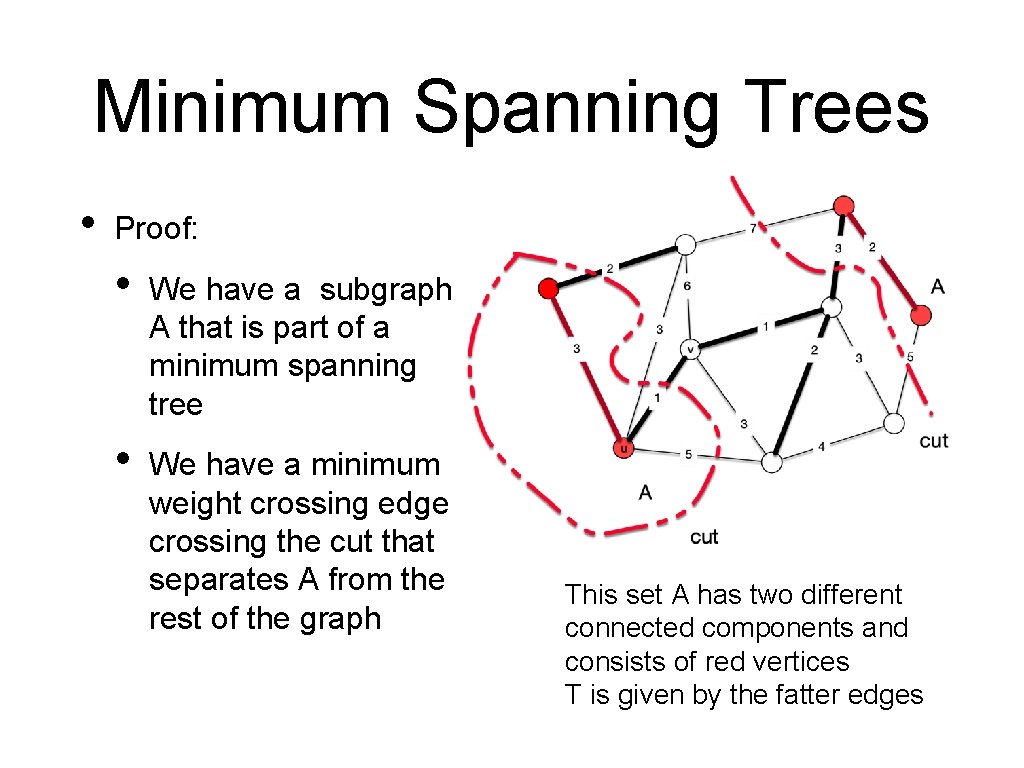
Minimum Spanning Trees • Proof: • We have a subgraph A that is part of a minimum spanning tree • We have a minimum weight crossing edge crossing the cut that separates A from the rest of the graph This set A has two different connected components and consists of red vertices T is given by the fatter edges
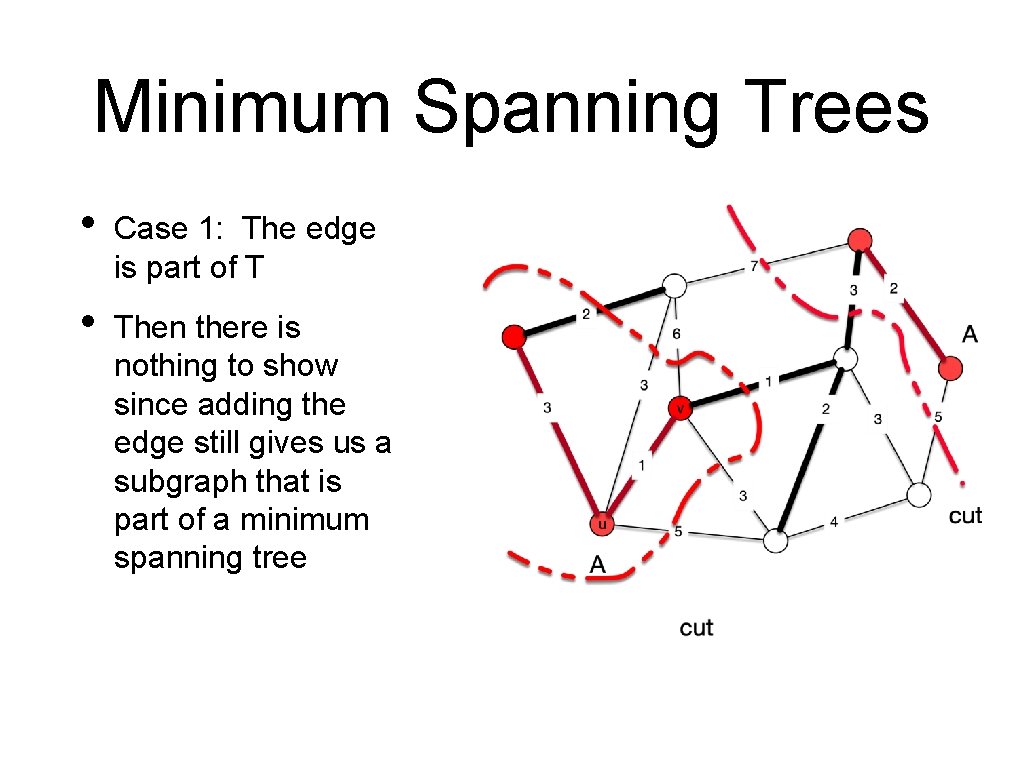
Minimum Spanning Trees • Case 1: The edge is part of T • Then there is nothing to show since adding the edge still gives us a subgraph that is part of a minimum spanning tree
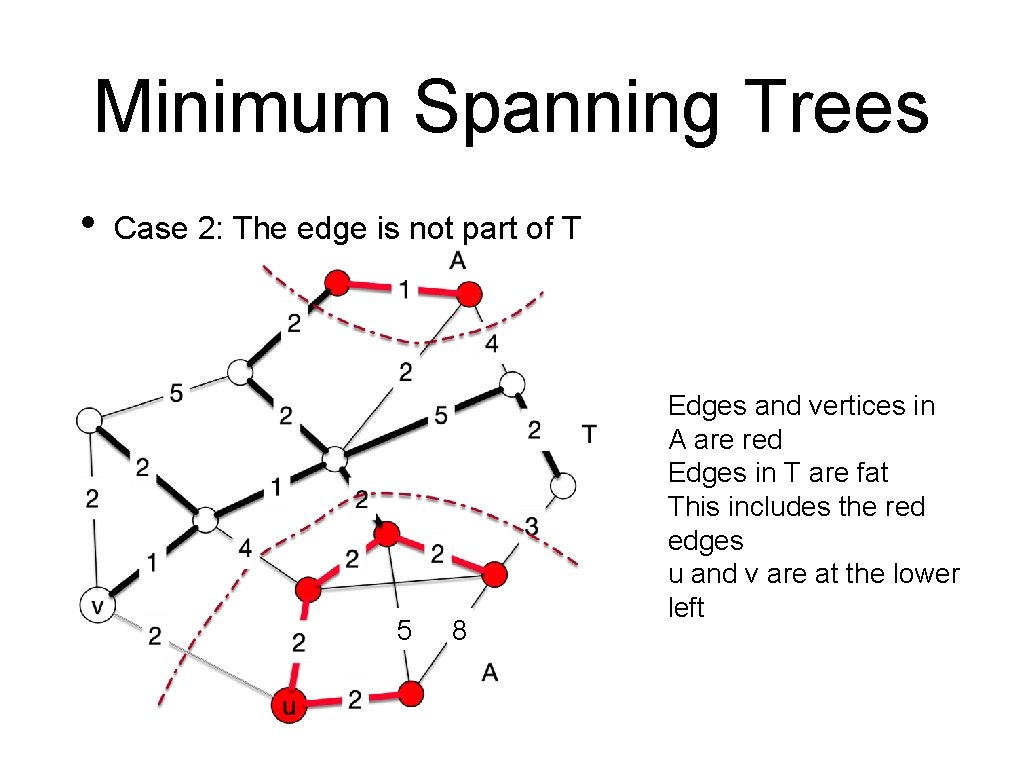
Minimum Spanning Trees • Case 2: The edge is not part of T 5 8 Edges and vertices in A are red Edges in T are fat This includes the red edges u and v are at the lower left
Minimum Spanning Trees • In this case, we need to construct a new minimum weight spanning tree • Observe that there has to be an edge of T that crosses the cut • Because we can travel from every node to every node in T and not all nodes are in A
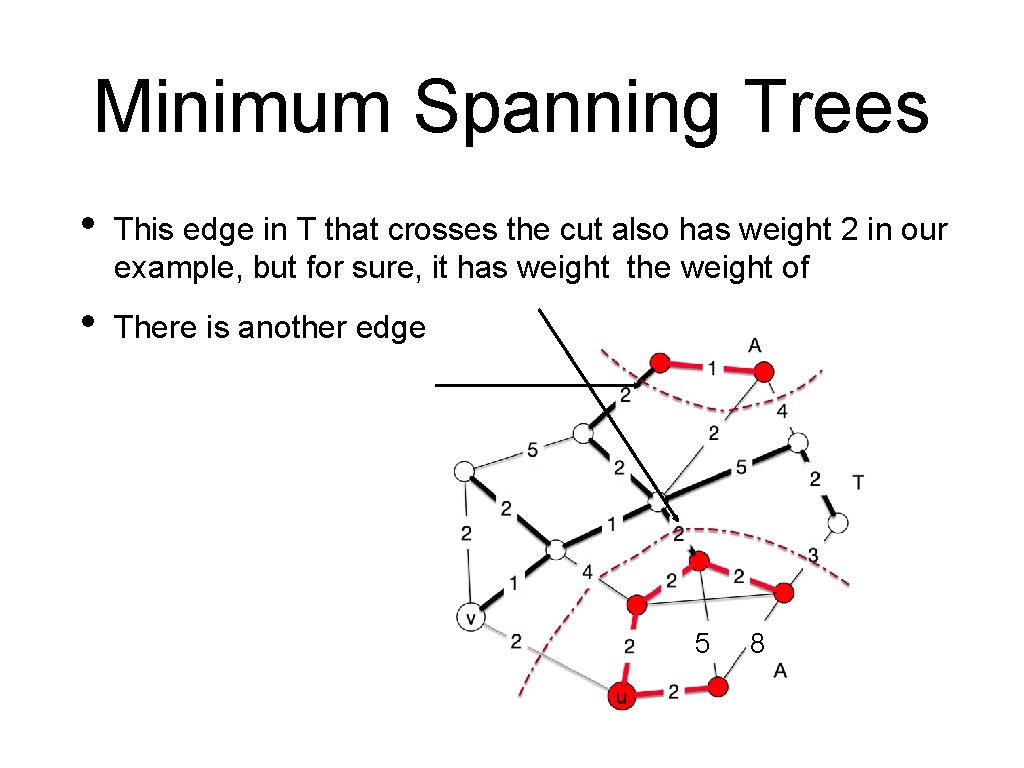
Minimum Spanning Trees • This edge in T that crosses the cut also has weight 2 in our example, but for sure, it has weight the weight of • There is another edge 5 8
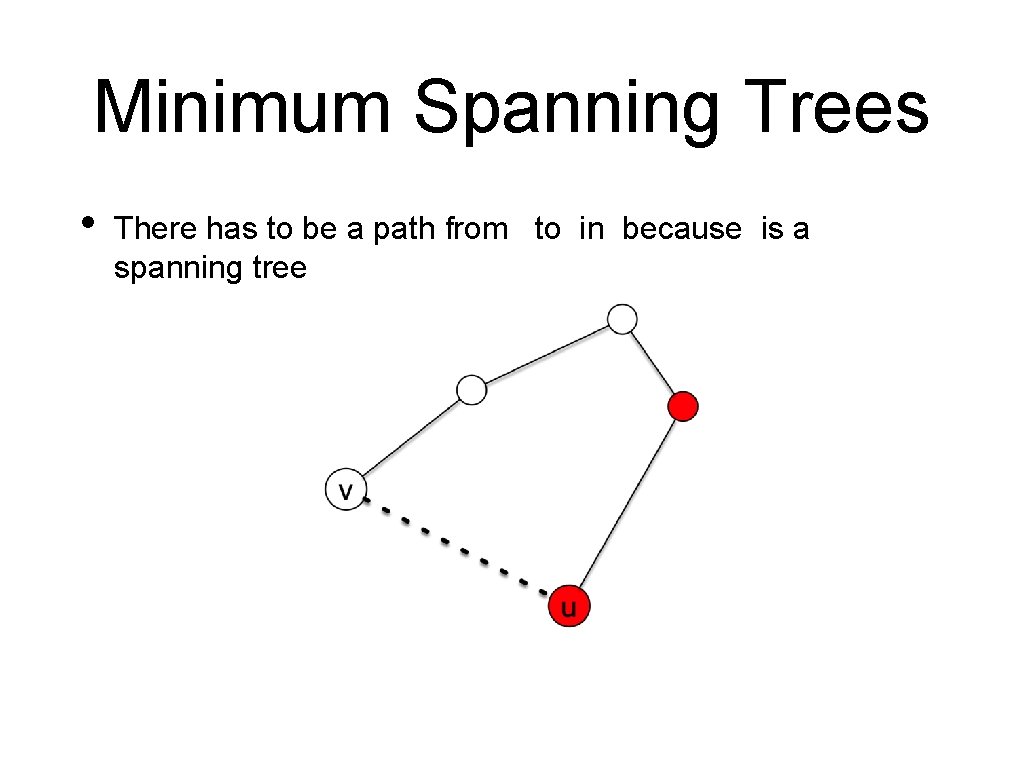
Minimum Spanning Trees • There has to be a path from to in because is a spanning tree
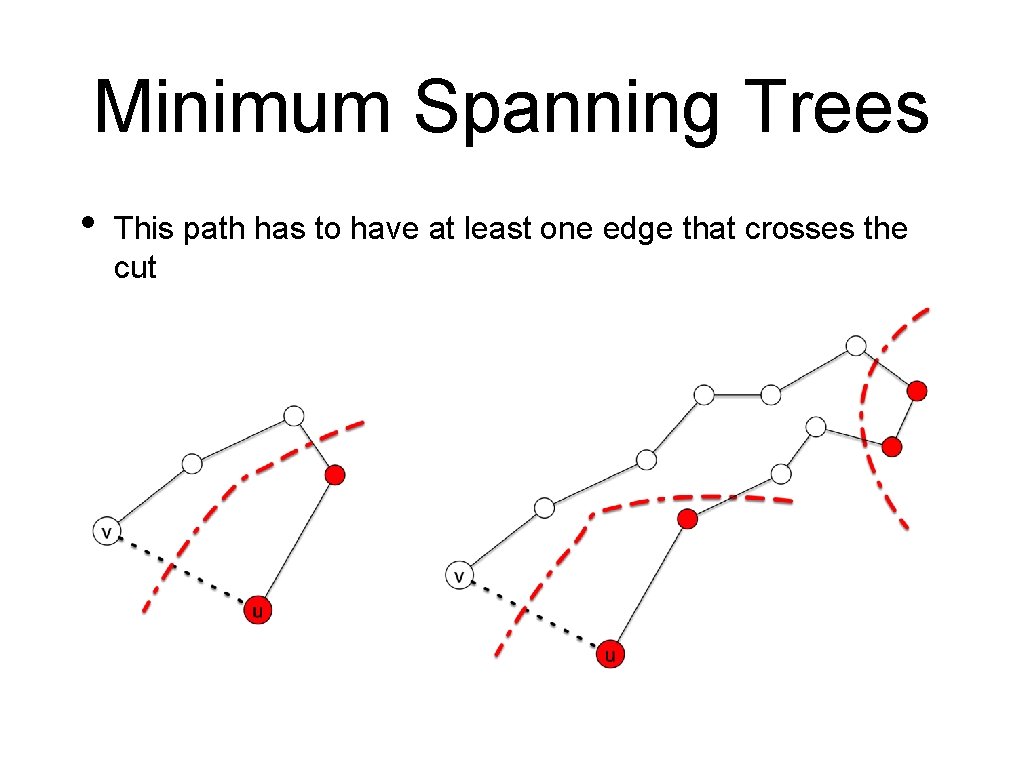
Minimum Spanning Trees • This path has to have at least one edge that crosses the cut
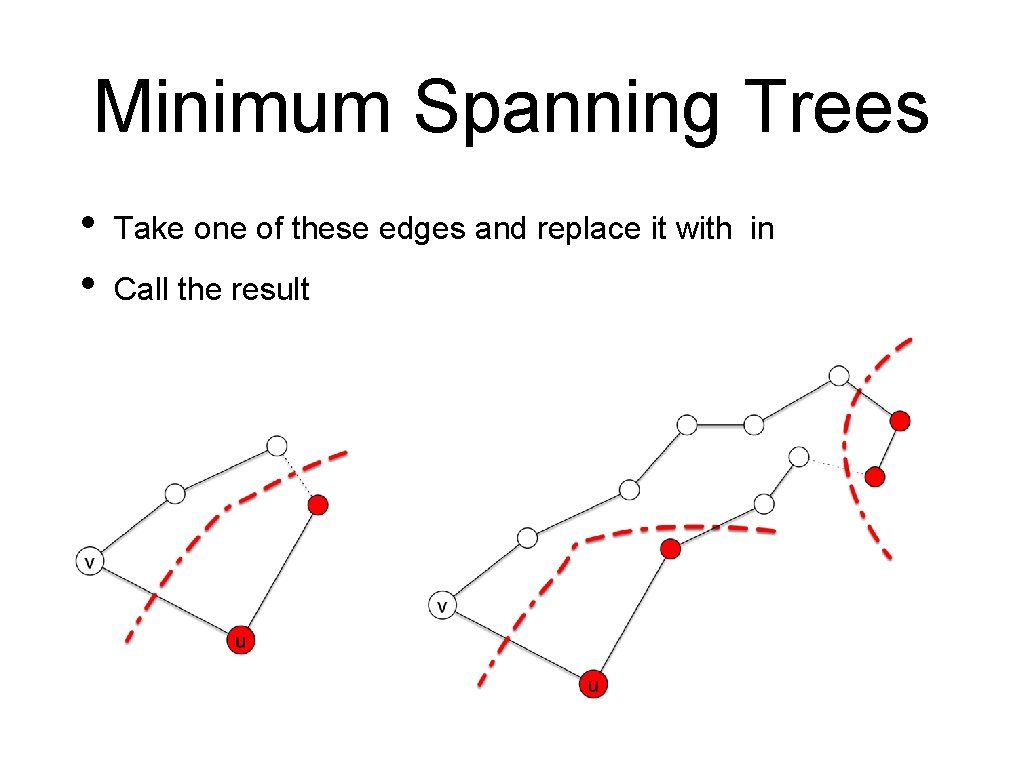
Minimum Spanning Trees • • Take one of these edges and replace it with in Call the result
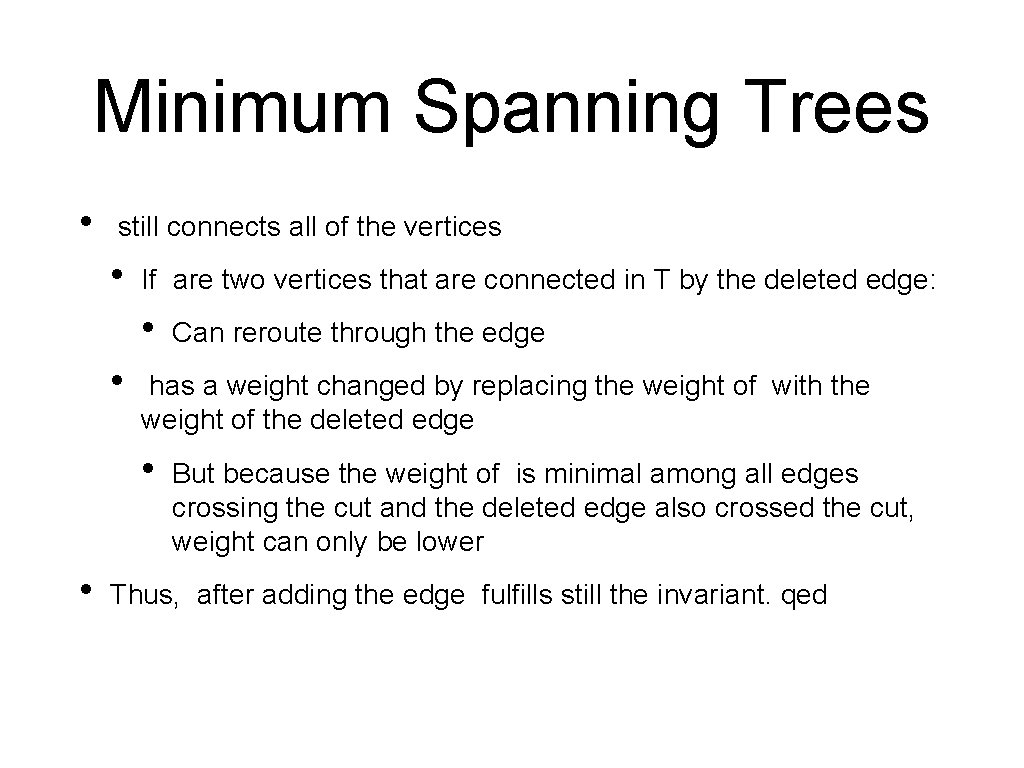
Minimum Spanning Trees • still connects all of the vertices • If are two vertices that are connected in T by the deleted edge: • • has a weight changed by replacing the weight of with the weight of the deleted edge • • Can reroute through the edge But because the weight of is minimal among all edges crossing the cut and the deleted edge also crossed the cut, weight can only be lower Thus, after adding the edge fulfills still the invariant. qed
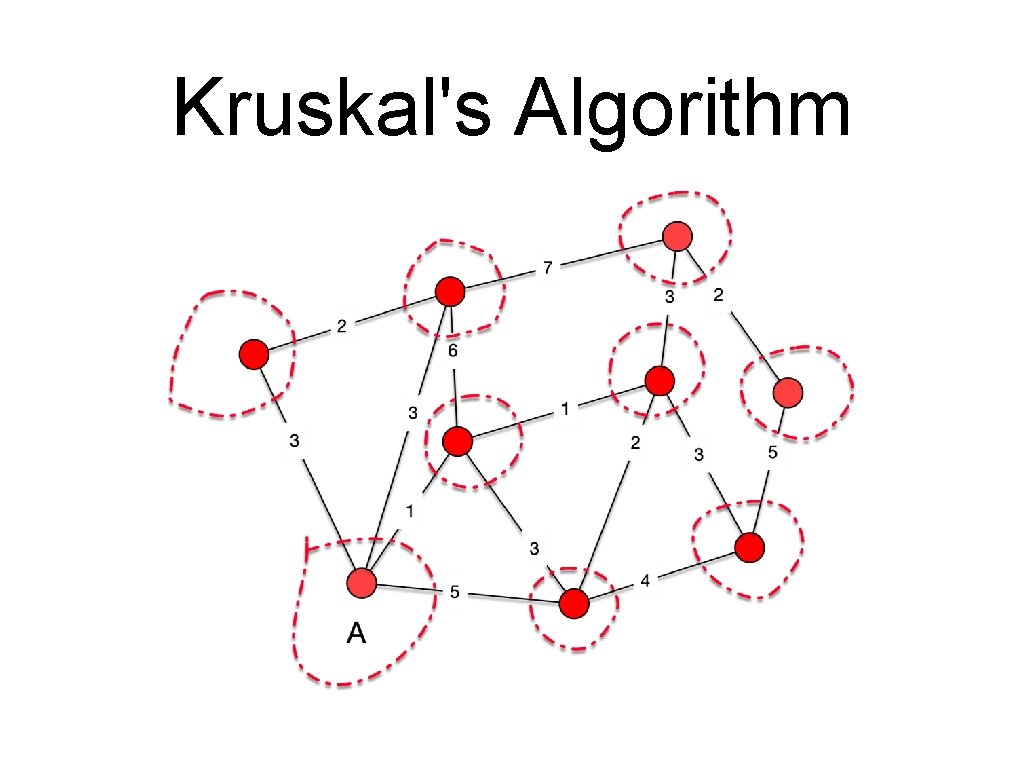
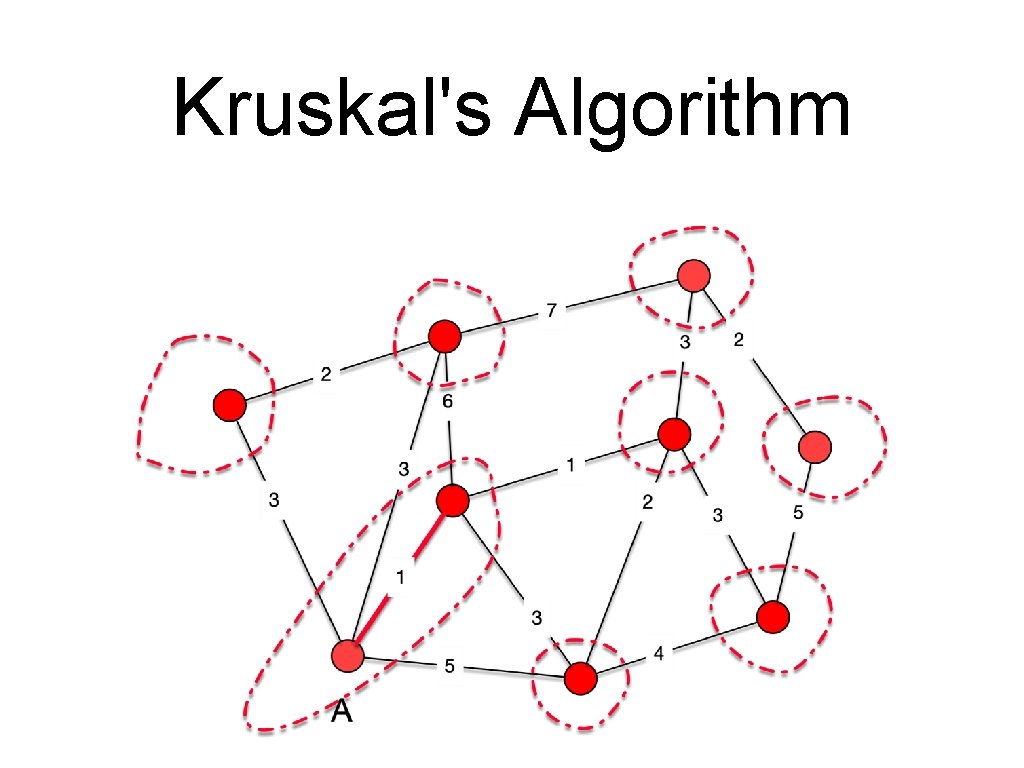
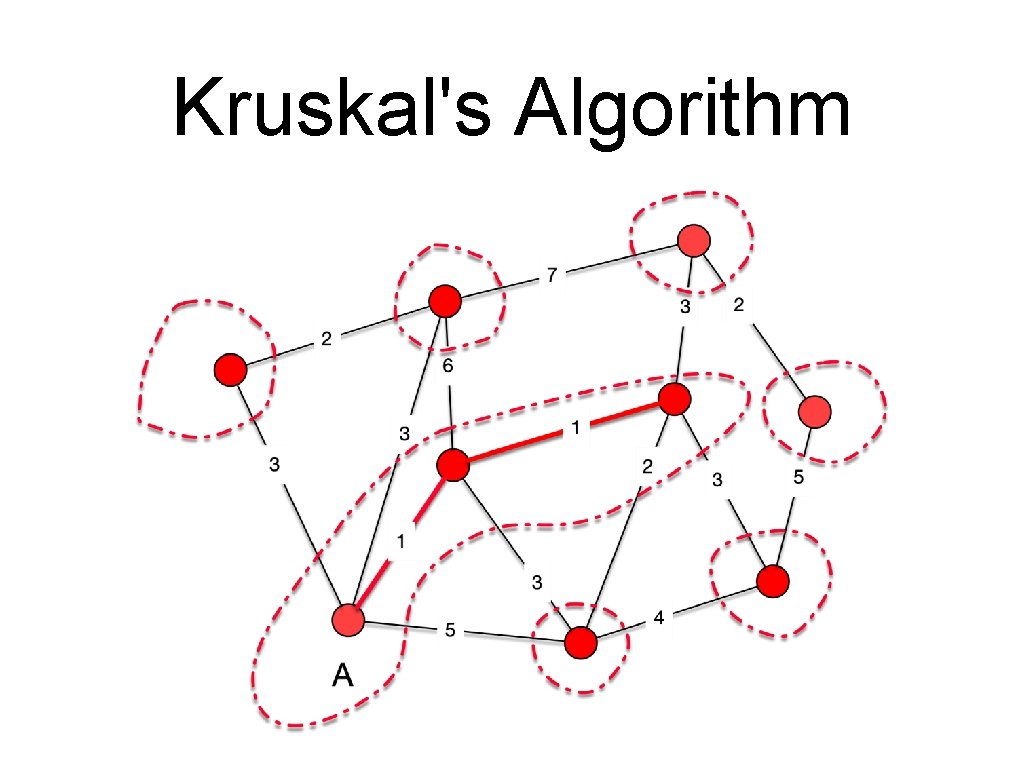
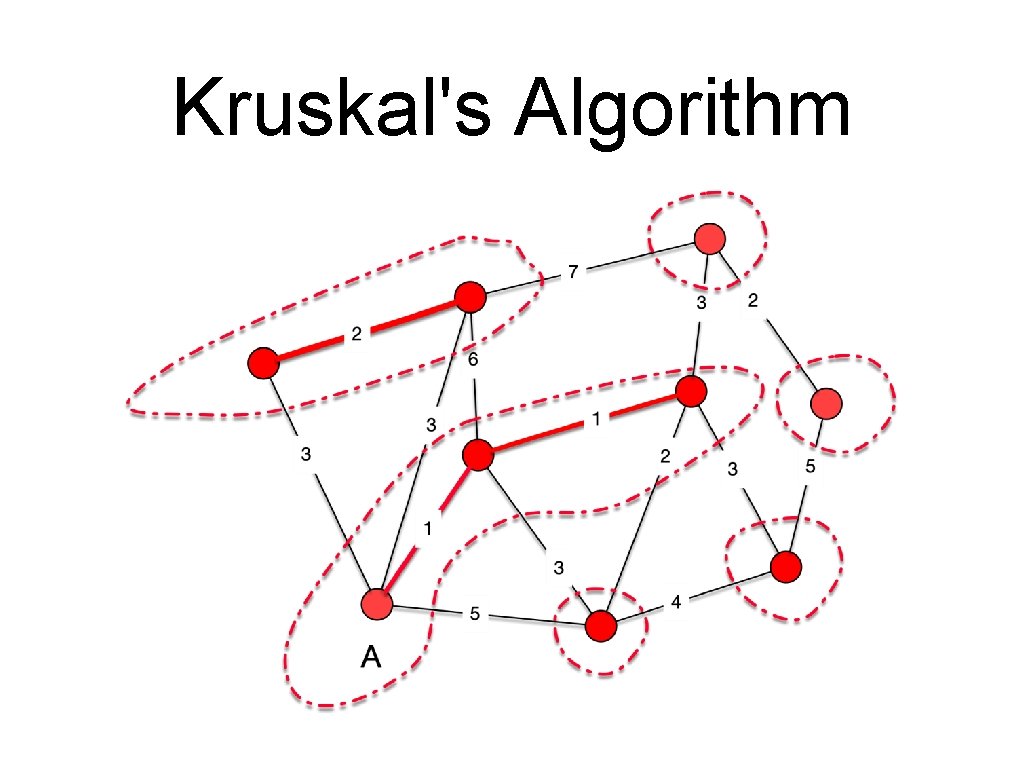
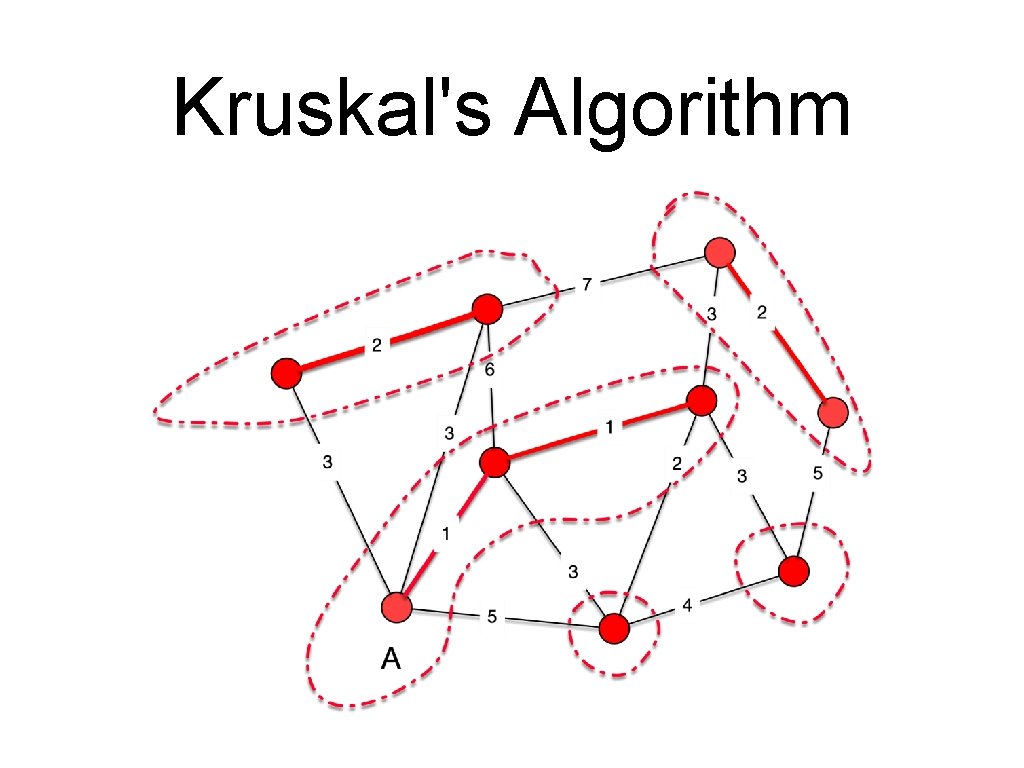
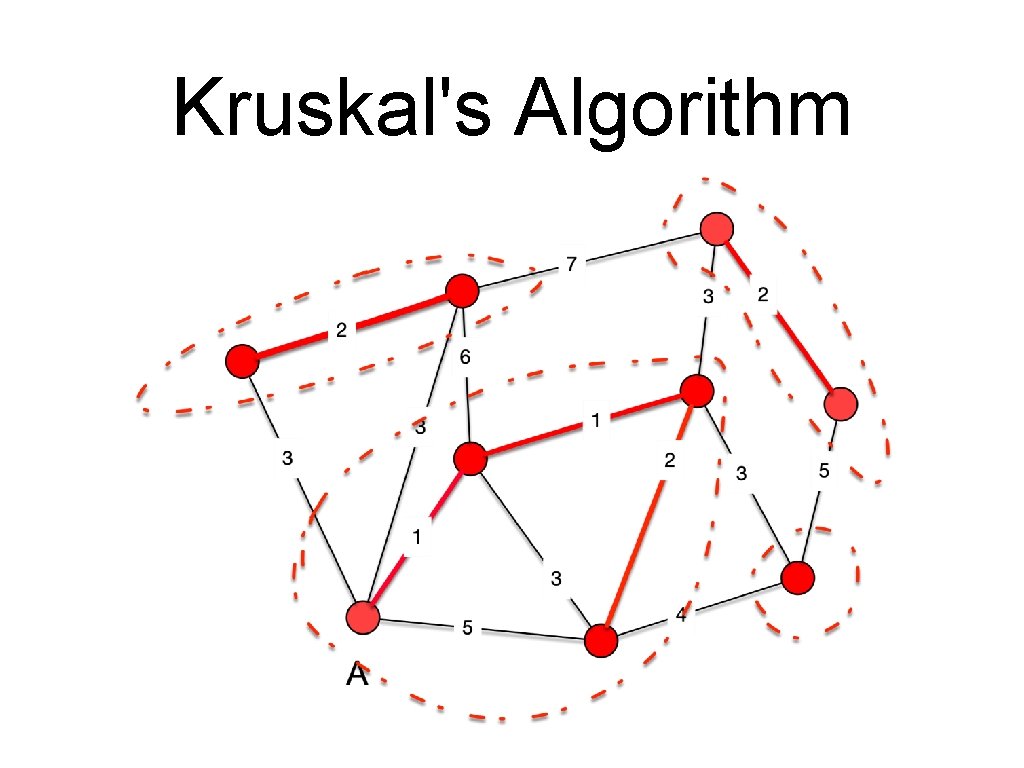
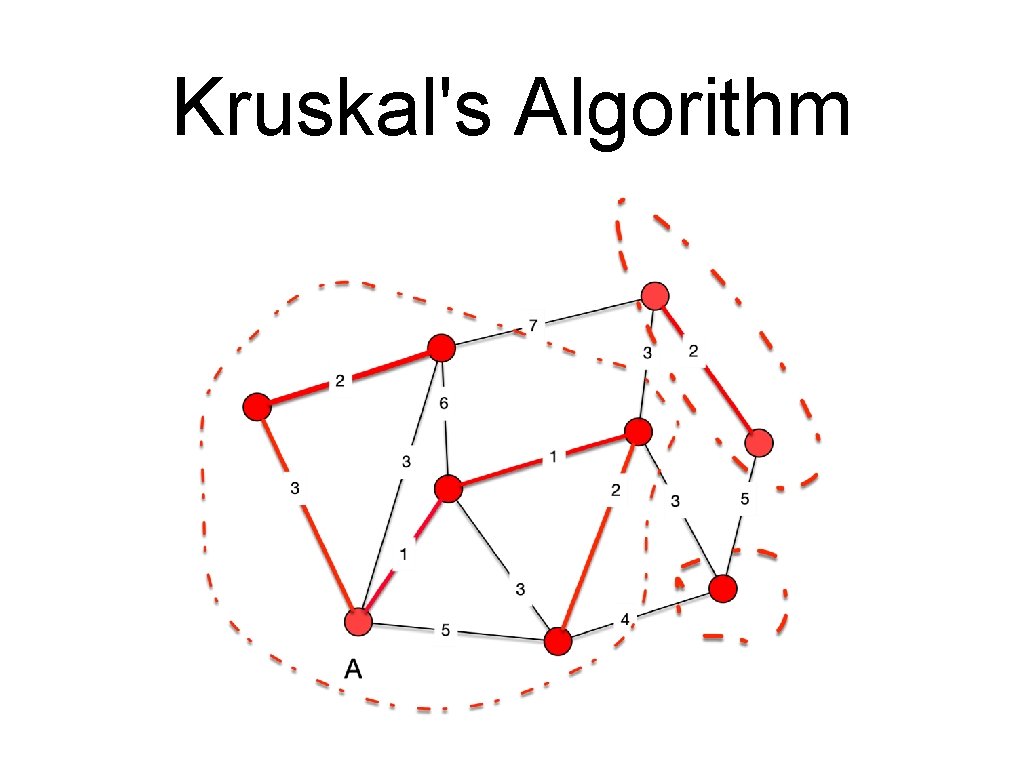
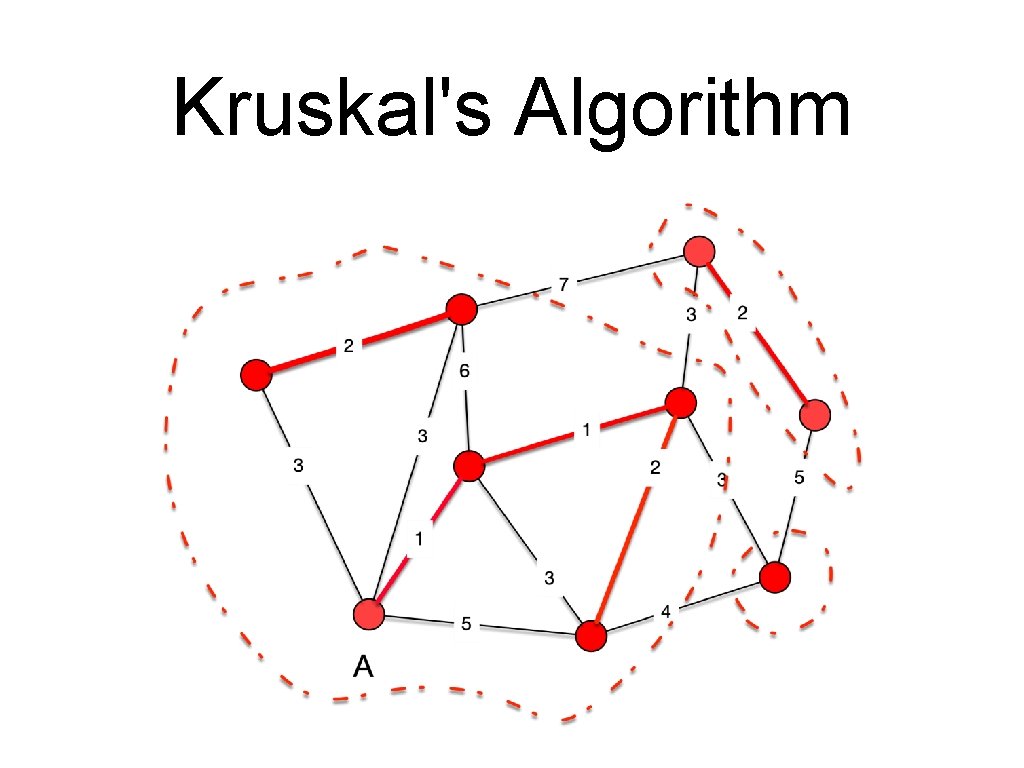
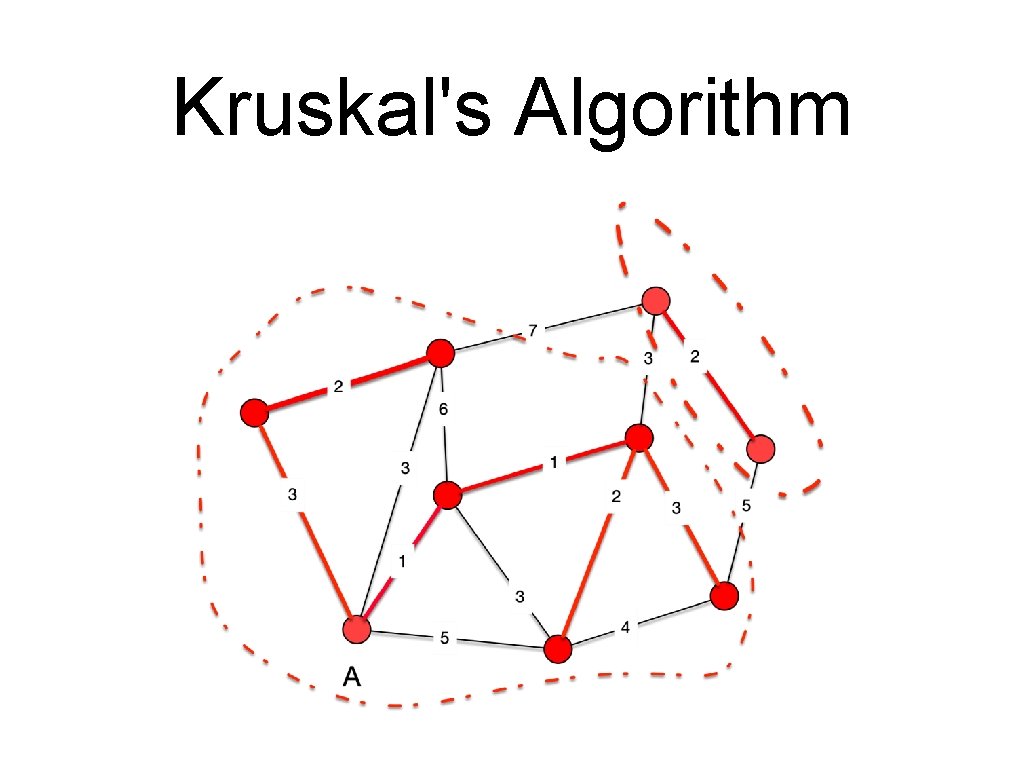
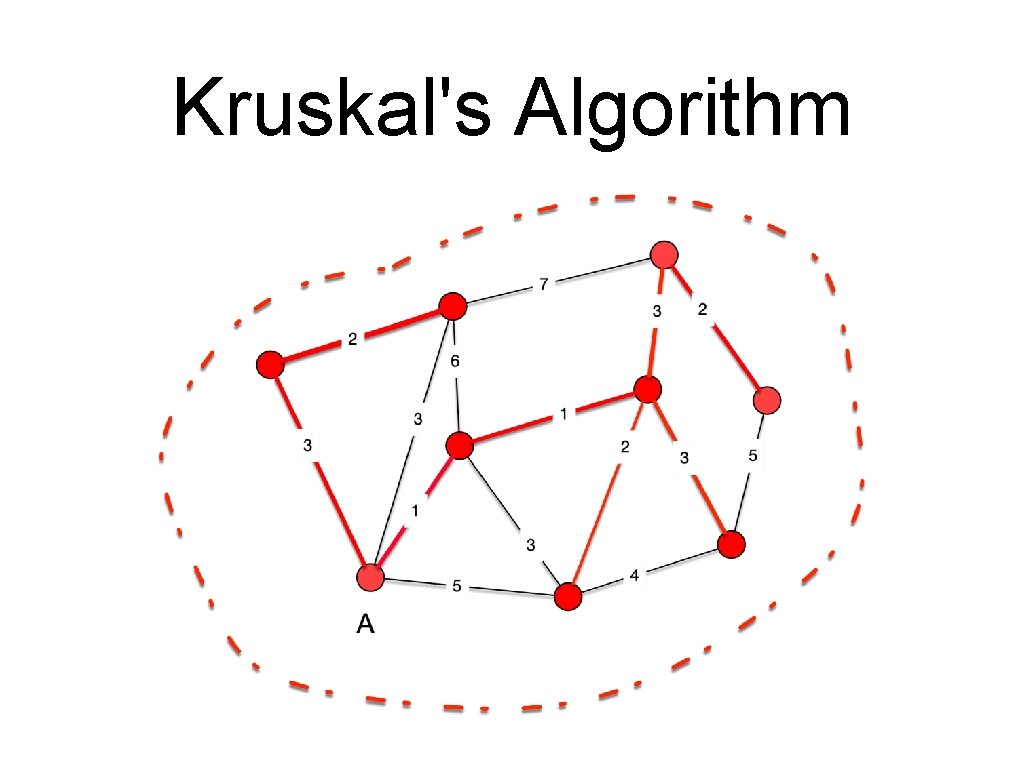
Kruskal's Algorithm • Kruskal's algorithm works by joining subtrees • Start out with all vertices being their own subtrees • • Thus, the cut is around all of the vertices While we have more than one subtree: • We select a cutting edge (i. e. between different subtrees) with minimum weight • This combines two subtrees
Kruskal's Algorithm
Kruskal's Algorithm
Kruskal's Algorithm
Kruskal's Algorithm
Kruskal's Algorithm
Kruskal's Algorithm
Kruskal's Algorithm
Kruskal's Algorithm
Kruskal's Algorithm
Kruskal's Algorithm
Kruskal's Algorithm • Because Kruskal's algorithm only adds safe edges, it generates a minimum weight spanning tree • How to organize it? • • We can order all of the edges by weight • Best way: And then remove edges if they no longer are cutting edges • • Maintain vertices in the same subtree in a set Determine quickly whether something is in a set
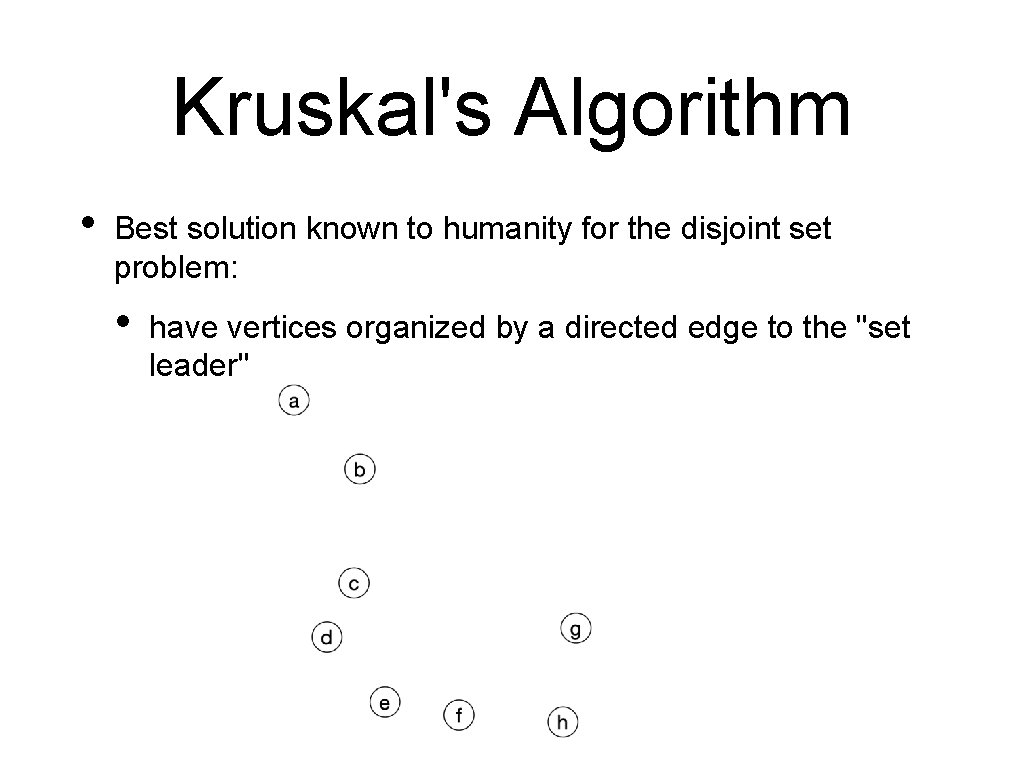
Kruskal's Algorithm • Best solution known to humanity for the disjoint set problem: • have vertices organized by a directed edge to the "set leader"
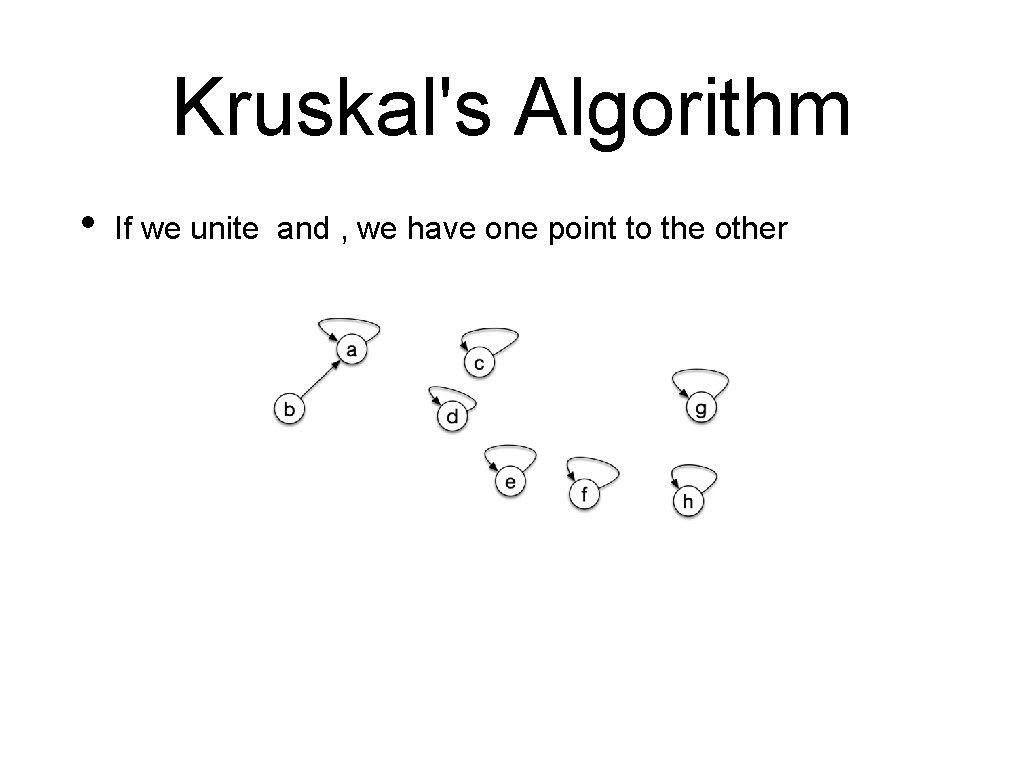
Kruskal's Algorithm • If we unite and , we have one point to the other
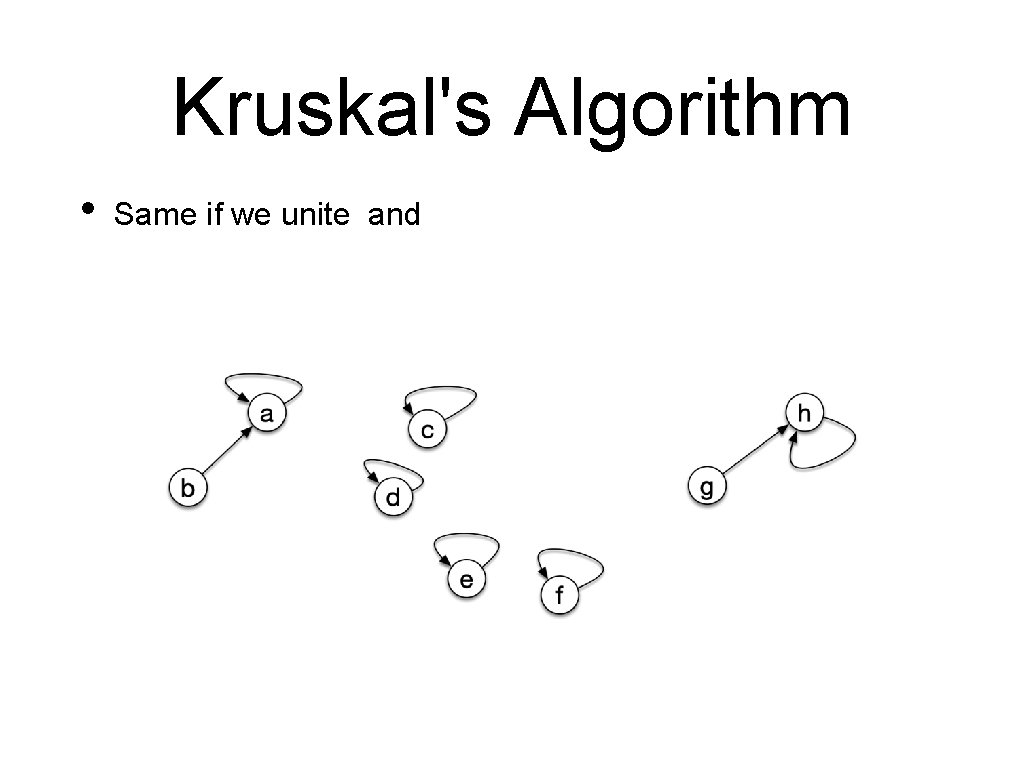
Kruskal's Algorithm • Same if we unite and
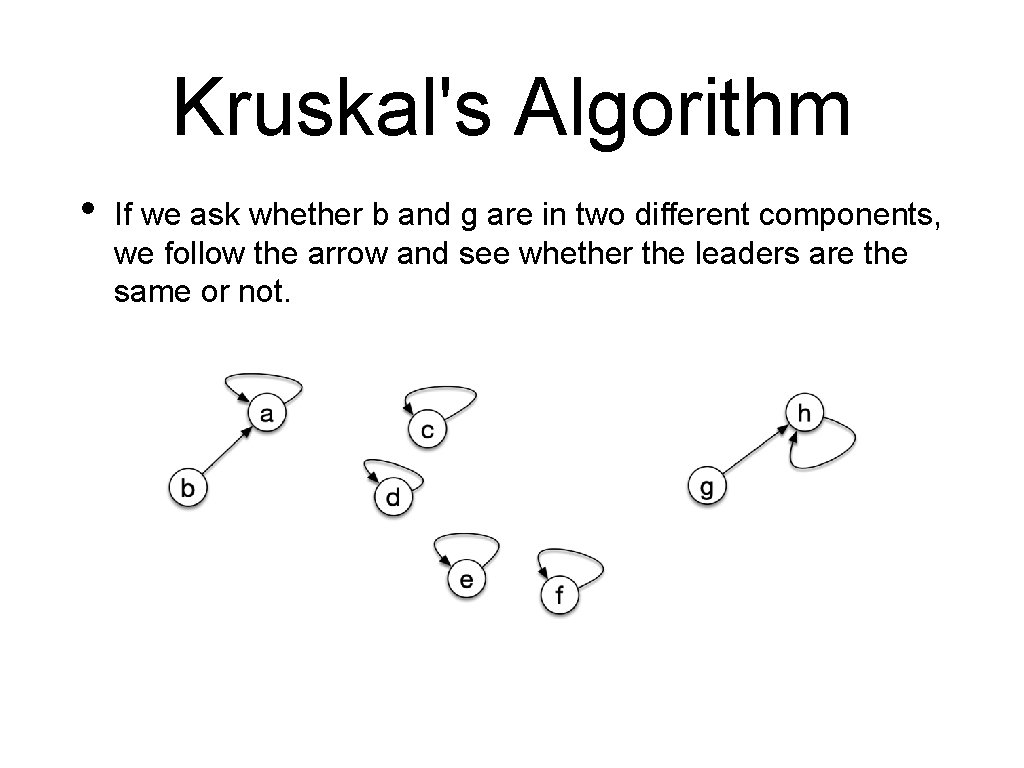
Kruskal's Algorithm • If we ask whether b and g are in two different components, we follow the arrow and see whether the leaders are the same or not.
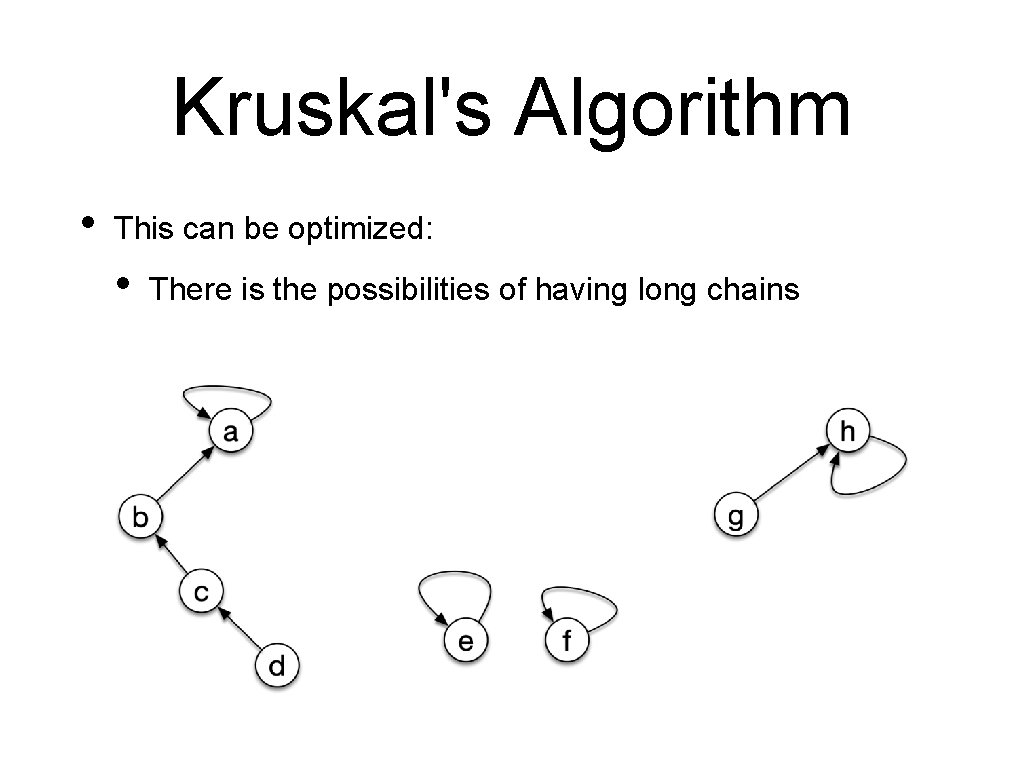
Kruskal's Algorithm • This can be optimized: • There is the possibilities of having long chains
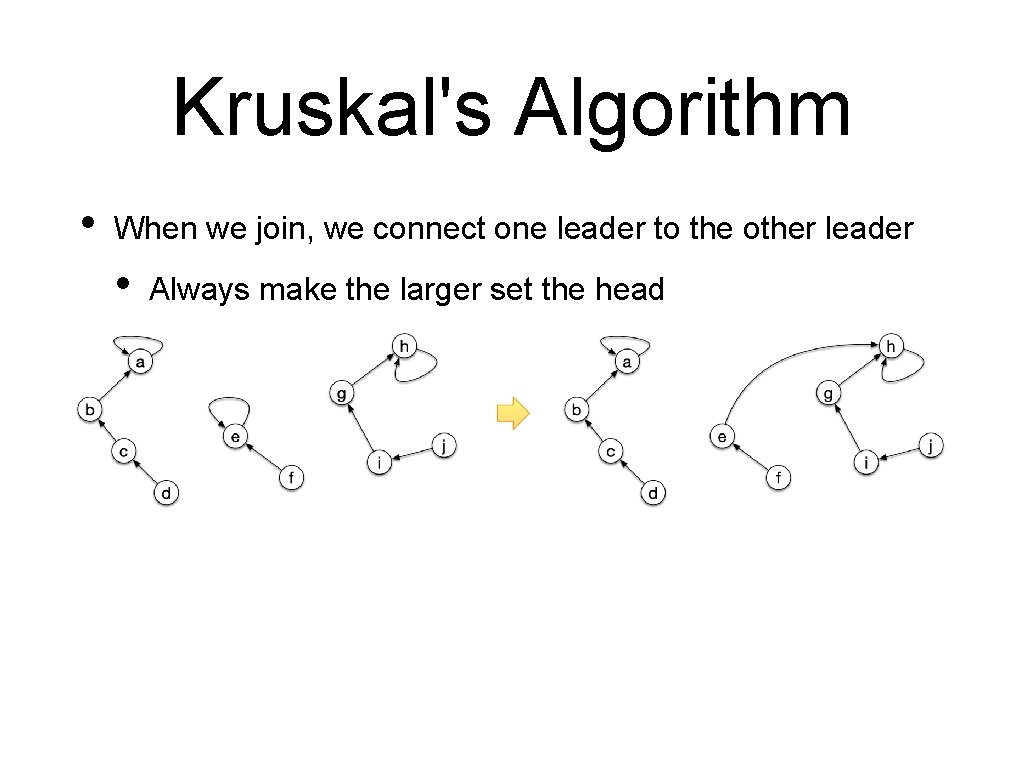
Kruskal's Algorithm • When we join, we connect one leader to the other leader • Always make the larger set the head
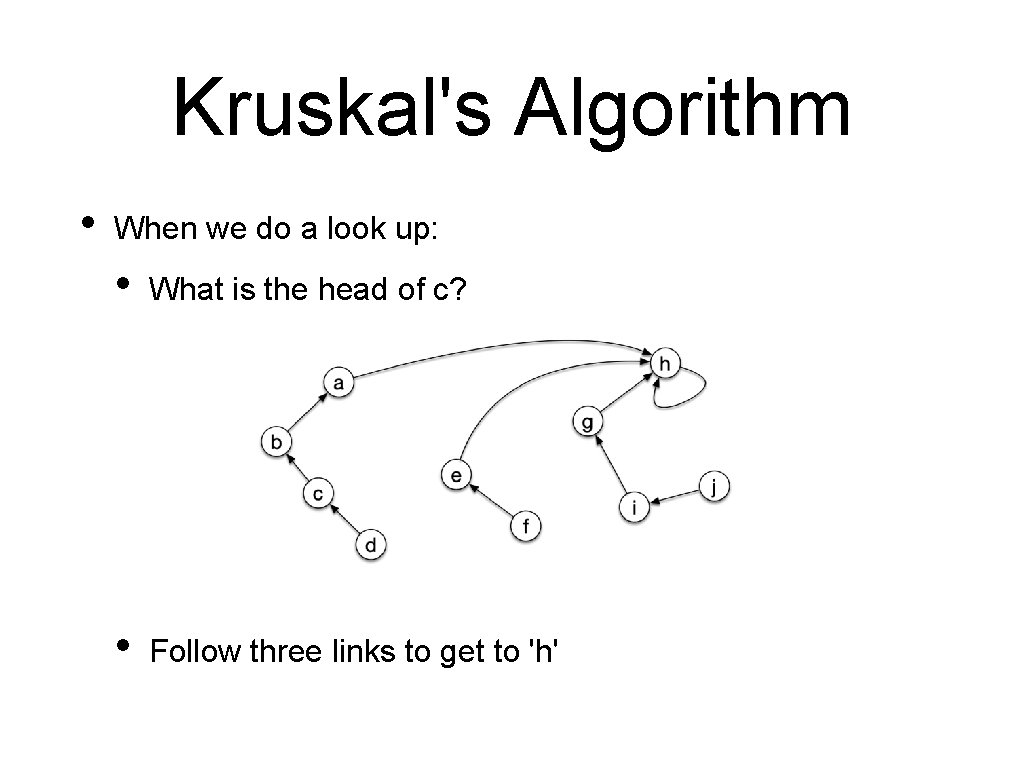
Kruskal's Algorithm • When we do a look up: • What is the head of c? • Follow three links to get to 'h'
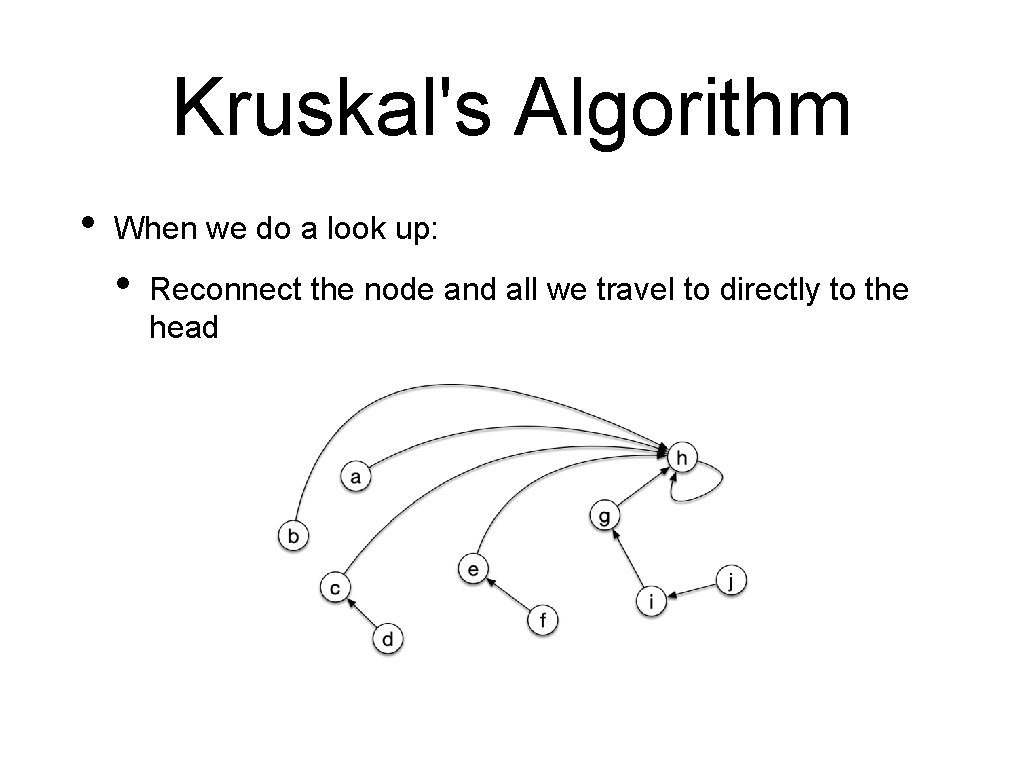
Kruskal's Algorithm • When we do a look up: • Reconnect the node and all we travel to directly to the head
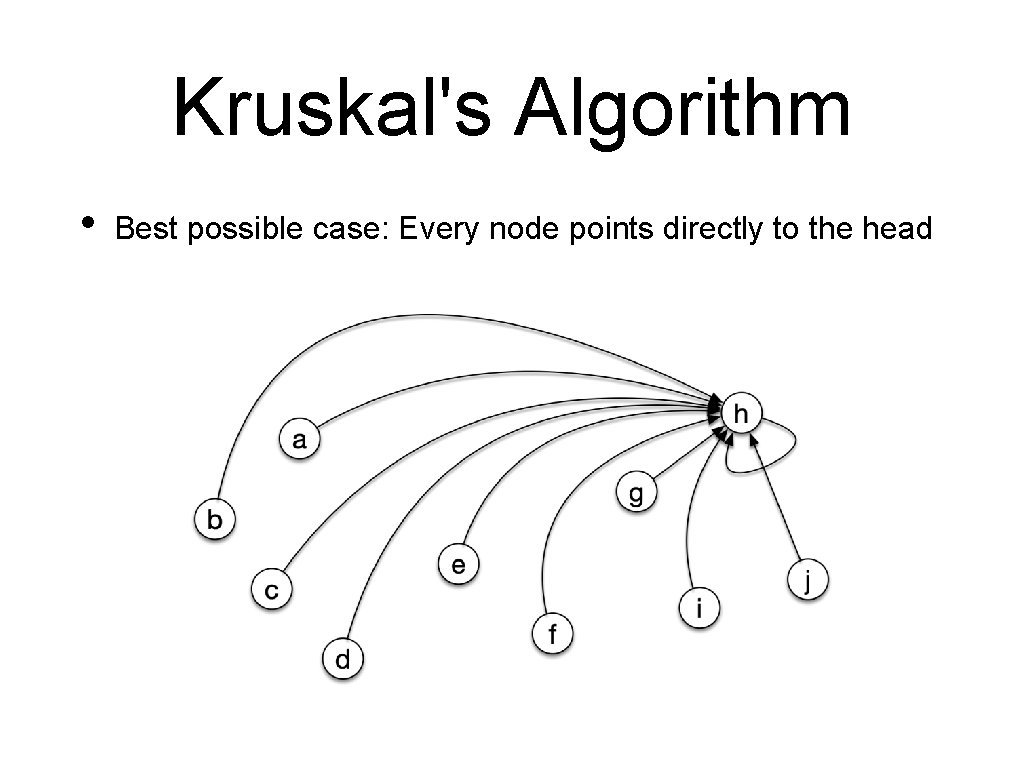
Kruskal's Algorithm • Best possible case: Every node points directly to the head
Kruskal's Algorithm • With this "disjoint union data structure": • Maintaining the disjoint set data structure costs per operation where is a function that grows very slowly • Kruskal's algorithm then runs in time
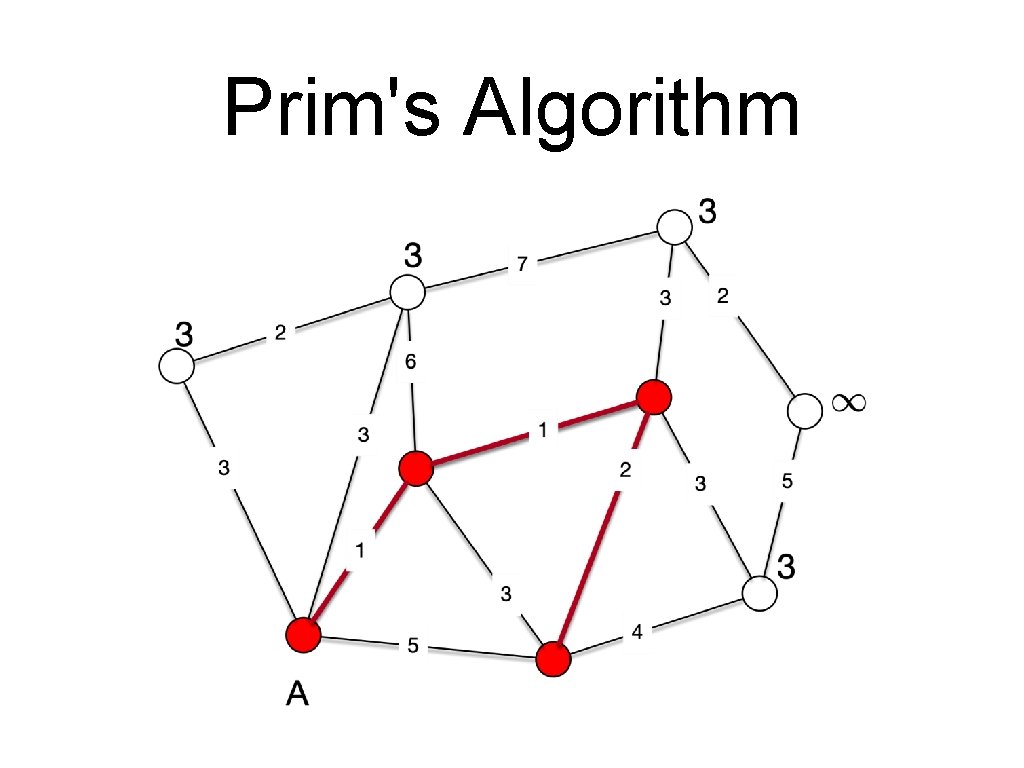
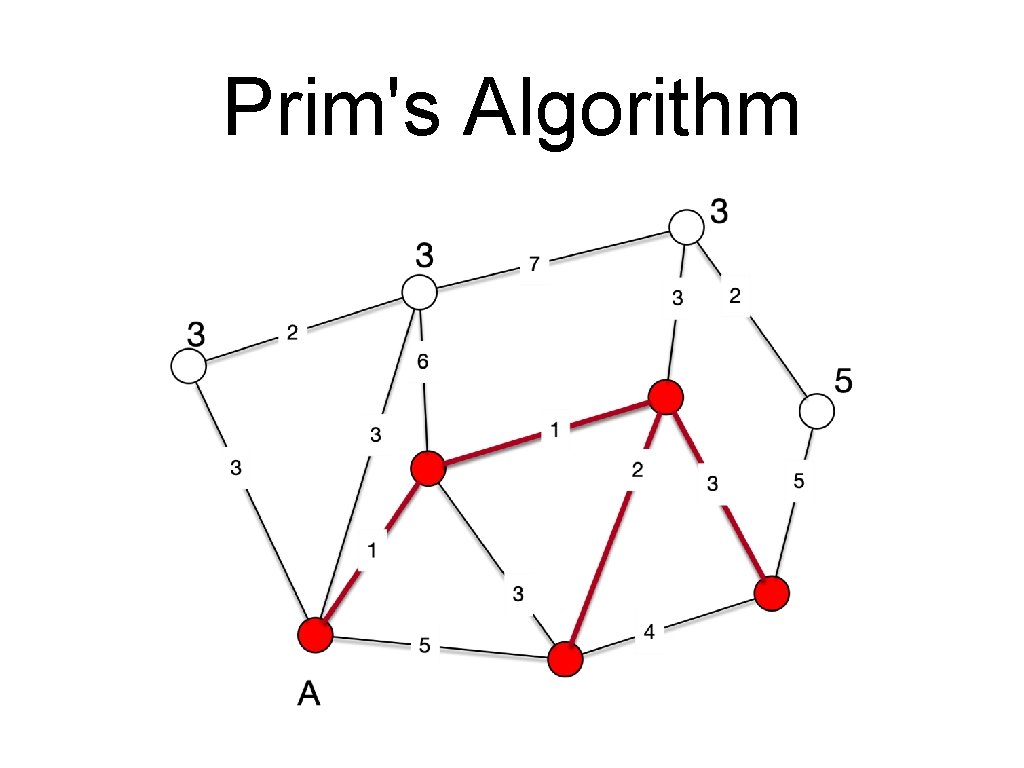
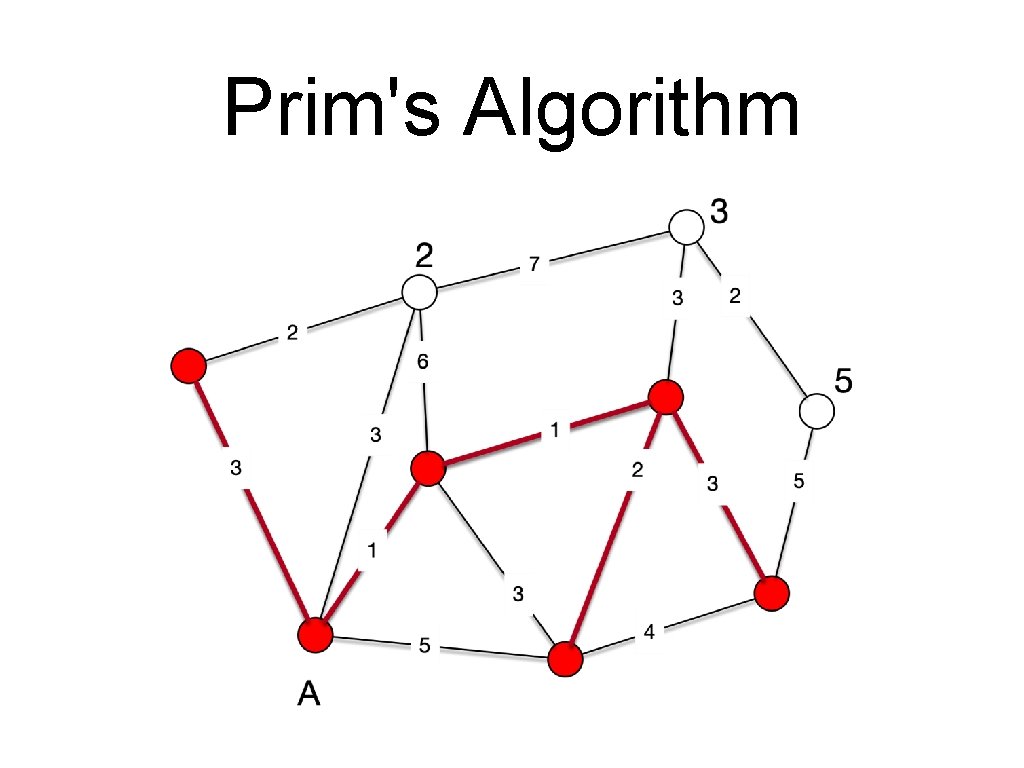
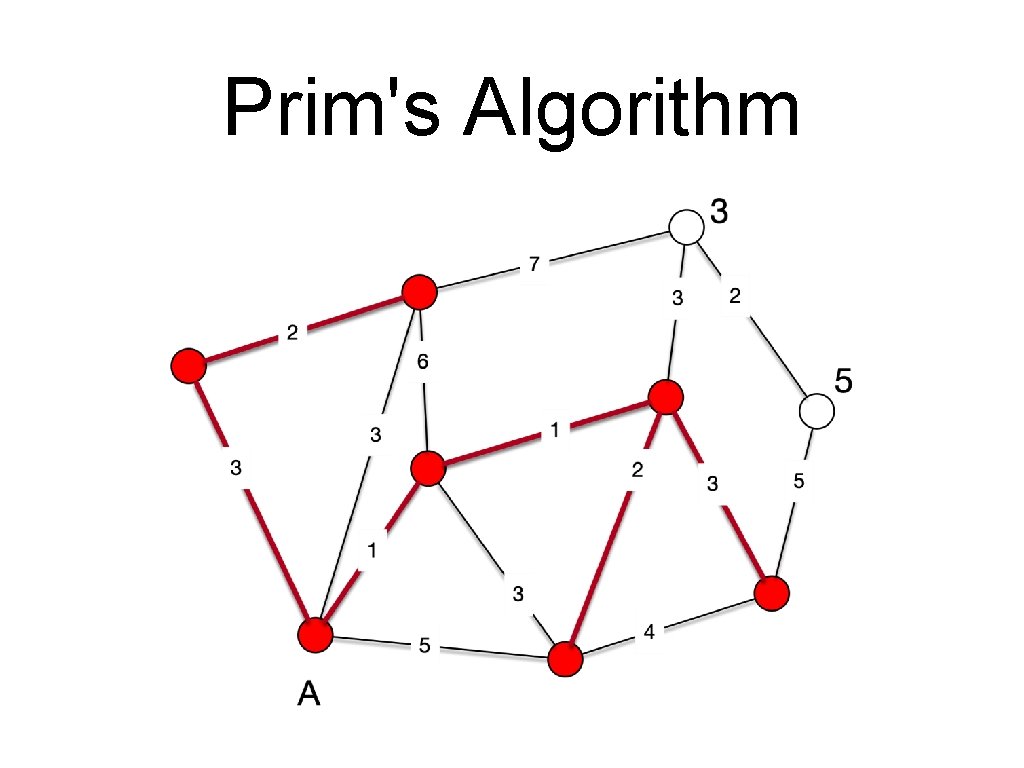
Prim's Algorithm • Prim's algorithm starts at a single node and then adds edges to it. • Thus, the intermediate results are always connected • Maintain a priority queue of all other vertices • The vertices are ordered by distance to
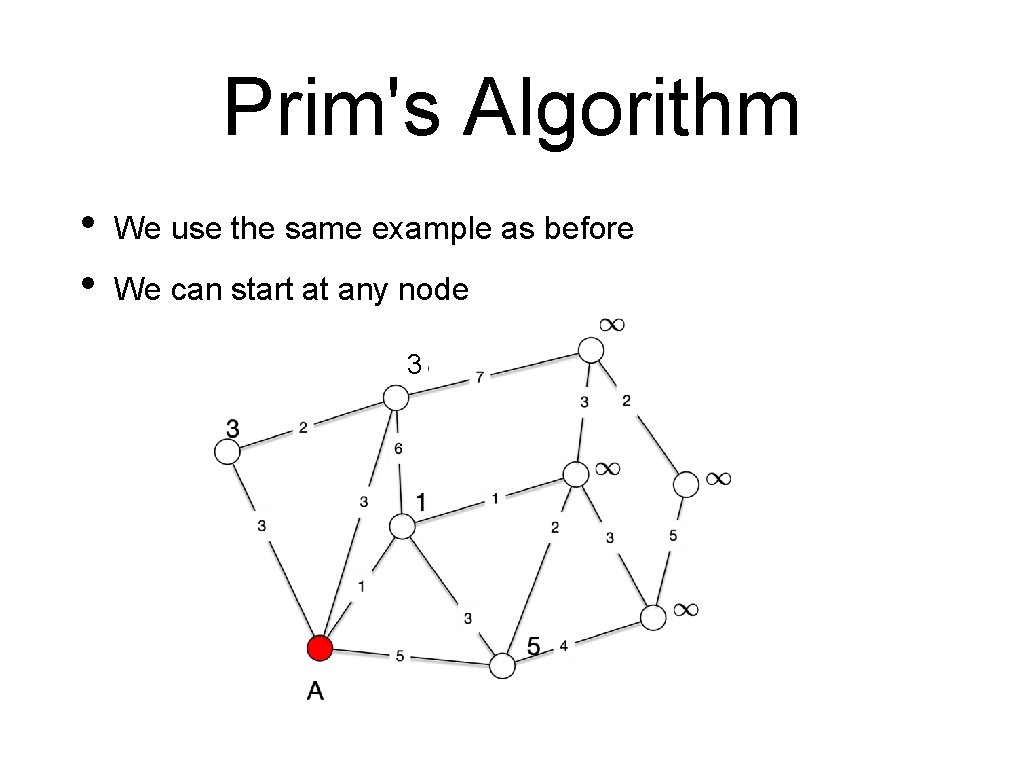
Prim's Algorithm • • We use the same example as before We can start at any node 3
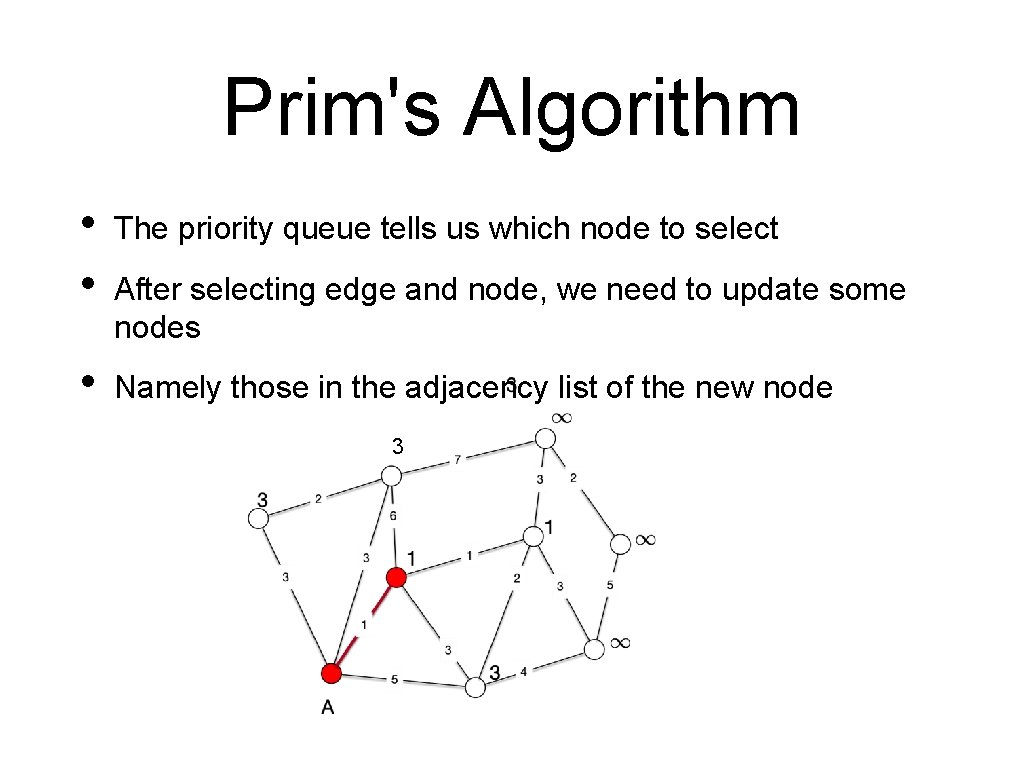
Prim's Algorithm • • The priority queue tells us which node to select • Namely those in the adjacency list of the new node After selecting edge and node, we need to update some nodes 3
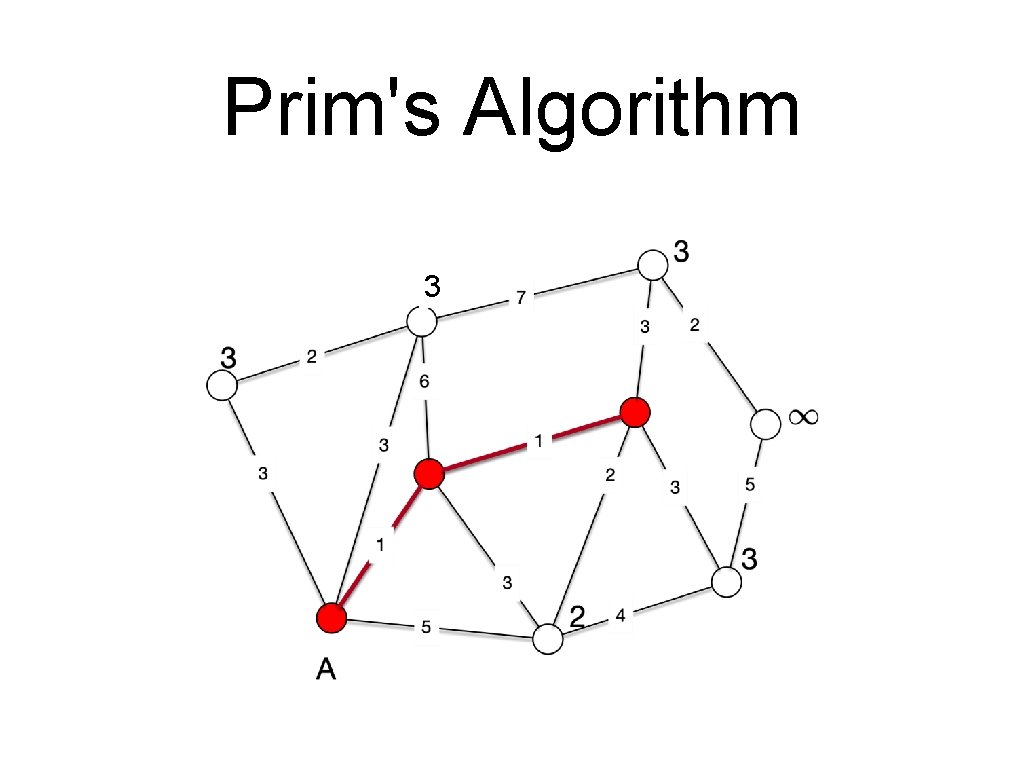
Prim's Algorithm 3
Prim's Algorithm
Prim's Algorithm
Prim's Algorithm
Prim's Algorithm
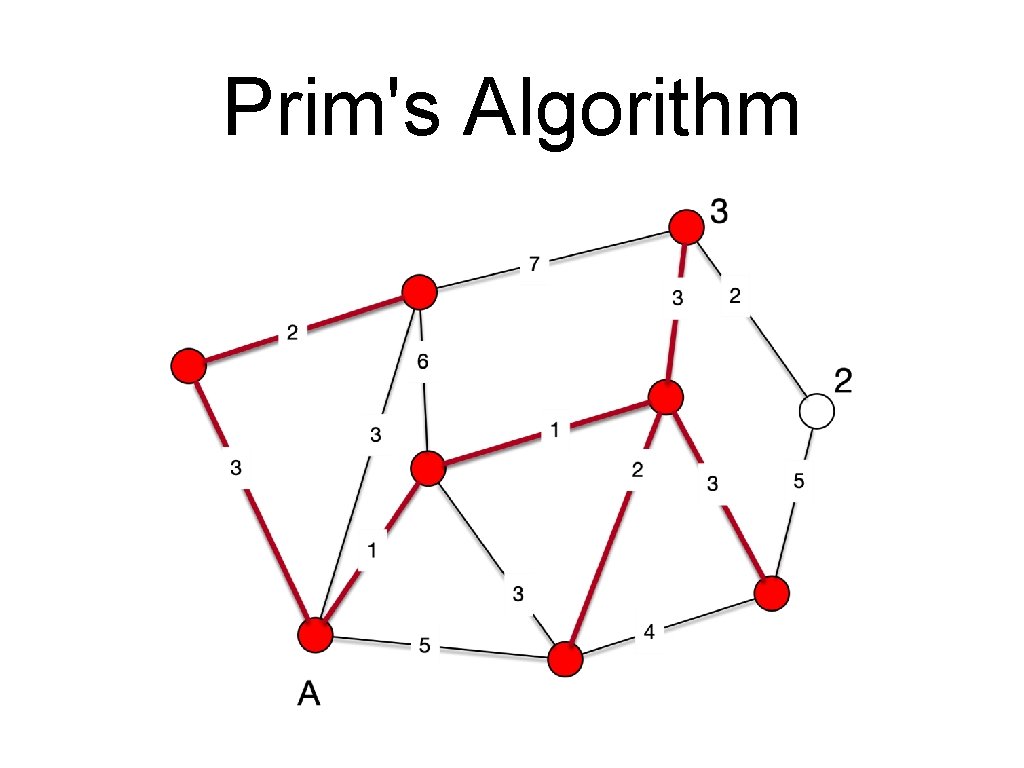
Prim's Algorithm
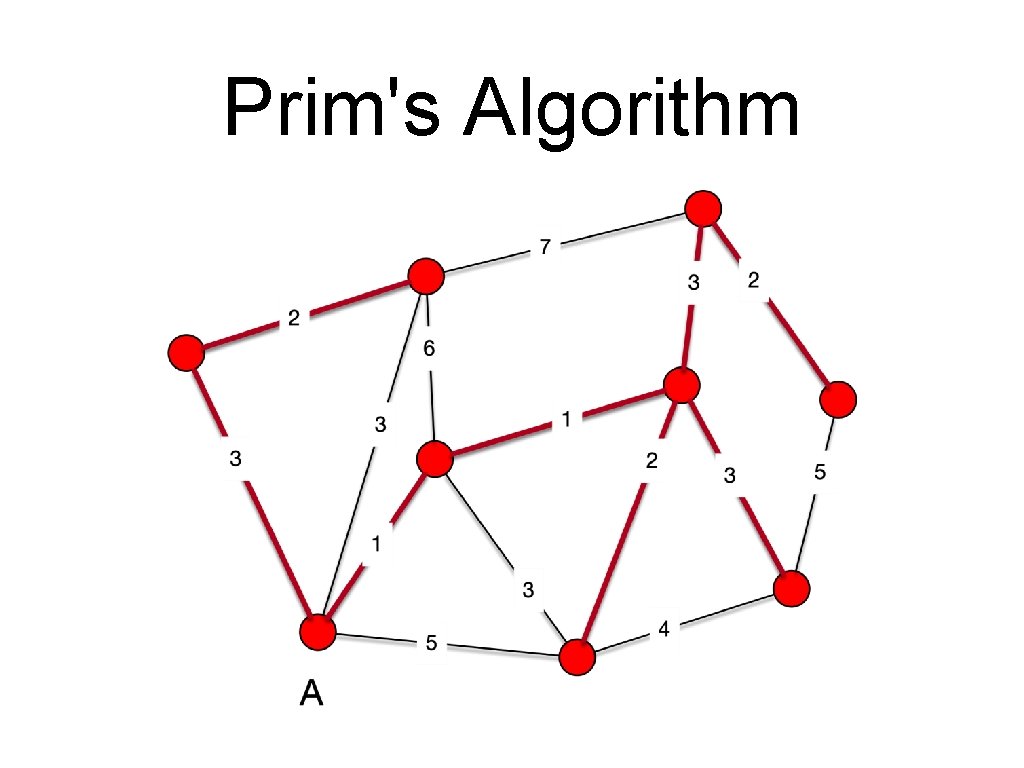
Prim's Algorithm

Prim's Algorithm • Because Prim's algorithm only selects safe edges, it correctly calculates a minimum spanning tree • The run-time of Prim's algorithm depends on the implementation of the priority heap • The best type is a Fibonacci heap • • In which case the run time is Or we can use a normal priority heap which gives us
- Slides: 56