
Spanning Tree Protocol Cisco Networking Academy Program Cisco
- Slides: 45
Spanning Tree Protocol Cisco Networking Academy Program © Cisco Systems, Inc. 2000 Spanning Tree Protocol
Spanning Tree Protocol Cisco Networking Academy Program © Cisco Systems, Inc. 2000 Spanning Tree to the Rescue!
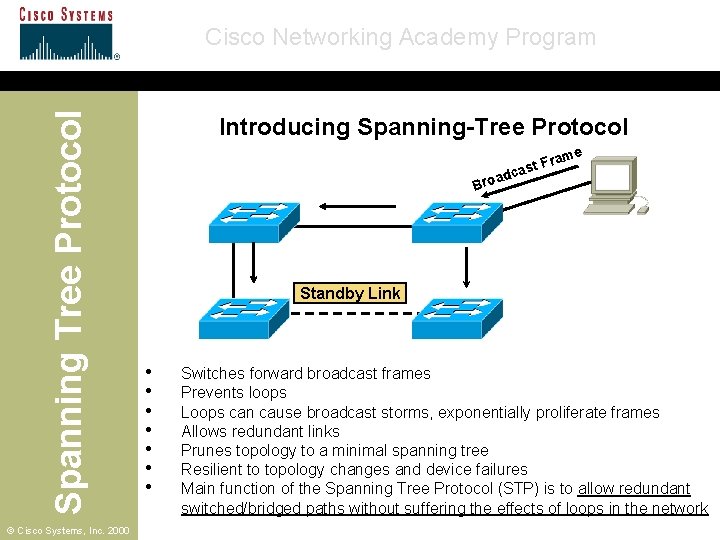
Spanning Tree Protocol Cisco Networking Academy Program © Cisco Systems, Inc. 2000 Introducing Spanning-Tree Protocol me t Fra s a c ad Bro Standby Link • • Switches forward broadcast frames Prevents loops Loops can cause broadcast storms, exponentially proliferate frames Allows redundant links Prunes topology to a minimal spanning tree Resilient to topology changes and device failures Main function of the Spanning Tree Protocol (STP) is to allow redundant switched/bridged paths without suffering the effects of loops in the network
Spanning Tree Protocol Cisco Networking Academy Program © Cisco Systems, Inc. 2000 • The STA is used to calculate a loop-free path. • Spanning-tree frames called bridge protocol data units (BPDUs) are sent and received by all switches in the network at regular intervals and are used to determine the spanning tree topology. • A separate instance of STP runs within each configured VLAN. • (VLANs are later)
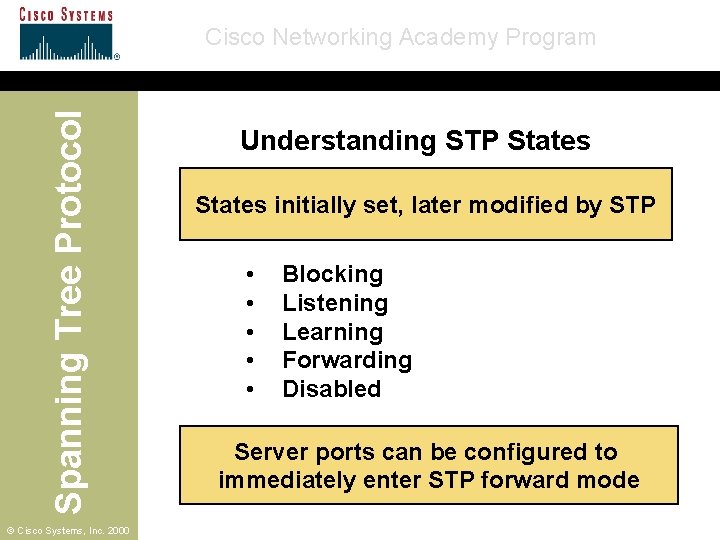
Spanning Tree Protocol Cisco Networking Academy Program © Cisco Systems, Inc. 2000 Understanding STP States initially set, later modified by STP • • • Blocking Listening Learning Forwarding Disabled Server ports can be configured to immediately enter STP forward mode
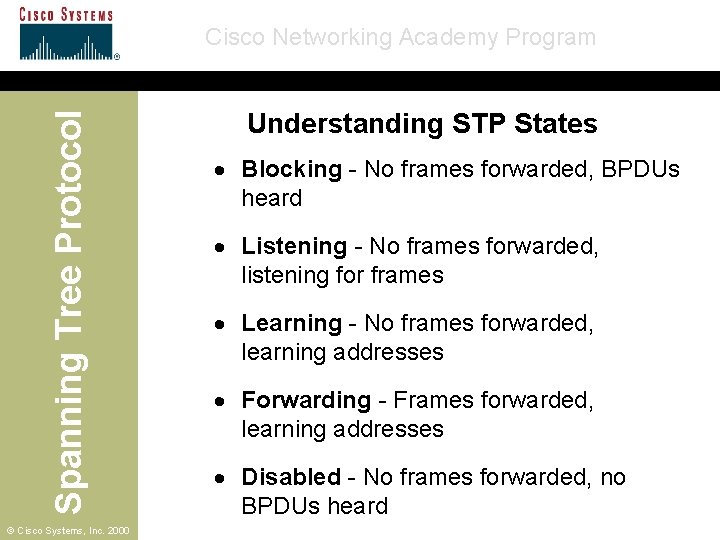
Spanning Tree Protocol Cisco Networking Academy Program © Cisco Systems, Inc. 2000 Understanding STP States · Blocking - No frames forwarded, BPDUs heard · Listening - No frames forwarded, listening for frames · Learning - No frames forwarded, learning addresses · Forwarding - Frames forwarded, learning addresses · Disabled - No frames forwarded, no BPDUs heard
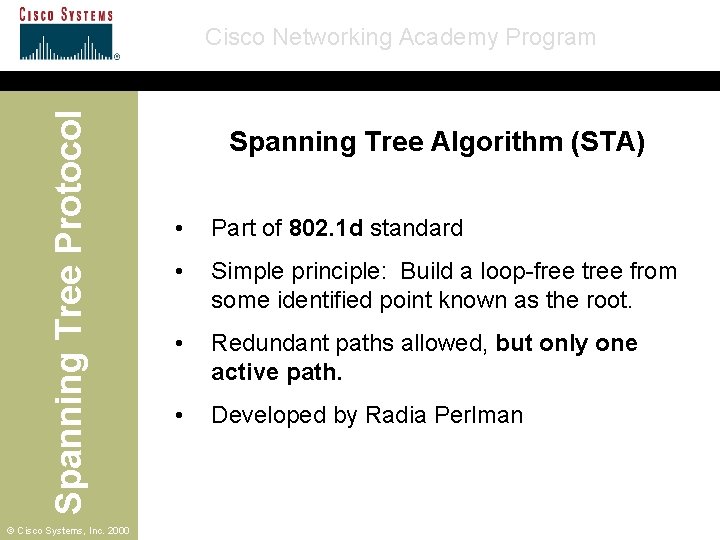
Spanning Tree Protocol Cisco Networking Academy Program © Cisco Systems, Inc. 2000 Spanning Tree Algorithm (STA) • Part of 802. 1 d standard • Simple principle: Build a loop-free tree from some identified point known as the root. • Redundant paths allowed, but only one active path. • Developed by Radia Perlman
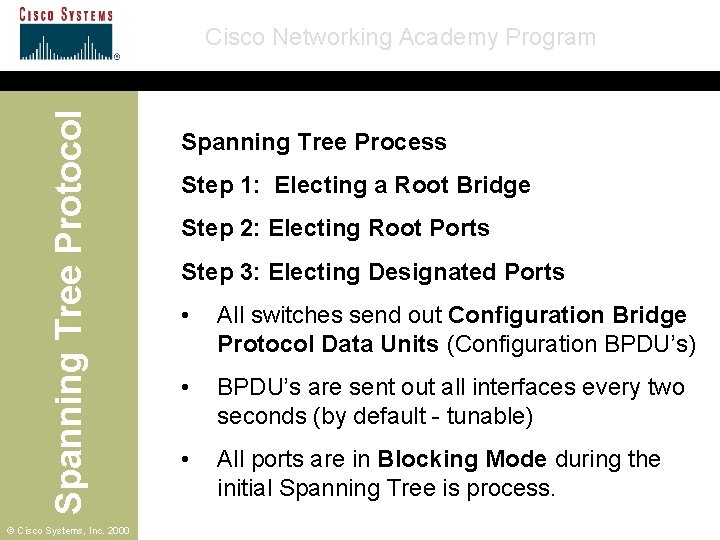
Spanning Tree Protocol Cisco Networking Academy Program © Cisco Systems, Inc. 2000 Spanning Tree Process Step 1: Electing a Root Bridge Step 2: Electing Root Ports Step 3: Electing Designated Ports • All switches send out Configuration Bridge Protocol Data Units (Configuration BPDU’s) • BPDU’s are sent out all interfaces every two seconds (by default - tunable) • All ports are in Blocking Mode during the initial Spanning Tree is process.
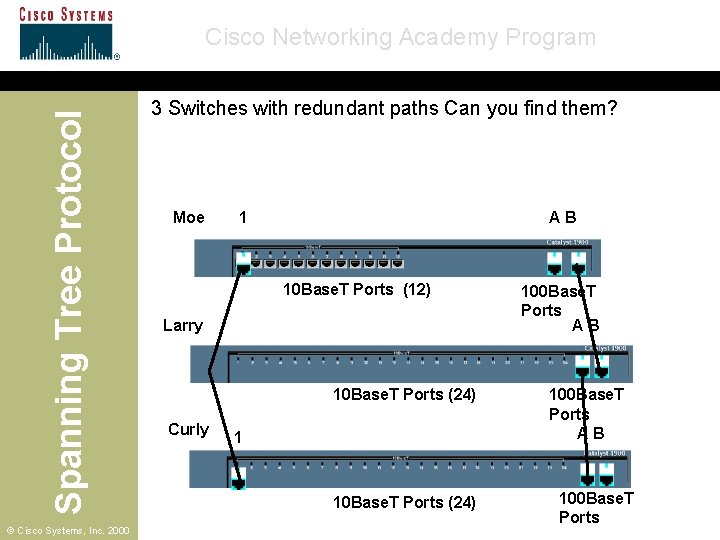
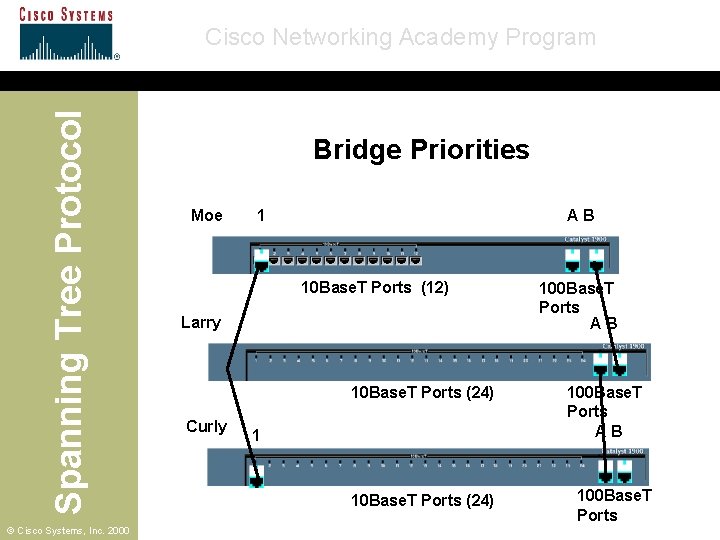
Spanning Tree Protocol Cisco Networking Academy Program © Cisco Systems, Inc. 2000 3 Switches with redundant paths Can you find them? Moe 1 AB 10 Base. T Ports (12) Larry 10 Base. T Ports (24) Curly 1 10 Base. T Ports (24) 100 Base. T Ports AB 100 Base. T Ports
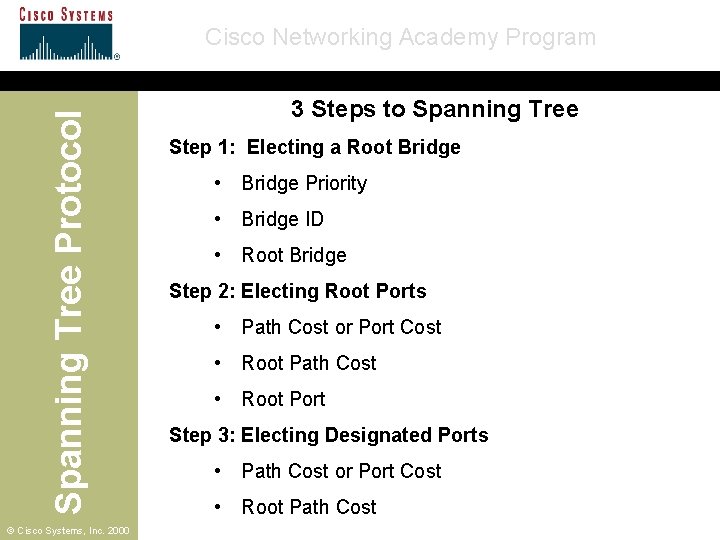
Spanning Tree Protocol Cisco Networking Academy Program © Cisco Systems, Inc. 2000 3 Steps to Spanning Tree Step 1: Electing a Root Bridge • Bridge Priority • Bridge ID • Root Bridge Step 2: Electing Root Ports • Path Cost or Port Cost • Root Path Cost • Root Port Step 3: Electing Designated Ports • Path Cost or Port Cost • Root Path Cost
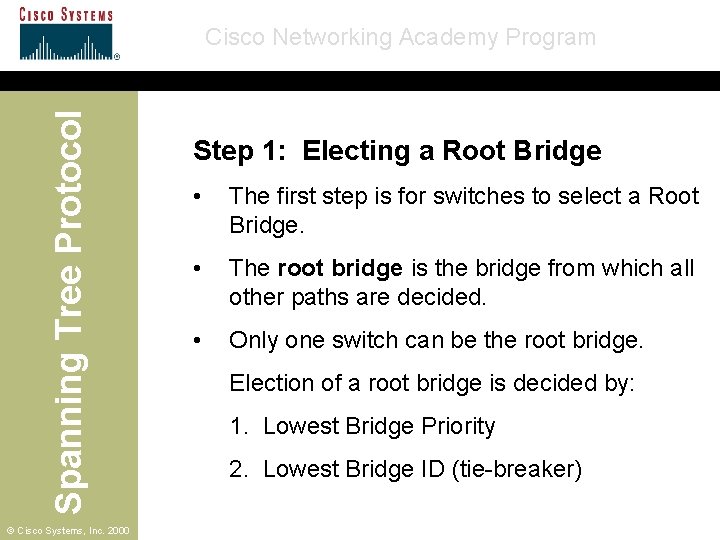
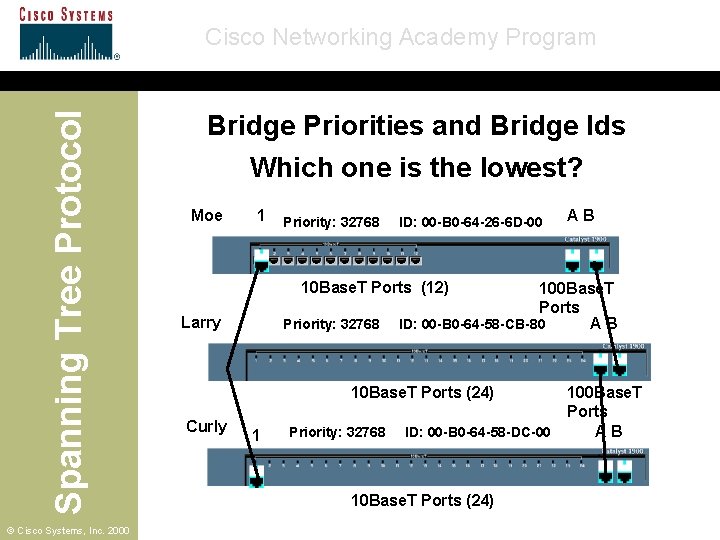
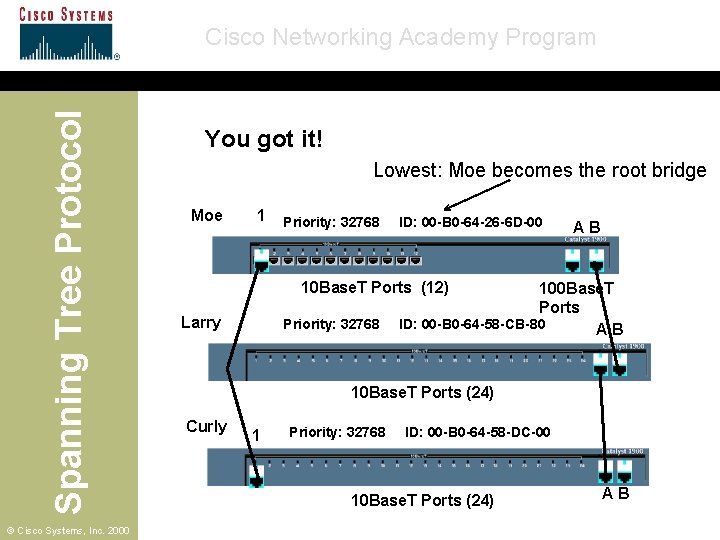
Spanning Tree Protocol Cisco Networking Academy Program © Cisco Systems, Inc. 2000 Step 1: Electing a Root Bridge • The first step is for switches to select a Root Bridge. • The root bridge is the bridge from which all other paths are decided. • Only one switch can be the root bridge. Election of a root bridge is decided by: 1. Lowest Bridge Priority 2. Lowest Bridge ID (tie-breaker)
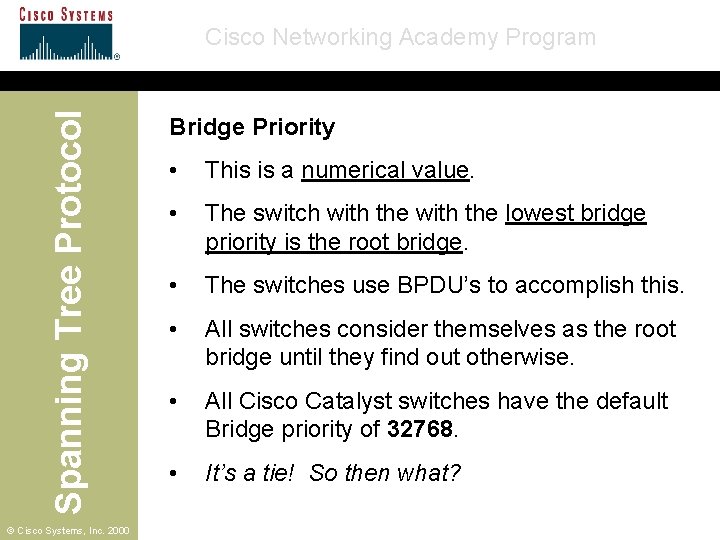
Spanning Tree Protocol Cisco Networking Academy Program © Cisco Systems, Inc. 2000 Bridge Priority • This is a numerical value. • The switch with the lowest bridge priority is the root bridge. • The switches use BPDU’s to accomplish this. • All switches consider themselves as the root bridge until they find out otherwise. • All Cisco Catalyst switches have the default Bridge priority of 32768. • It’s a tie! So then what?
Spanning Tree Protocol Cisco Networking Academy Program © Cisco Systems, Inc. 2000 Bridge Priorities Moe 1 AB 10 Base. T Ports (12) Larry 10 Base. T Ports (24) Curly 1 10 Base. T Ports (24) 100 Base. T Ports AB 100 Base. T Ports
Spanning Tree Protocol Cisco Networking Academy Program © Cisco Systems, Inc. 2000 Switch Moe: Bridge Priority
Spanning Tree Protocol Cisco Networking Academy Program © Cisco Systems, Inc. 2000 In case of a tie, the Bridge ID is used… Bridge ID • The Bridge ID is the MAC address assigned to the individual switch. • The lower Bridge ID (MAC address) is the tiebreaker. • Because MAC addresses are unique, this ensures that only one bridge will have the lowest value. • NOTE: There are other tie breakers, if these values are not unique, but we will not cover those situations.
Spanning Tree Protocol Cisco Networking Academy Program © Cisco Systems, Inc. 2000
Spanning Tree Protocol Cisco Networking Academy Program © Cisco Systems, Inc. 2000 Bridge Priorities and Bridge Ids Which one is the lowest? Moe 1 Priority: 32768 ID: 00 -B 0 -64 -26 -6 D-00 AB 10 Base. T Ports (12) Larry Priority: 32768 100 Base. T Ports AB ID: 00 -B 0 -64 -58 -CB-80 10 Base. T Ports (24) Curly 1 Priority: 32768 ID: 00 -B 0 -64 -58 -DC-00 10 Base. T Ports (24) 100 Base. T Ports AB
Spanning Tree Protocol Cisco Networking Academy Program © Cisco Systems, Inc. 2000 You got it! Lowest: Moe becomes the root bridge Moe 1 Priority: 32768 ID: 00 -B 0 -64 -26 -6 D-00 AB 10 Base. T Ports (12) Larry Priority: 32768 100 Base. T Ports ID: 00 -B 0 -64 -58 -CB-80 AB 10 Base. T Ports (24) Curly 1 Priority: 32768 ID: 00 -B 0 -64 -58 -DC-00 10 Base. T Ports (24) AB
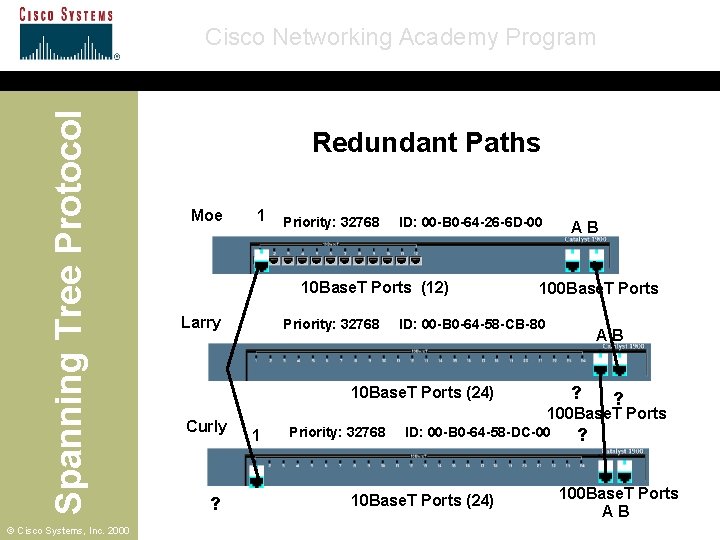
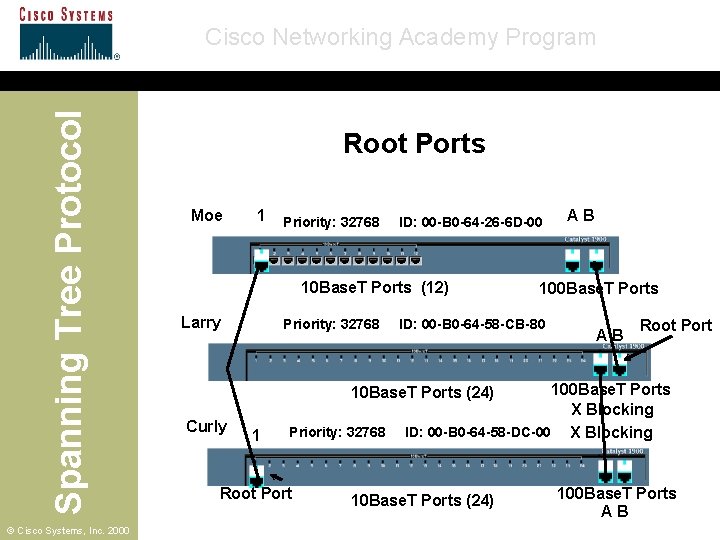
Spanning Tree Protocol Cisco Networking Academy Program © Cisco Systems, Inc. 2000 Step 2: Electing Root Ports • After the root bridge is selected, switches (bridges) must locate redundant paths to the root bridge and block all but one of these paths. • The switches use BPDU’s to accomplish this. • How does the switch make the decision on which port to use, known as the root port, and which one should be blocked?
Spanning Tree Protocol Cisco Networking Academy Program © Cisco Systems, Inc. 2000 Redundant Paths Moe 1 Priority: 32768 ID: 00 -B 0 -64 -26 -6 D-00 10 Base. T Ports (12) Larry Priority: 32768 AB 100 Base. T Ports ID: 00 -B 0 -64 -58 -CB-80 AB ? 10 Base. T Ports (24) Curly ? ? 100 Base. T Ports 1 Priority: 32768 ID: 00 -B 0 -64 -58 -DC-00 10 Base. T Ports (24) ? 100 Base. T Ports AB
Spanning Tree Protocol Cisco Networking Academy Program © Cisco Systems, Inc. 2000 Path Cost (or Port Cost) • Port Cost is used to help find the “cheapest” or “fastest” path to the root bridge. • By default, port cost is usually based on the medium or bandwidth of the port. • On Cisco Catalyst switches, this value is derived by dividing 1000 by the speed of the media in megabits per second. • Examples: • Standard Ethernet: 1, 000/10 = 100 • Fast Ethernet: 1, 000/100 = 10
Spanning Tree Protocol Cisco Networking Academy Program © Cisco Systems, Inc. 2000 Root Path Cost • The root path cost is the cumulative port costs (path costs) to the Root Bridge. • This value is transmitted in the BPDU cost field.
Spanning Tree Protocol Cisco Networking Academy Program © Cisco Systems, Inc. 2000 However, everything is viewed in relation to the root bridge. Root Ports • Ports directly connected to the root bridge will be the root ports. • Otherwise, the port with the lowest root path cost will be the root port.
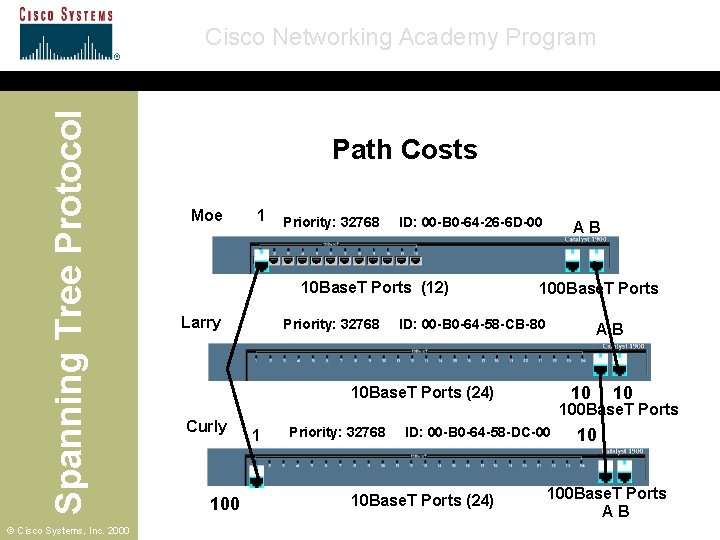
Spanning Tree Protocol Cisco Networking Academy Program © Cisco Systems, Inc. 2000 Path Costs Moe 1 Priority: 32768 ID: 00 -B 0 -64 -26 -6 D-00 10 Base. T Ports (12) Larry Priority: 32768 AB 100 Base. T Ports ID: 00 -B 0 -64 -58 -CB-80 AB 10 10 Base. T Ports (24) Curly 100 1 Priority: 32768 100 Base. T Ports ID: 00 -B 0 -64 -58 -DC-00 10 Base. T Ports (24) 10 10 100 Base. T Ports AB
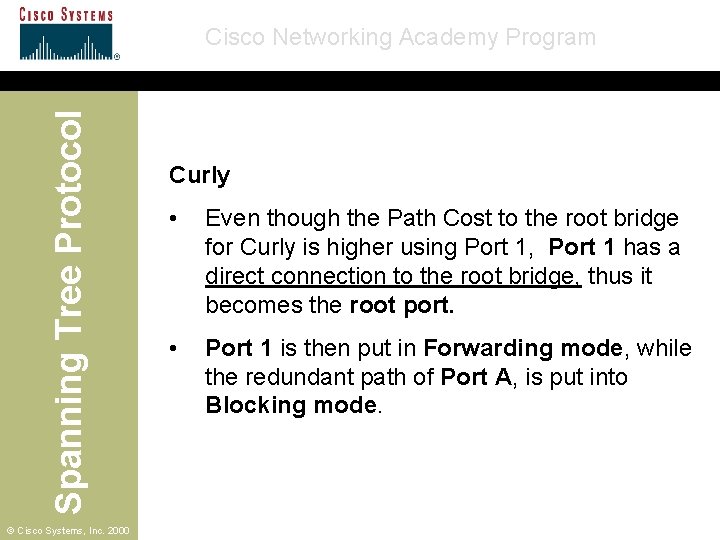
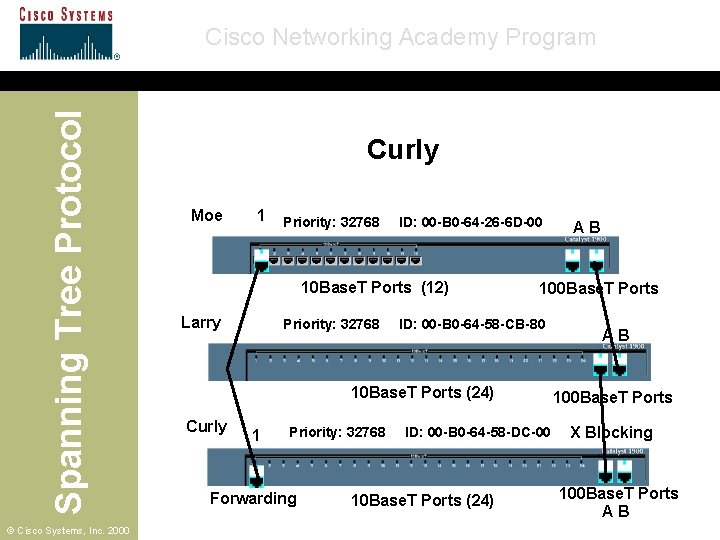
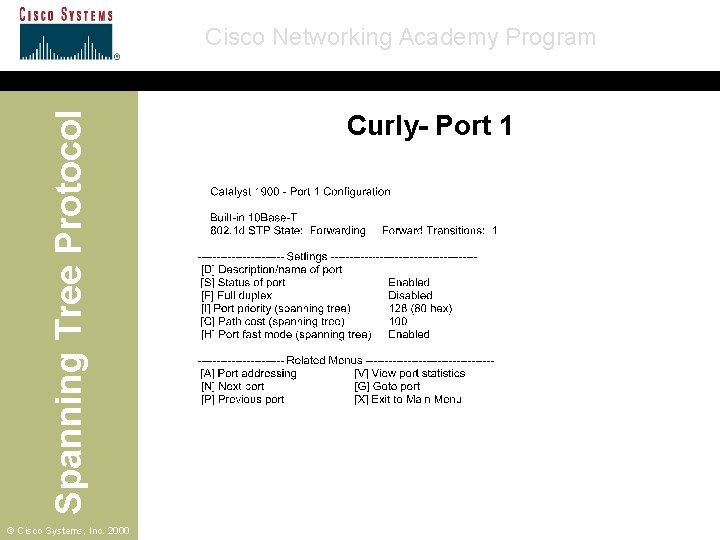
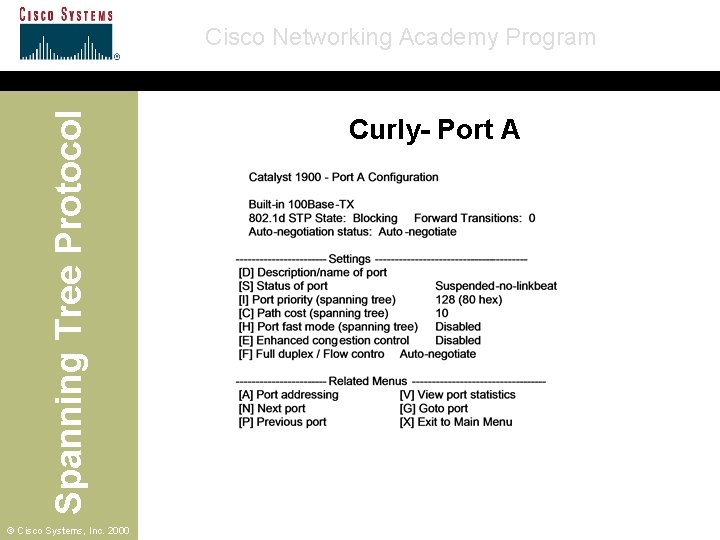
Spanning Tree Protocol Cisco Networking Academy Program © Cisco Systems, Inc. 2000 Curly • Even though the Path Cost to the root bridge for Curly is higher using Port 1, Port 1 has a direct connection to the root bridge, thus it becomes the root port. • Port 1 is then put in Forwarding mode, while the redundant path of Port A, is put into Blocking mode.
Spanning Tree Protocol Cisco Networking Academy Program © Cisco Systems, Inc. 2000 Curly Moe 1 Priority: 32768 ID: 00 -B 0 -64 -26 -6 D-00 10 Base. T Ports (12) Larry Priority: 32768 100 Base. T Ports ID: 00 -B 0 -64 -58 -CB-80 10 Base. T Ports (24) Curly 1 Priority: 32768 Forwarding ID: 00 -B 0 -64 -58 -DC-00 10 Base. T Ports (24) AB AB 100 Base. T Ports X Blocking 100 Base. T Ports AB
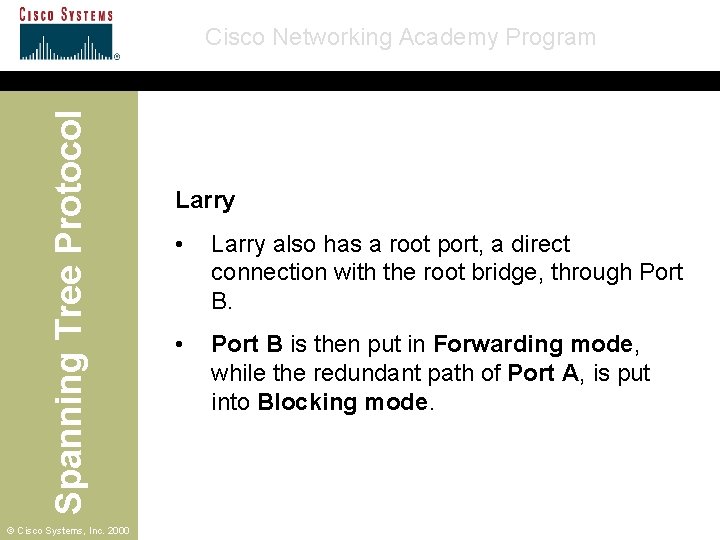
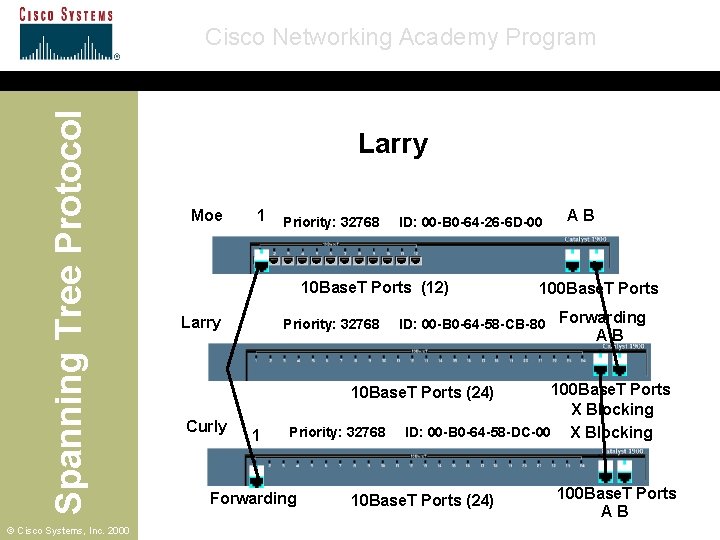
Spanning Tree Protocol Cisco Networking Academy Program © Cisco Systems, Inc. 2000 Larry • Larry also has a root port, a direct connection with the root bridge, through Port B. • Port B is then put in Forwarding mode, while the redundant path of Port A, is put into Blocking mode.
Spanning Tree Protocol Cisco Networking Academy Program © Cisco Systems, Inc. 2000 Larry Moe 1 Priority: 32768 ID: 00 -B 0 -64 -26 -6 D-00 10 Base. T Ports (12) Larry Priority: 32768 AB 100 Base. T Ports ID: 00 -B 0 -64 -58 -CB-80 Forwarding AB 100 Base. T Ports X Blocking ID: 00 -B 0 -64 -58 -DC-00 X Blocking 10 Base. T Ports (24) Curly 1 Priority: 32768 Forwarding 10 Base. T Ports (24) 100 Base. T Ports AB
Spanning Tree Protocol Cisco Networking Academy Program © Cisco Systems, Inc. 2000 Root Ports Moe 1 Priority: 32768 ID: 00 -B 0 -64 -26 -6 D-00 10 Base. T Ports (12) Larry Priority: 32768 AB 100 Base. T Ports ID: 00 -B 0 -64 -58 -CB-80 AB Root Port 100 Base. T Ports X Blocking ID: 00 -B 0 -64 -58 -DC-00 X Blocking 10 Base. T Ports (24) Curly 1 Priority: 32768 Root Port 10 Base. T Ports (24) 100 Base. T Ports AB
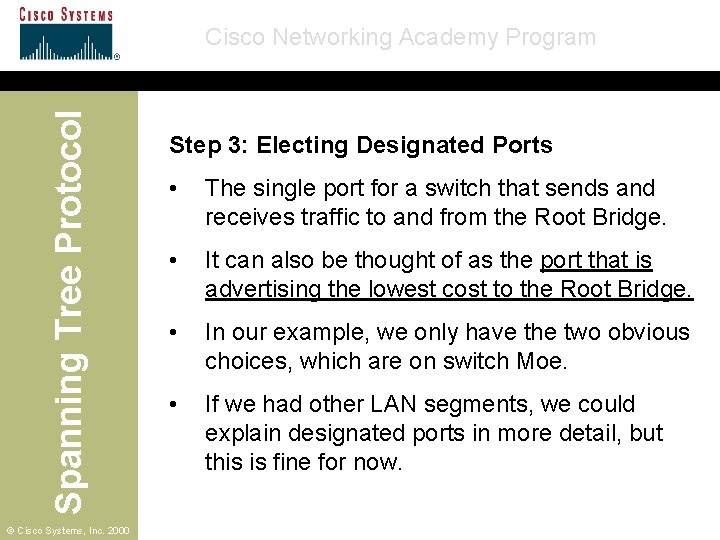
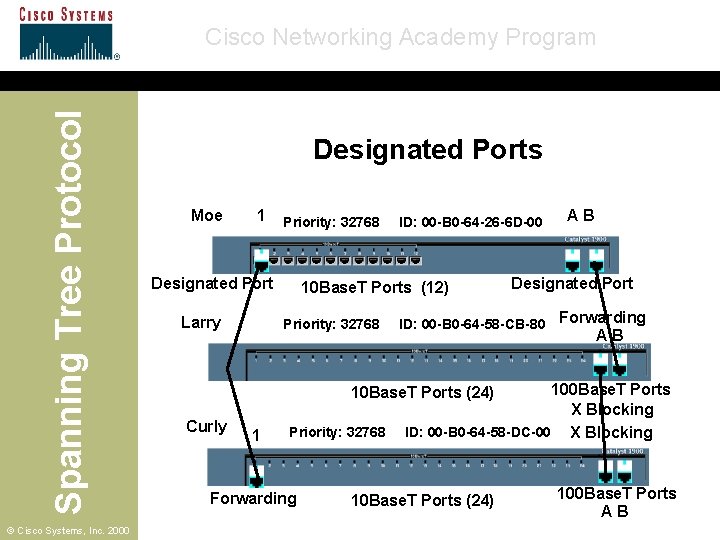
Spanning Tree Protocol Cisco Networking Academy Program © Cisco Systems, Inc. 2000 Step 3: Electing Designated Ports • The single port for a switch that sends and receives traffic to and from the Root Bridge. • It can also be thought of as the port that is advertising the lowest cost to the Root Bridge. • In our example, we only have the two obvious choices, which are on switch Moe. • If we had other LAN segments, we could explain designated ports in more detail, but this is fine for now.
Spanning Tree Protocol Cisco Networking Academy Program © Cisco Systems, Inc. 2000 Designated Ports Moe 1 Priority: 32768 Designated Port Larry ID: 00 -B 0 -64 -26 -6 D-00 10 Base. T Ports (12) Priority: 32768 AB Designated Port ID: 00 -B 0 -64 -58 -CB-80 Forwarding AB 100 Base. T Ports X Blocking ID: 00 -B 0 -64 -58 -DC-00 X Blocking 10 Base. T Ports (24) Curly 1 Priority: 32768 Forwarding 10 Base. T Ports (24) 100 Base. T Ports AB
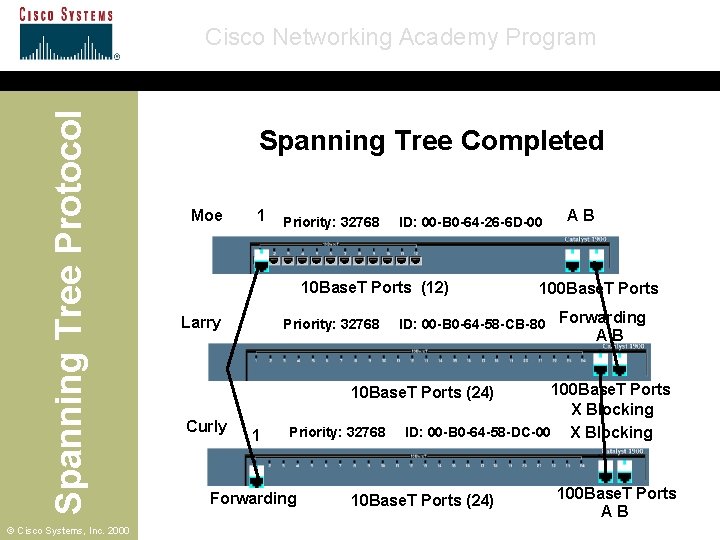
Spanning Tree Protocol Cisco Networking Academy Program © Cisco Systems, Inc. 2000 Spanning Tree is now complete, and the switches can begin to properly switch frames out the proper ports with the correct switching tables and without creating duplicate frames.
Spanning Tree Protocol Cisco Networking Academy Program © Cisco Systems, Inc. 2000 • Most LAN and switched internetwork books provide information on Spanning Tree. For more complex examples, you may wish to try these books: • Cisco Catalyst LAN Switching, by Rossi and Rossi, Mc. Graw Hill (Very Readable) • CCIE Professional Development: Cisco LAN Switching, by Clark and Hamilton, Cisco Press (More Advanced) • Interconnections, by Radia Perlman, Addison Wesley (Excellent, but very academic)
Spanning Tree Protocol Cisco Networking Academy Program © Cisco Systems, Inc. 2000 Extra Item! Port Fast Mode (from Cisco documentation) • Port Fast mode immediately brings a port from the blocking state into the forwarding state by eliminating the forward delay (the amount of time a port waits before changing from its STP learning and listening states to the forwarding state).
Spanning Tree Protocol Cisco Networking Academy Program © Cisco Systems, Inc. 2000 • When the switch is powered up, the forwarding state, even if Port Fast mode is enabled, is delayed to allow the Spanning. Tree Protocol to discover the topology of the network and ensure no temporary loops are formed. • Spanning-tree discovery takes approximately 30 seconds to complete, and no packet forwarding takes place during this time. • After the initial discovery, Port Fast-enabled ports transition directly from the blocking state to the forwarding state.
Spanning Tree Protocol Cisco Networking Academy Program © Cisco Systems, Inc. 2000 Spanning Tree Completed Moe 1 Priority: 32768 ID: 00 -B 0 -64 -26 -6 D-00 10 Base. T Ports (12) Larry Priority: 32768 AB 100 Base. T Ports ID: 00 -B 0 -64 -58 -CB-80 Forwarding AB 100 Base. T Ports X Blocking ID: 00 -B 0 -64 -58 -DC-00 X Blocking 10 Base. T Ports (24) Curly 1 Priority: 32768 Forwarding 10 Base. T Ports (24) 100 Base. T Ports AB
Spanning Tree Protocol Cisco Networking Academy Program © Cisco Systems, Inc. 2000 Moe- Port 1
Spanning Tree Protocol Cisco Networking Academy Program © Cisco Systems, Inc. 2000 Moe- Port B
Spanning Tree Protocol Cisco Networking Academy Program © Cisco Systems, Inc. 2000 Larry
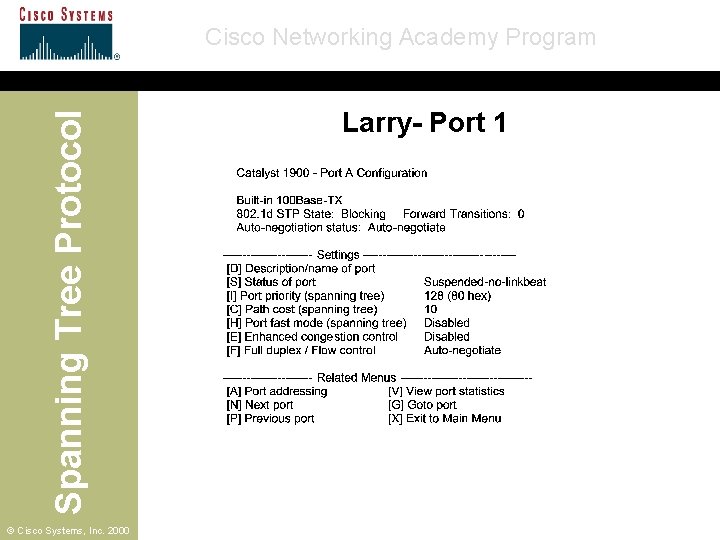
Spanning Tree Protocol Cisco Networking Academy Program © Cisco Systems, Inc. 2000 Larry- Port 1
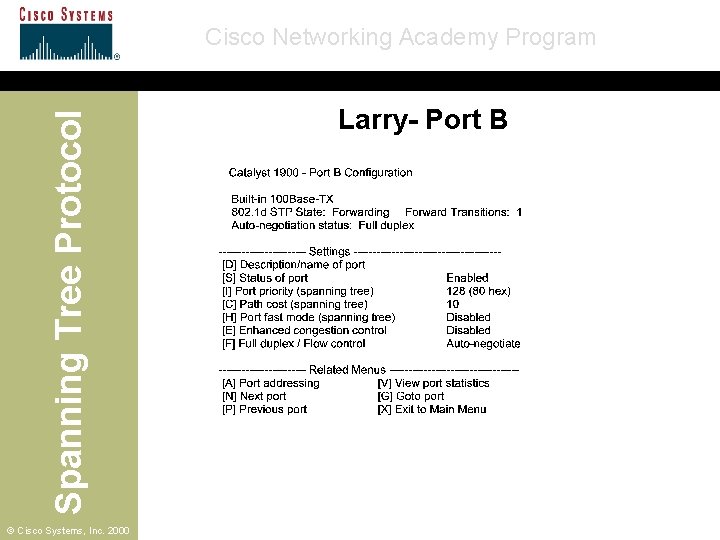
Spanning Tree Protocol Cisco Networking Academy Program © Cisco Systems, Inc. 2000 Larry- Port B
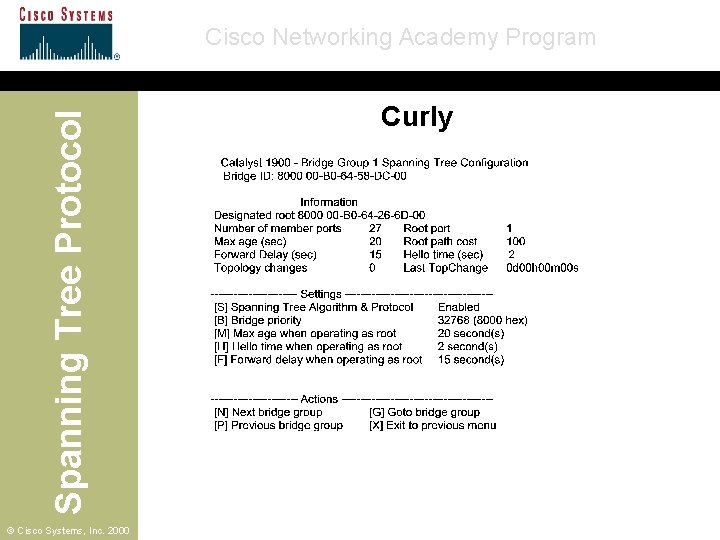
Spanning Tree Protocol Cisco Networking Academy Program © Cisco Systems, Inc. 2000 Curly
Spanning Tree Protocol Cisco Networking Academy Program © Cisco Systems, Inc. 2000 Curly- Port 1
Spanning Tree Protocol Cisco Networking Academy Program © Cisco Systems, Inc. 2000 Curly- Port A
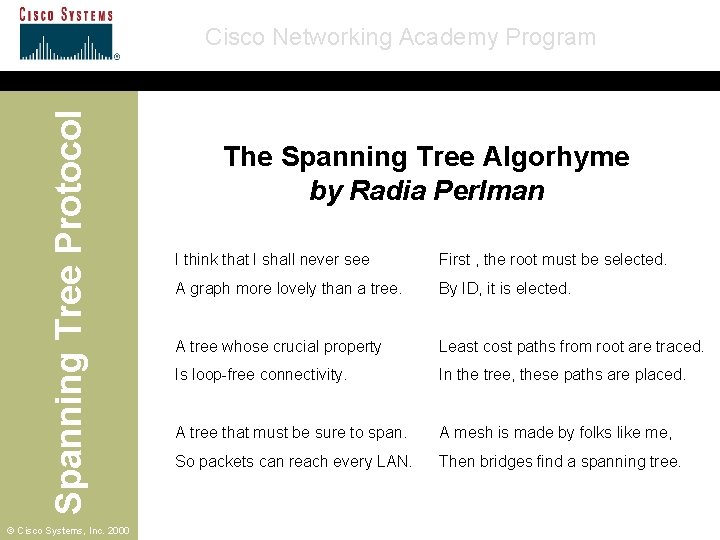
Spanning Tree Protocol Cisco Networking Academy Program © Cisco Systems, Inc. 2000 The Spanning Tree Algorhyme by Radia Perlman I think that I shall never see First , the root must be selected. A graph more lovely than a tree. By ID, it is elected. A tree whose crucial property Least cost paths from root are traced. Is loop-free connectivity. In the tree, these paths are placed. A tree that must be sure to span. A mesh is made by folks like me, So packets can reach every LAN. Then bridges find a spanning tree.