
Spanning the gap between structural materials and PFCs
Spanning the gap between structural materials and PFCs Steven J Zinkle University of Tennessee, Knoxville, TN USA Oak Ridge National Laboratory, Oak Ridge, TN USA Fusion materials planning meeting University of Tennessee, Knoxville, TN July 27, 2016 1
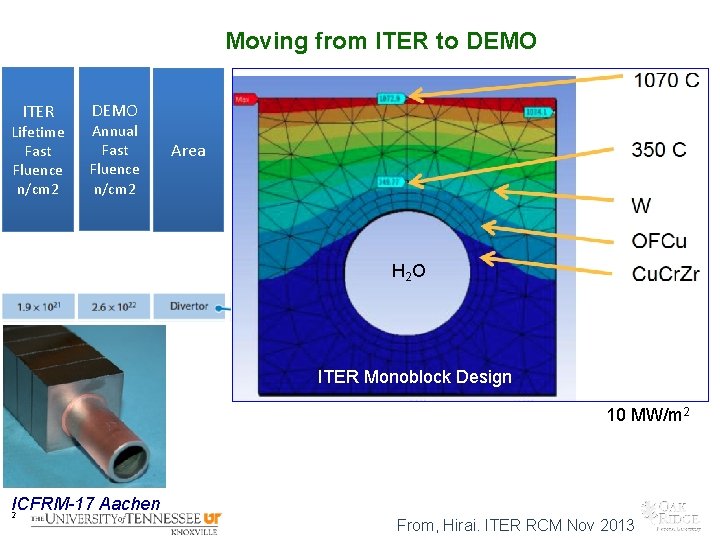
Moving from ITER to DEMO ITER Lifetime Fast Fluence n/cm 2 DEMO Annual Fast Fluence n/cm 2 Area H 2 O ITER Monoblock Design 10 MW/m 2 ICFRM-17 Aachen 2 From, Hirai. ITER RCM Nov 2013
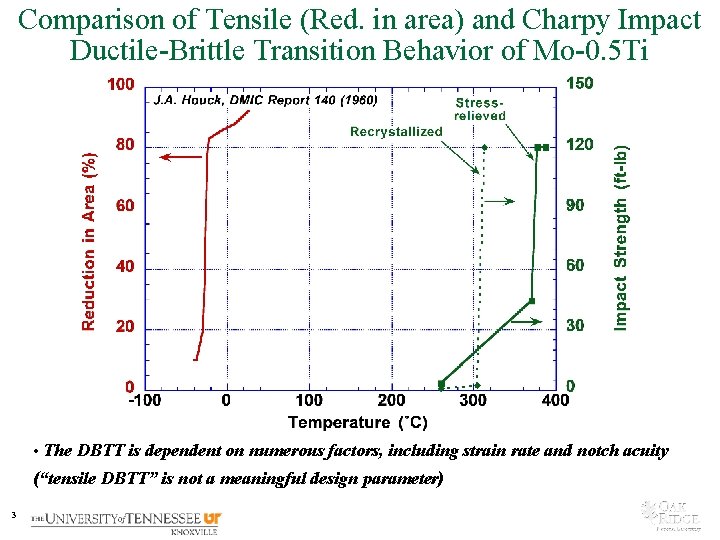
Comparison of Tensile (Red. in area) and Charpy Impact Ductile-Brittle Transition Behavior of Mo-0. 5 Ti • The DBTT is dependent on numerous factors, including strain rate and notch acuity (“tensile DBTT” is not a meaningful design parameter) 3

Effect of Strain Rate on the “Tensile DBTT” of W • The DBTT is dependent on numerous factors, including strain rate and notch acuity (“tensile DBTT” is not a meaningful design parameter) 4
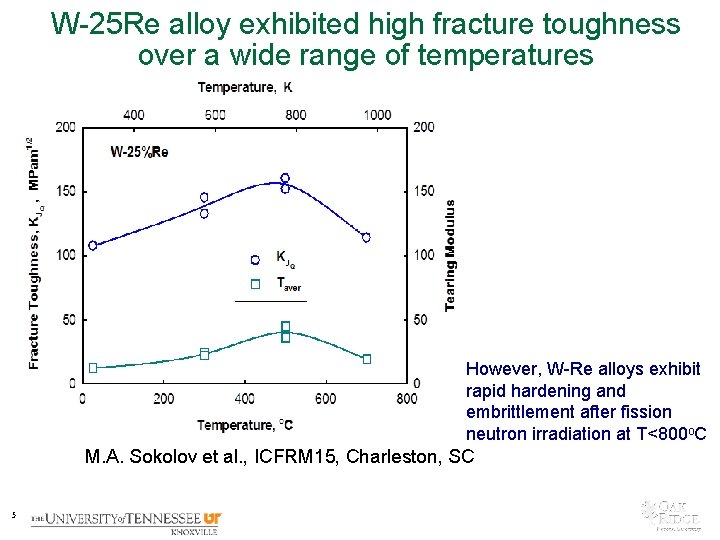
W-25 Re alloy exhibited high fracture toughness over a wide range of temperatures However, W-Re alloys exhibit rapid hardening and embrittlement after fission neutron irradiation at T<800 o. C M. A. Sokolov et al. , ICFRM 15, Charleston, SC 5

Options for PFCs · Multi-functional (structural plus PFM-compatible) material - Is a structural W alloy/composite possible? • Functional armor plus structural substrate • • Assumed temperature limits for W: T<1200 o. C (recrystallization/ resulting embrittlement) T<900 o. C (fuzz formation during plasma exposure) T>600 -800 o. C (neutron irradiation embrittlement) No temperature window for multifunctional tungsten unless W composites can be developed with broadened operating T’s T~700 -900 o. C for W tiles in multi-material PFC due to fuzz formation and severe irradiation embrittlement 6
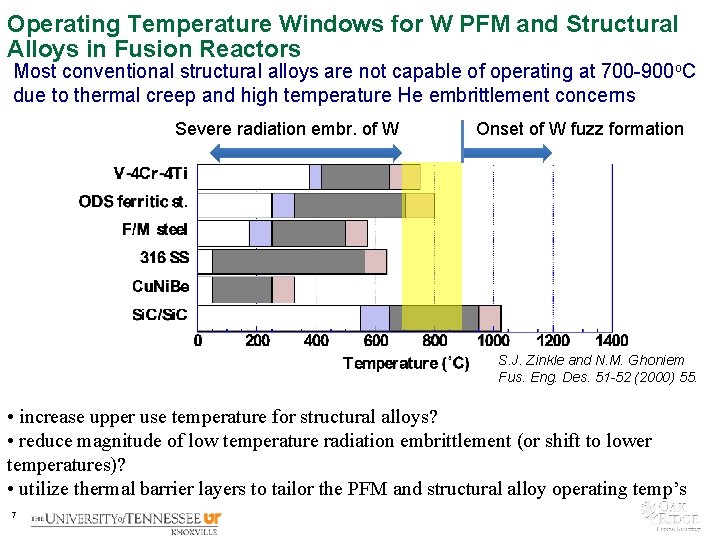
Operating Temperature Windows for W PFM and Structural Alloys in Fusion Reactors Most conventional structural alloys are not capable of operating at 700 -900 o. C due to thermal creep and high temperature He embrittlement concerns Severe radiation embr. of W Onset of W fuzz formation S. J. Zinkle and N. M. Ghoniem Fus. Eng. Des. 51 -52 (2000) 55. • increase upper use temperature for structural alloys? • reduce magnitude of low temperature radiation embrittlement (or shift to lower temperatures)? • utilize thermal barrier layers to tailor the PFM and structural alloy operating temp’s 7
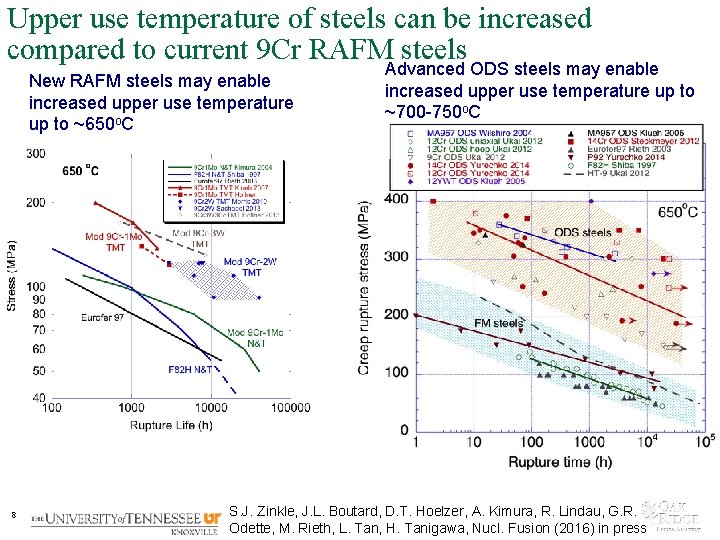
Upper use temperature of steels can be increased compared to current 9 Cr RAFM steels New RAFM steels may enable increased upper use temperature up to ~650 o. C 8 Advanced ODS steels may enable increased upper use temperature up to ~700 -750 o. C S. J. Zinkle, J. L. Boutard, D. T. Hoelzer, A. Kimura, R. Lindau, G. R. Odette, M. Rieth, L. Tan, H. Tanigawa, Nucl. Fusion (2016) in press
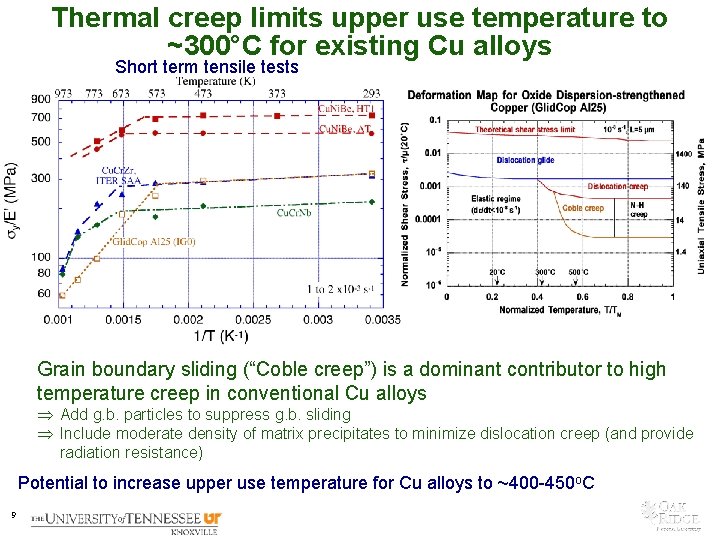
Thermal creep limits upper use temperature to ~300°C for existing Cu alloys Short term tensile tests Grain boundary sliding (“Coble creep”) is a dominant contributor to high temperature creep in conventional Cu alloys Add g. b. particles to suppress g. b. sliding Include moderate density of matrix precipitates to minimize dislocation creep (and provide radiation resistance) Potential to increase upper use temperature for Cu alloys to ~400 -450 o. C 9
Concluding remarks • Current operating temperature gap between W tiles and structural materials options may be partially closed by utilizing newly designed advanced high temperature structural alloys (steels, Cu alloys) • Utilization of thermal barrier coatings can provide additional tailoring of operating temperature windows for the PFC armor and structural heat sink • Innovative W armor (tbd) and other PFC options (e. g. , liquid walls) also provide opportunities for developing a viable PFC solution 10
- Slides: 10