
Spanner COS 418 Distributed Systems Lecture 16 Wyatt
Spanner COS 418: Distributed Systems Lecture 16 Wyatt Lloyd Slides adapted from Mike Freedman’s, which are adapted from the Spanner OSDI talk
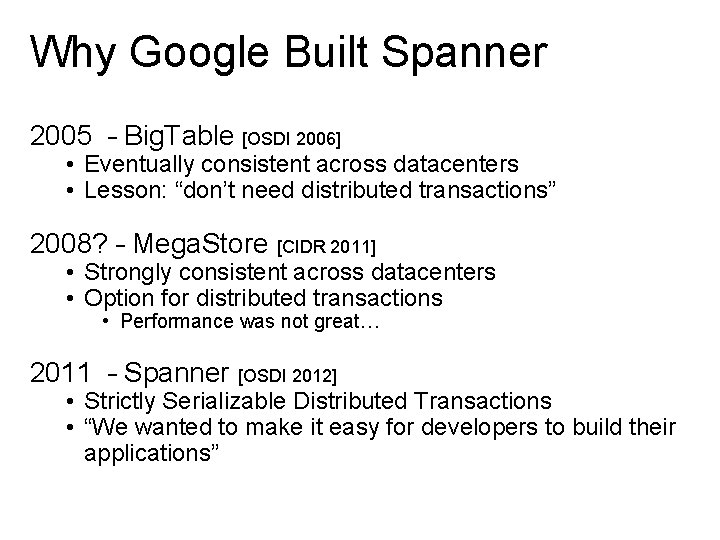
Why Google Built Spanner 2005 – Big. Table [OSDI 2006] • Eventually consistent across datacenters • Lesson: “don’t need distributed transactions” 2008? – Mega. Store [CIDR 2011] • Strongly consistent across datacenters • Option for distributed transactions • Performance was not great… 2011 – Spanner [OSDI 2012] • Strictly Serializable Distributed Transactions • “We wanted to make it easy for developers to build their applications”
Spanner: Google’s Globally. Distributed Database OSDI 2012 3
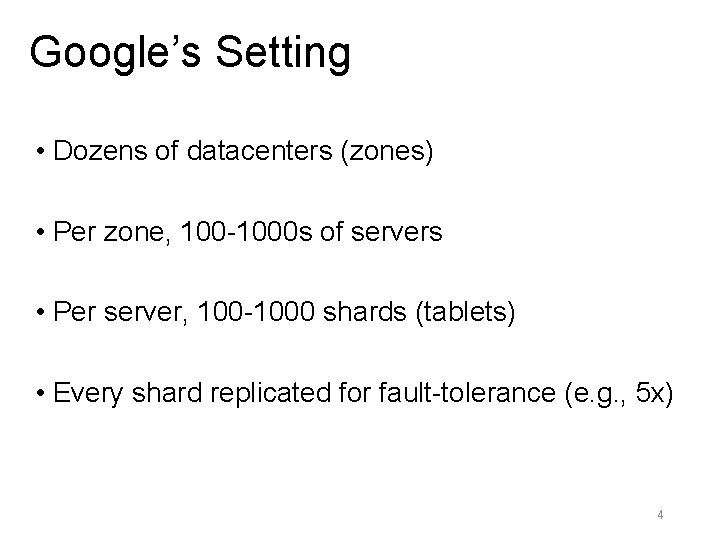
Google’s Setting • Dozens of datacenters (zones) • Per zone, 100 -1000 s of servers • Per server, 100 -1000 shards (tablets) • Every shard replicated for fault-tolerance (e. g. , 5 x) 4
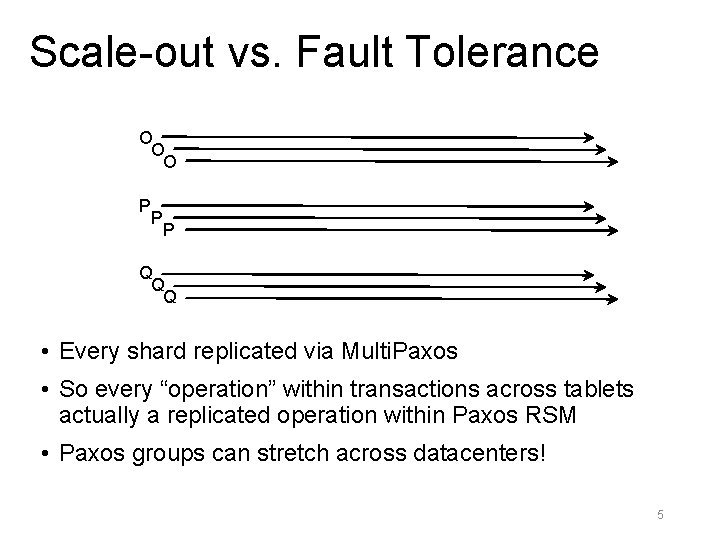
Scale-out vs. Fault Tolerance O O O P P P Q Q Q • Every shard replicated via Multi. Paxos • So every “operation” within transactions across tablets actually a replicated operation within Paxos RSM • Paxos groups can stretch across datacenters! 5
Read-Only Transactions • Transactions that only read data • Predeclared, i. e. , developer uses READ_ONLY flag / interface • Reads are dominant operations • e. g. , FB’s TAO had 500 reads : 1 write [ATC 2013] • e. g. , Google Ads (F 1) on Spanner from 1? DC in 24 h: 21. 5 B reads 31. 2 M single-shard transactions 32. 1 M multi-shard transactions
Make Read-Only Txns Efficient • Ideal: Read-only transactions that are non-blocking • Arrive at shard, read data, send data back • Impossible with Strict Serializability • SNOW after the break! • Goal 1: Lock-free read-only transactions • Goal 2: Non-blocking stale read-only txns
Disruptive idea: Do clocks really need to be arbitrarily unsynchronized? Can you engineer some max divergence? 8
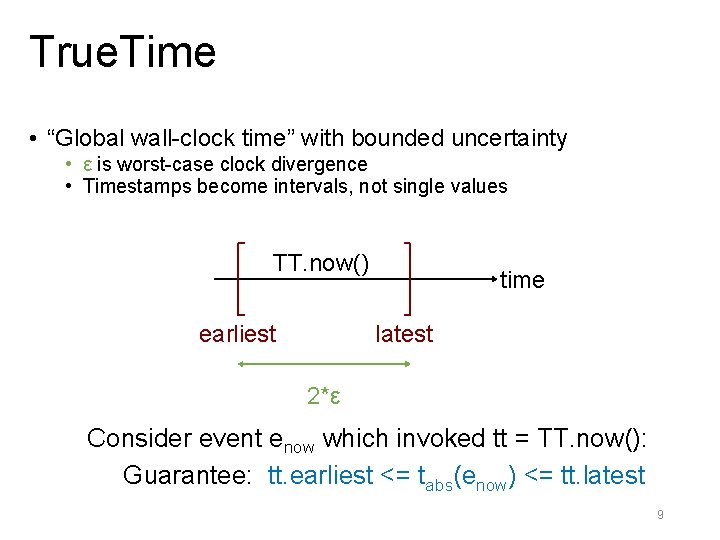
True. Time • “Global wall-clock time” with bounded uncertainty • ε is worst-case clock divergence • Timestamps become intervals, not single values TT. now() earliest time latest 2*ε Consider event enow which invoked tt = TT. now(): Guarantee: tt. earliest <= tabs(enow) <= tt. latest 9
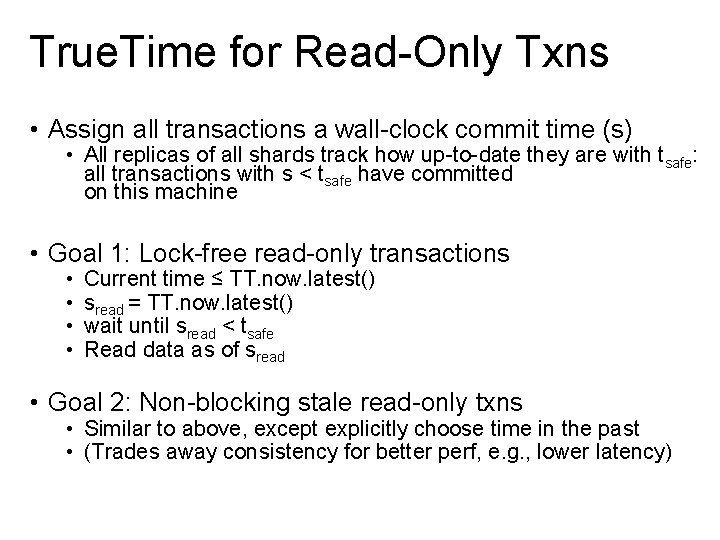
True. Time for Read-Only Txns • Assign all transactions a wall-clock commit time (s) • All replicas of all shards track how up-to-date they are with tsafe: all transactions with s < tsafe have committed on this machine • Goal 1: Lock-free read-only transactions • • Current time ≤ TT. now. latest() sread = TT. now. latest() wait until sread < tsafe Read data as of sread • Goal 2: Non-blocking stale read-only txns • Similar to above, except explicitly choose time in the past • (Trades away consistency for better perf, e. g. , lower latency)
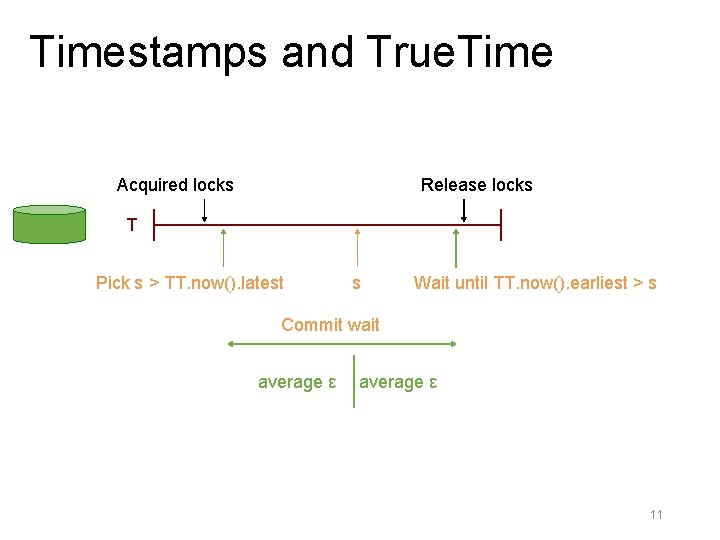
Timestamps and True. Time Acquired locks Release locks T Pick s > TT. now(). latest s Wait until TT. now(). earliest > s Commit wait average ε 11
Commit Wait • Enables efficient read-only transactions • Cost: 2ε extra latency • Reduce/eliminate by overlapping with: • Replication • Two-phase commit
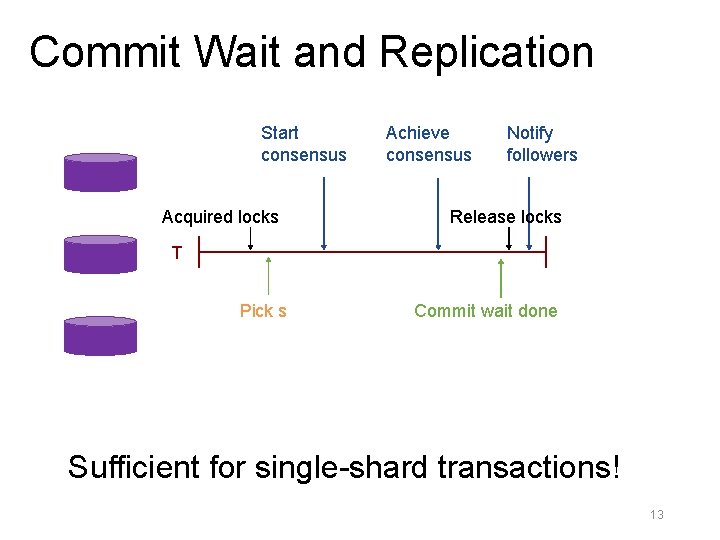
Commit Wait and Replication Start consensus Acquired locks Achieve consensus Notify followers Release locks T Pick s Commit wait done Sufficient for single-shard transactions! 13
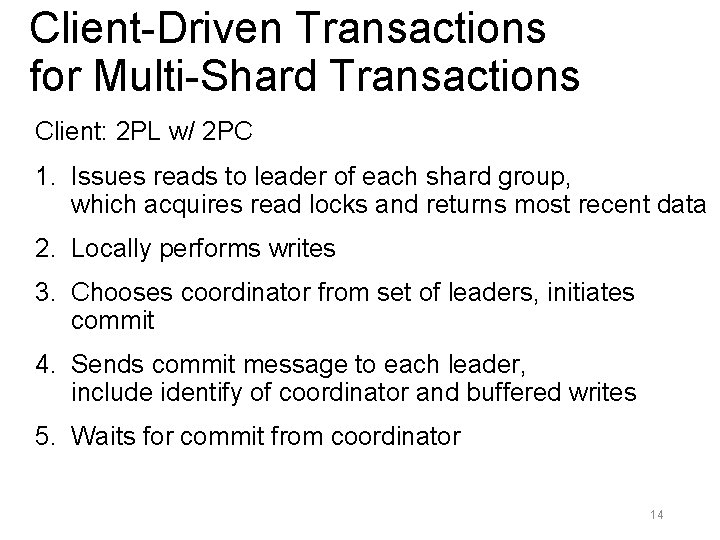
Client-Driven Transactions for Multi-Shard Transactions Client: 2 PL w/ 2 PC 1. Issues reads to leader of each shard group, which acquires read locks and returns most recent data 2. Locally performs writes 3. Chooses coordinator from set of leaders, initiates commit 4. Sends commit message to each leader, include identify of coordinator and buffered writes 5. Waits for commit from coordinator 14
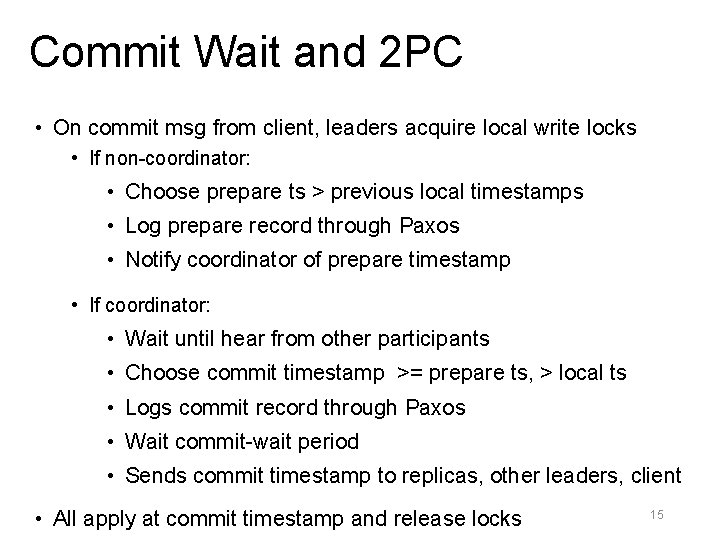
Commit Wait and 2 PC • On commit msg from client, leaders acquire local write locks • If non-coordinator: • Choose prepare ts > previous local timestamps • Log prepare record through Paxos • Notify coordinator of prepare timestamp • If coordinator: • Wait until hear from other participants • Choose commit timestamp >= prepare ts, > local ts • Logs commit record through Paxos • Wait commit-wait period • Sends commit timestamp to replicas, other leaders, client • All apply at commit timestamp and release locks 15
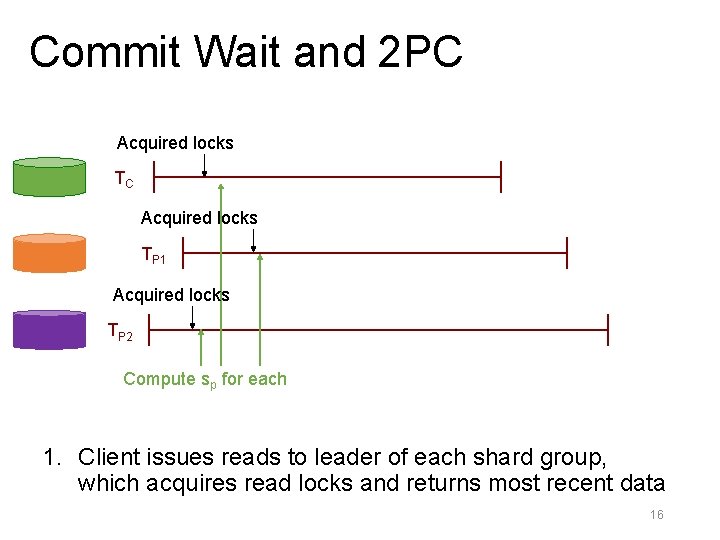
Commit Wait and 2 PC Acquired locks TP 1 Acquired locks TP 2 Compute sp for each 1. Client issues reads to leader of each shard group, which acquires read locks and returns most recent data 16
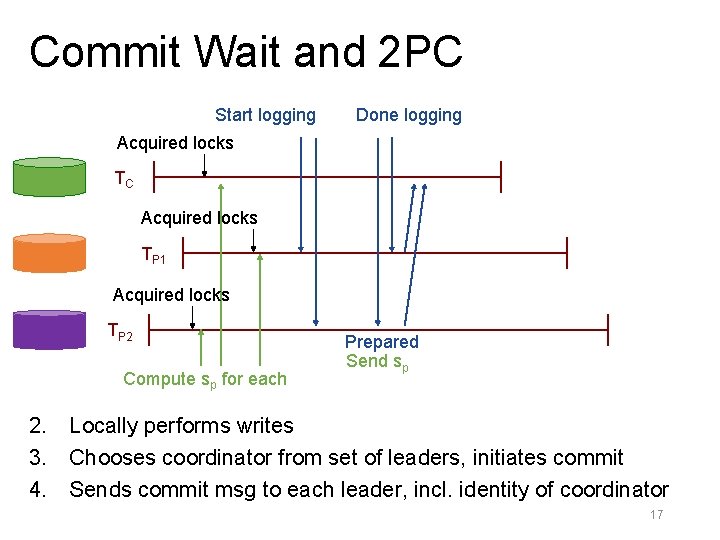
Commit Wait and 2 PC Start logging Done logging Acquired locks TC Acquired locks TP 1 Acquired locks TP 2 Compute sp for each Prepared Send sp 2. Locally performs writes 3. Chooses coordinator from set of leaders, initiates commit 4. Sends commit msg to each leader, incl. identity of coordinator 17
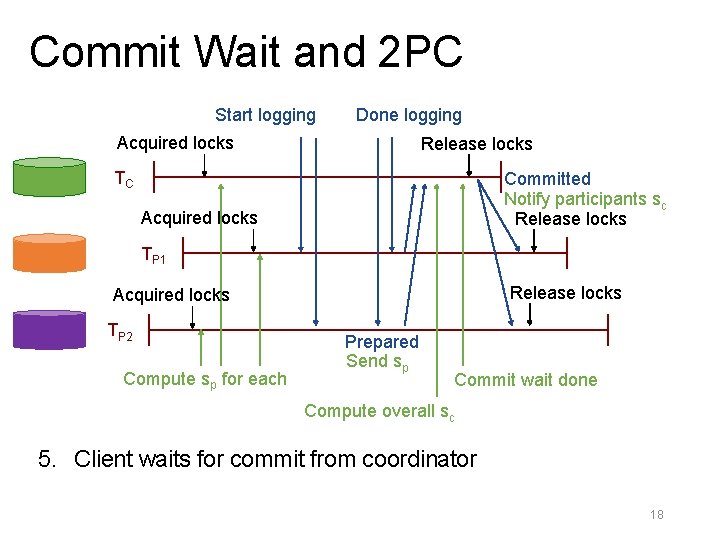
Commit Wait and 2 PC Start logging Done logging Acquired locks Release locks TC Committed Notify participants sc Release locks Acquired locks TP 1 Release locks Acquired locks TP 2 Compute sp for each Prepared Send sp Commit wait done Compute overall sc 5. Client waits for commit from coordinator 18
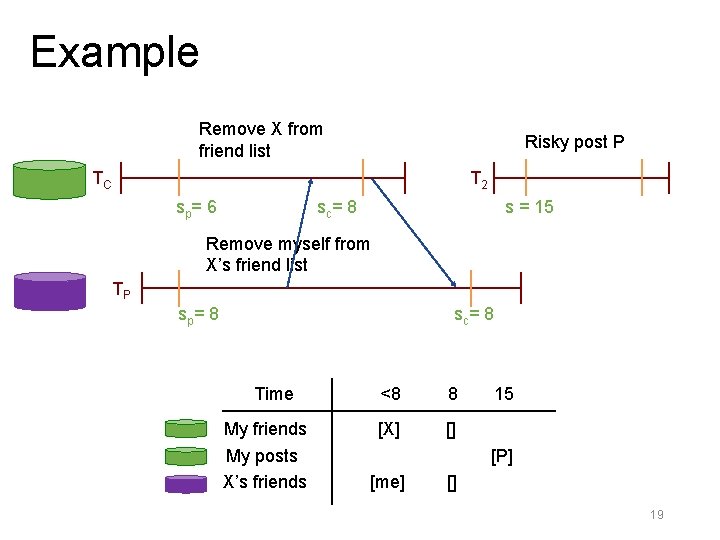
Example Remove X from friend list Risky post P TC T 2 sp= 6 sc= 8 s = 15 Remove myself from X’s friend list TP sp= 8 sc= 8 Time My friends My posts X’s friends <8 8 [X] [] 15 [P] [me] [] 19
Disruptive idea: Do clocks really need to be unsynchronized? arbitrarily Can you engineer some max divergence? 20
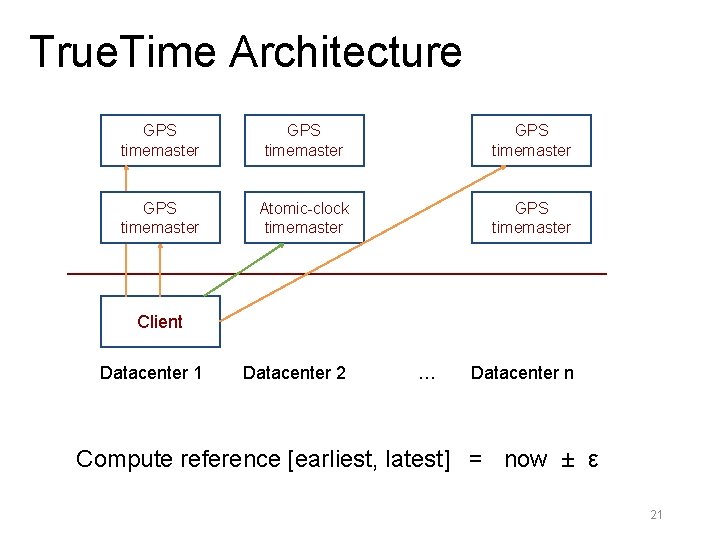
True. Time Architecture GPS timemaster Atomic-clock timemaster GPS timemaster Client Datacenter 1 Datacenter 2 … Datacenter n Compute reference [earliest, latest] = now ± ε 21
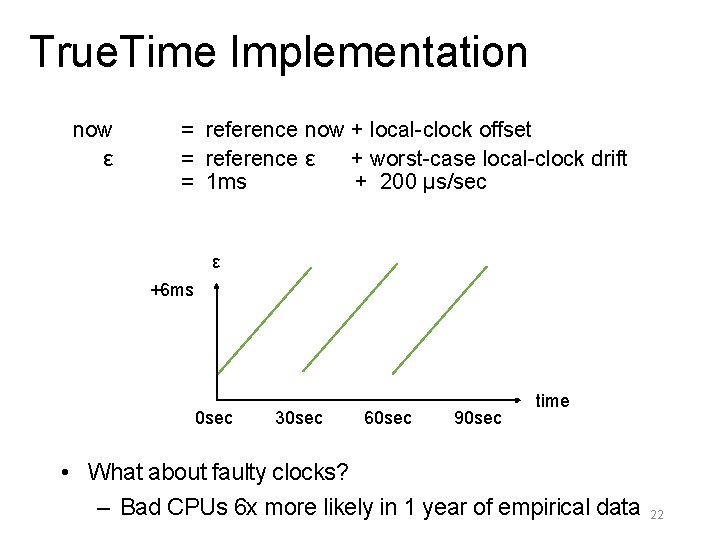
True. Time Implementation now ε = reference now + local-clock offset = reference ε + worst-case local-clock drift = 1 ms + 200 μs/sec ε +6 ms 0 sec 30 sec 60 sec 90 sec time • What about faulty clocks? – Bad CPUs 6 x more likely in 1 year of empirical data 22
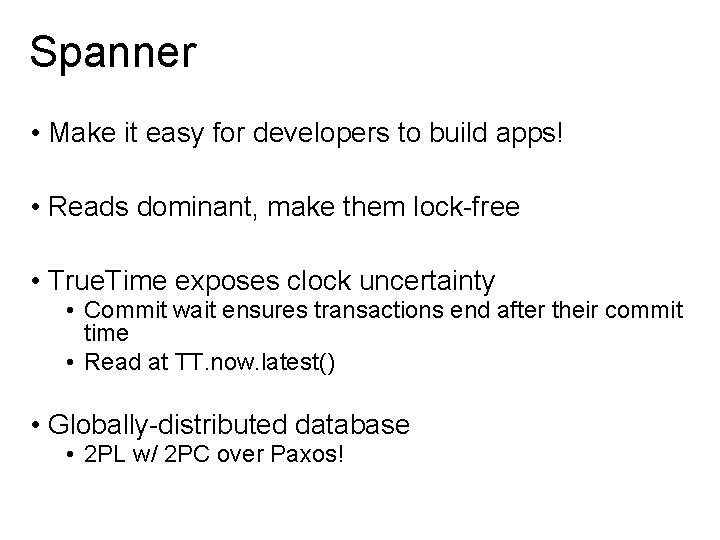
Spanner • Make it easy for developers to build apps! • Reads dominant, make them lock-free • True. Time exposes clock uncertainty • Commit wait ensures transactions end after their commit time • Read at TT. now. latest() • Globally-distributed database • 2 PL w/ 2 PC over Paxos!

- Slides: 24