
SPANISH RENAISSANCE THEATRE The Golden Age of Spanish







- Slides: 19
SPANISH RENAISSANCE THEATRE The Golden Age of Spanish Theatre 1500 -1700
SPANISH THEATRE v. Equal to England from 1585 -1642 v. Did not probe deeply into to man’s destiny/fate like British v. Preoccupied with narrow code of honorlimited v. Flourished in 1500 and 1600 s
INFLUENCES v English theatre suppressed by the church v Spanish theatre was secure due to Catholicism v Ferdinand Isabella were able to unite much of Spain q Established Inquisition q Punished heretics q Expelled Moors and Jews
WHO WERE THE MOORS? The Moors were a nomadic people from North Africa originally. They invaded Spain, taking their Islamic religion and culture with them
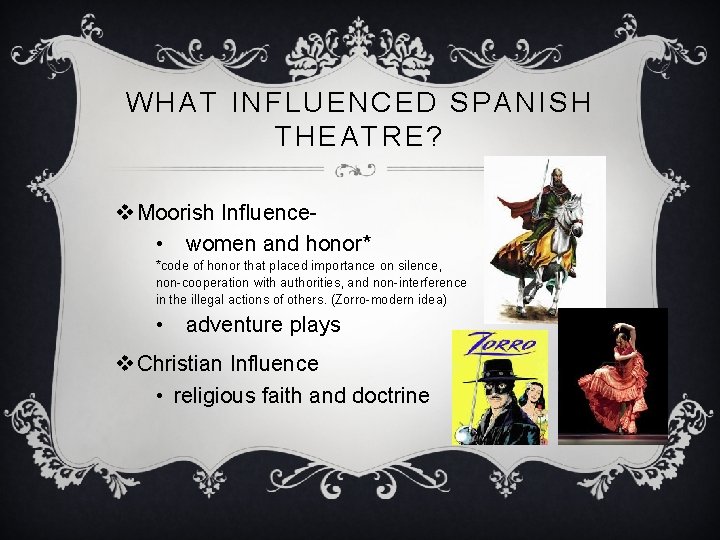
WHAT INFLUENCED SPANISH THEATRE? v Moorish Influence • women and honor* *code of honor that placed importance on silence, non-cooperation with authorities, and non-interference in the illegal actions of others. (Zorro-modern idea) • adventure plays v Christian Influence • religious faith and doctrine
SPANISH RELIGIOUS DRAMA v Extensive in the Northeast v Moorish influence was less there v Moors were expelled so religious drama expanded as a result v Auto sacramentale-combined ideas of the morality and cycle plays of England
AUTO SACRAMENTALE v Type of Play: auto sacramentale-combined ideas of the morality and cycle plays of England v Trade guilds helped with the productions (much like England) v Toured neighboring towns v Plays done on wagons (2 -4) usually 16 feet long and 36 feet tall v Much like pageant wagons of England v Later used fixed platforms
AUTO SACRAMENTALE v Performed in front of churches v Performed in courtyards v No evidence they were ever done in churches v Finally forbidden in 1765 - too carnival in spirit v Some of the dances considered too objectionable v Immoral actors- but still done for over 200 years
AUTO SACRAMENTALEWAGONS
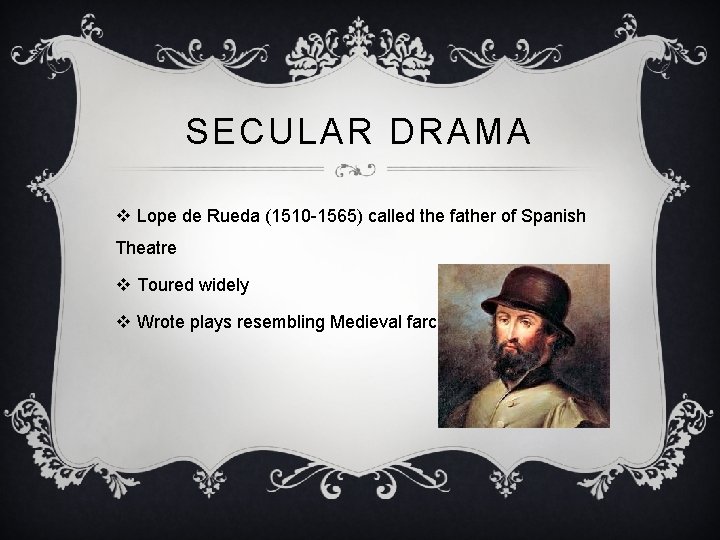
SECULAR DRAMA v Lope de Rueda (1510 -1565) called the father of Spanish Theatre v Toured widely v Wrote plays resembling Medieval farces
CERVANTES • Most famous for the play Don Quixote • Wrote 36 plays about Spanish life • Accused of copying the ideas of de Vega • Started writing full-length plays both serious and comic
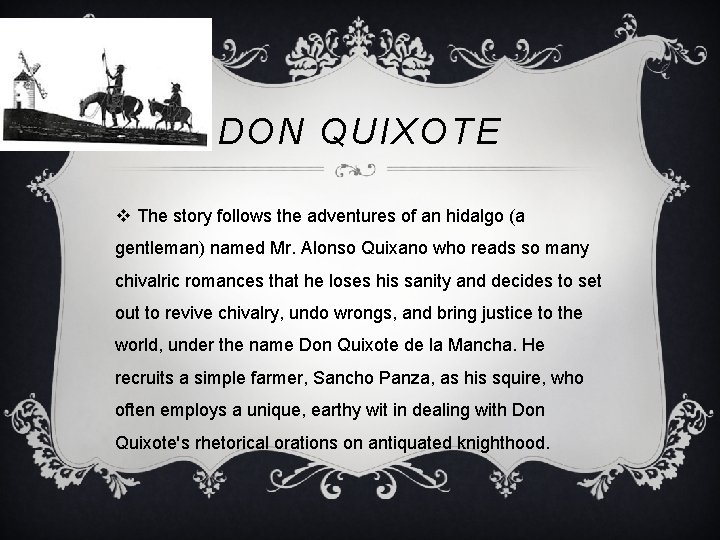
DON QUIXOTE v The story follows the adventures of an hidalgo (a gentleman) named Mr. Alonso Quixano who reads so many chivalric romances that he loses his sanity and decides to set out to revive chivalry, undo wrongs, and bring justice to the world, under the name Don Quixote de la Mancha. He recruits a simple farmer, Sancho Panza, as his squire, who often employs a unique, earthy wit in dealing with Don Quixote's rhetorical orations on antiquated knighthood.
TWO MAJOR PLAYWRIGHTS v Lope De Vega v Calderon v Between these two men there are over 700 plays to their credit.
DE VEGA 1562 -1634 v Member of the Armada v Many love affairs v Became a priest after 1614 v wrote comedies (estimates of 483 - over 1800 v 450 survive (thought to have written about 2 plays/week)
DE VEGA -STYLE v Clear actions v Suspense v Conflicting claims of love and honor v Happy endings
DE VEGA -STYLE v Characters represented rank and condition of people v Female roles- strong- among his best v Extended the simpleton character v Natural and lively dialog v Spanish equivalent to blank verse- but not considered equal to Shakespeare –never deep human traits and glossed over the dark side of human nature
CALDERON (1600 -1681) • Challenged de Vega for fame • Wrote mainly for court/wealthy- which contributed to the decline of Spanish theatre • University educated • Became a priest in 1651 (catholic church a strong influence in Spain) • Wrote 200 plays, about 100 survive; 8 are autos
CALDERON v Two styles of plays v Cape and Sword- dealt with intrigue and misunderstandings (the main characters literally wore these items). Cloak- hid identity Sword- concealable and silent weapon. v Serious- dealt with jealousy and honor
FAMOUS SPANIARD Don Juan: the son of a noble Spanish family led one of the first major colonization efforts into what is now the United States. • • He held a thanksgiving feast, and presented for the colonists a play, written by Captain Marcos de Farfan, celebrating the conquest and conversion of the native people of New Mexico. Many believe that this was the first thanksgiving service and the first dramatic presentation in America.